0
Integration architecture for the multi-cloud enterprise
Kim Clark
Integration Architect
Hybrid Integration
Rob Nicholson
Distinguished Engineer
Hybrid Integration
Webinar: http://ibm.biz/MultiCloudIntegrationArchitectureWebinar
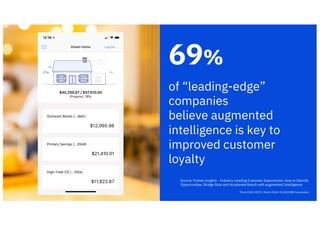
of “leading-edge”
companies
believe augmented
intelligence is key to
improved customer
loyalty
Source: Forbes insights - Industry-Leading Customer Experiences: How to Identify
Opportunities, Bridge Silos and Accelerate Result with augmented Intelligence
69%
Think 2018 / 8272 / March 2018 / © 2018 IBM Corporation
2
Four primary
trends driving
the integration
market today
Increasing need to integrate across a
hybrid, multi-cloud environment
Digital Transformation driving Increasing
need to provide API-led integration
across apps and data
Increasing need for integration to
appeal to the Line of Business
Changing application deployment
architectures challenging traditional
integration architectures
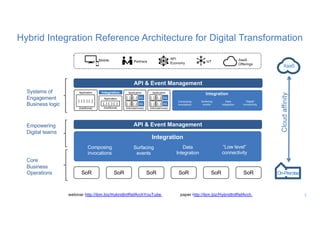
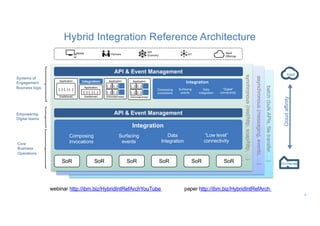
Hybrid Integration Reference Architecture for Digital Transformation
3
Composing
invocations
SoR
Core
Business
Operations
Empowering
Digital teams
Systems of
Engagement
Business logic
Mobile Partners SaaS
Offerings
API
Economy IoT
XaaS
On-Premise
Cloudaffinity
SoR
“Low level”
connectivity
Surfacing
events
Data
Integration
SoR
API & Event Management
SoR SoR
Composing
invocations
Surfacing
events
Data
Integration
“Digital”
connectivity
Application
(traditional)
Application
(microservices)
{..} {..}
{..}{..}
Int.
Int.
{..} {..} {..}
Application
(microservices)
{..} Int.{..}
{..} {..} Int.
SoR
Integration
Integration
Application
(traditional)
{..} {..} {..}
Integration
webinar http://ibm.biz/HybridIntRefArchYouTube paper http://ibm.biz/HybridIntRefArch
synchronous(rest/http,soap/http,…)
asynchronous(messaging,events,…)
Hybrid Integration Reference Architecture
4
Composing
invocations
SoR SoR
“Low level”
connectivity
Surfacing
events
Data
Integration
SoR
API & Event Management
SoR SoR
Composing
invocations
Surfacing
events
Data
Integration
“Digital”
connectivity
Application
(traditional)
Application
(microservices)
{..} {..}
{..}{..}
{..} {..} {..}
Application
(microservices)
SoR
Integration
Integration
Application
(traditional)
{..} {..} {..}
Integration
batch(bulkAPIs,filetransfer,…)
Core
Business
Operations
Empowering
Digital teams
Systems of
Engagement
Business logic
Mobile Partners SaaS
Offerings
API
Economy IoT
XaaS
On-Premise
Cloudaffinity
webinar http://ibm.biz/HybridIntRefArchYouTube paper http://ibm.biz/HybridIntRefArch
{..} {..}
{..}{..}
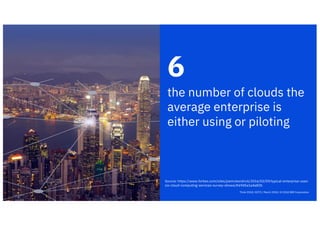
the number of clouds the
average enterprise is
either using or piloting
Source: https://www.forbes.com/sites/joemckendrick/2016/02/09/typical-enterprise-uses-
six-cloud-computing-services-survey-shows/#69d5a1a4a82b
6
Think 2018 / 8272 / March 2018 / © 2018 IBM Corporation
trad. on premises
SoRSoR SoR SoR
Application
(traditional)
{..} {..} {..}
cloud platform
cloud platform
Application
(traditional)
{..} {..} {..}
Application
(traditional)
{..} {..} {..}
cloud platform
Application
(microservices)
{..} {..} {..}
{..} {..} {..}
Application
(microservices)
{..} {..}
{..} {..}
private cloud
SoR SoR
Application
(traditional)
{..} {..} {..}
SoR
(SaaS)
SaaS platform
iPaaS/iSaaS
SoR
(SaaS)
SaaS platform
cloud platform
Application
(microservices)
{..} {..} {..}
{..} {..} {..}
Application
(microservices)
{..} {..}
{..} {..}
cloud platform
Application
(microservices)
{..} {..} {..}
{..} {..} {..}
Application
(microservices)
{..} {..}
{..} {..}
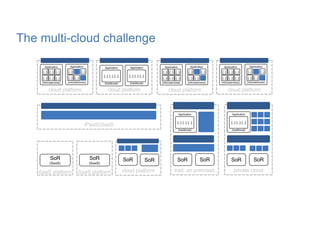
The multi-cloud challenge
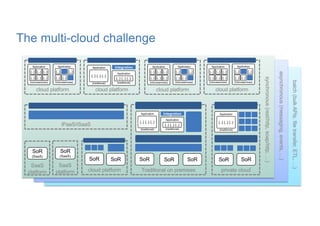
synchronous(rest/http,soap/http,…)
asynchronous(messaging,events,…)
batch(bulkAPIs,filetransfer,ETL,…)
Traditional on premises
SoRSoR SoR SoR
Application
(traditional)
{..} {..} {..}
cloud platform
cloud platform
Application
(traditional)
{..} {..} {..}
cloud platform
Application
(microservices)
{..} {..} {..}
{..} {..} {..}
Application
(microservices)
{..} {..}
{..} {..}
private cloud
SoR SoR
Application
(traditional)
{..} {..} {..}
iPaaS/iSaaS
SoR
(SaaS)
SaaS
platform
cloud platform
Application
(microservices)
{..} {..} {..}
{..} {..} {..}
Application
(microservices)
{..} {..}
{..} {..}
cloud platform
Application
(microservices)
{..} {..} {..}
{..} {..} {..}
Application
(microservices)
{..} {..}
{..} {..}
The multi-cloud challenge
Application
(traditional)
{..} {..} {..}
Integration
SoR
(SaaS)
SaaS
platform
SoR
Application
(traditional)
{..} {..} {..}
Integration
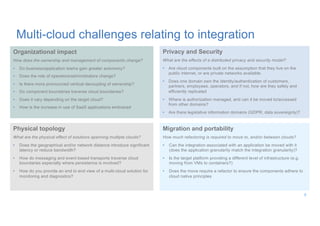
Multi-cloud challenges relating to integration
Organizational impact
How does the ownership and management of components change?
• Do business/application teams gain greater autonomy?
• Does the role of operators/administrators change?
• Is there more pronounced vertical decoupling of ownership?
• Do component boundaries traverse cloud boundaries?
• Does it vary depending on the target cloud?
• How is the increase in use of SaaS applications embraced
Migration and portability
How much refactoring is required to move to, and/or between clouds?
• Can the integration associated with an application be moved with it
(does the application granularity match the integration granularity)?
• Is the target platform providing a different level of infrastructure (e.g.
moving from VMs to containers?)
• Does the move require a refactor to ensure the components adhere to
cloud native principles
8
Privacy and Security
What are the effects of a distributed privacy and security model?
• Are cloud components built on the assumption that they live on the
public internet, or are private networks available.
• Does one domain own the identity/authentication of customers,
partners, employees, operators, and if not, how are they safely and
efficiently replicated
• Where is authorization managed, and can it be moved to/accessed
from other domains?
• Are there legislative information domains (GDPR, data sovereignty)?
Physical topology
What are the physical effect of solutions spanning multiple clouds?
• Does the geographical and/or network distance introduce significant
latency or reduce bandwidth?
• How do messaging and event based transports traverse cloud
boundaries especially where persistence is involved?
• How do you provide an end to end view of a multi-cloud solution for
monitoring and diagnostics?
Traditional infrastructure
(on premises)
Traditional infrastructure
(on premises)
CaaS
cloud platform
Private cloud
(on premises)
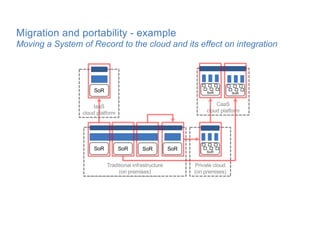
Migration and portability - example
Moving a System of Record to the cloud and its effect on integration
SoR SoRSoR
IaaS
cloud platform
SoR
SoR
SoR SoR
SoR
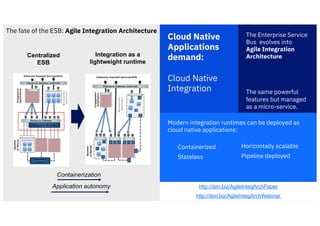
Modern integration runtimes can be deployed as
cloud native applications:
10
The fate of the ESB: Agile Integration Architecture
The Enterprise Service
Bus evolves into
Agile Integration
Architecture
The same powerful
features but managed
as a micro-service.
Cloud Native
Applications
demand:
Cloud Native
Integration
Centralized
ESB
Integration as a
lightweight runtime
Containerization
Application autonomy http://ibm.biz/AgileIntegArchPaper
http://ibm.biz/AgileIntegArchWebinar
Containerized
Stateless
Horizontally scalable
Pipeline deployed
asynchronous(messaging,events,…)
trad. on premisescloud platform
cloud platformcloud platform
private cloudSaaS platform
iPaaS/iSaaS
SaaS platform
cloud platform cloud platform
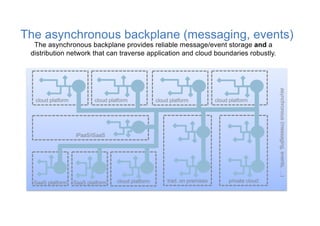
The asynchronous backplane (messaging, events)
The asynchronous backplane provides reliable message/event storage and a
distribution network that can traverse application and cloud boundaries robustly.
Think 2018 / 8272 / March 2018 / © 2018 IBM Corporation
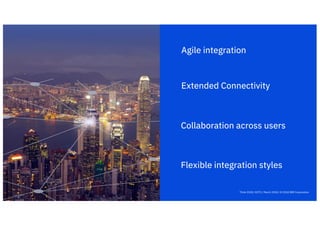
Flexible integration styles
Collaboration across users
Agile integration
Extended Connectivity
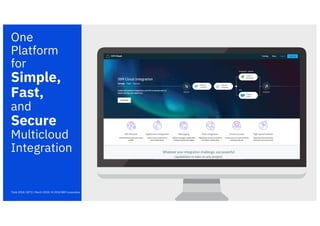
One
Platform
for
Simple,
Fast,
and
Secure
Multicloud
Integration
Think 2018 / 8272 / March 2018 / © 2018 IBM Corporation
Looking for
more
information?
“The evolving hybrid integration reference architecture”
https://ibm.biz/HybridIntRefArch
http://ibm.biz/HybridIntRefArchYouTube
More information on IBM’s integration products
https://www.ibm.com/cloud/integration
“Microservices, SOA, and APIs: Friends or enemies?”
https://ibm.biz/MicroservicesVsSoa
http://ibm.biz/MicroservicesVsSoaWebinar
Part 2: Moving to lightweight, agile integration
http://ibm.biz/AgileIntegArchPaper
Part 1: The fate of the ESB
http://ibm.biz/FateOfTheESBPaper

Multi-cloud integration architecture

  • 1.
    0 Integration architecture forthe multi-cloud enterprise Kim Clark Integration Architect Hybrid Integration Rob Nicholson Distinguished Engineer Hybrid Integration Webinar: http://ibm.biz/MultiCloudIntegrationArchitectureWebinar
  • 2.
    of “leading-edge” companies believe augmented intelligenceis key to improved customer loyalty Source: Forbes insights - Industry-Leading Customer Experiences: How to Identify Opportunities, Bridge Silos and Accelerate Result with augmented Intelligence 69% Think 2018 / 8272 / March 2018 / © 2018 IBM Corporation
  • 3.
    2 Four primary trends driving theintegration market today Increasing need to integrate across a hybrid, multi-cloud environment Digital Transformation driving Increasing need to provide API-led integration across apps and data Increasing need for integration to appeal to the Line of Business Changing application deployment architectures challenging traditional integration architectures
  • 4.
    Hybrid Integration ReferenceArchitecture for Digital Transformation 3 Composing invocations SoR Core Business Operations Empowering Digital teams Systems of Engagement Business logic Mobile Partners SaaS Offerings API Economy IoT XaaS On-Premise Cloudaffinity SoR “Low level” connectivity Surfacing events Data Integration SoR API & Event Management API & Event Management SoR SoR Composing invocations Surfacing events Data Integration “Digital” connectivity Application (traditional) Application (microservices) {..} {..} {..}{..} Int. Int. {..} {..} {..} Application (microservices) {..} Int.{..} {..} {..} Int. SoR Integration Integration Application (traditional) {..} {..} {..} Integration webinar http://ibm.biz/HybridIntRefArchYouTube paper http://ibm.biz/HybridIntRefArch
  • 5.
    synchronous(rest/http,soap/http,…) asynchronous(messaging,events,…) Hybrid Integration ReferenceArchitecture 4 Composing invocations SoR SoR “Low level” connectivity Surfacing events Data Integration SoR API & Event Management API & Event Management SoR SoR Composing invocations Surfacing events Data Integration “Digital” connectivity Application (traditional) Application (microservices) {..} {..} {..}{..} {..} {..} {..} Application (microservices) SoR Integration Integration Application (traditional) {..} {..} {..} Integration batch(bulkAPIs,filetransfer,…) Core Business Operations Empowering Digital teams Systems of Engagement Business logic Mobile Partners SaaS Offerings API Economy IoT XaaS On-Premise Cloudaffinity webinar http://ibm.biz/HybridIntRefArchYouTube paper http://ibm.biz/HybridIntRefArch {..} {..} {..}{..}
  • 6.
    the number ofclouds the average enterprise is either using or piloting Source: https://www.forbes.com/sites/joemckendrick/2016/02/09/typical-enterprise-uses- six-cloud-computing-services-survey-shows/#69d5a1a4a82b 6 Think 2018 / 8272 / March 2018 / © 2018 IBM Corporation
  • 7.
    trad. on premises SoRSoRSoR SoR Application (traditional) {..} {..} {..} cloud platform cloud platform Application (traditional) {..} {..} {..} Application (traditional) {..} {..} {..} cloud platform Application (microservices) {..} {..} {..} {..} {..} {..} Application (microservices) {..} {..} {..} {..} private cloud SoR SoR Application (traditional) {..} {..} {..} SoR (SaaS) SaaS platform iPaaS/iSaaS SoR (SaaS) SaaS platform cloud platform Application (microservices) {..} {..} {..} {..} {..} {..} Application (microservices) {..} {..} {..} {..} cloud platform Application (microservices) {..} {..} {..} {..} {..} {..} Application (microservices) {..} {..} {..} {..} The multi-cloud challenge
  • 8.
    synchronous(rest/http,soap/http,…) asynchronous(messaging,events,…) batch(bulkAPIs,filetransfer,ETL,…) Traditional on premises SoRSoRSoR SoR Application (traditional) {..} {..} {..} cloud platform cloud platform Application (traditional) {..} {..} {..} cloud platform Application (microservices) {..} {..} {..} {..} {..} {..} Application (microservices) {..} {..} {..} {..} private cloud SoR SoR Application (traditional) {..} {..} {..} iPaaS/iSaaS SoR (SaaS) SaaS platform cloud platform Application (microservices) {..} {..} {..} {..} {..} {..} Application (microservices) {..} {..} {..} {..} cloud platform Application (microservices) {..} {..} {..} {..} {..} {..} Application (microservices) {..} {..} {..} {..} The multi-cloud challenge Application (traditional) {..} {..} {..} Integration SoR (SaaS) SaaS platform SoR Application (traditional) {..} {..} {..} Integration
  • 9.
    Multi-cloud challenges relatingto integration Organizational impact How does the ownership and management of components change? • Do business/application teams gain greater autonomy? • Does the role of operators/administrators change? • Is there more pronounced vertical decoupling of ownership? • Do component boundaries traverse cloud boundaries? • Does it vary depending on the target cloud? • How is the increase in use of SaaS applications embraced Migration and portability How much refactoring is required to move to, and/or between clouds? • Can the integration associated with an application be moved with it (does the application granularity match the integration granularity)? • Is the target platform providing a different level of infrastructure (e.g. moving from VMs to containers?) • Does the move require a refactor to ensure the components adhere to cloud native principles 8 Privacy and Security What are the effects of a distributed privacy and security model? • Are cloud components built on the assumption that they live on the public internet, or are private networks available. • Does one domain own the identity/authentication of customers, partners, employees, operators, and if not, how are they safely and efficiently replicated • Where is authorization managed, and can it be moved to/accessed from other domains? • Are there legislative information domains (GDPR, data sovereignty)? Physical topology What are the physical effect of solutions spanning multiple clouds? • Does the geographical and/or network distance introduce significant latency or reduce bandwidth? • How do messaging and event based transports traverse cloud boundaries especially where persistence is involved? • How do you provide an end to end view of a multi-cloud solution for monitoring and diagnostics?
  • 10.
    Traditional infrastructure (on premises) Traditionalinfrastructure (on premises) CaaS cloud platform Private cloud (on premises) Migration and portability - example Moving a System of Record to the cloud and its effect on integration SoR SoRSoR IaaS cloud platform SoR SoR SoR SoR SoR
  • 11.
    Modern integration runtimescan be deployed as cloud native applications: 10 The fate of the ESB: Agile Integration Architecture The Enterprise Service Bus evolves into Agile Integration Architecture The same powerful features but managed as a micro-service. Cloud Native Applications demand: Cloud Native Integration Centralized ESB Integration as a lightweight runtime Containerization Application autonomy http://ibm.biz/AgileIntegArchPaper http://ibm.biz/AgileIntegArchWebinar Containerized Stateless Horizontally scalable Pipeline deployed
  • 12.
    asynchronous(messaging,events,…) trad. on premisescloudplatform cloud platformcloud platform private cloudSaaS platform iPaaS/iSaaS SaaS platform cloud platform cloud platform The asynchronous backplane (messaging, events) The asynchronous backplane provides reliable message/event storage and a distribution network that can traverse application and cloud boundaries robustly.
  • 13.
    Think 2018 /8272 / March 2018 / © 2018 IBM Corporation Flexible integration styles Collaboration across users Agile integration Extended Connectivity
  • 14.
  • 15.
    Looking for more information? “The evolvinghybrid integration reference architecture” https://ibm.biz/HybridIntRefArch http://ibm.biz/HybridIntRefArchYouTube More information on IBM’s integration products https://www.ibm.com/cloud/integration “Microservices, SOA, and APIs: Friends or enemies?” https://ibm.biz/MicroservicesVsSoa http://ibm.biz/MicroservicesVsSoaWebinar Part 2: Moving to lightweight, agile integration http://ibm.biz/AgileIntegArchPaper Part 1: The fate of the ESB http://ibm.biz/FateOfTheESBPaper