Capturing and analyzing interface characteristics, Part 1:
Capturing integration complexity for BPM and SOA solutions
Page 1 of 15
Interface characteristics: Capturing Integration
Complexity
Authors: Kim J. Clark, Brian M. Petrini
Back in 2011, Brian and I captured the approach we’d matured over the preceding decade designing integration
solutions. We were in part driven by the fact that some projects were more successful than others over the long term. It
often came down to whether in the early stages you had accurately explored the most important characteristics of the
interfaces concerned. We tried to identify a vocabulary for describing interfaces in order to make it the early analysis more
deterministic. A domain language for integration perhaps.
We first presented on the approach in 2008 at the IBM Impact conference in the middle of the service oriented
architecture (SOA) boom. It was provocatively titled: Exposing services people want to consume, in a nod to the many
“challenging” SOA project/programs in progress around that time.
Despite its age, we still regularly find ourselves referring to the concepts within it or getting requests for the content. Most
are still applicable, but it’s fair to say a sub-class of interfaces styles such as RESTful APIs have become fairly ubiquitous.
This means you can make assumptions across a number of characteristics as soon as you know it is a RESTful API – for
example the transport is HTTP, it is request-response, and also thread blocking. However, many of the other
characteristics still need to be investigated. For example, an API ought to be idempotent…but plenty are not.
Since the papers were taken down from their original location, we’ve decided to re-post them here. Enjoy!
Part 1 includes:
• Introducing interface characteristics: A look at the breadth of information you need to knowto truly understand
the complexity of an interface.
• Integration in SOA and BPM: Why integration is so important to architectural initiatives suchas SOA and BPM.
• Iterative interface analysis: Because it would be impractical to capture everything about all the interfaces in a
solution in one go, this section discusses which characteristics to capture atwhich stage in the project, and why.
Part 2 is a reference guide to each of the individual interface characteristics in detail.
DATA
• Principal data objects
• Operation/function
• Read or change
• Request/response objects
INTEGRITY
• Validation
• Transactionality
• Statefulness
• Event sequence
• Idempotence
TECHNICAL INTERFACE
• Transport
• Protocol
• Data format
SECURITY
• Identity/authentication
• Authorization
• Data ownership
• Privacy
INTERACTION TYPE
• Request-response or fire-forget
• Thread-blocking or asynchronous
• Batch or individual
• Message size
RELIABILITY
• Availability
• Delivery assurance
PERFORMANCE
• Response times
• Throughput
• Volumes
• Concurrency
ERROR HANDLING
• Error management capabilities
• Known exception conditions
• Unexpected error presentation
Capturing and analyzing interface characteristics, Part 1:
Capturing integration complexity for BPM and SOA solutions
Page 2 of 15
Part 1: Capturing integration complexity for BPM and
SOA solutions
Introduction
In terms of importance, one of the most commonly underestimated areas of complexity in an
IT solution is the integration with back end systems. Despite the efforts of service-oriented
architecture (SOA) to standardize and simplify the way we access back end systems, every new
project inevitably brings new points of integration, or, at the very least, enhancements to existing
integrations.
This two-part article introduces a way to capture and analyze integration complexity using
interface characteristics to improve your ability to plan, design, and ultimately implement
solutions involving integration.
Part 1 includes:
• Introducing interface characteristics: A look at the breadth of information you need to know
to truly understand the complexity of an interface.
• Integration in SOA and BPM: Why integration is so important to architectural initiatives such
as SOA and BPM.
• Iterative interface analysis: Because it would be impractical to capture everything about all
the interfaces in a solution in one go, this section discusses which characteristics to capture at
which stage in the project, and why.
Part 2 will dive into each of the individual interface characteristics in detail.
Introducing interface characteristics
With the tried and tested approach described in these articles for systematically analyzing the
integration requirements and capabilities of back end systems, you'll be able to ask just enough of
the right questions at each analysis and design stage to ensure that you can effectively estimate,
identify risks, and ultimately choose the right design patterns to achieve the desired integration in
the solution.
This two-part article describes a well-tested technique for capturing the fundamental interface
characteristics of integration points with back end systems. Integration still accounts for a
majority of the design and implementation effort of many IT solutions. Poorly understood
integration requirements represent a significant risk to a project. You will see how correct
analysis of the integration points improves estimating and technology selection, and ultimately
enables a more predictable pattern-based approach to solution design and implementation.
Moreover, these articles will specifically highlight the relevance of this technique to enterprise
architecture initiatives, such as service-oriented architecture (SOA) and business process
management (BPM).
Capturing and analyzing interface characteristics, Part 1:
Capturing integration complexity for BPM and SOA solutions
Page 3 of 15
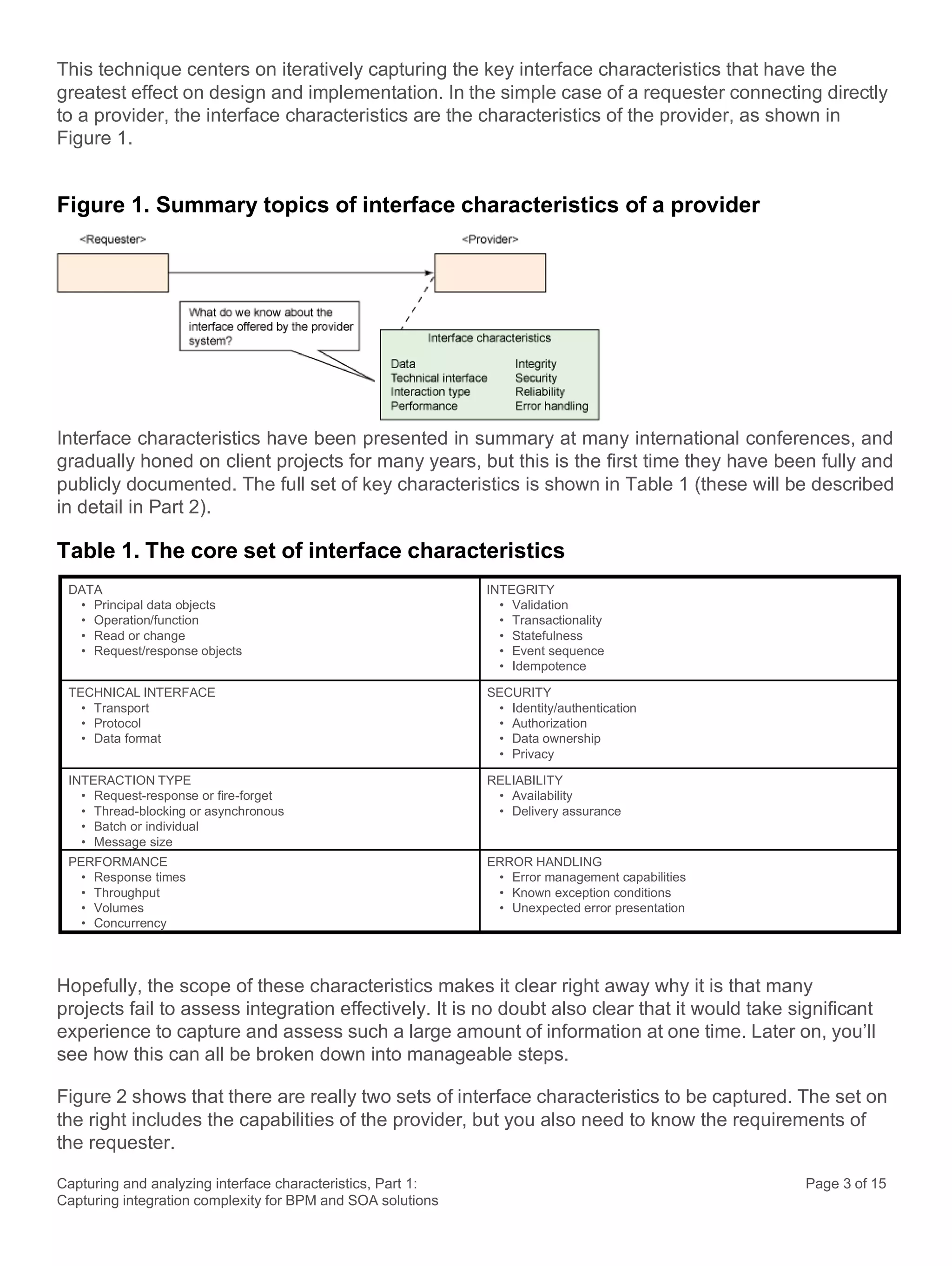
This technique centers on iteratively capturing the key interface characteristics that have the
greatest effect on design and implementation. In the simple case of a requester connecting directly
to a provider, the interface characteristics are the characteristics of the provider, as shown in
Figure 1.
Figure 1. Summary topics of interface characteristics of a provider
Interface characteristics have been presented in summary at many international conferences, and
gradually honed on client projects for many years, but this is the first time they have been fully and
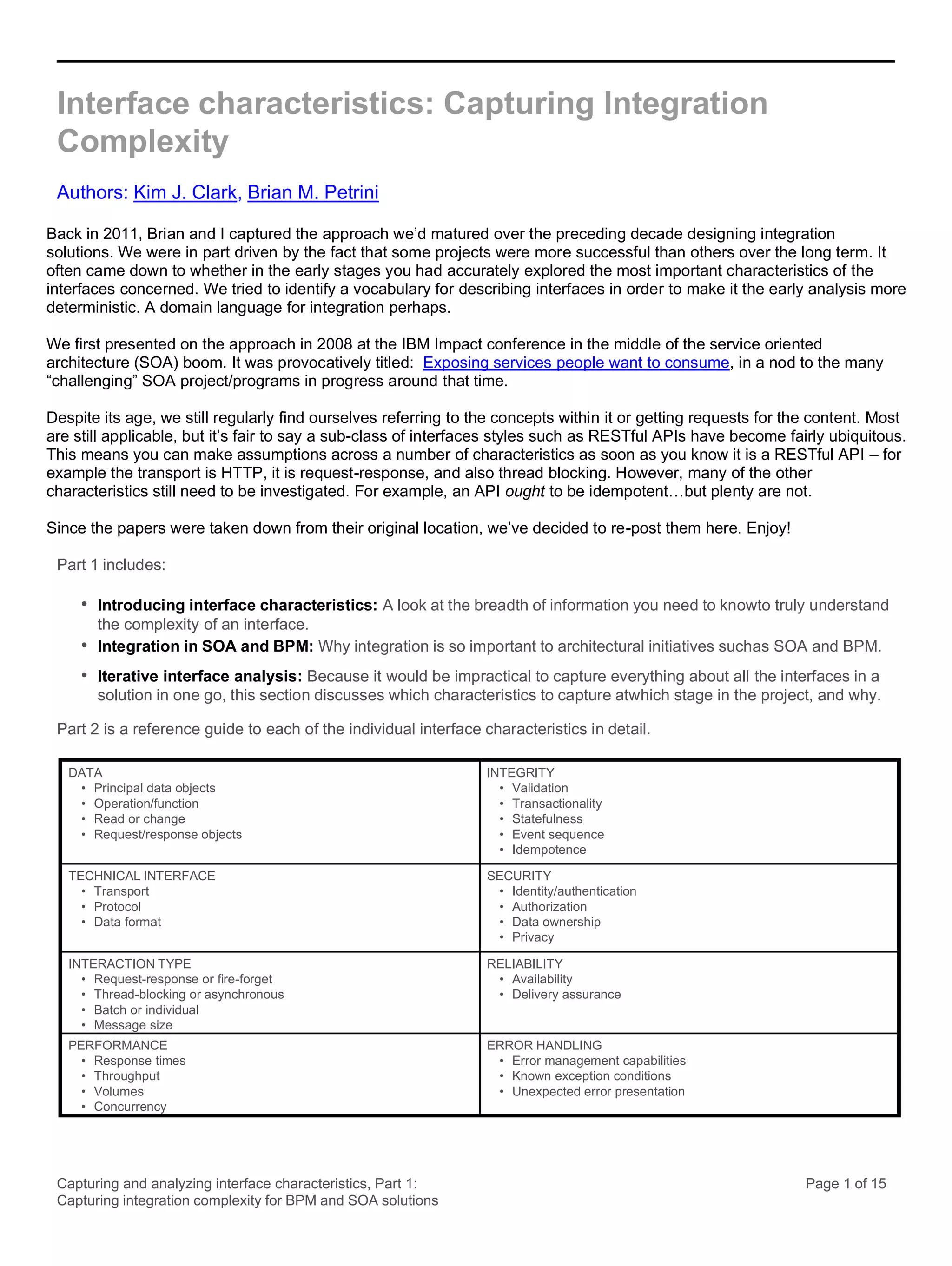
publicly documented. The full set of key characteristics is shown in Table 1 (these will be described
in detail in Part 2).
Table 1. The core set of interface characteristics
DATA
• Principal data objects
• Operation/function
• Read or change
• Request/response objects
INTEGRITY
• Validation
• Transactionality
• Statefulness
• Event sequence
• Idempotence
TECHNICAL INTERFACE
• Transport
• Protocol
• Data format
SECURITY
• Identity/authentication
• Authorization
• Data ownership
• Privacy
INTERACTION TYPE
• Request-response or fire-forget
• Thread-blocking or asynchronous
• Batch or individual
• Message size
RELIABILITY
• Availability
• Delivery assurance
PERFORMANCE
• Response times
• Throughput
• Volumes
• Concurrency
ERROR HANDLING
• Error management capabilities
• Known exception conditions
• Unexpected error presentation
Hopefully, the scope of these characteristics makes it clear right away why it is that many
projects fail to assess integration effectively. It is no doubt also clear that it would take significant
experience to capture and assess such a large amount of information at one time. Later on, you’ll
see how this can all be broken down into manageable steps.
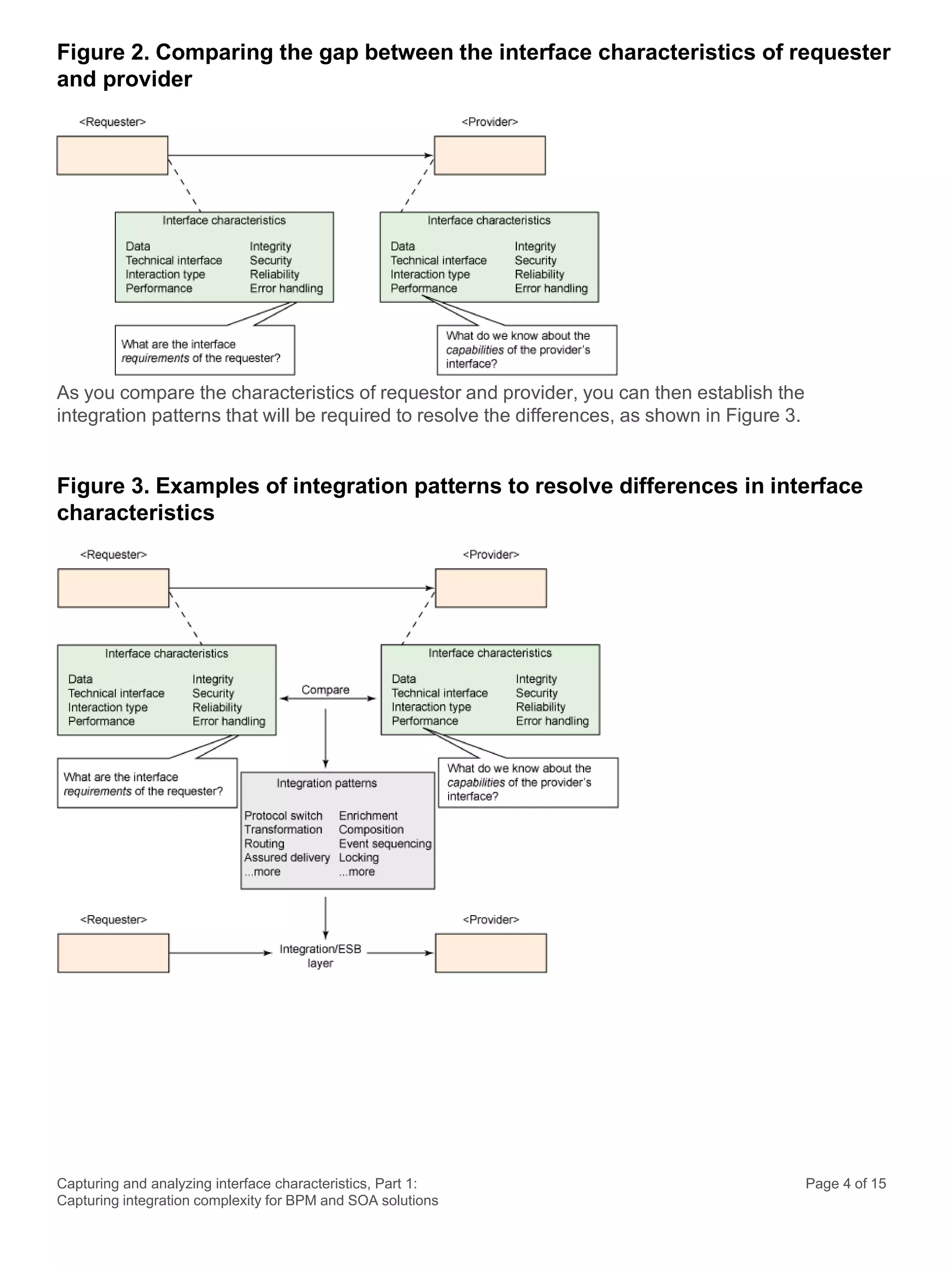
Figure 2 shows that there are really two sets of interface characteristics to be captured. The set on
the right includes the capabilities of the provider, but you also need to know the requirements of
the requester.
Capturing and analyzing interface characteristics, Part 1:
Capturing integration complexity for BPM and SOA solutions
Page 4 of 15
Figure 2. Comparing the gap between the interface characteristics of requester
and provider
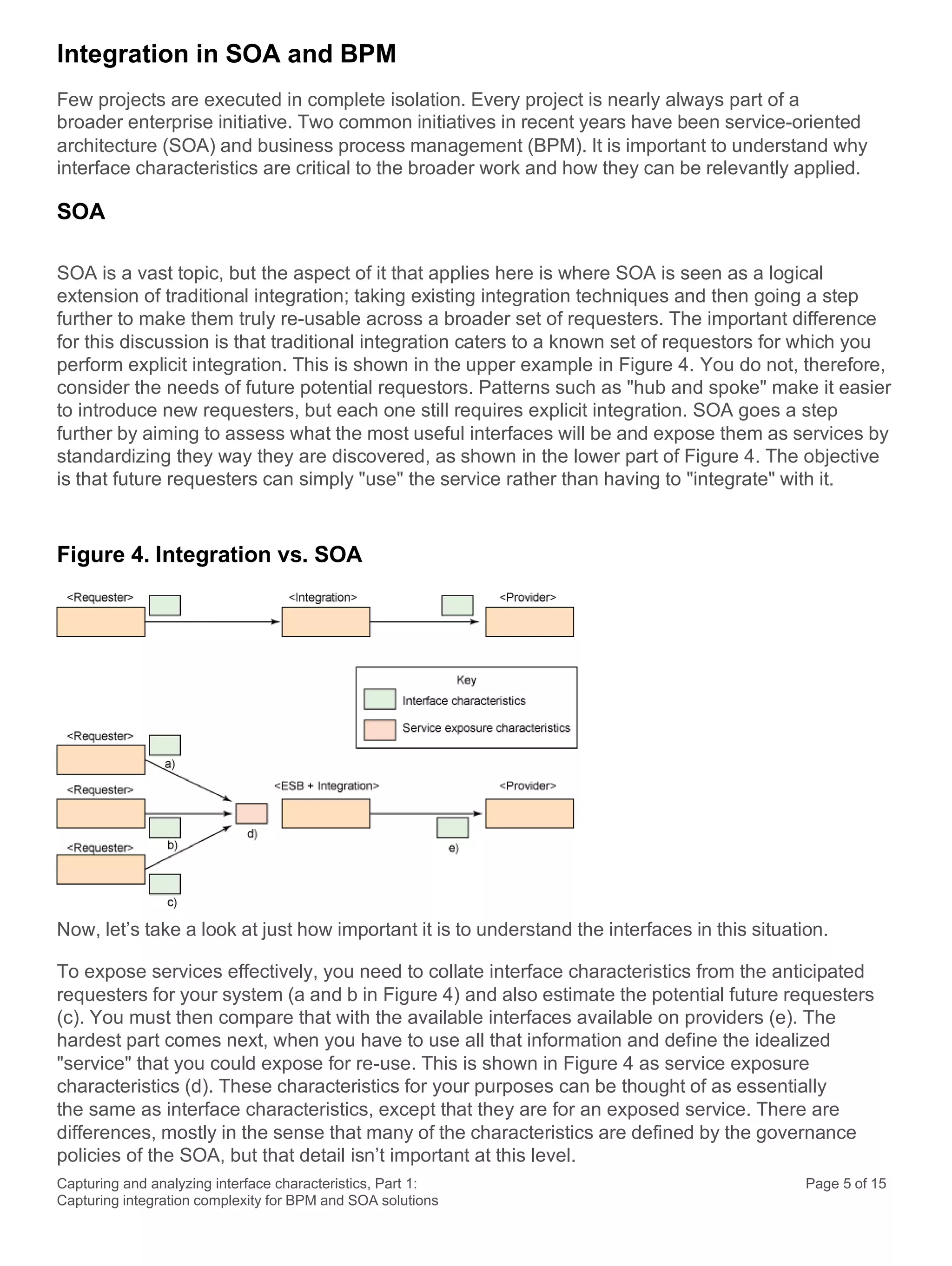
As you compare the characteristics of requestor and provider, you can then establish the
integration patterns that will be required to resolve the differences, as shown in Figure 3.
Figure 3. Examples of integration patterns to resolve differences in interface
characteristics
Capturing and analyzing interface characteristics, Part 1:
Capturing integration complexity for BPM and SOA solutions
Page 5 of 15
Integration in SOA and BPM
Few projects are executed in complete isolation. Every project is nearly always part of a
broader enterprise initiative. Two common initiatives in recent years have been service-oriented
architecture (SOA) and business process management (BPM). It is important to understand why
interface characteristics are critical to the broader work and how they can be relevantly applied.
SOA
SOA is a vast topic, but the aspect of it that applies here is where SOA is seen as a logical
extension of traditional integration; taking existing integration techniques and then going a step
further to make them truly re-usable across a broader set of requesters. The important difference
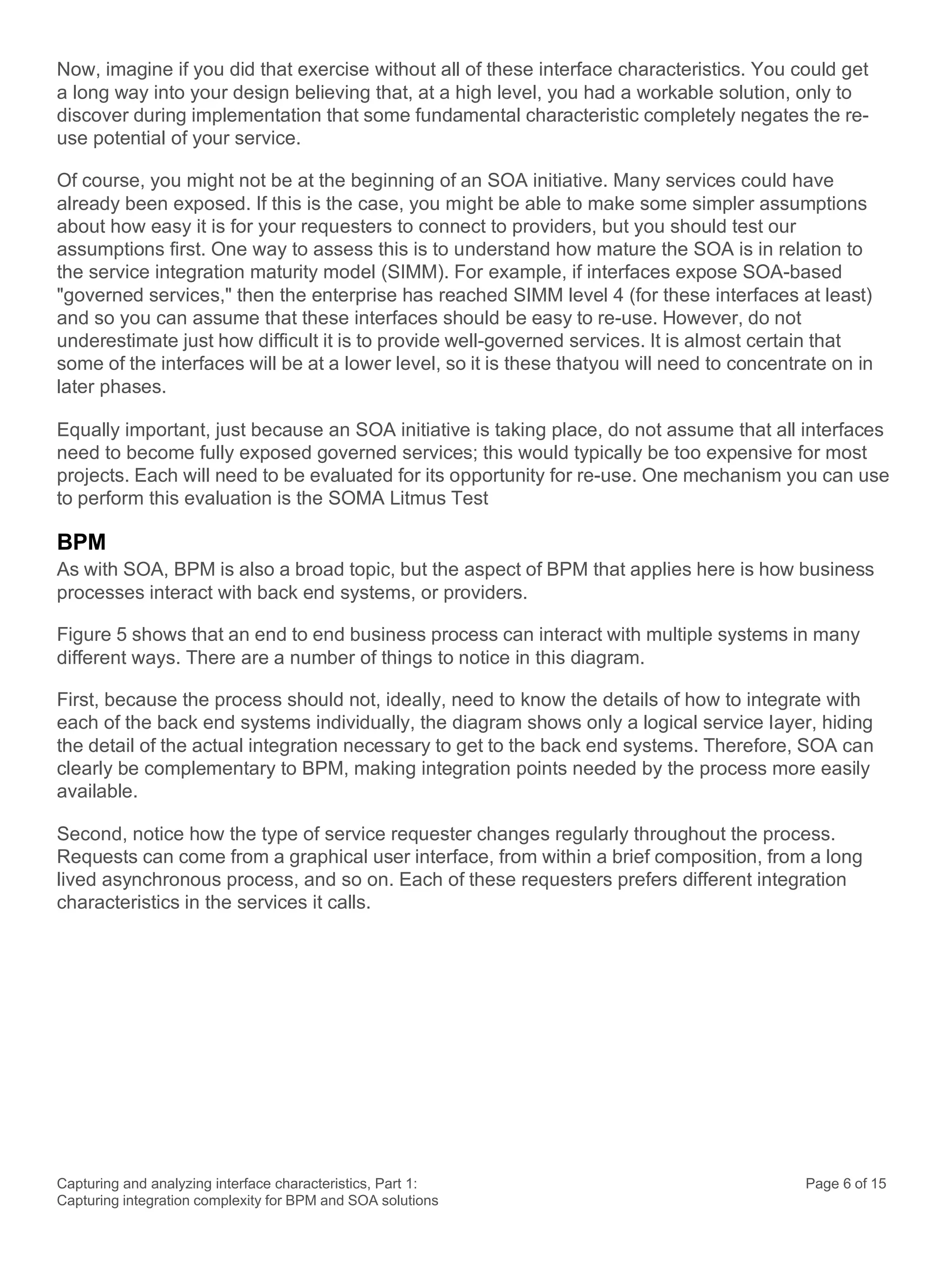
for this discussion is that traditional integration caters to a known set of requestors for which you
perform explicit integration. This is shown in the upper example in Figure 4. You do not, therefore,
consider the needs of future potential requestors. Patterns such as "hub and spoke" make it easier
to introduce new requesters, but each one still requires explicit integration. SOA goes a step
further by aiming to assess what the most useful interfaces will be and expose them as services by
standardizing they way they are discovered, as shown in the lower part of Figure 4. The objective
is that future requesters can simply "use" the service rather than having to "integrate" with it.
Figure 4. Integration vs. SOA
Now, let’s take a look at just how important it is to understand the interfaces in this situation.
To expose services effectively, you need to collate interface characteristics from the anticipated
requesters for your system (a and b in Figure 4) and also estimate the potential future requesters
(c). You must then compare that with the available interfaces available on providers (e). The
hardest part comes next, when you have to use all that information and define the idealized
"service" that you could expose for re-use. This is shown in Figure 4 as service exposure
characteristics (d). These characteristics for your purposes can be thought of as essentially
the same as interface characteristics, except that they are for an exposed service. There are
differences, mostly in the sense that many of the characteristics are defined by the governance
policies of the SOA, but that detail isn’t important at this level.
Capturing and analyzing interface characteristics, Part 1:
Capturing integration complexity for BPM and SOA solutions
Page 6 of 15
Now, imagine if you did that exercise without all of these interface characteristics. You could get
a long way into your design believing that, at a high level, you had a workable solution, only to
discover during implementation that some fundamental characteristic completely negates the re-
use potential of your service.
Of course, you might not be at the beginning of an SOA initiative. Many services could have
already been exposed. If this is the case, you might be able to make some simpler assumptions
about how easy it is for your requesters to connect to providers, but you should test our
assumptions first. One way to assess this is to understand how mature the SOA is in relation to
the service integration maturity model (SIMM). For example, if interfaces expose SOA-based
"governed services," then the enterprise has reached SIMM level 4 (for these interfaces at least)
and so you can assume that these interfaces should be easy to re-use. However, do not
underestimate just how difficult it is to provide well-governed services. It is almost certain that
some of the interfaces will be at a lower level, so it is these thatyou will need to concentrate on in
later phases.
Equally important, just because an SOA initiative is taking place, do not assume that all interfaces
need to become fully exposed governed services; this would typically be too expensive for most
projects. Each will need to be evaluated for its opportunity for re-use. One mechanism you can use
to perform this evaluation is the SOMA Litmus Test
BPM
As with SOA, BPM is also a broad topic, but the aspect of BPM that applies here is how business
processes interact with back end systems, or providers.
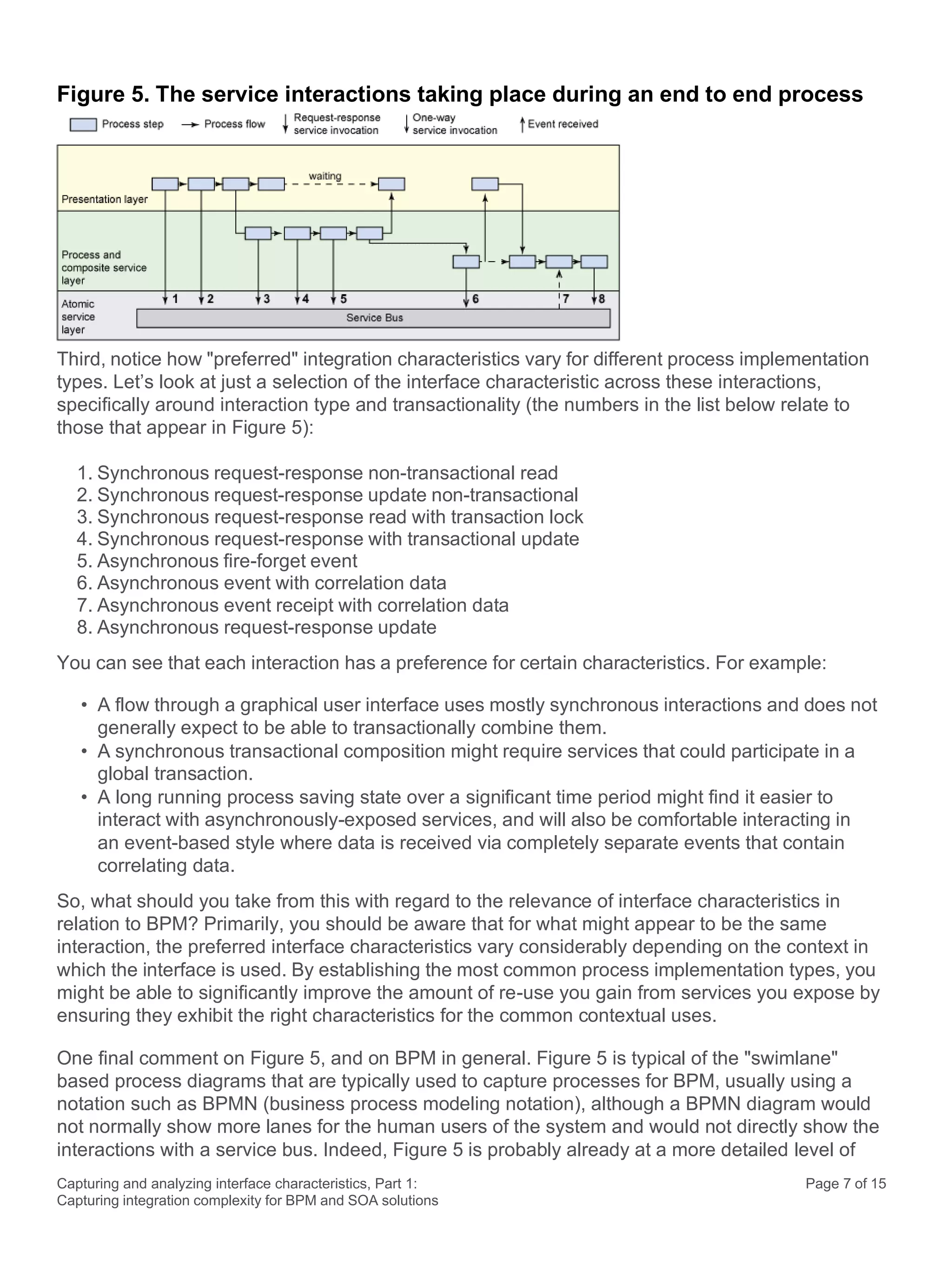
Figure 5 shows that an end to end business process can interact with multiple systems in many
different ways. There are a number of things to notice in this diagram.
First, because the process should not, ideally, need to know the details of how to integrate with
each of the back end systems individually, the diagram shows only a logical service layer, hiding
the detail of the actual integration necessary to get to the back end systems. Therefore, SOA can
clearly be complementary to BPM, making integration points needed by the process more easily
available.
Second, notice how the type of service requester changes regularly throughout the process.
Requests can come from a graphical user interface, from within a brief composition, from a long
lived asynchronous process, and so on. Each of these requesters prefers different integration
characteristics in the services it calls.
Capturing and analyzing interface characteristics, Part 1:
Capturing integration complexity for BPM and SOA solutions
Page 7 of 15
Figure 5. The service interactions taking place during an end to end process
Third, notice how "preferred" integration characteristics vary for different process implementation
types. Let’s look at just a selection of the interface characteristic across these interactions,
specifically around interaction type and transactionality (the numbers in the list below relate to
those that appear in Figure 5):
1. Synchronous request-response non-transactional read
2. Synchronous request-response update non-transactional
3. Synchronous request-response read with transaction lock
4. Synchronous request-response with transactional update
5. Asynchronous fire-forget event
6. Asynchronous event with correlation data
7. Asynchronous event receipt with correlation data
8. Asynchronous request-response update
You can see that each interaction has a preference for certain characteristics. For example:
• A flow through a graphical user interface uses mostly synchronous interactions and does not
generally expect to be able to transactionally combine them.
• A synchronous transactional composition might require services that could participate in a
global transaction.
• A long running process saving state over a significant time period might find it easier to
interact with asynchronously-exposed services, and will also be comfortable interacting in
an event-based style where data is received via completely separate events that contain
correlating data.
So, what should you take from this with regard to the relevance of interface characteristics in
relation to BPM? Primarily, you should be aware that for what might appear to be the same
interaction, the preferred interface characteristics vary considerably depending on the context in
which the interface is used. By establishing the most common process implementation types, you
might be able to significantly improve the amount of re-use you gain from services you expose by
ensuring they exhibit the right characteristics for the common contextual uses.
One final comment on Figure 5, and on BPM in general. Figure 5 is typical of the "swimlane"
based process diagrams that are typically used to capture processes for BPM, usually using a
notation such as BPMN (business process modeling notation), although a BPMN diagram would
not normally show more lanes for the human users of the system and would not directly show the
interactions with a service bus. Indeed, Figure 5 is probably already at a more detailed level of
Capturing and analyzing interface characteristics, Part 1:
Capturing integration complexity for BPM and SOA solutions
Page 8 of 15
granularity than a high level business process should be documented. That pure representation of
a business process, completely abstracted from the detail of interactions with back end systems,
is an essential part of what makes BPM so powerful as a way of documenting, analyzing, and
even implementing business requirements in a rapid and agile way, and is in itself of huge value.
However, you must remember just how much this abstraction is hiding when it come to integration.
The business process diagram is just the tip of the iceberg when it comes to integration. Clearly,
there are circumstances when integration issues might be less of an issue; for example, when
most of the business process is human-oriented rather than system-oriented, or if there is a
mature SOA on which to build BPM processes, many interactions should be simpler to implement.
However, this is not the general case. There are usually many new and complex interfaces -- or
different uses of existing ones -- that need detailed rigor and understanding, and you must surface
these as early as possible, using interface characteristics to ensure you remove the risk from the
overall BPM initiative.
Iterative interface analysis
Because it is impractical (and impossible) to capture all of the integration characteristics in the
early stages of a project, let’s look at how this process can be explored iteratively to ensure that
just enough information is captured to inform the project and the design at each phase.
Capture of interface characteristics must be aligned with project phases or iterations. There are
many different methodologies for defining projects and each use different terminology, but for the
sake of simplicity, let’s say that regardless of methodology there is always some form of two basic,
well-separated exercises:
• Solutioning, when you discover in which systems the data can be found, and what types of
technical interface are available to those systems.
• Design, when you look at the shape and size of the individual data operations that will be
required by the solution.
On a traditional waterfall project you would solution the whole landscape based on the project
requirements before moving to the next phase of design. In a more iterative or agile methodology,
you would solution a relevant slice (often described as a story) of the overall problem, then move
straight into design and implementation of that isolated slice of the overall picture. Either way, the
two phases exist, and so we can discuss here what you should capture at each stage.
Whilst a structured approach is preferred for collecting the minimum characteristics that should
be captured at each stage, nothing can replace the eye of an experienced integration specialist,
who will be able to infer from the early characteristics captured that deeper investigation into some
interfaces will be needed sooner than is suggested here. In the sections that follow, suggestions
are included (where possible) regarding what characteristics can be useful ahead of time if they
are easily available.
Solutioning
In this phase, you are only aware of the fundamental systems involved in the architecture and
the data they will provide to the solution. Early in this phase you will have nothing more than
box diagrams on a whiteboard, but by the end you could have the beginnings of an interface
catalogue.
Capturing and analyzing interface characteristics, Part 1:
Capturing integration complexity for BPM and SOA solutions
Page 9 of 15
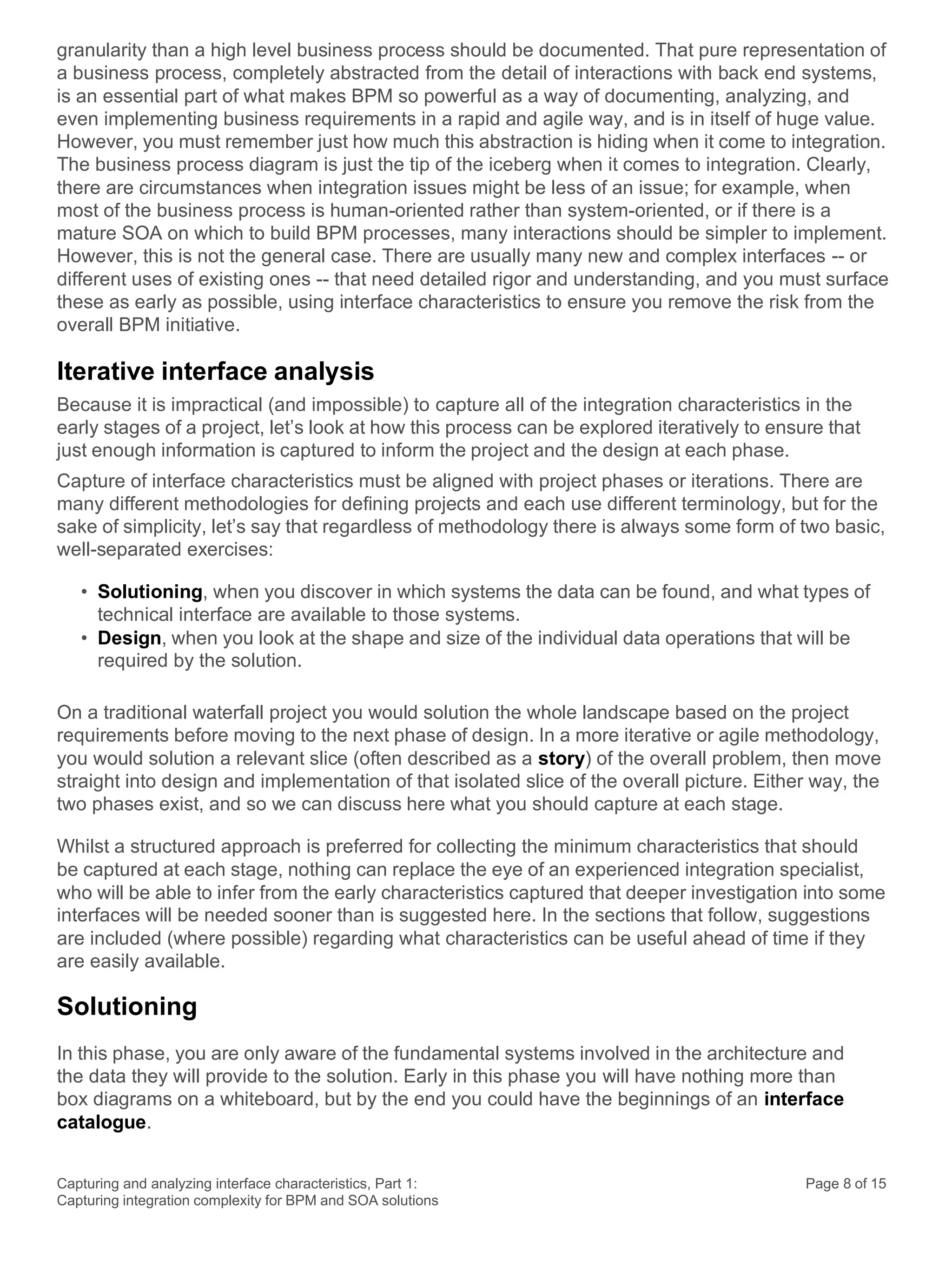
System context diagram
At this point in the project, you should have created a system context diagram at the very least
(Figure 6).
Figure 6. Basic system context diagram
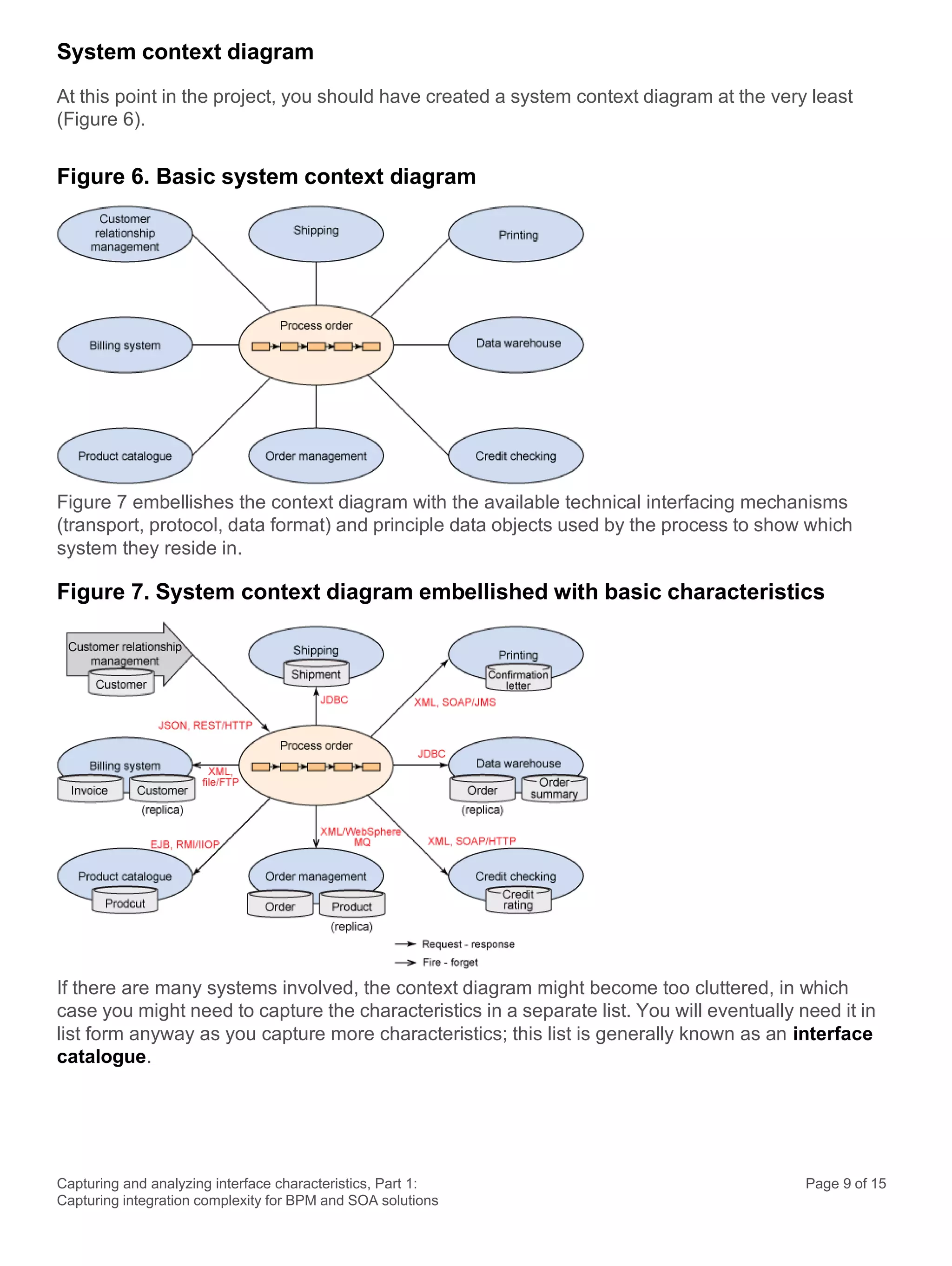
Figure 7 embellishes the context diagram with the available technical interfacing mechanisms
(transport, protocol, data format) and principle data objects used by the process to show which
system they reside in.
Figure 7. System context diagram embellished with basic characteristics
If there are many systems involved, the context diagram might become too cluttered, in which
case you might need to capture the characteristics in a separate list. You will eventually need it in
list form anyway as you capture more characteristics; this list is generally known as an interface
catalogue.
Capturing and analyzing interface characteristics, Part 1:
Capturing integration complexity for BPM and SOA solutions
Page 10 of 15
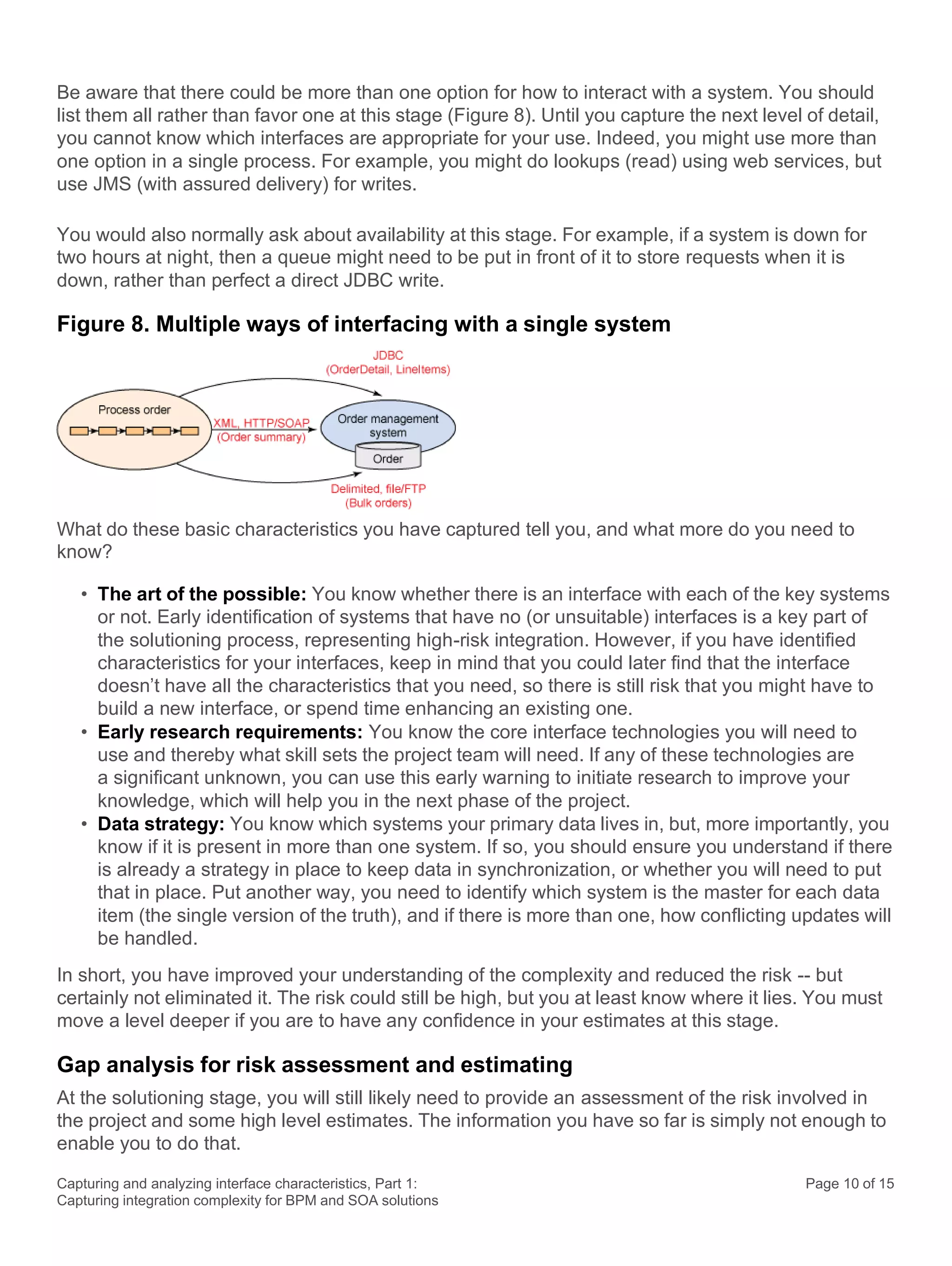
Be aware that there could be more than one option for how to interact with a system. You should
list them all rather than favor one at this stage (Figure 8). Until you capture the next level of detail,
you cannot know which interfaces are appropriate for your use. Indeed, you might use more than
one option in a single process. For example, you might do lookups (read) using web services, but
use JMS (with assured delivery) for writes.
You would also normally ask about availability at this stage. For example, if a system is down for
two hours at night, then a queue might need to be put in front of it to store requests when it is
down, rather than perfect a direct JDBC write.
Figure 8. Multiple ways of interfacing with a single system
What do these basic characteristics you have captured tell you, and what more do you need to
know?
• The art of the possible: You know whether there is an interface with each of the key systems
or not. Early identification of systems that have no (or unsuitable) interfaces is a key part of
the solutioning process, representing high-risk integration. However, if you have identified
characteristics for your interfaces, keep in mind that you could later find that the interface
doesn’t have all the characteristics that you need, so there is still risk that you might have to
build a new interface, or spend time enhancing an existing one.
• Early research requirements: You know the core interface technologies you will need to
use and thereby what skill sets the project team will need. If any of these technologies are
a significant unknown, you can use this early warning to initiate research to improve your
knowledge, which will help you in the next phase of the project.
• Data strategy: You know which systems your primary data lives in, but, more importantly, you
know if it is present in more than one system. If so, you should ensure you understand if there
is already a strategy in place to keep data in synchronization, or whether you will need to put
that in place. Put another way, you need to identify which system is the master for each data
item (the single version of the truth), and if there is more than one, how conflicting updates will
be handled.
In short, you have improved your understanding of the complexity and reduced the risk -- but
certainly not eliminated it. The risk could still be high, but you at least know where it lies. You must
move a level deeper if you are to have any confidence in your estimates at this stage.
Gap analysis for risk assessment and estimating
At the solutioning stage, you will still likely need to provide an assessment of the risk involved in
the project and some high level estimates. The information you have so far is simply not enough to
enable you to do that.
Capturing and analyzing interface characteristics, Part 1:
Capturing integration complexity for BPM and SOA solutions
Page 11 of 15
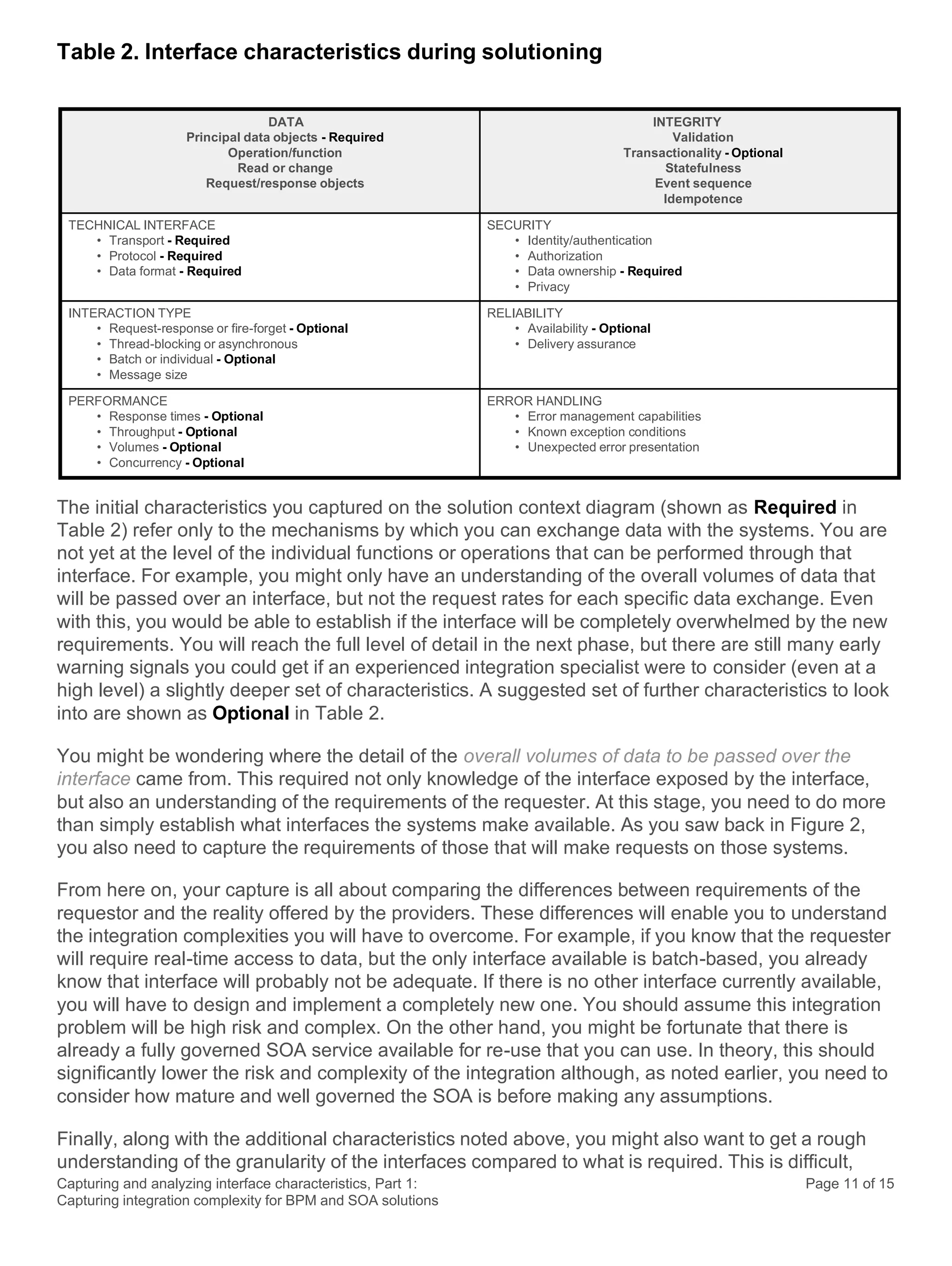
Table 2. Interface characteristics during solutioning
DATA
Principal data objects - Required
Operation/function
INTEGRITY
Validation
Transactionality - Optional
Read or change
Request/response objects
Statefulness
Event sequence
Idempotence
TECHNICAL INTERFACE
• Transport - Required
• Protocol - Required
• Data format - Required
SECURITY
• Identity/authentication
• Authorization
• Data ownership - Required
• Privacy
INTERACTION TYPE
• Request-response or fire-forget - Optional
• Thread-blocking or asynchronous
• Batch or individual - Optional
• Message size
RELIABILITY
• Availability - Optional
• Delivery assurance
PERFORMANCE
• Response times - Optional
• Throughput - Optional
• Volumes - Optional
• Concurrency - Optional
ERROR HANDLING
• Error management capabilities
• Known exception conditions
• Unexpected error presentation
The initial characteristics you captured on the solution context diagram (shown as Required in
Table 2) refer only to the mechanisms by which you can exchange data with the systems. You are
not yet at the level of the individual functions or operations that can be performed through that
interface. For example, you might only have an understanding of the overall volumes of data that
will be passed over an interface, but not the request rates for each specific data exchange. Even
with this, you would be able to establish if the interface will be completely overwhelmed by the new
requirements. You will reach the full level of detail in the next phase, but there are still many early
warning signals you could get if an experienced integration specialist were to consider (even at a
high level) a slightly deeper set of characteristics. A suggested set of further characteristics to look
into are shown as Optional in Table 2.
You might be wondering where the detail of the overall volumes of data to be passed over the
interface came from. This required not only knowledge of the interface exposed by the interface,
but also an understanding of the requirements of the requester. At this stage, you need to do more
than simply establish what interfaces the systems make available. As you saw back in Figure 2,
you also need to capture the requirements of those that will make requests on those systems.
From here on, your capture is all about comparing the differences between requirements of the
requestor and the reality offered by the providers. These differences will enable you to understand
the integration complexities you will have to overcome. For example, if you know that the requester
will require real-time access to data, but the only interface available is batch-based, you already
know that interface will probably not be adequate. If there is no other interface currently available,
you will have to design and implement a completely new one. You should assume this integration
problem will be high risk and complex. On the other hand, you might be fortunate that there is
already a fully governed SOA service available for re-use that you can use. In theory, this should
significantly lower the risk and complexity of the integration although, as noted earlier, you need to
consider how mature and well governed the SOA is before making any assumptions.
Finally, along with the additional characteristics noted above, you might also want to get a rough
understanding of the granularity of the interfaces compared to what is required. This is difficult,
Capturing and analyzing interface characteristics, Part 1:
Capturing integration complexity for BPM and SOA solutions
Page 12 of 15
as you will not gain a detailed picture of this until the next phase. However, composition adds
significant complexity to the integration, so it is a critical factor.
Since you cannot yet build an estimate on these additional factors in detail, the typical approach is
to delve deeply into a representative sample set of interactions and extrapolate from there. These
also provide opportunity for risk mitigation, as they can be used for proof of concept exercises.
Design
Individual interaction design
In the previous phase, you had no time to establish the specifics of each system interaction,
except for perhaps the representative examples created for estimating.
In this phase of the project, you will be realizing the specific functional interactions of the solution
by building out an understanding of the specific data exchanges that will take place across the
interfaces you already defined in the design phase. These exchanges are typically represented in
some form of sequence interaction diagram, such as that shown in Figure 9.
Figure 9. Sequence interaction diagram showing specific method signatures
and composition in the integration layer
The sequence diagrams force you to establish whether the systems’ interfaces provide the specific
data operations that you require. This implicitly populates the remaining characteristics in the
Data section. It is important that you use the same gap analysis technique you used earlier,
understanding the problem from the requester’s point of view, and then consider what the provider
has to offer.
Interface granularity and composition
There is some key information that will spill out from the creation of sequence diagrams – whether
or not the granularity of the available interfaces is correct. It is often the case that the requester
has a more course-grained functional requirement than the provider’s interface. For example,
the requester requires a customer, with any current orders, and a list of the high level details of
Capturing and analyzing interface characteristics, Part 1:
Capturing integration complexity for BPM and SOA solutions
Page 13 of 15
any accounts held. This might require several requests to a provider, and maybe even to multiple
providers. Figure 9 shows a further example of a mismatch in granularity whereby order creation
and shipping need to be combined into a single operation to "process the order." It’s easy to see
why the sequence diagrams are so important at this stage
This difference in granularity means you will need to perform composition (multiple requests
wrapped up as one). The macro design must establish where this composition should take place:
in the requester, in the integration layer, or in the back end system itself. The decision will be
based on a balance between factors such as performance and re-use. (Where and how this
composition should take place is beyond the scope of this article.)
What is relevant to the core concept of this article, however, is just how important the other
characteristics become if composition is required. Here are some common examples:
• If a composition requires more than one interaction that changes data, you need to consider
whether those interactions can be transactionally combined, and, if not, how you will perform
error management if the request fails between the updates.
• If the individual requests of a composition need to be performed in parallel in order to
meet the response time requirements, do you have sufficient concurrency to handle the
increased number of connections required. And if the system interfaces are thread-blocking,
how will you spawn and control the additional threads required?
• If a composition interacts with multiple systems, how will you retain the separate security
information and any other stateful context such as sessions and connections required?
Establishing the integration patterns
Once you know the specific operations that will be performed, you can then explore all the
other characteristics in the proper detail for each operation, both in terms of the requestor’s
requirements and the existing interface’s current capabilities.
As you compare the characteristics of requestor and provider, you can then establish the
integration patterns that will be required to resolve the differences, as you saw in Figure 3. Be
aware that the "composition" we have just been discussing is itself one of the integration patterns.
At this stage, the patterns are defined at a logical level, without reference to the specific
technology. However, as commonly used integration patterns are well established, standard
implementation techniques within the available technologies should also be explored, tested, and
documented. This will significantly streamline the micro design phase, next.
Micro design
In the micro design phase, you use the captured characteristics to complete the technology-
specific aspects of the design.
Notice that all the interface characteristics are agnostic of the integration technologies; they are
logical characteristics. Therefore, capturing interface characteristics should have been completed
by the time you reach micro design, and you are purely using the characteristics to aid you in
Capturing and analyzing interface characteristics, Part 2:
Reference guide to integration characteristics
Page 1 of 30
the final details of the design. One of the most common integration-related causes of projects
running over budget is ineffective capture of interface characteristics prior to micro design, leaving
inestimable -- possibly unresolvable -- issues for this phase, or, worse still, for implementation. By
far the most common and most troublesome issue here is failing to assess and capture a sufficient
amount of the data characteristics prior to micro design.
Beware of good intentions that aim to "add that on later," especially for characteristics that
are cross-cutting concerns, such as security. It is acceptable to defer something only once
you’ve established how complex it is, and how much harder it will be to add it onto a running
implementation.
The primary activities in this phase that make use of the interface characteristics are:
• Bringing precision to the data model, such as defining of detailed data types, and restructuring
of data required for physical representation.
• Detailing the technology specific implementation of the integration; what technologies features
will be used, and how.
• Designing for performance, using the performance characteristics to assist in choosing
between multiple technology options.
Conclusion
This article described a mechanical way to analyze integration requirements using interface
characteristics, and discussed why this is of such critical importance, not only to traditional
enterprise application integration but to other enterprise initiatives such as SOA and BPM as well.
This article also looked at how this technique can be used iteratively across the lifecycle of a
project to ensure you have the right information at the right time.
Part 2 will look at each individual interface characteristic in detail to help you acquire a clear
understanding of their meaning and importance.
Capturing and analyzing interface characteristics, Part 2:
Reference guide to integration characteristics
Page 2 of 30
Part2: Reference guide to integration characteristics
Kim J. Clark
Brian M. Petrini
January 25, 2012
Introduction
Understanding interface characteristics is fundamental to understanding how systems interact
with one another. Whilst some integration specifics, such as protocols, data formats, reference
architectures, and methodologies, come and go over time, the characteristics of integration
between systems have remained largely the same.
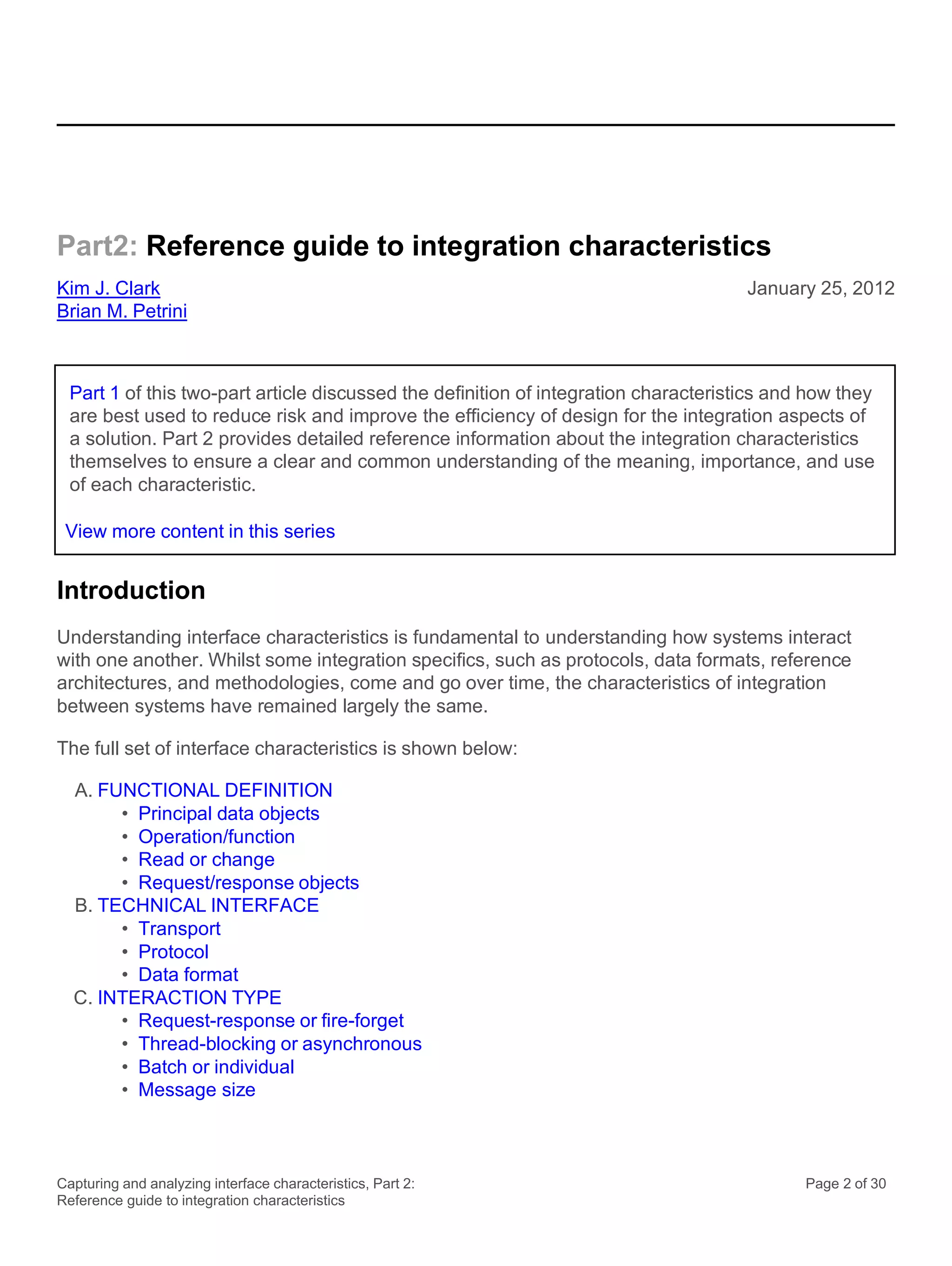
The full set of interface characteristics is shown below:
A. FUNCTIONAL DEFINITION
• Principal data objects
• Operation/function
• Read or change
• Request/response objects
B. TECHNICAL INTERFACE
• Transport
• Protocol
• Data format
C. INTERACTION TYPE
• Request-response or fire-forget
• Thread-blocking or asynchronous
• Batch or individual
• Message size
Part 1 of this two-part article discussed the definition of integration characteristics and how they
are best used to reduce risk and improve the efficiency of design for the integration aspects of
a solution. Part 2 provides detailed reference information about the integration characteristics
themselves to ensure a clear and common understanding of the meaning, importance, and use
of each characteristic.
View more content in this series
Capturing and analyzing interface characteristics, Part 2:
Reference guide to integration characteristics
Page 3 of 30
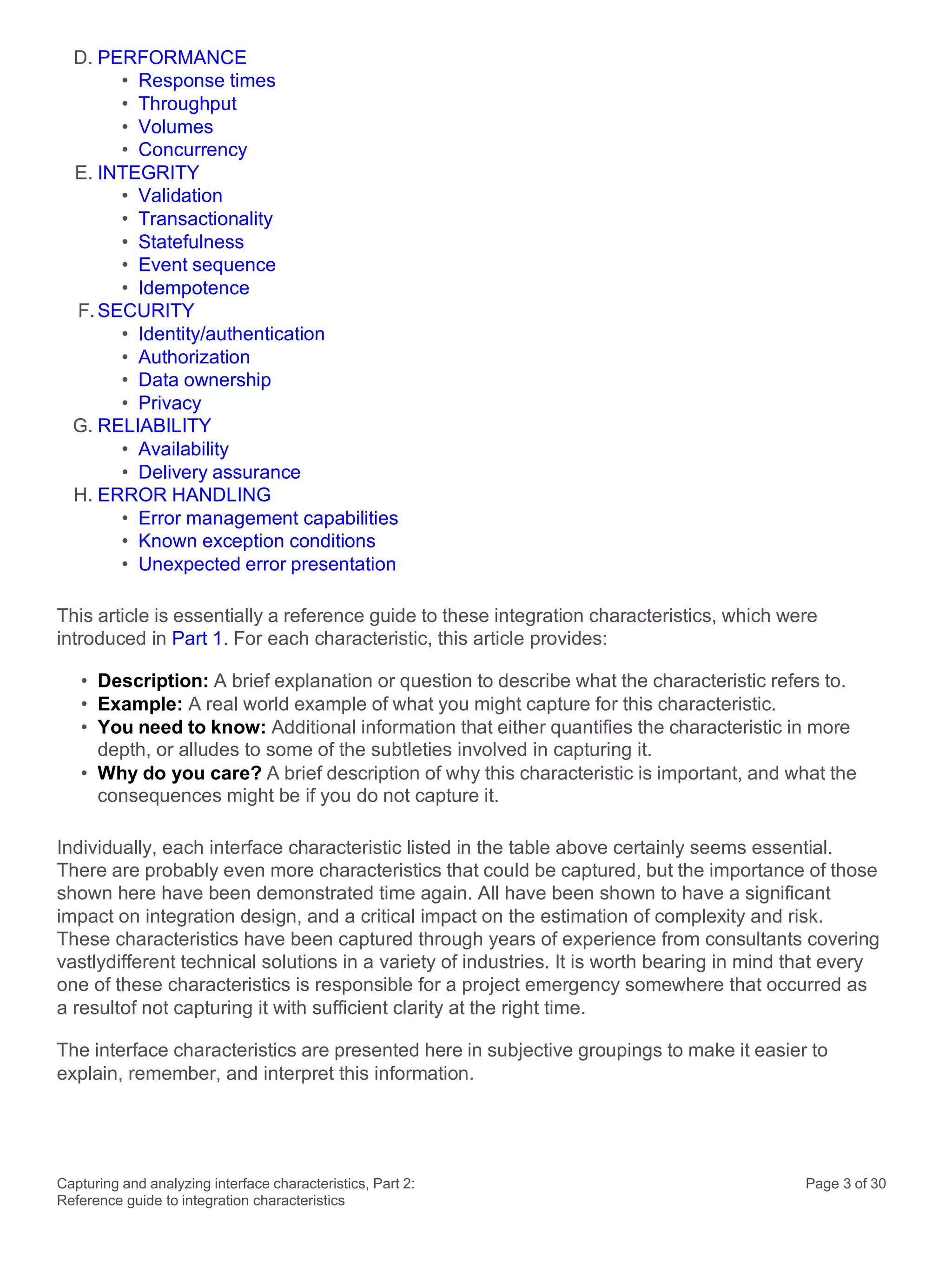
D. PERFORMANCE
• Response times
• Throughput
• Volumes
• Concurrency
E. INTEGRITY
• Validation
• Transactionality
• Statefulness
• Event sequence
• Idempotence
F.SECURITY
• Identity/authentication
• Authorization
• Data ownership
• Privacy
G. RELIABILITY
• Availability
• Delivery assurance
H. ERROR HANDLING
• Error management capabilities
• Known exception conditions
• Unexpected error presentation
This article is essentially a reference guide to these integration characteristics, which were
introduced in Part 1. For each characteristic, this article provides:
• Description: A brief explanation or question to describe what the characteristic refers to.
• Example: A real world example of what you might capture for this characteristic.
• You need to know: Additional information that either quantifies the characteristic in more
depth, or alludes to some of the subtleties involved in capturing it.
• Why do you care? A brief description of why this characteristic is important, and what the
consequences might be if you do not capture it.
Individually, each interface characteristic listed in the table above certainly seems essential.
There are probably even more characteristics that could be captured, but the importance of those
shown here have been demonstrated time again. All have been shown to have a significant
impact on integration design, and a critical impact on the estimation of complexity and risk.
These characteristics have been captured through years of experience from consultants covering
vastlydifferent technical solutions in a variety of industries. It is worth bearing in mind that every
one of these characteristics is responsible for a project emergency somewhere that occurred as
a resultof not capturing it with sufficient clarity at the right time.
The interface characteristics are presented here in subjective groupings to make it easier to
explain, remember, and interpret this information.
Capturing and analyzing interface characteristics, Part 2:
Reference guide to integration characteristics
Page 4 of 30
A. Functional definition
Principal data objects
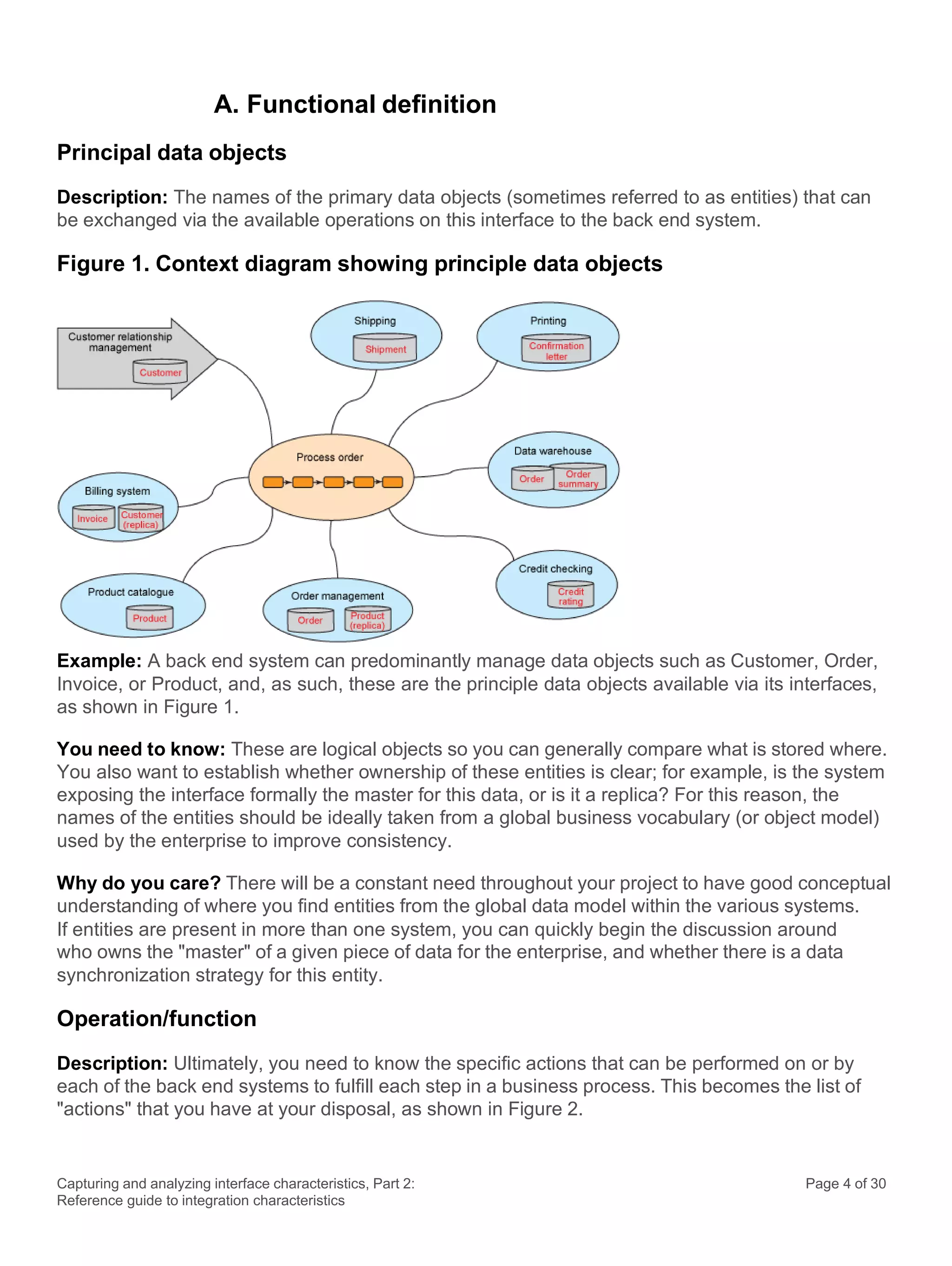
Description: The names of the primary data objects (sometimes referred to as entities) that can
be exchanged via the available operations on this interface to the back end system.
Figure 1. Context diagram showing principle data objects
Example: A back end system can predominantly manage data objects such as Customer, Order,
Invoice, or Product, and, as such, these are the principle data objects available via its interfaces,
as shown in Figure 1.
You need to know: These are logical objects so you can generally compare what is stored where.
You also want to establish whether ownership of these entities is clear; for example, is the system
exposing the interface formally the master for this data, or is it a replica? For this reason, the
names of the entities should be ideally taken from a global business vocabulary (or object model)
used by the enterprise to improve consistency.
Why do you care? There will be a constant need throughout your project to have good conceptual
understanding of where you find entities from the global data model within the various systems.
If entities are present in more than one system, you can quickly begin the discussion around
who owns the "master" of a given piece of data for the enterprise, and whether there is a data
synchronization strategy for this entity.
Operation/function
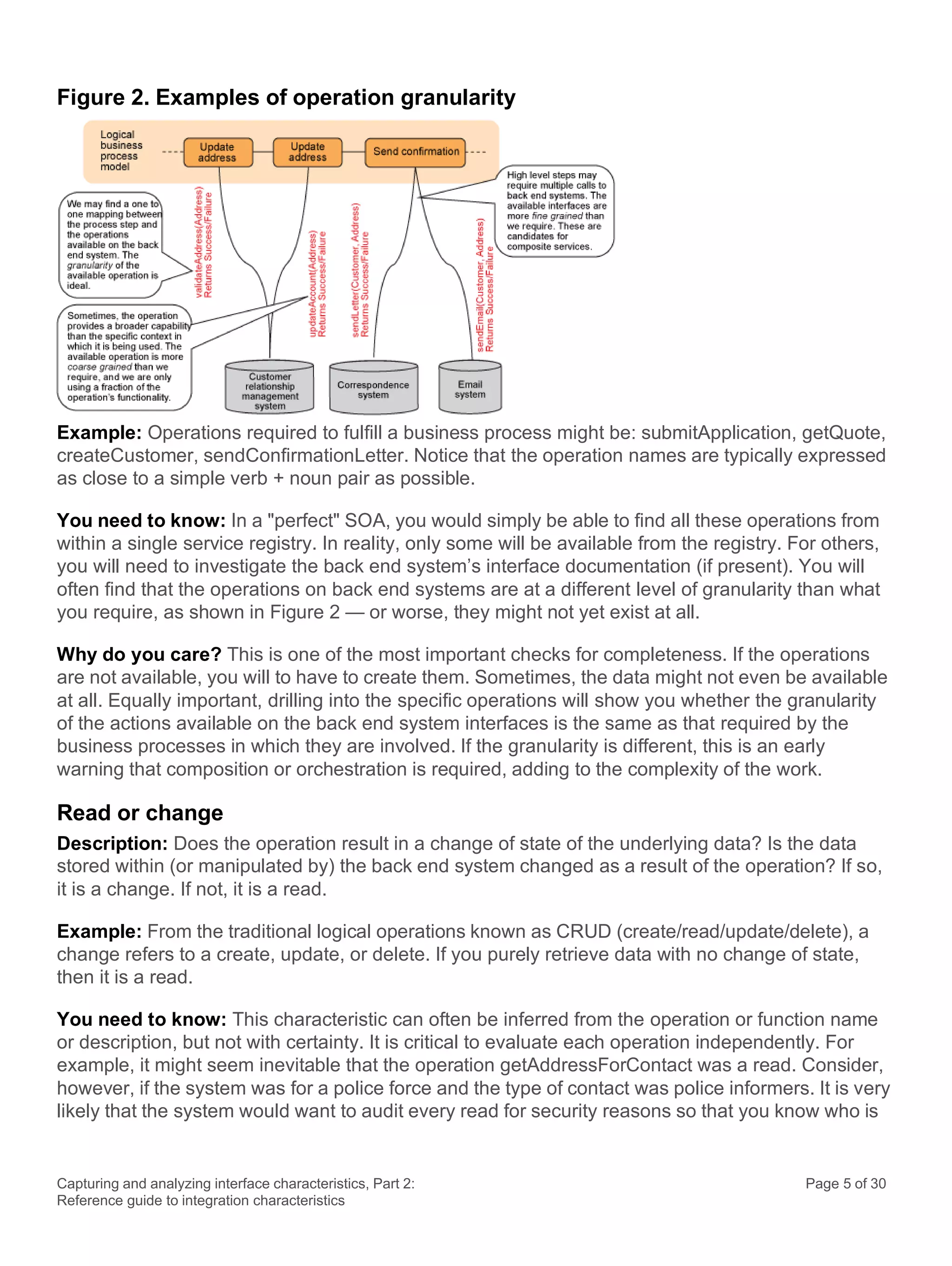
Description: Ultimately, you need to know the specific actions that can be performed on or by
each of the back end systems to fulfill each step in a business process. This becomes the list of
"actions" that you have at your disposal, as shown in Figure 2.
Capturing and analyzing interface characteristics, Part 2:
Reference guide to integration characteristics
Page 5 of 30
Figure 2. Examples of operation granularity
Example: Operations required to fulfill a business process might be: submitApplication, getQuote,
createCustomer, sendConfirmationLetter. Notice that the operation names are typically expressed
as close to a simple verb + noun pair as possible.
You need to know: In a "perfect" SOA, you would simply be able to find all these operations from
within a single service registry. In reality, only some will be available from the registry. For others,
you will need to investigate the back end system’s interface documentation (if present). You will
often find that the operations on back end systems are at a different level of granularity than what
you require, as shown in Figure 2 — or worse, they might not yet exist at all.
Why do you care? This is one of the most important checks for completeness. If the operations
are not available, you will to have to create them. Sometimes, the data might not even be available
at all. Equally important, drilling into the specific operations will show you whether the granularity
of the actions available on the back end system interfaces is the same as that required by the
business processes in which they are involved. If the granularity is different, this is an early
warning that composition or orchestration is required, adding to the complexity of the work.
Read or change
Description: Does the operation result in a change of state of the underlying data? Is the data
stored within (or manipulated by) the back end system changed as a result of the operation? If so,
it is a change. If not, it is a read.
Example: From the traditional logical operations known as CRUD (create/read/update/delete), a
change refers to a create, update, or delete. If you purely retrieve data with no change of state,
then it is a read.
You need to know: This characteristic can often be inferred from the operation or function name
or description, but not with certainty. It is critical to evaluate each operation independently. For
example, it might seem inevitable that the operation getAddressForContact was a read. Consider,
however, if the system was for a police force and the type of contact was police informers. It is very
likely that the system would want to audit every read for security reasons so that you know who is
Capturing and analyzing interface characteristics, Part 2:
Reference guide to integration characteristics
Page 6 of 30
asking for addresses of the informers. The recording of that audit trail means that the operation in
this context is, in fact, a change.
Why do you care? This characteristic has important knock-on effects on other characteristics,
and it has a huge effect on the integration patterns used. Read operations can appear simpler to
design, because, for example, they do not usually require transactions (though there are special
cases, as noted in the Transactionality characteristic); they are implicitly stateless, less likely to
require auditing, and often available to a lower security level. However, they can be equally or
more complex; for example, if the operations are always request-response requiring correlation
in some way. They can have shorter response time requirements (as they are often used by
graphical user interfaces), have typically higher throughput rate, and are more regularly used,
forcing the need for performance enhancements such as caching.
Request/response objects
Description: When you use this operation, what data do you need to send, and what will you get
in return?
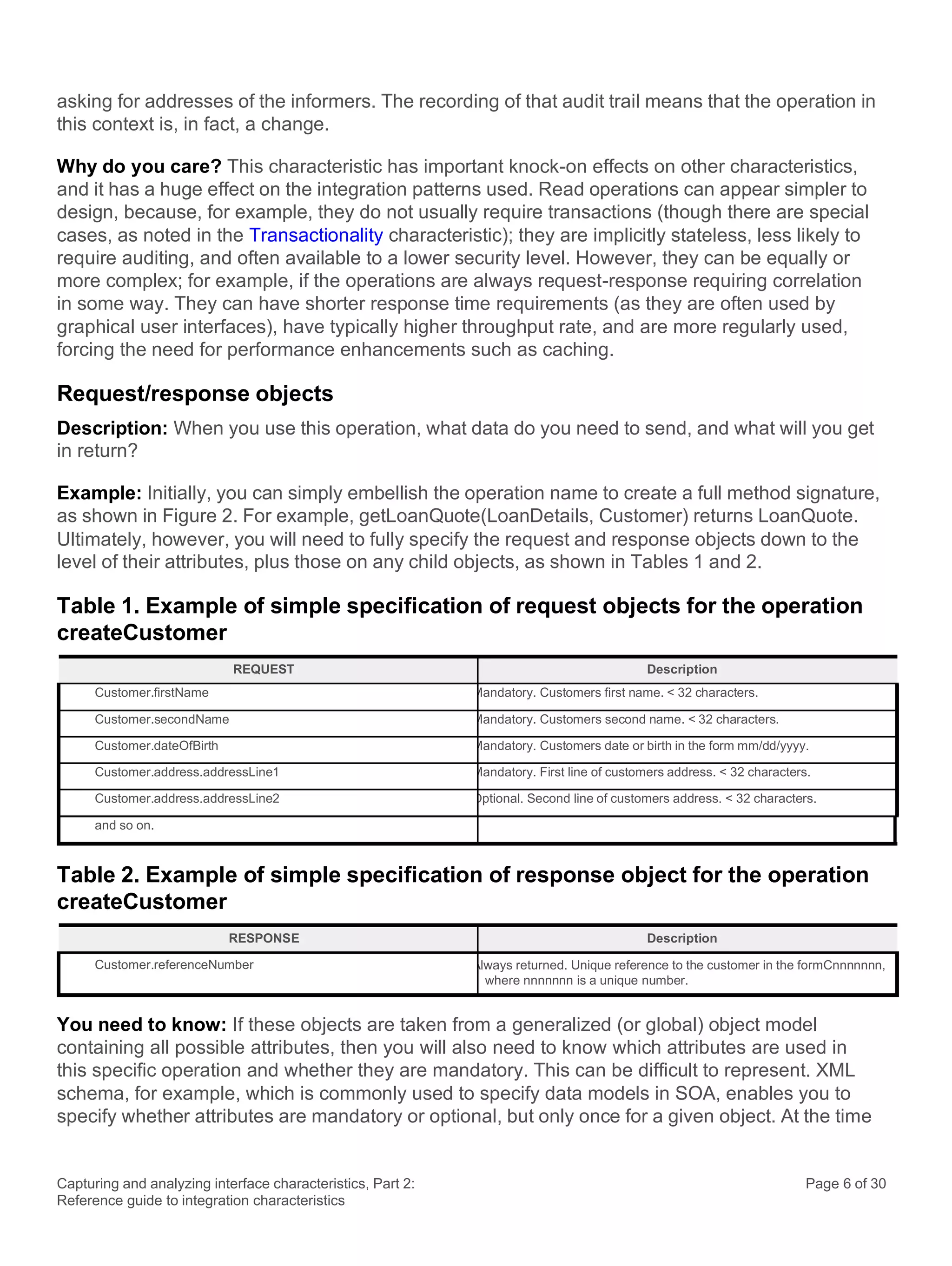
Example: Initially, you can simply embellish the operation name to create a full method signature,
as shown in Figure 2. For example, getLoanQuote(LoanDetails, Customer) returns LoanQuote.
Ultimately, however, you will need to fully specify the request and response objects down to the
level of their attributes, plus those on any child objects, as shown in Tables 1 and 2.
Table 1. Example of simple specification of request objects for the operation
createCustomer
REQUEST Description
Customer.firstName Mandatory. Customers first name. < 32 characters.
Customer.secondName Mandatory. Customers second name. < 32 characters.
Customer.dateOfBirth Mandatory. Customers date or birth in the form mm/dd/yyyy.
Customer.address.addressLine1 Mandatory. First line of customers address. < 32 characters.
Customer.address.addressLine2 Optional. Second line of customers address. < 32 characters.
and so on.
Table 2. Example of simple specification of response object for the operation
createCustomer
RESPONSE Description
Customer.referenceNumber Always returned. Unique reference to the customer in the formCnnnnnnn,
where nnnnnnn is a unique number.
You need to know: If these objects are taken from a generalized (or global) object model
containing all possible attributes, then you will also need to know which attributes are used in
this specific operation and whether they are mandatory. This can be difficult to represent. XML
schema, for example, which is commonly used to specify data models in SOA, enables you to
specify whether attributes are mandatory or optional, but only once for a given object. At the time
Capturing and analyzing interface characteristics, Part 2:
Reference guide to integration characteristics
Page 7 of 30
of this writing, XML schema does not provide a way of specifying restrictions to the use of an
object for a specific context.
Multiple cardinality objects (arrays/lists) need special attention. For example, what does a list
mean in a data changing operation? Consider where the provided list overlaps incompletely with
the existing list. Do you then need to translate that into a list merge involving a combination of
creates, updates, and deletes?
Finally, you need to consider which unique references and enumerated values are used in the
objects, as these might not be generally known or available outside the provider.
Why do you care? If you do not go to this level of depth, you cannot be sure that all the
necessary data is available at each step in the process. Without detailed knowledge of the
interface request/response objects, you will be unable to design the mapping required from the
requester’s data model to the interface data model. The importance of this is often understated,
and many projects stall at the detailed design because those who truly understand the data are no
longer available to the project.
Also, knowing what is sent to and received from a back end system when invoking a particular
operation is critical for validation of the business process flow. How else can you be sure that
you have all the data you need at each stage to perform the next action in line? Initially, you can
consider this at entity level, but very quickly it becomes important to look down to the individual
attribute level. For example, if a key piece of data (which could be a single attribute on a complex
object such as "partner’s product code" on an "order line" object within an "order") is not present,
then you might not be able to make the next invocation to "processOrderFromPartner." Without
that single piece of data, the process flow is completely invalid and might require an extra system
call — or worse, human intervention — before the process can actually work.
B. Technical interface
Transport
Description: The transport that requesters use to connect to the system for this interface. A
transport is the medium used by the interface to transfer data from requestor to provider and
back. You could ask the question, "What carries the data between requestor and provider?"
Example: HTTP, IIOP, IBM MQ, TCP/IP.
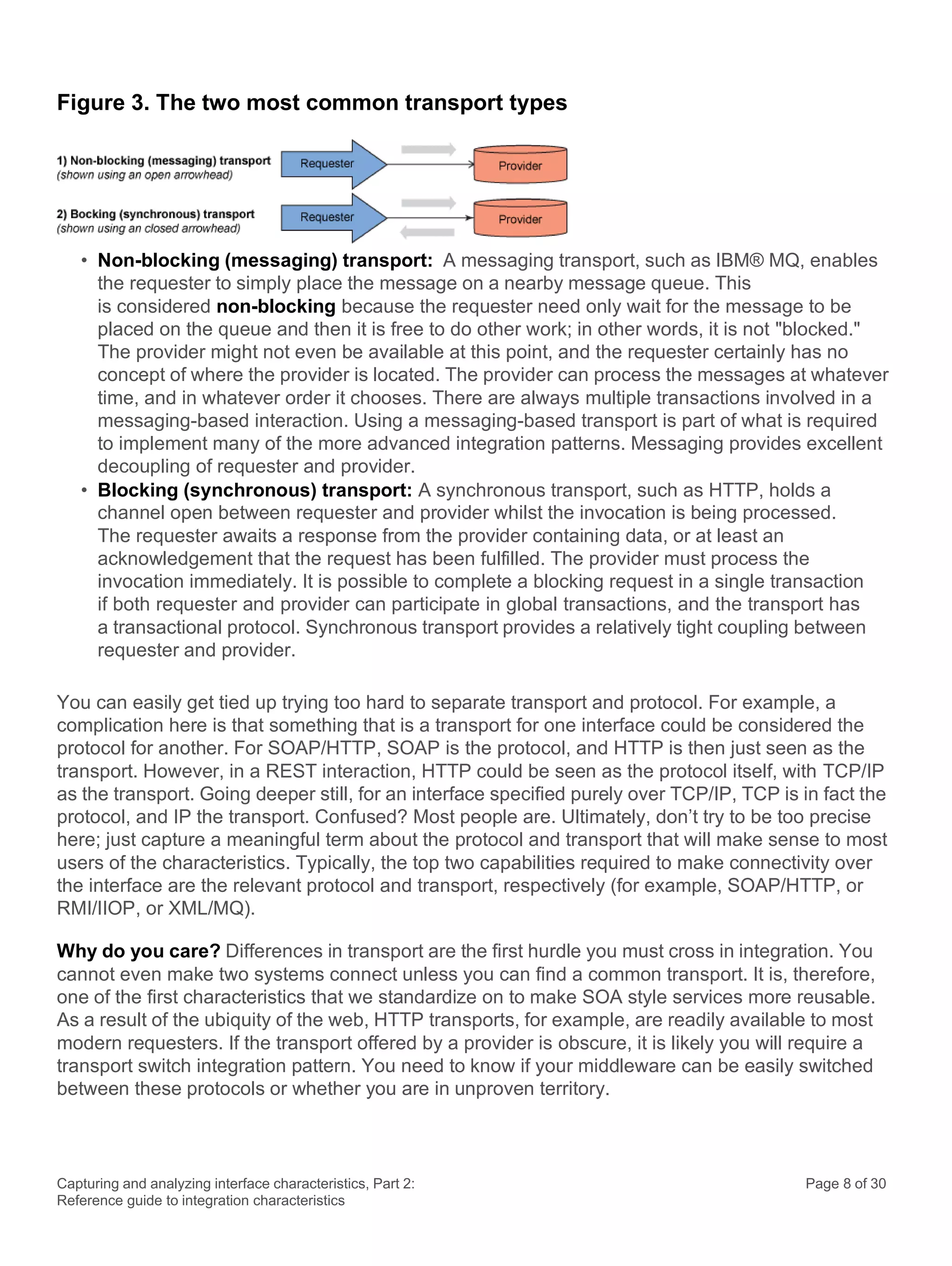
You need to know: There are two primary transport types, as shown below and in Figure 3. It will
be important to understand these differences for the discussion later about whether the overall
interaction type is thread blocking or synchronous.
Capturing and analyzing interface characteristics, Part 2:
Reference guide to integration characteristics
Page 8 of 30
Figure 3. The two most common transport types
• Non-blocking (messaging) transport: A messaging transport, such as IBM® MQ, enables
the requester to simply place the message on a nearby message queue. This
is considered non-blocking because the requester need only wait for the message to be
placed on the queue and then it is free to do other work; in other words, it is not "blocked."
The provider might not even be available at this point, and the requester certainly has no
concept of where the provider is located. The provider can process the messages at whatever
time, and in whatever order it chooses. There are always multiple transactions involved in a
messaging-based interaction. Using a messaging-based transport is part of what is required
to implement many of the more advanced integration patterns. Messaging provides excellent
decoupling of requester and provider.
• Blocking (synchronous) transport: A synchronous transport, such as HTTP, holds a
channel open between requester and provider whilst the invocation is being processed.
The requester awaits a response from the provider containing data, or at least an
acknowledgement that the request has been fulfilled. The provider must process the
invocation immediately. It is possible to complete a blocking request in a single transaction
if both requester and provider can participate in global transactions, and the transport has
a transactional protocol. Synchronous transport provides a relatively tight coupling between
requester and provider.
You can easily get tied up trying too hard to separate transport and protocol. For example, a
complication here is that something that is a transport for one interface could be considered the
protocol for another. For SOAP/HTTP, SOAP is the protocol, and HTTP is then just seen as the
transport. However, in a REST interaction, HTTP could be seen as the protocol itself, with TCP/IP
as the transport. Going deeper still, for an interface specified purely over TCP/IP, TCP is in fact the
protocol, and IP the transport. Confused? Most people are. Ultimately, don’t try to be too precise
here; just capture a meaningful term about the protocol and transport that will make sense to most
users of the characteristics. Typically, the top two capabilities required to make connectivity over
the interface are the relevant protocol and transport, respectively (for example, SOAP/HTTP, or
RMI/IIOP, or XML/MQ).
Why do you care? Differences in transport are the first hurdle you must cross in integration. You
cannot even make two systems connect unless you can find a common transport. It is, therefore,
one of the first characteristics that we standardize on to make SOA style services more reusable.
As a result of the ubiquity of the web, HTTP transports, for example, are readily available to most
modern requesters. If the transport offered by a provider is obscure, it is likely you will require a
transport switch integration pattern. You need to know if your middleware can be easily switched
between these protocols or whether you are in unproven territory.
Capturing and analyzing interface characteristics, Part 2:
Reference guide to integration characteristics
Page 9 of 30
Protocol
Description: A protocol is essentially an agreement between requestor and provider about
how and when they will send each other data over the transport, and how the data should be
interpreted at the other end. What (if any) protocol is used on top of the transport to control the
message conversation?
Example: Some interactions might have no protocol at all. A simple one way interaction using
XML over a IBM MQ transport has no formal protocol. However, it is also very limited. Web
services, however, require a more formalized interaction style to make them more extensibleand
re-usable. The protocol commonly used for web service is SOAP. SOAP provides a structureto
request and response messages so that they can be seen as part of the same interaction,
and that they can carry additional data, such as attachments. The protocol also defines standard
headers that can be used to instruct how the message should be interpreted, and these headers
are extensible such that further protocols can be built on top; for example, WS-Transactionality,
WS-Security, and so on. In short, protocols make it possible to carry out more sophisticated
interactions over a transport layer.
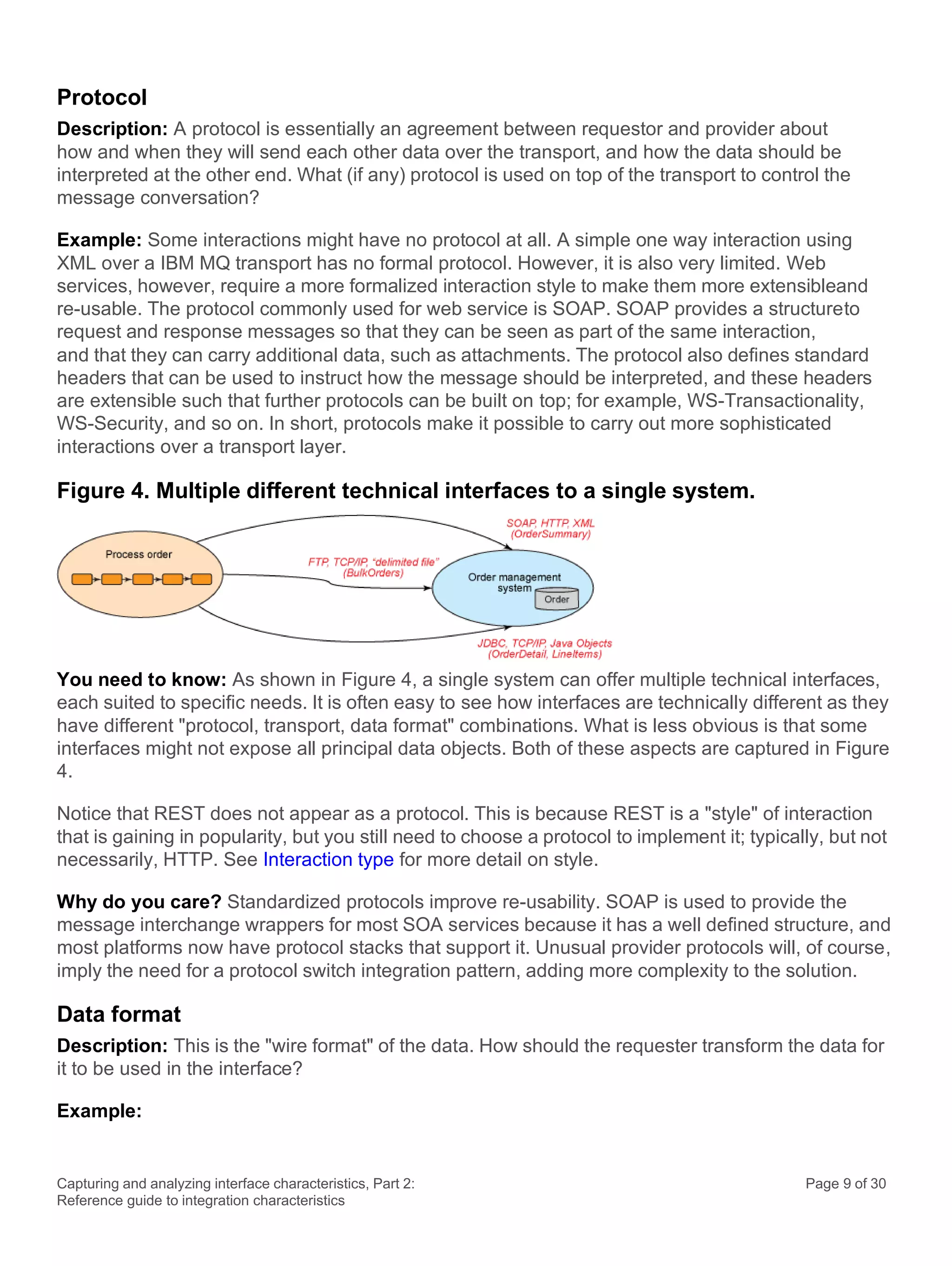
Figure 4. Multiple different technical interfaces to a single system.
You need to know: As shown in Figure 4, a single system can offer multiple technical interfaces,
each suited to specific needs. It is often easy to see how interfaces are technically different as they
have different "protocol, transport, data format" combinations. What is less obvious is that some
interfaces might not expose all principal data objects. Both of these aspects are captured in Figure
4.
Notice that REST does not appear as a protocol. This is because REST is a "style" of interaction
that is gaining in popularity, but you still need to choose a protocol to implement it; typically, but not
necessarily, HTTP. See Interaction type for more detail on style.
Why do you care? Standardized protocols improve re-usability. SOAP is used to provide the
message interchange wrappers for most SOA services because it has a well defined structure, and
most platforms now have protocol stacks that support it. Unusual provider protocols will, of course,
imply the need for a protocol switch integration pattern, adding more complexity to the solution.
Data format
Description: This is the "wire format" of the data. How should the requester transform the data for
it to be used in the interface?
Example:
Capturing and analyzing interface characteristics, Part 2:
Reference guide to integration characteristics
Page 10 of 30
• Is the data carried as text or binary?
• If text, what codepage does it use (for example, UTF-8, Unicode, EBCDIC, ASCII, 7-, 8- or
16-bit, multi-byte characters, and so on)?
• How is the data represented? For example, if text, is it XML, JSON, delimited, CSV?
• If binary, how is its structure defined (for example, COBOL copybook, structures, and so on)?
• What about individual data fields? How is currency formatted (for example, "$123456.00")?
This could vary by country (for example, "£123,456.89", "€123.456,89"). Notice the different
use of commas and dots.
• What about date formats? These vary enormously; for example,
"2010-10-17T09:34:22+01:00", "2011.06.08.14.33.56", "Tuesday, 30 August 2011."
You need to know: It is all too easy to make assumptions about the simplicity of a format based
on over-simplified sample data. A simple example would be comma separate values (CSV). From
a simple example line such as this one showing country codes:
"UK, "GB", "+44"
you might think it is the same as a "delimited" string, but with a comma for the delimiter and quotes
around each piece of data. But the reality is much more complex. Take a look at this example
representing data in a particular sequence:
"Size 2 Screwdriver", PAID, PART12345678, 24, $5.59, "Mr Smith, West Street, Big City"
Notice the subtleties about the format. For example, if you just used a delimited data handler
looking for commas, you would incorrectly break up the address at the end into three separate
fields. Also, not all data fields use quotes; here, quotes are only used if there is a space or comma
in the text field, and they are never used for numbers. Clearly, parsing CSV data is significantly
more complex than delimited data, and this is a very simple example in comparison to the range of
formats you could come across in integration solutions.
Why do you care? Text formats XML and JSON are the most readily used formats for re-usable
service interfaces. Less common formats will be hard for requestors to parse or create, resulting
in the need for data handler integration patterns. The full variation of formats that will need to be
handled must be fully understood. Again, you can see the benefit for an SOA to standardize things
such as data formats across an enterprise to make services more re-usable.
C. Interaction type
What does the complete interaction between requester and provider look like? A number of
characteristics are used to understand how the interaction is performed over the transport. Figure
5 shows the basic interaction types.
Capturing and analyzing interface characteristics, Part 2:
Reference guide to integration characteristics
Page 11 of 30
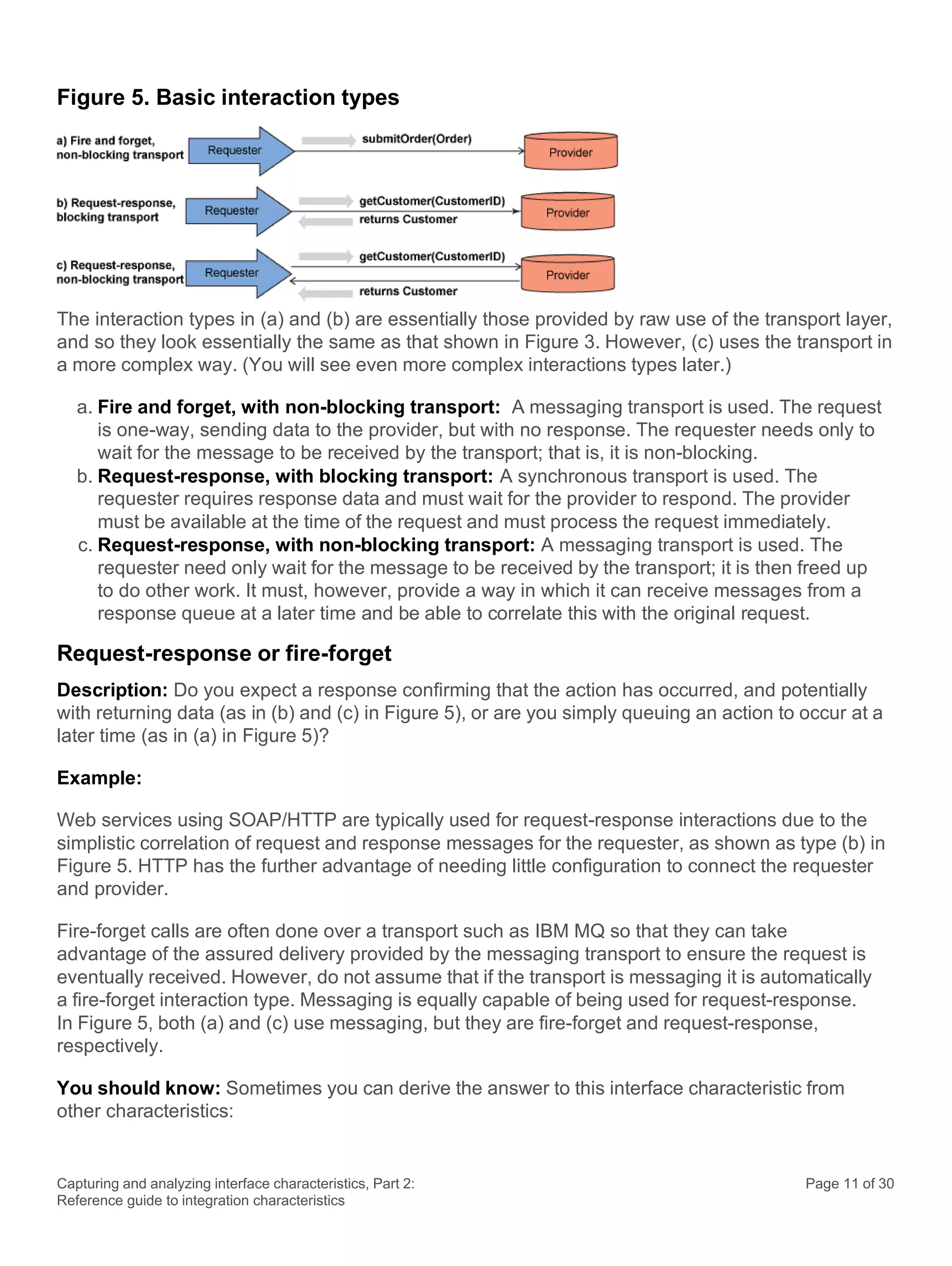
Figure 5. Basic interaction types
The interaction types in (a) and (b) are essentially those provided by raw use of the transport layer,
and so they look essentially the same as that shown in Figure 3. However, (c) uses the transport in
a more complex way. (You will see even more complex interactions types later.)
a. Fire and forget, with non-blocking transport: A messaging transport is used. The request
is one-way, sending data to the provider, but with no response. The requester needs only to
wait for the message to be received by the transport; that is, it is non-blocking.
b. Request-response, with blocking transport: A synchronous transport is used. The
requester requires response data and must wait for the provider to respond. The provider
must be available at the time of the request and must process the request immediately.
c. Request-response, with non-blocking transport: A messaging transport is used. The
requester need only wait for the message to be received by the transport; it is then freed up
to do other work. It must, however, provide a way in which it can receive messages from a
response queue at a later time and be able to correlate this with the original request.
Request-response or fire-forget
Description: Do you expect a response confirming that the action has occurred, and potentially
with returning data (as in (b) and (c) in Figure 5), or are you simply queuing an action to occur at a
later time (as in (a) in Figure 5)?
Example:
Web services using SOAP/HTTP are typically used for request-response interactions due to the
simplistic correlation of request and response messages for the requester, as shown as type (b) in
Figure 5. HTTP has the further advantage of needing little configuration to connect the requester
and provider.
Fire-forget calls are often done over a transport such as IBM MQ so that they can take
advantage of the assured delivery provided by the messaging transport to ensure the request is
eventually received. However, do not assume that if the transport is messaging it is automatically
a fire-forget interaction type. Messaging is equally capable of being used for request-response.
In Figure 5, both (a) and (c) use messaging, but they are fire-forget and request-response,
respectively.
You should know: Sometimes you can derive the answer to this interface characteristic from
other characteristics:
Capturing and analyzing interface characteristics, Part 2:
Reference guide to integration characteristics
Page 12 of 30
• "Read" type requests are by definition request-response, as the purpose of the call is to
"read" the response data.
• "Change" type calls could be either style, depending whether they simply lodge a request and
respond with an acknowledgement that the request has been received (fire-forget), or perform
the full processing of the change before responding (request-response).
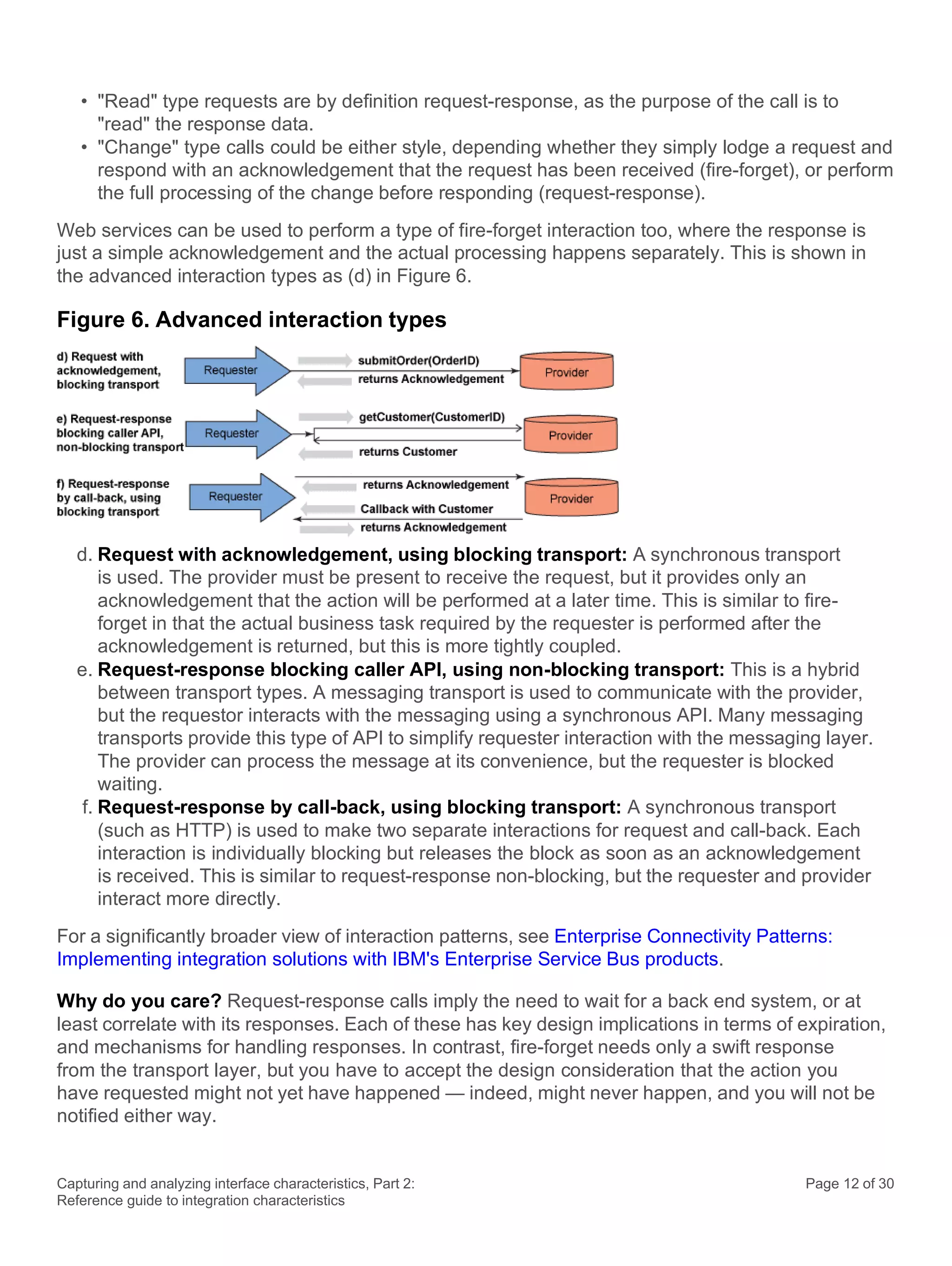
Web services can be used to perform a type of fire-forget interaction too, where the response is
just a simple acknowledgement and the actual processing happens separately. This is shown in
the advanced interaction types as (d) in Figure 6.
Figure 6. Advanced interaction types
d. Request with acknowledgement, using blocking transport: A synchronous transport
is used. The provider must be present to receive the request, but it provides only an
acknowledgement that the action will be performed at a later time. This is similar to fire-
forget in that the actual business task required by the requester is performed after the
acknowledgement is returned, but this is more tightly coupled.
e. Request-response blocking caller API, using non-blocking transport: This is a hybrid
between transport types. A messaging transport is used to communicate with the provider,
but the requestor interacts with the messaging using a synchronous API. Many messaging
transports provide this type of API to simplify requester interaction with the messaging layer.
The provider can process the message at its convenience, but the requester is blocked
waiting.
f. Request-response by call-back, using blocking transport: A synchronous transport
(such as HTTP) is used to make two separate interactions for request and call-back. Each
interaction is individually blocking but releases the block as soon as an acknowledgement
is received. This is similar to request-response non-blocking, but the requester and provider
interact more directly.
For a significantly broader view of interaction patterns, see Enterprise Connectivity Patterns:
Implementing integration solutions with IBM's Enterprise Service Bus products.
Why do you care? Request-response calls imply the need to wait for a back end system, or at
least correlate with its responses. Each of these has key design implications in terms of expiration,
and mechanisms for handling responses. In contrast, fire-forget needs only a swift response
from the transport layer, but you have to accept the design consideration that the action you
have requested might not yet have happened — indeed, might never happen, and you will not be
notified either way.
Capturing and analyzing interface characteristics, Part 2:
Reference guide to integration characteristics
Page 13 of 30
Thread-blocking or asynchronous
Description: Are the requesters forced to wait whilst the operation is performed, or does the
programming interface enable them to initiate the action and pick up the response separately?
What you are interested in is whether the overall interaction is blocking, not just the underlying
transport, so this is not as simple as the concept shown in Figure 3.
Example: The blocking transport HTTP is the most commonly used transport for request-response
SOAP protocol requests; in this situation, it is thread blocking interaction type (b), shown in Figure
5. However, HTTP can be used in other more creative ways, such as interaction types (d) and (f) in
Figure 6, where the overall interaction type is non-blocking from the requester’s point of view. Even
though the transport itself is briefly blocking the requestor, it does not block the overall interaction.
Messaging-based request/response interactions always have the capacity to be non-locking.
However, whether they are locking or not depends on how the requester codes to the messaging
API, or indeed which APIs are made available to the requester. Interaction (d) in Figure 6 shows a
hybrid, where the requester is genuinely blocked throughout the interaction, despite the fact that a
messaging-based non-blocking transport is in use.
Why do you care? It can be argued that non-thread blocking interactions can scale more
effectively; by definition, they use less thread resources. However, they present complex
challenges in terms of correlating the request with response. Error handling can be more complex,
as it cannot be performed in a single end to end transaction.
Batch or individual
Description: Does the interface process individual business actions, or does it take a group of
actions at a time and process them together?
Example: Early integration between systems was done by extracting a batch file containing data
relating to multiple business actions from one system and processing it with batch processing code
in another. These batch operations would only occur periodically; for example, daily, at month end,
and so on. Many of these interfaces still exist, and indeed in some cases continue to be the most
efficient way to process large amounts of data.
Modern interfaces more often work at the level of individual actions, and enable data operations
between systems to be performed in real time. The bulk of this section so far has been
discussing interfaces built on SOAP/HTTP or IBM MQ, and assumed that they process
individual events, which is normally the case. However, there will be occasions where these
interfaces will actually carry batch loads. As a simple example, take a common example, called
submitOrder(Order), which processes a single order from a customer. Imagine if this were instead
designed to pass the batch of orders placed by a store so they could be communicated to the main
office; for example, submit(OrderList []). In fact, it would more likely be submit(OrderBatch), where
OrderBatch contained the OrderList batch, but also various data that applied to the whole batch of
orders. Message-based transport is equally often used for handling batches. Message transports
are arguably better at handling large batch data objects than transports like HTTP.
Capturing and analyzing interface characteristics, Part 2:
Reference guide to integration characteristics
Page 14 of 30
Why do you care? Batch processing completely changes the characteristics of the interfaces,
from error handling, to transactionality, to performance, and likewise the patterns required and the
tools required to perform the work. Specialist tools now exist for handling large volumes of data
in blocks, termed Extract Transform Load (ETL), of which IBM DataStage® is an example. These
are very different in character from tools that perform event-by-event processing. If mostly batch
work is required, ETL tools should be considered rather than ESB (Enterprise Service Bus) or
process-based tools that typically work on individual events. However, it might be appropriate to
use ESB capabilities to turn batch interactions into individual actions and vice versa.
Message size
Description: The size of a message that is comfortably accepted by the provider whereby it is still
able to meet its service level agreements. Is there an agreed maximum size limit, or at least a size
that is considered inappropriate, or are large messages perhaps even blocked or rejected?
Example: Some ways that interfaces manage large objects include:
• Reject all messages over 100K to ensure the service cannot be brought down by malicious
"large object" attacks.
• Accept a typical message size of 10kbytes, although test to 1Mb to ensure handling of known
but rare cases of larger messages. Greater than 1Mb is rejected.
• Provide a mechanism for adding attachments (like in e-mail, and SOAP) that ensures that
large objects can be recognized and handled separately.
• Permit large objects to be sent by "chunking" — breaking up the object into manageable
chunks that will be re-assembled on the other side, in order to keep the individual message
size down. This enables the object to be processed in parallel if there are sufficient resources
available.
• Provide a "streaming" capability whereby the object is sent progressively over an open
connection, so the entire object is never present as a single object. This is similar to chunking,
but the requester and provider are in relatively direct and continuous communication.
You need to know: When introducing a new requester’s requirements, you should consider the
adage Just because you can, doesn’t mean you should; just because an interface can accept
10Mb messages, it does not mean you should assume that to be the normal usage scenario.
Unless a system is specifically designed to manage large objects, 10Mb of message will have
to sit in a system’s memory somewhere, and worse, copies will probably be made of it during its
passage through the system. Consider the memory management being done by a JVM (Java™
Virtual Machine); if many 10Mb objects are passing through the system it will become increasingly
difficult for the memory manager to find continuous slots of space, so the objects will have to be
fragmented, slowing down the JVM in much the same way as a hard disk slows down if the files it
is storing are fragmented.
It is critical to accept that the new requester is becoming part of a community of existing
requesters. They must all play nicely with the interface if they are to continue to get good service. If
they have radically different requirements, they should bring these to the table openly, rather than
attempting to squeeze them through the existing interface.
Capturing and analyzing interface characteristics, Part 2:
Reference guide to integration characteristics
Page 15 of 30
Why do you care? A new requester might use an interface in a way that appears to be identical
to what has been used before, but sending dramatically larger messages. A common example is
to suddenly include images in what before were small documents. This would have a significant
effect on memory and CPU in the provider and any integration components. One common
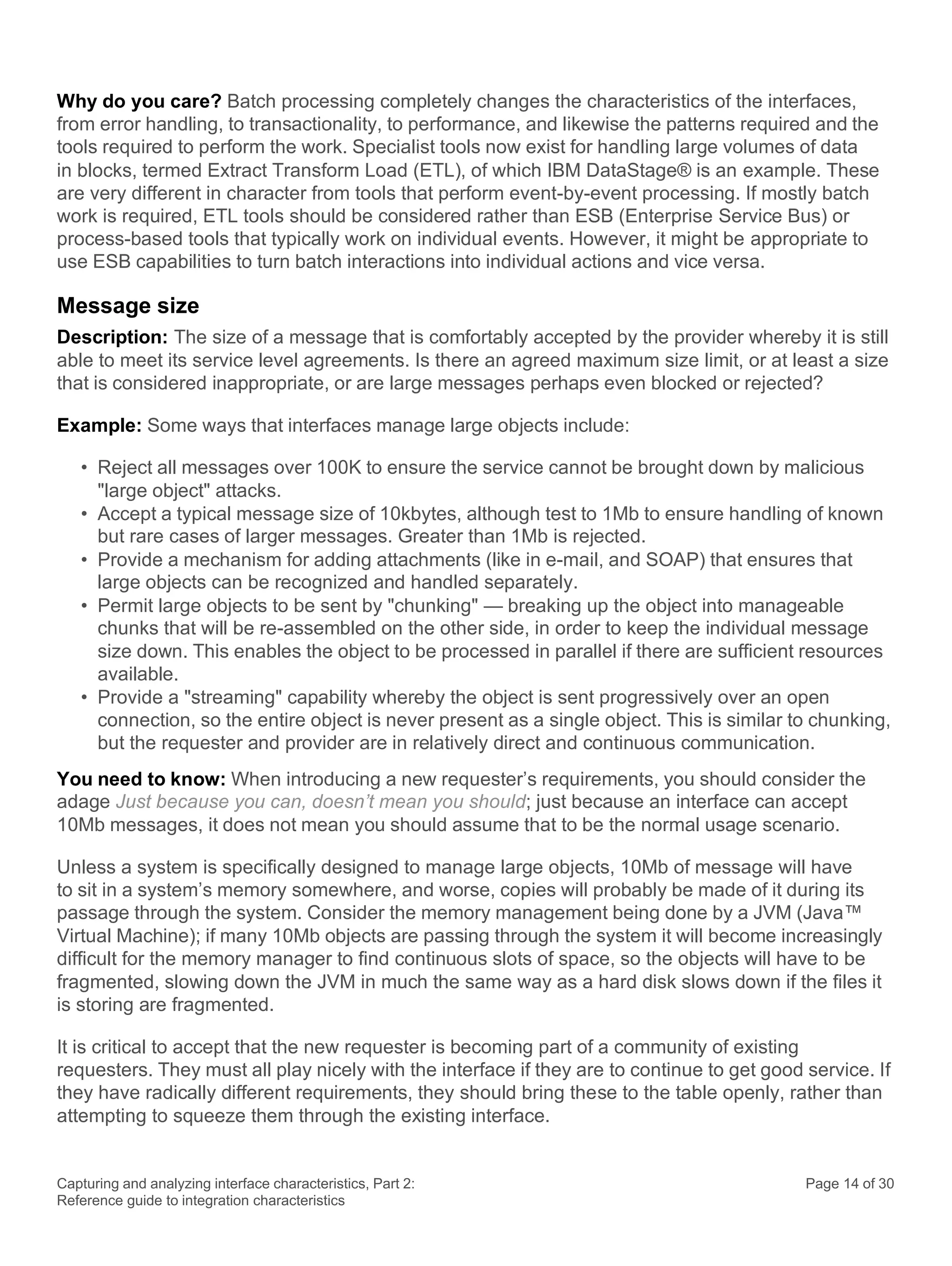
alternative to passing large messages end to end is to use the claim check integration pattern,
shown in Figure 7, where the large object is persisted and only a reference to the object is passed
on the interface.
Figure 7. "Claim Check" pattern
D. Performance
There are two primary uses of performance-related interface characteristics:
• Governance: How do you know if the interface is performing to its service level agreement
(SLA)? How do you know if a requester is "over-using" an interface? You need to be able to
monitor usage, you need thresholds against which to assess the monitoring information, and
you need to know who to alert, should the thresholds be over-stepped.
• Capacity planning: As it stands, does the interface have the ability to scale as new
requesters are introduced? You need to be able to predict the future usage of the interface,
and provide sufficient warning when capacity needs to be increased.
The performance-related characteristics provide you with essential non-functional measures, the
restrictions of which would not otherwise be immediately obvious during the early analysis phase.
Response times
Description: The duration between a request made and the receipt of a response time via this
interface.
Example: This is typically expressed as an average response time in units such as requests per
second, as shown in the left side of Figure 8.
Capturing and analyzing interface characteristics, Part 2:
Reference guide to integration characteristics
Page 16 of 30
Figure 8. Sequence diagram showing response time and throughput
You need to know: Ideally, response time figures would be provided with some idea of the range
and a concurrency. These are not easy to show on a sequence diagram, but let’s describe them
briefly nonetheless.
The range (or spread) of response times is at least as important as the value for the average. It
is particularly important to consider the spread or profile of response times, not just the average.
For example, if the average is 5 seconds, and most requests are within 2-7 seconds, that is very
different than if the average is 5 because occasionally the response takes up to 50 seconds, but
the rest of the time it is less than 1 second.
Concurrency itself is a separate characteristic discussed later, but note that sequence diagrams do
not represent concurrency and parallel processing very well. The example in Figure 7 implies only
one request can happen at a time. However, most interfaces permit concurrent requests, and this
would have to be taken into account when measuring the response time and throughput figures.
For example, you might say an interface provides these response time characteristics:
Average response time = 3 seconds, 95% of the time, for 10 concurrent requests.
Why do you care? Requesters might have expectations in terms of GUI (graphical user interface)
responsiveness, or limitations on threads, or transaction timeouts, that would be adversely affected
if response times were slow.
Throughput
Description: The number of requests that can be processed over a relevant period of time.
Example: The right side of Figure 8 shows an example where the throughput looks to be roughly
30 requests per minute. As was noted under response time, this assumes that the provider does
not offer parallelism, as this would be hard to show on a sequence diagram. (See the section on
concurrency for more.) Other time units are equally common, such as 10,000 records per hour, 10
requests per second, and so on.
You need to know: Whilst throughput is typically measured in number of requests over a time
period, this can be misleading, as what you really want to know is the sustained (or continuous)
Capturing and analyzing interface characteristics, Part 2:
Reference guide to integration characteristics
Page 17 of 30
throughput capacity. You might, for example, be able to make 50 requests to an interface within
2 seconds. Is the throughput therefore 25 requests per second? That might be an unsustainable
workload, and the provider may have had to queue up the requests internally. It might be 5
seconds before they are all complete. Rather than thinking of it as the request rate, you might get
a more realistic figure if you think of it more as the response rate. In this case, 50 responses in 5
seconds is more realistic than 10 per second.
The period of time should be relevant to the usage and type of the interface. An interface used
by a human user in real time might need a requests per second measurement, whereas a file-
based interaction might be measured in the number of records within a file that could be read and
processed within an hour.
Remember that 6000 request per hour does not necessarily mean 100 per minute. You need
to know when the peak periods are (for example, opening hour, lunch time, and so on). Is your
system permitted to "catch up" later, or do you always need to be on top of the load?
Why do you care? Just because you are able to call a fire-forget interface at 100 requests per
second does not mean the provider can actually process them at this rate. They could simply
be building up in a queue. On request-response interfaces, if you exceed the throughput for a
sustained period, the provider might run out of resources, at best resulting in failure responses,
and at worst bringing down the provider completely; the latter is what happens in a "denial of
service" attack. If you want predictable behaviour from your interfaces, you need to correctly
understand their capacity.
Volumes
Description: The aggregate volumes across longer periods of time. Volumes are a measure
of maximum capacity over a long enough interval to include aberrations due to maintenance,
outages, and periodic variations in capacity where resources are shared.
Example: Volumes would be measured at least across days (for example, 10000 records per
day), perhaps even over months or a year (for example, 1 million records per month). You need to
look at the profile of the load, sometimes called shaping, whereby, for example, you might be able
to handle 1000 requests per minute during the day, but only 50 per minute at night due to the CPU
taken up by batch processing.
You need to know: This measure is more often captured when looking at the requesters’
requirements in order to establish whether the provider can meet the overall demand. A maximum
capacity of the provider is derivable by combining the availability with the throughput.
Why do you care? Volumes are essential in capacity planning and provide an immediate
understanding of whether new requesters’ requirements are achievable with the existing
infrastructure. Resolution could be as simple as adding CPU to providers or bandwidth to a
network. However, it could mean a much more fundamental refactoring of the architecture, which
you would need to be aware of as early as possible.
Capturing and analyzing interface characteristics, Part 2:
Reference guide to integration characteristics
Page 18 of 30
Concurrency
Description: The number of requests that can be processed at the same time.
Example: Figure 9 shows how a provider might be processing multiple transactions at once in
parallel. In this case, you have a concurrency of 3.
Figure 9. Concurrent/parallel transactions over time
This might be a hard limit constrained by the number of connections you can initiate over the
interface, as would be the case with JDBC, or it could be a soft limit whereby the provider
continues to accept new requests, but performance significantly degrades when you go beyond
the number of concurrent threads available for processing in the provider.
Here are two very different interfaces and how concurrency would be defined for each:
• A JDBC interface allows no more than 10 concurrent requests to be made to the provider over
the interface. Additional requests will be rejected.
• A IBM MQ-based interface permits a total of 1000 requests based on the maximum queue
depth, but the provider only has threads to process 20 at a time. Here, you have a
maximum of concurrent requests of 1000, but the level of sustainable concurrent requests is
only 20.
You should know: In the second case, you see there is a stark difference between maximum
concurrency and sustainable concurrency. You would be most interested in sustainable
concurrency for throughput-based use of the interface, whereas you would be interested in the
profile of the response time for response time based scenarios, even beyond the sustainable
concurrency, on the basis that you might have brief peaks in load and would want to know if the
response time remains acceptable.
Why do you care? If your requester requires higher concurrency than the provider currently
offers, you might need to introduce a store and forward pattern to queue incoming requests and
give the impression to a caller that a higher concurrency is available, as in the second example
above. This can simplify error handling for the caller, although it might result in apparently slower
response times when significant numbers of requests are queued, and actually increase error
handling complexity if responses are unreasonably delayed. Conversely, if a guaranteed low
response time is more important than the occasional error, then a concurrency limiter might need
to be implemented to ensure a limited resource is never overloaded.
You might also need to look at load balancing in order to spread requests across available
resources in order to achieve the desired concurrency. If you are doing composition, you might
Capturing and analyzing interface characteristics, Part 2:
Reference guide to integration characteristics
Page 19 of 30
need to use some concurrency to do parallel patterns such as scatter/gather to aggregate multiple
requests in a reasonable period of time. Can the available concurrency cope with this extra load?
E. Integrity
Validation
Description: What data validation rules must a requester adhere to for a request to be accepted?
Example: Mandatory fields, data format of specific fields, inter-field validation rules, enumerated
values, references/identifiers/keys that must exist, and so on.
Why do you care? Ideally, validation is performed as part of a request-response interaction
pattern to enable the requester to be informed of these known exception conditions and handle the
issue immediately.
If the interface is fire-forget, then validation can only occur after a request has been received. In
this situation, it will be particularly important for requesters to be aware of the validation rules and
to understand that their request could fail even through it has apparently been accepted.
It might be necessary to add a pre-validation to the request in the integration layer to ensure that
invalid data is captured whilst the requestor is still present.
Batch fire-forget interfaces (such as EDIFACT and interfaces such as BACS) also have complex
validation rules. In both fire-forget cases there will be a need for an offline error handling pattern
that could involve a complex separate interaction pattern in its own right.
Transactionality
Description: What level of transactional support does the interface provide? The term
transactional means that a set of actions grouped under a transaction as a unit of work is always
either done completely or not at all, nothing in between. Transactions should comply with four
primary requirements known by the mnemonic ACID:
• Atomicity: The actions performed by the transaction are done as a whole or not at all.
• Consistency: The transaction must work only with consistent information.
• Isolation: The processes coming from two or more transactions must be isolated from one
another.
• Durability: The changes made by the transaction must be permanent.
This is a well understood and documented topic so there is no need to expand much further on
it here. However, although this is a relatively simple concept, there is some significant detail in
understanding the exact scope of the transactions, especially when you take into account the
different permutations of interaction style, protocol, and transport.
Example: The most commonly used transactional system is a database. As such, interface
standards such as JDBC enable transactional operations to be controlled by a requester. This is
typical of a transactional protocol over a synchronous medium, as shown in example (a) of Figure
10.
Capturing and analyzing interface characteristics, Part 2:
Reference guide to integration characteristics
Page 20 of 30
Figure 10. Transactions across a request response interface using a
synchronous transport
An alternative example would be a typical interaction over web services as SOAP/HTTP. In
common usage, the SOAP/HTTP protocol is not transactional, so the transactional scopes
look like those in example (b) of Figure 10. It is possible to introduce transactionality with
supplementary standards such as WS-Transactionality, but this is rarely desirable since the
circumstances where web services are used (such as to expose re-usable services within a
service oriented architecture) are usually where it is desirable to have very loose coupling between
requestor and provider.
Figure 11 shows that for fire-forget interactions, at least two transactions are involved. One initiated
by the requester to put the message onto the queue, and another initiated by the provider to pick it
up and process it.
Figure 11. Transactions across a fire-forget interface using a messaging
transport
By the time you look at request-response over a messaging transport, you can see from Figure 12
that things are becoming rather more complex. The minimum is three transactions, and often the
provider will break up Transaction 2 even further. It is worth considering the error handling here.
What will the requester do, having committed Transaction 1, if it does not receive a response from
the provider within a reasonable amount of time? It cannot know whether the action it requested
has been performed or not. That action could be held up briefly due to a temporary system outage,
or there could be a more serious problem and cannot therefore be processed, such as missing
data in the request. How can requesters require confirmation that the action has been performed
before continuing to the next step, should they want to?
Capturing and analyzing interface characteristics, Part 2:
Reference guide to integration characteristics
Page 21 of 30
Figure 12. Transactions across a request-response interface using a
messaging transport
As an exercise, you might like to take what was discussed on Figure 12 and consider what
additional complexities are introduced with the hybrid interaction in Figure 6 example (b).
You should know: To say an interface is transactional can mean a number of different things:
• Internally transactional: A request results in a single unit of work within the provider. If you
get an error back from a system which is not internally transactional, how do you know if
the call left the data in a consistent state or not? With modern systems, at least this level of
transactionality can usually be assumed, but it is still worth asking the question if the back end
technology is an unknown.
• Callable transactionally: Transaction with a single system can be controlled by the caller,
potentially combined with other requests to the same system, and the commit/rollback choice
is made by the requester. This requires transactional protocol such as JDBC. This is the
minimum required for example (a) in Figure 10.
• Potential global transaction participant: Can participate in two phase commit transaction
across multiple providers. The providers and protocol must support XA-compliance. This
is the minimum requirement if an interaction such as example (a) in Figure 10 must be
combined in a transaction that also includes a state change within the requester or with other
back end systems. An example of this would be an automated process engine, making a
request to one or more back end systems.
• Transactionally queued: Request transactionally puts work in a queue for subsequent
processing in a separate transaction. This is, of course, typical of interactions over a
messaging transport. Using messaging transports, among other advantages, releases the
requester from needing to establish transactional connections with providers. They need only
now how to transactionally communicate with the messaging transport. However, it introduces
complexities, as discussed above.
Generally, transactionality is only relevant on operations that change data. Read operations do
not generally require (or care about) transactionality, although there are some subtle cases where
they do, such as a "read for update" where records are deliberately locked using a read operation,
so that they stay in a consistent state throughout a subsequent update. Another example is read
audits, as described in the privacy section.
Capturing and analyzing interface characteristics, Part 2:
Reference guide to integration characteristics
Page 22 of 30
Why do you care? It should be clear that an understanding of the transactional behavior is
essential when understanding full the complexity of implementation. If an interface cannot provide
an appropriately transactional interface for the requester's purposes, there is a risk that a failure
could result in data being left in an inconsistent state. More complex error handling integration
patterns might be required, such as compensation.
There is an opposing view also. Transactionality over an interface nearly always results in some
locking of the provider’s resources. A transactional interface means the requester has control over
how long the locks are held open. This might be an inappropriate level of coupling, especially if
the requesters are largely unknown to the provider. You, therefore, can deliberately choose not to
enable participation in a global transaction to reduce inappropriate coupling, and manage errors
with knowledge of this strategy.
Statefulness
Description: Some form of requester-specific contextual state setup that is required to
successfully perform a sequence of calls.
Example: JDBC interfaces are common example of a stateful interface. The JDBC connection
itself must be explicitly set up, and there is thereby a stateful connection context retained between
transactions if you are to avoid the expensive overhead of creating new connections each time.
Furthermore, all transactions have to be explicitly started and ended (committed), so even the
simplest action requires at least three separate requests over the connection, throughout which a
stateful transaction context is retained. In application containers such as Java EE, this connection
and transaction management can be handled by the container, and as such might not be visible
to the coder; it could be argued that an overall transaction that is completely managed by the
container is not in itself stateful, even though the individual requests that make it up are. However,
the statefulness of the significant connection session context remains.
Part of the transactional state held during JDBC transactions relates to locks on the underlying
data. Any interaction resulting in holding open locks on data across requests, or indeed locks on
any underlying resources, should be considered stateful.
By contrast, a typical simple web service request is generally not stateful. No continuous
connection or context is held by any intermediary across multiple invocations between requester
and provider. Each request occurs completely independently. If any form of connection state is
held, it is at a very low level, and is completely invisible to the requester.
You need to know: It is common to wrap multiple requests to a database in a single database
stored procedure. One of the reasons for this practice is to reduce the number of stateful
interactions. There are other reasons of course, including better performance, and keeping data
specific logic in the hands of the data owners.
Why do you care? The main disadvantage of a stateful interface is that it is tightly coupled to
the workings of the provider and tends to be much more complex for a requester to use. Also,
stateful interfaces can often be used in a way that is wasteful (whether accidentally or not) of the
provider’s resources; for example, by holding connections or transactions open for unnecessarily
Capturing and analyzing interface characteristics, Part 2:
Reference guide to integration characteristics
Page 23 of 30
long periods. Stateful interfaces also cause issues for scalability, since the requester needs
to make all calls via a path that has awareness of the session context, which will necessitate
some form of session state replication or propagation. One way of resolving this is to force
connections to be "sticky," returning to the same endpoint for all requests in the session, but this
again increases coupling and sacrifices availability. It is often wise to wrap up the dependent calls
using composition, such that the requester sees only a single, coarser grained, request. For all
the reasons stated, it is considered particularly bad practice for services to be stateful in an SOA
where decoupling and scalability are paramount.
There are advantages to stateful interfaces, however. Due to the context held on both sides of the
interchange, less information needs to be passed in each request, so performance is inherently
higher. Performing multiple updates consistently is also easier since the context could be in the
form of pessimistic locks on the data to ensure the data does not change between requests.
Sometimes there are compromises that make sense in the context of a particular design, such as
the loss of scalability providing sufficient reward in terms of simplicity of error handling.
Event sequence
Description: Must requests be acted upon in the same order as they are received?
Example: A customer create request must not be overtaken by a customer update for the
same customer, since the update will fail with a customer not found exception. In Figure 13,
for example, messages containing business actions to "create a customer" and "add an address
to a customer" are placed in a queue. To improve performance, multiple threads of execution
are permitted to draw work from the queue so that actions can be performed simultaneously by
separate threads.
Figure 13: Example of an error caused by loss of event sequence
If both your customer actions are picked up by different threads and worked on in parallel, it is
likely that the action to add a customer address will fail because the customer has not yet been
created. The actions (events) have become out of sequence.
You should know: Event sequence is typically only relevant to non thread-blocking transports
that are often queue based, where there is risk that messages could overtake one another.
Synchronous thread blocking transports typically used when making requests from user interfaces
usually preserve order naturally, as requestors can only make one call at a time anyway. However,
with the introduction of more user interfaces that enable users to do multiple things in parallel
(using technologies such as Ajax), event sequence will become even more relevant.
Capturing and analyzing interface characteristics, Part 2:
Reference guide to integration characteristics
Page 24 of 30
Why do you care? If order is critical, you will need to ensure sequence is retained. There are a
variety of patterns to achieve this, from deliberately single threading related requests to introducing
re-sequencer patterns.
Idempotence
Description: If the same request is made twice, will it achieve the same effect, or will it have
an additional effect, such as duplicates? If an interface is idempotent, then two or more identical
requests should result in the same effect as the first one.
Example: Assume you have an operation on an interface that enables you to submit a mortgage
application. What would happen if you called the operation twice in succession with the same
data? Would it:
• Result in a duplicate mortgage application? If so, then the interface is not idempotent,
and requesters would have to be aware of this risk. For this example, this is probably an
inappropriate behavior for the interface, as two mortgage applications for the same data
would not make business sense.
• Result in an error (duplicate submission) on the second request? In this case, the operation
would be functionally idempotent. You need to consider how you detected the duplicates. Was
there some primary data within the application that you compared across the two requests
(for example, applicant name and date of birth)? If so, what if there were different data in the
remainder of the request? How should you handle that? The error message above would no
longer be entirely correct.
• Result in success on both invocations, but only the first application submission is actually
processed? In this case, the operation would be both functionally and behaviorally
idempotent. In this scenario, it would only be valid to behave in this way if the requests were
found to be completely identical, otherwise you could mislead the user into thinking that
different data in the second request had actually been processed.
In the above example, it is obvious that duplicate submissions must be in error. However, this is
clearly not always the case. Imagine ordering books via an online bookstore. An administrator
buying books on behalf of students might legitimately make multiple identical purchases in a short
span of time.
You should know: If you are to be able to enforce true transactionality all the way from requester
to provider, you generally need not concern yourself with duplicates from re-tries, but as noted in
the transactionality section, this is not always possible, or indeed desirable. If there are any non-
transactional hops along the way, then requesters can receive errors that leave the success of the
interaction "in-doubt" and re-tries could cause duplicates for non-idempotent interfaces.
Why do you care? Knowledge of the idempotence of an interface is critical in order to put in place
appropriate error handling for the requester, or indeed the integration layer to ensure you get the
correct result when multiple identical requests are made.
Idempotence is particularly relevant in SOA, as web services are typically not set up to be
transactional. It is also a common risk with request-response queue-based interactions. If a
Capturing and analyzing interface characteristics, Part 2:
Reference guide to integration characteristics
Page 25 of 30
response is not received, how can the requester know whether the request was received by the
provider or not? Even if it was received, was it processed correctly? Managing idempotence
quickly becomes non-trivial.
If duplicate requests would be a problem, you need to introduce idempotence either in the provider
or in the integration layer. There a number of techniques for this which generally rely on proving
the uniqueness of a request. For example:
• Unique data: A transaction ID that can only be used once.
• Time span: Two payments for the same annual insurance premium within the same day
would likely be duplicates.
F. Security
Security considerations are one of the most commonly overlooked aspects of interface
requirements. Functionally, an interface can appear to work perfectly in simpler environments, and
a project could progress in ignorance of the complexity that lies ahead. Retrofitting security can
be extremely complex, requiring anything from re-building of infrastructures and environments,
redesigning, refactoring and re-testing of extraordinary amounts of code. You might well find that
an interface that is perfect in every other respect is untenable from a security point of view, which
could result in the creation of a brand new interface at a later stage.
Identity/authentication
Description: Identities are critical for ensuring that only agreed users and systems are able to
make requests, establishing authorization (more on this in the next section), and for auditing
actions performed. There are two key types of identity relevant to interfaces: requesting user
identity and requesting system identity. Interfaces can require one, both, or neither of these.
Example:
Requesting user identity: How the interface recognizes "who" is performing the action. For
example:
• Identity is known to the session/connection, as in basic HTTP authentication or JDBC
connections.
• Identity is carried by the protocol (for example, SOAP WS-Security) as a token (for example,
SAML or LTPA).
• Identity is carried in specific fields in the body of the message, as is typically the case with a
home-grown security mechanism.
Requesting system identity: Is the interface aware of the identity of the calling system? For
example:
• Explicitly configured certificate authenticated HTTPS channels between systems.
• Calling system identifier carried in headers or body of the message.
• Firewall controlled IP access between systems; you might not know the identity of the system,
but you know it can only have come from a machine you trust.
Capturing and analyzing interface characteristics, Part 2:
Reference guide to integration characteristics
Page 26 of 30
You should know: How the identity was authenticated as being the user/system that it claims
to be is usually beyond scope of the interface itself, but it is a critical part of any validation of the
broader security architecture of the solution.
Why do you care? You must ensure that the calling system has the relevant identities at its
disposal when making requests, and the transport protocol and any integration layer must be able
to propagate these identities via a trusted mechanism.
These identities need to be the ones relevant to the security domain of the provider. In simplistic
situations, you might be able to effectively hardcode a single user ID for all requests, but this
could be misleading in the audit trail. If so, more sophisticated mechanisms of federated identity
management will need to be considered to translate user identities on the requesting system’s
domain to users on the provider’s domain.
Authorization
Description: How the interface establishes whether an identity has the authority to perform the
requested action.
Example: In simple cases, authorization might be hardcoded into the requesting application such
that it can only ever make requests that it is permitted to make. This is obviously not ideal from a
security point of view, and it is completely inappropriate in a broader re-use scenario such as SOA.
Authorization mechanisms are often specific to the system being called, and as such might be
reliant on the identity propagated being used compared to the roles it is permitted to perform.
An example of this would be the authorization present in Java EE systems such as that on EJB
methods.
An alternative is to delegate authorization to a separate component, such as IBM Tivoli® Access
Manager. This clearly has the advantage enabling authorizations to be managed centrally.
However, as with any centralization, this means more skills and teams are then required to deploy
the application.
You should know: Authorization is typically established via roles and groups, as administering at
the level of individual users and operations would be unmanageable.
Why do you care? Usage of the interface in the past might have been through a single
trusted application that performed authorization on behalf of the provider. If you now make this
interface available to other requesters, you have to trust each requester to write appropriate
authorization and access control logic into their application. This is generally an unacceptable
risk and adds far too much complexity to the requesting applications. Alternatives typically mean
extracting authorization logic into the integration layer, or better still, into an independent access
management component which the integration layer can call.
You might also have to consider "adopted authority" patterns; for example, the provider trusts the
requester, so that when the requester says "do this on behalf of user A," the provider executes the
request, without making a second check on who user A actually is.
Capturing and analyzing interface characteristics, Part 2:
Reference guide to integration characteristics
Page 27 of 30
Data ownership
Description: Who owns the data touched by the operation? Which system holds the master of
the data?
Example: Some examples of where the data can be owned might be:
• The system providing this interface owns the data. Reads and changes to data can be
performed by users who are suitably authorized.
• The data in the system are a replica. Through this interface data can be read, but not
updated.
• The data are not the master, but changes to them can be made and are replicated
automatically up to the master. Here, risk of conflicting updates need to be considered.
Why do you care? The existence of an interface on a provider that permits you to change data
does not in any way imply it is the most appropriate way to update that data from the broader point
of view of the enterprise. It is very common in large enterprises to find that important data entities
are actually duplicated into multiple separate systems. "Customer" data is commonly spread
across customer relationship management systems, billing systems, marketing systems, and many
others. Each system might contain different pieces of the customer data. Consider the complexity
of an apparently simple change of address operation under these circumstances. You need to
consider whether you are updating the data through the right interface, whether there is a data
management strategy in place that you must adhere to, and whether you should be introducing a
data synchronization pattern to ensure all sources of the data are kept up to date.
Privacy
Description: Does it matter who can see the data that is sent or received via the interface?
Example: There are different types of privacy issues. Some of the most common are:
• Data authorization: Salesmen should only be able to see the data in their region.
• Data encryption: Credit card details must not be visible in transit.
• Digital signatures: You must be able to prove that large orders were made by the requester
before processing them.
• Read auditing: You might need to record who has performed reads on the data, so that you
know who has formally seen it.
Why do you care? Authorization (discussed earlier) provides some level of privacy, but only acts
at the operations level, not at the data level. This is especially true where specific attributes of
data need to be treated in a special manner. For example, it could be that all credit card numbers
need to be encrypted or they might need to be removed entirely from any logging performed by
the integration layer. Data privacy patterns are by nature very specific to the business data, so
this can rarely be accomplished in a generic way, and will usually require explicit, sometimes
complex, and often CPU-intensive code. The need for these patterns will have a significant impact
on implementation estimates, and possibly software license costs.
Capturing and analyzing interface characteristics, Part 2:
Reference guide to integration characteristics
Page 28 of 30
G. Reliability
Availability
Description: When will the interface definitely be available? How often and for how long do
unexpected outages occur?
Example: Availability is one of the most important measures within a service level agreement, and
as such there are some fairly common ways of measuring it, such as:
• High availability: The percentage availability of a system is often measured in "nines,"
based on the ratio between the down time and the total intended availability. For example,
99.9% availability is "three nines" availability and works out to an average of about 10 minutes
per day of outages.
• Availability windows: When can the system be called via this interface? Are there scheduled
downtimes for maintenance? Is it only supported during office hours? For example, 24/7, 9:00
am – 5:00 pm weekdays, 5:00 am -11:00 pm excluding bank holidays, and so on.
• Mean time between failures: What is the average time between outages? This metric is
more often used as a way of retrospectively assessing whether the SLA is being achieved.
Why do you care? A provider with less availability than required could be a catastrophic problem,
no matter how many other characteristics match. This is typically a challenging problem to resolve
as availability — especially of an aging system — can be very expensive to improve on the system
itself. If the requester requires greater availability than the provider offers, you might need to
consider changing some request-response interfaces to fire-forget or introduce store and forward
interaction patterns.
Delivery assurance
Description: If a request has been made, can you have complete confidence that it will be
processed?
Example:
• If requests are made over non-transactional protocols (which is the default for web services)
and a communication failure occurs between the request and the response, it would be
impossible to know whether the request was actually received or not. Web service requests
without WS-Transactionality do not, therefore, have delivery assurance.
• If the interface uses a transactional message-oriented transport, such as IBM MQ,
where the messages are persisted (as opposed to in memory) and the provider
transactionally adds the message to the queue, you have delivery assurance. Of course, to be
completely assured you would also have to consider the disaster recovery strategy, such as
whether the queue data is mirrored to a second data centre.
You should know: There is a further aspect to assure delivery: once only delivery. Can you be
sure that the message will only be processed once? If the provider, for example, does not itself
pick up messages within a transaction, under certain error conditions it could process a message
twice or more.
Capturing and analyzing interface characteristics, Part 2:
Reference guide to integration characteristics
Page 29 of 30
Why do you care? If your business transactions have either a high value or would have high
cost side effects when they are lost, you will need to ensure that the interface has suitably robust
transport, transactionality, and recovery in place. If the provider does not offer the required level of
assurance, you might need to introduce an assured delivery pattern through the integration layer.
H. Error handling
Error management capabilities
Description: If errors occur when invoking the interface, how are they handled, and by whom?
Example: You are really interested in how the error is propagated along the interface so you can
see who is affected by it and who must react to it.
• In blocking transports, such as HTTP, errors must typically be pushed immediately back to
the requesters, so that they can free up the blocked thread. The requester is then expected
to manage any resubmission. The error might also be noted in the logs so that, for example,
they could be analysed on a daily basis for frequently occurring issues.
• For interfaces provided over non-blocking transports, other error management options are
possible. Whilst errors could be reflected directly back to the requester, it might be more
appropriate to hide some errors from the caller by storing the error and notifying support staff.
If the issue is resolved, a successful response is sent and the requester does not need to
know there was an issue.
Why do you care? The error handling strategy employed by the provider must be appropriate for
the requester. For example, can the requester manage error resubmission? How can the requester
find out if a request that has been in progress for a long time is stalled pending intervention from
support?
Known exception conditions
Description: Errors that you have an understanding of at design time, and therefore can expect to
be meaningfully reported back to the caller.
Example: There are two primary types of errors that could be reported back to the requester in a
meaningful way:
• Business errors: Errors that mean something in the functional context of the interface.
For example, "Customer not found" (on search), "Customer already exists" (on create), "No
delivery slots available on requested day."
• System errors: Errors that have nothing to do with the functional action performed by
the interface, but relate to aspects such as the provider availability or network status. For
example, "System unavailable due to scheduled maintenance," "Request timed out due to
overloaded system," "No connections available."
Why do you care? The requester will need to know what business errors are surfaced, as there
might be a need for specific code in the requester to manage these situations. For example, a
Capturing and analyzing interface characteristics, Part 2:
Reference guide to integration characteristics
Page 30 of 30
"customer not found" error might mean taking a user back to a different page to check that the
customer details have been entered correctly.
Some system errors might be transient, in which case you might wish to implement retry logic into
the integration layer so they are less commonly seen by the requester.
Unexpected error presentation
Description: How unexpected errors will be presented to the requester.
Example: Providers vary in how well behaved they are when things go wrong:
• Unknown errors are passed back as a SOAP fault with a specific fault code. This is a well-
controlled unknown error presentation.
• Unknown errors are sent back as free text message with un-specified structure. This is more
difficult for the requester to manage, but at least predictable.
• Unknown errors result in a variety of behaviors, from HTTP lost connections, to HTTP error
responses, to free text HTTP responses. The request might even hang indefinitely. This is a
challenging scenario, which is very difficult for a requester to manage.
Why do you care? You need to ascertain what level of sophistication your requesters will require
to be able to catch, control, and log unexpected errors when they occur. You will need to wrap
requests in a complex error handler, or even an isolated adapter to ensure these unexpected
errors do not affect the requester’s runtime.
Conclusion
It should now be clear why, as stated in the introduction, that while integration protocols, styles,
and architectures have changed and evolved, the fundamental characteristics of integration
between systems has remained largely the same. All of the characteristics here have been
relevant since computer systems first began talking to one another, and will continue to be
essential for the foreseeable future.
You now have a complete, detailed picture of what each of the integration characteristics
represents, why it is important, and what needs to be captured for successful and reliable
integration. You can combine this information with that from Part 1, which explained when these
various characteristics should be captured in the lifecycle of a project.
Armed with this knowledge, you should be able to assess the complexity of integration
requirements for projects in a more systematic way, reducing project risk, and improving the quality
of the final technical solution.
Acknowledgements
The authors would like to thank the following for their contributions to and reviews of this paper:
Andy Garratt, David George, Geoff Hambrick, Carlo Marcoli. and Claudio Tagliabue
Capturing and analyzing interface characteristics, Part 2:
Reference guide to integration characteristics
Page 31 of 30

Interface characteristics - Kim Clark and Brian Petrini

  • 1.
    Capturing and analyzinginterface characteristics, Part 1: Capturing integration complexity for BPM and SOA solutions Page 1 of 15 Interface characteristics: Capturing Integration Complexity Authors: Kim J. Clark, Brian M. Petrini Back in 2011, Brian and I captured the approach we’d matured over the preceding decade designing integration solutions. We were in part driven by the fact that some projects were more successful than others over the long term. It often came down to whether in the early stages you had accurately explored the most important characteristics of the interfaces concerned. We tried to identify a vocabulary for describing interfaces in order to make it the early analysis more deterministic. A domain language for integration perhaps. We first presented on the approach in 2008 at the IBM Impact conference in the middle of the service oriented architecture (SOA) boom. It was provocatively titled: Exposing services people want to consume, in a nod to the many “challenging” SOA project/programs in progress around that time. Despite its age, we still regularly find ourselves referring to the concepts within it or getting requests for the content. Most are still applicable, but it’s fair to say a sub-class of interfaces styles such as RESTful APIs have become fairly ubiquitous. This means you can make assumptions across a number of characteristics as soon as you know it is a RESTful API – for example the transport is HTTP, it is request-response, and also thread blocking. However, many of the other characteristics still need to be investigated. For example, an API ought to be idempotent…but plenty are not. Since the papers were taken down from their original location, we’ve decided to re-post them here. Enjoy! Part 1 includes: • Introducing interface characteristics: A look at the breadth of information you need to knowto truly understand the complexity of an interface. • Integration in SOA and BPM: Why integration is so important to architectural initiatives suchas SOA and BPM. • Iterative interface analysis: Because it would be impractical to capture everything about all the interfaces in a solution in one go, this section discusses which characteristics to capture atwhich stage in the project, and why. Part 2 is a reference guide to each of the individual interface characteristics in detail. DATA • Principal data objects • Operation/function • Read or change • Request/response objects INTEGRITY • Validation • Transactionality • Statefulness • Event sequence • Idempotence TECHNICAL INTERFACE • Transport • Protocol • Data format SECURITY • Identity/authentication • Authorization • Data ownership • Privacy INTERACTION TYPE • Request-response or fire-forget • Thread-blocking or asynchronous • Batch or individual • Message size RELIABILITY • Availability • Delivery assurance PERFORMANCE • Response times • Throughput • Volumes • Concurrency ERROR HANDLING • Error management capabilities • Known exception conditions • Unexpected error presentation
  • 2.
    Capturing and analyzinginterface characteristics, Part 1: Capturing integration complexity for BPM and SOA solutions Page 2 of 15 Part 1: Capturing integration complexity for BPM and SOA solutions Introduction In terms of importance, one of the most commonly underestimated areas of complexity in an IT solution is the integration with back end systems. Despite the efforts of service-oriented architecture (SOA) to standardize and simplify the way we access back end systems, every new project inevitably brings new points of integration, or, at the very least, enhancements to existing integrations. This two-part article introduces a way to capture and analyze integration complexity using interface characteristics to improve your ability to plan, design, and ultimately implement solutions involving integration. Part 1 includes: • Introducing interface characteristics: A look at the breadth of information you need to know to truly understand the complexity of an interface. • Integration in SOA and BPM: Why integration is so important to architectural initiatives such as SOA and BPM. • Iterative interface analysis: Because it would be impractical to capture everything about all the interfaces in a solution in one go, this section discusses which characteristics to capture at which stage in the project, and why. Part 2 will dive into each of the individual interface characteristics in detail. Introducing interface characteristics With the tried and tested approach described in these articles for systematically analyzing the integration requirements and capabilities of back end systems, you'll be able to ask just enough of the right questions at each analysis and design stage to ensure that you can effectively estimate, identify risks, and ultimately choose the right design patterns to achieve the desired integration in the solution. This two-part article describes a well-tested technique for capturing the fundamental interface characteristics of integration points with back end systems. Integration still accounts for a majority of the design and implementation effort of many IT solutions. Poorly understood integration requirements represent a significant risk to a project. You will see how correct analysis of the integration points improves estimating and technology selection, and ultimately enables a more predictable pattern-based approach to solution design and implementation. Moreover, these articles will specifically highlight the relevance of this technique to enterprise architecture initiatives, such as service-oriented architecture (SOA) and business process management (BPM).
  • 3.
    Capturing and analyzinginterface characteristics, Part 1: Capturing integration complexity for BPM and SOA solutions Page 3 of 15 This technique centers on iteratively capturing the key interface characteristics that have the greatest effect on design and implementation. In the simple case of a requester connecting directly to a provider, the interface characteristics are the characteristics of the provider, as shown in Figure 1. Figure 1. Summary topics of interface characteristics of a provider Interface characteristics have been presented in summary at many international conferences, and gradually honed on client projects for many years, but this is the first time they have been fully and publicly documented. The full set of key characteristics is shown in Table 1 (these will be described in detail in Part 2). Table 1. The core set of interface characteristics DATA • Principal data objects • Operation/function • Read or change • Request/response objects INTEGRITY • Validation • Transactionality • Statefulness • Event sequence • Idempotence TECHNICAL INTERFACE • Transport • Protocol • Data format SECURITY • Identity/authentication • Authorization • Data ownership • Privacy INTERACTION TYPE • Request-response or fire-forget • Thread-blocking or asynchronous • Batch or individual • Message size RELIABILITY • Availability • Delivery assurance PERFORMANCE • Response times • Throughput • Volumes • Concurrency ERROR HANDLING • Error management capabilities • Known exception conditions • Unexpected error presentation Hopefully, the scope of these characteristics makes it clear right away why it is that many projects fail to assess integration effectively. It is no doubt also clear that it would take significant experience to capture and assess such a large amount of information at one time. Later on, you’ll see how this can all be broken down into manageable steps. Figure 2 shows that there are really two sets of interface characteristics to be captured. The set on the right includes the capabilities of the provider, but you also need to know the requirements of the requester.
  • 4.
    Capturing and analyzinginterface characteristics, Part 1: Capturing integration complexity for BPM and SOA solutions Page 4 of 15 Figure 2. Comparing the gap between the interface characteristics of requester and provider As you compare the characteristics of requestor and provider, you can then establish the integration patterns that will be required to resolve the differences, as shown in Figure 3. Figure 3. Examples of integration patterns to resolve differences in interface characteristics
  • 5.
    Capturing and analyzinginterface characteristics, Part 1: Capturing integration complexity for BPM and SOA solutions Page 5 of 15 Integration in SOA and BPM Few projects are executed in complete isolation. Every project is nearly always part of a broader enterprise initiative. Two common initiatives in recent years have been service-oriented architecture (SOA) and business process management (BPM). It is important to understand why interface characteristics are critical to the broader work and how they can be relevantly applied. SOA SOA is a vast topic, but the aspect of it that applies here is where SOA is seen as a logical extension of traditional integration; taking existing integration techniques and then going a step further to make them truly re-usable across a broader set of requesters. The important difference for this discussion is that traditional integration caters to a known set of requestors for which you perform explicit integration. This is shown in the upper example in Figure 4. You do not, therefore, consider the needs of future potential requestors. Patterns such as "hub and spoke" make it easier to introduce new requesters, but each one still requires explicit integration. SOA goes a step further by aiming to assess what the most useful interfaces will be and expose them as services by standardizing they way they are discovered, as shown in the lower part of Figure 4. The objective is that future requesters can simply "use" the service rather than having to "integrate" with it. Figure 4. Integration vs. SOA Now, let’s take a look at just how important it is to understand the interfaces in this situation. To expose services effectively, you need to collate interface characteristics from the anticipated requesters for your system (a and b in Figure 4) and also estimate the potential future requesters (c). You must then compare that with the available interfaces available on providers (e). The hardest part comes next, when you have to use all that information and define the idealized "service" that you could expose for re-use. This is shown in Figure 4 as service exposure characteristics (d). These characteristics for your purposes can be thought of as essentially the same as interface characteristics, except that they are for an exposed service. There are differences, mostly in the sense that many of the characteristics are defined by the governance policies of the SOA, but that detail isn’t important at this level.
  • 6.
    Capturing and analyzinginterface characteristics, Part 1: Capturing integration complexity for BPM and SOA solutions Page 6 of 15 Now, imagine if you did that exercise without all of these interface characteristics. You could get a long way into your design believing that, at a high level, you had a workable solution, only to discover during implementation that some fundamental characteristic completely negates the re- use potential of your service. Of course, you might not be at the beginning of an SOA initiative. Many services could have already been exposed. If this is the case, you might be able to make some simpler assumptions about how easy it is for your requesters to connect to providers, but you should test our assumptions first. One way to assess this is to understand how mature the SOA is in relation to the service integration maturity model (SIMM). For example, if interfaces expose SOA-based "governed services," then the enterprise has reached SIMM level 4 (for these interfaces at least) and so you can assume that these interfaces should be easy to re-use. However, do not underestimate just how difficult it is to provide well-governed services. It is almost certain that some of the interfaces will be at a lower level, so it is these thatyou will need to concentrate on in later phases. Equally important, just because an SOA initiative is taking place, do not assume that all interfaces need to become fully exposed governed services; this would typically be too expensive for most projects. Each will need to be evaluated for its opportunity for re-use. One mechanism you can use to perform this evaluation is the SOMA Litmus Test BPM As with SOA, BPM is also a broad topic, but the aspect of BPM that applies here is how business processes interact with back end systems, or providers. Figure 5 shows that an end to end business process can interact with multiple systems in many different ways. There are a number of things to notice in this diagram. First, because the process should not, ideally, need to know the details of how to integrate with each of the back end systems individually, the diagram shows only a logical service layer, hiding the detail of the actual integration necessary to get to the back end systems. Therefore, SOA can clearly be complementary to BPM, making integration points needed by the process more easily available. Second, notice how the type of service requester changes regularly throughout the process. Requests can come from a graphical user interface, from within a brief composition, from a long lived asynchronous process, and so on. Each of these requesters prefers different integration characteristics in the services it calls.
  • 7.
    Capturing and analyzinginterface characteristics, Part 1: Capturing integration complexity for BPM and SOA solutions Page 7 of 15 Figure 5. The service interactions taking place during an end to end process Third, notice how "preferred" integration characteristics vary for different process implementation types. Let’s look at just a selection of the interface characteristic across these interactions, specifically around interaction type and transactionality (the numbers in the list below relate to those that appear in Figure 5): 1. Synchronous request-response non-transactional read 2. Synchronous request-response update non-transactional 3. Synchronous request-response read with transaction lock 4. Synchronous request-response with transactional update 5. Asynchronous fire-forget event 6. Asynchronous event with correlation data 7. Asynchronous event receipt with correlation data 8. Asynchronous request-response update You can see that each interaction has a preference for certain characteristics. For example: • A flow through a graphical user interface uses mostly synchronous interactions and does not generally expect to be able to transactionally combine them. • A synchronous transactional composition might require services that could participate in a global transaction. • A long running process saving state over a significant time period might find it easier to interact with asynchronously-exposed services, and will also be comfortable interacting in an event-based style where data is received via completely separate events that contain correlating data. So, what should you take from this with regard to the relevance of interface characteristics in relation to BPM? Primarily, you should be aware that for what might appear to be the same interaction, the preferred interface characteristics vary considerably depending on the context in which the interface is used. By establishing the most common process implementation types, you might be able to significantly improve the amount of re-use you gain from services you expose by ensuring they exhibit the right characteristics for the common contextual uses. One final comment on Figure 5, and on BPM in general. Figure 5 is typical of the "swimlane" based process diagrams that are typically used to capture processes for BPM, usually using a notation such as BPMN (business process modeling notation), although a BPMN diagram would not normally show more lanes for the human users of the system and would not directly show the interactions with a service bus. Indeed, Figure 5 is probably already at a more detailed level of
  • 8.
    Capturing and analyzinginterface characteristics, Part 1: Capturing integration complexity for BPM and SOA solutions Page 8 of 15 granularity than a high level business process should be documented. That pure representation of a business process, completely abstracted from the detail of interactions with back end systems, is an essential part of what makes BPM so powerful as a way of documenting, analyzing, and even implementing business requirements in a rapid and agile way, and is in itself of huge value. However, you must remember just how much this abstraction is hiding when it come to integration. The business process diagram is just the tip of the iceberg when it comes to integration. Clearly, there are circumstances when integration issues might be less of an issue; for example, when most of the business process is human-oriented rather than system-oriented, or if there is a mature SOA on which to build BPM processes, many interactions should be simpler to implement. However, this is not the general case. There are usually many new and complex interfaces -- or different uses of existing ones -- that need detailed rigor and understanding, and you must surface these as early as possible, using interface characteristics to ensure you remove the risk from the overall BPM initiative. Iterative interface analysis Because it is impractical (and impossible) to capture all of the integration characteristics in the early stages of a project, let’s look at how this process can be explored iteratively to ensure that just enough information is captured to inform the project and the design at each phase. Capture of interface characteristics must be aligned with project phases or iterations. There are many different methodologies for defining projects and each use different terminology, but for the sake of simplicity, let’s say that regardless of methodology there is always some form of two basic, well-separated exercises: • Solutioning, when you discover in which systems the data can be found, and what types of technical interface are available to those systems. • Design, when you look at the shape and size of the individual data operations that will be required by the solution. On a traditional waterfall project you would solution the whole landscape based on the project requirements before moving to the next phase of design. In a more iterative or agile methodology, you would solution a relevant slice (often described as a story) of the overall problem, then move straight into design and implementation of that isolated slice of the overall picture. Either way, the two phases exist, and so we can discuss here what you should capture at each stage. Whilst a structured approach is preferred for collecting the minimum characteristics that should be captured at each stage, nothing can replace the eye of an experienced integration specialist, who will be able to infer from the early characteristics captured that deeper investigation into some interfaces will be needed sooner than is suggested here. In the sections that follow, suggestions are included (where possible) regarding what characteristics can be useful ahead of time if they are easily available. Solutioning In this phase, you are only aware of the fundamental systems involved in the architecture and the data they will provide to the solution. Early in this phase you will have nothing more than box diagrams on a whiteboard, but by the end you could have the beginnings of an interface catalogue.
  • 9.
    Capturing and analyzinginterface characteristics, Part 1: Capturing integration complexity for BPM and SOA solutions Page 9 of 15 System context diagram At this point in the project, you should have created a system context diagram at the very least (Figure 6). Figure 6. Basic system context diagram Figure 7 embellishes the context diagram with the available technical interfacing mechanisms (transport, protocol, data format) and principle data objects used by the process to show which system they reside in. Figure 7. System context diagram embellished with basic characteristics If there are many systems involved, the context diagram might become too cluttered, in which case you might need to capture the characteristics in a separate list. You will eventually need it in list form anyway as you capture more characteristics; this list is generally known as an interface catalogue.
  • 10.
    Capturing and analyzinginterface characteristics, Part 1: Capturing integration complexity for BPM and SOA solutions Page 10 of 15 Be aware that there could be more than one option for how to interact with a system. You should list them all rather than favor one at this stage (Figure 8). Until you capture the next level of detail, you cannot know which interfaces are appropriate for your use. Indeed, you might use more than one option in a single process. For example, you might do lookups (read) using web services, but use JMS (with assured delivery) for writes. You would also normally ask about availability at this stage. For example, if a system is down for two hours at night, then a queue might need to be put in front of it to store requests when it is down, rather than perfect a direct JDBC write. Figure 8. Multiple ways of interfacing with a single system What do these basic characteristics you have captured tell you, and what more do you need to know? • The art of the possible: You know whether there is an interface with each of the key systems or not. Early identification of systems that have no (or unsuitable) interfaces is a key part of the solutioning process, representing high-risk integration. However, if you have identified characteristics for your interfaces, keep in mind that you could later find that the interface doesn’t have all the characteristics that you need, so there is still risk that you might have to build a new interface, or spend time enhancing an existing one. • Early research requirements: You know the core interface technologies you will need to use and thereby what skill sets the project team will need. If any of these technologies are a significant unknown, you can use this early warning to initiate research to improve your knowledge, which will help you in the next phase of the project. • Data strategy: You know which systems your primary data lives in, but, more importantly, you know if it is present in more than one system. If so, you should ensure you understand if there is already a strategy in place to keep data in synchronization, or whether you will need to put that in place. Put another way, you need to identify which system is the master for each data item (the single version of the truth), and if there is more than one, how conflicting updates will be handled. In short, you have improved your understanding of the complexity and reduced the risk -- but certainly not eliminated it. The risk could still be high, but you at least know where it lies. You must move a level deeper if you are to have any confidence in your estimates at this stage. Gap analysis for risk assessment and estimating At the solutioning stage, you will still likely need to provide an assessment of the risk involved in the project and some high level estimates. The information you have so far is simply not enough to enable you to do that.
  • 11.
    Capturing and analyzinginterface characteristics, Part 1: Capturing integration complexity for BPM and SOA solutions Page 11 of 15 Table 2. Interface characteristics during solutioning DATA Principal data objects - Required Operation/function INTEGRITY Validation Transactionality - Optional Read or change Request/response objects Statefulness Event sequence Idempotence TECHNICAL INTERFACE • Transport - Required • Protocol - Required • Data format - Required SECURITY • Identity/authentication • Authorization • Data ownership - Required • Privacy INTERACTION TYPE • Request-response or fire-forget - Optional • Thread-blocking or asynchronous • Batch or individual - Optional • Message size RELIABILITY • Availability - Optional • Delivery assurance PERFORMANCE • Response times - Optional • Throughput - Optional • Volumes - Optional • Concurrency - Optional ERROR HANDLING • Error management capabilities • Known exception conditions • Unexpected error presentation The initial characteristics you captured on the solution context diagram (shown as Required in Table 2) refer only to the mechanisms by which you can exchange data with the systems. You are not yet at the level of the individual functions or operations that can be performed through that interface. For example, you might only have an understanding of the overall volumes of data that will be passed over an interface, but not the request rates for each specific data exchange. Even with this, you would be able to establish if the interface will be completely overwhelmed by the new requirements. You will reach the full level of detail in the next phase, but there are still many early warning signals you could get if an experienced integration specialist were to consider (even at a high level) a slightly deeper set of characteristics. A suggested set of further characteristics to look into are shown as Optional in Table 2. You might be wondering where the detail of the overall volumes of data to be passed over the interface came from. This required not only knowledge of the interface exposed by the interface, but also an understanding of the requirements of the requester. At this stage, you need to do more than simply establish what interfaces the systems make available. As you saw back in Figure 2, you also need to capture the requirements of those that will make requests on those systems. From here on, your capture is all about comparing the differences between requirements of the requestor and the reality offered by the providers. These differences will enable you to understand the integration complexities you will have to overcome. For example, if you know that the requester will require real-time access to data, but the only interface available is batch-based, you already know that interface will probably not be adequate. If there is no other interface currently available, you will have to design and implement a completely new one. You should assume this integration problem will be high risk and complex. On the other hand, you might be fortunate that there is already a fully governed SOA service available for re-use that you can use. In theory, this should significantly lower the risk and complexity of the integration although, as noted earlier, you need to consider how mature and well governed the SOA is before making any assumptions. Finally, along with the additional characteristics noted above, you might also want to get a rough understanding of the granularity of the interfaces compared to what is required. This is difficult,
  • 12.
    Capturing and analyzinginterface characteristics, Part 1: Capturing integration complexity for BPM and SOA solutions Page 12 of 15 as you will not gain a detailed picture of this until the next phase. However, composition adds significant complexity to the integration, so it is a critical factor. Since you cannot yet build an estimate on these additional factors in detail, the typical approach is to delve deeply into a representative sample set of interactions and extrapolate from there. These also provide opportunity for risk mitigation, as they can be used for proof of concept exercises. Design Individual interaction design In the previous phase, you had no time to establish the specifics of each system interaction, except for perhaps the representative examples created for estimating. In this phase of the project, you will be realizing the specific functional interactions of the solution by building out an understanding of the specific data exchanges that will take place across the interfaces you already defined in the design phase. These exchanges are typically represented in some form of sequence interaction diagram, such as that shown in Figure 9. Figure 9. Sequence interaction diagram showing specific method signatures and composition in the integration layer The sequence diagrams force you to establish whether the systems’ interfaces provide the specific data operations that you require. This implicitly populates the remaining characteristics in the Data section. It is important that you use the same gap analysis technique you used earlier, understanding the problem from the requester’s point of view, and then consider what the provider has to offer. Interface granularity and composition There is some key information that will spill out from the creation of sequence diagrams – whether or not the granularity of the available interfaces is correct. It is often the case that the requester has a more course-grained functional requirement than the provider’s interface. For example, the requester requires a customer, with any current orders, and a list of the high level details of
  • 13.
    Capturing and analyzinginterface characteristics, Part 1: Capturing integration complexity for BPM and SOA solutions Page 13 of 15 any accounts held. This might require several requests to a provider, and maybe even to multiple providers. Figure 9 shows a further example of a mismatch in granularity whereby order creation and shipping need to be combined into a single operation to "process the order." It’s easy to see why the sequence diagrams are so important at this stage This difference in granularity means you will need to perform composition (multiple requests wrapped up as one). The macro design must establish where this composition should take place: in the requester, in the integration layer, or in the back end system itself. The decision will be based on a balance between factors such as performance and re-use. (Where and how this composition should take place is beyond the scope of this article.) What is relevant to the core concept of this article, however, is just how important the other characteristics become if composition is required. Here are some common examples: • If a composition requires more than one interaction that changes data, you need to consider whether those interactions can be transactionally combined, and, if not, how you will perform error management if the request fails between the updates. • If the individual requests of a composition need to be performed in parallel in order to meet the response time requirements, do you have sufficient concurrency to handle the increased number of connections required. And if the system interfaces are thread-blocking, how will you spawn and control the additional threads required? • If a composition interacts with multiple systems, how will you retain the separate security information and any other stateful context such as sessions and connections required? Establishing the integration patterns Once you know the specific operations that will be performed, you can then explore all the other characteristics in the proper detail for each operation, both in terms of the requestor’s requirements and the existing interface’s current capabilities. As you compare the characteristics of requestor and provider, you can then establish the integration patterns that will be required to resolve the differences, as you saw in Figure 3. Be aware that the "composition" we have just been discussing is itself one of the integration patterns. At this stage, the patterns are defined at a logical level, without reference to the specific technology. However, as commonly used integration patterns are well established, standard implementation techniques within the available technologies should also be explored, tested, and documented. This will significantly streamline the micro design phase, next. Micro design In the micro design phase, you use the captured characteristics to complete the technology- specific aspects of the design. Notice that all the interface characteristics are agnostic of the integration technologies; they are logical characteristics. Therefore, capturing interface characteristics should have been completed by the time you reach micro design, and you are purely using the characteristics to aid you in
  • 14.
    Capturing and analyzinginterface characteristics, Part 2: Reference guide to integration characteristics Page 1 of 30 the final details of the design. One of the most common integration-related causes of projects running over budget is ineffective capture of interface characteristics prior to micro design, leaving inestimable -- possibly unresolvable -- issues for this phase, or, worse still, for implementation. By far the most common and most troublesome issue here is failing to assess and capture a sufficient amount of the data characteristics prior to micro design. Beware of good intentions that aim to "add that on later," especially for characteristics that are cross-cutting concerns, such as security. It is acceptable to defer something only once you’ve established how complex it is, and how much harder it will be to add it onto a running implementation. The primary activities in this phase that make use of the interface characteristics are: • Bringing precision to the data model, such as defining of detailed data types, and restructuring of data required for physical representation. • Detailing the technology specific implementation of the integration; what technologies features will be used, and how. • Designing for performance, using the performance characteristics to assist in choosing between multiple technology options. Conclusion This article described a mechanical way to analyze integration requirements using interface characteristics, and discussed why this is of such critical importance, not only to traditional enterprise application integration but to other enterprise initiatives such as SOA and BPM as well. This article also looked at how this technique can be used iteratively across the lifecycle of a project to ensure you have the right information at the right time. Part 2 will look at each individual interface characteristic in detail to help you acquire a clear understanding of their meaning and importance.
  • 15.
    Capturing and analyzinginterface characteristics, Part 2: Reference guide to integration characteristics Page 2 of 30 Part2: Reference guide to integration characteristics Kim J. Clark Brian M. Petrini January 25, 2012 Introduction Understanding interface characteristics is fundamental to understanding how systems interact with one another. Whilst some integration specifics, such as protocols, data formats, reference architectures, and methodologies, come and go over time, the characteristics of integration between systems have remained largely the same. The full set of interface characteristics is shown below: A. FUNCTIONAL DEFINITION • Principal data objects • Operation/function • Read or change • Request/response objects B. TECHNICAL INTERFACE • Transport • Protocol • Data format C. INTERACTION TYPE • Request-response or fire-forget • Thread-blocking or asynchronous • Batch or individual • Message size Part 1 of this two-part article discussed the definition of integration characteristics and how they are best used to reduce risk and improve the efficiency of design for the integration aspects of a solution. Part 2 provides detailed reference information about the integration characteristics themselves to ensure a clear and common understanding of the meaning, importance, and use of each characteristic. View more content in this series
  • 16.
    Capturing and analyzinginterface characteristics, Part 2: Reference guide to integration characteristics Page 3 of 30 D. PERFORMANCE • Response times • Throughput • Volumes • Concurrency E. INTEGRITY • Validation • Transactionality • Statefulness • Event sequence • Idempotence F.SECURITY • Identity/authentication • Authorization • Data ownership • Privacy G. RELIABILITY • Availability • Delivery assurance H. ERROR HANDLING • Error management capabilities • Known exception conditions • Unexpected error presentation This article is essentially a reference guide to these integration characteristics, which were introduced in Part 1. For each characteristic, this article provides: • Description: A brief explanation or question to describe what the characteristic refers to. • Example: A real world example of what you might capture for this characteristic. • You need to know: Additional information that either quantifies the characteristic in more depth, or alludes to some of the subtleties involved in capturing it. • Why do you care? A brief description of why this characteristic is important, and what the consequences might be if you do not capture it. Individually, each interface characteristic listed in the table above certainly seems essential. There are probably even more characteristics that could be captured, but the importance of those shown here have been demonstrated time again. All have been shown to have a significant impact on integration design, and a critical impact on the estimation of complexity and risk. These characteristics have been captured through years of experience from consultants covering vastlydifferent technical solutions in a variety of industries. It is worth bearing in mind that every one of these characteristics is responsible for a project emergency somewhere that occurred as a resultof not capturing it with sufficient clarity at the right time. The interface characteristics are presented here in subjective groupings to make it easier to explain, remember, and interpret this information.
  • 17.
    Capturing and analyzinginterface characteristics, Part 2: Reference guide to integration characteristics Page 4 of 30 A. Functional definition Principal data objects Description: The names of the primary data objects (sometimes referred to as entities) that can be exchanged via the available operations on this interface to the back end system. Figure 1. Context diagram showing principle data objects Example: A back end system can predominantly manage data objects such as Customer, Order, Invoice, or Product, and, as such, these are the principle data objects available via its interfaces, as shown in Figure 1. You need to know: These are logical objects so you can generally compare what is stored where. You also want to establish whether ownership of these entities is clear; for example, is the system exposing the interface formally the master for this data, or is it a replica? For this reason, the names of the entities should be ideally taken from a global business vocabulary (or object model) used by the enterprise to improve consistency. Why do you care? There will be a constant need throughout your project to have good conceptual understanding of where you find entities from the global data model within the various systems. If entities are present in more than one system, you can quickly begin the discussion around who owns the "master" of a given piece of data for the enterprise, and whether there is a data synchronization strategy for this entity. Operation/function Description: Ultimately, you need to know the specific actions that can be performed on or by each of the back end systems to fulfill each step in a business process. This becomes the list of "actions" that you have at your disposal, as shown in Figure 2.
  • 18.
    Capturing and analyzinginterface characteristics, Part 2: Reference guide to integration characteristics Page 5 of 30 Figure 2. Examples of operation granularity Example: Operations required to fulfill a business process might be: submitApplication, getQuote, createCustomer, sendConfirmationLetter. Notice that the operation names are typically expressed as close to a simple verb + noun pair as possible. You need to know: In a "perfect" SOA, you would simply be able to find all these operations from within a single service registry. In reality, only some will be available from the registry. For others, you will need to investigate the back end system’s interface documentation (if present). You will often find that the operations on back end systems are at a different level of granularity than what you require, as shown in Figure 2 — or worse, they might not yet exist at all. Why do you care? This is one of the most important checks for completeness. If the operations are not available, you will to have to create them. Sometimes, the data might not even be available at all. Equally important, drilling into the specific operations will show you whether the granularity of the actions available on the back end system interfaces is the same as that required by the business processes in which they are involved. If the granularity is different, this is an early warning that composition or orchestration is required, adding to the complexity of the work. Read or change Description: Does the operation result in a change of state of the underlying data? Is the data stored within (or manipulated by) the back end system changed as a result of the operation? If so, it is a change. If not, it is a read. Example: From the traditional logical operations known as CRUD (create/read/update/delete), a change refers to a create, update, or delete. If you purely retrieve data with no change of state, then it is a read. You need to know: This characteristic can often be inferred from the operation or function name or description, but not with certainty. It is critical to evaluate each operation independently. For example, it might seem inevitable that the operation getAddressForContact was a read. Consider, however, if the system was for a police force and the type of contact was police informers. It is very likely that the system would want to audit every read for security reasons so that you know who is
  • 19.
    Capturing and analyzinginterface characteristics, Part 2: Reference guide to integration characteristics Page 6 of 30 asking for addresses of the informers. The recording of that audit trail means that the operation in this context is, in fact, a change. Why do you care? This characteristic has important knock-on effects on other characteristics, and it has a huge effect on the integration patterns used. Read operations can appear simpler to design, because, for example, they do not usually require transactions (though there are special cases, as noted in the Transactionality characteristic); they are implicitly stateless, less likely to require auditing, and often available to a lower security level. However, they can be equally or more complex; for example, if the operations are always request-response requiring correlation in some way. They can have shorter response time requirements (as they are often used by graphical user interfaces), have typically higher throughput rate, and are more regularly used, forcing the need for performance enhancements such as caching. Request/response objects Description: When you use this operation, what data do you need to send, and what will you get in return? Example: Initially, you can simply embellish the operation name to create a full method signature, as shown in Figure 2. For example, getLoanQuote(LoanDetails, Customer) returns LoanQuote. Ultimately, however, you will need to fully specify the request and response objects down to the level of their attributes, plus those on any child objects, as shown in Tables 1 and 2. Table 1. Example of simple specification of request objects for the operation createCustomer REQUEST Description Customer.firstName Mandatory. Customers first name. < 32 characters. Customer.secondName Mandatory. Customers second name. < 32 characters. Customer.dateOfBirth Mandatory. Customers date or birth in the form mm/dd/yyyy. Customer.address.addressLine1 Mandatory. First line of customers address. < 32 characters. Customer.address.addressLine2 Optional. Second line of customers address. < 32 characters. and so on. Table 2. Example of simple specification of response object for the operation createCustomer RESPONSE Description Customer.referenceNumber Always returned. Unique reference to the customer in the formCnnnnnnn, where nnnnnnn is a unique number. You need to know: If these objects are taken from a generalized (or global) object model containing all possible attributes, then you will also need to know which attributes are used in this specific operation and whether they are mandatory. This can be difficult to represent. XML schema, for example, which is commonly used to specify data models in SOA, enables you to specify whether attributes are mandatory or optional, but only once for a given object. At the time
  • 20.
    Capturing and analyzinginterface characteristics, Part 2: Reference guide to integration characteristics Page 7 of 30 of this writing, XML schema does not provide a way of specifying restrictions to the use of an object for a specific context. Multiple cardinality objects (arrays/lists) need special attention. For example, what does a list mean in a data changing operation? Consider where the provided list overlaps incompletely with the existing list. Do you then need to translate that into a list merge involving a combination of creates, updates, and deletes? Finally, you need to consider which unique references and enumerated values are used in the objects, as these might not be generally known or available outside the provider. Why do you care? If you do not go to this level of depth, you cannot be sure that all the necessary data is available at each step in the process. Without detailed knowledge of the interface request/response objects, you will be unable to design the mapping required from the requester’s data model to the interface data model. The importance of this is often understated, and many projects stall at the detailed design because those who truly understand the data are no longer available to the project. Also, knowing what is sent to and received from a back end system when invoking a particular operation is critical for validation of the business process flow. How else can you be sure that you have all the data you need at each stage to perform the next action in line? Initially, you can consider this at entity level, but very quickly it becomes important to look down to the individual attribute level. For example, if a key piece of data (which could be a single attribute on a complex object such as "partner’s product code" on an "order line" object within an "order") is not present, then you might not be able to make the next invocation to "processOrderFromPartner." Without that single piece of data, the process flow is completely invalid and might require an extra system call — or worse, human intervention — before the process can actually work. B. Technical interface Transport Description: The transport that requesters use to connect to the system for this interface. A transport is the medium used by the interface to transfer data from requestor to provider and back. You could ask the question, "What carries the data between requestor and provider?" Example: HTTP, IIOP, IBM MQ, TCP/IP. You need to know: There are two primary transport types, as shown below and in Figure 3. It will be important to understand these differences for the discussion later about whether the overall interaction type is thread blocking or synchronous.
  • 21.
    Capturing and analyzinginterface characteristics, Part 2: Reference guide to integration characteristics Page 8 of 30 Figure 3. The two most common transport types • Non-blocking (messaging) transport: A messaging transport, such as IBM® MQ, enables the requester to simply place the message on a nearby message queue. This is considered non-blocking because the requester need only wait for the message to be placed on the queue and then it is free to do other work; in other words, it is not "blocked." The provider might not even be available at this point, and the requester certainly has no concept of where the provider is located. The provider can process the messages at whatever time, and in whatever order it chooses. There are always multiple transactions involved in a messaging-based interaction. Using a messaging-based transport is part of what is required to implement many of the more advanced integration patterns. Messaging provides excellent decoupling of requester and provider. • Blocking (synchronous) transport: A synchronous transport, such as HTTP, holds a channel open between requester and provider whilst the invocation is being processed. The requester awaits a response from the provider containing data, or at least an acknowledgement that the request has been fulfilled. The provider must process the invocation immediately. It is possible to complete a blocking request in a single transaction if both requester and provider can participate in global transactions, and the transport has a transactional protocol. Synchronous transport provides a relatively tight coupling between requester and provider. You can easily get tied up trying too hard to separate transport and protocol. For example, a complication here is that something that is a transport for one interface could be considered the protocol for another. For SOAP/HTTP, SOAP is the protocol, and HTTP is then just seen as the transport. However, in a REST interaction, HTTP could be seen as the protocol itself, with TCP/IP as the transport. Going deeper still, for an interface specified purely over TCP/IP, TCP is in fact the protocol, and IP the transport. Confused? Most people are. Ultimately, don’t try to be too precise here; just capture a meaningful term about the protocol and transport that will make sense to most users of the characteristics. Typically, the top two capabilities required to make connectivity over the interface are the relevant protocol and transport, respectively (for example, SOAP/HTTP, or RMI/IIOP, or XML/MQ). Why do you care? Differences in transport are the first hurdle you must cross in integration. You cannot even make two systems connect unless you can find a common transport. It is, therefore, one of the first characteristics that we standardize on to make SOA style services more reusable. As a result of the ubiquity of the web, HTTP transports, for example, are readily available to most modern requesters. If the transport offered by a provider is obscure, it is likely you will require a transport switch integration pattern. You need to know if your middleware can be easily switched between these protocols or whether you are in unproven territory.
  • 22.
    Capturing and analyzinginterface characteristics, Part 2: Reference guide to integration characteristics Page 9 of 30 Protocol Description: A protocol is essentially an agreement between requestor and provider about how and when they will send each other data over the transport, and how the data should be interpreted at the other end. What (if any) protocol is used on top of the transport to control the message conversation? Example: Some interactions might have no protocol at all. A simple one way interaction using XML over a IBM MQ transport has no formal protocol. However, it is also very limited. Web services, however, require a more formalized interaction style to make them more extensibleand re-usable. The protocol commonly used for web service is SOAP. SOAP provides a structureto request and response messages so that they can be seen as part of the same interaction, and that they can carry additional data, such as attachments. The protocol also defines standard headers that can be used to instruct how the message should be interpreted, and these headers are extensible such that further protocols can be built on top; for example, WS-Transactionality, WS-Security, and so on. In short, protocols make it possible to carry out more sophisticated interactions over a transport layer. Figure 4. Multiple different technical interfaces to a single system. You need to know: As shown in Figure 4, a single system can offer multiple technical interfaces, each suited to specific needs. It is often easy to see how interfaces are technically different as they have different "protocol, transport, data format" combinations. What is less obvious is that some interfaces might not expose all principal data objects. Both of these aspects are captured in Figure 4. Notice that REST does not appear as a protocol. This is because REST is a "style" of interaction that is gaining in popularity, but you still need to choose a protocol to implement it; typically, but not necessarily, HTTP. See Interaction type for more detail on style. Why do you care? Standardized protocols improve re-usability. SOAP is used to provide the message interchange wrappers for most SOA services because it has a well defined structure, and most platforms now have protocol stacks that support it. Unusual provider protocols will, of course, imply the need for a protocol switch integration pattern, adding more complexity to the solution. Data format Description: This is the "wire format" of the data. How should the requester transform the data for it to be used in the interface? Example:
  • 23.
    Capturing and analyzinginterface characteristics, Part 2: Reference guide to integration characteristics Page 10 of 30 • Is the data carried as text or binary? • If text, what codepage does it use (for example, UTF-8, Unicode, EBCDIC, ASCII, 7-, 8- or 16-bit, multi-byte characters, and so on)? • How is the data represented? For example, if text, is it XML, JSON, delimited, CSV? • If binary, how is its structure defined (for example, COBOL copybook, structures, and so on)? • What about individual data fields? How is currency formatted (for example, "$123456.00")? This could vary by country (for example, "£123,456.89", "€123.456,89"). Notice the different use of commas and dots. • What about date formats? These vary enormously; for example, "2010-10-17T09:34:22+01:00", "2011.06.08.14.33.56", "Tuesday, 30 August 2011." You need to know: It is all too easy to make assumptions about the simplicity of a format based on over-simplified sample data. A simple example would be comma separate values (CSV). From a simple example line such as this one showing country codes: "UK, "GB", "+44" you might think it is the same as a "delimited" string, but with a comma for the delimiter and quotes around each piece of data. But the reality is much more complex. Take a look at this example representing data in a particular sequence: "Size 2 Screwdriver", PAID, PART12345678, 24, $5.59, "Mr Smith, West Street, Big City" Notice the subtleties about the format. For example, if you just used a delimited data handler looking for commas, you would incorrectly break up the address at the end into three separate fields. Also, not all data fields use quotes; here, quotes are only used if there is a space or comma in the text field, and they are never used for numbers. Clearly, parsing CSV data is significantly more complex than delimited data, and this is a very simple example in comparison to the range of formats you could come across in integration solutions. Why do you care? Text formats XML and JSON are the most readily used formats for re-usable service interfaces. Less common formats will be hard for requestors to parse or create, resulting in the need for data handler integration patterns. The full variation of formats that will need to be handled must be fully understood. Again, you can see the benefit for an SOA to standardize things such as data formats across an enterprise to make services more re-usable. C. Interaction type What does the complete interaction between requester and provider look like? A number of characteristics are used to understand how the interaction is performed over the transport. Figure 5 shows the basic interaction types.
  • 24.
    Capturing and analyzinginterface characteristics, Part 2: Reference guide to integration characteristics Page 11 of 30 Figure 5. Basic interaction types The interaction types in (a) and (b) are essentially those provided by raw use of the transport layer, and so they look essentially the same as that shown in Figure 3. However, (c) uses the transport in a more complex way. (You will see even more complex interactions types later.) a. Fire and forget, with non-blocking transport: A messaging transport is used. The request is one-way, sending data to the provider, but with no response. The requester needs only to wait for the message to be received by the transport; that is, it is non-blocking. b. Request-response, with blocking transport: A synchronous transport is used. The requester requires response data and must wait for the provider to respond. The provider must be available at the time of the request and must process the request immediately. c. Request-response, with non-blocking transport: A messaging transport is used. The requester need only wait for the message to be received by the transport; it is then freed up to do other work. It must, however, provide a way in which it can receive messages from a response queue at a later time and be able to correlate this with the original request. Request-response or fire-forget Description: Do you expect a response confirming that the action has occurred, and potentially with returning data (as in (b) and (c) in Figure 5), or are you simply queuing an action to occur at a later time (as in (a) in Figure 5)? Example: Web services using SOAP/HTTP are typically used for request-response interactions due to the simplistic correlation of request and response messages for the requester, as shown as type (b) in Figure 5. HTTP has the further advantage of needing little configuration to connect the requester and provider. Fire-forget calls are often done over a transport such as IBM MQ so that they can take advantage of the assured delivery provided by the messaging transport to ensure the request is eventually received. However, do not assume that if the transport is messaging it is automatically a fire-forget interaction type. Messaging is equally capable of being used for request-response. In Figure 5, both (a) and (c) use messaging, but they are fire-forget and request-response, respectively. You should know: Sometimes you can derive the answer to this interface characteristic from other characteristics:
  • 25.
    Capturing and analyzinginterface characteristics, Part 2: Reference guide to integration characteristics Page 12 of 30 • "Read" type requests are by definition request-response, as the purpose of the call is to "read" the response data. • "Change" type calls could be either style, depending whether they simply lodge a request and respond with an acknowledgement that the request has been received (fire-forget), or perform the full processing of the change before responding (request-response). Web services can be used to perform a type of fire-forget interaction too, where the response is just a simple acknowledgement and the actual processing happens separately. This is shown in the advanced interaction types as (d) in Figure 6. Figure 6. Advanced interaction types d. Request with acknowledgement, using blocking transport: A synchronous transport is used. The provider must be present to receive the request, but it provides only an acknowledgement that the action will be performed at a later time. This is similar to fire- forget in that the actual business task required by the requester is performed after the acknowledgement is returned, but this is more tightly coupled. e. Request-response blocking caller API, using non-blocking transport: This is a hybrid between transport types. A messaging transport is used to communicate with the provider, but the requestor interacts with the messaging using a synchronous API. Many messaging transports provide this type of API to simplify requester interaction with the messaging layer. The provider can process the message at its convenience, but the requester is blocked waiting. f. Request-response by call-back, using blocking transport: A synchronous transport (such as HTTP) is used to make two separate interactions for request and call-back. Each interaction is individually blocking but releases the block as soon as an acknowledgement is received. This is similar to request-response non-blocking, but the requester and provider interact more directly. For a significantly broader view of interaction patterns, see Enterprise Connectivity Patterns: Implementing integration solutions with IBM's Enterprise Service Bus products. Why do you care? Request-response calls imply the need to wait for a back end system, or at least correlate with its responses. Each of these has key design implications in terms of expiration, and mechanisms for handling responses. In contrast, fire-forget needs only a swift response from the transport layer, but you have to accept the design consideration that the action you have requested might not yet have happened — indeed, might never happen, and you will not be notified either way.
  • 26.
    Capturing and analyzinginterface characteristics, Part 2: Reference guide to integration characteristics Page 13 of 30 Thread-blocking or asynchronous Description: Are the requesters forced to wait whilst the operation is performed, or does the programming interface enable them to initiate the action and pick up the response separately? What you are interested in is whether the overall interaction is blocking, not just the underlying transport, so this is not as simple as the concept shown in Figure 3. Example: The blocking transport HTTP is the most commonly used transport for request-response SOAP protocol requests; in this situation, it is thread blocking interaction type (b), shown in Figure 5. However, HTTP can be used in other more creative ways, such as interaction types (d) and (f) in Figure 6, where the overall interaction type is non-blocking from the requester’s point of view. Even though the transport itself is briefly blocking the requestor, it does not block the overall interaction. Messaging-based request/response interactions always have the capacity to be non-locking. However, whether they are locking or not depends on how the requester codes to the messaging API, or indeed which APIs are made available to the requester. Interaction (d) in Figure 6 shows a hybrid, where the requester is genuinely blocked throughout the interaction, despite the fact that a messaging-based non-blocking transport is in use. Why do you care? It can be argued that non-thread blocking interactions can scale more effectively; by definition, they use less thread resources. However, they present complex challenges in terms of correlating the request with response. Error handling can be more complex, as it cannot be performed in a single end to end transaction. Batch or individual Description: Does the interface process individual business actions, or does it take a group of actions at a time and process them together? Example: Early integration between systems was done by extracting a batch file containing data relating to multiple business actions from one system and processing it with batch processing code in another. These batch operations would only occur periodically; for example, daily, at month end, and so on. Many of these interfaces still exist, and indeed in some cases continue to be the most efficient way to process large amounts of data. Modern interfaces more often work at the level of individual actions, and enable data operations between systems to be performed in real time. The bulk of this section so far has been discussing interfaces built on SOAP/HTTP or IBM MQ, and assumed that they process individual events, which is normally the case. However, there will be occasions where these interfaces will actually carry batch loads. As a simple example, take a common example, called submitOrder(Order), which processes a single order from a customer. Imagine if this were instead designed to pass the batch of orders placed by a store so they could be communicated to the main office; for example, submit(OrderList []). In fact, it would more likely be submit(OrderBatch), where OrderBatch contained the OrderList batch, but also various data that applied to the whole batch of orders. Message-based transport is equally often used for handling batches. Message transports are arguably better at handling large batch data objects than transports like HTTP.
  • 27.
    Capturing and analyzinginterface characteristics, Part 2: Reference guide to integration characteristics Page 14 of 30 Why do you care? Batch processing completely changes the characteristics of the interfaces, from error handling, to transactionality, to performance, and likewise the patterns required and the tools required to perform the work. Specialist tools now exist for handling large volumes of data in blocks, termed Extract Transform Load (ETL), of which IBM DataStage® is an example. These are very different in character from tools that perform event-by-event processing. If mostly batch work is required, ETL tools should be considered rather than ESB (Enterprise Service Bus) or process-based tools that typically work on individual events. However, it might be appropriate to use ESB capabilities to turn batch interactions into individual actions and vice versa. Message size Description: The size of a message that is comfortably accepted by the provider whereby it is still able to meet its service level agreements. Is there an agreed maximum size limit, or at least a size that is considered inappropriate, or are large messages perhaps even blocked or rejected? Example: Some ways that interfaces manage large objects include: • Reject all messages over 100K to ensure the service cannot be brought down by malicious "large object" attacks. • Accept a typical message size of 10kbytes, although test to 1Mb to ensure handling of known but rare cases of larger messages. Greater than 1Mb is rejected. • Provide a mechanism for adding attachments (like in e-mail, and SOAP) that ensures that large objects can be recognized and handled separately. • Permit large objects to be sent by "chunking" — breaking up the object into manageable chunks that will be re-assembled on the other side, in order to keep the individual message size down. This enables the object to be processed in parallel if there are sufficient resources available. • Provide a "streaming" capability whereby the object is sent progressively over an open connection, so the entire object is never present as a single object. This is similar to chunking, but the requester and provider are in relatively direct and continuous communication. You need to know: When introducing a new requester’s requirements, you should consider the adage Just because you can, doesn’t mean you should; just because an interface can accept 10Mb messages, it does not mean you should assume that to be the normal usage scenario. Unless a system is specifically designed to manage large objects, 10Mb of message will have to sit in a system’s memory somewhere, and worse, copies will probably be made of it during its passage through the system. Consider the memory management being done by a JVM (Java™ Virtual Machine); if many 10Mb objects are passing through the system it will become increasingly difficult for the memory manager to find continuous slots of space, so the objects will have to be fragmented, slowing down the JVM in much the same way as a hard disk slows down if the files it is storing are fragmented. It is critical to accept that the new requester is becoming part of a community of existing requesters. They must all play nicely with the interface if they are to continue to get good service. If they have radically different requirements, they should bring these to the table openly, rather than attempting to squeeze them through the existing interface.
  • 28.
    Capturing and analyzinginterface characteristics, Part 2: Reference guide to integration characteristics Page 15 of 30 Why do you care? A new requester might use an interface in a way that appears to be identical to what has been used before, but sending dramatically larger messages. A common example is to suddenly include images in what before were small documents. This would have a significant effect on memory and CPU in the provider and any integration components. One common alternative to passing large messages end to end is to use the claim check integration pattern, shown in Figure 7, where the large object is persisted and only a reference to the object is passed on the interface. Figure 7. "Claim Check" pattern D. Performance There are two primary uses of performance-related interface characteristics: • Governance: How do you know if the interface is performing to its service level agreement (SLA)? How do you know if a requester is "over-using" an interface? You need to be able to monitor usage, you need thresholds against which to assess the monitoring information, and you need to know who to alert, should the thresholds be over-stepped. • Capacity planning: As it stands, does the interface have the ability to scale as new requesters are introduced? You need to be able to predict the future usage of the interface, and provide sufficient warning when capacity needs to be increased. The performance-related characteristics provide you with essential non-functional measures, the restrictions of which would not otherwise be immediately obvious during the early analysis phase. Response times Description: The duration between a request made and the receipt of a response time via this interface. Example: This is typically expressed as an average response time in units such as requests per second, as shown in the left side of Figure 8.
  • 29.
    Capturing and analyzinginterface characteristics, Part 2: Reference guide to integration characteristics Page 16 of 30 Figure 8. Sequence diagram showing response time and throughput You need to know: Ideally, response time figures would be provided with some idea of the range and a concurrency. These are not easy to show on a sequence diagram, but let’s describe them briefly nonetheless. The range (or spread) of response times is at least as important as the value for the average. It is particularly important to consider the spread or profile of response times, not just the average. For example, if the average is 5 seconds, and most requests are within 2-7 seconds, that is very different than if the average is 5 because occasionally the response takes up to 50 seconds, but the rest of the time it is less than 1 second. Concurrency itself is a separate characteristic discussed later, but note that sequence diagrams do not represent concurrency and parallel processing very well. The example in Figure 7 implies only one request can happen at a time. However, most interfaces permit concurrent requests, and this would have to be taken into account when measuring the response time and throughput figures. For example, you might say an interface provides these response time characteristics: Average response time = 3 seconds, 95% of the time, for 10 concurrent requests. Why do you care? Requesters might have expectations in terms of GUI (graphical user interface) responsiveness, or limitations on threads, or transaction timeouts, that would be adversely affected if response times were slow. Throughput Description: The number of requests that can be processed over a relevant period of time. Example: The right side of Figure 8 shows an example where the throughput looks to be roughly 30 requests per minute. As was noted under response time, this assumes that the provider does not offer parallelism, as this would be hard to show on a sequence diagram. (See the section on concurrency for more.) Other time units are equally common, such as 10,000 records per hour, 10 requests per second, and so on. You need to know: Whilst throughput is typically measured in number of requests over a time period, this can be misleading, as what you really want to know is the sustained (or continuous)
  • 30.
    Capturing and analyzinginterface characteristics, Part 2: Reference guide to integration characteristics Page 17 of 30 throughput capacity. You might, for example, be able to make 50 requests to an interface within 2 seconds. Is the throughput therefore 25 requests per second? That might be an unsustainable workload, and the provider may have had to queue up the requests internally. It might be 5 seconds before they are all complete. Rather than thinking of it as the request rate, you might get a more realistic figure if you think of it more as the response rate. In this case, 50 responses in 5 seconds is more realistic than 10 per second. The period of time should be relevant to the usage and type of the interface. An interface used by a human user in real time might need a requests per second measurement, whereas a file- based interaction might be measured in the number of records within a file that could be read and processed within an hour. Remember that 6000 request per hour does not necessarily mean 100 per minute. You need to know when the peak periods are (for example, opening hour, lunch time, and so on). Is your system permitted to "catch up" later, or do you always need to be on top of the load? Why do you care? Just because you are able to call a fire-forget interface at 100 requests per second does not mean the provider can actually process them at this rate. They could simply be building up in a queue. On request-response interfaces, if you exceed the throughput for a sustained period, the provider might run out of resources, at best resulting in failure responses, and at worst bringing down the provider completely; the latter is what happens in a "denial of service" attack. If you want predictable behaviour from your interfaces, you need to correctly understand their capacity. Volumes Description: The aggregate volumes across longer periods of time. Volumes are a measure of maximum capacity over a long enough interval to include aberrations due to maintenance, outages, and periodic variations in capacity where resources are shared. Example: Volumes would be measured at least across days (for example, 10000 records per day), perhaps even over months or a year (for example, 1 million records per month). You need to look at the profile of the load, sometimes called shaping, whereby, for example, you might be able to handle 1000 requests per minute during the day, but only 50 per minute at night due to the CPU taken up by batch processing. You need to know: This measure is more often captured when looking at the requesters’ requirements in order to establish whether the provider can meet the overall demand. A maximum capacity of the provider is derivable by combining the availability with the throughput. Why do you care? Volumes are essential in capacity planning and provide an immediate understanding of whether new requesters’ requirements are achievable with the existing infrastructure. Resolution could be as simple as adding CPU to providers or bandwidth to a network. However, it could mean a much more fundamental refactoring of the architecture, which you would need to be aware of as early as possible.
  • 31.
    Capturing and analyzinginterface characteristics, Part 2: Reference guide to integration characteristics Page 18 of 30 Concurrency Description: The number of requests that can be processed at the same time. Example: Figure 9 shows how a provider might be processing multiple transactions at once in parallel. In this case, you have a concurrency of 3. Figure 9. Concurrent/parallel transactions over time This might be a hard limit constrained by the number of connections you can initiate over the interface, as would be the case with JDBC, or it could be a soft limit whereby the provider continues to accept new requests, but performance significantly degrades when you go beyond the number of concurrent threads available for processing in the provider. Here are two very different interfaces and how concurrency would be defined for each: • A JDBC interface allows no more than 10 concurrent requests to be made to the provider over the interface. Additional requests will be rejected. • A IBM MQ-based interface permits a total of 1000 requests based on the maximum queue depth, but the provider only has threads to process 20 at a time. Here, you have a maximum of concurrent requests of 1000, but the level of sustainable concurrent requests is only 20. You should know: In the second case, you see there is a stark difference between maximum concurrency and sustainable concurrency. You would be most interested in sustainable concurrency for throughput-based use of the interface, whereas you would be interested in the profile of the response time for response time based scenarios, even beyond the sustainable concurrency, on the basis that you might have brief peaks in load and would want to know if the response time remains acceptable. Why do you care? If your requester requires higher concurrency than the provider currently offers, you might need to introduce a store and forward pattern to queue incoming requests and give the impression to a caller that a higher concurrency is available, as in the second example above. This can simplify error handling for the caller, although it might result in apparently slower response times when significant numbers of requests are queued, and actually increase error handling complexity if responses are unreasonably delayed. Conversely, if a guaranteed low response time is more important than the occasional error, then a concurrency limiter might need to be implemented to ensure a limited resource is never overloaded. You might also need to look at load balancing in order to spread requests across available resources in order to achieve the desired concurrency. If you are doing composition, you might
  • 32.
    Capturing and analyzinginterface characteristics, Part 2: Reference guide to integration characteristics Page 19 of 30 need to use some concurrency to do parallel patterns such as scatter/gather to aggregate multiple requests in a reasonable period of time. Can the available concurrency cope with this extra load? E. Integrity Validation Description: What data validation rules must a requester adhere to for a request to be accepted? Example: Mandatory fields, data format of specific fields, inter-field validation rules, enumerated values, references/identifiers/keys that must exist, and so on. Why do you care? Ideally, validation is performed as part of a request-response interaction pattern to enable the requester to be informed of these known exception conditions and handle the issue immediately. If the interface is fire-forget, then validation can only occur after a request has been received. In this situation, it will be particularly important for requesters to be aware of the validation rules and to understand that their request could fail even through it has apparently been accepted. It might be necessary to add a pre-validation to the request in the integration layer to ensure that invalid data is captured whilst the requestor is still present. Batch fire-forget interfaces (such as EDIFACT and interfaces such as BACS) also have complex validation rules. In both fire-forget cases there will be a need for an offline error handling pattern that could involve a complex separate interaction pattern in its own right. Transactionality Description: What level of transactional support does the interface provide? The term transactional means that a set of actions grouped under a transaction as a unit of work is always either done completely or not at all, nothing in between. Transactions should comply with four primary requirements known by the mnemonic ACID: • Atomicity: The actions performed by the transaction are done as a whole or not at all. • Consistency: The transaction must work only with consistent information. • Isolation: The processes coming from two or more transactions must be isolated from one another. • Durability: The changes made by the transaction must be permanent. This is a well understood and documented topic so there is no need to expand much further on it here. However, although this is a relatively simple concept, there is some significant detail in understanding the exact scope of the transactions, especially when you take into account the different permutations of interaction style, protocol, and transport. Example: The most commonly used transactional system is a database. As such, interface standards such as JDBC enable transactional operations to be controlled by a requester. This is typical of a transactional protocol over a synchronous medium, as shown in example (a) of Figure 10.
  • 33.
    Capturing and analyzinginterface characteristics, Part 2: Reference guide to integration characteristics Page 20 of 30 Figure 10. Transactions across a request response interface using a synchronous transport An alternative example would be a typical interaction over web services as SOAP/HTTP. In common usage, the SOAP/HTTP protocol is not transactional, so the transactional scopes look like those in example (b) of Figure 10. It is possible to introduce transactionality with supplementary standards such as WS-Transactionality, but this is rarely desirable since the circumstances where web services are used (such as to expose re-usable services within a service oriented architecture) are usually where it is desirable to have very loose coupling between requestor and provider. Figure 11 shows that for fire-forget interactions, at least two transactions are involved. One initiated by the requester to put the message onto the queue, and another initiated by the provider to pick it up and process it. Figure 11. Transactions across a fire-forget interface using a messaging transport By the time you look at request-response over a messaging transport, you can see from Figure 12 that things are becoming rather more complex. The minimum is three transactions, and often the provider will break up Transaction 2 even further. It is worth considering the error handling here. What will the requester do, having committed Transaction 1, if it does not receive a response from the provider within a reasonable amount of time? It cannot know whether the action it requested has been performed or not. That action could be held up briefly due to a temporary system outage, or there could be a more serious problem and cannot therefore be processed, such as missing data in the request. How can requesters require confirmation that the action has been performed before continuing to the next step, should they want to?
  • 34.
    Capturing and analyzinginterface characteristics, Part 2: Reference guide to integration characteristics Page 21 of 30 Figure 12. Transactions across a request-response interface using a messaging transport As an exercise, you might like to take what was discussed on Figure 12 and consider what additional complexities are introduced with the hybrid interaction in Figure 6 example (b). You should know: To say an interface is transactional can mean a number of different things: • Internally transactional: A request results in a single unit of work within the provider. If you get an error back from a system which is not internally transactional, how do you know if the call left the data in a consistent state or not? With modern systems, at least this level of transactionality can usually be assumed, but it is still worth asking the question if the back end technology is an unknown. • Callable transactionally: Transaction with a single system can be controlled by the caller, potentially combined with other requests to the same system, and the commit/rollback choice is made by the requester. This requires transactional protocol such as JDBC. This is the minimum required for example (a) in Figure 10. • Potential global transaction participant: Can participate in two phase commit transaction across multiple providers. The providers and protocol must support XA-compliance. This is the minimum requirement if an interaction such as example (a) in Figure 10 must be combined in a transaction that also includes a state change within the requester or with other back end systems. An example of this would be an automated process engine, making a request to one or more back end systems. • Transactionally queued: Request transactionally puts work in a queue for subsequent processing in a separate transaction. This is, of course, typical of interactions over a messaging transport. Using messaging transports, among other advantages, releases the requester from needing to establish transactional connections with providers. They need only now how to transactionally communicate with the messaging transport. However, it introduces complexities, as discussed above. Generally, transactionality is only relevant on operations that change data. Read operations do not generally require (or care about) transactionality, although there are some subtle cases where they do, such as a "read for update" where records are deliberately locked using a read operation, so that they stay in a consistent state throughout a subsequent update. Another example is read audits, as described in the privacy section.
  • 35.
    Capturing and analyzinginterface characteristics, Part 2: Reference guide to integration characteristics Page 22 of 30 Why do you care? It should be clear that an understanding of the transactional behavior is essential when understanding full the complexity of implementation. If an interface cannot provide an appropriately transactional interface for the requester's purposes, there is a risk that a failure could result in data being left in an inconsistent state. More complex error handling integration patterns might be required, such as compensation. There is an opposing view also. Transactionality over an interface nearly always results in some locking of the provider’s resources. A transactional interface means the requester has control over how long the locks are held open. This might be an inappropriate level of coupling, especially if the requesters are largely unknown to the provider. You, therefore, can deliberately choose not to enable participation in a global transaction to reduce inappropriate coupling, and manage errors with knowledge of this strategy. Statefulness Description: Some form of requester-specific contextual state setup that is required to successfully perform a sequence of calls. Example: JDBC interfaces are common example of a stateful interface. The JDBC connection itself must be explicitly set up, and there is thereby a stateful connection context retained between transactions if you are to avoid the expensive overhead of creating new connections each time. Furthermore, all transactions have to be explicitly started and ended (committed), so even the simplest action requires at least three separate requests over the connection, throughout which a stateful transaction context is retained. In application containers such as Java EE, this connection and transaction management can be handled by the container, and as such might not be visible to the coder; it could be argued that an overall transaction that is completely managed by the container is not in itself stateful, even though the individual requests that make it up are. However, the statefulness of the significant connection session context remains. Part of the transactional state held during JDBC transactions relates to locks on the underlying data. Any interaction resulting in holding open locks on data across requests, or indeed locks on any underlying resources, should be considered stateful. By contrast, a typical simple web service request is generally not stateful. No continuous connection or context is held by any intermediary across multiple invocations between requester and provider. Each request occurs completely independently. If any form of connection state is held, it is at a very low level, and is completely invisible to the requester. You need to know: It is common to wrap multiple requests to a database in a single database stored procedure. One of the reasons for this practice is to reduce the number of stateful interactions. There are other reasons of course, including better performance, and keeping data specific logic in the hands of the data owners. Why do you care? The main disadvantage of a stateful interface is that it is tightly coupled to the workings of the provider and tends to be much more complex for a requester to use. Also, stateful interfaces can often be used in a way that is wasteful (whether accidentally or not) of the provider’s resources; for example, by holding connections or transactions open for unnecessarily
  • 36.
    Capturing and analyzinginterface characteristics, Part 2: Reference guide to integration characteristics Page 23 of 30 long periods. Stateful interfaces also cause issues for scalability, since the requester needs to make all calls via a path that has awareness of the session context, which will necessitate some form of session state replication or propagation. One way of resolving this is to force connections to be "sticky," returning to the same endpoint for all requests in the session, but this again increases coupling and sacrifices availability. It is often wise to wrap up the dependent calls using composition, such that the requester sees only a single, coarser grained, request. For all the reasons stated, it is considered particularly bad practice for services to be stateful in an SOA where decoupling and scalability are paramount. There are advantages to stateful interfaces, however. Due to the context held on both sides of the interchange, less information needs to be passed in each request, so performance is inherently higher. Performing multiple updates consistently is also easier since the context could be in the form of pessimistic locks on the data to ensure the data does not change between requests. Sometimes there are compromises that make sense in the context of a particular design, such as the loss of scalability providing sufficient reward in terms of simplicity of error handling. Event sequence Description: Must requests be acted upon in the same order as they are received? Example: A customer create request must not be overtaken by a customer update for the same customer, since the update will fail with a customer not found exception. In Figure 13, for example, messages containing business actions to "create a customer" and "add an address to a customer" are placed in a queue. To improve performance, multiple threads of execution are permitted to draw work from the queue so that actions can be performed simultaneously by separate threads. Figure 13: Example of an error caused by loss of event sequence If both your customer actions are picked up by different threads and worked on in parallel, it is likely that the action to add a customer address will fail because the customer has not yet been created. The actions (events) have become out of sequence. You should know: Event sequence is typically only relevant to non thread-blocking transports that are often queue based, where there is risk that messages could overtake one another. Synchronous thread blocking transports typically used when making requests from user interfaces usually preserve order naturally, as requestors can only make one call at a time anyway. However, with the introduction of more user interfaces that enable users to do multiple things in parallel (using technologies such as Ajax), event sequence will become even more relevant.
  • 37.
    Capturing and analyzinginterface characteristics, Part 2: Reference guide to integration characteristics Page 24 of 30 Why do you care? If order is critical, you will need to ensure sequence is retained. There are a variety of patterns to achieve this, from deliberately single threading related requests to introducing re-sequencer patterns. Idempotence Description: If the same request is made twice, will it achieve the same effect, or will it have an additional effect, such as duplicates? If an interface is idempotent, then two or more identical requests should result in the same effect as the first one. Example: Assume you have an operation on an interface that enables you to submit a mortgage application. What would happen if you called the operation twice in succession with the same data? Would it: • Result in a duplicate mortgage application? If so, then the interface is not idempotent, and requesters would have to be aware of this risk. For this example, this is probably an inappropriate behavior for the interface, as two mortgage applications for the same data would not make business sense. • Result in an error (duplicate submission) on the second request? In this case, the operation would be functionally idempotent. You need to consider how you detected the duplicates. Was there some primary data within the application that you compared across the two requests (for example, applicant name and date of birth)? If so, what if there were different data in the remainder of the request? How should you handle that? The error message above would no longer be entirely correct. • Result in success on both invocations, but only the first application submission is actually processed? In this case, the operation would be both functionally and behaviorally idempotent. In this scenario, it would only be valid to behave in this way if the requests were found to be completely identical, otherwise you could mislead the user into thinking that different data in the second request had actually been processed. In the above example, it is obvious that duplicate submissions must be in error. However, this is clearly not always the case. Imagine ordering books via an online bookstore. An administrator buying books on behalf of students might legitimately make multiple identical purchases in a short span of time. You should know: If you are to be able to enforce true transactionality all the way from requester to provider, you generally need not concern yourself with duplicates from re-tries, but as noted in the transactionality section, this is not always possible, or indeed desirable. If there are any non- transactional hops along the way, then requesters can receive errors that leave the success of the interaction "in-doubt" and re-tries could cause duplicates for non-idempotent interfaces. Why do you care? Knowledge of the idempotence of an interface is critical in order to put in place appropriate error handling for the requester, or indeed the integration layer to ensure you get the correct result when multiple identical requests are made. Idempotence is particularly relevant in SOA, as web services are typically not set up to be transactional. It is also a common risk with request-response queue-based interactions. If a
  • 38.
    Capturing and analyzinginterface characteristics, Part 2: Reference guide to integration characteristics Page 25 of 30 response is not received, how can the requester know whether the request was received by the provider or not? Even if it was received, was it processed correctly? Managing idempotence quickly becomes non-trivial. If duplicate requests would be a problem, you need to introduce idempotence either in the provider or in the integration layer. There a number of techniques for this which generally rely on proving the uniqueness of a request. For example: • Unique data: A transaction ID that can only be used once. • Time span: Two payments for the same annual insurance premium within the same day would likely be duplicates. F. Security Security considerations are one of the most commonly overlooked aspects of interface requirements. Functionally, an interface can appear to work perfectly in simpler environments, and a project could progress in ignorance of the complexity that lies ahead. Retrofitting security can be extremely complex, requiring anything from re-building of infrastructures and environments, redesigning, refactoring and re-testing of extraordinary amounts of code. You might well find that an interface that is perfect in every other respect is untenable from a security point of view, which could result in the creation of a brand new interface at a later stage. Identity/authentication Description: Identities are critical for ensuring that only agreed users and systems are able to make requests, establishing authorization (more on this in the next section), and for auditing actions performed. There are two key types of identity relevant to interfaces: requesting user identity and requesting system identity. Interfaces can require one, both, or neither of these. Example: Requesting user identity: How the interface recognizes "who" is performing the action. For example: • Identity is known to the session/connection, as in basic HTTP authentication or JDBC connections. • Identity is carried by the protocol (for example, SOAP WS-Security) as a token (for example, SAML or LTPA). • Identity is carried in specific fields in the body of the message, as is typically the case with a home-grown security mechanism. Requesting system identity: Is the interface aware of the identity of the calling system? For example: • Explicitly configured certificate authenticated HTTPS channels between systems. • Calling system identifier carried in headers or body of the message. • Firewall controlled IP access between systems; you might not know the identity of the system, but you know it can only have come from a machine you trust.
  • 39.
    Capturing and analyzinginterface characteristics, Part 2: Reference guide to integration characteristics Page 26 of 30 You should know: How the identity was authenticated as being the user/system that it claims to be is usually beyond scope of the interface itself, but it is a critical part of any validation of the broader security architecture of the solution. Why do you care? You must ensure that the calling system has the relevant identities at its disposal when making requests, and the transport protocol and any integration layer must be able to propagate these identities via a trusted mechanism. These identities need to be the ones relevant to the security domain of the provider. In simplistic situations, you might be able to effectively hardcode a single user ID for all requests, but this could be misleading in the audit trail. If so, more sophisticated mechanisms of federated identity management will need to be considered to translate user identities on the requesting system’s domain to users on the provider’s domain. Authorization Description: How the interface establishes whether an identity has the authority to perform the requested action. Example: In simple cases, authorization might be hardcoded into the requesting application such that it can only ever make requests that it is permitted to make. This is obviously not ideal from a security point of view, and it is completely inappropriate in a broader re-use scenario such as SOA. Authorization mechanisms are often specific to the system being called, and as such might be reliant on the identity propagated being used compared to the roles it is permitted to perform. An example of this would be the authorization present in Java EE systems such as that on EJB methods. An alternative is to delegate authorization to a separate component, such as IBM Tivoli® Access Manager. This clearly has the advantage enabling authorizations to be managed centrally. However, as with any centralization, this means more skills and teams are then required to deploy the application. You should know: Authorization is typically established via roles and groups, as administering at the level of individual users and operations would be unmanageable. Why do you care? Usage of the interface in the past might have been through a single trusted application that performed authorization on behalf of the provider. If you now make this interface available to other requesters, you have to trust each requester to write appropriate authorization and access control logic into their application. This is generally an unacceptable risk and adds far too much complexity to the requesting applications. Alternatives typically mean extracting authorization logic into the integration layer, or better still, into an independent access management component which the integration layer can call. You might also have to consider "adopted authority" patterns; for example, the provider trusts the requester, so that when the requester says "do this on behalf of user A," the provider executes the request, without making a second check on who user A actually is.
  • 40.
    Capturing and analyzinginterface characteristics, Part 2: Reference guide to integration characteristics Page 27 of 30 Data ownership Description: Who owns the data touched by the operation? Which system holds the master of the data? Example: Some examples of where the data can be owned might be: • The system providing this interface owns the data. Reads and changes to data can be performed by users who are suitably authorized. • The data in the system are a replica. Through this interface data can be read, but not updated. • The data are not the master, but changes to them can be made and are replicated automatically up to the master. Here, risk of conflicting updates need to be considered. Why do you care? The existence of an interface on a provider that permits you to change data does not in any way imply it is the most appropriate way to update that data from the broader point of view of the enterprise. It is very common in large enterprises to find that important data entities are actually duplicated into multiple separate systems. "Customer" data is commonly spread across customer relationship management systems, billing systems, marketing systems, and many others. Each system might contain different pieces of the customer data. Consider the complexity of an apparently simple change of address operation under these circumstances. You need to consider whether you are updating the data through the right interface, whether there is a data management strategy in place that you must adhere to, and whether you should be introducing a data synchronization pattern to ensure all sources of the data are kept up to date. Privacy Description: Does it matter who can see the data that is sent or received via the interface? Example: There are different types of privacy issues. Some of the most common are: • Data authorization: Salesmen should only be able to see the data in their region. • Data encryption: Credit card details must not be visible in transit. • Digital signatures: You must be able to prove that large orders were made by the requester before processing them. • Read auditing: You might need to record who has performed reads on the data, so that you know who has formally seen it. Why do you care? Authorization (discussed earlier) provides some level of privacy, but only acts at the operations level, not at the data level. This is especially true where specific attributes of data need to be treated in a special manner. For example, it could be that all credit card numbers need to be encrypted or they might need to be removed entirely from any logging performed by the integration layer. Data privacy patterns are by nature very specific to the business data, so this can rarely be accomplished in a generic way, and will usually require explicit, sometimes complex, and often CPU-intensive code. The need for these patterns will have a significant impact on implementation estimates, and possibly software license costs.
  • 41.
    Capturing and analyzinginterface characteristics, Part 2: Reference guide to integration characteristics Page 28 of 30 G. Reliability Availability Description: When will the interface definitely be available? How often and for how long do unexpected outages occur? Example: Availability is one of the most important measures within a service level agreement, and as such there are some fairly common ways of measuring it, such as: • High availability: The percentage availability of a system is often measured in "nines," based on the ratio between the down time and the total intended availability. For example, 99.9% availability is "three nines" availability and works out to an average of about 10 minutes per day of outages. • Availability windows: When can the system be called via this interface? Are there scheduled downtimes for maintenance? Is it only supported during office hours? For example, 24/7, 9:00 am – 5:00 pm weekdays, 5:00 am -11:00 pm excluding bank holidays, and so on. • Mean time between failures: What is the average time between outages? This metric is more often used as a way of retrospectively assessing whether the SLA is being achieved. Why do you care? A provider with less availability than required could be a catastrophic problem, no matter how many other characteristics match. This is typically a challenging problem to resolve as availability — especially of an aging system — can be very expensive to improve on the system itself. If the requester requires greater availability than the provider offers, you might need to consider changing some request-response interfaces to fire-forget or introduce store and forward interaction patterns. Delivery assurance Description: If a request has been made, can you have complete confidence that it will be processed? Example: • If requests are made over non-transactional protocols (which is the default for web services) and a communication failure occurs between the request and the response, it would be impossible to know whether the request was actually received or not. Web service requests without WS-Transactionality do not, therefore, have delivery assurance. • If the interface uses a transactional message-oriented transport, such as IBM MQ, where the messages are persisted (as opposed to in memory) and the provider transactionally adds the message to the queue, you have delivery assurance. Of course, to be completely assured you would also have to consider the disaster recovery strategy, such as whether the queue data is mirrored to a second data centre. You should know: There is a further aspect to assure delivery: once only delivery. Can you be sure that the message will only be processed once? If the provider, for example, does not itself pick up messages within a transaction, under certain error conditions it could process a message twice or more.
  • 42.
    Capturing and analyzinginterface characteristics, Part 2: Reference guide to integration characteristics Page 29 of 30 Why do you care? If your business transactions have either a high value or would have high cost side effects when they are lost, you will need to ensure that the interface has suitably robust transport, transactionality, and recovery in place. If the provider does not offer the required level of assurance, you might need to introduce an assured delivery pattern through the integration layer. H. Error handling Error management capabilities Description: If errors occur when invoking the interface, how are they handled, and by whom? Example: You are really interested in how the error is propagated along the interface so you can see who is affected by it and who must react to it. • In blocking transports, such as HTTP, errors must typically be pushed immediately back to the requesters, so that they can free up the blocked thread. The requester is then expected to manage any resubmission. The error might also be noted in the logs so that, for example, they could be analysed on a daily basis for frequently occurring issues. • For interfaces provided over non-blocking transports, other error management options are possible. Whilst errors could be reflected directly back to the requester, it might be more appropriate to hide some errors from the caller by storing the error and notifying support staff. If the issue is resolved, a successful response is sent and the requester does not need to know there was an issue. Why do you care? The error handling strategy employed by the provider must be appropriate for the requester. For example, can the requester manage error resubmission? How can the requester find out if a request that has been in progress for a long time is stalled pending intervention from support? Known exception conditions Description: Errors that you have an understanding of at design time, and therefore can expect to be meaningfully reported back to the caller. Example: There are two primary types of errors that could be reported back to the requester in a meaningful way: • Business errors: Errors that mean something in the functional context of the interface. For example, "Customer not found" (on search), "Customer already exists" (on create), "No delivery slots available on requested day." • System errors: Errors that have nothing to do with the functional action performed by the interface, but relate to aspects such as the provider availability or network status. For example, "System unavailable due to scheduled maintenance," "Request timed out due to overloaded system," "No connections available." Why do you care? The requester will need to know what business errors are surfaced, as there might be a need for specific code in the requester to manage these situations. For example, a
  • 43.
    Capturing and analyzinginterface characteristics, Part 2: Reference guide to integration characteristics Page 30 of 30 "customer not found" error might mean taking a user back to a different page to check that the customer details have been entered correctly. Some system errors might be transient, in which case you might wish to implement retry logic into the integration layer so they are less commonly seen by the requester. Unexpected error presentation Description: How unexpected errors will be presented to the requester. Example: Providers vary in how well behaved they are when things go wrong: • Unknown errors are passed back as a SOAP fault with a specific fault code. This is a well- controlled unknown error presentation. • Unknown errors are sent back as free text message with un-specified structure. This is more difficult for the requester to manage, but at least predictable. • Unknown errors result in a variety of behaviors, from HTTP lost connections, to HTTP error responses, to free text HTTP responses. The request might even hang indefinitely. This is a challenging scenario, which is very difficult for a requester to manage. Why do you care? You need to ascertain what level of sophistication your requesters will require to be able to catch, control, and log unexpected errors when they occur. You will need to wrap requests in a complex error handler, or even an isolated adapter to ensure these unexpected errors do not affect the requester’s runtime. Conclusion It should now be clear why, as stated in the introduction, that while integration protocols, styles, and architectures have changed and evolved, the fundamental characteristics of integration between systems has remained largely the same. All of the characteristics here have been relevant since computer systems first began talking to one another, and will continue to be essential for the foreseeable future. You now have a complete, detailed picture of what each of the integration characteristics represents, why it is important, and what needs to be captured for successful and reliable integration. You can combine this information with that from Part 1, which explained when these various characteristics should be captured in the lifecycle of a project. Armed with this knowledge, you should be able to assess the complexity of integration requirements for projects in a more systematic way, reducing project risk, and improving the quality of the final technical solution. Acknowledgements The authors would like to thank the following for their contributions to and reviews of this paper: Andy Garratt, David George, Geoff Hambrick, Carlo Marcoli. and Claudio Tagliabue
  • 44.
    Capturing and analyzinginterface characteristics, Part 2: Reference guide to integration characteristics Page 31 of 30