PREPARED BY,
MUHSINA MOIDEEN
Creativity is defined as the ability to
generate new ideas and solutions to
every day problems and challenges
DEFINITIONS
It is the capacity of person to produce
something new or uncommon
CHARACTERESTICS OF A CREATIVE
CHILD
ORIGINALITY
It is the ability to produce unique or new ideas.
Invention is the most common example of this
aspect of creativity.
FLUENCY
It refers to the ability to express or generate
multiple solution to a given problem.
FLEXIBILITY
It refers to the ability to state a variety of solutions
or answers to a problem.
DIVERGENT THINKING
It is the ability to think in different directions.
ELABERATION
It means the ability to develop well an idea or
insight.
CHARACTERESTICS OF
CREATIVITY
 Creativity is universal ,every individual is
capable of demonstrating creativity to some
degree
 Creativity is innate as well as acquired.
 Creativity rests more on divergent
thinking.
 Creativity can not be seperate from
intelligence.
 Creativity is a process and a product.
 It is the ability to take up challenges.
 Creativity cultivates a spirit to excel.
 Creativity produces novelty or unusual
experience.
 Creativity causes self discipline.
 Creativity facilitates willingness to accept
disagreement.
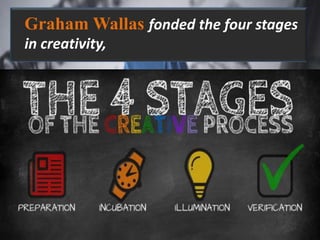
Graham Wallas fonded the four stages
in creativity,
PREPARATION
This stage consist of purposeful
study and enquiry in order to
collect experience and
information needed to solve
mystery.
INCUBATION
Creativity requires imaginative
posting. The person contemplates
on the idea for finding a valuable
solution to the problem. There
occurs vicarious experiencing of
the problem. He organizes and tests
his problem.
ILLUMINATION
In this stage, the individual
reaches the level of mastery.
He perceives the theme and
new situations regarding the
nature of the problem. This
lead him towards finding a
solution to the problem.
VERIFICATION
This is the final stage. He
evaluates his hypothesis, and
decides whether to accept or
reject it. The individual rethinks
revises and refines the solution.
Sincere love for the creation of
the mind is crucial to the thinker.
HOW TO IDENTIFY
CREATIVITY
 By observation of behavior.
 By conducting interviews.
 By using standardized tests.
 By studying the cumulative
record.
OBSTACLES IN THE
DEVELOPMENT OF
CREATIVITY
The development of creativity is
challenged and impeded in several
ways. The major impediments are
specified below.
 Unfavourable home atmosphere.
 Social reactions against innovations.
 Unfavorable atmosphere in
schools(Undue criticism from teachers,
over discipline, rigid time schedule lack
of freedom, rough attitude of teachers
towards student innovations etc.
hamper creativity.
 Lack of extra reading habits.
 Conformity to existing practices.
 Fear of failure.
TECHNIQUES TO DEVELOP
CREATIVITY
 Encourage originality.
 Encourage independent thinking.
 Build basic skills.
 Encourage acquisition of knowledge.
 Ask challenging questions
 Stimulate and reward curiosity and
exploration.
 Adopt proper reinforcement
techniques
 Provide opportunities for
creative expressions.
 Eliminate obstacles to the
creative thinking.
 Avoid too much discipline.
 Don’t ridicule for mistakes.
 Avoid harsh criticism.
 See child as child.
 Facilitate child autonomy.
 Tolerate a certain amount of
disorderliness.
Muhsi creativity

Muhsi creativity

  • 1.
  • 2.
    Creativity is definedas the ability to generate new ideas and solutions to every day problems and challenges DEFINITIONS It is the capacity of person to produce something new or uncommon
  • 3.
    CHARACTERESTICS OF ACREATIVE CHILD ORIGINALITY It is the ability to produce unique or new ideas. Invention is the most common example of this aspect of creativity. FLUENCY It refers to the ability to express or generate multiple solution to a given problem.
  • 4.
    FLEXIBILITY It refers tothe ability to state a variety of solutions or answers to a problem. DIVERGENT THINKING It is the ability to think in different directions. ELABERATION It means the ability to develop well an idea or insight.
  • 5.
    CHARACTERESTICS OF CREATIVITY  Creativityis universal ,every individual is capable of demonstrating creativity to some degree  Creativity is innate as well as acquired.  Creativity rests more on divergent thinking.  Creativity can not be seperate from intelligence.
  • 6.
     Creativity isa process and a product.  It is the ability to take up challenges.  Creativity cultivates a spirit to excel.  Creativity produces novelty or unusual experience.  Creativity causes self discipline.  Creativity facilitates willingness to accept disagreement.
  • 7.
    Graham Wallas fondedthe four stages in creativity,
  • 8.
    PREPARATION This stage consistof purposeful study and enquiry in order to collect experience and information needed to solve mystery.
  • 9.
    INCUBATION Creativity requires imaginative posting.The person contemplates on the idea for finding a valuable solution to the problem. There occurs vicarious experiencing of the problem. He organizes and tests his problem.
  • 10.
    ILLUMINATION In this stage,the individual reaches the level of mastery. He perceives the theme and new situations regarding the nature of the problem. This lead him towards finding a solution to the problem.
  • 11.
    VERIFICATION This is thefinal stage. He evaluates his hypothesis, and decides whether to accept or reject it. The individual rethinks revises and refines the solution. Sincere love for the creation of the mind is crucial to the thinker.
  • 12.
    HOW TO IDENTIFY CREATIVITY By observation of behavior.  By conducting interviews.  By using standardized tests.  By studying the cumulative record.
  • 13.
    OBSTACLES IN THE DEVELOPMENTOF CREATIVITY The development of creativity is challenged and impeded in several ways. The major impediments are specified below.  Unfavourable home atmosphere.  Social reactions against innovations.
  • 14.
     Unfavorable atmospherein schools(Undue criticism from teachers, over discipline, rigid time schedule lack of freedom, rough attitude of teachers towards student innovations etc. hamper creativity.  Lack of extra reading habits.  Conformity to existing practices.  Fear of failure.
  • 15.
    TECHNIQUES TO DEVELOP CREATIVITY Encourage originality.  Encourage independent thinking.  Build basic skills.  Encourage acquisition of knowledge.  Ask challenging questions  Stimulate and reward curiosity and exploration.
  • 16.
     Adopt properreinforcement techniques  Provide opportunities for creative expressions.  Eliminate obstacles to the creative thinking.  Avoid too much discipline.
  • 17.
     Don’t ridiculefor mistakes.  Avoid harsh criticism.  See child as child.  Facilitate child autonomy.  Tolerate a certain amount of disorderliness.