MONTHLY BUSINESS REVIEW
VOLUME: 09 ISSUE: 03
MARCH 2018
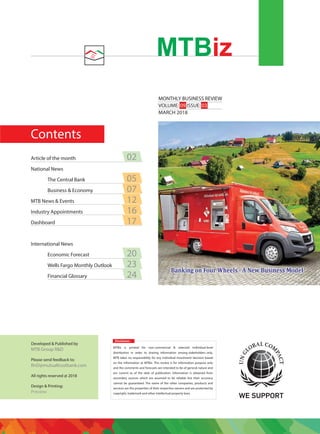
Banking on Four Wheels - A New Business Model
Contents
MONTHLY BUSINESS REVIEW
VOLUME: 09 ISSUE: 03
MARCH 2018
MTBiz
Disclaimer:
MTBiz is printed for non-commercial & selected individual-level
distribution in order to sharing information among stakeholders only.
MTB takes no responsibility for any individual investment decision based
on the information at MTBiz. This review is for information purpose only
and the comments and forecasts are intended to be of general nature and
are current as of the date of publication. Information is obtained from
secondary sources which are assumed to be reliable but their accuracy
cannot be guaranteed. The name of the other companies, products and
services are the properties of their respective owners and are protected by
copyright, trademark and other intellectual property laws.
Developed & Published by
MTB Group R&D
Please send feedback to:
RnD@mutualtrustbank.com
All rights reserved @ 2018
Design & Printing:
Preview
Article of the month 02
National News
The Central Bank 05
Business & Economy 07
MTB News & Events 12
Industry Appointments 16
Dashboard 17
International News
Economic Forecast 20
Wells Fargo Monthly Outlook 23
Financial Glossary 24
02 MTBiz
ARTICLE OF THE MONTH
The neatly dressed savings bank executive jumps behind the wheel four days a week to bring mobile services including
cash machine and consultation room to tiny countryside villages. The switch from desk to dashboard has enabled
Bank manager "to do something else while staying in touch with the customers".
High-street banks are increasingly being forced to shutter branches, as more and more customers go online, rural
populations shrink and low interest rates eat into profits. As a result, banks are having to rethink their business
models.
Banking on Four Wheels - A New Business Model
03 MTBiz
ARTICLE OF THE MONTH
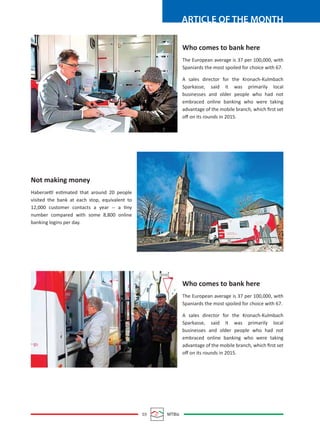
Who comes to bank here
The European average is 37 per 100,000, with
Spaniards the most spoiled for choice with 67.
A sales director for the Kronach-Kulmbach
Sparkasse, said it was primarily local
businesses and older people who had not
embraced online banking who were taking
advantage of the mobile branch, which first set
off on its rounds in 2015.
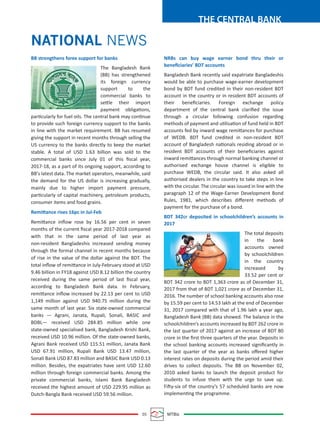
Who comes to bank here
The European average is 37 per 100,000, with
Spaniards the most spoiled for choice with 67.
A sales director for the Kronach-Kulmbach
Sparkasse, said it was primarily local
businesses and older people who had not
embraced online banking who were taking
advantage of the mobile branch, which first set
off on its rounds in 2015.
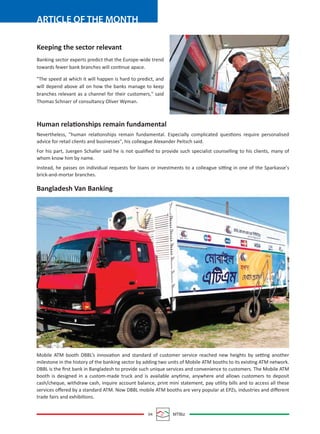
Not making money
Haberzettl estimated that around 20 people
visited the bank at each stop, equivalent to
12,000 customer contacts a year -- a tiny
number compared with some 8,800 online
banking logins per day.
04 MTBiz
ARTICLE OF THE MONTH
Keeping the sector relevant
Banking sector experts predict that the Europe-wide trend
towards fewer bank branches will continue apace.
"The speed at which it will happen is hard to predict, and
will depend above all on how the banks manage to keep
branches relevant as a channel for their customers," said
Thomas Schnarr of consultancy Oliver Wyman.
Human relationships remain fundamental
Nevertheless, "human relationships remain fundamental. Especially complicated questions require personalised
advice for retail clients and businesses", his colleague Alexander Peitsch said.
For his part, Juergen Schaller said he is not qualified to provide such specialist counselling to his clients, many of
whom know him by name.
Instead, he passes on individual requests for loans or investments to a colleague sitting in one of the Sparkasse's
brick-and-mortar branches.
Bangladesh Van Banking
Mobile ATM booth DBBL’s innovation and standard of customer service reached new heights by setting another
milestone in the history of the banking sector by adding two units of Mobile ATM booths to its existing ATM network.
DBBL is the first bank in Bangladesh to provide such unique services and convenience to customers. The Mobile ATM
booth is designed in a custom-made truck and is available anytime, anywhere and allows customers to deposit
cash/cheque, withdraw cash, inquire account balance, print mini statement, pay utility bills and to access all these
services offered by a standard ATM. Now DBBL mobile ATM booths are very popular at EPZs, industries and different
trade fairs and exhibitions.
05 MTBiz
THE CENTRAL BANK
NATIONAL NEWS
BB strengthens forex support for banks
The Bangladesh Bank
(BB) has strengthened
its foreign currency
support to the
commercial banks to
settle their import
payment obligations,
particularly for fuel oils. The central bank may continue
to provide such foreign currency support to the banks
in line with the market requirement. BB has resumed
giving the support in recent months through selling the
US currency to the banks directly to keep the market
stable. A total of USD 1.63 billion was sold to the
commercial banks since July 01 of this fiscal year,
2017-18, as a part of its ongoing support, according to
BB's latest data. The market operators, meanwhile, said
the demand for the US dollar is increasing gradually,
mainly due to higher import payment pressure,
particularly of capital machinery, petroleum products,
consumer items and food grains.
Remittance rises 16pc in Jul-Feb
Remittance inflow rose by 16.56 per cent in seven
months of the current fiscal year 2017-2018 compared
with that in the same period of last year as
non-resident Bangladeshis increased sending money
through the formal channel in recent months because
of rise in the value of the dollar against the BDT. The
total inflow of remittance in July-February stood at USD
9.46 billion in FY18 against USD 8.12 billion the country
received during the same period of last fiscal year,
according to Bangladesh Bank data. In February,
remittance inflow increased by 22.13 per cent to USD
1,149 million against USD 940.75 million during the
same month of last year. Six state-owned commercial
banks — Agrani, Janata, Rupali, Sonali, BASIC and
BDBL— received USD 284.85 million while one
state-owned specialised bank, Bangladesh Krishi Bank,
received USD 10.96 million. Of the state-owned banks,
Agrani Bank received USD 115.51 million, Janata Bank
USD 67.91 million, Rupali Bank USD 13.47 million,
Sonali Bank USD 87.83 million and BASIC Bank USD 0.13
million. Besides, the expatriates have sent USD 12.60
million through foreign commercial banks. Among the
private commercial banks, Islami Bank Bangladesh
received the highest amount of USD 229.95 million as
Dutch-Bangla Bank received USD 59.56 million.
NRBs can buy wage earner bond thru their or
beneficiaries’ BDT accounts
Bangladesh Bank recently said expatriate Bangladeshis
would be able to purchase wage-earner development
bond by BDT fund credited in their non-resident BDT
account in the country or in resident BDT accounts of
their beneficiaries. Foreign exchange policy
department of the central bank clarified the issue
through a circular following confusion regarding
methods of payment and utilisation of fund held in BDT
accounts fed by inward wage remittances for purchase
of WEDB. BDT fund credited in non-resident BDT
account of Bangladesh nationals residing abroad or in
resident BDT accounts of their beneficiaries against
inward remittances through normal banking channel or
authorised exchange house channel is eligible to
purchase WEDB, the circular said. It also asked all
authorised dealers in the country to take steps in line
with the circular. The circular was issued in line with the
paragraph 12 of the Wage-Earner Development Bond
Rules, 1981, which describes different methods of
payment for the purchase of a bond.
BDT 342cr deposited in schoolchildren’s accounts in
2017
The total deposits
in the bank
accounts owned
by schoolchildren
in the country
increased by
33.52 per cent or
BDT 342 crore to BDT 1,363 crore as of December 31,
2017 from that of BDT 1,021 crore as of December 31,
2016. The number of school banking accounts also rose
by 15.59 per cent to 14.53 lakh at the end of December
31, 2017 compared with that of 1.96 lakh a year ago,
Bangladesh Bank (BB) data showed. The balance in the
schoolchildren’s accounts increased by BDT 262 crore in
the last quarter of 2017 against an increase of BDT 80
crore in the first three quarters of the year. Deposits in
the school banking accounts increased significantly in
the last quarter of the year as banks offered higher
interest rates on deposits during the period amid their
drives to collect deposits. The BB on November 02,
2010 asked banks to launch the deposit product for
students to infuse them with the urge to save up.
Fifty-six of the country’s 57 scheduled banks are now
implementing the programme.
06 MTBiz
THE CENTRAL BANK
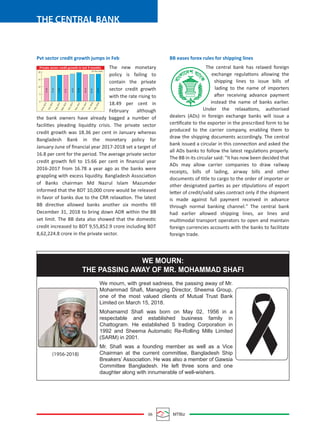
Pvt sector credit growth jumps in Feb
The new monetary
policy is failing to
contain the private
sector credit growth
with the rate rising to
18.49 per cent in
February although
the bank owners have already bagged a number of
facilities pleading liquidity crisis. The private sector
credit growth was 18.36 per cent in January whereas
Bangladesh Bank in the monetary policy for
January-June of financial year 2017-2018 set a target of
16.8 per cent for the period. The average private sector
credit growth fell to 15.66 per cent in financial year
2016-2017 from 16.78 a year ago as the banks were
grappling with excess liquidity. Bangladesh Association
of Banks chairman Md Nazrul Islam Mazumder
informed that the BDT 10,000 crore would be released
in favor of banks due to the CRR relaxation. The latest
BB directive allowed banks another six months till
December 31, 2018 to bring down ADR within the BB
set limit. The BB data also showed that the domestic
credit increased to BDT 9,55,852.9 crore including BDT
8,62,224.8 crore in the private sector.
BB eases forex rules for shipping lines
The central bank has relaxed foreign
exchange regulations allowing the
shipping lines to issue bills of
lading to the name of importers
after receiving advance payment
instead the name of banks earlier.
Under the relaxations, authorised
dealers (ADs) in foreign exchange banks will issue a
certificate to the exporter in the prescribed form to be
produced to the carrier company, enabling them to
draw the shipping documents accordingly. The central
bank issued a circular in this connection and asked the
all ADs banks to follow the latest regulations properly.
The BB in its circular said: "It has now been decided that
ADs may allow carrier companies to draw railway
receipts, bills of lading, airway bills and other
documents of title to cargo to the order of importer or
other designated parties as per stipulations of export
letter of credit/valid sales contract only if the shipment
is made against full payment received in advance
through normal banking channel." The central bank
had earlier allowed shipping lines, air lines and
multimodal transport operators to open and maintain
foreign currencies accounts with the banks to facilitate
foreign trade.
We mourn, with great sadness, the passing away of Mr.
Mohammad Shafi, Managing Director, Sheema Group,
one of the most valued clients of Mutual Trust Bank
Limited on March 15, 2018.
Mohamamd Shafi was born on May 02, 1956 in a
respectable and established business family in
Chattogram. He established S trading Corporation in
1992 and Sheema Automatic Re-Rolling Mills Limited
(SARM) in 2001.
Mr. Shafi was a founding member as well as a Vice
Chairman at the current committee, Bangladesh Ship
Breakers’ Association. He was also a member of Gawsia
Committee Bangladesh. He left three sons and one
daughter along with innumerable of well-wishers.
WE MOURN:
THE PASSING AWAY OF MR. MOHAMMAD SHAFI
(1956-2018)
Private sector credit growth in last 9 months
20
15
10
5
0
(In Per cent)
June,2017
July,2017
Aug,2017
Sept,2017
Oct,2017
Nov,2017
Dec,2017
Jan,2018
Feb,2018
15.66
15.94
17.84
17.8
18.63
19.06
18.13
18.36
18.49
07 MTBiz
BUSINESS & ECONOMY
NATIONAL NEWS
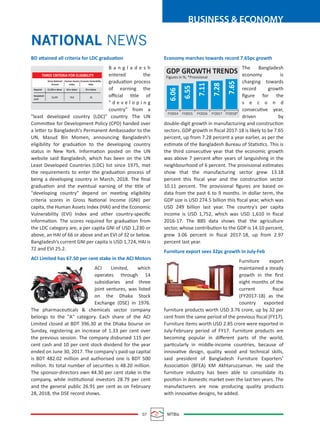
BD attained all criteria for LDC graduation
B a n g l a d e s h
entered the
graduation process
of earning the
official title of
" d e v e l o p i n g
country" from a
"least developed country (LDC)" country. The UN
Committee for Development Policy (CPD) handed over
a letter to Bangladesh's Permanent Ambassador to the
UN, Masud Bin Momen, announcing Bangladesh’s
eligibility for graduation to the developing country
status in New York. Information posted on the UN
website said Bangladesh, which has been on the UN
Least Developed Countries (LDC) list since 1975, met
the requirements to enter the graduation process of
being a developing country in March, 2018. The final
graduation and the eventual earning of the title of
"developing country" depend on meeting eligibility
criteria scores in Gross National Income (GNI) per
capita, the Human Assets Index (HAI) and the Economic
Vulnerability (EVI) Index and other country-specific
information. The scores required for graduation from
the LDC category are, a per capita GNI of USD 1,230 or
above, an HAI of 66 or above and an EVI of 32 or below.
Bangladesh’s current GNI per capita is USD 1,724, HAI is
72 and EVI 25.2.
ACI Limited has 67.50 per cent stake in the ACI Motors
ACI Limited, which
operates through 14
subsidiaries and three
joint ventures, was listed
on the Dhaka Stock
Exchange (DSE) in 1976.
The pharmaceuticals & chemicals sector company
belongs to the "A" category. Each share of the ACI
Limited closed at BDT 396.30 at the Dhaka bourse on
Sunday, registering an increase of 1.33 per cent over
the previous session. The company disbursed 115 per
cent cash and 10 per cent stock dividend for the year
ended on June 30, 2017. The company's paid-up capital
is BDT 482.02 million and authorised one is BDT 500
million. Its total number of securities is 48.20 million.
The sponsor-directors own 44.30 per cent stake in the
company, while institutional investors 28.79 per cent
and the general public 26.91 per cent as on February
28, 2018, the DSE record shows.
Economy marches towards record 7.65pc growth
The Bangladesh
economy is
charging towards
record growth
figure for the
s e c o n d
consecutive year,
driven by
double-digit growth in manufacturing and construction
sectors. GDP growth in fiscal 2017-18 is likely to be 7.65
percent, up from 7.28 percent a year earlier, as per the
estimate of the Bangladesh Bureau of Statistics. This is
the third consecutive year that the economic growth
was above 7 percent after years of languishing in the
neighbourhood of 6 percent. The provisional estimates
show that the manufacturing sector grew 13.18
percent this fiscal year and the construction sector
10.11 percent. The provisional figures are based on
data from the past 6 to 9 months. In dollar term, the
GDP size is USD 274.5 billion this fiscal year, which was
USD 249 billion last year. The country's per capita
income is USD 1,752, which was USD 1,610 in fiscal
2016-17. The BBS data shows that the agriculture
sector, whose contribution to the GDP is 14.10 percent,
grew 3.06 percent in fiscal 2017-18, up from 2.97
percent last year.
Furniture export sees 32pc growth in July-Feb
Furniture export
maintained a steady
growth in the first
eight months of the
current fiscal
(FY2017-18) as the
country exported
furniture products worth USD 3.76 crore, up by 32 per
cent from the same period of the previous fiscal (FY17).
Furniture items worth USD 2.85 crore were exported in
July-February period of FY17. Furniture products are
becoming popular in different parts of the world,
particularly in middle-income countries, because of
innovative design, quality wood and technical skills,
said president of Bangladesh Furniture Exporters’
Association (BFEA) KM Akhtaruzzaman. He said the
furniture industry has been able to consolidate its
position in domestic market over the last ten years. The
manufacturers are now producing quality products
with innovative designs, he added.
THREE CRITERIA FOR ELIGIBILITY
Gross National
Income
Human Assets
Index
Economic Vulnerability
Index
Required $1,230 or above 66 or above 32 or below
Bangladesh
score
$1,272 72.8 25
GDP GROWTH TRENDS
Figures in %; *Provisional
FY2014 FY2015 FY2016 FY2017 FY2018*
6.06
6.55
7.11
7.28
7.65
08 MTBiz
BUSINESS & ECONOMY
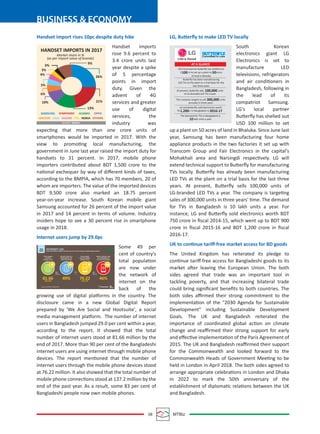
Handset import rises 10pc despite duty hike
Handset imports
rose 9.6 percent to
3.4 crore units last
year despite a spike
of 5 percentage
points in import
duty. Given the
advent of 4G
services and greater
use of digital
services, the
industry was
expecting that more than one crore units of
smartphones would be imported in 2017. With the
view to promoting local manufacturing, the
government in June last year raised the import duty for
handsets to 31 percent. In 2017, mobile phone
importers contributed about BDT 1,500 crore to the
national exchequer by way of different kinds of taxes,
according to the BMPIA, which has 70 members, 20 of
whom are importers. The value of the imported devices
BDT 9,500 crore also marked an 18.75 percent
year-on-year increase. South Korean mobile giant
Samsung accounted for 26 percent of the import value
in 2017 and 14 percent in terms of volume. Industry
insiders hope to see a 30 percent rise in smartphone
usage in 2018.
Internet users jump by 29.0pc
Some 49 per
cent of country's
total population
are now under
the network of
internet on the
back of the
growing use of digital platforms in the country. The
disclosure came in a new Global Digital Report
prepared by 'We Are Social and Hootsuite', a social
media management platform. The number of internet
users in Bangladesh jumped 29.0 per cent within a year,
according to the report. It showed that the total
number of internet users stood at 81.66 million by the
end of 2017. More than 90 per cent of the Bangladeshi
internet users are using internet through mobile phone
devices. The report mentioned that the number of
internet users through the mobile phone devices stood
at 76.22 million. It also showed that the total number of
mobile phone connections stood at 137.2 million by the
end of the past year. As a result, some 83 per cent of
Bangladeshi people now own mobile phones.
LG, Butterfly to make LED TV locally
South Korean
electronics giant LG
Electronics is set to
manufacture LED
televisions, refrigerators
and air conditioners in
Bangladesh, following in
the lead of its
compatriot Samsung.
LG's local partner
Butterfly has shelled out
USD 100 million to set
up a plant on 50 acres of land in Bhaluka. Since June last
year, Samsung has been manufacturing four home
appliance products in the two factories it set up with
Transcom Group and Fair Electronics in the capital's
Mohakhali area and Narsingdi respectively. LG will
extend technical support to Butterfly for manufacturing
TVs locally. Butterfly has already been manufacturing
LED TVs at the plant on a trial basis for the last three
years. At present, Butterfly sells 100,000 units of
LG-branded LED TVs a year. The company is targeting
sales of 300,000 units in three years' time. The demand
for TVs in Bangladesh is 10 lakh units a year. For
instance, LG and Butterfly sold electronics worth BDT
750 crore in fiscal 2014-15, which went up to BDT 900
crore in fiscal 2015-16 and BDT 1,200 crore in fiscal
2016-17.
UK to continue tariff-free market access for BD goods
The United Kingdom has reiterated its pledge to
continue tariff-free access for Bangladeshi goods to its
market after leaving the European Union. The both
sides agreed that trade was an important tool in
tackling poverty, and that increasing bilateral trade
could bring significant benefits to both countries. The
both sides affirmed their strong commitment to the
implementation of the "2030 Agenda for Sustainable
Development" including Sustainable Development
Goals. The UK and Bangladesh reiterated the
importance of coordinated global action on climate
change and reaffirmed their strong support for early
and effective implementation of the Paris Agreement of
2015. The UK and Bangladesh reaffirmed their support
for the Commonwealth and looked forward to the
Commonwealth Heads of Government Meeting to be
held in London in April 2018. The both sides agreed to
arrange appropriate celebrations in London and Dhaka
in 2022 to mark the 50th anniversary of the
establishment of diplomatic relations between the UK
and Bangladesh.
HANDSET IMPORTS IN 2017
Market share in %
(as per import value of brands)
3%
9%
26%
21%
13%
3%
4%
5%
6%
10%
SAMSUNG
WALTON LAVA XIAOMI ITEL NOKIA OTHERS
SYMPHONY HUAWEI OPPO
SOURCE: BMPIA
INTERNET USEBASED ON REPORTED INTERNET USER DATA, AND ACTIVE USE OF INTERNET-POWERED MOBILE SERVICES
TOTAL NUMBER
OF ACTIVE
INTERNET USERS
Sources: INTERNET WORLDSTATS
MILLION
81.66 MILLION
76.2249% 46%
we
are
social
we
are
social
we
are
social
INTERNET USERS AS A
PERCENTAGE OF THE
TOTAL POPULATION
TOTAL NUMBER
OF ACTIVE MOBILE
INTERNET USERS
MOBILE INTERNET USERS
AS A PERCENTAGE OF
THE TOTAL POPULATION
Hootsuite
JAN
2018
Life’s Good
Committed to care
AT A GLANCE
LG’s local partner Butterfly has shelled out
$ m to set up a plant on acres
of land in Bhaluka
Butterfly has been manufacturing
LED TVs at the plant on a trial basis for the
last three years
At present, Butterfly sells units
of LG-Branded LED TVs a year
100
100,000
The company targets to sell units
annually in three years
300,000
LG and Butterfly sold electronics worth
Tk cr in Bangladesh in1,200 2016-17
The demand for TVs in Bangladesh is
lakh units a year10
50
09 MTBiz
BUSINESS & ECONOMY
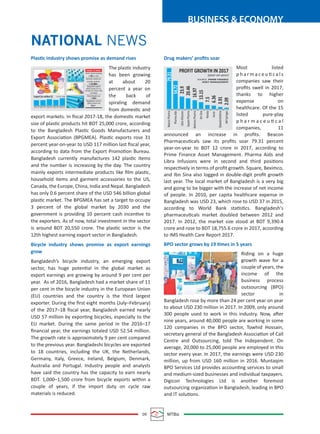
Plastic industry shows promise as demand rises
The plastic industry
has been growing
at about 20
percent a year on
the back of
spiraling demand
from domestic and
export markets. In fiscal 2017-18, the domestic market
size of plastic products hit BDT 25,000 crore, according
to the Bangladesh Plastic Goods Manufacturers and
Export Association (BPGMEA). Plastic exports rose 31
percent year-on-year to USD 117 million last fiscal year,
according to data from the Export Promotion Bureau.
Bangladesh currently manufactures 142 plastic items
and the number is increasing by the day. The country
mainly exports intermediate products like film plastic,
household items and garment accessories to the US,
Canada, the Europe, China, India and Nepal. Bangladesh
has only 0.6 percent share of the USD 546 billion global
plastic market. The BPGMEA has set a target to occupy
3 percent of the global market by 2030 and the
government is providing 10 percent cash incentive to
the exporters. As of now, total investment in the sector
is around BDT 20,550 crore. The plastic sector is the
12th highest earning export sector in Bangladesh.
Bicycle industry shows promise as export earnings
grow
Bangladesh’s bicycle industry, an emerging export
sector, has huge potential in the global market as
export earnings are growing by around 9 per cent per
year. As of 2016, Bangladesh had a market share of 11
per cent in the bicycle industry in the European Union
(EU) countries and the country is the third largest
exporter. During the first eight months (July–February)
of the 2017–18 fiscal year, Bangladesh earned nearly
USD 57 million by exporting bicycles, especially to the
EU market. During the same period in the 2016–17
financial year, the earnings totaled USD 52.54 million.
The growth rate is approximately 9 per cent compared
to the previous year. Bangladeshi bicycles are exported
to 18 countries, including the UK, the Netherlands,
Germany, Italy, Greece, Ireland, Belgium, Denmark,
Australia and Portugal. Industry people and analysts
have said the country has the capacity to earn nearly
BDT. 1,000–1,500 crore from bicycle exports within a
couple of years, if the import duty on cycle raw
materials is reduced.
Drug makers’ profits soar
Most listed
p h a r m a c e u ti c a l s
companies saw their
profits swell in 2017,
thanks to higher
expense on
healthcare. Of the 15
listed pure-play
p h a r m a c e u ti c a l
companies, 11
announced an increase in profits. Beacon
Pharmaceuticals saw its profits soar 79.31 percent
year-on-year to BDT 12 crore in 2017, according to
Prime Finance Asset Management. Pharma Aids and
Libra Infusions were in second and third positions
respectively in terms of profit growth. Square, Beximco,
and Ibn Sina also logged in double-digit profit growth
last year. The local market of Bangladesh is a very big
and going to be bigger with the increase of net income
of people. In 2010, per capita healthcare expense in
Bangladesh was USD 23, which rose to USD 37 in 2015,
according to World Bank statistics. Bangladesh's
pharmaceuticals market doubled between 2012 and
2017. In 2012, the market size stood at BDT 9,390.4
crore and rose to BDT 18,755.6 crore in 2017, according
to IMS Health Care Report 2017.
BPO sector grows by 19 times in 5 years
Riding on a huge
growth wave for a
couple of years, the
income of the
business process
outsourcing (BPO)
sector in
Bangladesh rose by more than 24 per cent year on year
to about USD 230 million in 2017. In 2009, only around
300 people used to work in this industry. Now, after
nine years, around 40,000 people are working in some
120 companies in the BPO sector, Towhid Hossain,
secretary general of the Bangladesh Association of Call
Centre and Outsourcing, told The Independent. On
average, 20,000 to 25,000 people are employed in this
sector every year. In 2017, the earnings were USD 230
million, up from USD 160 million in 2016. Muntaqim
BPO Services Ltd provides accounting services to small
and medium-sized businesses and individual taxpayers.
Digicon Technologies Ltd is another foremost
outsourcing organization in Bangladesh, leading in BPO
and IT solutions.
NATIONAL NEWS
Plastic industry growing
at pc a year20
Domestic market size
of plastic products:
Tk cr25,000
Global Market size:
$ b546
Bangladesh exports
plastic products to us,
Canada, EU, China, India
and Nepal
Bangladesh’s share in
global market only
pc0.6
Export (in million $) SOURCE: EPB
85
2012-13 2013-14 2014-15 2015-16 2016-17
86 101 89
117
THINGS TO KNOW
PROFIT GROWTH IN 2017
(year-on-year)
SOURCE: PRIME FINANCE
ASSET MANAGEMENT
BeaconPharma
PharmaAids
LibraInfusions
SquarePharma
BeximcoPharma
IbnSina
Renata
Acme
GlaxoSmithkline
JMISyringes
23.9
20.46
16.97
13.15
7.5
6.36
3.91
2.09
79.31
54.72
10 MTBiz
BUSINESS & ECONOMY
BD economy to grow 7.0pc in FY18: ADB
Bangladesh economy is
likely to grow by 7.0 per
cent in the current fiscal
year, according to the
latest projection of the
Asian Development Bank
(ADB). The Manila-based
international lender organisation also projected that
annual inflation rate may reach at 6.10 per cent in FY18.
The Asian Development Outlook (ADO-2018), released
today across the region, unveiled the latest projection.
GDP growth is expected to moderate to 7.0% in FY2018
as consumption demand slackens despite a rebound in
worker remittances, said the ADO. Remittance
beneficiaries are likely to adopt a cautious approach to
spending, repaying debt incurred in recent years of
remittance declines, it added. The World Bank,
however, strongly differed with the BBS estimation and
mentioned that the growth may stand at 6.50 per cent.
Analysing the current trend of Bangladesh economy, the
ADB pointed out that private investment would edge up
with support from an accommodative credit policy, and
public investment would expand as the ‘authorities seek
to speed the implementation of infrastructure projects’.
The ADB also forecast the GDP growth for Bangladesh at
7.2 per cent in the next fiscal year (FY19).
Economy to grow at 6.5pc in this fiscal, says WB
The World Bank has
expressed its doubt over
the Bangladesh's 7.65
per cent economic
growth projection for
the current fiscal year
(FY) raising questions
about data accuracy. The robust growth projection for
the current fiscal is doubtful as some government
statistics doesn't match with it (projection), said the
bank's lead economist in Dhaka Zahid Hussain. The
Bangladesh Bureau of Statistics, the state statistical
agency, has recently said that Bangladesh's gross
domestic product (GDP) is expected to grow at 7.65 per
cent rate in the current financial year 2017-18, which is
even higher than its 7.5 per cent target. In contrast, the
Washington-based lender said that Bangladesh's GDP
growth is expected to grow at 6.5 per cent rate in the
current FY2018. The WB economist said the service
sector growth rate had declined to 6.3 per cent in the
current FY2018 from 6.7 per cent in FY2017, its
employment rose by 1.76 million or nearly 8.0 per cent
in the current fiscal. He said that the BBS has showed a
7.0-8.0 per cent per capita consumption growth in the
current fiscal, although it was recorded at 1.4 per cent
on an average between 2010 and FY2017.
11 MTBiz
12 MTBiz
MTB NEWS & EVENTS
HONORABLE SPEAKER HANDS OVER A CHEQUE TO MTB WOMEN ENTREPRENEUR
MTB FINANCES WOMEN'S DEVELOPMENT CENTRE IN BHOLA
Bangladesh Bank (BB), in association with banks and
NBFIs, organized a “Banker–SME Women
Entrepreneur Conference and Product Display
Fair-2018” at the Bangladesh Shishu Academy on
Thursday, March 08, 2018.
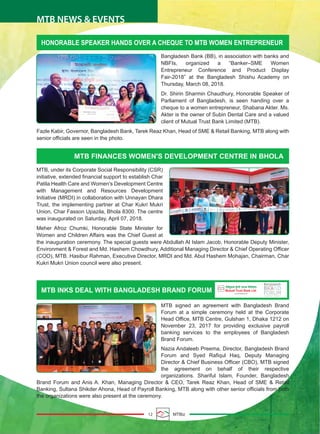
Dr. Shirin Sharmin Chaudhury, Honorable Speaker of
Parliament of Bangladesh, is seen handing over a
cheque to a women entrepreneur, Shabana Akter. Ms.
Akter is the owner of Subin Dental Care and a valued
client of Mutual Trust Bank Limited (MTB).
Fazle Kabir, Governor, Bangladesh Bank, Tarek Reaz Khan, Head of SME & Retail Banking, MTB along with
senior officials are seen in the photo.
MTB, under its Corporate Social Responsibility (CSR)
initiative, extended financial support to establish Char
Patila Health Care and Women's Development Centre
with Management and Resources Development
Initiative (MRDI) in collaboration with Unnayan Dhara
Trust, the implementing partner at Char Kukri Mukri
Union, Char Fasson Upazila, Bhola 8300. The centre
was inaugurated on Saturday, April 07, 2018.
Meher Afroz Chumki, Honorable State Minister for
Women and Children Affairs was the Chief Guest at
the inauguration ceremony. The special guests were Abdullah Al Islam Jacob, Honorable Deputy Minister,
Environment & Forest and Md. Hashem Chowdhury, Additional Managing Director & Chief Operating Officer
(COO), MTB. Hasibur Rahman, Executive Director, MRDI and Md. Abul Hashem Mohajan, Chairman, Char
Kukri Mukri Union council were also present.
MTB INKS DEAL WITH BANGLADESH BRAND FORUM
MTB signed an agreement with Bangladesh Brand
Forum at a simple ceremony held at the Corporate
Head Office, MTB Centre, Gulshan 1, Dhaka 1212 on
November 23, 2017 for providing exclusive payroll
banking services to the employees of Bangladesh
Brand Forum.
Nazia Andaleeb Preema, Director, Bangladesh Brand
Forum and Syed Rafiqul Haq, Deputy Managing
Director & Chief Business Officer (CBO), MTB signed
the agreement on behalf of their respective
organizations. Shariful Islam, Founder, Bangladesh
Brand Forum and Anis A. Khan, Managing Director & CEO, Tarek Reaz Khan, Head of SME & Retail
Banking, Sultana Shikder Ahona, Head of Payroll Banking, MTB along with other senior officials from both
the organizations were also present at the ceremony.
13 MTBiz
MTB NEWS & EVENTS
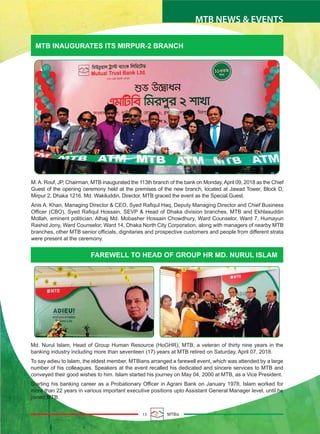
M. A. Rouf, JP, Chairman, MTB inaugurated the 113th branch of the bank on Monday, April 09, 2018 as the Chief
Guest of the opening ceremony held at the premises of the new branch, located at Jawad Tower, Block D,
Mirpur 2, Dhaka 1216. Md. Wakiluddin, Director, MTB graced the event as the Special Guest.
Anis A. Khan, Managing Director & CEO, Syed Rafiqul Haq, Deputy Managing Director and Chief Business
Officer (CBO), Syed Rafiqul Hossain, SEVP & Head of Dhaka division branches, MTB and Ekhlasuddin
Mollah, eminent politician, Alhajj Md. Mobasher Hossain Chowdhury, Ward Counselor, Ward 7, Humayun
Rashid Jony, Ward Counselor, Ward 14, Dhaka North City Corporation, along with managers of nearby MTB
branches, other MTB senior officials, dignitaries and prospective customers and people from different strata
were present at the ceremony.
MTB INAUGURATES ITS MIRPUR-2 BRANCH
FAREWELL TO HEAD OF GROUP HR MD. NURUL ISLAM
Md. Nurul Islam, Head of Group Human Resource (HoGHR), MTB, a veteran of thirty nine years in the
banking industry including more than seventeen (17) years at MTB retired on Saturday, April 07, 2018.
To say adieu to Islam, the eldest member, MTBians arranged a farewell event, which was attended by a large
number of his colleagues. Speakers at the event recalled his dedicated and sincere services to MTB and
conveyed their good wishes to him. Islam started his journey on May 04, 2000 at MTB, as a Vice President.
Starting his banking career as a Probationary Officer in Agrani Bank on January 1978, Islam worked for
more than 22 years in various important executive positions upto Assistant General Manager level, until he
joined MTB.
14 MTBiz
MTB NEWS & EVENTS
MTB OPENS AGENT BANKING CENTRE AT KABIRAJ HAT
BIRGANJ, DINAJPUR
MTB OPENS AGENT BANKING CENTRE AT SHIBER BAZAR
SYLHET SADAR, SYLHET
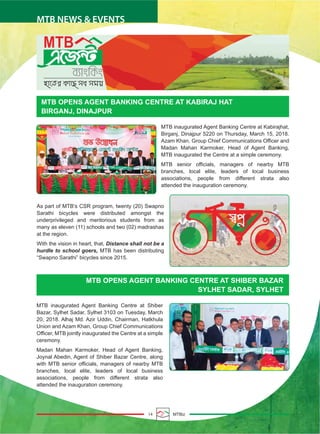
MTB inaugurated Agent Banking Centre at Kabirajhat,
Birganj, Dinajpur 5220 on Thursday, March 15, 2018.
Azam Khan, Group Chief Communications Officer and
Madan Mahan Karmoker, Head of Agent Banking,
MTB inaugurated the Centre at a simple ceremony.
MTB senior officials, managers of nearby MTB
branches, local elite, leaders of local business
associations, people from different strata also
attended the inauguration ceremony.
As part of MTB’s CSR program, twenty (20) Swapno
Sarathi bicycles were distributed amongst the
underprivileged and meritorious students from as
many as eleven (11) schools and two (02) madrashas
at the region.
With the vision in heart, that, Distance shall not be a
hurdle to school goers, MTB has been distributing
“Swapno Sarathi” bicycles since 2015.
MTB inaugurated Agent Banking Centre at Shiber
Bazar, Sylhet Sadar, Sylhet 3103 on Tuesday, March
20, 2018. Alhaj Md. Azir Uddin, Chairman, Hatkhula
Union and Azam Khan, Group Chief Communications
Officer, MTB jointly inaugurated the Centre at a simple
ceremony.
Madan Mahan Karmoker, Head of Agent Banking,
Joynal Abedin, Agent of Shiber Bazar Centre, along
with MTB senior officials, managers of nearby MTB
branches, local elite, leaders of local business
associations, people from different strata also
attended the inauguration ceremony.
15 MTBiz
MTB NEWS & EVENTS
MTB INKS DEAL WITH SCB BANGLADESH
MTB CELEBRATES INTERNATIONAL WOMEN’S DAY 2018
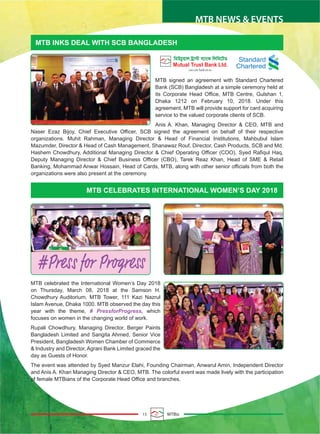
MTB signed an agreement with Standard Chartered
Bank (SCB) Bangladesh at a simple ceremony held at
its Corporate Head Office, MTB Centre, Gulshan 1,
Dhaka 1212 on February 10, 2018. Under this
agreement, MTB will provide support for card acquiring
service to the valued corporate clients of SCB.
Anis A. Khan, Managing Director & CEO, MTB and
Naser Ezaz Bijoy, Chief Executive Officer, SCB signed the agreement on behalf of their respective
organizations. Muhit Rahman, Managing Director & Head of Financial Institutions, Mahbubul Islam
Mazumder, Director & Head of Cash Management, Shanawaz Rouf, Director, Cash Products, SCB and Md.
Hashem Chowdhury, Additional Managing Director & Chief Operating Officer (COO), Syed Rafiqul Haq,
Deputy Managing Director & Chief Business Officer (CBO), Tarek Reaz Khan, Head of SME & Retail
Banking, Mohammad Anwar Hossain, Head of Cards, MTB, along with other senior officials from both the
organizations were also present at the ceremony.
MTB celebrated the International Women’s Day 2018
on Thursday, March 08, 2018 at the Samson H.
Chowdhury Auditorium, MTB Tower, 111 Kazi Nazrul
Islam Avenue, Dhaka 1000. MTB observed the day this
year with the theme, # PressforProgress, which
focuses on women in the changing world of work.
Rupali Chowdhury, Managing Director, Berger Paints
Bangladesh Limited and Sangita Ahmed, Senior Vice
President, Bangladesh Women Chamber of Commerce
& Industry and Director, Agrani Bank Limited graced the
day as Guests of Honor.
The event was attended by Syed Manzur Elahi, Founding Chairman, Anwarul Amin, Independent Director
and Anis A. Khan Managing Director & CEO, MTB. The colorful event was made lively with the participation
of female MTBians of the Corporate Head Office and branches.
Standard
Chartered
16 MTBiz
INDUSTRY APPOINTMENTS
NATIONAL NEWS
BB gets new Deputy Governor
Ahmed Jamal has recently been
promoted as Deputy Governor of
Bangladesh Bank. Prior to his
promotion, he held the position of
Executive Director since May 12,
2012. Jamal joined the central
bank as an Assistant Director in
1984.
Prime Bank gets new AMD
Habibur Rahman has been
promoted to the position of
Additional Managing Director of
Prime Bank Limited. Prior to his
promotion, he held the position of
Deputy Managing Director of the
same bank. He started his banking
career with AB Bank Limited in 1985. In 1986, Rahman
joined central bank as Assistant Director. He worked
there for long 20 years. Later, he joined Prime Bank
Limited in the year 2006.
City Bank’s new DMD
Mohammad Mahbubur Rahman
has recently been promoted as
Deputy Managing Director of The
City Bank Limited. Prior to his
promotion, he held the position of
Chief Financial Officer of the bank.
Mahbub earlier served the World
Bank as the financial management specialist for South
Asia. He also worked with Leads Corporation as chief
financial officer and Grameenphone in various
capacities including head of revenue accounting.
UCB gets new DMD
Nabil Mustafizur Rahman joined
United Commercial Bank Limited
(UCB) as Deputy Managing
Director. Prior to joining UCB, he
was the Chief Executive Officer of
Transbangla Group. He also
worked with BRAC Bank Limited as
Deputy Managing Director and Chief Risk Officer. Nabil
started his career in Hong Kong and worked in different
general management roles with BRAC Bank Limited,
SCB, HSBC, AB Bank Limited, IPDC of Bangladesh,
Credit Agricole Indosuez, ANZ Grindlays Bank and
Beximco Group.
Luna Shamsuddoha, First Female Chairman for a State
Bank
Luna Shamsuddoha, a prominent
ICT entrepreneur, recently took
over as the Chairman of Janata
Bank Limited (JBL), being the first
woman Chairman of any
state-owned bank in the country.
Since June 2016, she has been a
member of the board of directors of JBL. She also
served, from 2009 to 2012, as a member of the board of
directors of Agrani Bank Limited, another state-owned
lender. Luna is the Chairman of Dohatec New Media
and Managing Director of Global Voice
Telecommunications Limited.
New AMD for UCB
Mohammad Mamdudur Rashid
has recently been appointed as
Additional Managing Director of
United Commercial Bank Limited
(UCB). Prior to the appointment,
he was the Additional Managing
Director and head of wholesale
banking, BRAC Bank Limited. Rashid served Citibank in
Australia and New Zealand. He also worked as Chief
Operating Officer of Citibank, Bangladesh.
Premier Bank gets new AMD
Abdul Jabbar Choudhury has been
appointed as Additional Managing
Director of Premier Bank Limited
recently. Earlier, he held the
position of Deputy Managing
Director of United Commercial
Bank Limited. During his long
banking career, he worked in general banking, foreign
exchanges, credit, legal and recovery divisions of
different banks.
New DMD for Shahjalal Islami Bank
Shahjalal Islami Bank Limited has
recently appointed Mian Quamrul
Hasan Chowdhury as Deputy
Managing Director. He started his
banking career with Bangladesh
Bank as an Assistant Director in
1993. Later, he joined United
Commercial Bank Limited as Senior Vice President in
2008.
17 MTBiz
DASHBOARD
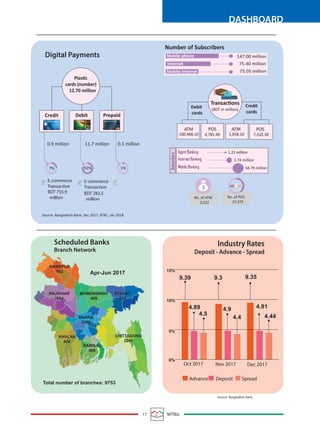
Source: Bangladesh Bank, Dec 2017; BTRC, Jan 2018
Digital Payments 147.00 million
75.40 million
75.05 million
Number of Subscribers
Mobile phone
Mobile Internet
Internet
Plastic
cards (number)
12.70 million
Credit Debit Prepaid
0.9 million 11.7 million 0.1 million
E-commerce
Transaction
BDT 755.9
million
E-commerce
Transaction
BDT 282.5
million
7% 92% 1%
Scheduled Banks
Branch Network
Apr-Jun 2017
RANGPUR
662
RAJSHAHI
1024
MYMENSINGH
409
SYLHET
745
DHAKA
3246
KHULNA
932
BARISAL
495
CHITTAGONG
2240
Industry Rates
Deposit - Advance - Spread
Source: Bangladesh Bank
Advance Deposit Spread
Dec 2017Nov 2017Oct 2017
15%
10%
5%
0%
9.3
4.9 4.91
4.4 4.44
9.39 9.35
4.89
4.5
Total number of branches: 9753
Debit
cards
Credit
cards
No. of ATM
9,522
No. of POS
37,379
POS
4,781.40
ATM
100,468.10
ATM
1,058.20
POS
7,532.30
1.74 million
1.21 million
58.79 millionMobile Banking
Internet Banking
Agent Banking
Subscribers
Transactions
(BDT in million)
18 MTBiz
DASHBOARD
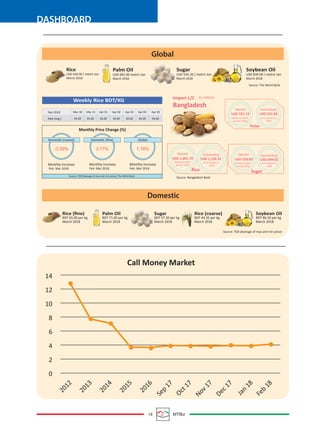
Domestic (coarse) Domestic (fine) Global
-3.30%
Monthly Increase
Feb- Mar 2018
3.17%
Monthly Increase
Feb- Mar 2018
1.18%
Monthly Increase
Feb- Mar 2018
Monthly Price Change (%)
Weekly Rice BDT/KG
Rice
USD 430.00 / metric ton
March 2018
Palm Oil
USD 681.00 metric ton
March 2018
Sugar
USD 545.20 / metric ton
March 2018
Soybean Oil
USD 834.00 / metric ton
March 2018
Source: TCB (Average of max and min price), The World Bank
Source: The World Bank
Source: Bangladesh Bank
(in million)
Rate (Avg.) 44.00 44.00 44.00
Apr 01Mar 30 Mar 31
44.00
Apr 02
44.00
Apr 03
44.00
Apr 04
44.00
Apr 05Year 2018
Global
Domestic
Import L/C
Opened
USD 533.03 USD 649.02
(during July 2017-
January 2018)
(during July 2017-
January 2018)
(as on January 31,
2018)
Outstanding
USD 1,133.32
(as on January 31,
2018)
OutstandingOpened
USD 1,601.70
(during July 2016-
January 2018)
(as on January 31,
2018)
Opened Outstanding
USD 191.19 USD 231.85
Bangladesh
SugarRice
Pulse
Rice (fine)
BDT 65.00 per kg
March 2018
Palm Oil
BDT 71.00 per kg
March 2018
Sugar
BDT 57.30 per kg
March 2018
Rice (coarse)
BDT 44.35 per kg
March 2018
Soybean Oil
BDT 86.50 per kg
March 2018
Source: TCB (Average of max and min price)
Call Money Market
14
12
10
8
6
4
2
0
2012
2013
2014
2015
2016
Sep
17
Oct17
Nov17
Dec17
Jan
18
Feb
18
19 MTBiz
DASHBOARD
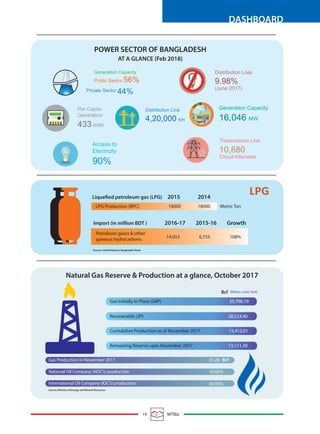
Natural Gas Reserve & Production at a glance, October 2017
Bcf
Gas Initially in Place (GIIP) 35,796.19
Recoverable (2P) 28,523.40
Gas Production in November 2017 83.28
National Oil Company (NOC’s) production 39.05%
International Oil Company (IOC’s) production 60.95%
(Billion cubic feet)
Cumulative Production as of November 2017 15,412.01
Remaining Reserve upto November 2017 13,111.39
Source: Ministry of Energy and Mineral Resources
Generation Capacity
Public Sector 56%
Private Sector
Per Capita
Generation
433 KWh
Distribution Line
4,20,000 km
Distribution Loss
9.98%
(June 2017)
Access to
Electricity
90%
Transmission Line
10,680
Circuit Kilometer
Generation Capacity
16,046 MW
POWER SECTOR OF BANGLADESH
AT A GLANCE (Feb 2018)
44%
Liquefied petroleum gas (LPG) 2015 2014
Import (in million BDT ) 2016-17 2015-16 Growth
LPG Production (BPC) 18000
14,053 6,755 108%
18000 Metric Ton
Petroleum gases & other
gaseous hydrocarbons
LPG
Bcf
Source: United Nations; Bangladesh Bank
20 MTBiz
ECONOMIC FORECAST
INTERNATIONAL NEWS
GETTING STRONGER, BUT TENSIONS ARE RISING_OECD
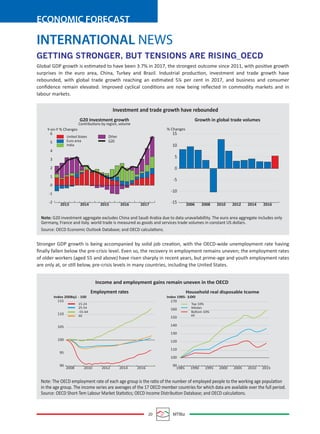
Global GDP growth is estimated to have been 3.7% in 2017, the strongest outcome since 2011, with positive growth
surprises in the euro area, China, Turkey and Brazil. Industrial production, investment and trade growth have
rebounded, with global trade growth reaching an estimated 5¼ per cent in 2017, and business and consumer
confidence remain elevated. Improved cyclical conditions are now being reflected in commodity markets and in
labour markets.
Stronger GDP growth is being accompanied by solid job creation, with the OECD-wide unemployment rate having
finally fallen below the pre-crisis level. Even so, the recovery in employment remains uneven; the employment rates
of older workers (aged 55 and above) have risen sharply in recent years, but prime-age and youth employment rates
are only at, or still below, pre-crisis levels in many countries, including the United States.
Income and employment gains remain uneven in the OECD
Employment rates Household real disposable Icome
Index 1985- 100Index 2008q1 - 100
Top 10%
Medan
Bottom 10%
All
15-24
25-54
-55-64
All
115
110
105
100
95
90
170
160
150
140
130
120
110
100
90
2008 2010 2012 2014 2016 1985 1990 1995 2000 2005 2010 2015
Note: The OECD employment rate of each age group is the ratio of the number of employed people to the working age population
in the age group. The income series are averages of the 17 OECD member countries for which data are available over the full period.
Source: OECD Short-Tem Labour Market Statistics; OECD Income Distribution Database; and OECD calculations.
Note: G20 investment aggregate excludes China and Saudi Arabia due to data unavailabillity. The euro area aggregate includes only
Germany, France and italy. world trade is measured as goods and services trade volumes in constant US dollars.
Source: OECD Economic Outlook Database; and OECD calculations.
Investment and trade growth have rebounded
G20 Investment growth
Contributions by region, volume
Growth in global trade volumes
Y-on-Y % Changes % Changes
Other
G20
United States
Euro area
India
6
5
4
3
2
1
0
-1
-2
2013 2014 2015 2016 2017
15
10
5
0
-5
-10
-15 2006 2008 2010 2012 2014 2016
21 MTBiz
ECONOMIC FORECAST
Labour markets have become more polarised, with a decline in the share of middle-skill jobs relative to jobs with
higher or lower skill levels. Despite steady declines in unemployment, wage growth generally remains weak,
contributing to popular dissatisfaction with economic performance. Many households have seen little growth in real
disposable incomes over the past decade, particularly those with low incomes.
Growth is set to strengthen further in the next two years
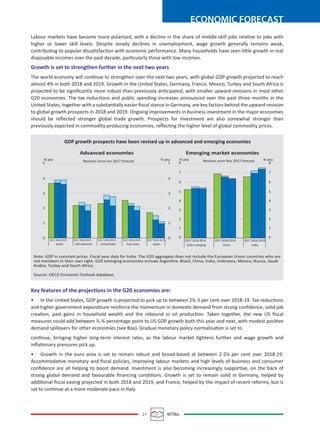
The world economy will continue to strengthen over the next two years, with global GDP growth projected to reach
almost 4% in both 2018 and 2019. Growth in the United States, Germany, France, Mexico, Turkey and South Africa is
projected to be significantly more robust than previously anticipated, with smaller upward revisions in most other
G20 economies. The tax reductions and public spending increases announced over the past three months in the
United States, together with a substantially easier fiscal stance in Germany, are key factors behind the upward revision
to global growth prospects in 2018 and 2019. Ongoing improvements in business investment in the major economies
should be reflected stronger global trade growth. Prospects for investment are also somewhat stronger than
previously expected in commodity-producing economies, reflecting the higher level of global commodity prices.
Key features of the projections in the G20 economies are:
• In the United States, GDP growth is projected to pick up to between 2¾-3 per cent over 2018-19. Tax reductions
and higher government expenditure reinforce the momentum in domestic demand from strong confidence, solid job
creation, past gains in household wealth and the rebound in oil production. Taken together, the new US fiscal
measures could add between ½-¾ percentage point to US GDP growth both this year and next, with modest positive
demand spillovers for other economies (see Box). Gradual monetary policy normalisation is set to
continue, bringing higher long-term interest rates, as the labour market tightens further and wage growth and
inflationary pressures pick up.
• Growth in the euro area is set to remain robust and broad-based at between 2-2¼ per cent over 2018-19.
Accommodative monetary and fiscal policies, improving labour markets and high levels of business and consumer
confidence are all helping to boost demand. Investment is also becoming increasingly supportive, on the back of
strong global demand and favourable financing conditions. Growth is set to remain solid in Germany, helped by
additional fiscal easing projected in both 2018 and 2019, and France, helped by the impact of recent reforms, but is
set to continue at a more moderate pace in Italy.
GDP growth prospects have been revised up in advanced and emerging economies
Advanced economies
Revision since nov 2017 forecast Revision since Nov 2017 forecast
Emerging market economies
% you % you % you % you
5
4
3
2
1
0
5
4
3
2
1
02017 2018 2019 2017 2018 2019 2017 2018 2019 2017 2018 2019 2017 2018 2019 2017 2018 2019 2017 2018 2019 2017 2018 2019
world G20 advanced United Statet Euro area Japan G20 e merging China India
8
7
6
5
4
3
2
1
0
8
7
6
5
4
3
2
1
0
Note: GDP in constant prices. Fiscal year data for India. The G20 aggregate does not include the European Union countries who are
not members in their own right. G20 emerging economies include Argentina. Brazil, China, India, Indonesia, Mexico, Russia, Saudi
Arabia, Turkey and South Africa.
Source: OECD Economic Outlook database.
22 MTBiz
ECONOMIC FORECAST
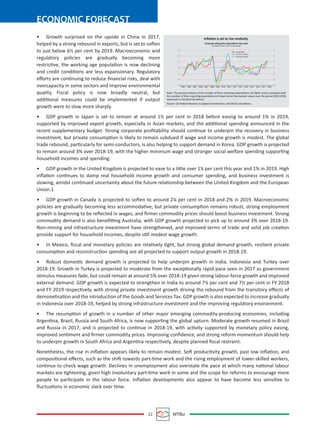
• Growth surprised on the upside in China in 2017,
helped by a strong rebound in exports, but is set to soften
to just below 6½ per cent by 2019. Macroeconomic and
regulatory policies are gradually becoming more
restrictive, the working age population is now declining
and credit conditions are less expansionary. Regulatory
efforts are continuing to reduce financial risks, deal with
overcapacity in some sectors and improve environmental
quality. Fiscal policy is now broadly neutral, but
additional measures could be implemented if output
growth were to slow more sharply.
• GDP growth in Japan is set to remain at around 1½ per cent in 2018 before easing to around 1% in 2019,
supported by improved export growth, especially in Asian markets, and the additional spending announced in the
recent supplementary budget. Strong corporate profitability should continue to underpin the recovery in business
investment, but private consumption is likely to remain subdued if wage and income growth is modest. The global
trade rebound, particularly for semi-conductors, is also helping to support demand in Korea. GDP growth is projected
to remain around 3% over 2018-19, with the higher minimum wage and stronger social welfare spending supporting
household incomes and spending.
• GDP growth in the United Kingdom is projected to ease to a little over 1¼ per cent this year and 1% in 2019. High
inflation continues to damp real household income growth and consumer spending, and business investment is
slowing, amidst continued uncertainty about the future relationship between the United Kingdom and the European
Union.1
• GDP growth in Canada is projected to soften to around 2¼ per cent in 2018 and 2% in 2019. Macroeconomic
policies are gradually becoming less accommodative, but private consumption remains robust, strong employment
growth is beginning to be reflected in wages, and firmer commodity prices should boost business investment. Strong
commodity demand is also benefitting Australia, with GDP growth projected to pick up to around 3% over 2018-19.
Non-mining and infrastructure investment have strengthened, and improved terms of trade and solid job creation
provide support for household incomes, despite still modest wage growth.
• In Mexico, fiscal and monetary policies are relatively tight, but strong global demand growth, resilient private
consumption and reconstruction spending are all projected to support output growth in 2018-19.
• Robust domestic demand growth is projected to help underpin growth in India, Indonesia and Turkey over
2018-19. Growth in Turkey is projected to moderate from the exceptionally rapid pace seen in 2017 as government
stimulus measures fade, but could remain at around 5% over 2018-19 given strong labour force growth and improved
external demand. GDP growth is expected to strengthen in India to around 7¼ per cent and 7½ per cent in FY 2018
and FY 2019 respectively, with strong private investment growth driving the rebound from the transitory effects of
demonetisation and the introduction of the Goods and Services Tax. GDP growth is also expected to increase gradually
in Indonesia over 2018-19, helped by strong infrastructure investment and the improving regulatory environment.
• The resumption of growth in a number of other major emerging commodity-producing economies, including
Argentina, Brazil, Russia and South Africa, is now supporting the global upturn. Moderate growth resumed in Brazil
and Russia in 2017, and is projected to continue in 2018-19, with activity supported by monetary policy easing,
improved sentiment and firmer commodity prices. Improving confidence, and strong reform momentum should help
to underpin growth in South Africa and Argentina respectively, despite planned fiscal restraint.
Nonetheless, the rise in inflation appears likely to remain modest. Soft productivity growth, past low inflation, and
compositional effects, such as the shift towards part-time work and the rising employment of lower-skilled workers,
continue to check wage growth. Declines in unemployment also overstate the pace at which many national labour
markets are tightening, given high involuntary part-time work in some and the scope for reforms to encourage more
people to participate in the labour force. Inflation developments also appear to have become less sensitive to
fluctuations in economic slack over time.
Inflation is set to rise modestly
Corporate selling price expectations have risen
Normalised, three-month moving avarage
3
2
1
0
-1
-2
-.3
3
2
1
0
-1
-2
-.3
United States
Euro area - Industry
Euro area - Services
2003 2004 2005 2006 2007 2008 2009 2010 2011 2012 2013 2014 2015 2016 2017 2018
Note: The percent balance of the number of firms reporting expectations oif higher prices compared with
the number of firms reporting expectations of lower prices Normalised values over the period 2003-2018,
expressed in standard deviations.
Source: US Federal Reserve; European Commission; and OECD calculations.
23 MTBiz
WELLS FARGO MONTHLY OUTLOOK
INTERNATIONAL NEWS WELLS
SECURITIES
FARGO
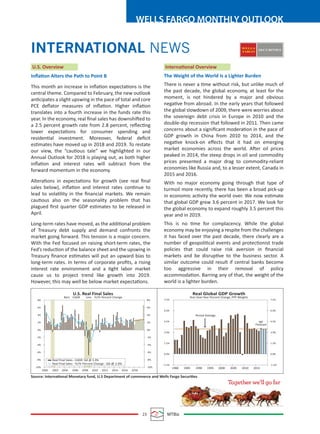
Inflation Alters the Path to Point B
This month an increase in inflation expectations is the
central theme. Compared to February, the new outlook
anticipates a slight upswing in the pace of total and core
PCE deflator measures of inflation. Higher inflation
translates into a fourth increase in the funds rate this
year. In the economy, real final sales has downshifted to
a 2.5 percent growth rate from 2.8 percent, reflecting
lower expectations for consumer spending and
residential investment. Moreover, federal deficit
estimates have moved up in 2018 and 2019. To restate
our view, the “cautious tale” we highlighted in our
Annual Outlook for 2018 is playing out, as both higher
inflation and interest rates will subtract from the
forward momentum in the economy.
Alterations in expectations for growth (see real final
sales below), inflation and interest rates continue to
lead to volatility in the financial markets. We remain
cautious also on the seasonality problem that has
plagued first quarter GDP estimates to be released in
April.
Long-term rates have moved, as the additional problem
of Treasury debt supply and demand confronts the
market going forward. This tension is a major concern.
With the Fed focused on raising short-term rates, the
Fed’s reduction of the balance sheet and the upswing in
Treasury finance estimates will put an upward bias to
long-term rates. In terms of corporate profits, a rising
interest rate environment and a tight labor market
cause us to project trend like growth into 2019.
However, this may well be below market expectations.
The Weight of the World Is a Lighter Burden
There is never a time without risk, but unlike much of
the past decade, the global economy, at least for the
moment, is not hindered by a major and obvious
negative from abroad. In the early years that followed
the global slowdown of 2009, there were worries about
the sovereign debt crisis in Europe in 2010 and the
double-dip recession that followed in 2011. Then came
concerns about a significant moderation in the pace of
GDP growth in China from 2010 to 2014, and the
negative knock-on effects that it had on emerging
market economies across the world. After oil prices
peaked in 2014, the steep drops in oil and commodity
prices presented a major drag to commodity-reliant
economies like Russia and, to a lesser extent, Canada in
2015 and 2016.
With no major economy going through that type of
turmoil more recently, there has been a broad pick-up
in economic activity the world over. We now estimate
that global GDP grew 3.6 percent in 2017. We look for
the global economy to expand roughly 3.5 percent this
year and in 2019.
This is no time for complacency. While the global
economy may be enjoying a respite from the challenges
it has faced over the past decade, there clearly are a
number of geopolitical events and protectionist trade
policies that could raise risk aversion in financial
markets and be disruptive to the business sector. A
similar outcome could result if central banks become
too aggressive in their removal of policy
accommodation. Barring any of that, the weight of the
world is a lighter burden.
U.S. Overview International Overview
Source: International Monetary fund, U.S Department of commverce and Wells Fargo Securities
8%
6%
4%
2%
0%
-2%
-4%
-6%
-8%
-10%
8%
6%
4%
2%
0%
-2%
-4%
-6%
-8%
-10%
2000 2002 2004 2006 2008 2010 2012 2014 2016 2018
Real Global GDP Growth
Year-Over-Year Percent Change, PPP Weights
7.5%
6.0%
4.5%
3.0%
1.5%
0.0%
-1.5%
7.5%
6.0%
4.5%
3.0%
1.5%
0.0%
-1.5%
1980 1985 1990 1995 2000 2005 2010 2015
WF
Forecast
U.S. Real Final Sales
Bars CAGR Line Yr/Yr Percent Change
Real Final Sales - CAGR: Q4 @ 3.3%
Real Final Sales - Yr/Yr Percent Change : Q4 @ 2.0%
Period Average
24 MTBiz
FINANCIAL GLOSSARY
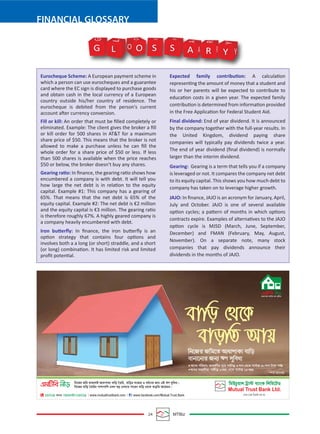
Eurocheque Scheme: A European payment scheme in
which a person can use eurocheques and a guarantee
card where the EC sign is displayed to purchase goods
and obtain cash in the local currency of a European
country outside his/her country of residence. The
eurocheque is debited from the person's current
account after currency conversion.
Fill or kill: An order that must be filled completely or
eliminated. Example: The client gives the broker a fill
or kill order for 500 shares in AT&T for a maximum
share price of $50. This means that the broker is not
allowed to make a purchase unless he can fill the
whole order for a share price of $50 or less. If less
than 500 shares is available when the price reaches
$50 or below, the broker doesn’t buy any shares.
Gearing ratio: In finance, the gearing ratio shows how
encumbered a company is with debt. It will tell you
how large the net debt is in relation to the equity
capital. Example #1: This company has a gearing of
65%. That means that the net debt is 65% of the
equity capital. Example #2: The net debt is €2 million
and the equity capital is €3 million. The gearing ratio
is therefore roughly 67%. A highly geared company is
a company heavily encumbered with debt.
Iron butterfly: In finance, the iron butterfly is an
option strategy that contains four options and
involves both a a long (or short) straddle, and a short
(or long) combination. It has limited risk and limited
profit potential.
Expected family contribution: A calculation
representing the amount of money that a student and
his or her parents will be expected to contribute to
education costs in a given year. The expected family
contribution is determined from information provided
in the Free Application for Federal Student Aid.
Final dividend: End of year dividend. It is announced
by the company together with the full-year results. In
the United Kingdom, dividend paying share
companies will typically pay dividends twice a year.
The end of year dividend (final dividend) is normally
larger than the interim dividend.
Gearing: Gearing is a term that tells you if a company
is leveraged or not. It compares the company net debt
to its equity capital. This shows you how much debt to
company has taken on to leverage higher growth.
JAJO: In finance, JAJO is an acronym for January, April,
July and October. JAJO is one of several available
option cycles; a pattern of months in which options
contracts expire. Examples of alternatives to the JAJO
option cycle is MJSD (March, June, September,
December) and FMAN (February, May, August,
November). On a separate note, many stock
companies that pay dividends announce their
dividends in the months of JAJO.
G O S S A R Y Y
Y
R
R
A
A
S S
O
O
L
L
G
MTB POS

MTBiz March 2018

  • 1.
    MONTHLY BUSINESS REVIEW VOLUME:09 ISSUE: 03 MARCH 2018 Banking on Four Wheels - A New Business Model
  • 3.
    Contents MONTHLY BUSINESS REVIEW VOLUME:09 ISSUE: 03 MARCH 2018 MTBiz Disclaimer: MTBiz is printed for non-commercial & selected individual-level distribution in order to sharing information among stakeholders only. MTB takes no responsibility for any individual investment decision based on the information at MTBiz. This review is for information purpose only and the comments and forecasts are intended to be of general nature and are current as of the date of publication. Information is obtained from secondary sources which are assumed to be reliable but their accuracy cannot be guaranteed. The name of the other companies, products and services are the properties of their respective owners and are protected by copyright, trademark and other intellectual property laws. Developed & Published by MTB Group R&D Please send feedback to: RnD@mutualtrustbank.com All rights reserved @ 2018 Design & Printing: Preview Article of the month 02 National News The Central Bank 05 Business & Economy 07 MTB News & Events 12 Industry Appointments 16 Dashboard 17 International News Economic Forecast 20 Wells Fargo Monthly Outlook 23 Financial Glossary 24
  • 4.
    02 MTBiz ARTICLE OFTHE MONTH The neatly dressed savings bank executive jumps behind the wheel four days a week to bring mobile services including cash machine and consultation room to tiny countryside villages. The switch from desk to dashboard has enabled Bank manager "to do something else while staying in touch with the customers". High-street banks are increasingly being forced to shutter branches, as more and more customers go online, rural populations shrink and low interest rates eat into profits. As a result, banks are having to rethink their business models. Banking on Four Wheels - A New Business Model
  • 5.
    03 MTBiz ARTICLE OFTHE MONTH Who comes to bank here The European average is 37 per 100,000, with Spaniards the most spoiled for choice with 67. A sales director for the Kronach-Kulmbach Sparkasse, said it was primarily local businesses and older people who had not embraced online banking who were taking advantage of the mobile branch, which first set off on its rounds in 2015. Who comes to bank here The European average is 37 per 100,000, with Spaniards the most spoiled for choice with 67. A sales director for the Kronach-Kulmbach Sparkasse, said it was primarily local businesses and older people who had not embraced online banking who were taking advantage of the mobile branch, which first set off on its rounds in 2015. Not making money Haberzettl estimated that around 20 people visited the bank at each stop, equivalent to 12,000 customer contacts a year -- a tiny number compared with some 8,800 online banking logins per day.
  • 6.
    04 MTBiz ARTICLE OFTHE MONTH Keeping the sector relevant Banking sector experts predict that the Europe-wide trend towards fewer bank branches will continue apace. "The speed at which it will happen is hard to predict, and will depend above all on how the banks manage to keep branches relevant as a channel for their customers," said Thomas Schnarr of consultancy Oliver Wyman. Human relationships remain fundamental Nevertheless, "human relationships remain fundamental. Especially complicated questions require personalised advice for retail clients and businesses", his colleague Alexander Peitsch said. For his part, Juergen Schaller said he is not qualified to provide such specialist counselling to his clients, many of whom know him by name. Instead, he passes on individual requests for loans or investments to a colleague sitting in one of the Sparkasse's brick-and-mortar branches. Bangladesh Van Banking Mobile ATM booth DBBL’s innovation and standard of customer service reached new heights by setting another milestone in the history of the banking sector by adding two units of Mobile ATM booths to its existing ATM network. DBBL is the first bank in Bangladesh to provide such unique services and convenience to customers. The Mobile ATM booth is designed in a custom-made truck and is available anytime, anywhere and allows customers to deposit cash/cheque, withdraw cash, inquire account balance, print mini statement, pay utility bills and to access all these services offered by a standard ATM. Now DBBL mobile ATM booths are very popular at EPZs, industries and different trade fairs and exhibitions.
  • 7.
    05 MTBiz THE CENTRALBANK NATIONAL NEWS BB strengthens forex support for banks The Bangladesh Bank (BB) has strengthened its foreign currency support to the commercial banks to settle their import payment obligations, particularly for fuel oils. The central bank may continue to provide such foreign currency support to the banks in line with the market requirement. BB has resumed giving the support in recent months through selling the US currency to the banks directly to keep the market stable. A total of USD 1.63 billion was sold to the commercial banks since July 01 of this fiscal year, 2017-18, as a part of its ongoing support, according to BB's latest data. The market operators, meanwhile, said the demand for the US dollar is increasing gradually, mainly due to higher import payment pressure, particularly of capital machinery, petroleum products, consumer items and food grains. Remittance rises 16pc in Jul-Feb Remittance inflow rose by 16.56 per cent in seven months of the current fiscal year 2017-2018 compared with that in the same period of last year as non-resident Bangladeshis increased sending money through the formal channel in recent months because of rise in the value of the dollar against the BDT. The total inflow of remittance in July-February stood at USD 9.46 billion in FY18 against USD 8.12 billion the country received during the same period of last fiscal year, according to Bangladesh Bank data. In February, remittance inflow increased by 22.13 per cent to USD 1,149 million against USD 940.75 million during the same month of last year. Six state-owned commercial banks — Agrani, Janata, Rupali, Sonali, BASIC and BDBL— received USD 284.85 million while one state-owned specialised bank, Bangladesh Krishi Bank, received USD 10.96 million. Of the state-owned banks, Agrani Bank received USD 115.51 million, Janata Bank USD 67.91 million, Rupali Bank USD 13.47 million, Sonali Bank USD 87.83 million and BASIC Bank USD 0.13 million. Besides, the expatriates have sent USD 12.60 million through foreign commercial banks. Among the private commercial banks, Islami Bank Bangladesh received the highest amount of USD 229.95 million as Dutch-Bangla Bank received USD 59.56 million. NRBs can buy wage earner bond thru their or beneficiaries’ BDT accounts Bangladesh Bank recently said expatriate Bangladeshis would be able to purchase wage-earner development bond by BDT fund credited in their non-resident BDT account in the country or in resident BDT accounts of their beneficiaries. Foreign exchange policy department of the central bank clarified the issue through a circular following confusion regarding methods of payment and utilisation of fund held in BDT accounts fed by inward wage remittances for purchase of WEDB. BDT fund credited in non-resident BDT account of Bangladesh nationals residing abroad or in resident BDT accounts of their beneficiaries against inward remittances through normal banking channel or authorised exchange house channel is eligible to purchase WEDB, the circular said. It also asked all authorised dealers in the country to take steps in line with the circular. The circular was issued in line with the paragraph 12 of the Wage-Earner Development Bond Rules, 1981, which describes different methods of payment for the purchase of a bond. BDT 342cr deposited in schoolchildren’s accounts in 2017 The total deposits in the bank accounts owned by schoolchildren in the country increased by 33.52 per cent or BDT 342 crore to BDT 1,363 crore as of December 31, 2017 from that of BDT 1,021 crore as of December 31, 2016. The number of school banking accounts also rose by 15.59 per cent to 14.53 lakh at the end of December 31, 2017 compared with that of 1.96 lakh a year ago, Bangladesh Bank (BB) data showed. The balance in the schoolchildren’s accounts increased by BDT 262 crore in the last quarter of 2017 against an increase of BDT 80 crore in the first three quarters of the year. Deposits in the school banking accounts increased significantly in the last quarter of the year as banks offered higher interest rates on deposits during the period amid their drives to collect deposits. The BB on November 02, 2010 asked banks to launch the deposit product for students to infuse them with the urge to save up. Fifty-six of the country’s 57 scheduled banks are now implementing the programme.
  • 8.
    06 MTBiz THE CENTRALBANK Pvt sector credit growth jumps in Feb The new monetary policy is failing to contain the private sector credit growth with the rate rising to 18.49 per cent in February although the bank owners have already bagged a number of facilities pleading liquidity crisis. The private sector credit growth was 18.36 per cent in January whereas Bangladesh Bank in the monetary policy for January-June of financial year 2017-2018 set a target of 16.8 per cent for the period. The average private sector credit growth fell to 15.66 per cent in financial year 2016-2017 from 16.78 a year ago as the banks were grappling with excess liquidity. Bangladesh Association of Banks chairman Md Nazrul Islam Mazumder informed that the BDT 10,000 crore would be released in favor of banks due to the CRR relaxation. The latest BB directive allowed banks another six months till December 31, 2018 to bring down ADR within the BB set limit. The BB data also showed that the domestic credit increased to BDT 9,55,852.9 crore including BDT 8,62,224.8 crore in the private sector. BB eases forex rules for shipping lines The central bank has relaxed foreign exchange regulations allowing the shipping lines to issue bills of lading to the name of importers after receiving advance payment instead the name of banks earlier. Under the relaxations, authorised dealers (ADs) in foreign exchange banks will issue a certificate to the exporter in the prescribed form to be produced to the carrier company, enabling them to draw the shipping documents accordingly. The central bank issued a circular in this connection and asked the all ADs banks to follow the latest regulations properly. The BB in its circular said: "It has now been decided that ADs may allow carrier companies to draw railway receipts, bills of lading, airway bills and other documents of title to cargo to the order of importer or other designated parties as per stipulations of export letter of credit/valid sales contract only if the shipment is made against full payment received in advance through normal banking channel." The central bank had earlier allowed shipping lines, air lines and multimodal transport operators to open and maintain foreign currencies accounts with the banks to facilitate foreign trade. We mourn, with great sadness, the passing away of Mr. Mohammad Shafi, Managing Director, Sheema Group, one of the most valued clients of Mutual Trust Bank Limited on March 15, 2018. Mohamamd Shafi was born on May 02, 1956 in a respectable and established business family in Chattogram. He established S trading Corporation in 1992 and Sheema Automatic Re-Rolling Mills Limited (SARM) in 2001. Mr. Shafi was a founding member as well as a Vice Chairman at the current committee, Bangladesh Ship Breakers’ Association. He was also a member of Gawsia Committee Bangladesh. He left three sons and one daughter along with innumerable of well-wishers. WE MOURN: THE PASSING AWAY OF MR. MOHAMMAD SHAFI (1956-2018) Private sector credit growth in last 9 months 20 15 10 5 0 (In Per cent) June,2017 July,2017 Aug,2017 Sept,2017 Oct,2017 Nov,2017 Dec,2017 Jan,2018 Feb,2018 15.66 15.94 17.84 17.8 18.63 19.06 18.13 18.36 18.49
  • 9.
    07 MTBiz BUSINESS &ECONOMY NATIONAL NEWS BD attained all criteria for LDC graduation B a n g l a d e s h entered the graduation process of earning the official title of " d e v e l o p i n g country" from a "least developed country (LDC)" country. The UN Committee for Development Policy (CPD) handed over a letter to Bangladesh's Permanent Ambassador to the UN, Masud Bin Momen, announcing Bangladesh’s eligibility for graduation to the developing country status in New York. Information posted on the UN website said Bangladesh, which has been on the UN Least Developed Countries (LDC) list since 1975, met the requirements to enter the graduation process of being a developing country in March, 2018. The final graduation and the eventual earning of the title of "developing country" depend on meeting eligibility criteria scores in Gross National Income (GNI) per capita, the Human Assets Index (HAI) and the Economic Vulnerability (EVI) Index and other country-specific information. The scores required for graduation from the LDC category are, a per capita GNI of USD 1,230 or above, an HAI of 66 or above and an EVI of 32 or below. Bangladesh’s current GNI per capita is USD 1,724, HAI is 72 and EVI 25.2. ACI Limited has 67.50 per cent stake in the ACI Motors ACI Limited, which operates through 14 subsidiaries and three joint ventures, was listed on the Dhaka Stock Exchange (DSE) in 1976. The pharmaceuticals & chemicals sector company belongs to the "A" category. Each share of the ACI Limited closed at BDT 396.30 at the Dhaka bourse on Sunday, registering an increase of 1.33 per cent over the previous session. The company disbursed 115 per cent cash and 10 per cent stock dividend for the year ended on June 30, 2017. The company's paid-up capital is BDT 482.02 million and authorised one is BDT 500 million. Its total number of securities is 48.20 million. The sponsor-directors own 44.30 per cent stake in the company, while institutional investors 28.79 per cent and the general public 26.91 per cent as on February 28, 2018, the DSE record shows. Economy marches towards record 7.65pc growth The Bangladesh economy is charging towards record growth figure for the s e c o n d consecutive year, driven by double-digit growth in manufacturing and construction sectors. GDP growth in fiscal 2017-18 is likely to be 7.65 percent, up from 7.28 percent a year earlier, as per the estimate of the Bangladesh Bureau of Statistics. This is the third consecutive year that the economic growth was above 7 percent after years of languishing in the neighbourhood of 6 percent. The provisional estimates show that the manufacturing sector grew 13.18 percent this fiscal year and the construction sector 10.11 percent. The provisional figures are based on data from the past 6 to 9 months. In dollar term, the GDP size is USD 274.5 billion this fiscal year, which was USD 249 billion last year. The country's per capita income is USD 1,752, which was USD 1,610 in fiscal 2016-17. The BBS data shows that the agriculture sector, whose contribution to the GDP is 14.10 percent, grew 3.06 percent in fiscal 2017-18, up from 2.97 percent last year. Furniture export sees 32pc growth in July-Feb Furniture export maintained a steady growth in the first eight months of the current fiscal (FY2017-18) as the country exported furniture products worth USD 3.76 crore, up by 32 per cent from the same period of the previous fiscal (FY17). Furniture items worth USD 2.85 crore were exported in July-February period of FY17. Furniture products are becoming popular in different parts of the world, particularly in middle-income countries, because of innovative design, quality wood and technical skills, said president of Bangladesh Furniture Exporters’ Association (BFEA) KM Akhtaruzzaman. He said the furniture industry has been able to consolidate its position in domestic market over the last ten years. The manufacturers are now producing quality products with innovative designs, he added. THREE CRITERIA FOR ELIGIBILITY Gross National Income Human Assets Index Economic Vulnerability Index Required $1,230 or above 66 or above 32 or below Bangladesh score $1,272 72.8 25 GDP GROWTH TRENDS Figures in %; *Provisional FY2014 FY2015 FY2016 FY2017 FY2018* 6.06 6.55 7.11 7.28 7.65
  • 10.
    08 MTBiz BUSINESS &ECONOMY Handset import rises 10pc despite duty hike Handset imports rose 9.6 percent to 3.4 crore units last year despite a spike of 5 percentage points in import duty. Given the advent of 4G services and greater use of digital services, the industry was expecting that more than one crore units of smartphones would be imported in 2017. With the view to promoting local manufacturing, the government in June last year raised the import duty for handsets to 31 percent. In 2017, mobile phone importers contributed about BDT 1,500 crore to the national exchequer by way of different kinds of taxes, according to the BMPIA, which has 70 members, 20 of whom are importers. The value of the imported devices BDT 9,500 crore also marked an 18.75 percent year-on-year increase. South Korean mobile giant Samsung accounted for 26 percent of the import value in 2017 and 14 percent in terms of volume. Industry insiders hope to see a 30 percent rise in smartphone usage in 2018. Internet users jump by 29.0pc Some 49 per cent of country's total population are now under the network of internet on the back of the growing use of digital platforms in the country. The disclosure came in a new Global Digital Report prepared by 'We Are Social and Hootsuite', a social media management platform. The number of internet users in Bangladesh jumped 29.0 per cent within a year, according to the report. It showed that the total number of internet users stood at 81.66 million by the end of 2017. More than 90 per cent of the Bangladeshi internet users are using internet through mobile phone devices. The report mentioned that the number of internet users through the mobile phone devices stood at 76.22 million. It also showed that the total number of mobile phone connections stood at 137.2 million by the end of the past year. As a result, some 83 per cent of Bangladeshi people now own mobile phones. LG, Butterfly to make LED TV locally South Korean electronics giant LG Electronics is set to manufacture LED televisions, refrigerators and air conditioners in Bangladesh, following in the lead of its compatriot Samsung. LG's local partner Butterfly has shelled out USD 100 million to set up a plant on 50 acres of land in Bhaluka. Since June last year, Samsung has been manufacturing four home appliance products in the two factories it set up with Transcom Group and Fair Electronics in the capital's Mohakhali area and Narsingdi respectively. LG will extend technical support to Butterfly for manufacturing TVs locally. Butterfly has already been manufacturing LED TVs at the plant on a trial basis for the last three years. At present, Butterfly sells 100,000 units of LG-branded LED TVs a year. The company is targeting sales of 300,000 units in three years' time. The demand for TVs in Bangladesh is 10 lakh units a year. For instance, LG and Butterfly sold electronics worth BDT 750 crore in fiscal 2014-15, which went up to BDT 900 crore in fiscal 2015-16 and BDT 1,200 crore in fiscal 2016-17. UK to continue tariff-free market access for BD goods The United Kingdom has reiterated its pledge to continue tariff-free access for Bangladeshi goods to its market after leaving the European Union. The both sides agreed that trade was an important tool in tackling poverty, and that increasing bilateral trade could bring significant benefits to both countries. The both sides affirmed their strong commitment to the implementation of the "2030 Agenda for Sustainable Development" including Sustainable Development Goals. The UK and Bangladesh reiterated the importance of coordinated global action on climate change and reaffirmed their strong support for early and effective implementation of the Paris Agreement of 2015. The UK and Bangladesh reaffirmed their support for the Commonwealth and looked forward to the Commonwealth Heads of Government Meeting to be held in London in April 2018. The both sides agreed to arrange appropriate celebrations in London and Dhaka in 2022 to mark the 50th anniversary of the establishment of diplomatic relations between the UK and Bangladesh. HANDSET IMPORTS IN 2017 Market share in % (as per import value of brands) 3% 9% 26% 21% 13% 3% 4% 5% 6% 10% SAMSUNG WALTON LAVA XIAOMI ITEL NOKIA OTHERS SYMPHONY HUAWEI OPPO SOURCE: BMPIA INTERNET USEBASED ON REPORTED INTERNET USER DATA, AND ACTIVE USE OF INTERNET-POWERED MOBILE SERVICES TOTAL NUMBER OF ACTIVE INTERNET USERS Sources: INTERNET WORLDSTATS MILLION 81.66 MILLION 76.2249% 46% we are social we are social we are social INTERNET USERS AS A PERCENTAGE OF THE TOTAL POPULATION TOTAL NUMBER OF ACTIVE MOBILE INTERNET USERS MOBILE INTERNET USERS AS A PERCENTAGE OF THE TOTAL POPULATION Hootsuite JAN 2018 Life’s Good Committed to care AT A GLANCE LG’s local partner Butterfly has shelled out $ m to set up a plant on acres of land in Bhaluka Butterfly has been manufacturing LED TVs at the plant on a trial basis for the last three years At present, Butterfly sells units of LG-Branded LED TVs a year 100 100,000 The company targets to sell units annually in three years 300,000 LG and Butterfly sold electronics worth Tk cr in Bangladesh in1,200 2016-17 The demand for TVs in Bangladesh is lakh units a year10 50
  • 11.
    09 MTBiz BUSINESS &ECONOMY Plastic industry shows promise as demand rises The plastic industry has been growing at about 20 percent a year on the back of spiraling demand from domestic and export markets. In fiscal 2017-18, the domestic market size of plastic products hit BDT 25,000 crore, according to the Bangladesh Plastic Goods Manufacturers and Export Association (BPGMEA). Plastic exports rose 31 percent year-on-year to USD 117 million last fiscal year, according to data from the Export Promotion Bureau. Bangladesh currently manufactures 142 plastic items and the number is increasing by the day. The country mainly exports intermediate products like film plastic, household items and garment accessories to the US, Canada, the Europe, China, India and Nepal. Bangladesh has only 0.6 percent share of the USD 546 billion global plastic market. The BPGMEA has set a target to occupy 3 percent of the global market by 2030 and the government is providing 10 percent cash incentive to the exporters. As of now, total investment in the sector is around BDT 20,550 crore. The plastic sector is the 12th highest earning export sector in Bangladesh. Bicycle industry shows promise as export earnings grow Bangladesh’s bicycle industry, an emerging export sector, has huge potential in the global market as export earnings are growing by around 9 per cent per year. As of 2016, Bangladesh had a market share of 11 per cent in the bicycle industry in the European Union (EU) countries and the country is the third largest exporter. During the first eight months (July–February) of the 2017–18 fiscal year, Bangladesh earned nearly USD 57 million by exporting bicycles, especially to the EU market. During the same period in the 2016–17 financial year, the earnings totaled USD 52.54 million. The growth rate is approximately 9 per cent compared to the previous year. Bangladeshi bicycles are exported to 18 countries, including the UK, the Netherlands, Germany, Italy, Greece, Ireland, Belgium, Denmark, Australia and Portugal. Industry people and analysts have said the country has the capacity to earn nearly BDT. 1,000–1,500 crore from bicycle exports within a couple of years, if the import duty on cycle raw materials is reduced. Drug makers’ profits soar Most listed p h a r m a c e u ti c a l s companies saw their profits swell in 2017, thanks to higher expense on healthcare. Of the 15 listed pure-play p h a r m a c e u ti c a l companies, 11 announced an increase in profits. Beacon Pharmaceuticals saw its profits soar 79.31 percent year-on-year to BDT 12 crore in 2017, according to Prime Finance Asset Management. Pharma Aids and Libra Infusions were in second and third positions respectively in terms of profit growth. Square, Beximco, and Ibn Sina also logged in double-digit profit growth last year. The local market of Bangladesh is a very big and going to be bigger with the increase of net income of people. In 2010, per capita healthcare expense in Bangladesh was USD 23, which rose to USD 37 in 2015, according to World Bank statistics. Bangladesh's pharmaceuticals market doubled between 2012 and 2017. In 2012, the market size stood at BDT 9,390.4 crore and rose to BDT 18,755.6 crore in 2017, according to IMS Health Care Report 2017. BPO sector grows by 19 times in 5 years Riding on a huge growth wave for a couple of years, the income of the business process outsourcing (BPO) sector in Bangladesh rose by more than 24 per cent year on year to about USD 230 million in 2017. In 2009, only around 300 people used to work in this industry. Now, after nine years, around 40,000 people are working in some 120 companies in the BPO sector, Towhid Hossain, secretary general of the Bangladesh Association of Call Centre and Outsourcing, told The Independent. On average, 20,000 to 25,000 people are employed in this sector every year. In 2017, the earnings were USD 230 million, up from USD 160 million in 2016. Muntaqim BPO Services Ltd provides accounting services to small and medium-sized businesses and individual taxpayers. Digicon Technologies Ltd is another foremost outsourcing organization in Bangladesh, leading in BPO and IT solutions. NATIONAL NEWS Plastic industry growing at pc a year20 Domestic market size of plastic products: Tk cr25,000 Global Market size: $ b546 Bangladesh exports plastic products to us, Canada, EU, China, India and Nepal Bangladesh’s share in global market only pc0.6 Export (in million $) SOURCE: EPB 85 2012-13 2013-14 2014-15 2015-16 2016-17 86 101 89 117 THINGS TO KNOW PROFIT GROWTH IN 2017 (year-on-year) SOURCE: PRIME FINANCE ASSET MANAGEMENT BeaconPharma PharmaAids LibraInfusions SquarePharma BeximcoPharma IbnSina Renata Acme GlaxoSmithkline JMISyringes 23.9 20.46 16.97 13.15 7.5 6.36 3.91 2.09 79.31 54.72
  • 12.
    10 MTBiz BUSINESS &ECONOMY BD economy to grow 7.0pc in FY18: ADB Bangladesh economy is likely to grow by 7.0 per cent in the current fiscal year, according to the latest projection of the Asian Development Bank (ADB). The Manila-based international lender organisation also projected that annual inflation rate may reach at 6.10 per cent in FY18. The Asian Development Outlook (ADO-2018), released today across the region, unveiled the latest projection. GDP growth is expected to moderate to 7.0% in FY2018 as consumption demand slackens despite a rebound in worker remittances, said the ADO. Remittance beneficiaries are likely to adopt a cautious approach to spending, repaying debt incurred in recent years of remittance declines, it added. The World Bank, however, strongly differed with the BBS estimation and mentioned that the growth may stand at 6.50 per cent. Analysing the current trend of Bangladesh economy, the ADB pointed out that private investment would edge up with support from an accommodative credit policy, and public investment would expand as the ‘authorities seek to speed the implementation of infrastructure projects’. The ADB also forecast the GDP growth for Bangladesh at 7.2 per cent in the next fiscal year (FY19). Economy to grow at 6.5pc in this fiscal, says WB The World Bank has expressed its doubt over the Bangladesh's 7.65 per cent economic growth projection for the current fiscal year (FY) raising questions about data accuracy. The robust growth projection for the current fiscal is doubtful as some government statistics doesn't match with it (projection), said the bank's lead economist in Dhaka Zahid Hussain. The Bangladesh Bureau of Statistics, the state statistical agency, has recently said that Bangladesh's gross domestic product (GDP) is expected to grow at 7.65 per cent rate in the current financial year 2017-18, which is even higher than its 7.5 per cent target. In contrast, the Washington-based lender said that Bangladesh's GDP growth is expected to grow at 6.5 per cent rate in the current FY2018. The WB economist said the service sector growth rate had declined to 6.3 per cent in the current FY2018 from 6.7 per cent in FY2017, its employment rose by 1.76 million or nearly 8.0 per cent in the current fiscal. He said that the BBS has showed a 7.0-8.0 per cent per capita consumption growth in the current fiscal, although it was recorded at 1.4 per cent on an average between 2010 and FY2017.
  • 13.
  • 14.
    12 MTBiz MTB NEWS& EVENTS HONORABLE SPEAKER HANDS OVER A CHEQUE TO MTB WOMEN ENTREPRENEUR MTB FINANCES WOMEN'S DEVELOPMENT CENTRE IN BHOLA Bangladesh Bank (BB), in association with banks and NBFIs, organized a “Banker–SME Women Entrepreneur Conference and Product Display Fair-2018” at the Bangladesh Shishu Academy on Thursday, March 08, 2018. Dr. Shirin Sharmin Chaudhury, Honorable Speaker of Parliament of Bangladesh, is seen handing over a cheque to a women entrepreneur, Shabana Akter. Ms. Akter is the owner of Subin Dental Care and a valued client of Mutual Trust Bank Limited (MTB). Fazle Kabir, Governor, Bangladesh Bank, Tarek Reaz Khan, Head of SME & Retail Banking, MTB along with senior officials are seen in the photo. MTB, under its Corporate Social Responsibility (CSR) initiative, extended financial support to establish Char Patila Health Care and Women's Development Centre with Management and Resources Development Initiative (MRDI) in collaboration with Unnayan Dhara Trust, the implementing partner at Char Kukri Mukri Union, Char Fasson Upazila, Bhola 8300. The centre was inaugurated on Saturday, April 07, 2018. Meher Afroz Chumki, Honorable State Minister for Women and Children Affairs was the Chief Guest at the inauguration ceremony. The special guests were Abdullah Al Islam Jacob, Honorable Deputy Minister, Environment & Forest and Md. Hashem Chowdhury, Additional Managing Director & Chief Operating Officer (COO), MTB. Hasibur Rahman, Executive Director, MRDI and Md. Abul Hashem Mohajan, Chairman, Char Kukri Mukri Union council were also present. MTB INKS DEAL WITH BANGLADESH BRAND FORUM MTB signed an agreement with Bangladesh Brand Forum at a simple ceremony held at the Corporate Head Office, MTB Centre, Gulshan 1, Dhaka 1212 on November 23, 2017 for providing exclusive payroll banking services to the employees of Bangladesh Brand Forum. Nazia Andaleeb Preema, Director, Bangladesh Brand Forum and Syed Rafiqul Haq, Deputy Managing Director & Chief Business Officer (CBO), MTB signed the agreement on behalf of their respective organizations. Shariful Islam, Founder, Bangladesh Brand Forum and Anis A. Khan, Managing Director & CEO, Tarek Reaz Khan, Head of SME & Retail Banking, Sultana Shikder Ahona, Head of Payroll Banking, MTB along with other senior officials from both the organizations were also present at the ceremony.
  • 15.
    13 MTBiz MTB NEWS& EVENTS M. A. Rouf, JP, Chairman, MTB inaugurated the 113th branch of the bank on Monday, April 09, 2018 as the Chief Guest of the opening ceremony held at the premises of the new branch, located at Jawad Tower, Block D, Mirpur 2, Dhaka 1216. Md. Wakiluddin, Director, MTB graced the event as the Special Guest. Anis A. Khan, Managing Director & CEO, Syed Rafiqul Haq, Deputy Managing Director and Chief Business Officer (CBO), Syed Rafiqul Hossain, SEVP & Head of Dhaka division branches, MTB and Ekhlasuddin Mollah, eminent politician, Alhajj Md. Mobasher Hossain Chowdhury, Ward Counselor, Ward 7, Humayun Rashid Jony, Ward Counselor, Ward 14, Dhaka North City Corporation, along with managers of nearby MTB branches, other MTB senior officials, dignitaries and prospective customers and people from different strata were present at the ceremony. MTB INAUGURATES ITS MIRPUR-2 BRANCH FAREWELL TO HEAD OF GROUP HR MD. NURUL ISLAM Md. Nurul Islam, Head of Group Human Resource (HoGHR), MTB, a veteran of thirty nine years in the banking industry including more than seventeen (17) years at MTB retired on Saturday, April 07, 2018. To say adieu to Islam, the eldest member, MTBians arranged a farewell event, which was attended by a large number of his colleagues. Speakers at the event recalled his dedicated and sincere services to MTB and conveyed their good wishes to him. Islam started his journey on May 04, 2000 at MTB, as a Vice President. Starting his banking career as a Probationary Officer in Agrani Bank on January 1978, Islam worked for more than 22 years in various important executive positions upto Assistant General Manager level, until he joined MTB.
  • 16.
    14 MTBiz MTB NEWS& EVENTS MTB OPENS AGENT BANKING CENTRE AT KABIRAJ HAT BIRGANJ, DINAJPUR MTB OPENS AGENT BANKING CENTRE AT SHIBER BAZAR SYLHET SADAR, SYLHET MTB inaugurated Agent Banking Centre at Kabirajhat, Birganj, Dinajpur 5220 on Thursday, March 15, 2018. Azam Khan, Group Chief Communications Officer and Madan Mahan Karmoker, Head of Agent Banking, MTB inaugurated the Centre at a simple ceremony. MTB senior officials, managers of nearby MTB branches, local elite, leaders of local business associations, people from different strata also attended the inauguration ceremony. As part of MTB’s CSR program, twenty (20) Swapno Sarathi bicycles were distributed amongst the underprivileged and meritorious students from as many as eleven (11) schools and two (02) madrashas at the region. With the vision in heart, that, Distance shall not be a hurdle to school goers, MTB has been distributing “Swapno Sarathi” bicycles since 2015. MTB inaugurated Agent Banking Centre at Shiber Bazar, Sylhet Sadar, Sylhet 3103 on Tuesday, March 20, 2018. Alhaj Md. Azir Uddin, Chairman, Hatkhula Union and Azam Khan, Group Chief Communications Officer, MTB jointly inaugurated the Centre at a simple ceremony. Madan Mahan Karmoker, Head of Agent Banking, Joynal Abedin, Agent of Shiber Bazar Centre, along with MTB senior officials, managers of nearby MTB branches, local elite, leaders of local business associations, people from different strata also attended the inauguration ceremony.
  • 17.
    15 MTBiz MTB NEWS& EVENTS MTB INKS DEAL WITH SCB BANGLADESH MTB CELEBRATES INTERNATIONAL WOMEN’S DAY 2018 MTB signed an agreement with Standard Chartered Bank (SCB) Bangladesh at a simple ceremony held at its Corporate Head Office, MTB Centre, Gulshan 1, Dhaka 1212 on February 10, 2018. Under this agreement, MTB will provide support for card acquiring service to the valued corporate clients of SCB. Anis A. Khan, Managing Director & CEO, MTB and Naser Ezaz Bijoy, Chief Executive Officer, SCB signed the agreement on behalf of their respective organizations. Muhit Rahman, Managing Director & Head of Financial Institutions, Mahbubul Islam Mazumder, Director & Head of Cash Management, Shanawaz Rouf, Director, Cash Products, SCB and Md. Hashem Chowdhury, Additional Managing Director & Chief Operating Officer (COO), Syed Rafiqul Haq, Deputy Managing Director & Chief Business Officer (CBO), Tarek Reaz Khan, Head of SME & Retail Banking, Mohammad Anwar Hossain, Head of Cards, MTB, along with other senior officials from both the organizations were also present at the ceremony. MTB celebrated the International Women’s Day 2018 on Thursday, March 08, 2018 at the Samson H. Chowdhury Auditorium, MTB Tower, 111 Kazi Nazrul Islam Avenue, Dhaka 1000. MTB observed the day this year with the theme, # PressforProgress, which focuses on women in the changing world of work. Rupali Chowdhury, Managing Director, Berger Paints Bangladesh Limited and Sangita Ahmed, Senior Vice President, Bangladesh Women Chamber of Commerce & Industry and Director, Agrani Bank Limited graced the day as Guests of Honor. The event was attended by Syed Manzur Elahi, Founding Chairman, Anwarul Amin, Independent Director and Anis A. Khan Managing Director & CEO, MTB. The colorful event was made lively with the participation of female MTBians of the Corporate Head Office and branches. Standard Chartered
  • 18.
    16 MTBiz INDUSTRY APPOINTMENTS NATIONALNEWS BB gets new Deputy Governor Ahmed Jamal has recently been promoted as Deputy Governor of Bangladesh Bank. Prior to his promotion, he held the position of Executive Director since May 12, 2012. Jamal joined the central bank as an Assistant Director in 1984. Prime Bank gets new AMD Habibur Rahman has been promoted to the position of Additional Managing Director of Prime Bank Limited. Prior to his promotion, he held the position of Deputy Managing Director of the same bank. He started his banking career with AB Bank Limited in 1985. In 1986, Rahman joined central bank as Assistant Director. He worked there for long 20 years. Later, he joined Prime Bank Limited in the year 2006. City Bank’s new DMD Mohammad Mahbubur Rahman has recently been promoted as Deputy Managing Director of The City Bank Limited. Prior to his promotion, he held the position of Chief Financial Officer of the bank. Mahbub earlier served the World Bank as the financial management specialist for South Asia. He also worked with Leads Corporation as chief financial officer and Grameenphone in various capacities including head of revenue accounting. UCB gets new DMD Nabil Mustafizur Rahman joined United Commercial Bank Limited (UCB) as Deputy Managing Director. Prior to joining UCB, he was the Chief Executive Officer of Transbangla Group. He also worked with BRAC Bank Limited as Deputy Managing Director and Chief Risk Officer. Nabil started his career in Hong Kong and worked in different general management roles with BRAC Bank Limited, SCB, HSBC, AB Bank Limited, IPDC of Bangladesh, Credit Agricole Indosuez, ANZ Grindlays Bank and Beximco Group. Luna Shamsuddoha, First Female Chairman for a State Bank Luna Shamsuddoha, a prominent ICT entrepreneur, recently took over as the Chairman of Janata Bank Limited (JBL), being the first woman Chairman of any state-owned bank in the country. Since June 2016, she has been a member of the board of directors of JBL. She also served, from 2009 to 2012, as a member of the board of directors of Agrani Bank Limited, another state-owned lender. Luna is the Chairman of Dohatec New Media and Managing Director of Global Voice Telecommunications Limited. New AMD for UCB Mohammad Mamdudur Rashid has recently been appointed as Additional Managing Director of United Commercial Bank Limited (UCB). Prior to the appointment, he was the Additional Managing Director and head of wholesale banking, BRAC Bank Limited. Rashid served Citibank in Australia and New Zealand. He also worked as Chief Operating Officer of Citibank, Bangladesh. Premier Bank gets new AMD Abdul Jabbar Choudhury has been appointed as Additional Managing Director of Premier Bank Limited recently. Earlier, he held the position of Deputy Managing Director of United Commercial Bank Limited. During his long banking career, he worked in general banking, foreign exchanges, credit, legal and recovery divisions of different banks. New DMD for Shahjalal Islami Bank Shahjalal Islami Bank Limited has recently appointed Mian Quamrul Hasan Chowdhury as Deputy Managing Director. He started his banking career with Bangladesh Bank as an Assistant Director in 1993. Later, he joined United Commercial Bank Limited as Senior Vice President in 2008.
  • 19.
    17 MTBiz DASHBOARD Source: BangladeshBank, Dec 2017; BTRC, Jan 2018 Digital Payments 147.00 million 75.40 million 75.05 million Number of Subscribers Mobile phone Mobile Internet Internet Plastic cards (number) 12.70 million Credit Debit Prepaid 0.9 million 11.7 million 0.1 million E-commerce Transaction BDT 755.9 million E-commerce Transaction BDT 282.5 million 7% 92% 1% Scheduled Banks Branch Network Apr-Jun 2017 RANGPUR 662 RAJSHAHI 1024 MYMENSINGH 409 SYLHET 745 DHAKA 3246 KHULNA 932 BARISAL 495 CHITTAGONG 2240 Industry Rates Deposit - Advance - Spread Source: Bangladesh Bank Advance Deposit Spread Dec 2017Nov 2017Oct 2017 15% 10% 5% 0% 9.3 4.9 4.91 4.4 4.44 9.39 9.35 4.89 4.5 Total number of branches: 9753 Debit cards Credit cards No. of ATM 9,522 No. of POS 37,379 POS 4,781.40 ATM 100,468.10 ATM 1,058.20 POS 7,532.30 1.74 million 1.21 million 58.79 millionMobile Banking Internet Banking Agent Banking Subscribers Transactions (BDT in million)
  • 20.
    18 MTBiz DASHBOARD Domestic (coarse)Domestic (fine) Global -3.30% Monthly Increase Feb- Mar 2018 3.17% Monthly Increase Feb- Mar 2018 1.18% Monthly Increase Feb- Mar 2018 Monthly Price Change (%) Weekly Rice BDT/KG Rice USD 430.00 / metric ton March 2018 Palm Oil USD 681.00 metric ton March 2018 Sugar USD 545.20 / metric ton March 2018 Soybean Oil USD 834.00 / metric ton March 2018 Source: TCB (Average of max and min price), The World Bank Source: The World Bank Source: Bangladesh Bank (in million) Rate (Avg.) 44.00 44.00 44.00 Apr 01Mar 30 Mar 31 44.00 Apr 02 44.00 Apr 03 44.00 Apr 04 44.00 Apr 05Year 2018 Global Domestic Import L/C Opened USD 533.03 USD 649.02 (during July 2017- January 2018) (during July 2017- January 2018) (as on January 31, 2018) Outstanding USD 1,133.32 (as on January 31, 2018) OutstandingOpened USD 1,601.70 (during July 2016- January 2018) (as on January 31, 2018) Opened Outstanding USD 191.19 USD 231.85 Bangladesh SugarRice Pulse Rice (fine) BDT 65.00 per kg March 2018 Palm Oil BDT 71.00 per kg March 2018 Sugar BDT 57.30 per kg March 2018 Rice (coarse) BDT 44.35 per kg March 2018 Soybean Oil BDT 86.50 per kg March 2018 Source: TCB (Average of max and min price) Call Money Market 14 12 10 8 6 4 2 0 2012 2013 2014 2015 2016 Sep 17 Oct17 Nov17 Dec17 Jan 18 Feb 18
  • 21.
    19 MTBiz DASHBOARD Natural GasReserve & Production at a glance, October 2017 Bcf Gas Initially in Place (GIIP) 35,796.19 Recoverable (2P) 28,523.40 Gas Production in November 2017 83.28 National Oil Company (NOC’s) production 39.05% International Oil Company (IOC’s) production 60.95% (Billion cubic feet) Cumulative Production as of November 2017 15,412.01 Remaining Reserve upto November 2017 13,111.39 Source: Ministry of Energy and Mineral Resources Generation Capacity Public Sector 56% Private Sector Per Capita Generation 433 KWh Distribution Line 4,20,000 km Distribution Loss 9.98% (June 2017) Access to Electricity 90% Transmission Line 10,680 Circuit Kilometer Generation Capacity 16,046 MW POWER SECTOR OF BANGLADESH AT A GLANCE (Feb 2018) 44% Liquefied petroleum gas (LPG) 2015 2014 Import (in million BDT ) 2016-17 2015-16 Growth LPG Production (BPC) 18000 14,053 6,755 108% 18000 Metric Ton Petroleum gases & other gaseous hydrocarbons LPG Bcf Source: United Nations; Bangladesh Bank
  • 22.
    20 MTBiz ECONOMIC FORECAST INTERNATIONALNEWS GETTING STRONGER, BUT TENSIONS ARE RISING_OECD Global GDP growth is estimated to have been 3.7% in 2017, the strongest outcome since 2011, with positive growth surprises in the euro area, China, Turkey and Brazil. Industrial production, investment and trade growth have rebounded, with global trade growth reaching an estimated 5¼ per cent in 2017, and business and consumer confidence remain elevated. Improved cyclical conditions are now being reflected in commodity markets and in labour markets. Stronger GDP growth is being accompanied by solid job creation, with the OECD-wide unemployment rate having finally fallen below the pre-crisis level. Even so, the recovery in employment remains uneven; the employment rates of older workers (aged 55 and above) have risen sharply in recent years, but prime-age and youth employment rates are only at, or still below, pre-crisis levels in many countries, including the United States. Income and employment gains remain uneven in the OECD Employment rates Household real disposable Icome Index 1985- 100Index 2008q1 - 100 Top 10% Medan Bottom 10% All 15-24 25-54 -55-64 All 115 110 105 100 95 90 170 160 150 140 130 120 110 100 90 2008 2010 2012 2014 2016 1985 1990 1995 2000 2005 2010 2015 Note: The OECD employment rate of each age group is the ratio of the number of employed people to the working age population in the age group. The income series are averages of the 17 OECD member countries for which data are available over the full period. Source: OECD Short-Tem Labour Market Statistics; OECD Income Distribution Database; and OECD calculations. Note: G20 investment aggregate excludes China and Saudi Arabia due to data unavailabillity. The euro area aggregate includes only Germany, France and italy. world trade is measured as goods and services trade volumes in constant US dollars. Source: OECD Economic Outlook Database; and OECD calculations. Investment and trade growth have rebounded G20 Investment growth Contributions by region, volume Growth in global trade volumes Y-on-Y % Changes % Changes Other G20 United States Euro area India 6 5 4 3 2 1 0 -1 -2 2013 2014 2015 2016 2017 15 10 5 0 -5 -10 -15 2006 2008 2010 2012 2014 2016
  • 23.
    21 MTBiz ECONOMIC FORECAST Labourmarkets have become more polarised, with a decline in the share of middle-skill jobs relative to jobs with higher or lower skill levels. Despite steady declines in unemployment, wage growth generally remains weak, contributing to popular dissatisfaction with economic performance. Many households have seen little growth in real disposable incomes over the past decade, particularly those with low incomes. Growth is set to strengthen further in the next two years The world economy will continue to strengthen over the next two years, with global GDP growth projected to reach almost 4% in both 2018 and 2019. Growth in the United States, Germany, France, Mexico, Turkey and South Africa is projected to be significantly more robust than previously anticipated, with smaller upward revisions in most other G20 economies. The tax reductions and public spending increases announced over the past three months in the United States, together with a substantially easier fiscal stance in Germany, are key factors behind the upward revision to global growth prospects in 2018 and 2019. Ongoing improvements in business investment in the major economies should be reflected stronger global trade growth. Prospects for investment are also somewhat stronger than previously expected in commodity-producing economies, reflecting the higher level of global commodity prices. Key features of the projections in the G20 economies are: • In the United States, GDP growth is projected to pick up to between 2¾-3 per cent over 2018-19. Tax reductions and higher government expenditure reinforce the momentum in domestic demand from strong confidence, solid job creation, past gains in household wealth and the rebound in oil production. Taken together, the new US fiscal measures could add between ½-¾ percentage point to US GDP growth both this year and next, with modest positive demand spillovers for other economies (see Box). Gradual monetary policy normalisation is set to continue, bringing higher long-term interest rates, as the labour market tightens further and wage growth and inflationary pressures pick up. • Growth in the euro area is set to remain robust and broad-based at between 2-2¼ per cent over 2018-19. Accommodative monetary and fiscal policies, improving labour markets and high levels of business and consumer confidence are all helping to boost demand. Investment is also becoming increasingly supportive, on the back of strong global demand and favourable financing conditions. Growth is set to remain solid in Germany, helped by additional fiscal easing projected in both 2018 and 2019, and France, helped by the impact of recent reforms, but is set to continue at a more moderate pace in Italy. GDP growth prospects have been revised up in advanced and emerging economies Advanced economies Revision since nov 2017 forecast Revision since Nov 2017 forecast Emerging market economies % you % you % you % you 5 4 3 2 1 0 5 4 3 2 1 02017 2018 2019 2017 2018 2019 2017 2018 2019 2017 2018 2019 2017 2018 2019 2017 2018 2019 2017 2018 2019 2017 2018 2019 world G20 advanced United Statet Euro area Japan G20 e merging China India 8 7 6 5 4 3 2 1 0 8 7 6 5 4 3 2 1 0 Note: GDP in constant prices. Fiscal year data for India. The G20 aggregate does not include the European Union countries who are not members in their own right. G20 emerging economies include Argentina. Brazil, China, India, Indonesia, Mexico, Russia, Saudi Arabia, Turkey and South Africa. Source: OECD Economic Outlook database.
  • 24.
    22 MTBiz ECONOMIC FORECAST •Growth surprised on the upside in China in 2017, helped by a strong rebound in exports, but is set to soften to just below 6½ per cent by 2019. Macroeconomic and regulatory policies are gradually becoming more restrictive, the working age population is now declining and credit conditions are less expansionary. Regulatory efforts are continuing to reduce financial risks, deal with overcapacity in some sectors and improve environmental quality. Fiscal policy is now broadly neutral, but additional measures could be implemented if output growth were to slow more sharply. • GDP growth in Japan is set to remain at around 1½ per cent in 2018 before easing to around 1% in 2019, supported by improved export growth, especially in Asian markets, and the additional spending announced in the recent supplementary budget. Strong corporate profitability should continue to underpin the recovery in business investment, but private consumption is likely to remain subdued if wage and income growth is modest. The global trade rebound, particularly for semi-conductors, is also helping to support demand in Korea. GDP growth is projected to remain around 3% over 2018-19, with the higher minimum wage and stronger social welfare spending supporting household incomes and spending. • GDP growth in the United Kingdom is projected to ease to a little over 1¼ per cent this year and 1% in 2019. High inflation continues to damp real household income growth and consumer spending, and business investment is slowing, amidst continued uncertainty about the future relationship between the United Kingdom and the European Union.1 • GDP growth in Canada is projected to soften to around 2¼ per cent in 2018 and 2% in 2019. Macroeconomic policies are gradually becoming less accommodative, but private consumption remains robust, strong employment growth is beginning to be reflected in wages, and firmer commodity prices should boost business investment. Strong commodity demand is also benefitting Australia, with GDP growth projected to pick up to around 3% over 2018-19. Non-mining and infrastructure investment have strengthened, and improved terms of trade and solid job creation provide support for household incomes, despite still modest wage growth. • In Mexico, fiscal and monetary policies are relatively tight, but strong global demand growth, resilient private consumption and reconstruction spending are all projected to support output growth in 2018-19. • Robust domestic demand growth is projected to help underpin growth in India, Indonesia and Turkey over 2018-19. Growth in Turkey is projected to moderate from the exceptionally rapid pace seen in 2017 as government stimulus measures fade, but could remain at around 5% over 2018-19 given strong labour force growth and improved external demand. GDP growth is expected to strengthen in India to around 7¼ per cent and 7½ per cent in FY 2018 and FY 2019 respectively, with strong private investment growth driving the rebound from the transitory effects of demonetisation and the introduction of the Goods and Services Tax. GDP growth is also expected to increase gradually in Indonesia over 2018-19, helped by strong infrastructure investment and the improving regulatory environment. • The resumption of growth in a number of other major emerging commodity-producing economies, including Argentina, Brazil, Russia and South Africa, is now supporting the global upturn. Moderate growth resumed in Brazil and Russia in 2017, and is projected to continue in 2018-19, with activity supported by monetary policy easing, improved sentiment and firmer commodity prices. Improving confidence, and strong reform momentum should help to underpin growth in South Africa and Argentina respectively, despite planned fiscal restraint. Nonetheless, the rise in inflation appears likely to remain modest. Soft productivity growth, past low inflation, and compositional effects, such as the shift towards part-time work and the rising employment of lower-skilled workers, continue to check wage growth. Declines in unemployment also overstate the pace at which many national labour markets are tightening, given high involuntary part-time work in some and the scope for reforms to encourage more people to participate in the labour force. Inflation developments also appear to have become less sensitive to fluctuations in economic slack over time. Inflation is set to rise modestly Corporate selling price expectations have risen Normalised, three-month moving avarage 3 2 1 0 -1 -2 -.3 3 2 1 0 -1 -2 -.3 United States Euro area - Industry Euro area - Services 2003 2004 2005 2006 2007 2008 2009 2010 2011 2012 2013 2014 2015 2016 2017 2018 Note: The percent balance of the number of firms reporting expectations oif higher prices compared with the number of firms reporting expectations of lower prices Normalised values over the period 2003-2018, expressed in standard deviations. Source: US Federal Reserve; European Commission; and OECD calculations.
  • 25.
    23 MTBiz WELLS FARGOMONTHLY OUTLOOK INTERNATIONAL NEWS WELLS SECURITIES FARGO Inflation Alters the Path to Point B This month an increase in inflation expectations is the central theme. Compared to February, the new outlook anticipates a slight upswing in the pace of total and core PCE deflator measures of inflation. Higher inflation translates into a fourth increase in the funds rate this year. In the economy, real final sales has downshifted to a 2.5 percent growth rate from 2.8 percent, reflecting lower expectations for consumer spending and residential investment. Moreover, federal deficit estimates have moved up in 2018 and 2019. To restate our view, the “cautious tale” we highlighted in our Annual Outlook for 2018 is playing out, as both higher inflation and interest rates will subtract from the forward momentum in the economy. Alterations in expectations for growth (see real final sales below), inflation and interest rates continue to lead to volatility in the financial markets. We remain cautious also on the seasonality problem that has plagued first quarter GDP estimates to be released in April. Long-term rates have moved, as the additional problem of Treasury debt supply and demand confronts the market going forward. This tension is a major concern. With the Fed focused on raising short-term rates, the Fed’s reduction of the balance sheet and the upswing in Treasury finance estimates will put an upward bias to long-term rates. In terms of corporate profits, a rising interest rate environment and a tight labor market cause us to project trend like growth into 2019. However, this may well be below market expectations. The Weight of the World Is a Lighter Burden There is never a time without risk, but unlike much of the past decade, the global economy, at least for the moment, is not hindered by a major and obvious negative from abroad. In the early years that followed the global slowdown of 2009, there were worries about the sovereign debt crisis in Europe in 2010 and the double-dip recession that followed in 2011. Then came concerns about a significant moderation in the pace of GDP growth in China from 2010 to 2014, and the negative knock-on effects that it had on emerging market economies across the world. After oil prices peaked in 2014, the steep drops in oil and commodity prices presented a major drag to commodity-reliant economies like Russia and, to a lesser extent, Canada in 2015 and 2016. With no major economy going through that type of turmoil more recently, there has been a broad pick-up in economic activity the world over. We now estimate that global GDP grew 3.6 percent in 2017. We look for the global economy to expand roughly 3.5 percent this year and in 2019. This is no time for complacency. While the global economy may be enjoying a respite from the challenges it has faced over the past decade, there clearly are a number of geopolitical events and protectionist trade policies that could raise risk aversion in financial markets and be disruptive to the business sector. A similar outcome could result if central banks become too aggressive in their removal of policy accommodation. Barring any of that, the weight of the world is a lighter burden. U.S. Overview International Overview Source: International Monetary fund, U.S Department of commverce and Wells Fargo Securities 8% 6% 4% 2% 0% -2% -4% -6% -8% -10% 8% 6% 4% 2% 0% -2% -4% -6% -8% -10% 2000 2002 2004 2006 2008 2010 2012 2014 2016 2018 Real Global GDP Growth Year-Over-Year Percent Change, PPP Weights 7.5% 6.0% 4.5% 3.0% 1.5% 0.0% -1.5% 7.5% 6.0% 4.5% 3.0% 1.5% 0.0% -1.5% 1980 1985 1990 1995 2000 2005 2010 2015 WF Forecast U.S. Real Final Sales Bars CAGR Line Yr/Yr Percent Change Real Final Sales - CAGR: Q4 @ 3.3% Real Final Sales - Yr/Yr Percent Change : Q4 @ 2.0% Period Average
  • 26.
    24 MTBiz FINANCIAL GLOSSARY EurochequeScheme: A European payment scheme in which a person can use eurocheques and a guarantee card where the EC sign is displayed to purchase goods and obtain cash in the local currency of a European country outside his/her country of residence. The eurocheque is debited from the person's current account after currency conversion. Fill or kill: An order that must be filled completely or eliminated. Example: The client gives the broker a fill or kill order for 500 shares in AT&T for a maximum share price of $50. This means that the broker is not allowed to make a purchase unless he can fill the whole order for a share price of $50 or less. If less than 500 shares is available when the price reaches $50 or below, the broker doesn’t buy any shares. Gearing ratio: In finance, the gearing ratio shows how encumbered a company is with debt. It will tell you how large the net debt is in relation to the equity capital. Example #1: This company has a gearing of 65%. That means that the net debt is 65% of the equity capital. Example #2: The net debt is €2 million and the equity capital is €3 million. The gearing ratio is therefore roughly 67%. A highly geared company is a company heavily encumbered with debt. Iron butterfly: In finance, the iron butterfly is an option strategy that contains four options and involves both a a long (or short) straddle, and a short (or long) combination. It has limited risk and limited profit potential. Expected family contribution: A calculation representing the amount of money that a student and his or her parents will be expected to contribute to education costs in a given year. The expected family contribution is determined from information provided in the Free Application for Federal Student Aid. Final dividend: End of year dividend. It is announced by the company together with the full-year results. In the United Kingdom, dividend paying share companies will typically pay dividends twice a year. The end of year dividend (final dividend) is normally larger than the interim dividend. Gearing: Gearing is a term that tells you if a company is leveraged or not. It compares the company net debt to its equity capital. This shows you how much debt to company has taken on to leverage higher growth. JAJO: In finance, JAJO is an acronym for January, April, July and October. JAJO is one of several available option cycles; a pattern of months in which options contracts expire. Examples of alternatives to the JAJO option cycle is MJSD (March, June, September, December) and FMAN (February, May, August, November). On a separate note, many stock companies that pay dividends announce their dividends in the months of JAJO. G O S S A R Y Y Y R R A A S S O O L L G
  • 28.