MONTHLY BUSINESS REVIEW
VOLUME: 10 ISSUE: 12
DECEMBER 2019
Bangladesh to outshine Malaysia, Singapore by 2024
Predicts CEBR, British think-tank
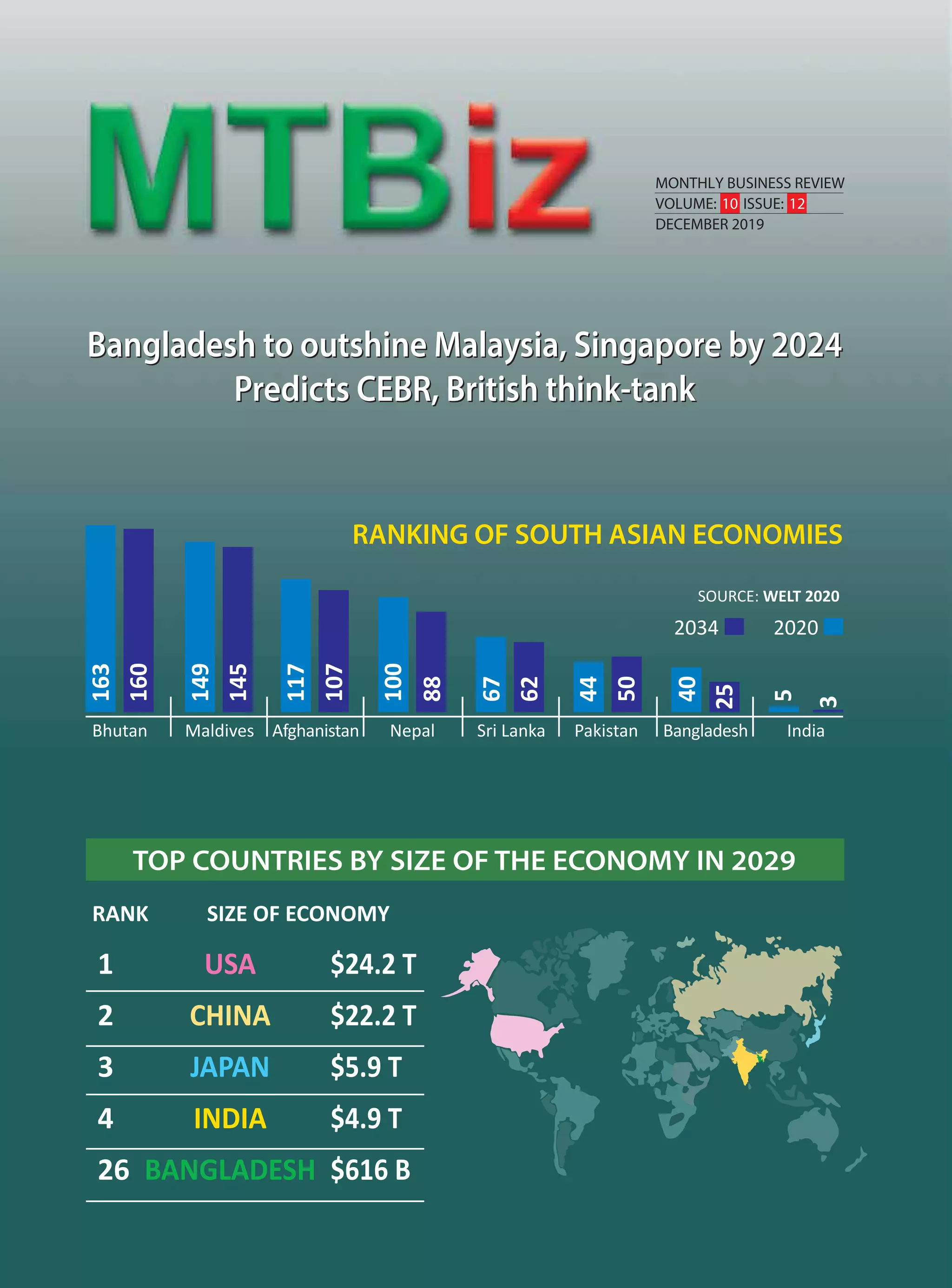
RANKING OF SOUTH ASIAN ECONOMIES
SOURCE: WELT 2020
20202034
149
107
117
88
100
62
67
50
145
163
160
44
25
3
40
5
RANK SIZE OF ECONOMY
1
2
3
4
26
$24.2 T
$22.2 T
$5.9 T
$4.9 T
$616 B
USA
CHINA
JAPAN
INDIA
BANGLADESH
TOP COUNTRIES BY SIZE OF THE ECONOMY IN 2029
Bangladesh to outshine Malaysia, Singapore by 2024
Predicts CEBR, British think-tank
Bhutan Maldives Afghanistan Nepal Sri Lanka Pakistan Bangladesh India
Contents
MONTHLY BUSINESS REVIEW
VOLUME: 10 ISSUE: 12
DECEMBER 2019
MTBiz
Disclaimer:
MTBiz is printed for non-commercial & selected individual-level
distribution in order to sharing information among stakeholders only.
MTB takes no responsibility for any individual investment decision based
on the information at MTBiz. This review is for information purpose only
and the comments and forecasts are intended to be of general nature and
are current as of the date of publication. Information is obtained from
secondary sources which are assumed to be reliable but their accuracy
cannot be guaranteed. The name of the other companies, products and
services are the properties of their respective owners and are protected by
copyright, trademark and other intellectual property laws.
Developed & Published by
MTB Group R&D
Please send feedback to:
RnD@mutualtrustbank.com
All rights reserved @ 2019
Design & Printing:
Preview
Article of the month 02
National News
The Central Bank 06
Business & Economy 08
MTB News & Events 12
Industry Appointments 16
Dashboard 17
International
Economic Forecast 20
Future Products 23
Financial Glossary 24
MONTHLY BUSINESS REVIEW
VOLUME: 10 ISSUE: 12
DECEMBER 2019
Bangladesh to outshine Malaysia, Singapore by 2024
Predicts CEBR, British think-tank
RANKING OF SOUTH ASIAN ECONOMIES
SOURCE: WELT 2020
20202034
149
107
117
88
100
62
67
50
145
163
160
44
25
3
40
5
RANK SIZE OF ECONOMY
1
2
3
4
26
$24.2 T
$22.2 T
$5.9 T
$4.9 T
$616 B
USA
CHINA
JAPAN
INDIA
BANGLADESH
TOP COUNTRIES BY SIZE OF THE ECONOMY IN 2029
Bangladesh to outshine Malaysia, Singapore by 2024
Predicts CEBR, British think-tank
Bhutan Maldives Afghanistan Nepal Sri Lanka Pakistan Bangladesh India
02 MTBiz
ARTICLE OF THE MONTH
The Center for Business and Economic Research was
founded the late 1960s as the Bureau of Business
Research at Ball State University. The founding was
initiated by Dr. Robert P. Bell soon after being hired as
the first dean of the College of Business. The focus of
the bureau was to look for research opportunities and
provide faculty with help pursuing those opportunities.
Also, focus was placed on using faculty in applied
business research.
The focus of the center has changed significantly since
its inception. An official name change from the Bureau
of Business Research to the Center for Business and
Economic Research (CEBR) occurred in 2008. Currently,
the center works in the community through services of
economic policy research, national, state, and local
forecasting, and data analysis. For 25 years the Centre
for Economics and Business Research (CEBR) has
supplied independent economic forecasting and
analysis to hundreds of private firms and public
organizations.
The Centre for Economics and Business Research has
been delivering independent economic forecasting and
analysis for decades. The centre also publishes the
World Economic League Table, which tracks the size of
different economies across the globe and projects
changes over the next 15 years, up to 2034.
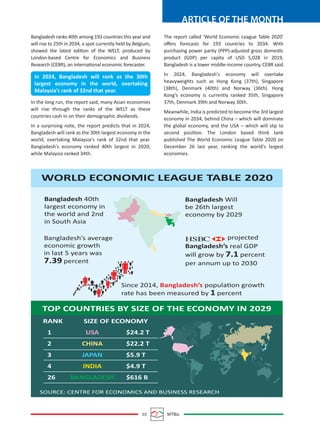
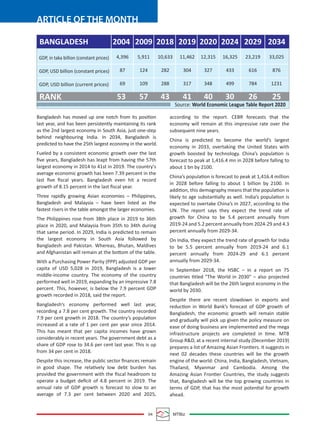
In a recent report CEBR said that Bangladesh is set to
become the world's 26th largest economy within the
next decade. The London based think tank published
The World Economic League Table 2020 on December
26 last year, ranking the world's largest economies
predicts that Bangladesh’s economy will make one of
the biggest jumps between 2020 and 2034 on the back
of demographic dividend and rising per capita income.
Bangladesh to outshine Malaysia, Singapore by 2024: Predicts CEBR, British think-tank
The World Bank has cut its economic growth forecast
for Bangladesh by 0.2 percentage points to 7.2
percent for the current fiscal year, but the country is
still poised to clock in the highest growth in South Asia.
The international lender in its flagship report
‘Global Economic Prospects, January 2020’
mentioned a number of challenges for Bangladesh
economy including falling credit demand, export
earnings and revenue earnings and rising
non-performing loans.
The WB had projected 7.4 per cent growth in June,
2019. The WB Dhaka office, however, in October,
2019 projected that the country’s GDP would grow
by 7.2 per cent. The government, however, has
insisted that the economy would grow over 8 per
cent in the current fiscal year.
The WB projection came amid a slowdown in
economic activities in the country with falling
export earnings and import payment and sharp
drop in private sector credit growth and tax revenue
collection. It noted that credit demand faltered in
Bangladesh, India and Pakistan amid credit
tightening, reflecting structurally high
non-performing assets like loans.
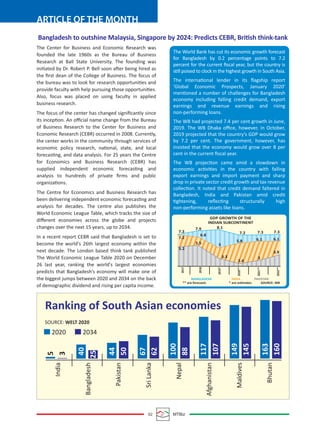
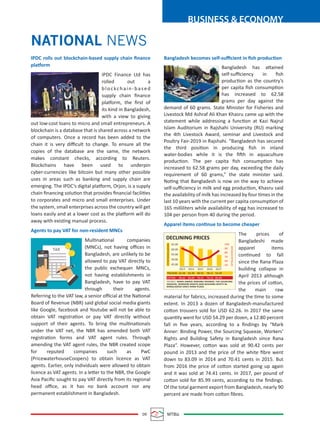
Ranking of South Asian economies
SOURCE: WELT 2020
2020 2034
5
3
India
Bangladesh
Pakistan
SriLanka
Nepal
Afghanistan
Maldives
Bhutan
25
40
44
50
67
62
100
88
117
107
149
145
163
160
GDP GROWTH OF THE
INDIAN SUBCONTINENT
7.3
7.9 8.1
7.2 7.3 7.3
2017
2018
2019*
2020**
2021**
2022**BANGLADESH
** are forecasts * are estimates SOURCE: WB
INDIA PAKISTAN
6.16.15.8
5
6.8
7.2
5.2
5.5
3.3
2.4
3
3.9
03 MTBiz
ARTICLE OF THE MONTH
Bangladesh ranks 40th among 193 countries this year and
will rise to 25th in 2034, a spot currently held by Belgium,
showed the latest edition of the WELT, produced by
London-based Centre for Economics and Business
Research (CEBR), an international economic forecaster.
In the long run, the report said, many Asian economies
will rise through the ranks of the WELT as these
countries cash in on their demographic dividends.
In a surprising note, the report predicts that in 2024,
Bangladesh will rank as the 30th largest economy in the
world, overtaking Malaysia's rank of 32nd that year.
Bangladesh's economy ranked 40th largest in 2020,
while Malaysia ranked 34th.
The report called ‘World Economic League Table 2020’
offers forecasts for 193 countries to 2034. With
purchasing power parity (PPP)-adjusted gross domestic
product (GDP) per capita of USD 5,028 in 2019,
Bangladesh is a lower middle-income country, CEBR said.
In 2024, Bangladesh's economy will overtake
heavyweights such as Hong Kong (37th), Singapore
(38th), Denmark (40th) and Norway (36th). Hong
Kong's economy is currently ranked 35th, Singapore
37th, Denmark 39th and Norway 30th.
Meanwhile, India is predicted to become the 3rd largest
economy in 2034, behind China – which will dominate
the global economy, and the USA – which will slip to
second position. The London based think tank
published The World Economic League Table 2020 on
December 26 last year, ranking the world's largest
economies.
In 2024, Bangladesh will rank as the 30th
largest economy in the world, overtaking
Malaysia’s rank of 32nd that year.
WORLD ECONOMIC LEAGUE TABLE 2020
Bangladesh 40th
largest economy in
the world and 2nd
in South Asia
Bangladesh’s average
economic growth
in last 5 years was
7.39 percent
projected
Bangladesh’s real GDP
will grow by 7.1 percent
per annum up to 2030
Since 2014, Bangladesh’s population growth
rate has been measured by 1 percent
Bangladesh Will
be 26th largest
economy by 2029
TOP COUNTRIES BY SIZE OF THE ECONOMY IN 2029
RANK SIZE OF ECONOMY
SOURCE: CENTRE FOR ECONOMICS AND BUSINESS RESEARCH
1
2
3
4
26
$24.2 T
$22.2 T
$5.9 T
$4.9 T
$616 B
USA
CHINA
JAPAN
INDIA
BANGLADESH
04 MTBiz
ARTICLE OF THE MONTH
Bangladesh has moved up one notch from its position
last year, and has been persistently maintaining its rank
as the 2nd largest economy in South Asia, just one-step
behind neighbouring India. In 2034, Bangladesh is
predicted to have the 25th largest economy in the world.
Fueled by a consistent economic growth over the last
five years, Bangladesh has leapt from having the 57th
largest economy in 2014 to 41st in 2019. The country's
average economic growth has been 7.39 percent in the
last five fiscal years. Bangladesh even hit a record
growth of 8.15 percent in the last fiscal year.
Three rapidly growing Asian economies – Philippines,
Bangladesh and Malaysia – have been listed as the
fastest risers in the table amongst the larger economies.
The Philippines rose from 38th place in 2019 to 36th
place in 2020, and Malaysia from 35th to 34th during
that same period. In 2029, India is predicted to remain
the largest economy in South Asia followed by
Bangladesh and Pakistan. Whereas, Bhutan, Maldives
and Afghanistan will remain at the bottom of the table.
With a Purchasing Power Parity (PPP) adjusted GDP per
capita of USD 5,028 in 2019, Bangladesh is a lower
middle-income country. The economy of the country
performed well in 2019, expanding by an impressive 7.8
percent. This, however, is below the 7.9 percent GDP
growth recorded in 2018, said the report.
Bangladesh’s economy performed well last year,
recording a 7.8 per cent growth. The country recorded
7.9 per cent growth in 2018. The country’s population
increased at a rate of 1 per cent per year since 2014.
This has meant that per capita incomes have grown
considerably in recent years. The government debt as a
share of GDP rose to 34.6 per cent last year. This is up
from 34 per cent in 2018.
Despite this increase, the public sector finances remain
in good shape. The relatively low debt burden has
provided the government with the fiscal headroom to
operate a budget deficit of 4.8 percent in 2019. The
annual rate of GDP growth is forecast to slow to an
average of 7.3 per cent between 2020 and 2025,
according to the report. CEBR forecasts that the
economy will remain at this impressive rate over the
subsequent nine years.
China is predicted to become the world’s largest
economy in 2033, overtaking the United States with
growth boosted by technology. China’s population is
forecast to peak at 1,416.4 mn in 2028 before falling to
about 1 bn by 2100.
China’s population is forecast to peak at 1,416.4 million
in 2028 before falling to about 1 billion by 2100. In
addition, this demography means that the population is
likely to age substantially as well. India’s population is
expected to overtake China’s in 2027, according to the
UN. The report says they expect the trend rate of
growth for China to be 5.4 percent annually from
2019-24 and 5.2 percent annually from 2024-29 and 4.3
percent annually from 2029-34.
On India, they expect the trend rate of growth for India
to be 5.5 percent annually from 2019-24 and 6.1
percent annually from 2024-29 and 6.1 percent
annually from 2029-34.
In September 2018, the HSBC – in a report on 75
countries titled "The World in 2030" – also projected
that Bangladesh will be the 26th largest economy in the
world by 2030.
Despite there are recent slowdown in exports and
reduction in World Bank’s forecast of GDP growth of
Bangladesh, the economic growth will remain stable
and gradually will pick up given the policy measure on
ease of doing business are implemented and the mega
infrastructure projects are completed in time. MTB
Group R&D, at a recent internal study (December 2019)
prepares a list of Amazing Asian Frontiers. It suggests in
next 02 decades these countries will be the growth
engine of the world: China, India, Bangladesh, Vietnam,
Thailand, Myanmar and Cambodia. Among the
Amazing Asian Frontier Countries, the study suggests
that, Bangladesh will be the top growing countries in
terms of GDP, that has the most potential for growth
ahead.
BANGLADESH
GDP, in taka billion (constant prices)
GDP, USD billion (constant prices)
GDP, USD billion (current prices)
2004
4,396
87
69
5,911
124
109
10,633
282
288
11,462
304
317
12,315
327
348
16,325
433
499
23,219
616
784
33,025
876
1231
2009 2018 2019 2020 2024 2029 2034
Source: World Economic League Table Report 2020
RANK 53 57 43 41 40 30 26 25
THE CENTRAL BANK
05 MTBiz
06 MTBiz
THE CENTRAL BANK
Transaction thru MFS grows by 6.6pc in Oct
Money transactions
through mobile
financial service (MFS)
grew by 6.6 per cent or
BDT 2,329 crore in
October this year
compared with that in the previous month as the MFS
operators focused on making the service more
convenient for clients. As per the Bangladesh Bank
data, transactions through MFS increased to BDT
37,762.54 crore in October from BDT 35,433.16 crore in
September. The number of transactions, daily average
transactions and number of MFS accounts also
increased in October. Apart from MFS transaction
value, the number of transactions in October increased
by 7 per cent or 1.48 crore. In October, the number of
transactions increased to 22.72 crore from 21.24 crore
in the previous month. The number and value of daily
average transaction through MFS increased by 3.6 per
cent and 3.10 per cent respectively in October
compared with that in the previous month. The number
of registered clients of MFS operators increased by 1.9
per cent or 14 lkah to 7.73 crore in October from 7.6
crore in the previous month.
BB eases transfer of foreign national's salary to home
Foreign nationals working
in the country from will
now on get their salaries
and parks on their
respective foreign
currency (FC) accounts,
says a Bangladesh Bank notice, issued recently. Earlier,
local employers have to deposit salaries of their hired
foreign staff to their banks in Taka accounts. The foreign
employees concerned had to remit any fund to their
native countries by telegraphic transfer (TT) after
converting those to currencies of their preferences. In
the latest directive, employers are allowed to transfer
salaries in foreign currency to their foreign employees’
FC account directly. The chapter 11 (section 8) of the
FEPD's Guidelines for Foreign Exchange
Transactions-2018 (Vol-1) permits foreign nationals
working in Bangladesh with valid work permits to
transfer remittances up to 75% of their net income. In
the directive, the central bank also said that balances of
the FC accounts of foreign nationals working in
Bangladesh are freely encashable to Taka to meet local
expenses.
BB relaxes rules on repaying buyer's credit by importers
The central bank has
relaxed regulations on
short-term buyer's and
supplier's credit
borrowed from
overseas sources for
making payments on
import of industrial raw materials. Importers are now
allowed to repay their foreign currency import loans at
a time, which is officially known as bullet payment,
instead of any quarterly payment. "To bring further
relaxation in import transactions, it has now been
decided that bullet repayment will also be permissible
for import of raw materials by industrial units for their
own use under supplier's/buyer's credit regardless of
shipment value," the Bangladesh Bank (BB) said. The
central bank relaxed its regulations considering
different trade bodies' recommendations. It will help
create employment opportunities through facilitating
import substitute sectors. Earlier on June 01, 2014, the
central bank imposed restrictions on repaying
short-term buyer's and supplier's credit from overseas
sources for minimizing repayment risks. The central
bank allowed the buyer's credit for importers in 2012 to
boost the country's overall production.
Remittance inflow increases by 31.75pc in November
Bangladesh received USD
1,555.22 million in
remittance in November
of the current fiscal,
which is apparently 31.75
per cent higher than that
of same month of
previous year, according
to Bangladesh Bank (BB) data. The country received
USD 1,180.44 million remittances during the month of
November in 2018-19 financial year, the central bank
said. Expatriate Bangladeshis sent USD 7,714.19 million
remittances during the first five months of the current
fiscal 2019-20. During the month of October, the
country received USD 1,639.62 million while USD
1,476.91 million in September, USD 1,444.75 million in
August and USD 1,597.69 million in July of the fiscal
2019-20. But in 2018-19, the country got USD 1,239.11
million in October, USD 1,139.66 million in September,
USD 1,411.05 million in August and USD 1,318.18
million in July.
NATIONAL NEWS
07 MTBiz
THE CENTRAL BANK
Trade deficit widens 5.6pc in July-Oct
The country’s trade deficit in the
July-October period of the
current fiscal year (2019-20)
increased by 5.58 per cent or USD
297 million year-on-year amid a
slowdown in export and import.
According to the BB data released
recently, trade deficit increased to USD 5.62 billion in
the July-October period of FY20 from USD 5.32 billion in
the same period of FY 2018-19. In July-October this
year, imports fell by 3.17 per cent to USD 18.14 billion
from USD 18.73 billion in the same period last year. The
current account deficit, however, dropped by 36.88 per
cent, or USD 762 million, to USD 1.3 billion in
July-October of FY20 from USD 2.07 billion in the same
period of FY19. The country’s overall deficit also
dropped to USD 229 million in the first four months of
FY20 against USD 444 million in the same period of last
fiscal year. The BB data also showed that the country
attained USD 881 million in net foreign direct
investment in July-October of this fiscal year against
USD 841 million in the same period of last fiscal year.
BB moves to curb trade-based money laundering
Bangladesh Financial
Intelligence Unit
(BFIU) recently
issued guidelines for
banks to prevent
money laundering in
the name of export
and import. The intelligence agency has been forced to
issue the guideline promptly following a Global
Financial Integrity report, which said Bangladesh is one
of the top countries facing the trade based money
laundering. As per the guidelines, all the banks will
have to prepare own guidelines to prevent money
laundering and submit those to the BFIU within March
10 of 2020. Along with that, they will have to
implement the guidelines within the first of June of the
same year. According to the guideline, trade-based
money laundering related cases would be analysed
with top priority. It will also help banks to improve their
capability to follow guidelines of trade-based money
laundering. According to the guideline, all the
international trade related bank officials would be
trained. The BFIU emphasised issuing the guidelines
because over 80 percent of money laundering was
committed through international trade.
Committee formed to ensure single digit bank interest
rate
Bangladesh Bank
(BB) recently formed
a seven-member
committee, led by its
Deputy Governor
SM Moniruzzaman,
to ensure single digit
bank interest rate for industrial sector. “BB Governor
Fazle Kabir has formed the committee to ensure single
digit lending rate in the industrial sector. The
committee will provide necessary suggestion to this
end,” BB Executive Director Abu Farah Md Naser told.
Other members of the committee are Agrani Bank
Chairman Dr Zaid Bakht, Standard Bank Chairman Kazi
Akarm Uddin Ahmed, Rupali Bank Managing Director
Md Obayed Ullah Al Masud, IFIC Bank Managing
Director Mohammad Shah Alam Sarwar, Association of
Bankers, Bangladesh (ABB) Chairman and Mutual Trust
Bank Limited (MTB) Managing Director & CEO Syed
Mahbubur Rahman and NRB Bank Managing Director
Md Mehmood Hussain.
BB allows use of other networks alongside NPSB
The Bangladesh Bank
recently allowed banks and
non-bank financial
institutions connected with
the National Payment
Switch Bangladesh to use
other networks alongside
NPSB while making transaction through point of sales.
The circular said that the waiver would be applicable to
local transactions only upon ensuring security of the
respective entities’ system. Earlier, there was no scope
for the banks and NBFIs for using other networks while
making transactions through PoS. The policy has been
relaxed to facilitate businesses using newly emerging
payment systems. In August, 2017, the BB issued a
detail instruction for the banks and NBFIs on the use of
automated teller machine, PoS and online payments
with a view to making the system secure for the users.
In August this year, the banks and NBFIs executed
through POS 5,11,590 transactions worth BDT 183.51
crore, up 6.18 per cent on BDT 172.83 crore in July this
year. As per the BB’s data, a total of 52,846 POS
terminals of 50 banks are connected with the NPSB.
NATIONAL NEWS
08 MTBiz
BUSINESS & ECONOMY
NATIONAL NEWS
Record GDP growth despite challenges
Bangladesh’s GDP ultimately
grew at a record 8.15
percent in fiscal 2018-19 -- 2
basis points higher than
earlier estimates -- smashing
the 7.8 percent target set for
the fiscal year back in June 2018. The
higher-than-expected growth came in spite of
headwinds from slowing exports and drying banking
sector liquidity. The development not only marks the
economy breaking into the 8 percent growth territory
after years of 6-7 percent growth, it makes Bangladesh
the fastest growing nation in the Asia Pacific region, as
per Asian Development Bank’s earlier forecasts. The
figure also surpassed the World Bank’s forecast of 7.3
percent for the year. In fiscal 2017-18, the GDP grew at
7.86 percent. The strong growth recorded last fiscal
year was down to higher contribution from the
manufacturing sub-sector: it increased from 22.85
percent to 24.08 percent. The share of industry to GDP
increased from 33.66 percent in fiscal 2017-18 to 35
percent.
Food inflates inflation in November
Inflation sharply
increased in
November and
stood at its
highest point
within the last
26 months due
to rising food prices. The point-to-point inflation rose
by 0.58 percentage point in November to 6.05 percent,
compared to the previous month's. The inflation rate in
November stood at 6.05 percent, while it was 5.47
percent in October this year and 5.91 percent in
November last year, according to a Bangladesh Bureau
of Statistics (BBS) report. The BBS report further
showed that the food inflation on point-to-point basis
stood at 6.41 percent in November, compared to 5.49
percent in the previous month. The non-food inflation
stood at 5.47 percent in November, slightly rising from
5.45 percent in October. The BBS data also revealed
that the point-to-point inflation rate both in rural and
urban areas increased in November. Rural areas
observed the inflation rate of 6.01 percent in
November, which was 5.36 percent in October. Rural
inflation on food stood at 6.54 percent in November,
which was 5.56 percent in October.
ADB holds steady on Bangladesh forecast, trims
developing Asia predictions
The Asian Development Bank
(ADB) presented the positive
outlook for Bangladesh in its
latest report released recently,
keeping its growth projection
unchanged at 8.1 percent for this year, when other
developing Asian economies are under a dark shadow.
In a supplement to its Asian Development Outlook
2019, the Manila-based bank revised its initial growth
forecast for developing Asia. The report said it now
expects GDP in developing Asia to expand 5.2 percent
in both 2019 and 2020, down from the September
forecast of 5.4 percent growth this year and 5.5 percent
next year. Export growth, which has remained low, is
projected to pick up, thanks to the government's fiscal
support of export-oriented business, according to the
report. The ADB in its latest report revised down the
growth projection of most Asian countries, including
both giants India and China. Bangladesh achieved 8.15
percent GDP growth in the 2018-19 fiscal year, slightly
higher than the preliminary estimation of 8.13 percent,
according to the Bangladesh Bureau of Statistics.
Sluggish revenue to worsen credit crunch
Revenue shortfall widened
further as sluggish tax
collection persisted in the
July-October period, stoking
concerns of a credit crunch
amid a surge in government
borrowing from the financial
sector and an economic slowdown. The tax authority
logged 4.33 percent year-on-year higher revenue to
BDT 65,096 crore from July to October this fiscal year,
preliminary data from the National Board of Revenue
showed. The latest collection pointed to a slowdown
from the same period in the previous fiscal year when
collection was 6.74 percent up. As a result, the NBR is
BDT 20,220 crore shy of reaching its July-October target
of raising BDT 85,317 crore. The tax authority fell short
of about BDT 15,000 crore from its collection goal in the
July-September period. The sluggish collection has
already compelled the government to increase its
borrowing from banks, which may further aggravate
the already tight liquidity condition in the financial
sector. Until November 21 in the current fiscal year, the
government borrowed 90 percent of its full fiscal-year
target of BDT 47,364 crore from the banking sector,
according to Bangladesh Bank data.
GDP GROWTH RATE
2014-15
2015-16
2016-17
2017-18
2018-19
(In percent)
6.55 7.11 7.28 7.86 8.15
SOURCE: BBS
TREND OF TAX COLLECTION
In crore taka
July-Oct period
20,631
CUSTOMS
DUTY
VALUE ADDED
TAX
INCOME AND
TRAVEL TAX
20,649
24,317
17,444
24,751
19,695
SOURCE: NBR
FY’19
FY’20
09 MTBiz
BUSINESS & ECONOMY
NATIONAL NEWS
IPDC rolls out blockchain-based supply chain finance
platform
IPDC Finance Ltd has
rolled out a
blockchain-based
supply chain finance
platform, the first of
its kind in Bangladesh,
with a view to giving
out low-cost loans to micro and small entrepreneurs. A
blockchain is a database that is shared across a network
of computers. Once a record has been added to the
chain it is very difficult to change. To ensure all the
copies of the database are the same, the network
makes constant checks, according to Reuters.
Blockchains have been used to underpin
cyber-currencies like bitcoin but many other possible
uses in areas such as banking and supply chain are
emerging. The IPDC’s digital platform, Orjon, is a supply
chain financing solution that provides financial facilities
to corporates and micro and small enterprises. Under
the system, small enterprises across the country will get
loans easily and at a lower cost as the platform will do
away with existing manual process.
Agents to pay VAT for non-resident MNCs
Multinational companies
(MNCs), not having offices in
Bangladesh, are unlikely to be
allowed to pay VAT directly to
the public exchequer. MNCs,
not having establishments in
Bangladesh, have to pay VAT
through their agents.
Referring to the VAT law, a senior official at the National
Board of Revenue (NBR) said global social media giants
like Google, facebook and Youtube will not be able to
obtain VAT registration or pay VAT directly without
support of their agents. To bring the multinationals
under the VAT net, the NBR has amended both VAT
registration forms and VAT agent rules. Through
amending the VAT agent rules, the NBR created scope
for reputed companies such as PwC
(PricewaterhouseCoopers) to obtain licence as VAT
agents. Earlier, only individuals were allowed to obtain
licence as VAT agents. In a letter to the NBR, the Google
Asia Pacific sought to pay VAT directly from its regional
head office, as it has no bank account nor any
permanent establishment in Bangladesh.
Bangladesh becomes self-sufficient in fish production
Bangladesh has attained
self-sufficiency in fish
production as the country’s
per capita fish consumption
has increased to 62.58
grams per day against the
demand of 60 grams. State Minister for Fisheries and
Livestock Md Ashraf Ali Khan Khasru came up with the
statement while addressing a function at Kazi Najrul
Islam Auditorium in Rajshahi University (RU) marking
the 4th Livestock Award, seminar and Livestock and
Poultry Fair-2019 in Rajshahi. “Bangladesh has secured
the third position in producing fish in inland
water-bodies while it is the fifth in aquaculture
production. The per capita fish consumption has
increased to 62.58 grams per day, exceeding the daily
requirement of 60 grams,” the state minister said.
Noting that Bangladesh is now on the way to achieve
self-sufficiency in milk and egg production, Khasru said
the availability of milk has increased by four times in the
last 10 years with the current per capita consumption of
165 milliliters while availability of egg has increased to
104 per person from 40 during the period.
Apparel items continue to become cheaper
The prices of
Bangladeshi made
apparel items
continued to fall
since the Rana Plaza
building collapse in
April 2013 although
the prices of cotton,
the main raw
material for fabrics, increased during the time to some
extent. In 2013 a dozen of Bangladesh-manufactured
cotton trousers sold for USD 62.26. In 2017 the same
quantity went for USD 54.29 per dozen, a 12.80 percent
fall in five years, according to a findings by “Mark
Anner: Binding Power, the Sourcing Squeeze, Workers’
Rights and Building Safety in Bangladesh since Rana
Plaza”. However, cotton was sold at 90.42 cents per
pound in 2013 and the price of the white fibre went
down to 83.09 in 2014 and 70.41 cents in 2015. But
from 2016 the price of cotton started going up again
and it was sold at 74.41 cents. In 2017, per pound of
cotton sold for 85.99 cents, according to the findings.
Of the total garment export from Bangladesh, nearly 90
percent are made from cotton fibres.
DECLINING PRICES
65.00
60.00
55.00
50.00
45.00
2013
54.2958.1160.5262.4962.26TROUSERS
COTTON,USDCENTS/POUND
85.9974.2370.4183.0990.42
SOURCE: MARK ANNER: BINDING PROWER, THE SOURCING
SQUEEZE, WORKERS RIGHTS AND BUILDING SEFETY IN
BANGLADESH SINCE RANA PLAZA
COTTON
2014 2015 2016 2017
-100
-90
-80
-70
-60
-50
COTTONTROUSERS.USD/DOZEN
BUSINESS & ECONOMY
10 MTBiz
NATIONAL NEWS
Ceramics market of Bangladesh
A study by the United States Agency for International
Development (USAID) says ceramics, with a 200
percent growth in the last five years, is now the top
emerging industry in Bangladesh. At the end of 2018,
the market size of the ceramics industry was BDT 5,950
crore, to which the tiles industry contributed the most
with BDT 4,500 crore. The size of the tableware and the
sanitary ware industries were BDT 500 crore and BDT
920 crore respectively, adds USAID.
The 200 percent growth in the ceramics industry is
centred on the tiles industry, according to the ceramic
manufacturers and exporters association. Ceramic
products have seen an overall growth of 20-22 percent,
whereas it is 30-35 percent for the tiles industry.
Considering the market share of specific products,
Shinepukur Ceramics Ltd, a part of the Beximco Group,
leads the tableware industry. The company currently
holds 30 percent of a BDT 500-crore market. In 2018, it
had a turnover of BDT 152 crore. Shinepukur is followed
by Monno Ceramics whose sales last year was BDT 140
crore. Some other firms, including Farr and Star, have a
significant share of the market.
At present, Bangladeshi ceramic products are going to
more than 50 countries. According to the Export
Promotion Bureau, Bangladeshi companies exported
ceramic goods worth BDT 585 crore in the 2018-19
fiscal year. Ceramics now occupies 7th position as an
export item. The sector witnessed 26 percent export
growth over the last three years, although tableware is
still the main ceramic goods exported.
The use of ceramic ware began in Bangladesh as luxury
items on the dining tables of the upper class. Until the
1990s, the country depended fully on imported ceramic
goods by a few companies. But that has changed
drastically in the last 10 years. Ceramic ware is no longer
a status symbol but a necessity in almost all households.
As a result, it has emerged as a big industry based on
which 66 brands have come into being so far in the
country. The domestic market for ceramic products,
including tableware, tiles and sanitary ware, is worth
about BDT 6,000 crore annually. Bangladesh exported
ceramic products worth BDT 585 crore last year.
Apart from 66 brands, more than one hundred
manufacturing companies, both small and medium,
have evolved in the country. At present the sector
employs around 5,00,000 people, including 55,000
direct employees and those from the backward linkage
industry. Annually, the companies manufacture 25
crore pieces of tableware, 15 crore square feet of tiles
and 50 lakh pieces of sanitary ware. A major part of the
tableware goes to Europe and to the Middle East.
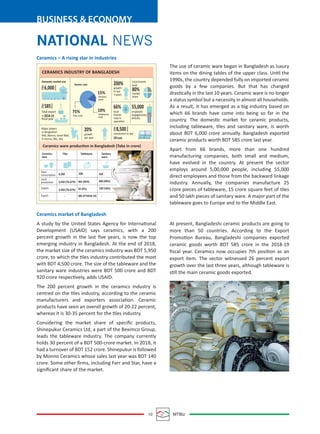
Ceramics – A rising star in industries
CERAMICS INDUSTRY OF BANGLADESH
Domestic market size
Market ratio
Tiles hold
Sanitary
ware
growth
in last
5 years
Local brands
hold
market
share
employee
engagements
directly
local
brands
now in
operation
investment in last
10
Tableware
hold
growth
per year
15%
10%
20%
75%
66% 55,000
80%
200%
585
2018-19
Total export
in
fiscal year
Major players
in Bangladesh
RAK, Monno, Great Wall,
X monica, DBL, Akij
CRORE
CRORE
6,000
YEARS
8,500CRORE
Ceramics ware production in Bangladesh (Taka in crore)
Ceramics
item
Total
consumption 4,500
3,450 (76.67%)
3,450 (76.67%)
465 (96%)
32 (4%)
585 (FY2918-19)
920
800 (90%)
120 (10%)
500
Local
production
Import
Export
Tiles Tableware Sanitary
ware
MTB NEWS & EVENTS
11 MTBiz
mutualtrustbank.com Mutual.Trust.Bank mtbltd Tweet2MTB
12 MTBiz
MTB NEWS & EVENTS
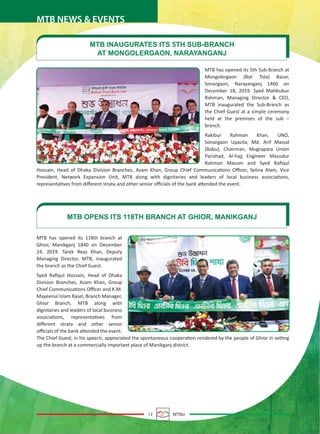
MTB OPENS ITS 118TH BRANCH AT GHIOR, MANIKGANJ
MTB has opened its 118th branch at
Ghior, Manikganj 1840 on December
24, 2019. Tarek Reaz Khan, Deputy
Managing Director, MTB, inaugurated
the branch as the Chief Guest.
Syed Rafiqul Hossain, Head of Dhaka
Division Branches, Azam Khan, Group
Chief Communications Officer and K.M.
Mayeenul Islam Rasel, Branch Manager,
Ghior Branch, MTB along with
dignitaries and leaders of local business
associations, representatives from
different strata and other senior
officials of the bank attended the event.
The Chief Guest, in his speech, appreciated the spontaneous cooperation rendered by the people of Ghior in setting
up the branch at a commercially important place of Manikganj district.
MTB INAUGURATES ITS 5TH SUB-BRANCH
AT MONGOLERGAON, NARAYANGANJ
MTB has opened its 5th Sub-Branch at
Mongolergaon (Bot Tola) Bazar,
Sonargaon, Narayanganj 1460 on
December 18, 2019. Syed Mahbubur
Rahman, Managing Director & CEO,
MTB inaugurated the Sub-Branch as
the Chief Guest at a simple ceremony
held at the premises of the sub –
branch.
Rakibur Rahman Khan, UNO,
Sonargaon Upazila, Md. Arif Masud
(Babu), Chairman, Mugrapara Union
Parishad, Al-hajj Engineer Masudur
Rahman Masum and Syed Rafiqul
Hossain, Head of Dhaka Division Branches, Azam Khan, Group Chief Communications Officer, Selina Alam, Vice
President, Network Expansion Unit, MTB along with dignitaries and leaders of local business associations,
representatives from different strata and other senior officials of the bank attended the event.
13 MTBiz
MTB NEWS & EVENTS
MTB has signed an agreement with Sea
Kitchens Bangladesh Limited (Sea
Kitchens) at a simple ceremony held at
the bank’s Corporate Head Office, MTB
Centre, 26 Gulshan Avenue, Dhaka
1212. Sea Kitchens is a leading German
modular kitchen brand with unique
modular kitchen and wardrobe
designs, combined with the highest
German quality standards.
Under this agreement, the clients will
be able to finance their purchases at
Sea Kitchens from MTB’s FlexiPay
(using credit card) or consumer
finances products at discounted processing fee and interest rate. MTB clients, likewise, will be entitled to buy kitchen
solutions and fittings with special discounted offers from Sea Kitchens.
Samia Afrin, Director, Sea Kitchens and Syed Rafiqul Haq, Deputy Managing Director2
& Chief Business Officer (CBO),
MTB signed the agreement on behalf of their respective organizations. Asoka Gamage, Director & CEO and
Muhammad Atique, Director, Sea Kitchens and Towfiqul Alam Chowdhury, Head of Business, Retail Division,
Mohammad Anwar Hossain, Head of Cards, Irfan Islam, Head of Privilege Banking & Cash Management, Sultana
Shikder Ahona, Head of Payroll Banking, Md. Ehethesham Rahman, Head of Structured Finance Unit and Azam Khan,
Group Chief Communications Officer, MTB along with other senior officials from both the organizations were also
present at the agreement signing ceremony.
MTB SIGNS AGREEMENT WITH SEA KITCHENS BANGLADESH LIMITED
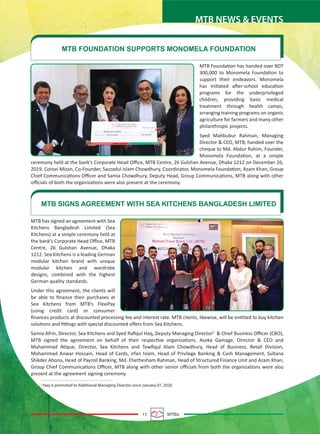
MTB Foundation has handed over BDT
300,000 to Monomela Foundation to
support their endeavors. Monomela
has initiated after-school education
programs for the underprivileged
children, providing basic medical
treatment through health camps,
arranging training programs on organic
agriculture for farmers and many other
philanthropic projects.
Syed Mahbubur Rahman, Managing
Director & CEO, MTB, handed over the
cheque to Md. Abdur Rahim, Founder,
Monomela Foundation, at a simple
ceremony held at the bank’s Corporate Head Office, MTB Centre, 26 Gulshan Avenue, Dhaka 1212 on December 26,
2019. Corovi Mizan, Co-Founder, Sazzadul Islam Chowdhury, Coordinator, Monomela Foundation, Azam Khan, Group
Chief Communications Officer and Samia Chowdhury, Deputy Head, Group Communications, MTB along with other
officials of both the organizations were also present at the ceremony.
MTB FOUNDATION SUPPORTS MONOMELA FOUNDATION
2
Haq is promoted to Additional Managing Director since January 01, 2020
14 MTBiz
MTB NEWS & EVENTS
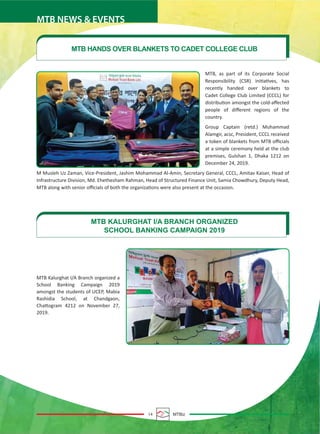
MTB, as part of its Corporate Social
Responsibility (CSR) initiatives, has
recently handed over blankets to
Cadet College Club Limited (CCCL) for
distribution amongst the cold-affected
people of different regions of the
country.
Group Captain (retd.) Muhammad
Alamgir, acsc, President, CCCL received
a token of blankets from MTB officials
at a simple ceremony held at the club
premises, Gulshan 1, Dhaka 1212 on
December 24, 2019.
M Musleh Uz Zaman, Vice-President, Jashim Mohammad Al-Amin, Secretary General, CCCL, Amitav Kaiser, Head of
Infrastructure Division, Md. Ehethesham Rahman, Head of Structured Finance Unit, Samia Chowdhury, Deputy Head,
MTB along with senior officials of both the organizations were also present at the occasion.
MTB HANDS OVER BLANKETS TO CADET COLLEGE CLUB
MTB Kalurghat I/A Branch organized a
School Banking Campaign 2019
amongst the students of UCEP, Mabia
Rashidia School, at Chandgaon,
Chattogram 4212 on November 27,
2019.
MTB KALURGHAT I/A BRANCH ORGANIZED
SCHOOL BANKING CAMPAIGN 2019
15 MTBiz
MTB NEWS & EVENTS
16 MTBiz
INDUSTRY APPOINTMENTS
NATIONAL NEWS
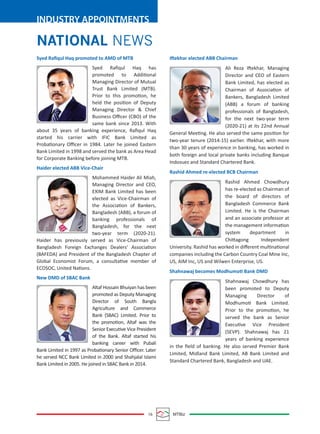
Syed Rafiqul Haq promoted to AMD of MTB
Syed Rafiqul Haq has
promoted to Additional
Managing Director of Mutual
Trust Bank Limited (MTB).
Prior to this promotion, he
held the position of Deputy
Managing Director & Chief
Business Officer (CBO) of the
same bank since 2013. With
about 35 years of banking experience, Rafiqul Haq
started his carrier with IFIC Bank Limited as
Probationary Officer in 1984. Later he joined Eastern
Bank Limited in 1998 and served the bank as Area Head
for Corporate Banking before joining MTB.
Haider elected ABB Vice-Chair
Mohammed Haider Ali Miah,
Managing Director and CEO,
EXIM Bank Limited has been
elected as Vice-Chairman of
the Association of Bankers,
Bangladesh (ABB), a forum of
banking professionals of
Bangladesh, for the next
two-year term (2020-21).
Haider has previously served as Vice-Chairman of
Bangladesh Foreign Exchanges Dealers’ Association
(BAFEDA) and President of the Bangladesh Chapter of
Global Economist Forum, a consultative member of
ECOSOC, United Nations.
New DMD of SBAC Bank
Altaf Hossain Bhuiyan has been
promoted as Deputy Managing
Director of South Bangla
Agriculture and Commerce
Bank (SBAC) Limited. Prior to
the promotion, Altaf was the
Senior Executive Vice President
of the Bank. Altaf started his
banking career with Pubali
Bank Limited in 1997 as Probationary Senior Officer. Later
he served NCC Bank Limited in 2000 and Shahjalal Islami
Bank Limited in 2005. He joined in SBAC Bank in 2014.
Iftekhar elected ABB Chairman
Ali Reza Iftekhar, Managing
Director and CEO of Eastern
Bank Limited, has elected as
Chairman of Association of
Bankers, Bangladesh Limited
(ABB) a forum of banking
professionals of Bangladesh,
for the next two-year term
(2020-21) at its 22nd Annual
General Meeting. He also served the same position for
two-year tenure (2014-15) earlier. Iftekhar, with more
than 30 years of experience in banking, has worked in
both foreign and local private banks including Banque
Indosuez and Standard Chartered Bank.
Rashid Ahmed re-elected BCB Chairman
Rashid Ahmed Chowdhury
has re-elected as Chairman of
the board of directors of
Bangladesh Commerce Bank
Limited. He is the Chairman
and an associate professor at
the management information
system department in
Chittagong Independent
University. Rashid has worked in different multinational
companies including the Carbon Country Coal Mine Inc,
US, AIM Inc, US and Wilwen Enterprise, US.
Shahnawaj becomes Modhumoti Bank DMD
Shahnawaj Chowdhury has
been promoted to Deputy
Managing Director of
Modhumoti Bank Limited.
Prior to the promotion, he
served the bank as Senior
Executive Vice President
(SEVP). Shahnawaj has 21
years of banking experience
in the field of banking. He also served Premier Bank
Limited, Midland Bank Limited, AB Bank Limited and
Standard Chartered Bank, Bangladesh and UAE.
17 MTBiz
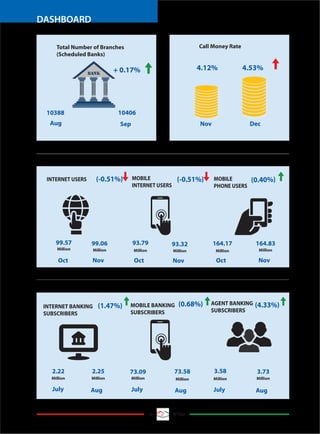
DASHBOARD
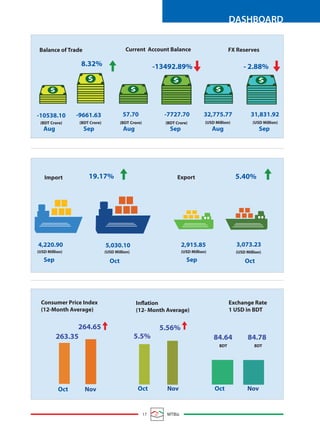
Inflation
(12- Month Average)
Oct Nov
263.35
264.65
Consumer Price Index
(12-Month Average)
Exchange Rate
1 USD in BDT
84.7884.64
Oct Nov Oct Nov
5.5%
5.56%
BDT BDT
-13492.89%
Current Account Balance
57.70 -7727.70 32,775.77 31,831.92
8.32%
Balance of Trade
Aug Sep Aug Sep Aug Sep
(BDT Crore) (BDT Crore) (BDT Crore) (BDT Crore) (USD Million) (USD Million)
-10538.10 -9661.63
FX Reserves
- 2.88%
Sep Oct Sep Oct
Import 19.17%
4,220.90 5,030.10
Export 5.40%
2,915.85 3,073.23
(USD Million) (USD Million) (USD Million) (USD Million)
18 MTBiz
DASHBOARD
Total Number of Branches
(Scheduled Banks)
10388 10406
Aug Sep
+ 0.17%
Call Money Rate
4.12% 4.53%
Nov Dec
Oct Oct NovNov
INTERNET USERS MOBILE
INTERNET USERS
MOBILE
PHONE USERS
99.06
Oct
99.57 93.79
Nov
93.32 164.17 164.83
(-0.51%) (-0.51%) (0.40%)
Million Million Million Million Million Million
Bcf
July JulyJuly
INTERNET BANKING
SUBSCRIBERS
MOBILE BANKING
SUBSCRIBERS
AGENT BANKING
SUBSCRIBERS
2.22
Aug
2.25 73.09
Aug
73.58 3.58
Aug
3.73
(1.47%) (0.68%) (4.33%)
MillionMillionMillionMillionMillionMillion
19 MTBiz
DASHBOARD
July Aug
Aug
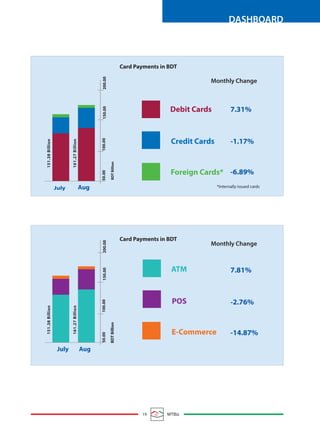
Debit Cards
Credit Cards
Foreign Cards*
50.00150.00
BDTBillionBDTBillion
100.00
-1.17%
-6.89%
7.31%
*Internally issued cards
ATM
POS
E-Commerce
-2.76%
-14.87%
7.81%
Card Payments in BDT
July
50.00150.00200.00200.00100.00
Monthly Change
Monthly Change
151.38Billion
161.27Billion
151.38Billion
161.27Billion
20 MTBiz
ECONOMIC FORECAST
INTERNATIONAL NEWS
Asia girds for prolonged uncertainty
Developing Asia’s strong growth prospects have
weakened since Asian Development Outlook 2019
(ADO 2019) was published in April, as global growth
slowed, trade tensions escalated, and regional
investment weakened. Exports declined with lower
demand from the major advanced economies,
compounded by the trade conflict between the United
States and the People’s Republic of China (PRC).
Tensions between the two have escalated since May,
shaking financial markets. Uncertainty has undermined
private investment in the region, leaving domestic
consumption as the main support to growth. On the
supply side, manufacturing slowed further, with
electronics in particular suffering an industry-wide
slump. Facing slower growth and muted inflation, many
countries have loosened fiscal and monetary policy to
support economic activity.
Regional growth will slow from 5.9% in 2018 to 5.4% in
2019, edging back up to 5.5% next year. Excluding the
newly industrialized economies (NIEs), growth will slow
to 6.0% this year and next (Figure 1.0.1). Growth in the
PRC is expected to decline to 6.2% in 2019 and 6.0% in
2020 under the impact of the trade conflict, while
domestic factors will slow growth in India to 6.5% in
2019, recovering to 7.2% in 2020. Regional inflation will
rise to 2.7% on higher food prices this year and next but
remain well below historical rates. Trade and
production redirection in response to the US–PRC trade
conflict is already occurring. Downside risks to the region
have intensified, with the trade conflict posing the
greatest of many risks to global growth and showing no
sign of abating. A rise in public and private debt over the
past decade leaves the region more vulnerable to shocks.
With slower growth and muted inflation, several
countries loosened fiscal and monetary policies to
support economic activity. August 2019 alone saw
expansionary budgets or other fiscal stimulus measures
announced in Hong Kong, China; India; Indonesia; the
Philippines; and Thailand. Many monetary authorities
have cut policy interest rates in step with a more
accommodative stance in the advanced economies.
Since January, India has cut interest rates four times.
Indonesia cut its policy rate by 25 basis points for a
second time in August despite the recent weakness in the
rupiah. Policy rates declined in most economies in East
and Southeast Asia. Bucking the trend, Pakistan raised its
interest rate as it continued to battle high inflation.
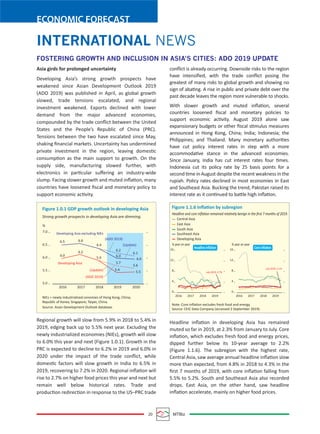
Headline inflation in developing Asia has remained
muted so far in 2019, at 2.3% from January to July. Core
inflation, which excludes fresh food and energy prices,
dipped further below its 10-year average to 2.2%
(Figure 1.1.6). The subregion with the highest rate,
Central Asia, saw average annual headline inflation slow
more than expected, from 4.8% in 2018 to 4.3% in the
first 7 months of 2019, with core inflation falling from
5.5% to 5.2%. South and Southeast Asia also recorded
drops. East Asia, on the other hand, saw headline
inflation accelerate, mainly on higher food prices.
FOSTERING GROWTH AND INCLUSION IN ASIA’S CITIES: ADO 2019 UPDATE
Figure 1.0.1 GDP growth outlook in developing Asia
Developing Asia excluding NIEs
NIEs = newly industrialized cenomies of Hong Kong, China;
Republic of Korea; Singapore; Taipei, China.
Source: Asian Development Outlook database.
Developing Asia
(Update)
(ADO 2019)
7.0
6.5
6.0
5.5
5.0
2016 2017 2018 2019 2020
Strong growth prospects in developing Asia are dimming.
%
6.5 6.6
6.4
6.0
6.2
5.9
(Update)
(ADO 2019)
6.2
6.0
5.7
5.4
5.6
6.0
6.1
5.5
Figure 1.1.6 Inflation by subregion
Headline and core inflation remained relatively benign in the first 7 months of 2019.
Central Asia
East Asia
South Asia
Southeast Asia
Developing Asia
Note: Core inflation excludes fresh food and energy.
Source: CEIC Data Company (accessed 2 September 2019).
% year on year
2016 2017 2018 2019
16
12
8
4
0
% year on year
2016 2017 2018 2019
16
12
8
4
0
Headline inflation
July 2019: 2.7%
July 2019: 2.1%
Core inflation
21 MTBiz
ECONOMIC FORECAST
Outlook by sub region
Growth forecasts for developing Asia are revised down.
Projections for 2019 are downgraded for 17 economies,
upgraded for 11, and maintained for 17. The
downgrades are concentrated in East, South, and
Southeast Asia—which together account for 98% of
developing Asia’s GDP—while the upgrades are mainly
for Central Asia and the Pacific.
Growth in developing Asia is expected to decelerate. In
light of declines in global and regional trade and
economic activity now evident in the data, regional GDP
growth is now projected to slow from 5.9% in 2018 to
5.4% this year before picking up marginally to 5.5% next
year. Relative to forecasts published in April in ADO 2019,
the growth projections are adjusted downward by 0.3
percentage points for this year and 0.1 points for 2020.
Excluding the NIEs, developing Asia’s growth rate is
forecast at 6.0% in both 2019 and 2020, a 0.2-point
downward adjustment from ADO 2019 for this year and
0.1 points for next year.
A weaker outlook for the major advanced economies is
one factor behind the downward revision for regional
growth. Growth in the three largest advanced economies
is seen to moderate from 2.2% in 2018 to 1.7% in 2019
and 1.4% in 2020 (Table 1.1.3). The forecasts for both
years are 0.2 percentage points lower than in April.
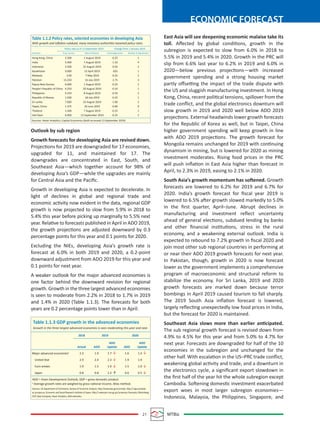
East Asia will see deepening economic malaise take its
toll. Affected by global conditions, growth in the
subregion is expected to slow from 6.0% in 2018 to
5.5% in 2019 and 5.4% in 2020. Growth in the PRC will
slip from 6.6% last year to 6.2% in 2019 and 6.0% in
2020—below previous projections—with increased
government spending and a strong housing market
partly offsetting the impact of the trade dispute with
the US and sluggish manufacturing investment. In Hong
Kong, China, recent political tensions, spillover from the
trade conflict, and the global electronics downturn will
slow growth in 2019 and 2020 well below ADO 2019
projections. External headwinds lower growth forecasts
for the Republic of Korea as well, but in Taipei, China
higher government spending will keep growth in line
with ADO 2019 projections. The growth forecast for
Mongolia remains unchanged for 2019 with continuing
dynamism in mining, but is lowered for 2020 as mining
investment moderates. Rising food prices in the PRC
will push inflation in East Asia higher than forecast in
April, to 2.3% in 2019, easing to 2.1% in 2020.
South Asia’s growth momentum has softened. Growth
forecasts are lowered to 6.2% for 2019 and 6.7% for
2020. India’s growth forecast for fiscal year 2019 is
lowered to 6.5% after growth slowed markedly to 5.0%
in the first quarter, April–June. Abrupt declines in
manufacturing and investment reflect uncertainty
ahead of general elections, subdued lending by banks
and other financial institutions, stress in the rural
economy, and a weakening external outlook. India is
expected to rebound to 7.2% growth in fiscal 2020 and
join most other sub regional countries in performing at
or near their ADO 2019 growth forecasts for next year.
In Pakistan, though, growth in 2020 is now forecast
lower as the government implements a comprehensive
program of macroeconomic and structural reform to
stabilize the economy. For Sri Lanka, 2019 and 2020
growth forecasts are marked down because terror
bombings in April 2019 caused tourism to fall sharply.
The 2019 South Asia inflation forecast is lowered,
largely reflecting unexpectedly low food prices in India,
but the forecast for 2020 is maintained.
Southeast Asia slows more than earlier anticipated.
The sub regional growth forecast is revised down from
4.9% to 4.5% for this year and from 5.0% to 4.7% for
next year. Forecasts are downgraded for half of the 10
economies in the subregion and unchanged for the
other half. With escalation in the US–PRC trade conflict,
weakening global activity and trade, and a downturn in
the electronics cycle, a significant export slowdown in
the first half of the year hit the whole subregion except
Cambodia. Softening domestic investment exacerbated
export woes in most larger subregion economies—
Indonesia, Malaysia, the Philippines, Singapore, and
Table 1.1.3 GDP growth in the advanced economies
Growth in the three largest advanced economies is seen moderating this year and next.
United Stat
Euro areaes
Japan
ADO = Asian Development Outlook, GDP = gross domestic product.
a
Average growth rates are weighed by gross national income, Atlas method.
Sources: US Department of Commerce, Bureau of Economic Analysis, http://www.bea.gov;Eurostat, http:// epp.eurostat.
ec.europa.eu; Economic and Social Research Institute of Japan, http:// www.esri.cao.go.jp;Consensus Forecasts; Bloomberg;
CEIC Data Company; Haver Analytics; ADB estimates.
2.2
2.9
1.9
0.8
1.9
2.4
1.5
0.8
1.7
2.3
1.0
1.2
1.6
1.9
1.5
0.6
1.4
1.9
1.0
0.5
Actual
Major advanced economiesa
ADO
ADO
Update
ADO
UpdateADO
20192018 2020
Table 1.1.2 Policy rates, selected economies in developing Asia
With growth and inflation subdued, many monetary authorities loosened policy rates.
Policy rate as of 13 September 2019
Hong Kong, China
India
Indonesia
Kazakhstan
Malaysia
Pakistan
Papua New Guinea
People’s Pepublic of China
Philippines
Republic of Kkorea
Sri Lanka
Taipei, China
Thailand
Viet Nam
2.500
5.400
5.500
9.000
3.00
13.250
6.000
4.250
4.250
1.500
7.000
1.375
1.500
6.000
-0.25
-1.10
-0.50
-025
-0.25
2.75
-0.25
-0.10
-0.50
-0.25
-1.00
-0.00
-0.25
-0.25
1
4
2
1
1
3
1
1
2
1
2
0
1
1
1 August 2019
7 August 2019
22 August 2019
15 April 2019
7 May 2019
16 July 2019
1 August 2019
20 August 2019
8 August 2019
18 July 2019
23 August 2019
20 June 2019
7 August 2019
13 September 2019
Countries
Sources: Haver Analytics; Capital Economics (both accessed 13 September 2019)
% per annum Date of decision Percentage points Number of adjustments
Change from 1 January 2019
ECONOMIC FORECAST
22 MTBiz
Thailand—but domestic consumption held up well to
cushion the slowdown. The downward revision for
growth is paralleled by one for the inflation forecasts.
Central Asia is now forecast to accelerate. Growth
forecasts for the subregion are revised up from 4.2% to
4.4% in 2019 and from 4.2% to 4.3% in 2020. Increased
government spending has boosted growth in
Kazakhstan, while a substantial rise in investment raises
prospects for Uzbekistan. These revisions and higher
growth projections for Armenia and Azerbaijan more
than offset slower growth prospects for Georgia.
Growth in 2020 is now projected at 4.3%, revised up
from 4.2% on a small upgrade for Kazakhstan and larger
ones for Tajikistan and Uzbekistan. The forecast for
inflation in 2019 is revised up from 7.8% to 8.0%
because cuts to subsidies, rising import prices, foreign
exchange shortages, and expansionary credit have
stoked inflation in Turkmenistan. This increase
offsets—along with higher inflation projections for
Georgia and Tajikistan that reflect accelerating prices in
the first half of the year—slightly lowered forecasts for
Kazakhstan and Uzbekistan. The forecast for subregional
inflation in 2020 is raised from 7.2% to 7.4%.
The Pacific outlook improves with recovery in its
largest economy. After near-stagnation in 2018, the
growth forecast for the subregion in 2019 is revised up
to 4.2%, mainly because gas production in Papua New
Guinea has outpaced projections, but also with
construction expenditure in Solomon Islands and
Samoa higher than expected and Nauru suffering less
economic decline than predicted. Conversely, tourism
downturns require lower growth projections for the
Cook Islands and Palau, as does disappointing recovery
expenditure for Tonga. Elsewhere, growth forecasts are
maintained. The subregional growth forecast for 2020
is downgraded to 2.6% largely because of project delays
in Papua New Guinea. Inflation in the subregion is now
expected to ease further to 3.4% in 2019, 0.3
percentage points lower than projected earlier. As more
benign price pressures are seen to persist into 2020, the
subregional projection for inflation next year is reduced
to 3.4%.
FUTURE PRODUCTS
23 MTBiz
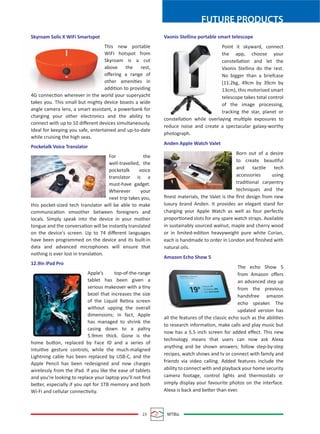
Skyroam Solis X WiFi Smartspot
This new portable
WIFI hotspot from
Skyroam is a cut
above the rest,
offering a range of
other amenities in
addition to providing
4G connection wherever in the world your superyacht
takes you. This small but mighty device boasts a wide
angle camera lens, a smart assistant, a powerbank for
charging your other electronics and the ability to
connect with up to 10 different devices simultaneously.
Ideal for keeping you safe, entertained and up-to-date
while cruising the high seas.
Pocketalk Voice Translator
For the
well-travelled, the
pocketalk voice
translator is a
must-have gadget.
Wherever your
next trip takes you,
this pocket-sized tech translator will be able to make
communication smoother between foreigners and
locals. Simply speak into the device in your mother
tongue and the conversation will be instantly translated
on the device's screen. Up to 74 different languages
have been programmed on the device and its built-in
data and advanced microphones will ensure that
nothing is ever lost in translation.
12.9in iPad Pro
Apple’s top-of-the-range
tablet has been given a
serious makeover with a tiny
bezel that increases the size
of the Liquid Retina screen
without upping the overall
dimensions; in fact, Apple
has managed to shrink the
casing down to a paltry
5.9mm thick. Gone is the
home button, replaced by Face ID and a series of
intuitive gesture controls, while the much-maligned
Lightning cable has been replaced by USB-C, and the
Apple Pencil has been redesigned and now charges
wirelessly from the iPad. If you like the ease of tablets
and you’re looking to replace your laptop you’ll not find
better, especially if you opt for 1TB memory and both
Wi-Fi and cellular connectivity.
Vaonis Stellina portable smart telescope
Point it skyward, connect
the app, choose your
constellation and let the
Vaonis Stellina do the rest.
No bigger than a briefcase
(11.2kg, 49cm by 39cm by
13cm), this motorised smart
telescope takes total control
of the image processing,
tracking the star, planet or
constellation while overlaying multiple exposures to
reduce noise and create a spectacular galaxy-worthy
photograph.
Anden Apple Watch Valet
Born out of a desire
to create beautiful
and tactile tech
accessories using
traditional carpentry
techniques and the
finest materials, the Valet is the first design from new
luxury brand Anden. It provides an elegant stand for
charging your Apple Watch as well as four perfectly
proportioned slots for any spare watch straps. Available
in sustainably sourced walnut, maple and cherry wood
or in limited-edition heavyweight pure white Corian,
each is handmade to order in London and finished with
natural oils.
Amazon Echo Show 5
The echo Show 5
from Amazon offers
an advanced step up
from the previous
handsfree amazon
echo speaker. The
updated version has
all the features of the classic echo such as the abilities
to research information, make calls and play music but
now has a 5.5 inch screen for added effect. This new
technology means that users can now ask Alexa
anything and be shown answers; follow step-by-step
recipes, watch shows and tv or connect with family and
friends via video calling. Added features include the
ability to connect with and playback your home security
camera footage, control lights and thermostats or
simply display your favourite photos on the interface.
Alexa is back and better than ever.
24 MTBiz
FINANCIAL GLOSSARY
Gearing: Gearing refers to the level of a company’s
debt related to its equity capital, usually expressed in
percentage form. It is a measure of a company’s
financial leverage and shows the extent to which its
operations are funded by lenders versus
shareholders. The term "gearing" also refers to the
ratio between a company’s stock price and the price
of its warrants.
Preference shares: A type of shares that give the
holder special benefits compared to other
stockholders. The benefits can vary between different
types of preferred shares. A common benefit assigned
to preferred shares is that the holder is guaranteed a
fixed dividend each year.
Pro Forma Invoice: A type of invoice that is send from
one company to another. A Pro Forma invoice is send
before any goods are sent out and it is a way to
guarantee that the company gets paid for products it
sells to another company. This is especially common if
the buyer has financial problems and when the two
companies lack prior relationship.
Zero coupon bond: With a Zero Coupon Bond, the
holder of the bond gets a lump sum upon maturity
instead of periodic payments of interest during the
lifetime of the bond. When the bond is issued, it costs
significantly less to purchase than what it will pay
upon maturity.
Near money: Near Money are highly liquid non-cash
assets that can be quickly converted into cash.
Examples of assets commonly considered near
money are bonds, treasury bills, widely traded foreign
currencies, and certificates of deposits and bank
deposits that allow instant conversion to cash.
Ticker symbol: The ticker symbol is an abbreviation
used to identify securities, e.g. on the exchange floor
and in newspapers. Using abbreviations instead of the
full name saves space, and the practice was
developed in an era where the telegraph was an
important tool for transmitting information.
Venture capital: Venture capital is a form of financing
for small, early-stage, emerging firms. Venture capital
is typically invested in small, early-stage, emerging
firms that the investors deem capable of growing fast.
The investor will normally require equity (ownership
stake) in the firm in exchange for the investment.
Leaseback: Arrangement in which one party sells a
property to a buyer and the buyer immediately leases
the property back to the seller. This arrangement
allows the initial buyer to make full use of the asset
while not having capital tied up in the asset.
Leasebacks sometimes provide tax benefits. Also
called sale and leaseback.
G O S S A R Y Y
Y
R
R
A
A
S S
O
O
L
L
G
MTB POS

MTBiz December 2019

  • 1.
    MONTHLY BUSINESS REVIEW VOLUME:10 ISSUE: 12 DECEMBER 2019 Bangladesh to outshine Malaysia, Singapore by 2024 Predicts CEBR, British think-tank RANKING OF SOUTH ASIAN ECONOMIES SOURCE: WELT 2020 20202034 149 107 117 88 100 62 67 50 145 163 160 44 25 3 40 5 RANK SIZE OF ECONOMY 1 2 3 4 26 $24.2 T $22.2 T $5.9 T $4.9 T $616 B USA CHINA JAPAN INDIA BANGLADESH TOP COUNTRIES BY SIZE OF THE ECONOMY IN 2029 Bangladesh to outshine Malaysia, Singapore by 2024 Predicts CEBR, British think-tank Bhutan Maldives Afghanistan Nepal Sri Lanka Pakistan Bangladesh India
  • 3.
    Contents MONTHLY BUSINESS REVIEW VOLUME:10 ISSUE: 12 DECEMBER 2019 MTBiz Disclaimer: MTBiz is printed for non-commercial & selected individual-level distribution in order to sharing information among stakeholders only. MTB takes no responsibility for any individual investment decision based on the information at MTBiz. This review is for information purpose only and the comments and forecasts are intended to be of general nature and are current as of the date of publication. Information is obtained from secondary sources which are assumed to be reliable but their accuracy cannot be guaranteed. The name of the other companies, products and services are the properties of their respective owners and are protected by copyright, trademark and other intellectual property laws. Developed & Published by MTB Group R&D Please send feedback to: RnD@mutualtrustbank.com All rights reserved @ 2019 Design & Printing: Preview Article of the month 02 National News The Central Bank 06 Business & Economy 08 MTB News & Events 12 Industry Appointments 16 Dashboard 17 International Economic Forecast 20 Future Products 23 Financial Glossary 24 MONTHLY BUSINESS REVIEW VOLUME: 10 ISSUE: 12 DECEMBER 2019 Bangladesh to outshine Malaysia, Singapore by 2024 Predicts CEBR, British think-tank RANKING OF SOUTH ASIAN ECONOMIES SOURCE: WELT 2020 20202034 149 107 117 88 100 62 67 50 145 163 160 44 25 3 40 5 RANK SIZE OF ECONOMY 1 2 3 4 26 $24.2 T $22.2 T $5.9 T $4.9 T $616 B USA CHINA JAPAN INDIA BANGLADESH TOP COUNTRIES BY SIZE OF THE ECONOMY IN 2029 Bangladesh to outshine Malaysia, Singapore by 2024 Predicts CEBR, British think-tank Bhutan Maldives Afghanistan Nepal Sri Lanka Pakistan Bangladesh India
  • 4.
    02 MTBiz ARTICLE OFTHE MONTH The Center for Business and Economic Research was founded the late 1960s as the Bureau of Business Research at Ball State University. The founding was initiated by Dr. Robert P. Bell soon after being hired as the first dean of the College of Business. The focus of the bureau was to look for research opportunities and provide faculty with help pursuing those opportunities. Also, focus was placed on using faculty in applied business research. The focus of the center has changed significantly since its inception. An official name change from the Bureau of Business Research to the Center for Business and Economic Research (CEBR) occurred in 2008. Currently, the center works in the community through services of economic policy research, national, state, and local forecasting, and data analysis. For 25 years the Centre for Economics and Business Research (CEBR) has supplied independent economic forecasting and analysis to hundreds of private firms and public organizations. The Centre for Economics and Business Research has been delivering independent economic forecasting and analysis for decades. The centre also publishes the World Economic League Table, which tracks the size of different economies across the globe and projects changes over the next 15 years, up to 2034. In a recent report CEBR said that Bangladesh is set to become the world's 26th largest economy within the next decade. The London based think tank published The World Economic League Table 2020 on December 26 last year, ranking the world's largest economies predicts that Bangladesh’s economy will make one of the biggest jumps between 2020 and 2034 on the back of demographic dividend and rising per capita income. Bangladesh to outshine Malaysia, Singapore by 2024: Predicts CEBR, British think-tank The World Bank has cut its economic growth forecast for Bangladesh by 0.2 percentage points to 7.2 percent for the current fiscal year, but the country is still poised to clock in the highest growth in South Asia. The international lender in its flagship report ‘Global Economic Prospects, January 2020’ mentioned a number of challenges for Bangladesh economy including falling credit demand, export earnings and revenue earnings and rising non-performing loans. The WB had projected 7.4 per cent growth in June, 2019. The WB Dhaka office, however, in October, 2019 projected that the country’s GDP would grow by 7.2 per cent. The government, however, has insisted that the economy would grow over 8 per cent in the current fiscal year. The WB projection came amid a slowdown in economic activities in the country with falling export earnings and import payment and sharp drop in private sector credit growth and tax revenue collection. It noted that credit demand faltered in Bangladesh, India and Pakistan amid credit tightening, reflecting structurally high non-performing assets like loans. Ranking of South Asian economies SOURCE: WELT 2020 2020 2034 5 3 India Bangladesh Pakistan SriLanka Nepal Afghanistan Maldives Bhutan 25 40 44 50 67 62 100 88 117 107 149 145 163 160 GDP GROWTH OF THE INDIAN SUBCONTINENT 7.3 7.9 8.1 7.2 7.3 7.3 2017 2018 2019* 2020** 2021** 2022**BANGLADESH ** are forecasts * are estimates SOURCE: WB INDIA PAKISTAN 6.16.15.8 5 6.8 7.2 5.2 5.5 3.3 2.4 3 3.9
  • 5.
    03 MTBiz ARTICLE OFTHE MONTH Bangladesh ranks 40th among 193 countries this year and will rise to 25th in 2034, a spot currently held by Belgium, showed the latest edition of the WELT, produced by London-based Centre for Economics and Business Research (CEBR), an international economic forecaster. In the long run, the report said, many Asian economies will rise through the ranks of the WELT as these countries cash in on their demographic dividends. In a surprising note, the report predicts that in 2024, Bangladesh will rank as the 30th largest economy in the world, overtaking Malaysia's rank of 32nd that year. Bangladesh's economy ranked 40th largest in 2020, while Malaysia ranked 34th. The report called ‘World Economic League Table 2020’ offers forecasts for 193 countries to 2034. With purchasing power parity (PPP)-adjusted gross domestic product (GDP) per capita of USD 5,028 in 2019, Bangladesh is a lower middle-income country, CEBR said. In 2024, Bangladesh's economy will overtake heavyweights such as Hong Kong (37th), Singapore (38th), Denmark (40th) and Norway (36th). Hong Kong's economy is currently ranked 35th, Singapore 37th, Denmark 39th and Norway 30th. Meanwhile, India is predicted to become the 3rd largest economy in 2034, behind China – which will dominate the global economy, and the USA – which will slip to second position. The London based think tank published The World Economic League Table 2020 on December 26 last year, ranking the world's largest economies. In 2024, Bangladesh will rank as the 30th largest economy in the world, overtaking Malaysia’s rank of 32nd that year. WORLD ECONOMIC LEAGUE TABLE 2020 Bangladesh 40th largest economy in the world and 2nd in South Asia Bangladesh’s average economic growth in last 5 years was 7.39 percent projected Bangladesh’s real GDP will grow by 7.1 percent per annum up to 2030 Since 2014, Bangladesh’s population growth rate has been measured by 1 percent Bangladesh Will be 26th largest economy by 2029 TOP COUNTRIES BY SIZE OF THE ECONOMY IN 2029 RANK SIZE OF ECONOMY SOURCE: CENTRE FOR ECONOMICS AND BUSINESS RESEARCH 1 2 3 4 26 $24.2 T $22.2 T $5.9 T $4.9 T $616 B USA CHINA JAPAN INDIA BANGLADESH
  • 6.
    04 MTBiz ARTICLE OFTHE MONTH Bangladesh has moved up one notch from its position last year, and has been persistently maintaining its rank as the 2nd largest economy in South Asia, just one-step behind neighbouring India. In 2034, Bangladesh is predicted to have the 25th largest economy in the world. Fueled by a consistent economic growth over the last five years, Bangladesh has leapt from having the 57th largest economy in 2014 to 41st in 2019. The country's average economic growth has been 7.39 percent in the last five fiscal years. Bangladesh even hit a record growth of 8.15 percent in the last fiscal year. Three rapidly growing Asian economies – Philippines, Bangladesh and Malaysia – have been listed as the fastest risers in the table amongst the larger economies. The Philippines rose from 38th place in 2019 to 36th place in 2020, and Malaysia from 35th to 34th during that same period. In 2029, India is predicted to remain the largest economy in South Asia followed by Bangladesh and Pakistan. Whereas, Bhutan, Maldives and Afghanistan will remain at the bottom of the table. With a Purchasing Power Parity (PPP) adjusted GDP per capita of USD 5,028 in 2019, Bangladesh is a lower middle-income country. The economy of the country performed well in 2019, expanding by an impressive 7.8 percent. This, however, is below the 7.9 percent GDP growth recorded in 2018, said the report. Bangladesh’s economy performed well last year, recording a 7.8 per cent growth. The country recorded 7.9 per cent growth in 2018. The country’s population increased at a rate of 1 per cent per year since 2014. This has meant that per capita incomes have grown considerably in recent years. The government debt as a share of GDP rose to 34.6 per cent last year. This is up from 34 per cent in 2018. Despite this increase, the public sector finances remain in good shape. The relatively low debt burden has provided the government with the fiscal headroom to operate a budget deficit of 4.8 percent in 2019. The annual rate of GDP growth is forecast to slow to an average of 7.3 per cent between 2020 and 2025, according to the report. CEBR forecasts that the economy will remain at this impressive rate over the subsequent nine years. China is predicted to become the world’s largest economy in 2033, overtaking the United States with growth boosted by technology. China’s population is forecast to peak at 1,416.4 mn in 2028 before falling to about 1 bn by 2100. China’s population is forecast to peak at 1,416.4 million in 2028 before falling to about 1 billion by 2100. In addition, this demography means that the population is likely to age substantially as well. India’s population is expected to overtake China’s in 2027, according to the UN. The report says they expect the trend rate of growth for China to be 5.4 percent annually from 2019-24 and 5.2 percent annually from 2024-29 and 4.3 percent annually from 2029-34. On India, they expect the trend rate of growth for India to be 5.5 percent annually from 2019-24 and 6.1 percent annually from 2024-29 and 6.1 percent annually from 2029-34. In September 2018, the HSBC – in a report on 75 countries titled "The World in 2030" – also projected that Bangladesh will be the 26th largest economy in the world by 2030. Despite there are recent slowdown in exports and reduction in World Bank’s forecast of GDP growth of Bangladesh, the economic growth will remain stable and gradually will pick up given the policy measure on ease of doing business are implemented and the mega infrastructure projects are completed in time. MTB Group R&D, at a recent internal study (December 2019) prepares a list of Amazing Asian Frontiers. It suggests in next 02 decades these countries will be the growth engine of the world: China, India, Bangladesh, Vietnam, Thailand, Myanmar and Cambodia. Among the Amazing Asian Frontier Countries, the study suggests that, Bangladesh will be the top growing countries in terms of GDP, that has the most potential for growth ahead. BANGLADESH GDP, in taka billion (constant prices) GDP, USD billion (constant prices) GDP, USD billion (current prices) 2004 4,396 87 69 5,911 124 109 10,633 282 288 11,462 304 317 12,315 327 348 16,325 433 499 23,219 616 784 33,025 876 1231 2009 2018 2019 2020 2024 2029 2034 Source: World Economic League Table Report 2020 RANK 53 57 43 41 40 30 26 25
  • 7.
  • 8.
    06 MTBiz THE CENTRALBANK Transaction thru MFS grows by 6.6pc in Oct Money transactions through mobile financial service (MFS) grew by 6.6 per cent or BDT 2,329 crore in October this year compared with that in the previous month as the MFS operators focused on making the service more convenient for clients. As per the Bangladesh Bank data, transactions through MFS increased to BDT 37,762.54 crore in October from BDT 35,433.16 crore in September. The number of transactions, daily average transactions and number of MFS accounts also increased in October. Apart from MFS transaction value, the number of transactions in October increased by 7 per cent or 1.48 crore. In October, the number of transactions increased to 22.72 crore from 21.24 crore in the previous month. The number and value of daily average transaction through MFS increased by 3.6 per cent and 3.10 per cent respectively in October compared with that in the previous month. The number of registered clients of MFS operators increased by 1.9 per cent or 14 lkah to 7.73 crore in October from 7.6 crore in the previous month. BB eases transfer of foreign national's salary to home Foreign nationals working in the country from will now on get their salaries and parks on their respective foreign currency (FC) accounts, says a Bangladesh Bank notice, issued recently. Earlier, local employers have to deposit salaries of their hired foreign staff to their banks in Taka accounts. The foreign employees concerned had to remit any fund to their native countries by telegraphic transfer (TT) after converting those to currencies of their preferences. In the latest directive, employers are allowed to transfer salaries in foreign currency to their foreign employees’ FC account directly. The chapter 11 (section 8) of the FEPD's Guidelines for Foreign Exchange Transactions-2018 (Vol-1) permits foreign nationals working in Bangladesh with valid work permits to transfer remittances up to 75% of their net income. In the directive, the central bank also said that balances of the FC accounts of foreign nationals working in Bangladesh are freely encashable to Taka to meet local expenses. BB relaxes rules on repaying buyer's credit by importers The central bank has relaxed regulations on short-term buyer's and supplier's credit borrowed from overseas sources for making payments on import of industrial raw materials. Importers are now allowed to repay their foreign currency import loans at a time, which is officially known as bullet payment, instead of any quarterly payment. "To bring further relaxation in import transactions, it has now been decided that bullet repayment will also be permissible for import of raw materials by industrial units for their own use under supplier's/buyer's credit regardless of shipment value," the Bangladesh Bank (BB) said. The central bank relaxed its regulations considering different trade bodies' recommendations. It will help create employment opportunities through facilitating import substitute sectors. Earlier on June 01, 2014, the central bank imposed restrictions on repaying short-term buyer's and supplier's credit from overseas sources for minimizing repayment risks. The central bank allowed the buyer's credit for importers in 2012 to boost the country's overall production. Remittance inflow increases by 31.75pc in November Bangladesh received USD 1,555.22 million in remittance in November of the current fiscal, which is apparently 31.75 per cent higher than that of same month of previous year, according to Bangladesh Bank (BB) data. The country received USD 1,180.44 million remittances during the month of November in 2018-19 financial year, the central bank said. Expatriate Bangladeshis sent USD 7,714.19 million remittances during the first five months of the current fiscal 2019-20. During the month of October, the country received USD 1,639.62 million while USD 1,476.91 million in September, USD 1,444.75 million in August and USD 1,597.69 million in July of the fiscal 2019-20. But in 2018-19, the country got USD 1,239.11 million in October, USD 1,139.66 million in September, USD 1,411.05 million in August and USD 1,318.18 million in July. NATIONAL NEWS
  • 9.
    07 MTBiz THE CENTRALBANK Trade deficit widens 5.6pc in July-Oct The country’s trade deficit in the July-October period of the current fiscal year (2019-20) increased by 5.58 per cent or USD 297 million year-on-year amid a slowdown in export and import. According to the BB data released recently, trade deficit increased to USD 5.62 billion in the July-October period of FY20 from USD 5.32 billion in the same period of FY 2018-19. In July-October this year, imports fell by 3.17 per cent to USD 18.14 billion from USD 18.73 billion in the same period last year. The current account deficit, however, dropped by 36.88 per cent, or USD 762 million, to USD 1.3 billion in July-October of FY20 from USD 2.07 billion in the same period of FY19. The country’s overall deficit also dropped to USD 229 million in the first four months of FY20 against USD 444 million in the same period of last fiscal year. The BB data also showed that the country attained USD 881 million in net foreign direct investment in July-October of this fiscal year against USD 841 million in the same period of last fiscal year. BB moves to curb trade-based money laundering Bangladesh Financial Intelligence Unit (BFIU) recently issued guidelines for banks to prevent money laundering in the name of export and import. The intelligence agency has been forced to issue the guideline promptly following a Global Financial Integrity report, which said Bangladesh is one of the top countries facing the trade based money laundering. As per the guidelines, all the banks will have to prepare own guidelines to prevent money laundering and submit those to the BFIU within March 10 of 2020. Along with that, they will have to implement the guidelines within the first of June of the same year. According to the guideline, trade-based money laundering related cases would be analysed with top priority. It will also help banks to improve their capability to follow guidelines of trade-based money laundering. According to the guideline, all the international trade related bank officials would be trained. The BFIU emphasised issuing the guidelines because over 80 percent of money laundering was committed through international trade. Committee formed to ensure single digit bank interest rate Bangladesh Bank (BB) recently formed a seven-member committee, led by its Deputy Governor SM Moniruzzaman, to ensure single digit bank interest rate for industrial sector. “BB Governor Fazle Kabir has formed the committee to ensure single digit lending rate in the industrial sector. The committee will provide necessary suggestion to this end,” BB Executive Director Abu Farah Md Naser told. Other members of the committee are Agrani Bank Chairman Dr Zaid Bakht, Standard Bank Chairman Kazi Akarm Uddin Ahmed, Rupali Bank Managing Director Md Obayed Ullah Al Masud, IFIC Bank Managing Director Mohammad Shah Alam Sarwar, Association of Bankers, Bangladesh (ABB) Chairman and Mutual Trust Bank Limited (MTB) Managing Director & CEO Syed Mahbubur Rahman and NRB Bank Managing Director Md Mehmood Hussain. BB allows use of other networks alongside NPSB The Bangladesh Bank recently allowed banks and non-bank financial institutions connected with the National Payment Switch Bangladesh to use other networks alongside NPSB while making transaction through point of sales. The circular said that the waiver would be applicable to local transactions only upon ensuring security of the respective entities’ system. Earlier, there was no scope for the banks and NBFIs for using other networks while making transactions through PoS. The policy has been relaxed to facilitate businesses using newly emerging payment systems. In August, 2017, the BB issued a detail instruction for the banks and NBFIs on the use of automated teller machine, PoS and online payments with a view to making the system secure for the users. In August this year, the banks and NBFIs executed through POS 5,11,590 transactions worth BDT 183.51 crore, up 6.18 per cent on BDT 172.83 crore in July this year. As per the BB’s data, a total of 52,846 POS terminals of 50 banks are connected with the NPSB. NATIONAL NEWS
  • 10.
    08 MTBiz BUSINESS &ECONOMY NATIONAL NEWS Record GDP growth despite challenges Bangladesh’s GDP ultimately grew at a record 8.15 percent in fiscal 2018-19 -- 2 basis points higher than earlier estimates -- smashing the 7.8 percent target set for the fiscal year back in June 2018. The higher-than-expected growth came in spite of headwinds from slowing exports and drying banking sector liquidity. The development not only marks the economy breaking into the 8 percent growth territory after years of 6-7 percent growth, it makes Bangladesh the fastest growing nation in the Asia Pacific region, as per Asian Development Bank’s earlier forecasts. The figure also surpassed the World Bank’s forecast of 7.3 percent for the year. In fiscal 2017-18, the GDP grew at 7.86 percent. The strong growth recorded last fiscal year was down to higher contribution from the manufacturing sub-sector: it increased from 22.85 percent to 24.08 percent. The share of industry to GDP increased from 33.66 percent in fiscal 2017-18 to 35 percent. Food inflates inflation in November Inflation sharply increased in November and stood at its highest point within the last 26 months due to rising food prices. The point-to-point inflation rose by 0.58 percentage point in November to 6.05 percent, compared to the previous month's. The inflation rate in November stood at 6.05 percent, while it was 5.47 percent in October this year and 5.91 percent in November last year, according to a Bangladesh Bureau of Statistics (BBS) report. The BBS report further showed that the food inflation on point-to-point basis stood at 6.41 percent in November, compared to 5.49 percent in the previous month. The non-food inflation stood at 5.47 percent in November, slightly rising from 5.45 percent in October. The BBS data also revealed that the point-to-point inflation rate both in rural and urban areas increased in November. Rural areas observed the inflation rate of 6.01 percent in November, which was 5.36 percent in October. Rural inflation on food stood at 6.54 percent in November, which was 5.56 percent in October. ADB holds steady on Bangladesh forecast, trims developing Asia predictions The Asian Development Bank (ADB) presented the positive outlook for Bangladesh in its latest report released recently, keeping its growth projection unchanged at 8.1 percent for this year, when other developing Asian economies are under a dark shadow. In a supplement to its Asian Development Outlook 2019, the Manila-based bank revised its initial growth forecast for developing Asia. The report said it now expects GDP in developing Asia to expand 5.2 percent in both 2019 and 2020, down from the September forecast of 5.4 percent growth this year and 5.5 percent next year. Export growth, which has remained low, is projected to pick up, thanks to the government's fiscal support of export-oriented business, according to the report. The ADB in its latest report revised down the growth projection of most Asian countries, including both giants India and China. Bangladesh achieved 8.15 percent GDP growth in the 2018-19 fiscal year, slightly higher than the preliminary estimation of 8.13 percent, according to the Bangladesh Bureau of Statistics. Sluggish revenue to worsen credit crunch Revenue shortfall widened further as sluggish tax collection persisted in the July-October period, stoking concerns of a credit crunch amid a surge in government borrowing from the financial sector and an economic slowdown. The tax authority logged 4.33 percent year-on-year higher revenue to BDT 65,096 crore from July to October this fiscal year, preliminary data from the National Board of Revenue showed. The latest collection pointed to a slowdown from the same period in the previous fiscal year when collection was 6.74 percent up. As a result, the NBR is BDT 20,220 crore shy of reaching its July-October target of raising BDT 85,317 crore. The tax authority fell short of about BDT 15,000 crore from its collection goal in the July-September period. The sluggish collection has already compelled the government to increase its borrowing from banks, which may further aggravate the already tight liquidity condition in the financial sector. Until November 21 in the current fiscal year, the government borrowed 90 percent of its full fiscal-year target of BDT 47,364 crore from the banking sector, according to Bangladesh Bank data. GDP GROWTH RATE 2014-15 2015-16 2016-17 2017-18 2018-19 (In percent) 6.55 7.11 7.28 7.86 8.15 SOURCE: BBS TREND OF TAX COLLECTION In crore taka July-Oct period 20,631 CUSTOMS DUTY VALUE ADDED TAX INCOME AND TRAVEL TAX 20,649 24,317 17,444 24,751 19,695 SOURCE: NBR FY’19 FY’20
  • 11.
    09 MTBiz BUSINESS &ECONOMY NATIONAL NEWS IPDC rolls out blockchain-based supply chain finance platform IPDC Finance Ltd has rolled out a blockchain-based supply chain finance platform, the first of its kind in Bangladesh, with a view to giving out low-cost loans to micro and small entrepreneurs. A blockchain is a database that is shared across a network of computers. Once a record has been added to the chain it is very difficult to change. To ensure all the copies of the database are the same, the network makes constant checks, according to Reuters. Blockchains have been used to underpin cyber-currencies like bitcoin but many other possible uses in areas such as banking and supply chain are emerging. The IPDC’s digital platform, Orjon, is a supply chain financing solution that provides financial facilities to corporates and micro and small enterprises. Under the system, small enterprises across the country will get loans easily and at a lower cost as the platform will do away with existing manual process. Agents to pay VAT for non-resident MNCs Multinational companies (MNCs), not having offices in Bangladesh, are unlikely to be allowed to pay VAT directly to the public exchequer. MNCs, not having establishments in Bangladesh, have to pay VAT through their agents. Referring to the VAT law, a senior official at the National Board of Revenue (NBR) said global social media giants like Google, facebook and Youtube will not be able to obtain VAT registration or pay VAT directly without support of their agents. To bring the multinationals under the VAT net, the NBR has amended both VAT registration forms and VAT agent rules. Through amending the VAT agent rules, the NBR created scope for reputed companies such as PwC (PricewaterhouseCoopers) to obtain licence as VAT agents. Earlier, only individuals were allowed to obtain licence as VAT agents. In a letter to the NBR, the Google Asia Pacific sought to pay VAT directly from its regional head office, as it has no bank account nor any permanent establishment in Bangladesh. Bangladesh becomes self-sufficient in fish production Bangladesh has attained self-sufficiency in fish production as the country’s per capita fish consumption has increased to 62.58 grams per day against the demand of 60 grams. State Minister for Fisheries and Livestock Md Ashraf Ali Khan Khasru came up with the statement while addressing a function at Kazi Najrul Islam Auditorium in Rajshahi University (RU) marking the 4th Livestock Award, seminar and Livestock and Poultry Fair-2019 in Rajshahi. “Bangladesh has secured the third position in producing fish in inland water-bodies while it is the fifth in aquaculture production. The per capita fish consumption has increased to 62.58 grams per day, exceeding the daily requirement of 60 grams,” the state minister said. Noting that Bangladesh is now on the way to achieve self-sufficiency in milk and egg production, Khasru said the availability of milk has increased by four times in the last 10 years with the current per capita consumption of 165 milliliters while availability of egg has increased to 104 per person from 40 during the period. Apparel items continue to become cheaper The prices of Bangladeshi made apparel items continued to fall since the Rana Plaza building collapse in April 2013 although the prices of cotton, the main raw material for fabrics, increased during the time to some extent. In 2013 a dozen of Bangladesh-manufactured cotton trousers sold for USD 62.26. In 2017 the same quantity went for USD 54.29 per dozen, a 12.80 percent fall in five years, according to a findings by “Mark Anner: Binding Power, the Sourcing Squeeze, Workers’ Rights and Building Safety in Bangladesh since Rana Plaza”. However, cotton was sold at 90.42 cents per pound in 2013 and the price of the white fibre went down to 83.09 in 2014 and 70.41 cents in 2015. But from 2016 the price of cotton started going up again and it was sold at 74.41 cents. In 2017, per pound of cotton sold for 85.99 cents, according to the findings. Of the total garment export from Bangladesh, nearly 90 percent are made from cotton fibres. DECLINING PRICES 65.00 60.00 55.00 50.00 45.00 2013 54.2958.1160.5262.4962.26TROUSERS COTTON,USDCENTS/POUND 85.9974.2370.4183.0990.42 SOURCE: MARK ANNER: BINDING PROWER, THE SOURCING SQUEEZE, WORKERS RIGHTS AND BUILDING SEFETY IN BANGLADESH SINCE RANA PLAZA COTTON 2014 2015 2016 2017 -100 -90 -80 -70 -60 -50 COTTONTROUSERS.USD/DOZEN
  • 12.
    BUSINESS & ECONOMY 10MTBiz NATIONAL NEWS Ceramics market of Bangladesh A study by the United States Agency for International Development (USAID) says ceramics, with a 200 percent growth in the last five years, is now the top emerging industry in Bangladesh. At the end of 2018, the market size of the ceramics industry was BDT 5,950 crore, to which the tiles industry contributed the most with BDT 4,500 crore. The size of the tableware and the sanitary ware industries were BDT 500 crore and BDT 920 crore respectively, adds USAID. The 200 percent growth in the ceramics industry is centred on the tiles industry, according to the ceramic manufacturers and exporters association. Ceramic products have seen an overall growth of 20-22 percent, whereas it is 30-35 percent for the tiles industry. Considering the market share of specific products, Shinepukur Ceramics Ltd, a part of the Beximco Group, leads the tableware industry. The company currently holds 30 percent of a BDT 500-crore market. In 2018, it had a turnover of BDT 152 crore. Shinepukur is followed by Monno Ceramics whose sales last year was BDT 140 crore. Some other firms, including Farr and Star, have a significant share of the market. At present, Bangladeshi ceramic products are going to more than 50 countries. According to the Export Promotion Bureau, Bangladeshi companies exported ceramic goods worth BDT 585 crore in the 2018-19 fiscal year. Ceramics now occupies 7th position as an export item. The sector witnessed 26 percent export growth over the last three years, although tableware is still the main ceramic goods exported. The use of ceramic ware began in Bangladesh as luxury items on the dining tables of the upper class. Until the 1990s, the country depended fully on imported ceramic goods by a few companies. But that has changed drastically in the last 10 years. Ceramic ware is no longer a status symbol but a necessity in almost all households. As a result, it has emerged as a big industry based on which 66 brands have come into being so far in the country. The domestic market for ceramic products, including tableware, tiles and sanitary ware, is worth about BDT 6,000 crore annually. Bangladesh exported ceramic products worth BDT 585 crore last year. Apart from 66 brands, more than one hundred manufacturing companies, both small and medium, have evolved in the country. At present the sector employs around 5,00,000 people, including 55,000 direct employees and those from the backward linkage industry. Annually, the companies manufacture 25 crore pieces of tableware, 15 crore square feet of tiles and 50 lakh pieces of sanitary ware. A major part of the tableware goes to Europe and to the Middle East. Ceramics – A rising star in industries CERAMICS INDUSTRY OF BANGLADESH Domestic market size Market ratio Tiles hold Sanitary ware growth in last 5 years Local brands hold market share employee engagements directly local brands now in operation investment in last 10 Tableware hold growth per year 15% 10% 20% 75% 66% 55,000 80% 200% 585 2018-19 Total export in fiscal year Major players in Bangladesh RAK, Monno, Great Wall, X monica, DBL, Akij CRORE CRORE 6,000 YEARS 8,500CRORE Ceramics ware production in Bangladesh (Taka in crore) Ceramics item Total consumption 4,500 3,450 (76.67%) 3,450 (76.67%) 465 (96%) 32 (4%) 585 (FY2918-19) 920 800 (90%) 120 (10%) 500 Local production Import Export Tiles Tableware Sanitary ware
  • 13.
    MTB NEWS &EVENTS 11 MTBiz mutualtrustbank.com Mutual.Trust.Bank mtbltd Tweet2MTB
  • 14.
    12 MTBiz MTB NEWS& EVENTS MTB OPENS ITS 118TH BRANCH AT GHIOR, MANIKGANJ MTB has opened its 118th branch at Ghior, Manikganj 1840 on December 24, 2019. Tarek Reaz Khan, Deputy Managing Director, MTB, inaugurated the branch as the Chief Guest. Syed Rafiqul Hossain, Head of Dhaka Division Branches, Azam Khan, Group Chief Communications Officer and K.M. Mayeenul Islam Rasel, Branch Manager, Ghior Branch, MTB along with dignitaries and leaders of local business associations, representatives from different strata and other senior officials of the bank attended the event. The Chief Guest, in his speech, appreciated the spontaneous cooperation rendered by the people of Ghior in setting up the branch at a commercially important place of Manikganj district. MTB INAUGURATES ITS 5TH SUB-BRANCH AT MONGOLERGAON, NARAYANGANJ MTB has opened its 5th Sub-Branch at Mongolergaon (Bot Tola) Bazar, Sonargaon, Narayanganj 1460 on December 18, 2019. Syed Mahbubur Rahman, Managing Director & CEO, MTB inaugurated the Sub-Branch as the Chief Guest at a simple ceremony held at the premises of the sub – branch. Rakibur Rahman Khan, UNO, Sonargaon Upazila, Md. Arif Masud (Babu), Chairman, Mugrapara Union Parishad, Al-hajj Engineer Masudur Rahman Masum and Syed Rafiqul Hossain, Head of Dhaka Division Branches, Azam Khan, Group Chief Communications Officer, Selina Alam, Vice President, Network Expansion Unit, MTB along with dignitaries and leaders of local business associations, representatives from different strata and other senior officials of the bank attended the event.
  • 15.
    13 MTBiz MTB NEWS& EVENTS MTB has signed an agreement with Sea Kitchens Bangladesh Limited (Sea Kitchens) at a simple ceremony held at the bank’s Corporate Head Office, MTB Centre, 26 Gulshan Avenue, Dhaka 1212. Sea Kitchens is a leading German modular kitchen brand with unique modular kitchen and wardrobe designs, combined with the highest German quality standards. Under this agreement, the clients will be able to finance their purchases at Sea Kitchens from MTB’s FlexiPay (using credit card) or consumer finances products at discounted processing fee and interest rate. MTB clients, likewise, will be entitled to buy kitchen solutions and fittings with special discounted offers from Sea Kitchens. Samia Afrin, Director, Sea Kitchens and Syed Rafiqul Haq, Deputy Managing Director2 & Chief Business Officer (CBO), MTB signed the agreement on behalf of their respective organizations. Asoka Gamage, Director & CEO and Muhammad Atique, Director, Sea Kitchens and Towfiqul Alam Chowdhury, Head of Business, Retail Division, Mohammad Anwar Hossain, Head of Cards, Irfan Islam, Head of Privilege Banking & Cash Management, Sultana Shikder Ahona, Head of Payroll Banking, Md. Ehethesham Rahman, Head of Structured Finance Unit and Azam Khan, Group Chief Communications Officer, MTB along with other senior officials from both the organizations were also present at the agreement signing ceremony. MTB SIGNS AGREEMENT WITH SEA KITCHENS BANGLADESH LIMITED MTB Foundation has handed over BDT 300,000 to Monomela Foundation to support their endeavors. Monomela has initiated after-school education programs for the underprivileged children, providing basic medical treatment through health camps, arranging training programs on organic agriculture for farmers and many other philanthropic projects. Syed Mahbubur Rahman, Managing Director & CEO, MTB, handed over the cheque to Md. Abdur Rahim, Founder, Monomela Foundation, at a simple ceremony held at the bank’s Corporate Head Office, MTB Centre, 26 Gulshan Avenue, Dhaka 1212 on December 26, 2019. Corovi Mizan, Co-Founder, Sazzadul Islam Chowdhury, Coordinator, Monomela Foundation, Azam Khan, Group Chief Communications Officer and Samia Chowdhury, Deputy Head, Group Communications, MTB along with other officials of both the organizations were also present at the ceremony. MTB FOUNDATION SUPPORTS MONOMELA FOUNDATION 2 Haq is promoted to Additional Managing Director since January 01, 2020
  • 16.
    14 MTBiz MTB NEWS& EVENTS MTB, as part of its Corporate Social Responsibility (CSR) initiatives, has recently handed over blankets to Cadet College Club Limited (CCCL) for distribution amongst the cold-affected people of different regions of the country. Group Captain (retd.) Muhammad Alamgir, acsc, President, CCCL received a token of blankets from MTB officials at a simple ceremony held at the club premises, Gulshan 1, Dhaka 1212 on December 24, 2019. M Musleh Uz Zaman, Vice-President, Jashim Mohammad Al-Amin, Secretary General, CCCL, Amitav Kaiser, Head of Infrastructure Division, Md. Ehethesham Rahman, Head of Structured Finance Unit, Samia Chowdhury, Deputy Head, MTB along with senior officials of both the organizations were also present at the occasion. MTB HANDS OVER BLANKETS TO CADET COLLEGE CLUB MTB Kalurghat I/A Branch organized a School Banking Campaign 2019 amongst the students of UCEP, Mabia Rashidia School, at Chandgaon, Chattogram 4212 on November 27, 2019. MTB KALURGHAT I/A BRANCH ORGANIZED SCHOOL BANKING CAMPAIGN 2019
  • 17.
  • 18.
    16 MTBiz INDUSTRY APPOINTMENTS NATIONALNEWS Syed Rafiqul Haq promoted to AMD of MTB Syed Rafiqul Haq has promoted to Additional Managing Director of Mutual Trust Bank Limited (MTB). Prior to this promotion, he held the position of Deputy Managing Director & Chief Business Officer (CBO) of the same bank since 2013. With about 35 years of banking experience, Rafiqul Haq started his carrier with IFIC Bank Limited as Probationary Officer in 1984. Later he joined Eastern Bank Limited in 1998 and served the bank as Area Head for Corporate Banking before joining MTB. Haider elected ABB Vice-Chair Mohammed Haider Ali Miah, Managing Director and CEO, EXIM Bank Limited has been elected as Vice-Chairman of the Association of Bankers, Bangladesh (ABB), a forum of banking professionals of Bangladesh, for the next two-year term (2020-21). Haider has previously served as Vice-Chairman of Bangladesh Foreign Exchanges Dealers’ Association (BAFEDA) and President of the Bangladesh Chapter of Global Economist Forum, a consultative member of ECOSOC, United Nations. New DMD of SBAC Bank Altaf Hossain Bhuiyan has been promoted as Deputy Managing Director of South Bangla Agriculture and Commerce Bank (SBAC) Limited. Prior to the promotion, Altaf was the Senior Executive Vice President of the Bank. Altaf started his banking career with Pubali Bank Limited in 1997 as Probationary Senior Officer. Later he served NCC Bank Limited in 2000 and Shahjalal Islami Bank Limited in 2005. He joined in SBAC Bank in 2014. Iftekhar elected ABB Chairman Ali Reza Iftekhar, Managing Director and CEO of Eastern Bank Limited, has elected as Chairman of Association of Bankers, Bangladesh Limited (ABB) a forum of banking professionals of Bangladesh, for the next two-year term (2020-21) at its 22nd Annual General Meeting. He also served the same position for two-year tenure (2014-15) earlier. Iftekhar, with more than 30 years of experience in banking, has worked in both foreign and local private banks including Banque Indosuez and Standard Chartered Bank. Rashid Ahmed re-elected BCB Chairman Rashid Ahmed Chowdhury has re-elected as Chairman of the board of directors of Bangladesh Commerce Bank Limited. He is the Chairman and an associate professor at the management information system department in Chittagong Independent University. Rashid has worked in different multinational companies including the Carbon Country Coal Mine Inc, US, AIM Inc, US and Wilwen Enterprise, US. Shahnawaj becomes Modhumoti Bank DMD Shahnawaj Chowdhury has been promoted to Deputy Managing Director of Modhumoti Bank Limited. Prior to the promotion, he served the bank as Senior Executive Vice President (SEVP). Shahnawaj has 21 years of banking experience in the field of banking. He also served Premier Bank Limited, Midland Bank Limited, AB Bank Limited and Standard Chartered Bank, Bangladesh and UAE.
  • 19.
    17 MTBiz DASHBOARD Inflation (12- MonthAverage) Oct Nov 263.35 264.65 Consumer Price Index (12-Month Average) Exchange Rate 1 USD in BDT 84.7884.64 Oct Nov Oct Nov 5.5% 5.56% BDT BDT -13492.89% Current Account Balance 57.70 -7727.70 32,775.77 31,831.92 8.32% Balance of Trade Aug Sep Aug Sep Aug Sep (BDT Crore) (BDT Crore) (BDT Crore) (BDT Crore) (USD Million) (USD Million) -10538.10 -9661.63 FX Reserves - 2.88% Sep Oct Sep Oct Import 19.17% 4,220.90 5,030.10 Export 5.40% 2,915.85 3,073.23 (USD Million) (USD Million) (USD Million) (USD Million)
  • 20.
    18 MTBiz DASHBOARD Total Numberof Branches (Scheduled Banks) 10388 10406 Aug Sep + 0.17% Call Money Rate 4.12% 4.53% Nov Dec Oct Oct NovNov INTERNET USERS MOBILE INTERNET USERS MOBILE PHONE USERS 99.06 Oct 99.57 93.79 Nov 93.32 164.17 164.83 (-0.51%) (-0.51%) (0.40%) Million Million Million Million Million Million Bcf July JulyJuly INTERNET BANKING SUBSCRIBERS MOBILE BANKING SUBSCRIBERS AGENT BANKING SUBSCRIBERS 2.22 Aug 2.25 73.09 Aug 73.58 3.58 Aug 3.73 (1.47%) (0.68%) (4.33%) MillionMillionMillionMillionMillionMillion
  • 21.
    19 MTBiz DASHBOARD July Aug Aug DebitCards Credit Cards Foreign Cards* 50.00150.00 BDTBillionBDTBillion 100.00 -1.17% -6.89% 7.31% *Internally issued cards ATM POS E-Commerce -2.76% -14.87% 7.81% Card Payments in BDT Card Payments in BDT July 50.00150.00200.00200.00100.00 Monthly Change Monthly Change 151.38Billion 161.27Billion 151.38Billion 161.27Billion
  • 22.
    20 MTBiz ECONOMIC FORECAST INTERNATIONALNEWS Asia girds for prolonged uncertainty Developing Asia’s strong growth prospects have weakened since Asian Development Outlook 2019 (ADO 2019) was published in April, as global growth slowed, trade tensions escalated, and regional investment weakened. Exports declined with lower demand from the major advanced economies, compounded by the trade conflict between the United States and the People’s Republic of China (PRC). Tensions between the two have escalated since May, shaking financial markets. Uncertainty has undermined private investment in the region, leaving domestic consumption as the main support to growth. On the supply side, manufacturing slowed further, with electronics in particular suffering an industry-wide slump. Facing slower growth and muted inflation, many countries have loosened fiscal and monetary policy to support economic activity. Regional growth will slow from 5.9% in 2018 to 5.4% in 2019, edging back up to 5.5% next year. Excluding the newly industrialized economies (NIEs), growth will slow to 6.0% this year and next (Figure 1.0.1). Growth in the PRC is expected to decline to 6.2% in 2019 and 6.0% in 2020 under the impact of the trade conflict, while domestic factors will slow growth in India to 6.5% in 2019, recovering to 7.2% in 2020. Regional inflation will rise to 2.7% on higher food prices this year and next but remain well below historical rates. Trade and production redirection in response to the US–PRC trade conflict is already occurring. Downside risks to the region have intensified, with the trade conflict posing the greatest of many risks to global growth and showing no sign of abating. A rise in public and private debt over the past decade leaves the region more vulnerable to shocks. With slower growth and muted inflation, several countries loosened fiscal and monetary policies to support economic activity. August 2019 alone saw expansionary budgets or other fiscal stimulus measures announced in Hong Kong, China; India; Indonesia; the Philippines; and Thailand. Many monetary authorities have cut policy interest rates in step with a more accommodative stance in the advanced economies. Since January, India has cut interest rates four times. Indonesia cut its policy rate by 25 basis points for a second time in August despite the recent weakness in the rupiah. Policy rates declined in most economies in East and Southeast Asia. Bucking the trend, Pakistan raised its interest rate as it continued to battle high inflation. Headline inflation in developing Asia has remained muted so far in 2019, at 2.3% from January to July. Core inflation, which excludes fresh food and energy prices, dipped further below its 10-year average to 2.2% (Figure 1.1.6). The subregion with the highest rate, Central Asia, saw average annual headline inflation slow more than expected, from 4.8% in 2018 to 4.3% in the first 7 months of 2019, with core inflation falling from 5.5% to 5.2%. South and Southeast Asia also recorded drops. East Asia, on the other hand, saw headline inflation accelerate, mainly on higher food prices. FOSTERING GROWTH AND INCLUSION IN ASIA’S CITIES: ADO 2019 UPDATE Figure 1.0.1 GDP growth outlook in developing Asia Developing Asia excluding NIEs NIEs = newly industrialized cenomies of Hong Kong, China; Republic of Korea; Singapore; Taipei, China. Source: Asian Development Outlook database. Developing Asia (Update) (ADO 2019) 7.0 6.5 6.0 5.5 5.0 2016 2017 2018 2019 2020 Strong growth prospects in developing Asia are dimming. % 6.5 6.6 6.4 6.0 6.2 5.9 (Update) (ADO 2019) 6.2 6.0 5.7 5.4 5.6 6.0 6.1 5.5 Figure 1.1.6 Inflation by subregion Headline and core inflation remained relatively benign in the first 7 months of 2019. Central Asia East Asia South Asia Southeast Asia Developing Asia Note: Core inflation excludes fresh food and energy. Source: CEIC Data Company (accessed 2 September 2019). % year on year 2016 2017 2018 2019 16 12 8 4 0 % year on year 2016 2017 2018 2019 16 12 8 4 0 Headline inflation July 2019: 2.7% July 2019: 2.1% Core inflation
  • 23.
    21 MTBiz ECONOMIC FORECAST Outlookby sub region Growth forecasts for developing Asia are revised down. Projections for 2019 are downgraded for 17 economies, upgraded for 11, and maintained for 17. The downgrades are concentrated in East, South, and Southeast Asia—which together account for 98% of developing Asia’s GDP—while the upgrades are mainly for Central Asia and the Pacific. Growth in developing Asia is expected to decelerate. In light of declines in global and regional trade and economic activity now evident in the data, regional GDP growth is now projected to slow from 5.9% in 2018 to 5.4% this year before picking up marginally to 5.5% next year. Relative to forecasts published in April in ADO 2019, the growth projections are adjusted downward by 0.3 percentage points for this year and 0.1 points for 2020. Excluding the NIEs, developing Asia’s growth rate is forecast at 6.0% in both 2019 and 2020, a 0.2-point downward adjustment from ADO 2019 for this year and 0.1 points for next year. A weaker outlook for the major advanced economies is one factor behind the downward revision for regional growth. Growth in the three largest advanced economies is seen to moderate from 2.2% in 2018 to 1.7% in 2019 and 1.4% in 2020 (Table 1.1.3). The forecasts for both years are 0.2 percentage points lower than in April. East Asia will see deepening economic malaise take its toll. Affected by global conditions, growth in the subregion is expected to slow from 6.0% in 2018 to 5.5% in 2019 and 5.4% in 2020. Growth in the PRC will slip from 6.6% last year to 6.2% in 2019 and 6.0% in 2020—below previous projections—with increased government spending and a strong housing market partly offsetting the impact of the trade dispute with the US and sluggish manufacturing investment. In Hong Kong, China, recent political tensions, spillover from the trade conflict, and the global electronics downturn will slow growth in 2019 and 2020 well below ADO 2019 projections. External headwinds lower growth forecasts for the Republic of Korea as well, but in Taipei, China higher government spending will keep growth in line with ADO 2019 projections. The growth forecast for Mongolia remains unchanged for 2019 with continuing dynamism in mining, but is lowered for 2020 as mining investment moderates. Rising food prices in the PRC will push inflation in East Asia higher than forecast in April, to 2.3% in 2019, easing to 2.1% in 2020. South Asia’s growth momentum has softened. Growth forecasts are lowered to 6.2% for 2019 and 6.7% for 2020. India’s growth forecast for fiscal year 2019 is lowered to 6.5% after growth slowed markedly to 5.0% in the first quarter, April–June. Abrupt declines in manufacturing and investment reflect uncertainty ahead of general elections, subdued lending by banks and other financial institutions, stress in the rural economy, and a weakening external outlook. India is expected to rebound to 7.2% growth in fiscal 2020 and join most other sub regional countries in performing at or near their ADO 2019 growth forecasts for next year. In Pakistan, though, growth in 2020 is now forecast lower as the government implements a comprehensive program of macroeconomic and structural reform to stabilize the economy. For Sri Lanka, 2019 and 2020 growth forecasts are marked down because terror bombings in April 2019 caused tourism to fall sharply. The 2019 South Asia inflation forecast is lowered, largely reflecting unexpectedly low food prices in India, but the forecast for 2020 is maintained. Southeast Asia slows more than earlier anticipated. The sub regional growth forecast is revised down from 4.9% to 4.5% for this year and from 5.0% to 4.7% for next year. Forecasts are downgraded for half of the 10 economies in the subregion and unchanged for the other half. With escalation in the US–PRC trade conflict, weakening global activity and trade, and a downturn in the electronics cycle, a significant export slowdown in the first half of the year hit the whole subregion except Cambodia. Softening domestic investment exacerbated export woes in most larger subregion economies— Indonesia, Malaysia, the Philippines, Singapore, and Table 1.1.3 GDP growth in the advanced economies Growth in the three largest advanced economies is seen moderating this year and next. United Stat Euro areaes Japan ADO = Asian Development Outlook, GDP = gross domestic product. a Average growth rates are weighed by gross national income, Atlas method. Sources: US Department of Commerce, Bureau of Economic Analysis, http://www.bea.gov;Eurostat, http:// epp.eurostat. ec.europa.eu; Economic and Social Research Institute of Japan, http:// www.esri.cao.go.jp;Consensus Forecasts; Bloomberg; CEIC Data Company; Haver Analytics; ADB estimates. 2.2 2.9 1.9 0.8 1.9 2.4 1.5 0.8 1.7 2.3 1.0 1.2 1.6 1.9 1.5 0.6 1.4 1.9 1.0 0.5 Actual Major advanced economiesa ADO ADO Update ADO UpdateADO 20192018 2020 Table 1.1.2 Policy rates, selected economies in developing Asia With growth and inflation subdued, many monetary authorities loosened policy rates. Policy rate as of 13 September 2019 Hong Kong, China India Indonesia Kazakhstan Malaysia Pakistan Papua New Guinea People’s Pepublic of China Philippines Republic of Kkorea Sri Lanka Taipei, China Thailand Viet Nam 2.500 5.400 5.500 9.000 3.00 13.250 6.000 4.250 4.250 1.500 7.000 1.375 1.500 6.000 -0.25 -1.10 -0.50 -025 -0.25 2.75 -0.25 -0.10 -0.50 -0.25 -1.00 -0.00 -0.25 -0.25 1 4 2 1 1 3 1 1 2 1 2 0 1 1 1 August 2019 7 August 2019 22 August 2019 15 April 2019 7 May 2019 16 July 2019 1 August 2019 20 August 2019 8 August 2019 18 July 2019 23 August 2019 20 June 2019 7 August 2019 13 September 2019 Countries Sources: Haver Analytics; Capital Economics (both accessed 13 September 2019) % per annum Date of decision Percentage points Number of adjustments Change from 1 January 2019
  • 24.
    ECONOMIC FORECAST 22 MTBiz Thailand—butdomestic consumption held up well to cushion the slowdown. The downward revision for growth is paralleled by one for the inflation forecasts. Central Asia is now forecast to accelerate. Growth forecasts for the subregion are revised up from 4.2% to 4.4% in 2019 and from 4.2% to 4.3% in 2020. Increased government spending has boosted growth in Kazakhstan, while a substantial rise in investment raises prospects for Uzbekistan. These revisions and higher growth projections for Armenia and Azerbaijan more than offset slower growth prospects for Georgia. Growth in 2020 is now projected at 4.3%, revised up from 4.2% on a small upgrade for Kazakhstan and larger ones for Tajikistan and Uzbekistan. The forecast for inflation in 2019 is revised up from 7.8% to 8.0% because cuts to subsidies, rising import prices, foreign exchange shortages, and expansionary credit have stoked inflation in Turkmenistan. This increase offsets—along with higher inflation projections for Georgia and Tajikistan that reflect accelerating prices in the first half of the year—slightly lowered forecasts for Kazakhstan and Uzbekistan. The forecast for subregional inflation in 2020 is raised from 7.2% to 7.4%. The Pacific outlook improves with recovery in its largest economy. After near-stagnation in 2018, the growth forecast for the subregion in 2019 is revised up to 4.2%, mainly because gas production in Papua New Guinea has outpaced projections, but also with construction expenditure in Solomon Islands and Samoa higher than expected and Nauru suffering less economic decline than predicted. Conversely, tourism downturns require lower growth projections for the Cook Islands and Palau, as does disappointing recovery expenditure for Tonga. Elsewhere, growth forecasts are maintained. The subregional growth forecast for 2020 is downgraded to 2.6% largely because of project delays in Papua New Guinea. Inflation in the subregion is now expected to ease further to 3.4% in 2019, 0.3 percentage points lower than projected earlier. As more benign price pressures are seen to persist into 2020, the subregional projection for inflation next year is reduced to 3.4%.
  • 25.
    FUTURE PRODUCTS 23 MTBiz SkyroamSolis X WiFi Smartspot This new portable WIFI hotspot from Skyroam is a cut above the rest, offering a range of other amenities in addition to providing 4G connection wherever in the world your superyacht takes you. This small but mighty device boasts a wide angle camera lens, a smart assistant, a powerbank for charging your other electronics and the ability to connect with up to 10 different devices simultaneously. Ideal for keeping you safe, entertained and up-to-date while cruising the high seas. Pocketalk Voice Translator For the well-travelled, the pocketalk voice translator is a must-have gadget. Wherever your next trip takes you, this pocket-sized tech translator will be able to make communication smoother between foreigners and locals. Simply speak into the device in your mother tongue and the conversation will be instantly translated on the device's screen. Up to 74 different languages have been programmed on the device and its built-in data and advanced microphones will ensure that nothing is ever lost in translation. 12.9in iPad Pro Apple’s top-of-the-range tablet has been given a serious makeover with a tiny bezel that increases the size of the Liquid Retina screen without upping the overall dimensions; in fact, Apple has managed to shrink the casing down to a paltry 5.9mm thick. Gone is the home button, replaced by Face ID and a series of intuitive gesture controls, while the much-maligned Lightning cable has been replaced by USB-C, and the Apple Pencil has been redesigned and now charges wirelessly from the iPad. If you like the ease of tablets and you’re looking to replace your laptop you’ll not find better, especially if you opt for 1TB memory and both Wi-Fi and cellular connectivity. Vaonis Stellina portable smart telescope Point it skyward, connect the app, choose your constellation and let the Vaonis Stellina do the rest. No bigger than a briefcase (11.2kg, 49cm by 39cm by 13cm), this motorised smart telescope takes total control of the image processing, tracking the star, planet or constellation while overlaying multiple exposures to reduce noise and create a spectacular galaxy-worthy photograph. Anden Apple Watch Valet Born out of a desire to create beautiful and tactile tech accessories using traditional carpentry techniques and the finest materials, the Valet is the first design from new luxury brand Anden. It provides an elegant stand for charging your Apple Watch as well as four perfectly proportioned slots for any spare watch straps. Available in sustainably sourced walnut, maple and cherry wood or in limited-edition heavyweight pure white Corian, each is handmade to order in London and finished with natural oils. Amazon Echo Show 5 The echo Show 5 from Amazon offers an advanced step up from the previous handsfree amazon echo speaker. The updated version has all the features of the classic echo such as the abilities to research information, make calls and play music but now has a 5.5 inch screen for added effect. This new technology means that users can now ask Alexa anything and be shown answers; follow step-by-step recipes, watch shows and tv or connect with family and friends via video calling. Added features include the ability to connect with and playback your home security camera footage, control lights and thermostats or simply display your favourite photos on the interface. Alexa is back and better than ever.
  • 26.
    24 MTBiz FINANCIAL GLOSSARY Gearing:Gearing refers to the level of a company’s debt related to its equity capital, usually expressed in percentage form. It is a measure of a company’s financial leverage and shows the extent to which its operations are funded by lenders versus shareholders. The term "gearing" also refers to the ratio between a company’s stock price and the price of its warrants. Preference shares: A type of shares that give the holder special benefits compared to other stockholders. The benefits can vary between different types of preferred shares. A common benefit assigned to preferred shares is that the holder is guaranteed a fixed dividend each year. Pro Forma Invoice: A type of invoice that is send from one company to another. A Pro Forma invoice is send before any goods are sent out and it is a way to guarantee that the company gets paid for products it sells to another company. This is especially common if the buyer has financial problems and when the two companies lack prior relationship. Zero coupon bond: With a Zero Coupon Bond, the holder of the bond gets a lump sum upon maturity instead of periodic payments of interest during the lifetime of the bond. When the bond is issued, it costs significantly less to purchase than what it will pay upon maturity. Near money: Near Money are highly liquid non-cash assets that can be quickly converted into cash. Examples of assets commonly considered near money are bonds, treasury bills, widely traded foreign currencies, and certificates of deposits and bank deposits that allow instant conversion to cash. Ticker symbol: The ticker symbol is an abbreviation used to identify securities, e.g. on the exchange floor and in newspapers. Using abbreviations instead of the full name saves space, and the practice was developed in an era where the telegraph was an important tool for transmitting information. Venture capital: Venture capital is a form of financing for small, early-stage, emerging firms. Venture capital is typically invested in small, early-stage, emerging firms that the investors deem capable of growing fast. The investor will normally require equity (ownership stake) in the firm in exchange for the investment. Leaseback: Arrangement in which one party sells a property to a buyer and the buyer immediately leases the property back to the seller. This arrangement allows the initial buyer to make full use of the asset while not having capital tied up in the asset. Leasebacks sometimes provide tax benefits. Also called sale and leaseback. G O S S A R Y Y Y R R A A S S O O L L G
  • 28.