PUT TING SERVICE AND THE NEEDS OF PEOPLE FIRST
A
E F F E C T S O F M I N I N G
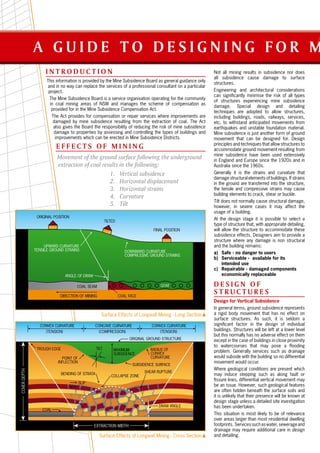
Movement of the ground surface following the underground
extraction of coal results in the following:
1. Vertical subsidence
2. Horizontal displacement
3. Horizontal strains
4. Curvature
5. Tilt
I N T R O D U C T I O N
This information is provided by the Mine Subsidence Board as general guidance only
and in no way can replace the services of a professional consultant on a particular
project.
The Mine Subsidence Board is a service organisation operating for the community
in coal mining areas of NSW and manages the scheme of compensation as
provided for in the Mine Subsidence Compensation Act.
The Act provides for compensation or repair services where improvements are
damaged by mine subsidence resulting from the extraction of coal. The Act
also gives the Board the responsibility of reducing the risk of mine subsidence
damage to properties by assessing and controlling the types of buildings and
improvements which can be erected in Mine Subsidence Districts.
Not all mining results in subsidence nor does
all subsidence cause damage to surface
structures.
Engineering and architectural considerations
can significantly minimise the risk of all types
of structures experiencing mine subsidence
damage. Special design and detailing
techniques are adopted to allow structures,
including buildings, roads, railways, services,
etc, to withstand anticipated movements from
earthquakes and unstable foundation material.
Mine subsidence is just another form of ground
movement that can be designed for. Design
principles and techniques that allow structures to
accommodate ground movement resulting from
mine subsidence have been used extensively
in England and Europe since the 1920s and in
Australia since the 1960s.
Generally it is the strains and curvature that
damage structural elements of buildings. If strains
in the ground are transferred into the structure,
the tensile and compressive strains may cause
building elements to crack, shear or buckle.
Tilt does not normally cause structural damage,
however, in severe cases it may affect the
usage of a building.
At the design stage it is possible to select a
type of structure that, with appropriate detailing,
will allow the structure to accommodate these
subsidence effects. Designers aim to provide a
structure where any damage is non structural
and the building remains:
a) Safe - no danger to users
b) Serviceable - available for its
intended use
c) Repairable - damaged components
economically replaceable
D E S I G N O F
S T R U C T U R E S
Design for Vertical Subsidence
In general terms, ground subsidence represents
a rigid body movement that has no effect on
surface structures. As such, it is seldom a
significant factor in the design of individual
buildings. Structures will be left at a lower level
but this normally has no adverse effect on them
except in the case of buildings in close proximity
to watercourses that may pose a flooding
problem. Generally services such as drainage
would subside with the building so no differential
movement would occur.
Where geological conditions are present which
may induce stepping such as along fault or
fissure lines, differential vertical movement may
be an issue. However, such geological features
are often hidden beneath the surface soils and
it is unlikely that their presence will be known at
design stage unless a detailed site investigation
has been undertaken.
This situation is most likely to be of relevance
over areas larger than most residential dwelling
footprints. Servicessuchaswater,sewerageand
drainage may require additional care in design
and detailing.Surface Effects of Longwall Mining - Cross Section
A G U I D E T O D E S I G N I N G F O R M
Surface Effects of Longwall Mining - Long Section
DESIGNA GUIDE TO
Design for Horizontal Displacements
Horizontal movements due to mining occur in
such a way that points on the surface move in
towards the centre of the subsidence trough.
Differential movements result in strains. Overall
horizontal movements are generally small
except where there are unusual topographical
features such as steep slopes, gorges or
geological features.
Design for Horizontal Strain
Ground strains occur as a result of differential
movement between two points causing a change
in length of the surface between the two points.
If the length of the surface increases, a tensile
strain is induced and if the length of the surface
reduces, a compressive strain is created.
Both tensile and compressive strains can
generate damage in buildings. In most
buildings, the materials are generally
weaker in tension than compression,
hence tensile forces are the more difficult
to accommodate.
Tensile strains can cause cracks in brickwork,
internal linings such as plasterboard, pulled
joints in pipework, cracks and separation of
joints in paving.
Compressive strains can cause spalling of
brickwork, crushing of components, closure
of door and window openings, buckling of
materials, buckling of pipes, paving and other
components.
Not all strain in the ground will be transferred into
the structure. This is due to a number of factors
including foundation type, ground material, the
presence of sliding layers, the location and
orientationofthemininginrelationtothestructure
and so on.
In general terms, ground strains are transferred
into footing systems by friction beneath and
beside the footing elements. The obvious
solution, therefore, is to reduce such friction
and - wherever possible - separating the footing
structure from the soil. This may be achieved by
providing a slip layer between the structure and
the ground to allow the ground to move without
damaging the structure.
Footings can be designed to minimise the effect
of strains on the superstructure by making
them as shallow as possible and by placing
them on slip layers. When deep foundations are
unavoidable, the forces imposed can be reduced
by excavating trenches around the structure.
These trenches are placed as near as practical
to, and extend to just below the underside of,
the foundation. They can be backfilled with a
compressible material which is strong enough
to support the sides of the excavation but more
compressible than the natural soil. This fill will
crush and not transfer all of the forces to the
foundation. Coke, slabs of expanded polystyrene
foam, vermiculite, cork and void formers have
been used for this purpose.
Various techniques have been used to allow
footings to slip relative to the foundation
material. The sides and bottoms of footings
and slabs are kept as smooth as practical and
are often poured on slip layers that incorporate
plastic or bituminous membranes over layers of
granular materials (sands). Exaggerated slopes
are used on transition zones between stiffening
beams and slabs to facilitate shearing actions.
The use of concrete slab on ground footing
systems is now close to 90% in NSW with
the emergence in recent years of the waffle
raft system as the preferred reinforced
concrete slab footing system. This is a
fortunate outcome as the waffle raft system
is ideal as a mechanism for isolation
of the superstructure from horizontal ground
strains.
Design for Curvature
Curvature results from differential settlement
across the ground surface and is considered
the most damaging of the mine subsidence
parameters to impact on a building. Curvature
is normally defined by the deflection ratio or the
radius of curvature.
In practice, damage from mine subsidence will
often be a result of the combination of curvature
and ground strains.
The effects of ground curvature can be minimised
by panelling and articulating walls to move
without developing strains or cracks or causing
doors and windows to jam. Vertical articulation
joints are provided at appropriate intervals and
at sections where the wall stiffness changes.
Damage due to curvature can also be
minimised by eliminating brickwork
above windows, doorways and arches.
If such details are included, special attention
must be paid to provision of bond beams and
strengthening panels that incorporate arches.
Design for Tilt
Ground tilt results from a differential vertical
subsidence between two points that changes
the slope of the surface between the two points.
Ground tilts that occur during the course of
mining operations may be either a temporary
or permanent phenomenon depending
on their location in reference to the subsidence
trough.
Structures subject to tilt are only adversely
affected if they remain in a significant permanent
tilt at the conclusion of subsidence. This normally
occurs when a structure is located on the edge
of the subsidence trough.
Small tilts generally do not affect the usage of
a building and can be catered for by providing
such things as generous falls for services. Tilts
over 7 mm/m will start to affect the serviceability
of the building and the type of construction
will be restricted to allow economical repair.
Suspended flooring systems can be relevelled
economically where access is available to the
supporting bearers and joists.
If sufficient ceiling height has been
provided in the original design, and if
appropriate detailing has been adopted,
it may be possible to relevel floor slabs
by adding a topping layer to recover original
grades.
M I N E S U B S I D E N C E
Domestic floor slabs are not normally strong
enough to withstand relevelling by jacking. Other
types of slabs may be designed with jacking
points and sufficient strength to be relevelled
after subsidence.
Considerable research effort has been expended
in recent years in relation to designing footing
systems that are capable of being relevelled if
unacceptable tilts result from mining operations.
This research will continue in an attempt to find
solutions to the relevelling issue.
Combined Effects
In reality the damage that occurs to a building
is a result of a combination of some or all of
these parameters. The deformation of the
ground surface as a result of subsidence can
lead to both curvature and strain affecting a
structure with the possibility of tilts affecting the
serviceability.
Generally a building should be designed taking
a conservative approach and assuming a full
transfer of strains and displacements from the
ground to the structure.
O T H E R
R E Q U I R E M E N T S
Pothole Type Subsidence
Where movements of the ground surface occur
over old shallow abandoned underground mine
workings it can result in a localised depression
or ‘pothole’ in the surface. The majority of
these types of subsidence are generally small,
however, the design parameter used by the
Board is for a potential pothole up to 5 metres
in diameter.
For further information on designing for
pothole subsidence refer to the Mine
Subsidence Board brochure “Designing
For Pothole Subsidence”.
M I N E S U B S I D E N C E
B O A R D
R E Q U I R E M E N T S
Approval must be obtained from the Mine
Subsidence Board prior to any building activity
or extensions for sites within Mine Subsidence
Districts. The Board may grant unconditional
approval of the application or stipulate certain
conditions that must be met prior to final
approval. In some extreme cases, where the
risk of mine subsidence damage is too great,
the Board may refuse a building application.
Architectural plans submitted to the Mine
Subsidence Board for approval must show
the location and detailing of articulation/
control joints in brickwork to comply with the
requirements of the Building Code of Australia
and best building practices.
Please contact any of the Board’s offices for
further information and advice.
G O O D B U I L D I N G
PUT TING SERVICE AND THE NEEDS OF PEOPLE FIRST
P R A C T I C E
It is essential that good building practice
be complied with in conjunction with any
design features. The correct placement
and detailing of articulation joints,
detailing of brickwork above windows
and doors, internal wall detailing and so
on are all important to achieve a structure
that is capable of handling the subsidence
movements.
Some publications relevant to the
description and implementation of these
best practice procedures are referenced
below.
1) Technical Note 61 - “Articulated
Walling”, Cement and Concrete
Association of Australia
2) Techniques 11 - “Articulation Joints &
Control Gaps for Full Brick Houses”,
Clay Brick and Paver Institute
3) Australian Standard AS2870
4) The Building Code of Australia
R E F E R E N C E S
1) R.G. Hanson., “Designing For
Subsidence”. Mine Subsidence
Board Annual Review 1988-89.
2) Holla L., “Mining Subsidence in New
South Wales - 2. Surface Subsidence
Prediction in the Newcastle
Coalfield.” NSW Department of
Mineral Resources.
3) Australian Standard AS2870.
4) The Building Code of Australia.
hdp 2007
2 4 H O U R
E M E R G E N C Y S E R V I C E
Free Call 1800 248 083
Email: mail@minesub.nsw.gov.au
Web: www.minesub.nsw.gov.au
N E W C A S T L E
Ground Floor
NSW Government Offices
117 Bull Street, Newcastle 2300
Telephone: (02) 4908 4300
Facsimile: (02) 4929 1032
P I C T O N
100 Argyle Street, Picton 2571
Telephone: (02) 4677 1967
Facsimile: (02) 4677 2040
S I N G L E T O N
The Central Business Centre
Unit 6, 1 Pitt Street, Singleton 2330
Telephone: (02) 6572 4344
Facsimile: (02) 6572 4504
W Y O N G
Suite 3 Feldwin Court
30 Hely Street, Wyong 2259
Telephone: (02) 4352 1646
Facsimile: (02) 4352 1757

Msb4pp a4design07

  • 1.
    PUT TING SERVICEAND THE NEEDS OF PEOPLE FIRST
  • 2.
    A E F FE C T S O F M I N I N G Movement of the ground surface following the underground extraction of coal results in the following: 1. Vertical subsidence 2. Horizontal displacement 3. Horizontal strains 4. Curvature 5. Tilt I N T R O D U C T I O N This information is provided by the Mine Subsidence Board as general guidance only and in no way can replace the services of a professional consultant on a particular project. The Mine Subsidence Board is a service organisation operating for the community in coal mining areas of NSW and manages the scheme of compensation as provided for in the Mine Subsidence Compensation Act. The Act provides for compensation or repair services where improvements are damaged by mine subsidence resulting from the extraction of coal. The Act also gives the Board the responsibility of reducing the risk of mine subsidence damage to properties by assessing and controlling the types of buildings and improvements which can be erected in Mine Subsidence Districts. Not all mining results in subsidence nor does all subsidence cause damage to surface structures. Engineering and architectural considerations can significantly minimise the risk of all types of structures experiencing mine subsidence damage. Special design and detailing techniques are adopted to allow structures, including buildings, roads, railways, services, etc, to withstand anticipated movements from earthquakes and unstable foundation material. Mine subsidence is just another form of ground movement that can be designed for. Design principles and techniques that allow structures to accommodate ground movement resulting from mine subsidence have been used extensively in England and Europe since the 1920s and in Australia since the 1960s. Generally it is the strains and curvature that damage structural elements of buildings. If strains in the ground are transferred into the structure, the tensile and compressive strains may cause building elements to crack, shear or buckle. Tilt does not normally cause structural damage, however, in severe cases it may affect the usage of a building. At the design stage it is possible to select a type of structure that, with appropriate detailing, will allow the structure to accommodate these subsidence effects. Designers aim to provide a structure where any damage is non structural and the building remains: a) Safe - no danger to users b) Serviceable - available for its intended use c) Repairable - damaged components economically replaceable D E S I G N O F S T R U C T U R E S Design for Vertical Subsidence In general terms, ground subsidence represents a rigid body movement that has no effect on surface structures. As such, it is seldom a significant factor in the design of individual buildings. Structures will be left at a lower level but this normally has no adverse effect on them except in the case of buildings in close proximity to watercourses that may pose a flooding problem. Generally services such as drainage would subside with the building so no differential movement would occur. Where geological conditions are present which may induce stepping such as along fault or fissure lines, differential vertical movement may be an issue. However, such geological features are often hidden beneath the surface soils and it is unlikely that their presence will be known at design stage unless a detailed site investigation has been undertaken. This situation is most likely to be of relevance over areas larger than most residential dwelling footprints. Servicessuchaswater,sewerageand drainage may require additional care in design and detailing.Surface Effects of Longwall Mining - Cross Section A G U I D E T O D E S I G N I N G F O R M Surface Effects of Longwall Mining - Long Section
  • 3.
    DESIGNA GUIDE TO Designfor Horizontal Displacements Horizontal movements due to mining occur in such a way that points on the surface move in towards the centre of the subsidence trough. Differential movements result in strains. Overall horizontal movements are generally small except where there are unusual topographical features such as steep slopes, gorges or geological features. Design for Horizontal Strain Ground strains occur as a result of differential movement between two points causing a change in length of the surface between the two points. If the length of the surface increases, a tensile strain is induced and if the length of the surface reduces, a compressive strain is created. Both tensile and compressive strains can generate damage in buildings. In most buildings, the materials are generally weaker in tension than compression, hence tensile forces are the more difficult to accommodate. Tensile strains can cause cracks in brickwork, internal linings such as plasterboard, pulled joints in pipework, cracks and separation of joints in paving. Compressive strains can cause spalling of brickwork, crushing of components, closure of door and window openings, buckling of materials, buckling of pipes, paving and other components. Not all strain in the ground will be transferred into the structure. This is due to a number of factors including foundation type, ground material, the presence of sliding layers, the location and orientationofthemininginrelationtothestructure and so on. In general terms, ground strains are transferred into footing systems by friction beneath and beside the footing elements. The obvious solution, therefore, is to reduce such friction and - wherever possible - separating the footing structure from the soil. This may be achieved by providing a slip layer between the structure and the ground to allow the ground to move without damaging the structure. Footings can be designed to minimise the effect of strains on the superstructure by making them as shallow as possible and by placing them on slip layers. When deep foundations are unavoidable, the forces imposed can be reduced by excavating trenches around the structure. These trenches are placed as near as practical to, and extend to just below the underside of, the foundation. They can be backfilled with a compressible material which is strong enough to support the sides of the excavation but more compressible than the natural soil. This fill will crush and not transfer all of the forces to the foundation. Coke, slabs of expanded polystyrene foam, vermiculite, cork and void formers have been used for this purpose. Various techniques have been used to allow footings to slip relative to the foundation material. The sides and bottoms of footings and slabs are kept as smooth as practical and are often poured on slip layers that incorporate plastic or bituminous membranes over layers of granular materials (sands). Exaggerated slopes are used on transition zones between stiffening beams and slabs to facilitate shearing actions. The use of concrete slab on ground footing systems is now close to 90% in NSW with the emergence in recent years of the waffle raft system as the preferred reinforced concrete slab footing system. This is a fortunate outcome as the waffle raft system is ideal as a mechanism for isolation of the superstructure from horizontal ground strains. Design for Curvature Curvature results from differential settlement across the ground surface and is considered the most damaging of the mine subsidence parameters to impact on a building. Curvature is normally defined by the deflection ratio or the radius of curvature. In practice, damage from mine subsidence will often be a result of the combination of curvature and ground strains. The effects of ground curvature can be minimised by panelling and articulating walls to move without developing strains or cracks or causing doors and windows to jam. Vertical articulation joints are provided at appropriate intervals and at sections where the wall stiffness changes. Damage due to curvature can also be minimised by eliminating brickwork above windows, doorways and arches. If such details are included, special attention must be paid to provision of bond beams and strengthening panels that incorporate arches. Design for Tilt Ground tilt results from a differential vertical subsidence between two points that changes the slope of the surface between the two points. Ground tilts that occur during the course of mining operations may be either a temporary or permanent phenomenon depending on their location in reference to the subsidence trough. Structures subject to tilt are only adversely affected if they remain in a significant permanent tilt at the conclusion of subsidence. This normally occurs when a structure is located on the edge of the subsidence trough. Small tilts generally do not affect the usage of a building and can be catered for by providing such things as generous falls for services. Tilts over 7 mm/m will start to affect the serviceability of the building and the type of construction will be restricted to allow economical repair. Suspended flooring systems can be relevelled economically where access is available to the supporting bearers and joists. If sufficient ceiling height has been provided in the original design, and if appropriate detailing has been adopted, it may be possible to relevel floor slabs by adding a topping layer to recover original grades. M I N E S U B S I D E N C E Domestic floor slabs are not normally strong enough to withstand relevelling by jacking. Other types of slabs may be designed with jacking points and sufficient strength to be relevelled after subsidence. Considerable research effort has been expended in recent years in relation to designing footing systems that are capable of being relevelled if unacceptable tilts result from mining operations. This research will continue in an attempt to find solutions to the relevelling issue. Combined Effects In reality the damage that occurs to a building is a result of a combination of some or all of these parameters. The deformation of the ground surface as a result of subsidence can lead to both curvature and strain affecting a structure with the possibility of tilts affecting the serviceability. Generally a building should be designed taking a conservative approach and assuming a full transfer of strains and displacements from the ground to the structure. O T H E R R E Q U I R E M E N T S Pothole Type Subsidence Where movements of the ground surface occur over old shallow abandoned underground mine workings it can result in a localised depression or ‘pothole’ in the surface. The majority of these types of subsidence are generally small, however, the design parameter used by the Board is for a potential pothole up to 5 metres in diameter. For further information on designing for pothole subsidence refer to the Mine Subsidence Board brochure “Designing For Pothole Subsidence”. M I N E S U B S I D E N C E B O A R D R E Q U I R E M E N T S Approval must be obtained from the Mine Subsidence Board prior to any building activity or extensions for sites within Mine Subsidence Districts. The Board may grant unconditional approval of the application or stipulate certain conditions that must be met prior to final approval. In some extreme cases, where the risk of mine subsidence damage is too great, the Board may refuse a building application. Architectural plans submitted to the Mine Subsidence Board for approval must show the location and detailing of articulation/ control joints in brickwork to comply with the requirements of the Building Code of Australia and best building practices. Please contact any of the Board’s offices for further information and advice. G O O D B U I L D I N G
  • 4.
    PUT TING SERVICEAND THE NEEDS OF PEOPLE FIRST P R A C T I C E It is essential that good building practice be complied with in conjunction with any design features. The correct placement and detailing of articulation joints, detailing of brickwork above windows and doors, internal wall detailing and so on are all important to achieve a structure that is capable of handling the subsidence movements. Some publications relevant to the description and implementation of these best practice procedures are referenced below. 1) Technical Note 61 - “Articulated Walling”, Cement and Concrete Association of Australia 2) Techniques 11 - “Articulation Joints & Control Gaps for Full Brick Houses”, Clay Brick and Paver Institute 3) Australian Standard AS2870 4) The Building Code of Australia R E F E R E N C E S 1) R.G. Hanson., “Designing For Subsidence”. Mine Subsidence Board Annual Review 1988-89. 2) Holla L., “Mining Subsidence in New South Wales - 2. Surface Subsidence Prediction in the Newcastle Coalfield.” NSW Department of Mineral Resources. 3) Australian Standard AS2870. 4) The Building Code of Australia. hdp 2007 2 4 H O U R E M E R G E N C Y S E R V I C E Free Call 1800 248 083 Email: mail@minesub.nsw.gov.au Web: www.minesub.nsw.gov.au N E W C A S T L E Ground Floor NSW Government Offices 117 Bull Street, Newcastle 2300 Telephone: (02) 4908 4300 Facsimile: (02) 4929 1032 P I C T O N 100 Argyle Street, Picton 2571 Telephone: (02) 4677 1967 Facsimile: (02) 4677 2040 S I N G L E T O N The Central Business Centre Unit 6, 1 Pitt Street, Singleton 2330 Telephone: (02) 6572 4344 Facsimile: (02) 6572 4504 W Y O N G Suite 3 Feldwin Court 30 Hely Street, Wyong 2259 Telephone: (02) 4352 1646 Facsimile: (02) 4352 1757