Introduction
Background Knowledge
Problems Solved
Conclusion and Future Work
Efficient Data Structures and Algorithms for
Range Aggregate Problems
Jatin Agarwal
Advisor: Dr. Kannan Srinathan and Dr. Kishore Kothapalli
CSTAR, IIIT Hyderabad
November 27, 2013
Jatin Agarwal Efficient Data Structures and Algorithms for Range Aggregate Pr
Introduction
Background Knowledge
Problems Solved
Conclusion and Future Work
Computational Geometry
What is Computational Geometry?
Study of Geometric Algorithms
Why study CG?
Geometric problems arise in the field of databases,
Geographical Information Systems (GIS), graphics, VLSI etc.
Jatin Agarwal Efficient Data Structures and Algorithms for Range Aggregate Pr
Introduction
Background Knowledge
Problems Solved
Conclusion and Future Work
Classic problems
In Health GIS there is a need to demarcate disease infected areas.
Figure: Convex hull of a finite set of points
Jatin Agarwal Efficient Data Structures and Algorithms for Range Aggregate Pr
Introduction
Background Knowledge
Problems Solved
Conclusion and Future Work
Classic Problems
Problem of finding closest pair w.r.t Euclidean distance.
Figure: Closest pair of a finite set of points
Jatin Agarwal Efficient Data Structures and Algorithms for Range Aggregate Pr
Introduction
Background Knowledge
Problems Solved
Conclusion and Future Work
Classic Problems
Location based services (finding the nearest restaurant or the
nearest theater)
Figure: Nearest neighbour problem. This lead to discovery of Voronoi
diagram
Jatin Agarwal Efficient Data Structures and Algorithms for Range Aggregate Pr
Introduction
Background Knowledge
Problems Solved
Conclusion and Future Work
Output Sensitvity
Computation Models
Range Search
Orthogonal Range Successor Queries
Outline
1 Introduction
2 Background Knowledge
Output Sensitvity
Computation Models
Range Search
Orthogonal Range Successor Queries
3 Problems Solved
Planar Range Maxima
Planar Range Convex Hull and Related problems
4 Conclusion and Future Work
Jatin Agarwal Efficient Data Structures and Algorithms for Range Aggregate Pr
Introduction
Background Knowledge
Problems Solved
Conclusion and Future Work
Output Sensitvity
Computation Models
Range Search
Orthogonal Range Successor Queries
Example
Given an unsorted array of n numbers and any given query
q = [a, b] report all the numbers x in range a < x < b.
5 9 3 1 7 6 4 12 2
Figure: Unsorted Array of Numbers
Jatin Agarwal Efficient Data Structures and Algorithms for Range Aggregate Pr
Introduction
Background Knowledge
Problems Solved
Conclusion and Future Work
Output Sensitvity
Computation Models
Range Search
Orthogonal Range Successor Queries
Naive Algorithm
Scan the whole Array !!
Query time: O(n).
Jatin Agarwal Efficient Data Structures and Algorithms for Range Aggregate Pr
Introduction
Background Knowledge
Problems Solved
Conclusion and Future Work
Output Sensitvity
Computation Models
Range Search
Orthogonal Range Successor Queries
Smart Algorithm
Preprocessing Step: Sort the Array.
Query Algorithm: Binary Search !
Query Time: O(log n + k)
1 2 3 4 5 6 7 9 12
Figure: Unsorted Array of Numbers
Jatin Agarwal Efficient Data Structures and Algorithms for Range Aggregate Pr
Introduction
Background Knowledge
Problems Solved
Conclusion and Future Work
Output Sensitvity
Computation Models
Range Search
Orthogonal Range Successor Queries
Output Sensitive
Reporting Problem: Lower bound of ω(k) query time, where k
are the number of items reported.
Objective: O(f (n) + k), where f (n) is a small value. An
algorithm which satisfies this objective is considered
output-sensitive.
Jatin Agarwal Efficient Data Structures and Algorithms for Range Aggregate Pr
Introduction
Background Knowledge
Problems Solved
Conclusion and Future Work
Output Sensitvity
Computation Models
Range Search
Orthogonal Range Successor Queries
Outline
1 Introduction
2 Background Knowledge
Output Sensitvity
Computation Models
Range Search
Orthogonal Range Successor Queries
3 Problems Solved
Planar Range Maxima
Planar Range Convex Hull and Related problems
4 Conclusion and Future Work
Jatin Agarwal Efficient Data Structures and Algorithms for Range Aggregate Pr
Introduction
Background Knowledge
Problems Solved
Conclusion and Future Work
Output Sensitvity
Computation Models
Range Search
Orthogonal Range Successor Queries
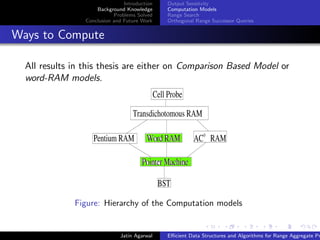
Ways to Compute
All results in this thesis are either on Comparison Based Model or
word-RAM models.
Cell Probe
Transdichotomous RAM
AC RAM0
Word RAM
Pointer Machine
BST
Pentium RAM
Figure: Hierarchy of the Computation models
Jatin Agarwal Efficient Data Structures and Algorithms for Range Aggregate Pr
Introduction
Background Knowledge
Problems Solved
Conclusion and Future Work
Output Sensitvity
Computation Models
Range Search
Orthogonal Range Successor Queries
Models
Cell Probe Model: Used for proving lower bounds as we pay
for each memory operation.
Word RAM Model: word-size on computer changes with input
size n.
Comparison Based Model: Only Comparison is only allowed
operation.
Pointer Machine Model: Described by a directed graph with
constant branching factor.
Jatin Agarwal Efficient Data Structures and Algorithms for Range Aggregate Pr
Introduction
Background Knowledge
Problems Solved
Conclusion and Future Work
Output Sensitvity
Computation Models
Range Search
Orthogonal Range Successor Queries
Outline
1 Introduction
2 Background Knowledge
Output Sensitvity
Computation Models
Range Search
Orthogonal Range Successor Queries
3 Problems Solved
Planar Range Maxima
Planar Range Convex Hull and Related problems
4 Conclusion and Future Work
Jatin Agarwal Efficient Data Structures and Algorithms for Range Aggregate Pr
Introduction
Background Knowledge
Problems Solved
Conclusion and Future Work
Output Sensitvity
Computation Models
Range Search
Orthogonal Range Successor Queries
Applications
Range Tree has tremendous applications in :
GIS
Databases
VLSI
Jatin Agarwal Efficient Data Structures and Algorithms for Range Aggregate Pr
Introduction
Background Knowledge
Problems Solved
Conclusion and Future Work
Output Sensitvity
Computation Models
Range Search
Orthogonal Range Successor Queries
Range Query
X
Y
q
Figure: Two dimensional Range Tree
S is the set of given points and q is the query hyperbox. The
objective is to efficiently
report
count
Jatin Agarwal Efficient Data Structures and Algorithms for Range Aggregate Pr
Introduction
Background Knowledge
Problems Solved
Conclusion and Future Work
Output Sensitvity
Computation Models
Range Search
Orthogonal Range Successor Queries
Range Searching
How do we solve this problem?
Jatin Agarwal Efficient Data Structures and Algorithms for Range Aggregate Pr
Introduction
Background Knowledge
Problems Solved
Conclusion and Future Work
Output Sensitvity
Computation Models
Range Search
Orthogonal Range Successor Queries
Naive Technique
Linear Scan of the database.
O(n) query time. No pre-processing involved.
Not output sensitive !!!
Jatin Agarwal Efficient Data Structures and Algorithms for Range Aggregate Pr
Introduction
Background Knowledge
Problems Solved
Conclusion and Future Work
Output Sensitvity
Computation Models
Range Search
Orthogonal Range Successor Queries
Reduction to Binary Search
Preprocessing step: Build a binary search tree T on the
x-coordinates of the points.
Query algorithm: T is queried with qx and filter the points.
Query time: O(log n + |S ∩ qx |). Not good if |S ∩ qx | >> k.
Therefore, there was a need to build efficient data structures.
Jatin Agarwal Efficient Data Structures and Algorithms for Range Aggregate Pr
Introduction
Background Knowledge
Problems Solved
Conclusion and Future Work
Output Sensitvity
Computation Models
Range Search
Orthogonal Range Successor Queries
Popular Structures for Range Searching
Reporting data structures
Query Type Query Time Storage Space query region
Range Tree O(logd−1
n + k) O(n logd
n) Orthogonal
kd-Tree O(log1−1/d
n + k) O(n) arbitrary
Table: n is the number of points, d is the dimensional space and k is the
size of the output
Jatin Agarwal Efficient Data Structures and Algorithms for Range Aggregate Pr
Introduction
Background Knowledge
Problems Solved
Conclusion and Future Work
Output Sensitvity
Computation Models
Range Search
Orthogonal Range Successor Queries
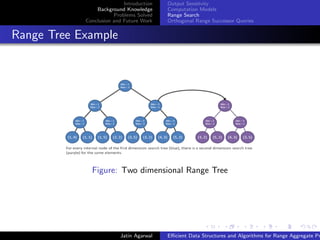
Range Tree Example
Figure: Two dimensional Range Tree
Jatin Agarwal Efficient Data Structures and Algorithms for Range Aggregate Pr
Introduction
Background Knowledge
Problems Solved
Conclusion and Future Work
Output Sensitvity
Computation Models
Range Search
Orthogonal Range Successor Queries
Partition based on Range Tree
v1 v2 ............................... vl
w1
wm
.
(b)
xlt xrt
w2
.
.
.
Figure: (a)Standard Range Tree (b)Query Region get partition into
O(log2
n) regions
Jatin Agarwal Efficient Data Structures and Algorithms for Range Aggregate Pr
Introduction
Background Knowledge
Problems Solved
Conclusion and Future Work
Output Sensitvity
Computation Models
Range Search
Orthogonal Range Successor Queries
Outline
1 Introduction
2 Background Knowledge
Output Sensitvity
Computation Models
Range Search
Orthogonal Range Successor Queries
3 Problems Solved
Planar Range Maxima
Planar Range Convex Hull and Related problems
4 Conclusion and Future Work
Jatin Agarwal Efficient Data Structures and Algorithms for Range Aggregate Pr
Introduction
Background Knowledge
Problems Solved
Conclusion and Future Work
Output Sensitvity
Computation Models
Range Search
Orthogonal Range Successor Queries
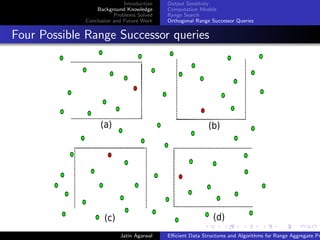
Four Possible Range Successor queries
(a) (b)
(c) (d)
Figure: Four different types of range successor queries possible in a planeJatin Agarwal Efficient Data Structures and Algorithms for Range Aggregate Pr
Introduction
Background Knowledge
Problems Solved
Conclusion and Future Work
Output Sensitvity
Computation Models
Range Search
Orthogonal Range Successor Queries
Compact Range Trees
Navarro & Nekrich in WADS 2012 proposed following result.
Lemma
There exists a data structure that uses O(n) space and answers
orthogonal range successor queries in O(log n) time.
We will use above result to answer all types of Range Successor
Queries.
Jatin Agarwal Efficient Data Structures and Algorithms for Range Aggregate Pr
Introduction
Background Knowledge
Problems Solved
Conclusion and Future Work
Planar Range Maxima
Planar Range Convex Hull and Related problems
Problems Solved
Planar Range Skyline
2-sided Range Reporting
2-sided Range Counting
3-sided Range Reporting
3-sided Range Counting
Planar Range Convex hull
Othogonal Range Convex hull Reporting
Orthogonal Range Convex Hull Counting
Area of Convex hull in an Orthogonal Range
Perimater of Convex hull in an Orthogonal Range
Jatin Agarwal Efficient Data Structures and Algorithms for Range Aggregate Pr
Introduction
Background Knowledge
Problems Solved
Conclusion and Future Work
Planar Range Maxima
Planar Range Convex Hull and Related problems
Common Challenge
Maintain order in more than one dimension
Jatin Agarwal Efficient Data Structures and Algorithms for Range Aggregate Pr
Introduction
Background Knowledge
Problems Solved
Conclusion and Future Work
Planar Range Maxima
Planar Range Convex Hull and Related problems
Common Challenge
Maintain order in more than one dimension
Output sensitivity
Starting with finding all points in the range is not output
sensitive
Single-shot algorithm: O(log n + m) time, where m is the total
number of points inside the query range
Jatin Agarwal Efficient Data Structures and Algorithms for Range Aggregate Pr
Introduction
Background Knowledge
Problems Solved
Conclusion and Future Work
Planar Range Maxima
Planar Range Convex Hull and Related problems
Outline
1 Introduction
2 Background Knowledge
Output Sensitvity
Computation Models
Range Search
Orthogonal Range Successor Queries
3 Problems Solved
Planar Range Maxima
Planar Range Convex Hull and Related problems
4 Conclusion and Future Work
Jatin Agarwal Efficient Data Structures and Algorithms for Range Aggregate Pr
Introduction
Background Knowledge
Problems Solved
Conclusion and Future Work
Planar Range Maxima
Planar Range Convex Hull and Related problems
Dominating or Maximalpoint
Point A = (xa, ya) is said to
dominate point B = (xb, yb)
iff xa > xb and ya > yb.
Maximal point or skyline point:
Whose North East quadrant is
empty.
Red point is Maximal point.
Maxima or skyline is used
interchangeably
Empty
Figure: Dominating point or
Maximal point or Skyline
point
Jatin Agarwal Efficient Data Structures and Algorithms for Range Aggregate Pr
Introduction
Background Knowledge
Problems Solved
Conclusion and Future Work
Planar Range Maxima
Planar Range Convex Hull and Related problems
Maxima
x
y
Figure: Skyline of a finite set of points
Jatin Agarwal Efficient Data Structures and Algorithms for Range Aggregate Pr
Introduction
Background Knowledge
Problems Solved
Conclusion and Future Work
Planar Range Maxima
Planar Range Convex Hull and Related problems
Planar Range Maxima
x
y
q
Figure: Range Maxima for a given orthogonal range query
Jatin Agarwal Efficient Data Structures and Algorithms for Range Aggregate Pr
Introduction
Background Knowledge
Problems Solved
Conclusion and Future Work
Planar Range Maxima
Planar Range Convex Hull and Related problems
Orthogonal range maxima queries
Jatin Agarwal Efficient Data Structures and Algorithms for Range Aggregate Pr
Introduction
Background Knowledge
Problems Solved
Conclusion and Future Work
Planar Range Maxima
Planar Range Convex Hull and Related problems
Problem Statements
Given a set S of n points in a plane and an orthogonal query Q of
the form [a, b] × [c, d] where [a, b] is a range on the x-axis and
[c, d] is a range on the y-axis, report the skyline points in S ∩ Q.
Problem 1: Report the skyline inside S ∩ Q. Here
Q = [a, +∞] × [c, +∞].
Problem 2: Count the number of points on the skyline of S ∩ Q.
Here Q = [a, +∞] × [c, +∞].
Problem 3: Report the skyline inside S ∩ Q. Here
Q = [a, +∞] × [c, d].
Problem 4: Count the number of points on the skyline of S ∩ Q.
Here Q = [a, +∞] × [c, d].
Jatin Agarwal Efficient Data Structures and Algorithms for Range Aggregate Pr
Introduction
Background Knowledge
Problems Solved
Conclusion and Future Work
Planar Range Maxima
Planar Range Convex Hull and Related problems
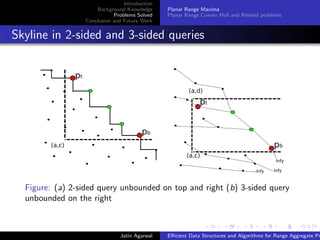
Skyline in 2-sided and 3-sided queries
Infy
InfyInfy
(a,d)
(a,c)
pt
pb(a,c)
pt
pb
Figure: (a) 2-sided query unbounded on top and right (b) 3-sided query
unbounded on the right
Jatin Agarwal Efficient Data Structures and Algorithms for Range Aggregate Pr
Introduction
Background Knowledge
Problems Solved
Conclusion and Future Work
Planar Range Maxima
Planar Range Convex Hull and Related problems
2-sided Range Maxima
(a,c)
pt
pb
Figure: 2-sided query unbounded on top and right
Jatin Agarwal Efficient Data Structures and Algorithms for Range Aggregate Pr
Introduction
Background Knowledge
Problems Solved
Conclusion and Future Work
Planar Range Maxima
Planar Range Convex Hull and Related problems
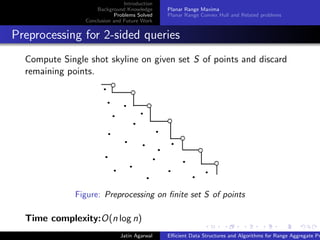
Preprocessing for 2-sided queries
Compute Single shot skyline on given set S of points and discard
remaining points.
Figure: Preprocessing on finite set S of points
Time complexity:O(n log n)
Jatin Agarwal Efficient Data Structures and Algorithms for Range Aggregate Pr
Introduction
Background Knowledge
Problems Solved
Conclusion and Future Work
Planar Range Maxima
Planar Range Convex Hull and Related problems
Preprocessing Array for 2-sided queries
Construct range successor data structure D on this points.
Figure: Preprocessed on finite set S of points
Preprocessing Time complexity:O(n log n)
Jatin Agarwal Efficient Data Structures and Algorithms for Range Aggregate Pr
Introduction
Background Knowledge
Problems Solved
Conclusion and Future Work
Planar Range Maxima
Planar Range Convex Hull and Related problems
2-sided query
Given any query Q = [a, +∞] × [c, +∞].
query q=(a,c)
Figure: 2-sided query to unbounded on top and right
Jatin Agarwal Efficient Data Structures and Algorithms for Range Aggregate Pr
Introduction
Background Knowledge
Problems Solved
Conclusion and Future Work
Planar Range Maxima
Planar Range Convex Hull and Related problems
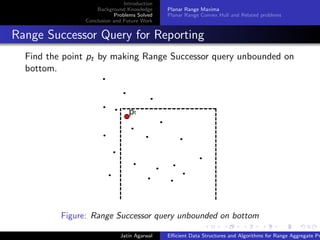
Range Successor Query for Reporting
Find the point pt by making Range Successor query unbounded on
bottom.
pt
Figure: Range Successor query unbounded on bottom
Jatin Agarwal Efficient Data Structures and Algorithms for Range Aggregate Pr
Introduction
Background Knowledge
Problems Solved
Conclusion and Future Work
Planar Range Maxima
Planar Range Convex Hull and Related problems
2-sided Range Reporting
Keep reporting all the points from pt until we encounter some
point whose x co-ordinate is greater than a.
pt
(a,c)
Figure: 2-sided Range Reporting till x = a
Query Time complexity:O(log n + k) where is total number of
points reported. Jatin Agarwal Efficient Data Structures and Algorithms for Range Aggregate Pr
Introduction
Background Knowledge
Problems Solved
Conclusion and Future Work
Planar Range Maxima
Planar Range Convex Hull and Related problems
2-sided Range counting
To solve counting problem we find point pb.
(a,c)
pt
pb
Figure: 2-sided Range Counting
Jatin Agarwal Efficient Data Structures and Algorithms for Range Aggregate Pr
Introduction
Background Knowledge
Problems Solved
Conclusion and Future Work
Planar Range Maxima
Planar Range Convex Hull and Related problems
Range Successor Query for Counting
Find the point pt by making Range Successor query unbounded on
left.
pb
Figure: Range Successor query unbounded on left
Time complexity:O(log n)
Jatin Agarwal Efficient Data Structures and Algorithms for Range Aggregate Pr
Introduction
Background Knowledge
Problems Solved
Conclusion and Future Work
Planar Range Maxima
Planar Range Convex Hull and Related problems
2-sided Range counting
count = index[pt] − index[pb] + 1 takes constant O(1) time.
(a,c)
pt
pb
Figure: 2-sided Range Counting
Query Time complexity:O(log n)
Jatin Agarwal Efficient Data Structures and Algorithms for Range Aggregate Pr
Introduction
Background Knowledge
Problems Solved
Conclusion and Future Work
Planar Range Maxima
Planar Range Convex Hull and Related problems
Our results on 2-sided queries
Theorem
Given a set S of n points in R2, we can pre-process S into a data
structure of size O(n) in time O(n log n) such that, given an
2-sided query Q = [a, ∞] × [c, ∞], we can report/count the
maximal points of S ∩ Q in time O(log n + k)/O(log n), where k
is the number of points reported.
Jatin Agarwal Efficient Data Structures and Algorithms for Range Aggregate Pr
Introduction
Background Knowledge
Problems Solved
Conclusion and Future Work
Planar Range Maxima
Planar Range Convex Hull and Related problems
Finite set of points on a plane
Figure: Finite Set S of points in 2d-plane
Jatin Agarwal Efficient Data Structures and Algorithms for Range Aggregate Pr
Introduction
Background Knowledge
Problems Solved
Conclusion and Future Work
Planar Range Maxima
Planar Range Convex Hull and Related problems
Preprocessing for 3-sided queries
Point with maximum y
co-ordinate in South-west
quadrant of point pi is its
next maximal point
Every point in set S is
pointing to its next maximal
point in array next
Construct range successor
data structure D on this
points.
Takes preprocessing
O(n log n) time.
Infy
InfyInfy
Figure: Preprocessing 3-sided
maxima queries
Jatin Agarwal Efficient Data Structures and Algorithms for Range Aggregate Pr
Introduction
Background Knowledge
Problems Solved
Conclusion and Future Work
Planar Range Maxima
Planar Range Convex Hull and Related problems
3-sided Reporting query
Report the skyline inside S ∩ Q. Here Q = [a, +∞] × [c, d].
Infy
InfyInfy
(a,d)
(a,c)
Figure: 3-sided query to find maxima
Jatin Agarwal Efficient Data Structures and Algorithms for Range Aggregate Pr
Introduction
Background Knowledge
Problems Solved
Conclusion and Future Work
Planar Range Maxima
Planar Range Convex Hull and Related problems
3-sided Range Reporting
Find the point pt by making Range Successor query unbounded on
bottom.
Infy
InfyInfy
(a,d)
(a,c)
pt
Figure: 3-sided Range Reporting requires point pt
Jatin Agarwal Efficient Data Structures and Algorithms for Range Aggregate Pr
Introduction
Background Knowledge
Problems Solved
Conclusion and Future Work
Planar Range Maxima
Planar Range Convex Hull and Related problems
Range Successor Query for Reporting
Find the point pt by making Range Successor query unbounded on
bottom.
pt
Figure: Range Successor query unbounded on bottom
Jatin Agarwal Efficient Data Structures and Algorithms for Range Aggregate Pr
Introduction
Background Knowledge
Problems Solved
Conclusion and Future Work
Planar Range Maxima
Planar Range Convex Hull and Related problems
3-sided Range Reporting
Keep reporting all the points from pt until we encounter some
point whose x co-ordinate is greater than a.
Infy
InfyInfy
(a,d)
(a,c)
pt
Figure: 3-sided Range Reporting requires point pt
Query Time complexity:O(log n + k)
Jatin Agarwal Efficient Data Structures and Algorithms for Range Aggregate Pr
Introduction
Background Knowledge
Problems Solved
Conclusion and Future Work
Planar Range Maxima
Planar Range Convex Hull and Related problems
3-sided Range counting
Report then count is not output sensitive.
Infy
InfyInfy
(a,d)
(a,c)
pt
pb
Figure: 3-sided Range Counting
Jatin Agarwal Efficient Data Structures and Algorithms for Range Aggregate Pr
Introduction
Background Knowledge
Problems Solved
Conclusion and Future Work
Planar Range Maxima
Planar Range Convex Hull and Related problems
Preprocessing for 3-sided Counting
We store a level count of maximal as shown in figure.
Infy
InfyInfy
1
2
1
2
3
4
5
6
34
5
3
4
5
4
56
123
Figure: Range Successor query unbounded on left
Jatin Agarwal Efficient Data Structures and Algorithms for Range Aggregate Pr
Introduction
Background Knowledge
Problems Solved
Conclusion and Future Work
Planar Range Maxima
Planar Range Convex Hull and Related problems
Range Successor Query for Counting
We find point pb using range successor query as shown.
pb
Figure: Range Successor query unbounded on left
Time complexity:O(log n)
Jatin Agarwal Efficient Data Structures and Algorithms for Range Aggregate Pr
Introduction
Background Knowledge
Problems Solved
Conclusion and Future Work
Planar Range Maxima
Planar Range Convex Hull and Related problems
3-sided Range counting
count =
count[pt] − count[pb] + 1
takes constant O(1) time.
In this example count is
3 = 4 − 1 + 1.
Time complexity:O(log n)
Infy
InfyInfy
1
2
1
2
3
4
5
6
3
4
5
3
4
5
4
56
12
3
pt
pb
(a,d)
(a,c)
Figure: 3-sided Range Counting
Jatin Agarwal Efficient Data Structures and Algorithms for Range Aggregate Pr
Introduction
Background Knowledge
Problems Solved
Conclusion and Future Work
Planar Range Maxima
Planar Range Convex Hull and Related problems
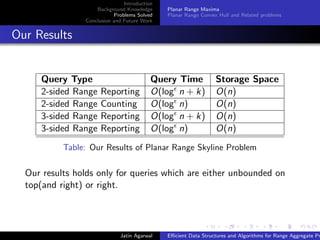
Our Results
Query Type Query Time Storage Space
2-sided Range Reporting O(log n + k) O(n)
2-sided Range Counting O(log n) O(n)
3-sided Range Reporting O(log n + k) O(n)
3-sided Range Reporting O(log n) O(n)
Table: Our Results of Planar Range Skyline Problem
Our results holds only for queries which are either unbounded on
top(and right) or right.
Jatin Agarwal Efficient Data Structures and Algorithms for Range Aggregate Pr
Introduction
Background Knowledge
Problems Solved
Conclusion and Future Work
Planar Range Maxima
Planar Range Convex Hull and Related problems
Conjecture
Conjecture
Given a set S of n points in R2, it may be possible to pre-process
S into a data structure of size O(n log n) in time O(n log n) such
that, given an 4-sided orthogonal query Q = [a, b] × [c, d], we can
report and count the number of maximal points of S ∩ Q in time
O(log n + k) and O(log n + k) respectively.
Jatin Agarwal Efficient Data Structures and Algorithms for Range Aggregate Pr
Introduction
Background Knowledge
Problems Solved
Conclusion and Future Work
Planar Range Maxima
Planar Range Convex Hull and Related problems
Outline
1 Introduction
2 Background Knowledge
Output Sensitvity
Computation Models
Range Search
Orthogonal Range Successor Queries
3 Problems Solved
Planar Range Maxima
Planar Range Convex Hull and Related problems
4 Conclusion and Future Work
Jatin Agarwal Efficient Data Structures and Algorithms for Range Aggregate Pr
Introduction
Background Knowledge
Problems Solved
Conclusion and Future Work
Planar Range Maxima
Planar Range Convex Hull and Related problems
Green Nails on a board
Given point set of size n in a plane.
Figure: Finite set of points
Consider green Nails as shown in the figure. Stretch and leave a
rubber band on this green nails.
Jatin Agarwal Efficient Data Structures and Algorithms for Range Aggregate Pr
Introduction
Background Knowledge
Problems Solved
Conclusion and Future Work
Planar Range Maxima
Planar Range Convex Hull and Related problems
Convex Hull
Points on the rubber band forms Convex Hull.
Figure: Finite set of points
Jatin Agarwal Efficient Data Structures and Algorithms for Range Aggregate Pr
Introduction
Background Knowledge
Problems Solved
Conclusion and Future Work
Planar Range Maxima
Planar Range Convex Hull and Related problems
Problem Statements
We are given a set P of n points in R2 and a query
q = [xlt, xrt] × [yb, yt]. We wish to pre-process P into a data
structure such that given an orthogonal query region q, we can
efficiently
Problem 1: Report the points on convex hull of P ∩ q.
Problem 2: Count the number of points on the convex hull of
P ∩ q.
Problem 3: Find the area of the convex hull of P ∩ q.
Problem 4: Find the perimeter of the convex hull of P ∩ q.
Jatin Agarwal Efficient Data Structures and Algorithms for Range Aggregate Pr
Introduction
Background Knowledge
Problems Solved
Conclusion and Future Work
Planar Range Maxima
Planar Range Convex Hull and Related problems
Planar Range Convex Hull
q
Figure: Range Convex hull for a given query
Jatin Agarwal Efficient Data Structures and Algorithms for Range Aggregate Pr
Introduction
Background Knowledge
Problems Solved
Conclusion and Future Work
Planar Range Maxima
Planar Range Convex Hull and Related problems
Challenges
Output sensitivity
Reporting and computing convex hull takes time
O(log n + m log h) where m is total number of point on q and
h is points on the convex hull.
Counting/Area/Perimeter by actually reporting all points on
hull is not output sensitive
Output size is O(1)
Jatin Agarwal Efficient Data Structures and Algorithms for Range Aggregate Pr
Introduction
Background Knowledge
Problems Solved
Conclusion and Future Work
Planar Range Maxima
Planar Range Convex Hull and Related problems
Challenges
Output sensitivity
Reporting and computing convex hull takes time
O(log n + m log h) where m is total number of point on q and
h is points on the convex hull.
Counting/Area/Perimeter by actually reporting all points on
hull is not output sensitive
Output size is O(1)
Space constraint
Total number of possible query ranges is O(n4
)
Jatin Agarwal Efficient Data Structures and Algorithms for Range Aggregate Pr
Introduction
Background Knowledge
Problems Solved
Conclusion and Future Work
Planar Range Maxima
Planar Range Convex Hull and Related problems
Preliminaries
Combining two disjoint convex
hulls:
Only the common outer
tangents(bridges) need to be
computed
Can be done in O(log n)
(Overmars and van Leeuwen
1994)
Jatin Agarwal Efficient Data Structures and Algorithms for Range Aggregate Pr
Introduction
Background Knowledge
Problems Solved
Conclusion and Future Work
Planar Range Maxima
Planar Range Convex Hull and Related problems
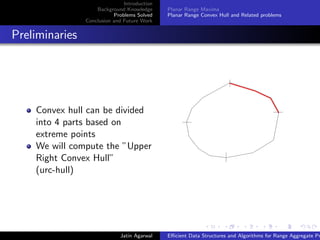
Preliminaries
Convex hull can be divided
into 4 parts based on
extreme points
We will compute the ”Upper
Right Convex Hull”
(urc-hull)
Jatin Agarwal Efficient Data Structures and Algorithms for Range Aggregate Pr
Introduction
Background Knowledge
Problems Solved
Conclusion and Future Work
Planar Range Maxima
Planar Range Convex Hull and Related problems
Preprocessing
Use a standard 2D range
tree.
In each node, store the
convex hull of all points in
that subtree
A query is split into O(log n)
horizontal regions, each
further split into O(log n)
vertical regions (”blocks”)
Jatin Agarwal Efficient Data Structures and Algorithms for Range Aggregate Pr
Introduction
Background Knowledge
Problems Solved
Conclusion and Future Work
Planar Range Maxima
Planar Range Convex Hull and Related problems
Crux Idea
Total of O(log2
n) nodes per
query
Do polygon version of
Graham’s scan
Takes time O(log3
n + h)
time per query, where h is
the number of points on the
hull
Jatin Agarwal Efficient Data Structures and Algorithms for Range Aggregate Pr
Introduction
Background Knowledge
Problems Solved
Conclusion and Future Work
Planar Range Maxima
Planar Range Convex Hull and Related problems
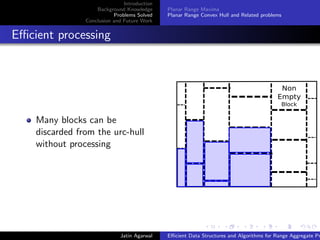
Efficient processing
Many blocks can be
discarded from the urc-hull
without processing
Non
Empty
Block
Jatin Agarwal Efficient Data Structures and Algorithms for Range Aggregate Pr
Introduction
Background Knowledge
Problems Solved
Conclusion and Future Work
Planar Range Maxima
Planar Range Convex Hull and Related problems
Worst Case
Define ”candidate block” as
a non-empty block which is
not discarded
Worst case we still have
O(log2
n) candidate blocks
Jatin Agarwal Efficient Data Structures and Algorithms for Range Aggregate Pr
Introduction
Background Knowledge
Problems Solved
Conclusion and Future Work
Planar Range Maxima
Planar Range Convex Hull and Related problems
Analysis
Range tree divides query into O(log2
n) region
Merging two convex hull takes O(log n) time
Linear Merging of O(log2
n) hulls in query region takes
O(log3
n)
Reporting takes O(h) time where h is total number points on
the convex hull
Therefore it takes O(log3
n + h) for convex hull points in S ∩ q
Jatin Agarwal Efficient Data Structures and Algorithms for Range Aggregate Pr
Introduction
Background Knowledge
Problems Solved
Conclusion and Future Work
Planar Range Maxima
Planar Range Convex Hull and Related problems
Convex Hull as an Cyclic Array
Points on the convex hull
are stored as an array A.
Points in the array are
stored in Anti-clockwise
direction as shown in figure.
Starting from Maximum y
co-ordinate to minimum y
co-ordinate and vice versa.
p1
p2
p3
p4
p6
p5
p7
p10
p8
p9
p11
p4 p2 p1 p5 p9 p11 p8
A
Jatin Agarwal Efficient Data Structures and Algorithms for Range Aggregate Pr
Introduction
Background Knowledge
Problems Solved
Conclusion and Future Work
Planar Range Maxima
Planar Range Convex Hull and Related problems
Counting points on a Convex hull
Each candidate convex hull
contribute some part from
array A.
Difference of indices at this
boundaries gives us the
count.
For example
index[p8] − index[p9] + 1 as
shown in figure.
Therefore computing count
for candidate convex hull
takes O(1) time.
p1
p2
p3
p4
p6
p5
p7
p10
p8
p9
p11
p4 p2 p1 p5 p9 p11 p8
A
Jatin Agarwal Efficient Data Structures and Algorithms for Range Aggregate Pr
Introduction
Background Knowledge
Problems Solved
Conclusion and Future Work
Planar Range Maxima
Planar Range Convex Hull and Related problems
Perimeter of the convex hull
We store commutative sum
of perimeter in Array P.
Each candidate convex hull
contribute some perimeter
to total perimeter A.
Difference of indices at this
boundaries gives us the
perimeteri .
P[p8] − P[p9] + 1 gives
perimeter as shown in figure.
Therefore computing
perimeteri for candidate
convex hull takes O(1) time.
p1
p2
p3
p4
p6
p5
p7
p10
p8
p9
p11
p4 p2 p1 p5 p9 p11 p8
A
p42 p41 p43 p46 p411 p48 p44P
Jatin Agarwal Efficient Data Structures and Algorithms for Range Aggregate Pr
Introduction
Background Knowledge
Problems Solved
Conclusion and Future Work
Planar Range Maxima
Planar Range Convex Hull and Related problems
Area of the convex hull
We store commutative sum of areas in Array Ar.
Each candidate convex hull contribute some area to total area
A.
Difference of indices at this boundaries gives us the areai .
Therefore computing areai for candidate convex hull takes
O(1) time.
1
2
3
4
5
6
7
1
2
3
4
5
6
7
Figure: Finite set of pointsJatin Agarwal Efficient Data Structures and Algorithms for Range Aggregate Pr
Introduction
Background Knowledge
Problems Solved
Conclusion and Future Work
Planar Range Maxima
Planar Range Convex Hull and Related problems
Previous Work
Brass et. al. gave first results on Planar Range Convex hull
problem.
Query Type Query Time Storage Space
Reporting O(log5
n + h) O(n log2
n)
Area O(log5
n) O(n log2
n)
Table: Previous Work on Convex hull and Related problems
Jatin Agarwal Efficient Data Structures and Algorithms for Range Aggregate Pr
Introduction
Background Knowledge
Problems Solved
Conclusion and Future Work
Planar Range Maxima
Planar Range Convex Hull and Related problems
Our Results
We studied Counting and Perimeter problem for the first time in
the literature.
Query Type Query Time Storage Space
Reporting O(log3
n + h) O(n log2
n)
Counting O(log3
n) O(n log2
n)
Area O(log3
n) O(n log2
n)
Perimeter O(log3
n) O(n log2
n)
Table: Our Results of Planar Range Convex hull and Related problems
Jatin Agarwal Efficient Data Structures and Algorithms for Range Aggregate Pr
Introduction
Background Knowledge
Problems Solved
Conclusion and Future Work
Conclusion
Skyline and Convex Hull provides ordering in higher
dimensions.
Planar Range provides searching in higher dimensions
Our structures are efficient for large number of queries.
Our structure provides information like count, area and
perimeter without processing individual data elements.
Jatin Agarwal Efficient Data Structures and Algorithms for Range Aggregate Pr
Introduction
Background Knowledge
Problems Solved
Conclusion and Future Work
Future Work
Generalization: Categorization can be made by assigning
colors to each point and find distinct colors.
Other models of Computation: Studying both planar range
maxima and planar range convex hull in the cell-probe model
to understand lower bound.
Higher Dimensions: Interesting to see this problems in
dimensions greater than two.
Dynamism: Solving on dynamic point sets.
Jatin Agarwal Efficient Data Structures and Algorithms for Range Aggregate Pr
Introduction
Background Knowledge
Problems Solved
Conclusion and Future Work
Related Work
Improved bounds for Smallest Enclosing Disk Range
Queries(Accepted as full paper), Sankalp Khare, Jatin
Agarwal, Nadeem Moidu, and Kannan Srinathan Conference:
To appear in the proceedings of the 16th Japan Conference on
Discrete and Computational Geometry and Graphs
(JCDCG22013)
Efficient Range Reporting of Convex Hull(Submitted as
e-print), Jatin Agarwal, Nadeem Moidu, Kishore Kothapalli
and Kannan Srinathan Conference: Computing Research
Repository(CoRR)
Jatin Agarwal Efficient Data Structures and Algorithms for Range Aggregate Pr
Introduction
Background Knowledge
Problems Solved
Conclusion and Future Work
Related Work
Planar Convex Hull Range Query and Related
Problems(Accepted as full paper), Nadeem Moidu, Jatin
Agarwal and Kishore Kothapalli Conference: To appear in
proceedings of the 25th Canadian Conference on
Computational Geometry(CCCG 2013)
On Counting Range Maxima Points in Plane (Accepted as full
paper), Anil Kishore Kalavagattu, Jatin Agarwal, Ananda
Swarup Das, and Kishore Kothapalli. Conference: The 23rd
International Workshop on Combinatorial Algorithms(IWOCA
2012)
Range Aggregate Maximal Points in the Plane. (Accepted as
full paper), Ananda Swarup Das, Prosenjit Gupta, Anil
Kishore Kalavagattu, Jatin Agarwal, Kannan Srinathan,
Kishore Kothapalli. Conference: The 6th Workshop on
Algorithms and Computation(WALCOM 2012)Jatin Agarwal Efficient Data Structures and Algorithms for Range Aggregate Pr
Introduction
Background Knowledge
Problems Solved
Conclusion and Future Work
Thank You!
Questions?
Jatin Agarwal Efficient Data Structures and Algorithms for Range Aggregate Pr

MS Thesis

  • 1.
    Introduction Background Knowledge Problems Solved Conclusionand Future Work Efficient Data Structures and Algorithms for Range Aggregate Problems Jatin Agarwal Advisor: Dr. Kannan Srinathan and Dr. Kishore Kothapalli CSTAR, IIIT Hyderabad November 27, 2013 Jatin Agarwal Efficient Data Structures and Algorithms for Range Aggregate Pr
  • 2.
    Introduction Background Knowledge Problems Solved Conclusionand Future Work Computational Geometry What is Computational Geometry? Study of Geometric Algorithms Why study CG? Geometric problems arise in the field of databases, Geographical Information Systems (GIS), graphics, VLSI etc. Jatin Agarwal Efficient Data Structures and Algorithms for Range Aggregate Pr
  • 3.
    Introduction Background Knowledge Problems Solved Conclusionand Future Work Classic problems In Health GIS there is a need to demarcate disease infected areas. Figure: Convex hull of a finite set of points Jatin Agarwal Efficient Data Structures and Algorithms for Range Aggregate Pr
  • 4.
    Introduction Background Knowledge Problems Solved Conclusionand Future Work Classic Problems Problem of finding closest pair w.r.t Euclidean distance. Figure: Closest pair of a finite set of points Jatin Agarwal Efficient Data Structures and Algorithms for Range Aggregate Pr
  • 5.
    Introduction Background Knowledge Problems Solved Conclusionand Future Work Classic Problems Location based services (finding the nearest restaurant or the nearest theater) Figure: Nearest neighbour problem. This lead to discovery of Voronoi diagram Jatin Agarwal Efficient Data Structures and Algorithms for Range Aggregate Pr
  • 6.
    Introduction Background Knowledge Problems Solved Conclusionand Future Work Output Sensitvity Computation Models Range Search Orthogonal Range Successor Queries Outline 1 Introduction 2 Background Knowledge Output Sensitvity Computation Models Range Search Orthogonal Range Successor Queries 3 Problems Solved Planar Range Maxima Planar Range Convex Hull and Related problems 4 Conclusion and Future Work Jatin Agarwal Efficient Data Structures and Algorithms for Range Aggregate Pr
  • 7.
    Introduction Background Knowledge Problems Solved Conclusionand Future Work Output Sensitvity Computation Models Range Search Orthogonal Range Successor Queries Example Given an unsorted array of n numbers and any given query q = [a, b] report all the numbers x in range a < x < b. 5 9 3 1 7 6 4 12 2 Figure: Unsorted Array of Numbers Jatin Agarwal Efficient Data Structures and Algorithms for Range Aggregate Pr
  • 8.
    Introduction Background Knowledge Problems Solved Conclusionand Future Work Output Sensitvity Computation Models Range Search Orthogonal Range Successor Queries Naive Algorithm Scan the whole Array !! Query time: O(n). Jatin Agarwal Efficient Data Structures and Algorithms for Range Aggregate Pr
  • 9.
    Introduction Background Knowledge Problems Solved Conclusionand Future Work Output Sensitvity Computation Models Range Search Orthogonal Range Successor Queries Smart Algorithm Preprocessing Step: Sort the Array. Query Algorithm: Binary Search ! Query Time: O(log n + k) 1 2 3 4 5 6 7 9 12 Figure: Unsorted Array of Numbers Jatin Agarwal Efficient Data Structures and Algorithms for Range Aggregate Pr
  • 10.
    Introduction Background Knowledge Problems Solved Conclusionand Future Work Output Sensitvity Computation Models Range Search Orthogonal Range Successor Queries Output Sensitive Reporting Problem: Lower bound of ω(k) query time, where k are the number of items reported. Objective: O(f (n) + k), where f (n) is a small value. An algorithm which satisfies this objective is considered output-sensitive. Jatin Agarwal Efficient Data Structures and Algorithms for Range Aggregate Pr
  • 11.
    Introduction Background Knowledge Problems Solved Conclusionand Future Work Output Sensitvity Computation Models Range Search Orthogonal Range Successor Queries Outline 1 Introduction 2 Background Knowledge Output Sensitvity Computation Models Range Search Orthogonal Range Successor Queries 3 Problems Solved Planar Range Maxima Planar Range Convex Hull and Related problems 4 Conclusion and Future Work Jatin Agarwal Efficient Data Structures and Algorithms for Range Aggregate Pr
  • 12.
    Introduction Background Knowledge Problems Solved Conclusionand Future Work Output Sensitvity Computation Models Range Search Orthogonal Range Successor Queries Ways to Compute All results in this thesis are either on Comparison Based Model or word-RAM models. Cell Probe Transdichotomous RAM AC RAM0 Word RAM Pointer Machine BST Pentium RAM Figure: Hierarchy of the Computation models Jatin Agarwal Efficient Data Structures and Algorithms for Range Aggregate Pr
  • 13.
    Introduction Background Knowledge Problems Solved Conclusionand Future Work Output Sensitvity Computation Models Range Search Orthogonal Range Successor Queries Models Cell Probe Model: Used for proving lower bounds as we pay for each memory operation. Word RAM Model: word-size on computer changes with input size n. Comparison Based Model: Only Comparison is only allowed operation. Pointer Machine Model: Described by a directed graph with constant branching factor. Jatin Agarwal Efficient Data Structures and Algorithms for Range Aggregate Pr
  • 14.
    Introduction Background Knowledge Problems Solved Conclusionand Future Work Output Sensitvity Computation Models Range Search Orthogonal Range Successor Queries Outline 1 Introduction 2 Background Knowledge Output Sensitvity Computation Models Range Search Orthogonal Range Successor Queries 3 Problems Solved Planar Range Maxima Planar Range Convex Hull and Related problems 4 Conclusion and Future Work Jatin Agarwal Efficient Data Structures and Algorithms for Range Aggregate Pr
  • 15.
    Introduction Background Knowledge Problems Solved Conclusionand Future Work Output Sensitvity Computation Models Range Search Orthogonal Range Successor Queries Applications Range Tree has tremendous applications in : GIS Databases VLSI Jatin Agarwal Efficient Data Structures and Algorithms for Range Aggregate Pr
  • 16.
    Introduction Background Knowledge Problems Solved Conclusionand Future Work Output Sensitvity Computation Models Range Search Orthogonal Range Successor Queries Range Query X Y q Figure: Two dimensional Range Tree S is the set of given points and q is the query hyperbox. The objective is to efficiently report count Jatin Agarwal Efficient Data Structures and Algorithms for Range Aggregate Pr
  • 17.
    Introduction Background Knowledge Problems Solved Conclusionand Future Work Output Sensitvity Computation Models Range Search Orthogonal Range Successor Queries Range Searching How do we solve this problem? Jatin Agarwal Efficient Data Structures and Algorithms for Range Aggregate Pr
  • 18.
    Introduction Background Knowledge Problems Solved Conclusionand Future Work Output Sensitvity Computation Models Range Search Orthogonal Range Successor Queries Naive Technique Linear Scan of the database. O(n) query time. No pre-processing involved. Not output sensitive !!! Jatin Agarwal Efficient Data Structures and Algorithms for Range Aggregate Pr
  • 19.
    Introduction Background Knowledge Problems Solved Conclusionand Future Work Output Sensitvity Computation Models Range Search Orthogonal Range Successor Queries Reduction to Binary Search Preprocessing step: Build a binary search tree T on the x-coordinates of the points. Query algorithm: T is queried with qx and filter the points. Query time: O(log n + |S ∩ qx |). Not good if |S ∩ qx | >> k. Therefore, there was a need to build efficient data structures. Jatin Agarwal Efficient Data Structures and Algorithms for Range Aggregate Pr
  • 20.
    Introduction Background Knowledge Problems Solved Conclusionand Future Work Output Sensitvity Computation Models Range Search Orthogonal Range Successor Queries Popular Structures for Range Searching Reporting data structures Query Type Query Time Storage Space query region Range Tree O(logd−1 n + k) O(n logd n) Orthogonal kd-Tree O(log1−1/d n + k) O(n) arbitrary Table: n is the number of points, d is the dimensional space and k is the size of the output Jatin Agarwal Efficient Data Structures and Algorithms for Range Aggregate Pr
  • 21.
    Introduction Background Knowledge Problems Solved Conclusionand Future Work Output Sensitvity Computation Models Range Search Orthogonal Range Successor Queries Range Tree Example Figure: Two dimensional Range Tree Jatin Agarwal Efficient Data Structures and Algorithms for Range Aggregate Pr
  • 22.
    Introduction Background Knowledge Problems Solved Conclusionand Future Work Output Sensitvity Computation Models Range Search Orthogonal Range Successor Queries Partition based on Range Tree v1 v2 ............................... vl w1 wm . (b) xlt xrt w2 . . . Figure: (a)Standard Range Tree (b)Query Region get partition into O(log2 n) regions Jatin Agarwal Efficient Data Structures and Algorithms for Range Aggregate Pr
  • 23.
    Introduction Background Knowledge Problems Solved Conclusionand Future Work Output Sensitvity Computation Models Range Search Orthogonal Range Successor Queries Outline 1 Introduction 2 Background Knowledge Output Sensitvity Computation Models Range Search Orthogonal Range Successor Queries 3 Problems Solved Planar Range Maxima Planar Range Convex Hull and Related problems 4 Conclusion and Future Work Jatin Agarwal Efficient Data Structures and Algorithms for Range Aggregate Pr
  • 24.
    Introduction Background Knowledge Problems Solved Conclusionand Future Work Output Sensitvity Computation Models Range Search Orthogonal Range Successor Queries Four Possible Range Successor queries (a) (b) (c) (d) Figure: Four different types of range successor queries possible in a planeJatin Agarwal Efficient Data Structures and Algorithms for Range Aggregate Pr
  • 25.
    Introduction Background Knowledge Problems Solved Conclusionand Future Work Output Sensitvity Computation Models Range Search Orthogonal Range Successor Queries Compact Range Trees Navarro & Nekrich in WADS 2012 proposed following result. Lemma There exists a data structure that uses O(n) space and answers orthogonal range successor queries in O(log n) time. We will use above result to answer all types of Range Successor Queries. Jatin Agarwal Efficient Data Structures and Algorithms for Range Aggregate Pr
  • 26.
    Introduction Background Knowledge Problems Solved Conclusionand Future Work Planar Range Maxima Planar Range Convex Hull and Related problems Problems Solved Planar Range Skyline 2-sided Range Reporting 2-sided Range Counting 3-sided Range Reporting 3-sided Range Counting Planar Range Convex hull Othogonal Range Convex hull Reporting Orthogonal Range Convex Hull Counting Area of Convex hull in an Orthogonal Range Perimater of Convex hull in an Orthogonal Range Jatin Agarwal Efficient Data Structures and Algorithms for Range Aggregate Pr
  • 27.
    Introduction Background Knowledge Problems Solved Conclusionand Future Work Planar Range Maxima Planar Range Convex Hull and Related problems Common Challenge Maintain order in more than one dimension Jatin Agarwal Efficient Data Structures and Algorithms for Range Aggregate Pr
  • 28.
    Introduction Background Knowledge Problems Solved Conclusionand Future Work Planar Range Maxima Planar Range Convex Hull and Related problems Common Challenge Maintain order in more than one dimension Output sensitivity Starting with finding all points in the range is not output sensitive Single-shot algorithm: O(log n + m) time, where m is the total number of points inside the query range Jatin Agarwal Efficient Data Structures and Algorithms for Range Aggregate Pr
  • 29.
    Introduction Background Knowledge Problems Solved Conclusionand Future Work Planar Range Maxima Planar Range Convex Hull and Related problems Outline 1 Introduction 2 Background Knowledge Output Sensitvity Computation Models Range Search Orthogonal Range Successor Queries 3 Problems Solved Planar Range Maxima Planar Range Convex Hull and Related problems 4 Conclusion and Future Work Jatin Agarwal Efficient Data Structures and Algorithms for Range Aggregate Pr
  • 30.
    Introduction Background Knowledge Problems Solved Conclusionand Future Work Planar Range Maxima Planar Range Convex Hull and Related problems Dominating or Maximalpoint Point A = (xa, ya) is said to dominate point B = (xb, yb) iff xa > xb and ya > yb. Maximal point or skyline point: Whose North East quadrant is empty. Red point is Maximal point. Maxima or skyline is used interchangeably Empty Figure: Dominating point or Maximal point or Skyline point Jatin Agarwal Efficient Data Structures and Algorithms for Range Aggregate Pr
  • 31.
    Introduction Background Knowledge Problems Solved Conclusionand Future Work Planar Range Maxima Planar Range Convex Hull and Related problems Maxima x y Figure: Skyline of a finite set of points Jatin Agarwal Efficient Data Structures and Algorithms for Range Aggregate Pr
  • 32.
    Introduction Background Knowledge Problems Solved Conclusionand Future Work Planar Range Maxima Planar Range Convex Hull and Related problems Planar Range Maxima x y q Figure: Range Maxima for a given orthogonal range query Jatin Agarwal Efficient Data Structures and Algorithms for Range Aggregate Pr
  • 33.
    Introduction Background Knowledge Problems Solved Conclusionand Future Work Planar Range Maxima Planar Range Convex Hull and Related problems Orthogonal range maxima queries Jatin Agarwal Efficient Data Structures and Algorithms for Range Aggregate Pr
  • 34.
    Introduction Background Knowledge Problems Solved Conclusionand Future Work Planar Range Maxima Planar Range Convex Hull and Related problems Problem Statements Given a set S of n points in a plane and an orthogonal query Q of the form [a, b] × [c, d] where [a, b] is a range on the x-axis and [c, d] is a range on the y-axis, report the skyline points in S ∩ Q. Problem 1: Report the skyline inside S ∩ Q. Here Q = [a, +∞] × [c, +∞]. Problem 2: Count the number of points on the skyline of S ∩ Q. Here Q = [a, +∞] × [c, +∞]. Problem 3: Report the skyline inside S ∩ Q. Here Q = [a, +∞] × [c, d]. Problem 4: Count the number of points on the skyline of S ∩ Q. Here Q = [a, +∞] × [c, d]. Jatin Agarwal Efficient Data Structures and Algorithms for Range Aggregate Pr
  • 35.
    Introduction Background Knowledge Problems Solved Conclusionand Future Work Planar Range Maxima Planar Range Convex Hull and Related problems Skyline in 2-sided and 3-sided queries Infy InfyInfy (a,d) (a,c) pt pb(a,c) pt pb Figure: (a) 2-sided query unbounded on top and right (b) 3-sided query unbounded on the right Jatin Agarwal Efficient Data Structures and Algorithms for Range Aggregate Pr
  • 36.
    Introduction Background Knowledge Problems Solved Conclusionand Future Work Planar Range Maxima Planar Range Convex Hull and Related problems 2-sided Range Maxima (a,c) pt pb Figure: 2-sided query unbounded on top and right Jatin Agarwal Efficient Data Structures and Algorithms for Range Aggregate Pr
  • 37.
    Introduction Background Knowledge Problems Solved Conclusionand Future Work Planar Range Maxima Planar Range Convex Hull and Related problems Preprocessing for 2-sided queries Compute Single shot skyline on given set S of points and discard remaining points. Figure: Preprocessing on finite set S of points Time complexity:O(n log n) Jatin Agarwal Efficient Data Structures and Algorithms for Range Aggregate Pr
  • 38.
    Introduction Background Knowledge Problems Solved Conclusionand Future Work Planar Range Maxima Planar Range Convex Hull and Related problems Preprocessing Array for 2-sided queries Construct range successor data structure D on this points. Figure: Preprocessed on finite set S of points Preprocessing Time complexity:O(n log n) Jatin Agarwal Efficient Data Structures and Algorithms for Range Aggregate Pr
  • 39.
    Introduction Background Knowledge Problems Solved Conclusionand Future Work Planar Range Maxima Planar Range Convex Hull and Related problems 2-sided query Given any query Q = [a, +∞] × [c, +∞]. query q=(a,c) Figure: 2-sided query to unbounded on top and right Jatin Agarwal Efficient Data Structures and Algorithms for Range Aggregate Pr
  • 40.
    Introduction Background Knowledge Problems Solved Conclusionand Future Work Planar Range Maxima Planar Range Convex Hull and Related problems Range Successor Query for Reporting Find the point pt by making Range Successor query unbounded on bottom. pt Figure: Range Successor query unbounded on bottom Jatin Agarwal Efficient Data Structures and Algorithms for Range Aggregate Pr
  • 41.
    Introduction Background Knowledge Problems Solved Conclusionand Future Work Planar Range Maxima Planar Range Convex Hull and Related problems 2-sided Range Reporting Keep reporting all the points from pt until we encounter some point whose x co-ordinate is greater than a. pt (a,c) Figure: 2-sided Range Reporting till x = a Query Time complexity:O(log n + k) where is total number of points reported. Jatin Agarwal Efficient Data Structures and Algorithms for Range Aggregate Pr
  • 42.
    Introduction Background Knowledge Problems Solved Conclusionand Future Work Planar Range Maxima Planar Range Convex Hull and Related problems 2-sided Range counting To solve counting problem we find point pb. (a,c) pt pb Figure: 2-sided Range Counting Jatin Agarwal Efficient Data Structures and Algorithms for Range Aggregate Pr
  • 43.
    Introduction Background Knowledge Problems Solved Conclusionand Future Work Planar Range Maxima Planar Range Convex Hull and Related problems Range Successor Query for Counting Find the point pt by making Range Successor query unbounded on left. pb Figure: Range Successor query unbounded on left Time complexity:O(log n) Jatin Agarwal Efficient Data Structures and Algorithms for Range Aggregate Pr
  • 44.
    Introduction Background Knowledge Problems Solved Conclusionand Future Work Planar Range Maxima Planar Range Convex Hull and Related problems 2-sided Range counting count = index[pt] − index[pb] + 1 takes constant O(1) time. (a,c) pt pb Figure: 2-sided Range Counting Query Time complexity:O(log n) Jatin Agarwal Efficient Data Structures and Algorithms for Range Aggregate Pr
  • 45.
    Introduction Background Knowledge Problems Solved Conclusionand Future Work Planar Range Maxima Planar Range Convex Hull and Related problems Our results on 2-sided queries Theorem Given a set S of n points in R2, we can pre-process S into a data structure of size O(n) in time O(n log n) such that, given an 2-sided query Q = [a, ∞] × [c, ∞], we can report/count the maximal points of S ∩ Q in time O(log n + k)/O(log n), where k is the number of points reported. Jatin Agarwal Efficient Data Structures and Algorithms for Range Aggregate Pr
  • 46.
    Introduction Background Knowledge Problems Solved Conclusionand Future Work Planar Range Maxima Planar Range Convex Hull and Related problems Finite set of points on a plane Figure: Finite Set S of points in 2d-plane Jatin Agarwal Efficient Data Structures and Algorithms for Range Aggregate Pr
  • 47.
    Introduction Background Knowledge Problems Solved Conclusionand Future Work Planar Range Maxima Planar Range Convex Hull and Related problems Preprocessing for 3-sided queries Point with maximum y co-ordinate in South-west quadrant of point pi is its next maximal point Every point in set S is pointing to its next maximal point in array next Construct range successor data structure D on this points. Takes preprocessing O(n log n) time. Infy InfyInfy Figure: Preprocessing 3-sided maxima queries Jatin Agarwal Efficient Data Structures and Algorithms for Range Aggregate Pr
  • 48.
    Introduction Background Knowledge Problems Solved Conclusionand Future Work Planar Range Maxima Planar Range Convex Hull and Related problems 3-sided Reporting query Report the skyline inside S ∩ Q. Here Q = [a, +∞] × [c, d]. Infy InfyInfy (a,d) (a,c) Figure: 3-sided query to find maxima Jatin Agarwal Efficient Data Structures and Algorithms for Range Aggregate Pr
  • 49.
    Introduction Background Knowledge Problems Solved Conclusionand Future Work Planar Range Maxima Planar Range Convex Hull and Related problems 3-sided Range Reporting Find the point pt by making Range Successor query unbounded on bottom. Infy InfyInfy (a,d) (a,c) pt Figure: 3-sided Range Reporting requires point pt Jatin Agarwal Efficient Data Structures and Algorithms for Range Aggregate Pr
  • 50.
    Introduction Background Knowledge Problems Solved Conclusionand Future Work Planar Range Maxima Planar Range Convex Hull and Related problems Range Successor Query for Reporting Find the point pt by making Range Successor query unbounded on bottom. pt Figure: Range Successor query unbounded on bottom Jatin Agarwal Efficient Data Structures and Algorithms for Range Aggregate Pr
  • 51.
    Introduction Background Knowledge Problems Solved Conclusionand Future Work Planar Range Maxima Planar Range Convex Hull and Related problems 3-sided Range Reporting Keep reporting all the points from pt until we encounter some point whose x co-ordinate is greater than a. Infy InfyInfy (a,d) (a,c) pt Figure: 3-sided Range Reporting requires point pt Query Time complexity:O(log n + k) Jatin Agarwal Efficient Data Structures and Algorithms for Range Aggregate Pr
  • 52.
    Introduction Background Knowledge Problems Solved Conclusionand Future Work Planar Range Maxima Planar Range Convex Hull and Related problems 3-sided Range counting Report then count is not output sensitive. Infy InfyInfy (a,d) (a,c) pt pb Figure: 3-sided Range Counting Jatin Agarwal Efficient Data Structures and Algorithms for Range Aggregate Pr
  • 53.
    Introduction Background Knowledge Problems Solved Conclusionand Future Work Planar Range Maxima Planar Range Convex Hull and Related problems Preprocessing for 3-sided Counting We store a level count of maximal as shown in figure. Infy InfyInfy 1 2 1 2 3 4 5 6 34 5 3 4 5 4 56 123 Figure: Range Successor query unbounded on left Jatin Agarwal Efficient Data Structures and Algorithms for Range Aggregate Pr
  • 54.
    Introduction Background Knowledge Problems Solved Conclusionand Future Work Planar Range Maxima Planar Range Convex Hull and Related problems Range Successor Query for Counting We find point pb using range successor query as shown. pb Figure: Range Successor query unbounded on left Time complexity:O(log n) Jatin Agarwal Efficient Data Structures and Algorithms for Range Aggregate Pr
  • 55.
    Introduction Background Knowledge Problems Solved Conclusionand Future Work Planar Range Maxima Planar Range Convex Hull and Related problems 3-sided Range counting count = count[pt] − count[pb] + 1 takes constant O(1) time. In this example count is 3 = 4 − 1 + 1. Time complexity:O(log n) Infy InfyInfy 1 2 1 2 3 4 5 6 3 4 5 3 4 5 4 56 12 3 pt pb (a,d) (a,c) Figure: 3-sided Range Counting Jatin Agarwal Efficient Data Structures and Algorithms for Range Aggregate Pr
  • 56.
    Introduction Background Knowledge Problems Solved Conclusionand Future Work Planar Range Maxima Planar Range Convex Hull and Related problems Our Results Query Type Query Time Storage Space 2-sided Range Reporting O(log n + k) O(n) 2-sided Range Counting O(log n) O(n) 3-sided Range Reporting O(log n + k) O(n) 3-sided Range Reporting O(log n) O(n) Table: Our Results of Planar Range Skyline Problem Our results holds only for queries which are either unbounded on top(and right) or right. Jatin Agarwal Efficient Data Structures and Algorithms for Range Aggregate Pr
  • 57.
    Introduction Background Knowledge Problems Solved Conclusionand Future Work Planar Range Maxima Planar Range Convex Hull and Related problems Conjecture Conjecture Given a set S of n points in R2, it may be possible to pre-process S into a data structure of size O(n log n) in time O(n log n) such that, given an 4-sided orthogonal query Q = [a, b] × [c, d], we can report and count the number of maximal points of S ∩ Q in time O(log n + k) and O(log n + k) respectively. Jatin Agarwal Efficient Data Structures and Algorithms for Range Aggregate Pr
  • 58.
    Introduction Background Knowledge Problems Solved Conclusionand Future Work Planar Range Maxima Planar Range Convex Hull and Related problems Outline 1 Introduction 2 Background Knowledge Output Sensitvity Computation Models Range Search Orthogonal Range Successor Queries 3 Problems Solved Planar Range Maxima Planar Range Convex Hull and Related problems 4 Conclusion and Future Work Jatin Agarwal Efficient Data Structures and Algorithms for Range Aggregate Pr
  • 59.
    Introduction Background Knowledge Problems Solved Conclusionand Future Work Planar Range Maxima Planar Range Convex Hull and Related problems Green Nails on a board Given point set of size n in a plane. Figure: Finite set of points Consider green Nails as shown in the figure. Stretch and leave a rubber band on this green nails. Jatin Agarwal Efficient Data Structures and Algorithms for Range Aggregate Pr
  • 60.
    Introduction Background Knowledge Problems Solved Conclusionand Future Work Planar Range Maxima Planar Range Convex Hull and Related problems Convex Hull Points on the rubber band forms Convex Hull. Figure: Finite set of points Jatin Agarwal Efficient Data Structures and Algorithms for Range Aggregate Pr
  • 61.
    Introduction Background Knowledge Problems Solved Conclusionand Future Work Planar Range Maxima Planar Range Convex Hull and Related problems Problem Statements We are given a set P of n points in R2 and a query q = [xlt, xrt] × [yb, yt]. We wish to pre-process P into a data structure such that given an orthogonal query region q, we can efficiently Problem 1: Report the points on convex hull of P ∩ q. Problem 2: Count the number of points on the convex hull of P ∩ q. Problem 3: Find the area of the convex hull of P ∩ q. Problem 4: Find the perimeter of the convex hull of P ∩ q. Jatin Agarwal Efficient Data Structures and Algorithms for Range Aggregate Pr
  • 62.
    Introduction Background Knowledge Problems Solved Conclusionand Future Work Planar Range Maxima Planar Range Convex Hull and Related problems Planar Range Convex Hull q Figure: Range Convex hull for a given query Jatin Agarwal Efficient Data Structures and Algorithms for Range Aggregate Pr
  • 63.
    Introduction Background Knowledge Problems Solved Conclusionand Future Work Planar Range Maxima Planar Range Convex Hull and Related problems Challenges Output sensitivity Reporting and computing convex hull takes time O(log n + m log h) where m is total number of point on q and h is points on the convex hull. Counting/Area/Perimeter by actually reporting all points on hull is not output sensitive Output size is O(1) Jatin Agarwal Efficient Data Structures and Algorithms for Range Aggregate Pr
  • 64.
    Introduction Background Knowledge Problems Solved Conclusionand Future Work Planar Range Maxima Planar Range Convex Hull and Related problems Challenges Output sensitivity Reporting and computing convex hull takes time O(log n + m log h) where m is total number of point on q and h is points on the convex hull. Counting/Area/Perimeter by actually reporting all points on hull is not output sensitive Output size is O(1) Space constraint Total number of possible query ranges is O(n4 ) Jatin Agarwal Efficient Data Structures and Algorithms for Range Aggregate Pr
  • 65.
    Introduction Background Knowledge Problems Solved Conclusionand Future Work Planar Range Maxima Planar Range Convex Hull and Related problems Preliminaries Combining two disjoint convex hulls: Only the common outer tangents(bridges) need to be computed Can be done in O(log n) (Overmars and van Leeuwen 1994) Jatin Agarwal Efficient Data Structures and Algorithms for Range Aggregate Pr
  • 66.
    Introduction Background Knowledge Problems Solved Conclusionand Future Work Planar Range Maxima Planar Range Convex Hull and Related problems Preliminaries Convex hull can be divided into 4 parts based on extreme points We will compute the ”Upper Right Convex Hull” (urc-hull) Jatin Agarwal Efficient Data Structures and Algorithms for Range Aggregate Pr
  • 67.
    Introduction Background Knowledge Problems Solved Conclusionand Future Work Planar Range Maxima Planar Range Convex Hull and Related problems Preprocessing Use a standard 2D range tree. In each node, store the convex hull of all points in that subtree A query is split into O(log n) horizontal regions, each further split into O(log n) vertical regions (”blocks”) Jatin Agarwal Efficient Data Structures and Algorithms for Range Aggregate Pr
  • 68.
    Introduction Background Knowledge Problems Solved Conclusionand Future Work Planar Range Maxima Planar Range Convex Hull and Related problems Crux Idea Total of O(log2 n) nodes per query Do polygon version of Graham’s scan Takes time O(log3 n + h) time per query, where h is the number of points on the hull Jatin Agarwal Efficient Data Structures and Algorithms for Range Aggregate Pr
  • 69.
    Introduction Background Knowledge Problems Solved Conclusionand Future Work Planar Range Maxima Planar Range Convex Hull and Related problems Efficient processing Many blocks can be discarded from the urc-hull without processing Non Empty Block Jatin Agarwal Efficient Data Structures and Algorithms for Range Aggregate Pr
  • 70.
    Introduction Background Knowledge Problems Solved Conclusionand Future Work Planar Range Maxima Planar Range Convex Hull and Related problems Worst Case Define ”candidate block” as a non-empty block which is not discarded Worst case we still have O(log2 n) candidate blocks Jatin Agarwal Efficient Data Structures and Algorithms for Range Aggregate Pr
  • 71.
    Introduction Background Knowledge Problems Solved Conclusionand Future Work Planar Range Maxima Planar Range Convex Hull and Related problems Analysis Range tree divides query into O(log2 n) region Merging two convex hull takes O(log n) time Linear Merging of O(log2 n) hulls in query region takes O(log3 n) Reporting takes O(h) time where h is total number points on the convex hull Therefore it takes O(log3 n + h) for convex hull points in S ∩ q Jatin Agarwal Efficient Data Structures and Algorithms for Range Aggregate Pr
  • 72.
    Introduction Background Knowledge Problems Solved Conclusionand Future Work Planar Range Maxima Planar Range Convex Hull and Related problems Convex Hull as an Cyclic Array Points on the convex hull are stored as an array A. Points in the array are stored in Anti-clockwise direction as shown in figure. Starting from Maximum y co-ordinate to minimum y co-ordinate and vice versa. p1 p2 p3 p4 p6 p5 p7 p10 p8 p9 p11 p4 p2 p1 p5 p9 p11 p8 A Jatin Agarwal Efficient Data Structures and Algorithms for Range Aggregate Pr
  • 73.
    Introduction Background Knowledge Problems Solved Conclusionand Future Work Planar Range Maxima Planar Range Convex Hull and Related problems Counting points on a Convex hull Each candidate convex hull contribute some part from array A. Difference of indices at this boundaries gives us the count. For example index[p8] − index[p9] + 1 as shown in figure. Therefore computing count for candidate convex hull takes O(1) time. p1 p2 p3 p4 p6 p5 p7 p10 p8 p9 p11 p4 p2 p1 p5 p9 p11 p8 A Jatin Agarwal Efficient Data Structures and Algorithms for Range Aggregate Pr
  • 74.
    Introduction Background Knowledge Problems Solved Conclusionand Future Work Planar Range Maxima Planar Range Convex Hull and Related problems Perimeter of the convex hull We store commutative sum of perimeter in Array P. Each candidate convex hull contribute some perimeter to total perimeter A. Difference of indices at this boundaries gives us the perimeteri . P[p8] − P[p9] + 1 gives perimeter as shown in figure. Therefore computing perimeteri for candidate convex hull takes O(1) time. p1 p2 p3 p4 p6 p5 p7 p10 p8 p9 p11 p4 p2 p1 p5 p9 p11 p8 A p42 p41 p43 p46 p411 p48 p44P Jatin Agarwal Efficient Data Structures and Algorithms for Range Aggregate Pr
  • 75.
    Introduction Background Knowledge Problems Solved Conclusionand Future Work Planar Range Maxima Planar Range Convex Hull and Related problems Area of the convex hull We store commutative sum of areas in Array Ar. Each candidate convex hull contribute some area to total area A. Difference of indices at this boundaries gives us the areai . Therefore computing areai for candidate convex hull takes O(1) time. 1 2 3 4 5 6 7 1 2 3 4 5 6 7 Figure: Finite set of pointsJatin Agarwal Efficient Data Structures and Algorithms for Range Aggregate Pr
  • 76.
    Introduction Background Knowledge Problems Solved Conclusionand Future Work Planar Range Maxima Planar Range Convex Hull and Related problems Previous Work Brass et. al. gave first results on Planar Range Convex hull problem. Query Type Query Time Storage Space Reporting O(log5 n + h) O(n log2 n) Area O(log5 n) O(n log2 n) Table: Previous Work on Convex hull and Related problems Jatin Agarwal Efficient Data Structures and Algorithms for Range Aggregate Pr
  • 77.
    Introduction Background Knowledge Problems Solved Conclusionand Future Work Planar Range Maxima Planar Range Convex Hull and Related problems Our Results We studied Counting and Perimeter problem for the first time in the literature. Query Type Query Time Storage Space Reporting O(log3 n + h) O(n log2 n) Counting O(log3 n) O(n log2 n) Area O(log3 n) O(n log2 n) Perimeter O(log3 n) O(n log2 n) Table: Our Results of Planar Range Convex hull and Related problems Jatin Agarwal Efficient Data Structures and Algorithms for Range Aggregate Pr
  • 78.
    Introduction Background Knowledge Problems Solved Conclusionand Future Work Conclusion Skyline and Convex Hull provides ordering in higher dimensions. Planar Range provides searching in higher dimensions Our structures are efficient for large number of queries. Our structure provides information like count, area and perimeter without processing individual data elements. Jatin Agarwal Efficient Data Structures and Algorithms for Range Aggregate Pr
  • 79.
    Introduction Background Knowledge Problems Solved Conclusionand Future Work Future Work Generalization: Categorization can be made by assigning colors to each point and find distinct colors. Other models of Computation: Studying both planar range maxima and planar range convex hull in the cell-probe model to understand lower bound. Higher Dimensions: Interesting to see this problems in dimensions greater than two. Dynamism: Solving on dynamic point sets. Jatin Agarwal Efficient Data Structures and Algorithms for Range Aggregate Pr
  • 80.
    Introduction Background Knowledge Problems Solved Conclusionand Future Work Related Work Improved bounds for Smallest Enclosing Disk Range Queries(Accepted as full paper), Sankalp Khare, Jatin Agarwal, Nadeem Moidu, and Kannan Srinathan Conference: To appear in the proceedings of the 16th Japan Conference on Discrete and Computational Geometry and Graphs (JCDCG22013) Efficient Range Reporting of Convex Hull(Submitted as e-print), Jatin Agarwal, Nadeem Moidu, Kishore Kothapalli and Kannan Srinathan Conference: Computing Research Repository(CoRR) Jatin Agarwal Efficient Data Structures and Algorithms for Range Aggregate Pr
  • 81.
    Introduction Background Knowledge Problems Solved Conclusionand Future Work Related Work Planar Convex Hull Range Query and Related Problems(Accepted as full paper), Nadeem Moidu, Jatin Agarwal and Kishore Kothapalli Conference: To appear in proceedings of the 25th Canadian Conference on Computational Geometry(CCCG 2013) On Counting Range Maxima Points in Plane (Accepted as full paper), Anil Kishore Kalavagattu, Jatin Agarwal, Ananda Swarup Das, and Kishore Kothapalli. Conference: The 23rd International Workshop on Combinatorial Algorithms(IWOCA 2012) Range Aggregate Maximal Points in the Plane. (Accepted as full paper), Ananda Swarup Das, Prosenjit Gupta, Anil Kishore Kalavagattu, Jatin Agarwal, Kannan Srinathan, Kishore Kothapalli. Conference: The 6th Workshop on Algorithms and Computation(WALCOM 2012)Jatin Agarwal Efficient Data Structures and Algorithms for Range Aggregate Pr
  • 82.
    Introduction Background Knowledge Problems Solved Conclusionand Future Work Thank You! Questions? Jatin Agarwal Efficient Data Structures and Algorithms for Range Aggregate Pr