MATERIAL REQUIREMENTS
PLANNING
Dr B Merceline Anitha,
Assistant Professor,
Department of MBA,
Sri Ramakrishna College of Arts & Science,
Coimbatore.
• It is a scientific technique for ordering and
monitoring inventories.
• It is for determining the quantity and timing
for the demand
• It helps managers in achieving effective
manufacturing control.
American Production and Inventory Control
(APICS) – “ MRP constitutes a set of
techniques that use bill of material, Inventory
data, and the master production schedule to
calculate the requirements for materials”.
OBJECTIVES OF MRP
• Inventory Reduction
• Reduction in production and delivery lead
time
• Realistic Commitments
• Increased Efficiency
FUNCTION SERVED BY MRP
- Order planning and control
- Priority planning and control
PROCEDURAL STEPS IN MRP
• Determine the gross requirements of the
finished products.
• Determine the net requirements of finished
products
• Adjust requirements for scrap allowances
• Schedule planned orders
• Explode next level
• Aggregate requirements and determine order
• Write and place the planned order
• Maintain the schedule
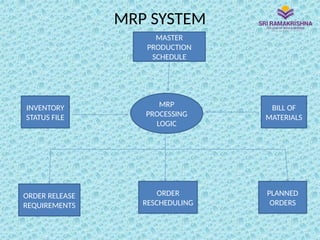
MRP SYSTEM
MASTER
PRODUCTION
SCHEDULE
INVENTORY
STATUS FILE
MRP
PROCESSING
LOGIC
BILL OF
MATERIALS
ORDER RELEASE
REQUIREMENTS
ORDER
RESCHEDULING
PLANNED
ORDERS
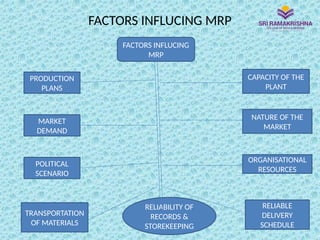
FACTORS INFLUCING MRP
FACTORS INFLUCING
MRP
PRODUCTION
PLANS
MARKET
DEMAND
POLITICAL
SCENARIO
TRANSPORTATION
OF MATERIALS
CAPACITY OF THE
PLANT
NATURE OF THE
MARKET
ORGANISATIONAL
RESOURCES
RELIABLE
DELIVERY
SCHEDULE
RELIABILITY OF
RECORDS &
STOREKEEPING
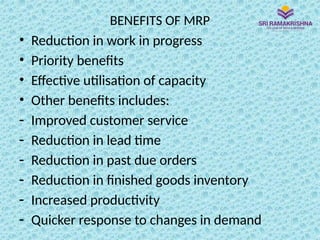
BENEFITS OF MRP
• Reduction in work in progress
• Priority benefits
• Effective utilisation of capacity
• Other benefits includes:
- Improved customer service
- Reduction in lead time
- Reduction in past due orders
- Reduction in finished goods inventory
- Increased productivity
- Quicker response to changes in demand
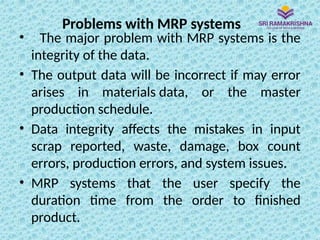
Problems with MRP systems
• The major problem with MRP systems is the
integrity of the data.
• The output data will be incorrect if may error
arises in materials data, or the master
production schedule.
• Data integrity affects the mistakes in input
scrap reported, waste, damage, box count
errors, production errors, and system issues.
• MRP systems that the user specify the
duration time from the order to finished
product.
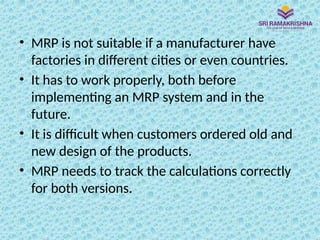
• MRP is not suitable if a manufacturer have
factories in different cities or even countries.
• It has to work properly, both before
implementing an MRP system and in the
future.
• It is difficult when customers ordered old and
new design of the products.
• MRP needs to track the calculations correctly
for both versions.
• List of all that goes into a final end product.
• It is a list of components that are required to
build a product.
• It is maintained on computers in different files.
• list of the raw materials, sub-assemblies, sub-
components, and the quantities of each
needed to manufacture an finished product.
• Master file is created.
• This file contains the data of all parts in terms
of the classification of the part.
BILLS OF MATERIALS (BOM)
• BOM is not simply a materials list but it
provides information to reconstruct the
manufacturing process.
• It gives the interface to order entry.
• Based on the business BOS have different types.
• In industries, the BOM is also known as the
formula, recipe, or ingredients list.
• list of the raw materials, sub-assemblies, sub-
components, and the quantities of each needed
to manufacture an finished product.
• In electronics, the BOM represents the printing
wiring board or printed circuit board.
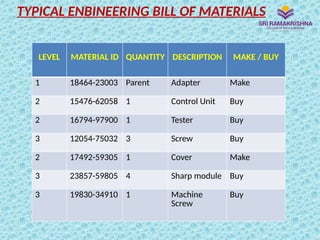
TYPICAL ENBINEERING BILL OF MATERIALS
LEVEL MATERIAL ID QUANTITY DESCRIPTION MAKE / BUY
1 18464-23003 Parent Adapter Make
2 15476-62058 1 Control Unit Buy
2 16794-97900 1 Tester Buy
3 12054-75032 3 Screw Buy
2 17492-59305 1 Cover Make
3 23857-59805 4 Sharp module Buy
3 19830-34910 1 Machine
Screw
Buy
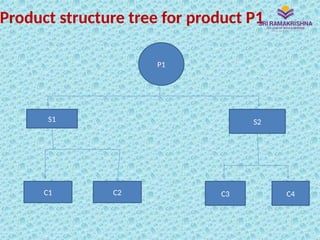
Product structure tree for product P1
P1
S1 S2
C1 C2 C3 C4

MRP.pptx - Ensure Material Availability - Inventory Optimization

  • 1.
    MATERIAL REQUIREMENTS PLANNING Dr BMerceline Anitha, Assistant Professor, Department of MBA, Sri Ramakrishna College of Arts & Science, Coimbatore.
  • 2.
    • It isa scientific technique for ordering and monitoring inventories. • It is for determining the quantity and timing for the demand • It helps managers in achieving effective manufacturing control. American Production and Inventory Control (APICS) – “ MRP constitutes a set of techniques that use bill of material, Inventory data, and the master production schedule to calculate the requirements for materials”.
  • 3.
    OBJECTIVES OF MRP •Inventory Reduction • Reduction in production and delivery lead time • Realistic Commitments • Increased Efficiency FUNCTION SERVED BY MRP - Order planning and control - Priority planning and control
  • 4.
    PROCEDURAL STEPS INMRP • Determine the gross requirements of the finished products. • Determine the net requirements of finished products • Adjust requirements for scrap allowances • Schedule planned orders • Explode next level • Aggregate requirements and determine order • Write and place the planned order • Maintain the schedule
  • 5.
    MRP SYSTEM MASTER PRODUCTION SCHEDULE INVENTORY STATUS FILE MRP PROCESSING LOGIC BILLOF MATERIALS ORDER RELEASE REQUIREMENTS ORDER RESCHEDULING PLANNED ORDERS
  • 6.
    FACTORS INFLUCING MRP FACTORSINFLUCING MRP PRODUCTION PLANS MARKET DEMAND POLITICAL SCENARIO TRANSPORTATION OF MATERIALS CAPACITY OF THE PLANT NATURE OF THE MARKET ORGANISATIONAL RESOURCES RELIABLE DELIVERY SCHEDULE RELIABILITY OF RECORDS & STOREKEEPING
  • 7.
    BENEFITS OF MRP •Reduction in work in progress • Priority benefits • Effective utilisation of capacity • Other benefits includes: - Improved customer service - Reduction in lead time - Reduction in past due orders - Reduction in finished goods inventory - Increased productivity - Quicker response to changes in demand
  • 8.
    Problems with MRPsystems • The major problem with MRP systems is the integrity of the data. • The output data will be incorrect if may error arises in materials data, or the master production schedule. • Data integrity affects the mistakes in input scrap reported, waste, damage, box count errors, production errors, and system issues. • MRP systems that the user specify the duration time from the order to finished product.
  • 9.
    • MRP isnot suitable if a manufacturer have factories in different cities or even countries. • It has to work properly, both before implementing an MRP system and in the future. • It is difficult when customers ordered old and new design of the products. • MRP needs to track the calculations correctly for both versions.
  • 10.
    • List ofall that goes into a final end product. • It is a list of components that are required to build a product. • It is maintained on computers in different files. • list of the raw materials, sub-assemblies, sub- components, and the quantities of each needed to manufacture an finished product. • Master file is created. • This file contains the data of all parts in terms of the classification of the part.
  • 11.
  • 12.
    • BOM isnot simply a materials list but it provides information to reconstruct the manufacturing process. • It gives the interface to order entry. • Based on the business BOS have different types. • In industries, the BOM is also known as the formula, recipe, or ingredients list. • list of the raw materials, sub-assemblies, sub- components, and the quantities of each needed to manufacture an finished product. • In electronics, the BOM represents the printing wiring board or printed circuit board.
  • 13.
    TYPICAL ENBINEERING BILLOF MATERIALS LEVEL MATERIAL ID QUANTITY DESCRIPTION MAKE / BUY 1 18464-23003 Parent Adapter Make 2 15476-62058 1 Control Unit Buy 2 16794-97900 1 Tester Buy 3 12054-75032 3 Screw Buy 2 17492-59305 1 Cover Make 3 23857-59805 4 Sharp module Buy 3 19830-34910 1 Machine Screw Buy
  • 14.
    Product structure treefor product P1 P1 S1 S2 C1 C2 C3 C4