Age related changes in relation to
reproductive system
Astuti mishra
Radiological technologist
In prostate –
At birth – small, mainly stroma
At 6 weeks – squamous metaplasia
Till 9 years - no changes
9 to 14 years – duct system enlarges
At puberty – double in size due to growth of follicle, stroma is reduced
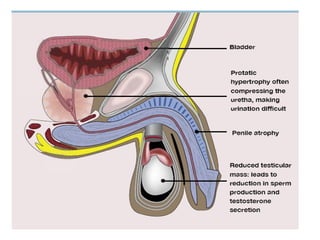
45 to 50 years – BPH or senile atrophy.
In testis –
Testicular size , sperm quality and quantity, no. of sertoli cells and Leyding cell
activity decreases in elderly.
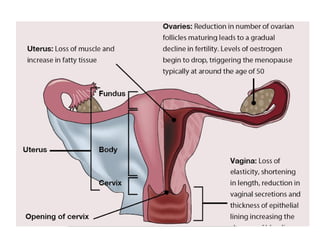
Uterus
 In foetal life the carvix is larger than body and project above pelvic brim
 At puberty the uterus enlarges and descends to adult position. The arbor vitae
uteri appear.
 During menstruation the uterus is slightly enlarged and become more
vascular
 During pregnancy the uterus is enlarged due to hypertrophy and hyperplasia,
in late pregnancy uterus becomes thinner and after delivery uterus returns to
normal position.
 At old old age uterus atrophies and become small.
Development of breast –
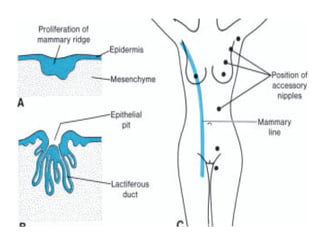
 in seven week a band like thickening of epidermis appear , mammary line or
mammary ridge.
 this line extends on each side of the body from the base of the forelimb to the
region of the hindlimb.
 ` major part of the mammary line disappears shortly after it forms, a small
portion in the thoracic region persists and penetrates the underlying
mesenchyme .
 it forms 16 to 24 sprouts, which in turn give rise to small, solid buds. By the
end of prenatal life, the epithelial sprouts are canalized and form the lactiferous
ducts, and the buds form small ducts and alveoli of the gland. Initially, the
lactiferous ducts open into a small epithelial pit (Fig. 18.4B). Shortly after
birth, this pit is transformed into the nipple by proliferation of the underlying
mesenchyme.
Polythelia – accessory nipple are present.
Polymastia - occurs when a remnant of the mammary line develops into
a complete breast.
Inverted nipple - is a condition in which the lactiferous ducts open into
the original epithelial pit that has failed to evert.

Age related changes in relation to reproductive system

  • 1.
    Age related changesin relation to reproductive system Astuti mishra Radiological technologist
  • 2.
    In prostate – Atbirth – small, mainly stroma At 6 weeks – squamous metaplasia Till 9 years - no changes 9 to 14 years – duct system enlarges At puberty – double in size due to growth of follicle, stroma is reduced 45 to 50 years – BPH or senile atrophy. In testis – Testicular size , sperm quality and quantity, no. of sertoli cells and Leyding cell activity decreases in elderly.
  • 5.
    Uterus  In foetallife the carvix is larger than body and project above pelvic brim  At puberty the uterus enlarges and descends to adult position. The arbor vitae uteri appear.  During menstruation the uterus is slightly enlarged and become more vascular  During pregnancy the uterus is enlarged due to hypertrophy and hyperplasia, in late pregnancy uterus becomes thinner and after delivery uterus returns to normal position.  At old old age uterus atrophies and become small.
  • 6.
    Development of breast–  in seven week a band like thickening of epidermis appear , mammary line or mammary ridge.  this line extends on each side of the body from the base of the forelimb to the region of the hindlimb.  ` major part of the mammary line disappears shortly after it forms, a small portion in the thoracic region persists and penetrates the underlying mesenchyme .  it forms 16 to 24 sprouts, which in turn give rise to small, solid buds. By the end of prenatal life, the epithelial sprouts are canalized and form the lactiferous ducts, and the buds form small ducts and alveoli of the gland. Initially, the lactiferous ducts open into a small epithelial pit (Fig. 18.4B). Shortly after birth, this pit is transformed into the nipple by proliferation of the underlying mesenchyme.
  • 8.
    Polythelia – accessorynipple are present. Polymastia - occurs when a remnant of the mammary line develops into a complete breast. Inverted nipple - is a condition in which the lactiferous ducts open into the original epithelial pit that has failed to evert.