PROJECT PAKISTAN
Mr.Liaquat Ali Khan (1895–
1951)
Rizwan Ahmed Tahir
rizwanahmedtahir@gmail.com
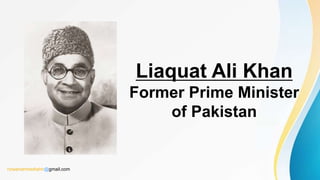
Liaquat Ali Khan
Former Prime Minister
of Pakistan
rizwanahmedtahir@gmail.com
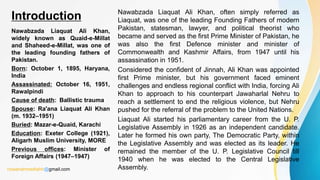
Nawabzada Liaquat Ali Khan,
widely known as Quaid-e-Millat
and Shaheed-e-Millat, was one of
the leading founding fathers of
Pakistan.
Born: October 1, 1895, Haryana,
India
Assassinated: October 16, 1951,
Rawalpindi
Cause of death: Ballistic trauma
Spouse: Ra'ana Liaquat Ali Khan
(m. 1932–1951)
Buried: Mazar-e-Quaid, Karachi
Education: Exeter College (1921),
Aligarh Muslim University, MORE
Previous offices: Minister of
Foreign Affairs (1947–1947)
Nawabzada Liaquat Ali Khan, often simply referred as
Liaquat, was one of the leading Founding Fathers of modern
Pakistan, statesman, lawyer, and political theorist who
became and served as the first Prime Minister of Pakistan, he
was also the first Defence minister and minister of
Commonwealth and Kashmir Affairs, from 1947 until his
assassination in 1951.
Considered the confident of Jinnah, Ali Khan was appointed
first Prime minister, but his government faced eminent
challenges and endless regional conflict with India, forcing Ali
Khan to approach to his counterpart Jawaharlal Nehru to
reach a settlement to end the religious violence, but Nehru
pushed for the referral of the problem to the United Nations.
Liaquat Ali started his parliamentary career from the U. P.
Legislative Assembly in 1926 as an independent candidate.
Later he formed his own party, The Democratic Party, within
the Legislative Assembly and was elected as its leader. He
remained the member of the U. P. Legislative Council till
1940 when he was elected to the Central Legislative
Assembly.
Introduction
rizwanahmedtahir@gmail.com
In his parliamentary career, Liaquat Ali Khan established his reputation as an eloquent, principled and
honest spokesman who never compromised on his principles even in the face of severe odds. He used
his influence and good offices for the liquidation of communal tension and bitterness. He took active
part in legislative affairs. He was one of the members of the Muslim League delegation that attended
the National Convention held at Calcutta to discuss the Nehru Report in December 1928.
Liaquat Ali’s second marriage took place in 1933. His wife Begum Ra’ana was a distinguished
economist and an educationist who stood by her husband during the ups and downs of his political
career. She proved to be a valuable asset to his political career as well as his private life. Quaid-i-Azam
in those days was in England in self-exile. The newly-wed couple had a number of meetings with the
Quaid and convinced him to come back to India to take up the leadership of the Muslims of the region.
When Quaid-i-Azam returned to India, he started reorganizing the Muslim League. Liaquat was elected
as the Honorary Sectary of the party on April 26, 1936. He held the office till the establishment of
Pakistan in 1947. In 1940, he was made the deputy leader of the Muslim League Parliamentary party.
Quaid-i-Azam was not able to take active part in the proceedings of the Assembly on account of his
heavy political work; thus the whole burden of protecting Muslim interests in the Assembly fell on
Liaquat Ali’s shoulders. Liaquat Ali was also the member of Muslim Masses Civil Defense Committee,
which was formed to keep the Muslims safe from Congress activities and to strengthen the League’s
mission.
rizwanahmedtahir@gmail.com
Liaquat Ali Khan won the Central Legislature election in 1945-46 from the Meerut Constituency in U. P.
He was also elected Chairman of the League’s Central Parliamentary Board. He assisted Quaid-i-
Azam in his negotiations with the members of the Cabinet Mission and the leaders of the Congress
during the final phases of the Freedom Movement. When the Government asked the Muslim League
to send their nominees for representation in the interim government, Liaquat was asked to lead the
League group in the cabinet. He was given the portfolio of finance, which he handled brilliantly. He
influenced the working of all the departments of the Government and presented a poor man’s budget.
His policies as Finance Minister helped in convincing the Congress to accept the Muslim demand of a
separate homeland.
After independence, Quaid-i-Azam and Muslim League appointed Liaquat to be the head of the
Pakistan Government. Being the first Prime Minister of the country, He had to deal with a number of
difficulties facing Pakistan in its early days. Liaquat Ali Khan helped Quaid-i-Azam in solving the riot
and refugee problem and setting up an effective administrative system for the country. After the death
of Quaid-i-Azam, Liaquat tried to fill the vacuum created by the departure of the Father of the Nation.
Under his premiership, Pakistan took its first steps in the field of constitution making, as well as foreign
policy. He presented the Objectives Resolution in the Legislative Assembly. The house passed this on
March 12, 1949. Under his leadership a team also drafted the first report of the Basic Principle
Committee. His efforts in signing the Liaquat-Nehru pact pertaining to the minority issue in 1950
reduced tensions between India and Pakistan. In May 1951, he visited the United States and set the
course of Pakistan’s foreign policy towards closer ties with the West.
rizwanahmedtahir@gmail.com
On October 16, 1951, Liaquat Ali Khan was
assassinated. He had been scheduled to make an
important announcement in a public meeting at
Municipal Park, Rawalpindi. The security forces
immediately shot the assassin, who was later
identified as Saad Akbar. Killing the assassin erased
all clues to the identity of the real culprit behind the
murder. Liaquat Ali Khan was officially given the title
of Shaheed-i-Millat, but the question of who was
behind his murder is yet to be answered.
rizwanahmedtahir@gmail.com
THANK
YOU
rizwanahmedtahir@gmail.com

Mr. liaquat ali khan

  • 2.
    PROJECT PAKISTAN Mr.Liaquat AliKhan (1895– 1951) Rizwan Ahmed Tahir rizwanahmedtahir@gmail.com
  • 3.
    Liaquat Ali Khan FormerPrime Minister of Pakistan rizwanahmedtahir@gmail.com
  • 4.
    Nawabzada Liaquat AliKhan, widely known as Quaid-e-Millat and Shaheed-e-Millat, was one of the leading founding fathers of Pakistan. Born: October 1, 1895, Haryana, India Assassinated: October 16, 1951, Rawalpindi Cause of death: Ballistic trauma Spouse: Ra'ana Liaquat Ali Khan (m. 1932–1951) Buried: Mazar-e-Quaid, Karachi Education: Exeter College (1921), Aligarh Muslim University, MORE Previous offices: Minister of Foreign Affairs (1947–1947) Nawabzada Liaquat Ali Khan, often simply referred as Liaquat, was one of the leading Founding Fathers of modern Pakistan, statesman, lawyer, and political theorist who became and served as the first Prime Minister of Pakistan, he was also the first Defence minister and minister of Commonwealth and Kashmir Affairs, from 1947 until his assassination in 1951. Considered the confident of Jinnah, Ali Khan was appointed first Prime minister, but his government faced eminent challenges and endless regional conflict with India, forcing Ali Khan to approach to his counterpart Jawaharlal Nehru to reach a settlement to end the religious violence, but Nehru pushed for the referral of the problem to the United Nations. Liaquat Ali started his parliamentary career from the U. P. Legislative Assembly in 1926 as an independent candidate. Later he formed his own party, The Democratic Party, within the Legislative Assembly and was elected as its leader. He remained the member of the U. P. Legislative Council till 1940 when he was elected to the Central Legislative Assembly. Introduction rizwanahmedtahir@gmail.com
  • 5.
    In his parliamentarycareer, Liaquat Ali Khan established his reputation as an eloquent, principled and honest spokesman who never compromised on his principles even in the face of severe odds. He used his influence and good offices for the liquidation of communal tension and bitterness. He took active part in legislative affairs. He was one of the members of the Muslim League delegation that attended the National Convention held at Calcutta to discuss the Nehru Report in December 1928. Liaquat Ali’s second marriage took place in 1933. His wife Begum Ra’ana was a distinguished economist and an educationist who stood by her husband during the ups and downs of his political career. She proved to be a valuable asset to his political career as well as his private life. Quaid-i-Azam in those days was in England in self-exile. The newly-wed couple had a number of meetings with the Quaid and convinced him to come back to India to take up the leadership of the Muslims of the region. When Quaid-i-Azam returned to India, he started reorganizing the Muslim League. Liaquat was elected as the Honorary Sectary of the party on April 26, 1936. He held the office till the establishment of Pakistan in 1947. In 1940, he was made the deputy leader of the Muslim League Parliamentary party. Quaid-i-Azam was not able to take active part in the proceedings of the Assembly on account of his heavy political work; thus the whole burden of protecting Muslim interests in the Assembly fell on Liaquat Ali’s shoulders. Liaquat Ali was also the member of Muslim Masses Civil Defense Committee, which was formed to keep the Muslims safe from Congress activities and to strengthen the League’s mission. rizwanahmedtahir@gmail.com
  • 6.
    Liaquat Ali Khanwon the Central Legislature election in 1945-46 from the Meerut Constituency in U. P. He was also elected Chairman of the League’s Central Parliamentary Board. He assisted Quaid-i- Azam in his negotiations with the members of the Cabinet Mission and the leaders of the Congress during the final phases of the Freedom Movement. When the Government asked the Muslim League to send their nominees for representation in the interim government, Liaquat was asked to lead the League group in the cabinet. He was given the portfolio of finance, which he handled brilliantly. He influenced the working of all the departments of the Government and presented a poor man’s budget. His policies as Finance Minister helped in convincing the Congress to accept the Muslim demand of a separate homeland. After independence, Quaid-i-Azam and Muslim League appointed Liaquat to be the head of the Pakistan Government. Being the first Prime Minister of the country, He had to deal with a number of difficulties facing Pakistan in its early days. Liaquat Ali Khan helped Quaid-i-Azam in solving the riot and refugee problem and setting up an effective administrative system for the country. After the death of Quaid-i-Azam, Liaquat tried to fill the vacuum created by the departure of the Father of the Nation. Under his premiership, Pakistan took its first steps in the field of constitution making, as well as foreign policy. He presented the Objectives Resolution in the Legislative Assembly. The house passed this on March 12, 1949. Under his leadership a team also drafted the first report of the Basic Principle Committee. His efforts in signing the Liaquat-Nehru pact pertaining to the minority issue in 1950 reduced tensions between India and Pakistan. In May 1951, he visited the United States and set the course of Pakistan’s foreign policy towards closer ties with the West. rizwanahmedtahir@gmail.com
  • 7.
    On October 16,1951, Liaquat Ali Khan was assassinated. He had been scheduled to make an important announcement in a public meeting at Municipal Park, Rawalpindi. The security forces immediately shot the assassin, who was later identified as Saad Akbar. Killing the assassin erased all clues to the identity of the real culprit behind the murder. Liaquat Ali Khan was officially given the title of Shaheed-i-Millat, but the question of who was behind his murder is yet to be answered. rizwanahmedtahir@gmail.com
  • 8.