A Guide to
  Rules & Readings in
   “ECONOMICESE”

  A Primer on Basic & Generic
Reading ECONOMICS Principles

                                1
Mentally calculating the
          Rate of Change
            [as a %age]
            New(n) – Old(o)
              Old(o)
as an example:
        600 – 500 = 0.2 = 20%
          500
                                2
when considering
      What To Look For
• What was originally expected?
• What actually happened?
• If those two (2) components are
  different the markets will react.
• How will the news affect the Fed?

                                      3
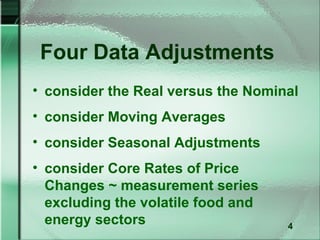
Four Data Adjustments
• consider the Real versus the Nominal
• consider Moving Averages
• consider Seasonal Adjustments
• consider Core Rates of Price
  Changes ~ measurement series
  excluding the volatile food and
  energy sectors                    4
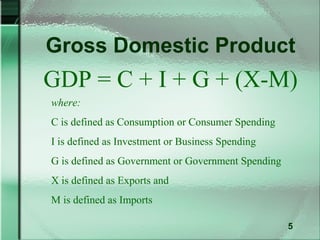
Gross Domestic Product
GDP = C + I + G + (X-M)
where:
C is defined as Consumption or Consumer Spending
I is defined as Investment or Business Spending
G is defined as Government or Government Spending
X is defined as Exports and
M is defined as Imports

                                                    5
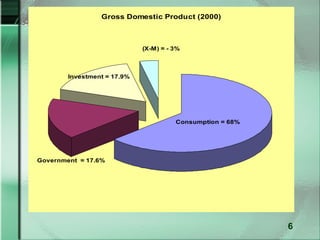
Gross Domestic Product (2000)


                     GDP 2000(X-M) = - 3%


        Investment = 17.9%


                                       Consumption = 68%


Government = 17.6%


                                                           6
evaluating:
       Economic Growth

calculating the:
              Rate of Change
               of REAL GDP


                               7
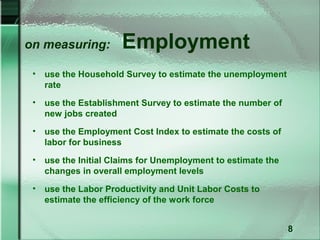
on measuring:          Employment
 •   use the Household Survey to estimate the unemployment
     rate
 •   use the Establishment Survey to estimate the number of
     new jobs created
 •   use the Employment Cost Index to estimate the costs of
     labor for business
 •   use the Initial Claims for Unemployment to estimate the
     changes in overall employment levels
 •   use the Labor Productivity and Unit Labor Costs to
     estimate the efficiency of the work force


                                                               8
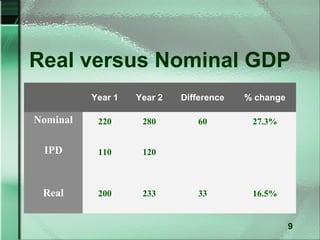
Real versus Nominal GDP
          Year 1   Year 2   Difference   % change

Nominal    220      280        60         27.3%


 IPD       110      120


 Real      200      233        33         16.5%


                                                    9
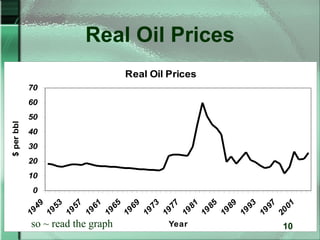
Real Oil Prices
                                  Real Oil Prices
            70
            60
            50
$ per bbl


            40
            30
            20
            10
            0
               49

               53

               57

               61

               65

               69

               73

               77

               81

               85

               89

               93

               97

               01
            19

            19

            19

            19

            19

            19

            19

            19

            19

            19

            19

            19

            19

            20
            so ~ read the graph            Year     10
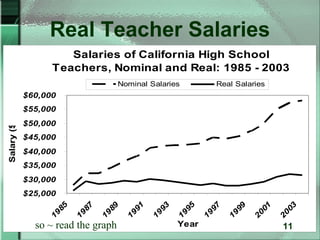
Real Teacher Salaries
                      Salaries of California High School
                   Teachers, Nominal and Real: 1985 - 2003
                                     Nominal Salaries             Real Salaries
             $60,000
             $55,000
             $50,000
Salary ($)


             $45,000
             $40,000
             $35,000
             $30,000
             $25,000
                   85


                         87


                               89


                                        91


                                              93


                                                        95


                                                              97


                                                                      99


                                                                             01


                                                                                   03
                  19


                        19


                              19


                                      19


                                             19


                                                   19


                                                             19


                                                                    19


                                                                           20


                                                                                  20
               so ~ read the graph                  Year                           11
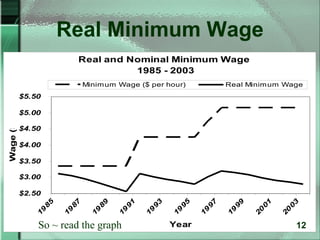
Real Minimum Wage
                             Real and Nominal Minimum Wage
                                       1985 - 2003
                              Minimum Wage ($ per hour)         Real Minim um Wage
           $5.50

           $5.00
Wage ($)


           $4.50

           $4.00

           $3.50

           $3.00

           $2.50
                   85


                         87


                                 89


                                       91


                                              93


                                                     95


                                                           97


                                                                 99


                                                                       01


                                                                              03
                        19


                                            19


                                                          19
              19


                               19


                                      19


                                                   19


                                                                19


                                                                      20


                                                                            20
               So ~ read the graph                 Year                          12
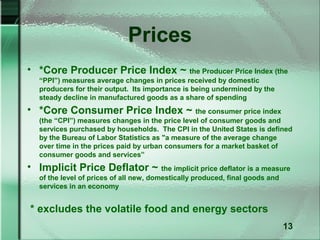
Prices
• *Core Producer Price Index ~ the Producer Price Index (the
   “PPI”) measures average changes in prices received by domestic
   producers for their output. Its importance is being undermined by the
   steady decline in manufactured goods as a share of spending
• *Core Consumer Price Index ~ the consumer price index
   (the “CPI”) measures changes in the price level of consumer goods and
   services purchased by households. The CPI in the United States is defined
   by the Bureau of Labor Statistics as "a measure of the average change
   over time in the prices paid by urban consumers for a market basket of
   consumer goods and services”
• Implicit Price Deflator ~ the implicit price deflator is a measure
   of the level of prices of all new, domestically produced, final goods and
   services in an economy


* excludes the volatile food and energy sectors
                                                                               13
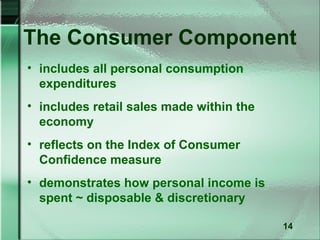
The Consumer Component
• includes all personal consumption
  expenditures
• includes retail sales made within the
  economy
• reflects on the Index of Consumer
  Confidence measure
• demonstrates how personal income is
  spent ~ disposable & discretionary

                                          14
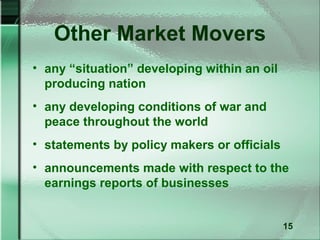
Other Market Movers
• any “situation” developing within an oil
  producing nation
• any developing conditions of war and
  peace throughout the world
• statements by policy makers or officials
• announcements made with respect to the
  earnings reports of businesses


                                             15

Mpp#017+a.guide.2.readings.economics.(15)

  • 1.
    A Guide to Rules & Readings in “ECONOMICESE” A Primer on Basic & Generic Reading ECONOMICS Principles 1
  • 2.
    Mentally calculating the Rate of Change [as a %age] New(n) – Old(o) Old(o) as an example: 600 – 500 = 0.2 = 20% 500 2
  • 3.
    when considering What To Look For • What was originally expected? • What actually happened? • If those two (2) components are different the markets will react. • How will the news affect the Fed? 3
  • 4.
    Four Data Adjustments •consider the Real versus the Nominal • consider Moving Averages • consider Seasonal Adjustments • consider Core Rates of Price Changes ~ measurement series excluding the volatile food and energy sectors 4
  • 5.
    Gross Domestic Product GDP= C + I + G + (X-M) where: C is defined as Consumption or Consumer Spending I is defined as Investment or Business Spending G is defined as Government or Government Spending X is defined as Exports and M is defined as Imports 5
  • 6.
    Gross Domestic Product(2000) GDP 2000(X-M) = - 3% Investment = 17.9% Consumption = 68% Government = 17.6% 6
  • 7.
    evaluating: Economic Growth calculating the: Rate of Change of REAL GDP 7
  • 8.
    on measuring: Employment • use the Household Survey to estimate the unemployment rate • use the Establishment Survey to estimate the number of new jobs created • use the Employment Cost Index to estimate the costs of labor for business • use the Initial Claims for Unemployment to estimate the changes in overall employment levels • use the Labor Productivity and Unit Labor Costs to estimate the efficiency of the work force 8
  • 9.
    Real versus NominalGDP Year 1 Year 2 Difference % change Nominal 220 280 60 27.3% IPD 110 120 Real 200 233 33 16.5% 9
  • 10.
    Real Oil Prices Real Oil Prices 70 60 50 $ per bbl 40 30 20 10 0 49 53 57 61 65 69 73 77 81 85 89 93 97 01 19 19 19 19 19 19 19 19 19 19 19 19 19 20 so ~ read the graph Year 10
  • 11.
    Real Teacher Salaries Salaries of California High School Teachers, Nominal and Real: 1985 - 2003 Nominal Salaries Real Salaries $60,000 $55,000 $50,000 Salary ($) $45,000 $40,000 $35,000 $30,000 $25,000 85 87 89 91 93 95 97 99 01 03 19 19 19 19 19 19 19 19 20 20 so ~ read the graph Year 11
  • 12.
    Real Minimum Wage Real and Nominal Minimum Wage 1985 - 2003 Minimum Wage ($ per hour) Real Minim um Wage $5.50 $5.00 Wage ($) $4.50 $4.00 $3.50 $3.00 $2.50 85 87 89 91 93 95 97 99 01 03 19 19 19 19 19 19 19 19 20 20 So ~ read the graph Year 12
  • 13.
    Prices • *Core ProducerPrice Index ~ the Producer Price Index (the “PPI”) measures average changes in prices received by domestic producers for their output. Its importance is being undermined by the steady decline in manufactured goods as a share of spending • *Core Consumer Price Index ~ the consumer price index (the “CPI”) measures changes in the price level of consumer goods and services purchased by households. The CPI in the United States is defined by the Bureau of Labor Statistics as "a measure of the average change over time in the prices paid by urban consumers for a market basket of consumer goods and services” • Implicit Price Deflator ~ the implicit price deflator is a measure of the level of prices of all new, domestically produced, final goods and services in an economy * excludes the volatile food and energy sectors 13
  • 14.
    The Consumer Component •includes all personal consumption expenditures • includes retail sales made within the economy • reflects on the Index of Consumer Confidence measure • demonstrates how personal income is spent ~ disposable & discretionary 14
  • 15.
    Other Market Movers •any “situation” developing within an oil producing nation • any developing conditions of war and peace throughout the world • statements by policy makers or officials • announcements made with respect to the earnings reports of businesses 15