The Magic of Exchange

   SUBJECTIVELY: where one
person’s (perceived) trash is another
   person’s (perceived) treasure.
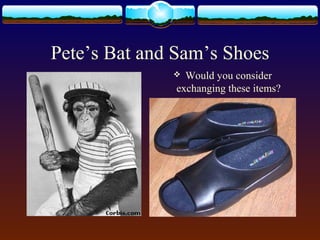
Pete’s Bat and Sam’s Shoes
               Would you consider
              exchanging these items?
Why (and How) does an
    exchange create wealth?
 One  person’s trash is another’s treasure.
 because any one individual’s evaluation
  of goods and services is
   subjective   and
   different.
The Principle of Exchange
       as an application of the
      benefit versus cost analysis
  People will exchange if they expect to gain more
than they give up --- specifically, if they believe the
expected benefit is greater than their expected cost.
These principles refer to
“Voluntary” Exchanges ~
      Not Rip Offs!
When agreeing to exchange, both
    parties expect to gain
 more than they are giving up.
The Gasoline Purchase…..
       as Rip Off (?)
   ex ante ~ Gasoline prices are ridiculous; so international
    oil companies are ripping you off!
   Did you make the choice to buy the gas?
   Why did you buy the gas?
   Using marginal analysis, you compared the benefits of
    “buying the gas” to the opportunity cost of the using the
    funds to “do something else you may have wanted to do”.
   If the benefits outweighed the cost! You gained.
   nota bene: The gas station owner gained also.
When “benefit/cost” doesn’t work
 When   there is a “lack of information”
 When   there is “misinformation” (or fraud)
 When   there is “asymmetric information”
Employment as Voluntary Exchange
 Employers must gain
 Though you say “I hate my job!” (how much)
 Use marginal analysis to explain:
    Why SF Giants might let Barry Bonds go? Why
                might he decide to leave
    Why the SF 49ers let Jerry Rice go? Why did he
           decide to leave and go to the hated
                  Oakland Raiders?
Education as Voluntary Exchange
 You are voluntarily exchanging your money
 and contributing your human capital to this
 class. Why?

 Many high school students don’t expect to gain
 from school. How does that affect the nature of
 the exchange? TYPE of EXCHANGE(?)
Voluntary Exchanges Create Wealth
 Wealth  is the value people place on their assets ~
  both human and non-human.
 After a voluntary exchange both parties should
  place a higher value on their “after” assets than
  their “before” assets. They believe they gave up a
  “lesser wealth” for a “greater wealth” something.
 Even if only two people voluntarily exchange,
  wealth is created.
Barter exchanges are inefficient.

 Barter– exchanging goods for goods
 Must have mutual coincidence of wants
   You  have to want what I have and I have to
    want what you have.
   Otherwise we might have to make many
    transactions before getting the thing each of
    us wants.
Transaction Cost
   Opportunity Costs are subjective valuations associated
     with Searching for the product (search cost)
     with Arranging for the exchange
     with Agreeing to the terms of exchange
     with “Dead Weight Loss”
        In an “exchange” your cost is someone’s gain.
        With a “Dead Weight Loss” your cost is no one’s gain.
Money
A way of exchanging personal resources for
 goods and services
  You  are a carpenter
  You exchange your human capital for money
  You exchange money for goods and services
  thus You exchanged your human capital for
   goods and services
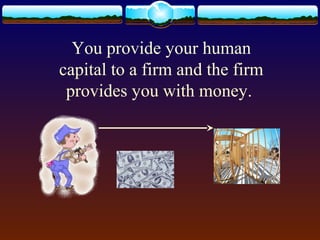
You provide your human
capital to a firm and the firm
 provides you with money.
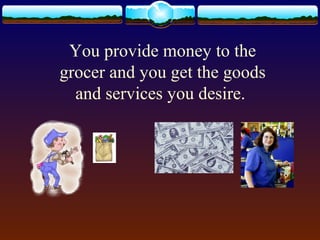
You provide money to the
grocer and you get the goods
  and services you desire.
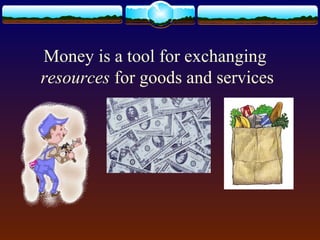
Money is a tool for exchanging
resources for goods and services
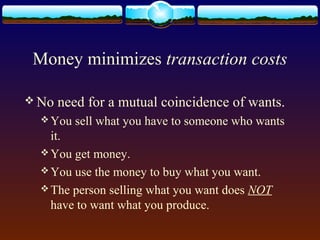
Money minimizes transaction costs

 No   need for a mutual coincidence of wants.
   You   sell what you have to someone who wants
    it.
   You get money.
   You use the money to buy what you want.
   The person selling what you want does NOT
    have to want what you produce.
Further reductions of
           transaction costs
  Credit and debit cards
  ATM’s
  The Internet
  Direct deposit
  Posting menus outside restaurants
Main Points to Consider
 Because  peoples’ evaluations of goods and
  services are subjective and different, both parties
  can benefit from exchange, increasing wealth.
 The Principle of Exchange – people will engage
  in exchange if they expect to gain more than
  they have to give up.
 When people voluntarily engage in an exchange
  there are no rip-offs = they are efficient?
Main Points to Remember
 Asymmetric information conditions reduce the
  probability both parties will benefit from
  exchange transaction.
 Transaction costs include
    opportunity costs involved with exchange
    dead weight losses
    search costs
 Money facilitates exchange by reducing the
  total of the transaction costs incurred.
....DEFINITIONS….
Asymmetric Information Problem: A problem arising
when either buyers or sellers have important action about
the product not possessed by the other side in potential
transactions.

Deadweight Loss: A net loss associated with the forgoing
of an economic action. The loss does not lead to an
offsetting gain for other participants. It thus reflects
economic inefficiency.

Mpp#005+exchange.basics.(21)

  • 1.
    The Magic ofExchange SUBJECTIVELY: where one person’s (perceived) trash is another person’s (perceived) treasure.
  • 2.
    Pete’s Bat andSam’s Shoes  Would you consider exchanging these items?
  • 3.
    Why (and How)does an exchange create wealth?  One person’s trash is another’s treasure.  because any one individual’s evaluation of goods and services is  subjective and  different.
  • 4.
    The Principle ofExchange as an application of the benefit versus cost analysis People will exchange if they expect to gain more than they give up --- specifically, if they believe the expected benefit is greater than their expected cost.
  • 5.
    These principles referto “Voluntary” Exchanges ~ Not Rip Offs! When agreeing to exchange, both parties expect to gain more than they are giving up.
  • 6.
    The Gasoline Purchase….. as Rip Off (?)  ex ante ~ Gasoline prices are ridiculous; so international oil companies are ripping you off!  Did you make the choice to buy the gas?  Why did you buy the gas?  Using marginal analysis, you compared the benefits of “buying the gas” to the opportunity cost of the using the funds to “do something else you may have wanted to do”.  If the benefits outweighed the cost! You gained.  nota bene: The gas station owner gained also.
  • 7.
    When “benefit/cost” doesn’twork  When there is a “lack of information”  When there is “misinformation” (or fraud)  When there is “asymmetric information”
  • 8.
    Employment as VoluntaryExchange  Employers must gain  Though you say “I hate my job!” (how much)  Use marginal analysis to explain:  Why SF Giants might let Barry Bonds go? Why might he decide to leave  Why the SF 49ers let Jerry Rice go? Why did he decide to leave and go to the hated Oakland Raiders?
  • 9.
    Education as VoluntaryExchange  You are voluntarily exchanging your money and contributing your human capital to this class. Why?  Many high school students don’t expect to gain from school. How does that affect the nature of the exchange? TYPE of EXCHANGE(?)
  • 10.
    Voluntary Exchanges CreateWealth  Wealth is the value people place on their assets ~ both human and non-human.  After a voluntary exchange both parties should place a higher value on their “after” assets than their “before” assets. They believe they gave up a “lesser wealth” for a “greater wealth” something.  Even if only two people voluntarily exchange, wealth is created.
  • 11.
    Barter exchanges areinefficient.  Barter– exchanging goods for goods  Must have mutual coincidence of wants  You have to want what I have and I have to want what you have.  Otherwise we might have to make many transactions before getting the thing each of us wants.
  • 12.
    Transaction Cost  Opportunity Costs are subjective valuations associated  with Searching for the product (search cost)  with Arranging for the exchange  with Agreeing to the terms of exchange  with “Dead Weight Loss”  In an “exchange” your cost is someone’s gain.  With a “Dead Weight Loss” your cost is no one’s gain.
  • 13.
    Money A way ofexchanging personal resources for goods and services  You are a carpenter  You exchange your human capital for money  You exchange money for goods and services  thus You exchanged your human capital for goods and services
  • 14.
    You provide yourhuman capital to a firm and the firm provides you with money.
  • 15.
    You provide moneyto the grocer and you get the goods and services you desire.
  • 16.
    Money is atool for exchanging resources for goods and services
  • 17.
    Money minimizes transactioncosts  No need for a mutual coincidence of wants.  You sell what you have to someone who wants it.  You get money.  You use the money to buy what you want.  The person selling what you want does NOT have to want what you produce.
  • 18.
    Further reductions of transaction costs  Credit and debit cards  ATM’s  The Internet  Direct deposit  Posting menus outside restaurants
  • 19.
    Main Points toConsider  Because peoples’ evaluations of goods and services are subjective and different, both parties can benefit from exchange, increasing wealth.  The Principle of Exchange – people will engage in exchange if they expect to gain more than they have to give up.  When people voluntarily engage in an exchange there are no rip-offs = they are efficient?
  • 20.
    Main Points toRemember  Asymmetric information conditions reduce the probability both parties will benefit from exchange transaction.  Transaction costs include  opportunity costs involved with exchange  dead weight losses  search costs  Money facilitates exchange by reducing the total of the transaction costs incurred.
  • 21.
    ....DEFINITIONS…. Asymmetric Information Problem:A problem arising when either buyers or sellers have important action about the product not possessed by the other side in potential transactions. Deadweight Loss: A net loss associated with the forgoing of an economic action. The loss does not lead to an offsetting gain for other participants. It thus reflects economic inefficiency.