interesting cases
CASE HISTORY 
30 year old female 
• Swelling in the right thigh X 4 months 
• Gradually progressed in size & associated with pain 
• Burning sensation and numbness – right lower limb X 4 months 
• No H/O Diabetes, hypertension, medications or trauma
CLINICAL DETAILS 
• Nodular swelling – anterior and lateral aspect of right thigh 
• Firm, non tender, free from bone underneath 
• No evidence of any other swellings / skin lesions 
• No features of vascular compromise 
• CLINICAL DIAGNOSIS : 
• NEUROFIBROMA – RIGHT THIGH 
• Lesion was excised with the surrounding skin 
and sent for histopathology. 
Gross: irregular skin flap (10cm) with a nodular lesion in the middle 
Cut surface was tan grey, firm to hard with occasional necrotic areas.
MICROSCOPY 
• Fascicles, nodules, whorls and diffuse distribution 
• Largely monomorphic spindled to epithelioid cells with few pleomorphic 
cells 
• Dark hyperchromatic nucleus, inconspicuous nucleoli and pale cytoplasm 
• Prominent nuclear palisades, perivascular arrangement 
• Mitotic figures [25/10 HPF] 
• Necrosis + 
• Few round cells with eccentric nucleus & eosinophilic cytoplasm
Histological differentials ??? 
• MPNST 
• Fibrosarcoma 
• Synovial sarcomas 
• Angiosarcoma 
• Leiomyosarcoma 
• Malignant fibrous histiocytoma
VIMENTIN
S-100 
Positivity IN around 10% tumor cells for S-100
CK EMA SMA
DESMIN MYOGENIN
CD 34
• MPNST 
• Fibrosarcoma 
• Synovial sarcomas 
• Angiosarcoma 
• Leiomyosarcoma 
• Malignant fibrous histiocytoma
Final diagnosis 
• MALIGNANT PERIPHERAL NERVE SHEATH TUMOR (MPNST) 
• FNCLCC GRADING : GRADE III
????? 
• Desmin + and Myogenin + ?????? 
• CD 34 + ??????
Final diagnosis 
• MALIGNANT PERIPHERAL NERVE SHEATH TUMOR (MPNST) WITH 
RHABDOMYOBLASTIC DIFFERENTIATION (MALIGNANT TRITON 
TUMOR) 
• [ MULTI LINEAGE DIFFERENTIATION ] 
• FNCLCC GRADING : GRADE III
OVERVIEW 
DEFINITION 
•Any sarcoma with one/more of the following features: 
oarising from a peripheral nerve 
oarising from a pre-existing benign nerve sheath tumor 
odemonstrating Schwann cell differentiation on histologic examination 
•Any malignant spindled tumor in a patient with neurofibromatosis 1 (NF-1), unless proven 
otherwise 
EPIDEMIOLOGY 
•Accounts for 5-10% of all soft tissue sarcomas 
•Incidence of 0.001% in the general population 
•Up to 50% occur in patients with NF-1, 10% are radiation-induced, 40% are sporadic 
• NF-1 associated MPNST 
•develops from existing plexiform neurofibromas, NOT superficial neurofibromas 
•lifetime risk of MPNST in NF-1 patients has been reported between 5-10% 
•tend to present earlier in life and with larger tumors than sporadic MPNSTs
CLINICAL FEATURES 
•Enlarging mass 
•Pain 
•Paresthesias / neurologic deficits 
•Most commonly occurs in or near a nerve trunk (e.g. brachial plexus, 
sacral plexus, sciatic nerve) 
•Local recurrence 
•Hematogenous spread 
• lungs - most common site of metastasis.
Loss of remaining 
functional NF-1 gene ↑Ras, cAMP, Ca2+ 
↑EGFR, Kit-L, TGFβ1 
↓p53, p16INK4A, p19ARF, Rb 
↑EGFR, ErbB2, c-KIT, c-MET 
HGF, PDGF 
A B 
C 
D 
E 
PATHOGENESIS 
(adapted by Timothy Beer from Carroll S, Acta Neuropathol, 2012) 
Model for the pathogenesis of plexiform neurofibroma development and subsequent 
malignant transformation to malignant peripheral nerve sheath tumor (MPNST). 
The NF-1 gene  neurofibromin  tumor suppressor function.
Absence of the second 
functional NF-1 gene 
de-regulation of several 
intracellular signaling 
cascades like RAS & cAMP 
increases in secretion of the 
factors like Kit ligand (Kit-L) 
& TGFβ1 
NEUROFIBROMA 
Decreased/absent expression 
of tumor suppressor proteins 
p53, p16INK4A, p19ARF & Rb 
further increased expression 
of EGFR, ErbB2, c-KIT, c-MET, 
HGF and PDGF. 
MPNST
GROSS PATHOLOGY 
FEATURES 
• Shape  globoid or fusiform 
•Mean size  10-15 cm in greatest dimension. 
• Consistency Fleshy and firm to hard 
• Color  tan-gray on cut section, but may include a wide variety of colors 
• Necrosis  present, either focally or extensively 
• Fibrous pseudocapsule, gross invasion into surrounding soft tissues maybe seen 
•Entering and exiting nerve segments may be thickened due to spread along the epineurium and perineurium 
•May be surrounded by portions of plexiform neurofibroma which have not yet undergone malignant 
transformation 
Retroperitoneal MPNST. MPNST adherent to psoas 
muscle. 
MPNST of the right arm.
MICROSCOPIC PATHOLOGY 
FEATURES 
•“Marbled” pattern of hypercellular fascicles 
interrupted by hypocellular myxoid areas. 
• Long, wavy/“serpentine” nuclei. 
• “punched out” nuclei 
•Perivascular hypercellularity & indentation of 
cells into vascular lumens, is characteristic 
•High-grade tumors - high mitotic activity 
and necrosis. 
•Geographic necrosis with palisading of 
tumor cells 
.
MICROSCOPIC VARIANTS 
•MPNST – highly heterogenous tumor. 
•MPNSTs can exhibit variable 
differentiation. 
[Rhabdomyoblastic, Epithelioid, 
Glandular, Melanocytic, Endothelial, 
Osseous, cartilaginous, 
Neuro- endocrine, smooth muscle] 
•EPITHELIOID MALIGNANT MPNST 
•MALIGNANT TRITON TUMOR 
•PERINEURIAL MPNST
IMMUNOHISTOCHEMISTRY 
No single sensitive or specific immunohistochemicalmarker. 
IHC Classical MPNST Aberrations 
S100 FOCAL 
POSITIVITY IN 
50% 
STRONG S-100 POSITIVITY IN EPITHELIOID 
VARIANTS 
CK, CEA Negative POSITIVE IN MPNST with GLANDULAR 
DIFFERENTIATION 
Desmin, myogenin Negative POSITIVE IN MALIGNANT TRITON TUMOR 
CD 34 Negative/Positiv 
e 
POSITIVE IN MPNST with ENDOTHELIAL OR 
PERINEURIAL DIFFERENTIATION 
HMB45 Negative POSITIVE IN MPNST with MELANOCYTIC 
DIFFERENTIATION 
EMA Negative POSITIVE IN MPNST with PERINEURIAL/ 
GLANDULAR DIFFERENTIATION 
• Vimentin. Leu-7+ in 50%. 
• Myelin basic protein, Nestin, Sox 10, HMGA2 
MPNST Neurofibroma 
MALIGNANT TRITON TUMOR
IMAGING 
MRI (with and without contrast) 
• Imaging modality of choice for peripheral nerve sheath tumors 
• Differentiates MPNST from benign plexiform neurofibromas (see table) 
• Magnetic resonance neurography (MRN) offers superior visualization and delineation of peripheral nerves from surrounding soft tissue 
• CT scan - All patients with MPNSTs should receive CT of the chest to assess for pulmonary metastases 
MRI CHARACTERISTICS OF BENIGN AND MALIGNANT PERIPHERAL NERVE SHEATH TUMORS 
CHARACTERISTIC BPNST MPNST 
Fusiform shape with tapered ends Present Present 
Oriented longitudinally along direction of peripheral nerve Present Present 
Fascicular sign: multiple ring-like structures with peripheral hyperintensity on T2 weighted MR Present Absent 
Target sign: hyperintense periphery surrounding a hypointense center on T2 weighted MR Present Absent 
Split-fat sign: rim of fat surrounding the neurovascular bundle (and lesion) on T1 weighted MR Present Absent 
Fascicular sign. (T2-MR) Target sign. (T2-MRI) Split-fat sign. (T1 MRI)
PROGNOSTIC FACTORS 
FAVORABLE PROGNOSTIC FACTORS IDENTIFIED IN 11 REVIEWS OF MPNST 
PUBLICATION n SIGNIFICANT RELATIVELY FAVORABLE POSTOPERATIVE PROGNOSTIC FACTORS* 
Anghileri (2006) 205 smaller tumor size, lack of local recurrence, extremity location 
Stucky (2012) 175 tumor size < 5 cm, lack of local recurrence, low histologic grade, extremity location 
Zou (2009) 140 tumor size < 10 cm, low intensity p53 staining, positive S-100 staining 
Wong (1999) 134 smaller tumor size, low histologic grade, perineural histologic subtype 
Brekke (2009) 64 tumor size < 8 cm, complete surgical resection, lower intensity p53 staining 
Okada (2006) 56 tumor size < 7 cm 
Baehring (2003) 54 complete surgical resection, young age, radiation therapy, lack of chemotherapy 
Gousias** (2010) 43 gross total resection 
Kar (2006) 25 lower histologic grade, greater cellular differentiation 
Romanathan (1999) 23 tumor size < 10 cm, low histologic grade 
Zhu** (2012) 16 low histologic grade 
* For studies that performed both univariate and multivariate analyses, only those risk factors found to be significant on multivariate analysis are 
included here. Metastasis at time of presentation is a uniformly poor prognostic factor and therefore was not evaluated in most studies 
** Zhu series included only spinal tumors and Gousias series included only intracranial tumors 
SUMMARY 
• Evidence overwhelmingly supports tumor size and local recurrence as important postoperative prognostic factors. 
By extension, because lack of local recurrence by definition requires complete surgical resection, complete surgical 
resection is likely also an important prognostic factor.. 
• Evidence is suggestive, but not conclusive, that tumor location (extremity vs. trunk, head and neck) and histologic 
grade are also important prognostic factors. 
• Further analysis is needed to determine whether factors such as p53 expression, radiation therapy, histologic 
subtype and S-100 staining are significant prognostic factors.
Differential Diagnosis 
• Synovial sarcomas 
• Liposarcomas 
• Malignant fibrous histiocytoma 
• Fibrosarcoma 
• Angiosarcoma 
• Leiomyosarcoma 
• Malignant Melanoma
GENERAL MANAGEMENT 
Complete surgical excision is required for cure 
SURGICAL RESECTION 
•Often requires en-bloc resection of major nerves and acceptance of potentially significant functional loss 
•Complete resectability rates are determined primarily by neuroanatomic location 
• Reported to be around 95% for extremity lesions and 20% for paraspinal lesions 
•Most cases of extremity MPNST can be completely resected without amputation 
RADIOTHERAPY (ADJUVANT OR NEOADJUVANT) 
• Found to improve local control and reduce local recurrence rates in many series 
• However, most series have found no benefit with respect to overall survival 
CHEMOTHERAPY (ADJUVANT) 
• Has NOT been shown in any large studies to significantly improve survival
Case 2 
• 40 year female 
• Fever on & off 
• Generalised weakness & weight loss 
• Swelling in the axilla and neck X 2 months 
• Progressed to > 2cm in size. Not associated with pain / discharge 
• Tru cut biopsy cores were received from both the swelling, processed and 
stained.
H & E sections
Histological Differentials 
• Lymphomas 
• Metastasis from epithelial malignancies 
• Metastasis from sarcomas 
• Round cell tumors
LCA, CK, 
Vimentin & 
Desmin 
LCA Vimentin CK Desmin
PRIOR HPE: Reported as Anaplastic Large Cell Lymphoma outside
CD 3, CD 20 
& 
CD 30 
CD 3 CD 20 CD 30
CD 19, CD 56 
& 
Tdt 
CD 19 CD 56 Tdt
• A PLEOMORPHIC HEMATOLOGICAL TUMOR which is 
• LCA + & Vimentin + 
• CD 3 – 
• CD 19 & CD 20 – 
• CD 30 – 
• Tdt – 
• CD 56 –
MPO
• GRANULOCYTIC / MYELOID SARCOMA
Discussion 
• Definition 
• ‘Is a pathologic diagnosis for extramedullary proliferation of blasts of one or 
more myeloid lineages that disrupts the normal architecture of the tissues in 
which it is found’ 
• Leukemia cutis 
• Meningeal leukemia 
• Extramedullary myeloid tumour 
• Myeloblastoma
History 
• ‘Chloroma’ 
• Burns A. Observations of surgical anatomy, in Head and Neck. London, England, Royce, 
1811, p. 364 
• King A. A case of chloroma. Monthly J Med 17:17, 1853. 
• ‘Granulocytic sarcoma’ 
• Rappaport H. Tumors of the hematopoietic system, in Atlas of Tumor Pathology, Section III, 
Fascicle 8. Armed Forces Institute of Pathology, Washington DC, 1967, pp. 241‐247 
• ‘Granulocytic Leukemia and Reticulum Cell Sarcoma’ John Laszlo and Harvey E Grode. 
Cancer April 1967. 
• FAB classification (1976) – does not specify 
• WHO classification (2001) – Included under ‘AML not otherwise categorized’ 
• WHO Classification (2008) – separate entity in classification of AML
Types of presentation 
• De novo – 27% 
• Concurrent with AML, MPD or MDS – 35% 
• Previous H/O AML, MDS, MPN – 38% 
• Initial manifestation of relapse in AML in remission 
• Evolution to AML in known MDS or MDS/MPN 
• Blast transformation in MPN
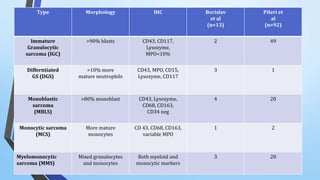
Type Morphology IHC Borislav 
et al 
(n=13) 
Pileri et 
al 
(n=92) 
Immature 
Granulocytic 
sarcoma (IGC) 
>90% blasts CD43, CD117, 
Lysozyme, 
MPO<10% 
2 49 
Differntiated 
GS (DGS) 
>10% more 
mature neutrophils 
CD43, MPO, CD15, 
Lysozyme, CD117 
3 1 
Monoblastic 
sarcoma 
(MBLS) 
>80% monoblast CD43, Lysozyme, 
CD68, CD163, 
CD34 neg 
4 20 
Monocytic sarcoma 
(MCS) 
More mature 
monocytes 
CD 43, CD68, CD163, 
variable MPO 
1 2 
Myelomonocytic 
sarcoma (MMS) 
Mixed granulocytes 
and monocytes 
Both myeloid and 
monocytic markers 
3 20
Gross
Granulocytic sarcoma - ovary Granulocytic sarcoma - orbit
Differential Diagnosis 
• Haematopoietic: 
• Lymphoblastic, 
• Diffuse large B cell Lymphoma 
• Anaplastic Large Cell Lymphoma 
• Burkitts, 
• Non haematopoietic : 
• Small round cell tumour (neuroblastoma, rhabdomyosarcoma, Ewing Sarcoma/PNET, 
medulloblastoma) 
• Undifferentiated carcinomas 
Immunophenotyping is mandatory. 
Misdiagnosed 50% of the times if IPT is not done
Treatment 
• No definite guidelines 
• Complex issue – depends on type of presentation 
• Various modalities 
• Surgery 
• Radiotherapy 
• Chemotherapy 
• Anti‐AML therapy - less intense /more intense therapy? 
• Combined therapy: 
• EFS and OS of the MS patients vs AML patients matched for age, PS, Cytogenetics, 
time of treatment.
Mpnst and myeloid sarcoma

Mpnst and myeloid sarcoma

  • 1.
  • 2.
    CASE HISTORY 30year old female • Swelling in the right thigh X 4 months • Gradually progressed in size & associated with pain • Burning sensation and numbness – right lower limb X 4 months • No H/O Diabetes, hypertension, medications or trauma
  • 3.
    CLINICAL DETAILS •Nodular swelling – anterior and lateral aspect of right thigh • Firm, non tender, free from bone underneath • No evidence of any other swellings / skin lesions • No features of vascular compromise • CLINICAL DIAGNOSIS : • NEUROFIBROMA – RIGHT THIGH • Lesion was excised with the surrounding skin and sent for histopathology. Gross: irregular skin flap (10cm) with a nodular lesion in the middle Cut surface was tan grey, firm to hard with occasional necrotic areas.
  • 7.
    MICROSCOPY • Fascicles,nodules, whorls and diffuse distribution • Largely monomorphic spindled to epithelioid cells with few pleomorphic cells • Dark hyperchromatic nucleus, inconspicuous nucleoli and pale cytoplasm • Prominent nuclear palisades, perivascular arrangement • Mitotic figures [25/10 HPF] • Necrosis + • Few round cells with eccentric nucleus & eosinophilic cytoplasm
  • 8.
    Histological differentials ??? • MPNST • Fibrosarcoma • Synovial sarcomas • Angiosarcoma • Leiomyosarcoma • Malignant fibrous histiocytoma
  • 9.
  • 10.
    S-100 Positivity INaround 10% tumor cells for S-100
  • 11.
  • 12.
  • 13.
  • 14.
    • MPNST •Fibrosarcoma • Synovial sarcomas • Angiosarcoma • Leiomyosarcoma • Malignant fibrous histiocytoma
  • 15.
    Final diagnosis •MALIGNANT PERIPHERAL NERVE SHEATH TUMOR (MPNST) • FNCLCC GRADING : GRADE III
  • 16.
    ????? • Desmin+ and Myogenin + ?????? • CD 34 + ??????
  • 17.
    Final diagnosis •MALIGNANT PERIPHERAL NERVE SHEATH TUMOR (MPNST) WITH RHABDOMYOBLASTIC DIFFERENTIATION (MALIGNANT TRITON TUMOR) • [ MULTI LINEAGE DIFFERENTIATION ] • FNCLCC GRADING : GRADE III
  • 18.
    OVERVIEW DEFINITION •Anysarcoma with one/more of the following features: oarising from a peripheral nerve oarising from a pre-existing benign nerve sheath tumor odemonstrating Schwann cell differentiation on histologic examination •Any malignant spindled tumor in a patient with neurofibromatosis 1 (NF-1), unless proven otherwise EPIDEMIOLOGY •Accounts for 5-10% of all soft tissue sarcomas •Incidence of 0.001% in the general population •Up to 50% occur in patients with NF-1, 10% are radiation-induced, 40% are sporadic • NF-1 associated MPNST •develops from existing plexiform neurofibromas, NOT superficial neurofibromas •lifetime risk of MPNST in NF-1 patients has been reported between 5-10% •tend to present earlier in life and with larger tumors than sporadic MPNSTs
  • 19.
    CLINICAL FEATURES •Enlargingmass •Pain •Paresthesias / neurologic deficits •Most commonly occurs in or near a nerve trunk (e.g. brachial plexus, sacral plexus, sciatic nerve) •Local recurrence •Hematogenous spread • lungs - most common site of metastasis.
  • 20.
    Loss of remaining functional NF-1 gene ↑Ras, cAMP, Ca2+ ↑EGFR, Kit-L, TGFβ1 ↓p53, p16INK4A, p19ARF, Rb ↑EGFR, ErbB2, c-KIT, c-MET HGF, PDGF A B C D E PATHOGENESIS (adapted by Timothy Beer from Carroll S, Acta Neuropathol, 2012) Model for the pathogenesis of plexiform neurofibroma development and subsequent malignant transformation to malignant peripheral nerve sheath tumor (MPNST). The NF-1 gene  neurofibromin  tumor suppressor function.
  • 21.
    Absence of thesecond functional NF-1 gene de-regulation of several intracellular signaling cascades like RAS & cAMP increases in secretion of the factors like Kit ligand (Kit-L) & TGFβ1 NEUROFIBROMA Decreased/absent expression of tumor suppressor proteins p53, p16INK4A, p19ARF & Rb further increased expression of EGFR, ErbB2, c-KIT, c-MET, HGF and PDGF. MPNST
  • 22.
    GROSS PATHOLOGY FEATURES • Shape  globoid or fusiform •Mean size  10-15 cm in greatest dimension. • Consistency Fleshy and firm to hard • Color  tan-gray on cut section, but may include a wide variety of colors • Necrosis  present, either focally or extensively • Fibrous pseudocapsule, gross invasion into surrounding soft tissues maybe seen •Entering and exiting nerve segments may be thickened due to spread along the epineurium and perineurium •May be surrounded by portions of plexiform neurofibroma which have not yet undergone malignant transformation Retroperitoneal MPNST. MPNST adherent to psoas muscle. MPNST of the right arm.
  • 23.
    MICROSCOPIC PATHOLOGY FEATURES •“Marbled” pattern of hypercellular fascicles interrupted by hypocellular myxoid areas. • Long, wavy/“serpentine” nuclei. • “punched out” nuclei •Perivascular hypercellularity & indentation of cells into vascular lumens, is characteristic •High-grade tumors - high mitotic activity and necrosis. •Geographic necrosis with palisading of tumor cells .
  • 24.
    MICROSCOPIC VARIANTS •MPNST– highly heterogenous tumor. •MPNSTs can exhibit variable differentiation. [Rhabdomyoblastic, Epithelioid, Glandular, Melanocytic, Endothelial, Osseous, cartilaginous, Neuro- endocrine, smooth muscle] •EPITHELIOID MALIGNANT MPNST •MALIGNANT TRITON TUMOR •PERINEURIAL MPNST
  • 25.
    IMMUNOHISTOCHEMISTRY No singlesensitive or specific immunohistochemicalmarker. IHC Classical MPNST Aberrations S100 FOCAL POSITIVITY IN 50% STRONG S-100 POSITIVITY IN EPITHELIOID VARIANTS CK, CEA Negative POSITIVE IN MPNST with GLANDULAR DIFFERENTIATION Desmin, myogenin Negative POSITIVE IN MALIGNANT TRITON TUMOR CD 34 Negative/Positiv e POSITIVE IN MPNST with ENDOTHELIAL OR PERINEURIAL DIFFERENTIATION HMB45 Negative POSITIVE IN MPNST with MELANOCYTIC DIFFERENTIATION EMA Negative POSITIVE IN MPNST with PERINEURIAL/ GLANDULAR DIFFERENTIATION • Vimentin. Leu-7+ in 50%. • Myelin basic protein, Nestin, Sox 10, HMGA2 MPNST Neurofibroma MALIGNANT TRITON TUMOR
  • 26.
    IMAGING MRI (withand without contrast) • Imaging modality of choice for peripheral nerve sheath tumors • Differentiates MPNST from benign plexiform neurofibromas (see table) • Magnetic resonance neurography (MRN) offers superior visualization and delineation of peripheral nerves from surrounding soft tissue • CT scan - All patients with MPNSTs should receive CT of the chest to assess for pulmonary metastases MRI CHARACTERISTICS OF BENIGN AND MALIGNANT PERIPHERAL NERVE SHEATH TUMORS CHARACTERISTIC BPNST MPNST Fusiform shape with tapered ends Present Present Oriented longitudinally along direction of peripheral nerve Present Present Fascicular sign: multiple ring-like structures with peripheral hyperintensity on T2 weighted MR Present Absent Target sign: hyperintense periphery surrounding a hypointense center on T2 weighted MR Present Absent Split-fat sign: rim of fat surrounding the neurovascular bundle (and lesion) on T1 weighted MR Present Absent Fascicular sign. (T2-MR) Target sign. (T2-MRI) Split-fat sign. (T1 MRI)
  • 27.
    PROGNOSTIC FACTORS FAVORABLEPROGNOSTIC FACTORS IDENTIFIED IN 11 REVIEWS OF MPNST PUBLICATION n SIGNIFICANT RELATIVELY FAVORABLE POSTOPERATIVE PROGNOSTIC FACTORS* Anghileri (2006) 205 smaller tumor size, lack of local recurrence, extremity location Stucky (2012) 175 tumor size < 5 cm, lack of local recurrence, low histologic grade, extremity location Zou (2009) 140 tumor size < 10 cm, low intensity p53 staining, positive S-100 staining Wong (1999) 134 smaller tumor size, low histologic grade, perineural histologic subtype Brekke (2009) 64 tumor size < 8 cm, complete surgical resection, lower intensity p53 staining Okada (2006) 56 tumor size < 7 cm Baehring (2003) 54 complete surgical resection, young age, radiation therapy, lack of chemotherapy Gousias** (2010) 43 gross total resection Kar (2006) 25 lower histologic grade, greater cellular differentiation Romanathan (1999) 23 tumor size < 10 cm, low histologic grade Zhu** (2012) 16 low histologic grade * For studies that performed both univariate and multivariate analyses, only those risk factors found to be significant on multivariate analysis are included here. Metastasis at time of presentation is a uniformly poor prognostic factor and therefore was not evaluated in most studies ** Zhu series included only spinal tumors and Gousias series included only intracranial tumors SUMMARY • Evidence overwhelmingly supports tumor size and local recurrence as important postoperative prognostic factors. By extension, because lack of local recurrence by definition requires complete surgical resection, complete surgical resection is likely also an important prognostic factor.. • Evidence is suggestive, but not conclusive, that tumor location (extremity vs. trunk, head and neck) and histologic grade are also important prognostic factors. • Further analysis is needed to determine whether factors such as p53 expression, radiation therapy, histologic subtype and S-100 staining are significant prognostic factors.
  • 28.
    Differential Diagnosis •Synovial sarcomas • Liposarcomas • Malignant fibrous histiocytoma • Fibrosarcoma • Angiosarcoma • Leiomyosarcoma • Malignant Melanoma
  • 29.
    GENERAL MANAGEMENT Completesurgical excision is required for cure SURGICAL RESECTION •Often requires en-bloc resection of major nerves and acceptance of potentially significant functional loss •Complete resectability rates are determined primarily by neuroanatomic location • Reported to be around 95% for extremity lesions and 20% for paraspinal lesions •Most cases of extremity MPNST can be completely resected without amputation RADIOTHERAPY (ADJUVANT OR NEOADJUVANT) • Found to improve local control and reduce local recurrence rates in many series • However, most series have found no benefit with respect to overall survival CHEMOTHERAPY (ADJUVANT) • Has NOT been shown in any large studies to significantly improve survival
  • 30.
    Case 2 •40 year female • Fever on & off • Generalised weakness & weight loss • Swelling in the axilla and neck X 2 months • Progressed to > 2cm in size. Not associated with pain / discharge • Tru cut biopsy cores were received from both the swelling, processed and stained.
  • 31.
    H & Esections
  • 32.
    Histological Differentials •Lymphomas • Metastasis from epithelial malignancies • Metastasis from sarcomas • Round cell tumors
  • 33.
    LCA, CK, Vimentin& Desmin LCA Vimentin CK Desmin
  • 34.
    PRIOR HPE: Reportedas Anaplastic Large Cell Lymphoma outside
  • 35.
    CD 3, CD20 & CD 30 CD 3 CD 20 CD 30
  • 36.
    CD 19, CD56 & Tdt CD 19 CD 56 Tdt
  • 37.
    • A PLEOMORPHICHEMATOLOGICAL TUMOR which is • LCA + & Vimentin + • CD 3 – • CD 19 & CD 20 – • CD 30 – • Tdt – • CD 56 –
  • 38.
  • 40.
    • GRANULOCYTIC /MYELOID SARCOMA
  • 41.
    Discussion • Definition • ‘Is a pathologic diagnosis for extramedullary proliferation of blasts of one or more myeloid lineages that disrupts the normal architecture of the tissues in which it is found’ • Leukemia cutis • Meningeal leukemia • Extramedullary myeloid tumour • Myeloblastoma
  • 42.
    History • ‘Chloroma’ • Burns A. Observations of surgical anatomy, in Head and Neck. London, England, Royce, 1811, p. 364 • King A. A case of chloroma. Monthly J Med 17:17, 1853. • ‘Granulocytic sarcoma’ • Rappaport H. Tumors of the hematopoietic system, in Atlas of Tumor Pathology, Section III, Fascicle 8. Armed Forces Institute of Pathology, Washington DC, 1967, pp. 241‐247 • ‘Granulocytic Leukemia and Reticulum Cell Sarcoma’ John Laszlo and Harvey E Grode. Cancer April 1967. • FAB classification (1976) – does not specify • WHO classification (2001) – Included under ‘AML not otherwise categorized’ • WHO Classification (2008) – separate entity in classification of AML
  • 43.
    Types of presentation • De novo – 27% • Concurrent with AML, MPD or MDS – 35% • Previous H/O AML, MDS, MPN – 38% • Initial manifestation of relapse in AML in remission • Evolution to AML in known MDS or MDS/MPN • Blast transformation in MPN
  • 45.
    Type Morphology IHCBorislav et al (n=13) Pileri et al (n=92) Immature Granulocytic sarcoma (IGC) >90% blasts CD43, CD117, Lysozyme, MPO<10% 2 49 Differntiated GS (DGS) >10% more mature neutrophils CD43, MPO, CD15, Lysozyme, CD117 3 1 Monoblastic sarcoma (MBLS) >80% monoblast CD43, Lysozyme, CD68, CD163, CD34 neg 4 20 Monocytic sarcoma (MCS) More mature monocytes CD 43, CD68, CD163, variable MPO 1 2 Myelomonocytic sarcoma (MMS) Mixed granulocytes and monocytes Both myeloid and monocytic markers 3 20
  • 46.
  • 47.
    Granulocytic sarcoma -ovary Granulocytic sarcoma - orbit
  • 48.
    Differential Diagnosis •Haematopoietic: • Lymphoblastic, • Diffuse large B cell Lymphoma • Anaplastic Large Cell Lymphoma • Burkitts, • Non haematopoietic : • Small round cell tumour (neuroblastoma, rhabdomyosarcoma, Ewing Sarcoma/PNET, medulloblastoma) • Undifferentiated carcinomas Immunophenotyping is mandatory. Misdiagnosed 50% of the times if IPT is not done
  • 51.
    Treatment • Nodefinite guidelines • Complex issue – depends on type of presentation • Various modalities • Surgery • Radiotherapy • Chemotherapy • Anti‐AML therapy - less intense /more intense therapy? • Combined therapy: • EFS and OS of the MS patients vs AML patients matched for age, PS, Cytogenetics, time of treatment.