Prof.Dipak Mahurkar Department of E&C Engineering
Sanjivani College of Engineering, Kopargaon
Department of Electronics & Telecommunication Engineering
(An Autonomous Institute)
Affiliated to Savitribai Phule Pune University
Accredited ‘A’ Grade by NAAC
________________________________________________________________________________________
Subject: Microcontroller & Microprocessor (EC214)
Unit-I Introduction to 80386
1
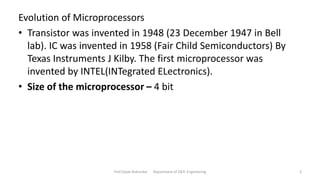
Evolution of Microprocessors
• Transistor was invented in 1948 (23 December 1947 in Bell
lab). IC was invented in 1958 (Fair Child Semiconductors) By
Texas Instruments J Kilby. The first microprocessor was
invented by INTEL(INTegrated ELectronics).
• Size of the microprocessor – 4 bit
Prof.Dipak Mahurkar Department of E&Tc Engineering 2
Prof.Dipak Mahurkar Department of E&Tc Engineering 3
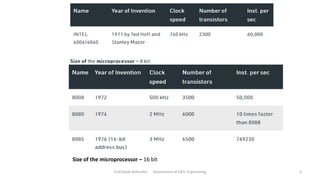
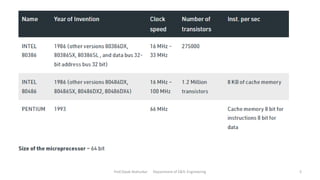
Size of the microprocessor – 16 bit
Prof.Dipak Mahurkar Department of E&Tc Engineering 4
Prof.Dipak Mahurkar Department of E&Tc Engineering 5
Prof.Dipak Mahurkar Department of E&Tc Engineering 6
Prof.Dipak Mahurkar Department of E&Tc Engineering 7
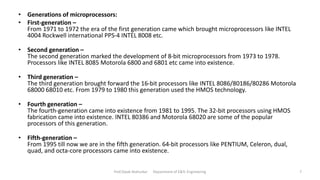
• Generations of microprocessors:
• First-generation –
From 1971 to 1972 the era of the first generation came which brought microprocessors like INTEL
4004 Rockwell international PPS-4 INTEL 8008 etc.
• Second generation –
The second generation marked the development of 8-bit microprocessors from 1973 to 1978.
Processors like INTEL 8085 Motorola 6800 and 6801 etc came into existence.
• Third generation –
The third generation brought forward the 16-bit processors like INTEL 8086/80186/80286 Motorola
68000 68010 etc. From 1979 to 1980 this generation used the HMOS technology.
• Fourth generation –
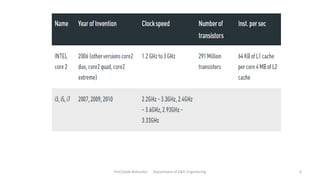
The fourth-generation came into existence from 1981 to 1995. The 32-bit processors using HMOS
fabrication came into existence. INTEL 80386 and Motorola 68020 are some of the popular
processors of this generation.
• Fifth-generation –
From 1995 till now we are in the fifth generation. 64-bit processors like PENTIUM, Celeron, dual,
quad, and octa-core processors came into existence.
• Text Books:
• A.Ray, K.Bhurchandi, ”Advanced Microprocessors and peripherals: Arch, Programming & Interfacing”,
Tata McGraw Hill, 3rd edition, 2006, ISBN 1-25-900613-1
• James Turley, “Advanced 80386 Programming Techniques”, McGraw-Hill, 1st edition, 2005.
• ISBN: 0-07-059841-X
• M. Ali Mazidi, Janice Gillispie Mazidi, Rolin McKinlay “The 8051 Microcontroller and Embedded
Systems Using Assembly and C”, 2nd Edition, , 2005
• Microcontrollers and application, Ajay. V. Deshmukh, TMGH, 2005, ISBN 0-07-058595-4.
• M. Ali Mazidi, Rolind McKinlay “PIC Microcontroller and Embedded Systems Using Assembly and C
for PIC18”, 2008, ISBN 978-81-317-1675-5
• Reference Books:
• Chris H. Pappas, William H. Murray, “80386 Microprocessor Handbooks”, McGraw-Hill Osborne
Media, ISBN-10: 0078812429, 13: 978-0078812422
• Barry B. Bray , The Intel Microprocessor 8086/8088, 80186,80286, 80386 and 80486 Architecture,
programming and interfacing, PHI, 8th Edition, 2009.
• Mohammad Rafiquzzaman, "Microprocessors: Theory and Applications: Intel and Motorola",
Prentice Hall, Revised edition 1992,ISBN-81-203-0848-4
• Kenneth J. Ayala. The 8051 microcontroller, 3rd edition, Cengage learning, 2010
• K.Uma Rao, Andhe Pallavi, “The 8051 microcontrollers, architecture and programming and
applications”, Pearson, 2009.
Prof.Dipak Mahurkar Department of E&Tc Engineering 8
• e-Resources:
• NPTEL Course :
https://onlinecourses.nptel.ac.in/noc23_ee47/course
• Guidelines for Continuous Internal Assessment:
• 1. Test1 will be conducted on UNIT1 & UNIT2 for 20 marks.
• 2. Test2 will be conducted on UNIT3 & UNIT4 for 20 marks.
• 3. Test3 will be conducted on UNIT5 & UNIT6 for 20 marks.
• 4. Self-learning activity will be conducted for 20 marks.
• Total marks(40) = Average of all Tests(20 Marks) + Self learning
activity(20 Marks)
Prof.Dipak Mahurkar Department of E&Tc Engineering 9
Prof.Dipak Mahurkar Department of E&Tc Engineering
Thank You! 10

MPMC-2.pptx

  • 1.
    Prof.Dipak Mahurkar Departmentof E&C Engineering Sanjivani College of Engineering, Kopargaon Department of Electronics & Telecommunication Engineering (An Autonomous Institute) Affiliated to Savitribai Phule Pune University Accredited ‘A’ Grade by NAAC ________________________________________________________________________________________ Subject: Microcontroller & Microprocessor (EC214) Unit-I Introduction to 80386 1
  • 2.
    Evolution of Microprocessors •Transistor was invented in 1948 (23 December 1947 in Bell lab). IC was invented in 1958 (Fair Child Semiconductors) By Texas Instruments J Kilby. The first microprocessor was invented by INTEL(INTegrated ELectronics). • Size of the microprocessor – 4 bit Prof.Dipak Mahurkar Department of E&Tc Engineering 2
  • 3.
    Prof.Dipak Mahurkar Departmentof E&Tc Engineering 3 Size of the microprocessor – 16 bit
  • 4.
    Prof.Dipak Mahurkar Departmentof E&Tc Engineering 4
  • 5.
    Prof.Dipak Mahurkar Departmentof E&Tc Engineering 5
  • 6.
    Prof.Dipak Mahurkar Departmentof E&Tc Engineering 6
  • 7.
    Prof.Dipak Mahurkar Departmentof E&Tc Engineering 7 • Generations of microprocessors: • First-generation – From 1971 to 1972 the era of the first generation came which brought microprocessors like INTEL 4004 Rockwell international PPS-4 INTEL 8008 etc. • Second generation – The second generation marked the development of 8-bit microprocessors from 1973 to 1978. Processors like INTEL 8085 Motorola 6800 and 6801 etc came into existence. • Third generation – The third generation brought forward the 16-bit processors like INTEL 8086/80186/80286 Motorola 68000 68010 etc. From 1979 to 1980 this generation used the HMOS technology. • Fourth generation – The fourth-generation came into existence from 1981 to 1995. The 32-bit processors using HMOS fabrication came into existence. INTEL 80386 and Motorola 68020 are some of the popular processors of this generation. • Fifth-generation – From 1995 till now we are in the fifth generation. 64-bit processors like PENTIUM, Celeron, dual, quad, and octa-core processors came into existence.
  • 8.
    • Text Books: •A.Ray, K.Bhurchandi, ”Advanced Microprocessors and peripherals: Arch, Programming & Interfacing”, Tata McGraw Hill, 3rd edition, 2006, ISBN 1-25-900613-1 • James Turley, “Advanced 80386 Programming Techniques”, McGraw-Hill, 1st edition, 2005. • ISBN: 0-07-059841-X • M. Ali Mazidi, Janice Gillispie Mazidi, Rolin McKinlay “The 8051 Microcontroller and Embedded Systems Using Assembly and C”, 2nd Edition, , 2005 • Microcontrollers and application, Ajay. V. Deshmukh, TMGH, 2005, ISBN 0-07-058595-4. • M. Ali Mazidi, Rolind McKinlay “PIC Microcontroller and Embedded Systems Using Assembly and C for PIC18”, 2008, ISBN 978-81-317-1675-5 • Reference Books: • Chris H. Pappas, William H. Murray, “80386 Microprocessor Handbooks”, McGraw-Hill Osborne Media, ISBN-10: 0078812429, 13: 978-0078812422 • Barry B. Bray , The Intel Microprocessor 8086/8088, 80186,80286, 80386 and 80486 Architecture, programming and interfacing, PHI, 8th Edition, 2009. • Mohammad Rafiquzzaman, "Microprocessors: Theory and Applications: Intel and Motorola", Prentice Hall, Revised edition 1992,ISBN-81-203-0848-4 • Kenneth J. Ayala. The 8051 microcontroller, 3rd edition, Cengage learning, 2010 • K.Uma Rao, Andhe Pallavi, “The 8051 microcontrollers, architecture and programming and applications”, Pearson, 2009. Prof.Dipak Mahurkar Department of E&Tc Engineering 8
  • 9.
    • e-Resources: • NPTELCourse : https://onlinecourses.nptel.ac.in/noc23_ee47/course • Guidelines for Continuous Internal Assessment: • 1. Test1 will be conducted on UNIT1 & UNIT2 for 20 marks. • 2. Test2 will be conducted on UNIT3 & UNIT4 for 20 marks. • 3. Test3 will be conducted on UNIT5 & UNIT6 for 20 marks. • 4. Self-learning activity will be conducted for 20 marks. • Total marks(40) = Average of all Tests(20 Marks) + Self learning activity(20 Marks) Prof.Dipak Mahurkar Department of E&Tc Engineering 9
  • 10.
    Prof.Dipak Mahurkar Departmentof E&Tc Engineering Thank You! 10