EE8691
MICROPROCESSORS AND
MICROCONTROLLERS
Dr. S. ELANGOVAN
INTRODUCTION AND COURSE OUTLINE
• Historical Background
• Moore’s Law
• Evolution of IC Technology
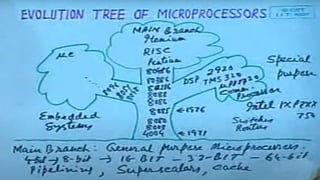
• Evolution tree of Microprocessors
• Key features of MPMC
• Typical applications
• Educational need
• Course Outline
HISTORICAL BACKGROUND
• 1947 - Invention of Transistor
• 1949 - Invention of Integrated Circuits
• 1965 - Birth of Moore’s Law
• 1971 - Development of first Microprocessor
• 1976 - Introduction of first Microcontroller
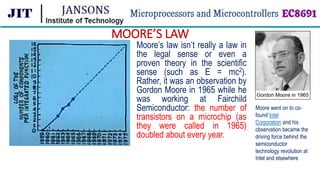
MOORE’S LAW
Moore’s law isn’t really a law in
the legal sense or even a
proven theory in the scientific
sense (such as E = mc2).
Rather, it was an observation by
Gordon Moore in 1965 while he
was working at Fairchild
Semiconductor: the number of
transistors on a microchip (as
they were called in 1965)
doubled about every year.
Moore went on to co-
found Intel
Corporation and his
observation became the
driving force behind the
semiconductor
technology revolution at
Intel and elsewhere
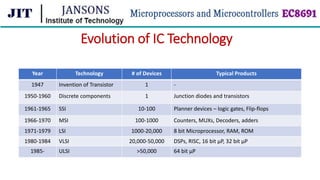
Evolution of IC Technology
Year Technology # of Devices Typical Products
1947 Invention of Transistor 1 -
1950-1960 Discrete components 1 Junction diodes and transistors
1961-1965 SSI 10-100 Planner devices – logic gates, Flip-flops
1966-1970 MSI 100-1000 Counters, MUXs, Decoders, adders
1971-1979 LSI 1000-20,000 8 bit Microprocessor, RAM, ROM
1980-1984 VLSI 20,000-50,000 DSPs, RISC, 16 bit µP, 32 bit µP
1985- ULSI >50,000 64 bit µP
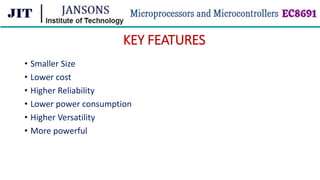
KEY FEATURES
• Smaller Size
• Lower cost
• Higher Reliability
• Lower power consumption
• Higher Versatility
• More powerful
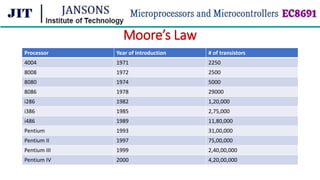
Moore’s Law
Processor Year of Introduction # of transistors
4004 1971 2250
8008 1972 2500
8080 1974 5000
8086 1978 29000
i286 1982 1,20,000
i386 1985 2,75,000
i486 1989 11,80,000
Pentium 1993 31,00,000
Pentium II 1997 75,00,000
Pentium III 1999 2,40,00,000
Pentium IV 2000 4,20,00,000
APPLICATIONS
General Purpose µPs: 32 bit and 64 bit
Desktop, Personal computers, laptops, workstations, servers and
Supercomputers
Microcontrollers: Embedded systems
Consumer Electronics: Toys, camera, camcorders, Robots
Consumer products: Washing machines, Microwave ovens
Instrumentation: Oscilloscopes, medical equipment
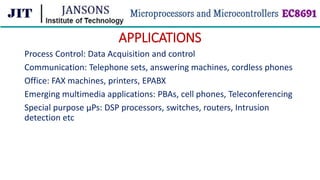
APPLICATIONS
Process Control: Data Acquisition and control
Communication: Telephone sets, answering machines, cordless phones
Office: FAX machines, printers, EPABX
Emerging multimedia applications: PBAs, cell phones, Teleconferencing
Special purpose µPs: DSP processors, switches, routers, Intrusion
detection etc
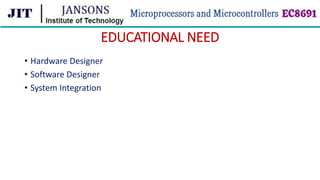
EDUCATIONAL NEED
• Hardware Designer
• Software Designer
• System Integration
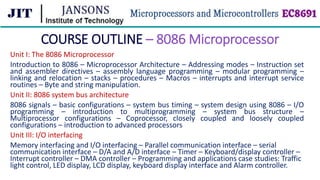
COURSE OUTLINE – 8086 Microprocessor
Unit I: The 8086 Microprocessor
Introduction to 8086 – Microprocessor Architecture – Addressing modes – Instruction set
and assembler directives – assembly language programming – modular programming –
linking and relocation – stacks – procedures – Macros – interrupts and interrupt service
routines – Byte and string manipulation.
Unit II: 8086 system bus architecture
8086 signals – basic configurations – system bus timing – system design using 8086 – I/O
programming – introduction to multiprogramming – system bus structure –
Multiprocessor configurations – Coprocessor, closely coupled and loosely coupled
configurations – introduction to advanced processors
Unit III: I/O interfacing
Memory interfacing and I/O interfacing – Parallel communication interface – serial
communication interface – D/A and A/D interface – Timer – Keyboard/display controller –
Interrupt controller – DMA controller – Programming and applications case studies: Traffic
light control, LED display, LCD display, keyboard display interface and Alarm controller.
Unit IV: Microcontroller
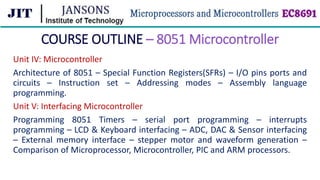
Architecture of 8051 – Special Function Registers(SFRs) – I/O pins ports and
circuits – Instruction set – Addressing modes – Assembly language
programming.
Unit V: Interfacing Microcontroller
Programming 8051 Timers – serial port programming – interrupts
programming – LCD & Keyboard interfacing – ADC, DAC & Sensor interfacing
– External memory interface – stepper motor and waveform generation –
Comparison of Microprocessor, Microcontroller, PIC and ARM processors.
COURSE OUTLINE – 8051 Microcontroller
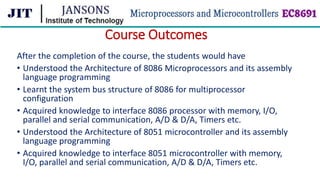
Course Outcomes
After the completion of the course, the students would have
• Understood the Architecture of 8086 Microprocessors and its assembly
language programming
• Learnt the system bus structure of 8086 for multiprocessor
configuration
• Acquired knowledge to interface 8086 processor with memory, I/O,
parallel and serial communication, A/D & D/A, Timers etc.
• Understood the Architecture of 8051 microcontroller and its assembly
language programming
• Acquired knowledge to interface 8051 microcontroller with memory,
I/O, parallel and serial communication, A/D & D/A, Timers etc.
THANK YOU

EC 8691 MPMC Introduction.pptx

  • 1.
  • 2.
    INTRODUCTION AND COURSEOUTLINE • Historical Background • Moore’s Law • Evolution of IC Technology • Evolution tree of Microprocessors • Key features of MPMC • Typical applications • Educational need • Course Outline
  • 3.
    HISTORICAL BACKGROUND • 1947- Invention of Transistor • 1949 - Invention of Integrated Circuits • 1965 - Birth of Moore’s Law • 1971 - Development of first Microprocessor • 1976 - Introduction of first Microcontroller
  • 4.
    MOORE’S LAW Moore’s lawisn’t really a law in the legal sense or even a proven theory in the scientific sense (such as E = mc2). Rather, it was an observation by Gordon Moore in 1965 while he was working at Fairchild Semiconductor: the number of transistors on a microchip (as they were called in 1965) doubled about every year. Moore went on to co- found Intel Corporation and his observation became the driving force behind the semiconductor technology revolution at Intel and elsewhere
  • 6.
    Evolution of ICTechnology Year Technology # of Devices Typical Products 1947 Invention of Transistor 1 - 1950-1960 Discrete components 1 Junction diodes and transistors 1961-1965 SSI 10-100 Planner devices – logic gates, Flip-flops 1966-1970 MSI 100-1000 Counters, MUXs, Decoders, adders 1971-1979 LSI 1000-20,000 8 bit Microprocessor, RAM, ROM 1980-1984 VLSI 20,000-50,000 DSPs, RISC, 16 bit µP, 32 bit µP 1985- ULSI >50,000 64 bit µP
  • 9.
    KEY FEATURES • SmallerSize • Lower cost • Higher Reliability • Lower power consumption • Higher Versatility • More powerful
  • 10.
    Moore’s Law Processor Yearof Introduction # of transistors 4004 1971 2250 8008 1972 2500 8080 1974 5000 8086 1978 29000 i286 1982 1,20,000 i386 1985 2,75,000 i486 1989 11,80,000 Pentium 1993 31,00,000 Pentium II 1997 75,00,000 Pentium III 1999 2,40,00,000 Pentium IV 2000 4,20,00,000
  • 11.
    APPLICATIONS General Purpose µPs:32 bit and 64 bit Desktop, Personal computers, laptops, workstations, servers and Supercomputers Microcontrollers: Embedded systems Consumer Electronics: Toys, camera, camcorders, Robots Consumer products: Washing machines, Microwave ovens Instrumentation: Oscilloscopes, medical equipment
  • 12.
    APPLICATIONS Process Control: DataAcquisition and control Communication: Telephone sets, answering machines, cordless phones Office: FAX machines, printers, EPABX Emerging multimedia applications: PBAs, cell phones, Teleconferencing Special purpose µPs: DSP processors, switches, routers, Intrusion detection etc
  • 13.
    EDUCATIONAL NEED • HardwareDesigner • Software Designer • System Integration
  • 14.
    COURSE OUTLINE –8086 Microprocessor Unit I: The 8086 Microprocessor Introduction to 8086 – Microprocessor Architecture – Addressing modes – Instruction set and assembler directives – assembly language programming – modular programming – linking and relocation – stacks – procedures – Macros – interrupts and interrupt service routines – Byte and string manipulation. Unit II: 8086 system bus architecture 8086 signals – basic configurations – system bus timing – system design using 8086 – I/O programming – introduction to multiprogramming – system bus structure – Multiprocessor configurations – Coprocessor, closely coupled and loosely coupled configurations – introduction to advanced processors Unit III: I/O interfacing Memory interfacing and I/O interfacing – Parallel communication interface – serial communication interface – D/A and A/D interface – Timer – Keyboard/display controller – Interrupt controller – DMA controller – Programming and applications case studies: Traffic light control, LED display, LCD display, keyboard display interface and Alarm controller.
  • 15.
    Unit IV: Microcontroller Architectureof 8051 – Special Function Registers(SFRs) – I/O pins ports and circuits – Instruction set – Addressing modes – Assembly language programming. Unit V: Interfacing Microcontroller Programming 8051 Timers – serial port programming – interrupts programming – LCD & Keyboard interfacing – ADC, DAC & Sensor interfacing – External memory interface – stepper motor and waveform generation – Comparison of Microprocessor, Microcontroller, PIC and ARM processors. COURSE OUTLINE – 8051 Microcontroller
  • 16.
    Course Outcomes After thecompletion of the course, the students would have • Understood the Architecture of 8086 Microprocessors and its assembly language programming • Learnt the system bus structure of 8086 for multiprocessor configuration • Acquired knowledge to interface 8086 processor with memory, I/O, parallel and serial communication, A/D & D/A, Timers etc. • Understood the Architecture of 8051 microcontroller and its assembly language programming • Acquired knowledge to interface 8051 microcontroller with memory, I/O, parallel and serial communication, A/D & D/A, Timers etc.
  • 17.