The Mpemba Effect: An Overview
Cian McElhinney
Émer Jones
Jonathan McKeon
Cian Tuohy
What is the Mpemba Effect?
 The Mpemba effect is the observation that, in
certain specific circumstances, warmer water
freezes faster than colder water.
 Has never been conclusively explained and
baffles scientists.
 Several physical conditions have been
associated with the effect.
History and Origin:
 Phenomenon observed by Aristotle, Francis
Bacon and René Descartes.
 Aristotle observed ‘antiperistasis’; ‘the
supposed increase in the intensity of a quality
as a result of being surrounded by its
contrary quality’.
 Term ‘Mpemba effect’ originated in the
1960’s.
Erasto B. Mpemba:
 Tanzanian high-school student.
 Noticed effect while doing a school cookery
assignment in 1963.
 Enquired about the effect during a seminar
given by Dr. Denis G. Osborne.
 Osborne was sceptical at first but researched
and confirmed Erasto’s findings.
 The duo published the combined results of
their research in 1969.
Definition Of “Mpemba Effect”
“Hot water freezes quicker than
cold”
 As “Mpemba Effect” isn't very well
defined or limited to a specific
definition, there are many variables
which we fell is one of the main
reasons it hasn’t been scientifically
proven to date.
Variables
 Method Of Freezing
 Definition of Freezing
 Container Type & Size
 Method of taking temperature
Method Of Freezing
 Slow freezing
 Non-frost-free refrigerator (-14°C)
 Frost-free refrigerator (-14°C)
 Ice container with salt (-6°C)
 Fast freezing
 Cold liquid (e.g. Liquid Nitrogen -196°C)
 Cold outside temperature (North/South,
Pole −70°C)
Definition of ‘Frozen’:
 Point at which water forms a visible surface
layer of ice.
 Point at which the entire volume of water
becomes a solid
 Point at which the temperature ,at any point,
reaches 0°C
 Point at which the temperature of entire
volume is 0°C or lower.
Container Type & Size
 Type
 Use of plastic/glass/Pyrex or metal.
 As all these materials have different
thermometric properties and
physicals (conductivity and type of
surface)
 Size
 Changes surface area in contact
with air/container
Method of taking temperature
 Digital
 IR, Thermocouple probe -accurate-
 Non-Digital
 Mercury, Alcohol thermometer -not
as accurate-
 Thermometer/probe may influence
freezing as they may move or have
ice form around them.
What causes the effect?
 There is no generally accepted cause.
 Causes we proposed:
 Insulating effect of frost/ice & Convection
currents.
 Hotter liquids Molecules.
 Evaporation of the warmer liquid.
-Loss of mass
-Change in pressure
 Quality of water (Solutes)- impurities
 Supercooling observed more in cold water
Insulating effect of Frost/Ice and
Convection currents
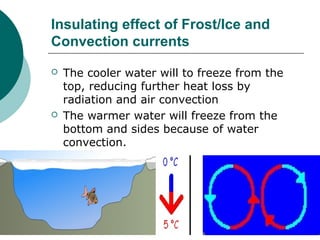
 The cooler water will to freeze from the
top, reducing further heat loss by
radiation and air convection
 The warmer water will freeze from the
bottom and sides because of water
convection.
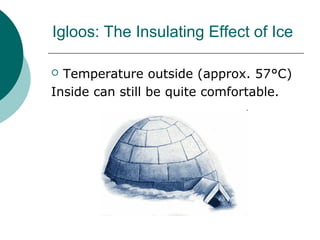
Igloos: The Insulating Effect of Ice
 Temperature outside (approx. 57°C)
Inside can still be quite comfortable.
Hotter liquids Molecules
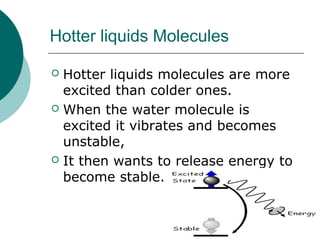
 Hotter liquids molecules are more
excited than colder ones.
 When the water molecule is
excited it vibrates and becomes
unstable,
 It then wants to release energy to
become stable.
Evaporation of the warmer liquid:
-Loss of mass
 As the warmer liquid evaporates its
mass decreases. -This may have
been the case for Erasto Mpemba.-
 But there has been several further
experiments using a coating of oil or
a lid on the container to prevent
loss of mass by evaporation.
Evaporation of the warmer liquid:
-Change in pressure
“Liquid freezes at higher
temperatures with higher pressure.”
 Covering the container will mean
there will be different pressure
levels in each container.
 Container with the hotter liquid may
have a greater pressure.
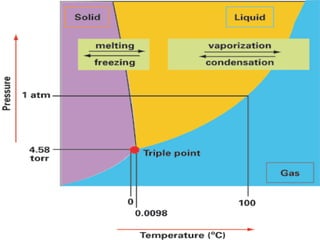
Triple point of water
 The combination of pressure and
temperature at which liquid water,
solid ice, and water vapour can coexist
in a stable equilibrium occurs at
exactly 273.16 K (0.0098 °C) at
atmospheric pressure.
 The change in pressure can change
this point.
Quality of water (Solutes)- impurities
“Increasing the number of dissolved
particles lowers freezing point.”
 Boiling the water may remove
impurities such as bacteria and
other objects that may be
suspended or dissolved in the liquid.
Supercooling
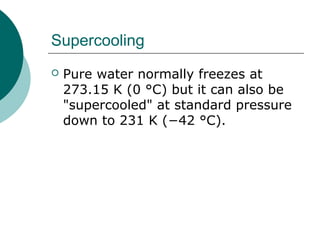
 Pure water normally freezes at
273.15 K (0 °C) but it can also be
"supercooled" at standard pressure
down to 231 K (−42 °C).
Our Experiment:
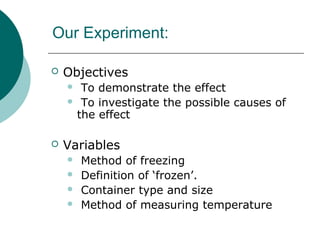
 Objectives
 To demonstrate the effect
 To investigate the possible causes of
the effect
 Variables
 Method of freezing
 Definition of ‘frozen’.
 Container type and size
 Method of measuring temperature
Method:
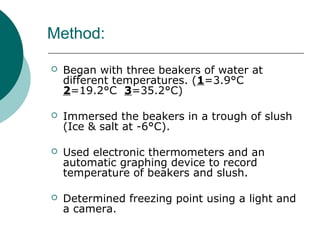
 Began with three beakers of water at
different temperatures. (1=3.9°C
2=19.2°C 3=35.2°C)
 Immersed the beakers in a trough of slush
(Ice & salt at -6°C).
 Used electronic thermometers and an
automatic graphing device to record
temperature of beakers and slush.
 Determined freezing point using a light and
a camera.
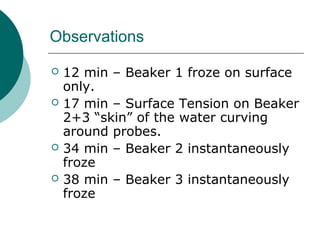
Observations
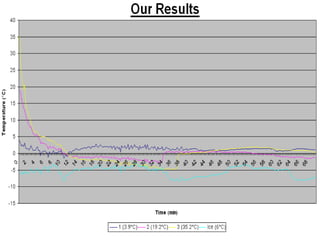
 12 min – Beaker 1 froze on surface
only.
 17 min – Surface Tension on Beaker
2+3 “skin” of the water curving
around probes.
 34 min – Beaker 2 instantaneously
froze
 38 min – Beaker 3 instantaneously
froze
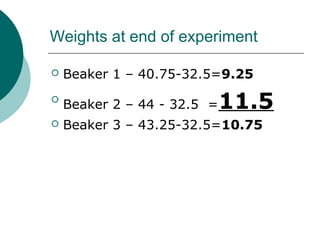
Weights at end of experiment
 Beaker 1 – 40.75-32.5=9.25

Beaker 2 – 44 - 32.5 =11.5
 Beaker 3 – 43.25-32.5=10.75
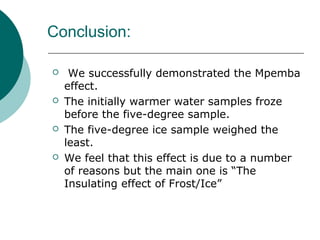
Conclusion:
 We successfully demonstrated the Mpemba
effect.
 The initially warmer water samples froze
before the five-degree sample.
 The five-degree ice sample weighed the
least.
 We feel that this effect is due to a number
of reasons but the main one is “The
Insulating effect of Frost/Ice”
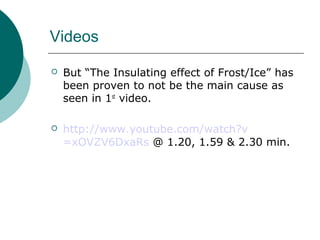
Videos
 But “The Insulating effect of Frost/Ice” has
been proven to not be the main cause as
seen in 1st
video.
 http://www.youtube.com/watch?v
=xOVZV6DxaRs @ 1.20, 1.59 & 2.30 min.
Mpemba Effect

Mpemba Effect

  • 1.
    The Mpemba Effect:An Overview Cian McElhinney Émer Jones Jonathan McKeon Cian Tuohy
  • 2.
    What is theMpemba Effect?  The Mpemba effect is the observation that, in certain specific circumstances, warmer water freezes faster than colder water.  Has never been conclusively explained and baffles scientists.  Several physical conditions have been associated with the effect.
  • 3.
    History and Origin: Phenomenon observed by Aristotle, Francis Bacon and René Descartes.  Aristotle observed ‘antiperistasis’; ‘the supposed increase in the intensity of a quality as a result of being surrounded by its contrary quality’.  Term ‘Mpemba effect’ originated in the 1960’s.
  • 4.
    Erasto B. Mpemba: Tanzanian high-school student.  Noticed effect while doing a school cookery assignment in 1963.  Enquired about the effect during a seminar given by Dr. Denis G. Osborne.  Osborne was sceptical at first but researched and confirmed Erasto’s findings.  The duo published the combined results of their research in 1969.
  • 5.
    Definition Of “MpembaEffect” “Hot water freezes quicker than cold”  As “Mpemba Effect” isn't very well defined or limited to a specific definition, there are many variables which we fell is one of the main reasons it hasn’t been scientifically proven to date.
  • 6.
    Variables  Method OfFreezing  Definition of Freezing  Container Type & Size  Method of taking temperature
  • 7.
    Method Of Freezing Slow freezing  Non-frost-free refrigerator (-14°C)  Frost-free refrigerator (-14°C)  Ice container with salt (-6°C)  Fast freezing  Cold liquid (e.g. Liquid Nitrogen -196°C)  Cold outside temperature (North/South, Pole −70°C)
  • 8.
    Definition of ‘Frozen’: Point at which water forms a visible surface layer of ice.  Point at which the entire volume of water becomes a solid  Point at which the temperature ,at any point, reaches 0°C  Point at which the temperature of entire volume is 0°C or lower.
  • 9.
    Container Type &Size  Type  Use of plastic/glass/Pyrex or metal.  As all these materials have different thermometric properties and physicals (conductivity and type of surface)  Size  Changes surface area in contact with air/container
  • 10.
    Method of takingtemperature  Digital  IR, Thermocouple probe -accurate-  Non-Digital  Mercury, Alcohol thermometer -not as accurate-  Thermometer/probe may influence freezing as they may move or have ice form around them.
  • 11.
    What causes theeffect?  There is no generally accepted cause.  Causes we proposed:  Insulating effect of frost/ice & Convection currents.  Hotter liquids Molecules.  Evaporation of the warmer liquid. -Loss of mass -Change in pressure  Quality of water (Solutes)- impurities  Supercooling observed more in cold water
  • 12.
    Insulating effect ofFrost/Ice and Convection currents  The cooler water will to freeze from the top, reducing further heat loss by radiation and air convection  The warmer water will freeze from the bottom and sides because of water convection.
  • 13.
    Igloos: The InsulatingEffect of Ice  Temperature outside (approx. 57°C) Inside can still be quite comfortable.
  • 14.
    Hotter liquids Molecules Hotter liquids molecules are more excited than colder ones.  When the water molecule is excited it vibrates and becomes unstable,  It then wants to release energy to become stable.
  • 15.
    Evaporation of thewarmer liquid: -Loss of mass  As the warmer liquid evaporates its mass decreases. -This may have been the case for Erasto Mpemba.-  But there has been several further experiments using a coating of oil or a lid on the container to prevent loss of mass by evaporation.
  • 16.
    Evaporation of thewarmer liquid: -Change in pressure “Liquid freezes at higher temperatures with higher pressure.”  Covering the container will mean there will be different pressure levels in each container.  Container with the hotter liquid may have a greater pressure.
  • 17.
    Triple point ofwater  The combination of pressure and temperature at which liquid water, solid ice, and water vapour can coexist in a stable equilibrium occurs at exactly 273.16 K (0.0098 °C) at atmospheric pressure.  The change in pressure can change this point.
  • 19.
    Quality of water(Solutes)- impurities “Increasing the number of dissolved particles lowers freezing point.”  Boiling the water may remove impurities such as bacteria and other objects that may be suspended or dissolved in the liquid.
  • 20.
    Supercooling  Pure waternormally freezes at 273.15 K (0 °C) but it can also be "supercooled" at standard pressure down to 231 K (−42 °C).
  • 21.
    Our Experiment:  Objectives To demonstrate the effect  To investigate the possible causes of the effect  Variables  Method of freezing  Definition of ‘frozen’.  Container type and size  Method of measuring temperature
  • 22.
    Method:  Began withthree beakers of water at different temperatures. (1=3.9°C 2=19.2°C 3=35.2°C)  Immersed the beakers in a trough of slush (Ice & salt at -6°C).  Used electronic thermometers and an automatic graphing device to record temperature of beakers and slush.  Determined freezing point using a light and a camera.
  • 24.
    Observations  12 min– Beaker 1 froze on surface only.  17 min – Surface Tension on Beaker 2+3 “skin” of the water curving around probes.  34 min – Beaker 2 instantaneously froze  38 min – Beaker 3 instantaneously froze
  • 25.
    Weights at endof experiment  Beaker 1 – 40.75-32.5=9.25  Beaker 2 – 44 - 32.5 =11.5  Beaker 3 – 43.25-32.5=10.75
  • 26.
    Conclusion:  We successfullydemonstrated the Mpemba effect.  The initially warmer water samples froze before the five-degree sample.  The five-degree ice sample weighed the least.  We feel that this effect is due to a number of reasons but the main one is “The Insulating effect of Frost/Ice”
  • 27.
    Videos  But “TheInsulating effect of Frost/Ice” has been proven to not be the main cause as seen in 1st video.  http://www.youtube.com/watch?v =xOVZV6DxaRs @ 1.20, 1.59 & 2.30 min.