Moving Viadeo to AWS
Julien Simon, Chief Technology Officer
jsimon@viadeoteam.com
@julsimon
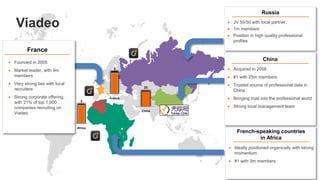
25
China
9
France
Russia
 JV 50/50 with local partner,
 1m members
 Position in high quality professional
profiles
French-speaking countries
in Africa
 Ideally positioned organically with strong
momentum
 #1 with 3m members
France
 Founded in 2005
 Market leader, with 9m
members
 Very strong ties with local
recruiters
 Strong corporate offering,
with 21% of top 1,000
companies recruiting on
Viadeo
 Acquired in 2008
 #1 with 25m members
 Trusted source of professional data in
China
 Bringing trust into the professional world
 Strong local management team
China
3
Africa
Viadeo
Viadeo in 2015 ?
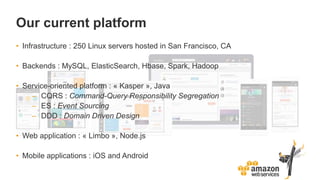
Our current platform
• Infrastructure : 250 Linux servers hosted in San Francisco, CA
• Backends : MySQL, ElasticSearch, Hbase, Spark, Hadoop
• Service-oriented platform : « Kasper », Java
– CQRS : Command-Query Responsibility Segregation
– ES : Event Sourcing
– DDD : Domain Driven Design
• Web application : « Limbo », Node.js
• Mobile applications : iOS and Android
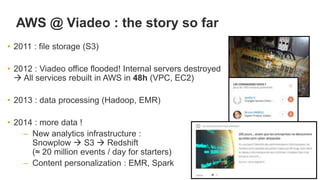
AWS @ Viadeo : the story so far
• 2011 : file storage (S3)
• 2012 : Viadeo office flooded! Internal servers destroyed
 All services rebuilt in AWS in 48h (VPC, EC2)
• 2013 : data processing (Hadoop, EMR)
• 2014 : more data !
– New analytics infrastructure :
Snowplow  S3  Redshift
(≈ 20 million events / day for starters)
– Content personalization : EMR, Spark
AWS @ Viadeo : the story so far
• Infrastructure live in 3 regions (us-east-1, us-west-2, eu-west-1)
• 4 VPC
• ≈ 100 EC2 instances (half production, half development)
• ≈ 15 TB in S3
• 2 Redshift clusters (5 instances each)
• AWS services currently in production at Viadeo :
– Core infra : VPC, Route 53, IAM, S3, CloudFront,
– Instances : Elastic Load Balancing, Elastic Beanstalk,
CloudFormation, EC2
– Data storage & processing : RDS, EMR, Redshift
Enter physical infrastructure challenges…
• Improving our agility
– How can we deploy infrastructure as often as we deploy code (i.e. every day)?
– How can we experiment quickly and at (almost) zero cost?
• Optimizing our spend
– How can we avoid CAPEX peaks caused by hardware refresh?
– How do we best adapt spend to traffic and business conditions?
• Implementing a stronger Disaster Recovery plan
– …without building a 2nd DC which we don’t need anyway
• Scaling storage & CPU for data processing
– Do we really need big servers, lots of rack space and lots of power?
– How do we efficiently handle unpredictable workloads?
Why we decided to move everything to AWS
• We want to focus on our real job : building a great service
– No more issues with hardware vendors, no more licensing hell. Ever!
– Experimenting, (re)deploying & scaling are just a few clicks away
– Great ecosystem of SaaS partners running in AWS
• We’ve been using it for a while now and it just works
– AWS CloudFormation is infrastructure as code
– « Time to server » is in minutes, not days
• We’re ready and eager for it : Agile and DevOps are strong Viadeo values
• We want to measure ROI and optimize cost
Our AWS manifesto
• Key objectives : automation, scalability, safety
• Continuous integration & delivery on all layers
(infrastructure, instances, applications)
• Infrastructure : deep integration with AWS services for maximum leverage
• Applications : use our current stack for now, unless the benefit/cost ratio of
adopting an equivalent AWS service is too good to pass (Redshift)
• Move everything, but no big bang : the move will be gradual
 plan & build with parallel run in mind (DC + AWS)
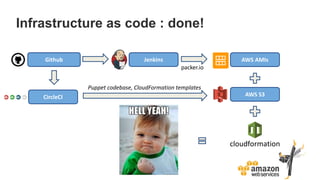
Infrastructure as code : done!
Github
CircleCI
Jenkins
AWS S3
AWS AMIs
packer.io
cloudformation
Puppet codebase, CloudFormation templates
New challenges ;)
• Some performance & cost trade-off in the short term
• Technical debt (aka « guess what’s under the rug? »)
– Layer 7 load balancing rules (*evil*), legacy filers, etc.
– Servers running really old versions of whatever: keep or reinstall?
– Any cruft ignored over the years. Time to clean up!
• Parallel run requires good connectivity AWS DirectConnect
• CloudFront performance not great across regions  need a 2nd CDN
• Negotiating early termination of the legacy hosting contract !
Conclusion
• 5 years ago : «Cloud computing? Why?»
• Now : «NO cloud computing? Why?»
• Some good reasons, but mostly really bad
ones
• Cloud computing a fashion? I don’t think so.
• Cloud = infrastructure in digital form
(like photos, music, movies, money, etc.)
• Using AWS helps Viadeo change every day,
by speeding up innovation and delivery
• See you there!

Moving Viadeo to AWS (2015)

  • 1.
    Moving Viadeo toAWS Julien Simon, Chief Technology Officer jsimon@viadeoteam.com @julsimon
  • 2.
    25 China 9 France Russia  JV 50/50with local partner,  1m members  Position in high quality professional profiles French-speaking countries in Africa  Ideally positioned organically with strong momentum  #1 with 3m members France  Founded in 2005  Market leader, with 9m members  Very strong ties with local recruiters  Strong corporate offering, with 21% of top 1,000 companies recruiting on Viadeo  Acquired in 2008  #1 with 25m members  Trusted source of professional data in China  Bringing trust into the professional world  Strong local management team China 3 Africa Viadeo
  • 3.
  • 4.
    Our current platform •Infrastructure : 250 Linux servers hosted in San Francisco, CA • Backends : MySQL, ElasticSearch, Hbase, Spark, Hadoop • Service-oriented platform : « Kasper », Java – CQRS : Command-Query Responsibility Segregation – ES : Event Sourcing – DDD : Domain Driven Design • Web application : « Limbo », Node.js • Mobile applications : iOS and Android
  • 5.
    AWS @ Viadeo: the story so far • 2011 : file storage (S3) • 2012 : Viadeo office flooded! Internal servers destroyed  All services rebuilt in AWS in 48h (VPC, EC2) • 2013 : data processing (Hadoop, EMR) • 2014 : more data ! – New analytics infrastructure : Snowplow  S3  Redshift (≈ 20 million events / day for starters) – Content personalization : EMR, Spark
  • 6.
    AWS @ Viadeo: the story so far • Infrastructure live in 3 regions (us-east-1, us-west-2, eu-west-1) • 4 VPC • ≈ 100 EC2 instances (half production, half development) • ≈ 15 TB in S3 • 2 Redshift clusters (5 instances each) • AWS services currently in production at Viadeo : – Core infra : VPC, Route 53, IAM, S3, CloudFront, – Instances : Elastic Load Balancing, Elastic Beanstalk, CloudFormation, EC2 – Data storage & processing : RDS, EMR, Redshift
  • 7.
    Enter physical infrastructurechallenges… • Improving our agility – How can we deploy infrastructure as often as we deploy code (i.e. every day)? – How can we experiment quickly and at (almost) zero cost? • Optimizing our spend – How can we avoid CAPEX peaks caused by hardware refresh? – How do we best adapt spend to traffic and business conditions? • Implementing a stronger Disaster Recovery plan – …without building a 2nd DC which we don’t need anyway • Scaling storage & CPU for data processing – Do we really need big servers, lots of rack space and lots of power? – How do we efficiently handle unpredictable workloads?
  • 8.
    Why we decidedto move everything to AWS • We want to focus on our real job : building a great service – No more issues with hardware vendors, no more licensing hell. Ever! – Experimenting, (re)deploying & scaling are just a few clicks away – Great ecosystem of SaaS partners running in AWS • We’ve been using it for a while now and it just works – AWS CloudFormation is infrastructure as code – « Time to server » is in minutes, not days • We’re ready and eager for it : Agile and DevOps are strong Viadeo values • We want to measure ROI and optimize cost
  • 9.
    Our AWS manifesto •Key objectives : automation, scalability, safety • Continuous integration & delivery on all layers (infrastructure, instances, applications) • Infrastructure : deep integration with AWS services for maximum leverage • Applications : use our current stack for now, unless the benefit/cost ratio of adopting an equivalent AWS service is too good to pass (Redshift) • Move everything, but no big bang : the move will be gradual  plan & build with parallel run in mind (DC + AWS)
  • 10.
    Infrastructure as code: done! Github CircleCI Jenkins AWS S3 AWS AMIs packer.io cloudformation Puppet codebase, CloudFormation templates
  • 11.
    New challenges ;) •Some performance & cost trade-off in the short term • Technical debt (aka « guess what’s under the rug? ») – Layer 7 load balancing rules (*evil*), legacy filers, etc. – Servers running really old versions of whatever: keep or reinstall? – Any cruft ignored over the years. Time to clean up! • Parallel run requires good connectivity AWS DirectConnect • CloudFront performance not great across regions  need a 2nd CDN • Negotiating early termination of the legacy hosting contract !
  • 12.
    Conclusion • 5 yearsago : «Cloud computing? Why?» • Now : «NO cloud computing? Why?» • Some good reasons, but mostly really bad ones • Cloud computing a fashion? I don’t think so. • Cloud = infrastructure in digital form (like photos, music, movies, money, etc.) • Using AWS helps Viadeo change every day, by speeding up innovation and delivery • See you there!