Module 1: Cloud Concepts Overview
AWS A ca d e my Cl ou d Fou n d at i on s
© 2019 Amazon Web Services, Inc. or its Affiliates. All rights reserved.
Module overview
Topics
• Introduction to cloud computing
• Advantages of cloud computing
• Introduction to Amazon Web Services (AWS)
• AWS Cloud Adoption Framework (AWS CAF)
Knowledge check
© 2019 Amazon Web Services, Inc. or its Affiliates. All rights reserved. 2
Module objectives
After completing this module, you should be able to:
• Define different types of cloud computing models
• Describe six advantages of cloud computing
• Recognize the main AWS service categories and core services
• Review the AWS Cloud Adoption Framework (AWS CAF)
© 2019 Amazon Web Services, Inc. or its Affiliates. All rights reserved. 3
M od u l e 1: Cl ou d Con c e pt s O ve r vi ew
Section 1: Introduction to cloud computing
© 2019 Amazon Web Services, Inc. or its Affiliates. All rights reserved.
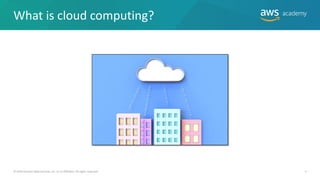
What is cloud computing?
© 2019 Amazon Web Services, Inc. or its Affiliates. All rights reserved. 5
Cloud computing defined
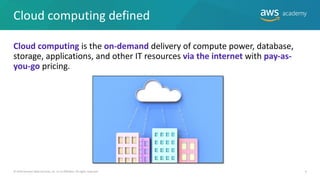
Cloud computing is the on-demand delivery of compute power, database,
storage, applications, and other IT resources via the internet with pay-as-
you-go pricing.
© 2019 Amazon Web Services, Inc. or its Affiliates. All rights reserved. 6
Infrastructure as software
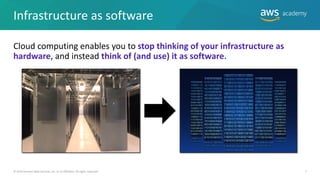
Cloud computing enables you to stop thinking of your infrastructure as
hardware, and instead think of (and use) it as software.
© 2019 Amazon Web Services, Inc. or its Affiliates. All rights reserved. 7
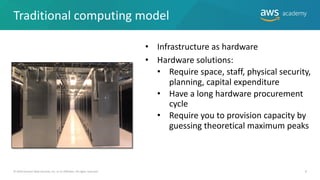
Traditional computing model
• Infrastructure as hardware
• Hardware solutions:
• Require space, staff, physical security,
planning, capital expenditure
• Have a long hardware procurement
cycle
• Require you to provision capacity by
guessing theoretical maximum peaks
© 2019 Amazon Web Services, Inc. or its Affiliates. All rights reserved. 8
Cloud computing model
• Infrastructure as software
• Software solutions:
• Are flexible
• Can change more quickly, easily, and
cost-effectively than hardware
solutions
• Eliminate the undifferentiated heavy-
lifting tasks
© 2019 Amazon Web Services, Inc. or its Affiliates. All rights reserved. 9
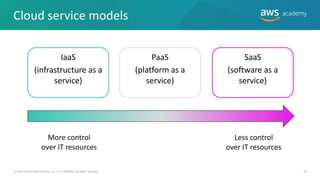
Cloud service models
IaaS
(infrastructure as a
service)
More control
over IT resources
PaaS
(platform as a
service)
SaaS
(software as a
service)
Less control
over IT resources
© 2019 Amazon Web Services, Inc. or its Affiliates. All rights reserved. 10
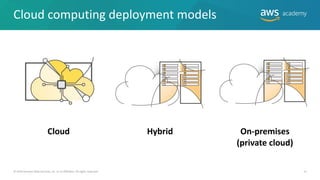
Cloud computing deployment models
Cloud Hybrid On-premises
(private cloud)
© 2019 Amazon Web Services, Inc. or its Affiliates. All rights reserved. 11
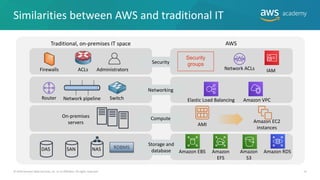
Similarities between AWS and traditional IT
Traditional, on-premises IT space AWS
Firewalls ACLs Administrators Network ACLs IAM
Router Network pipeline Switch Elastic Load Balancing Amazon VPC
On-premises
servers AMI
Amazon EC2
instances
RDBMS
Security
Networking
Compute
Storage and
database Amazon EBS Amazon
EFS
Amazon
S3
Amazon RDS
Security
groups
DAS SAN NAS
© 2019 Amazon Web Services, Inc. or its Affiliates. All rights reserved. 12
Section 1 key
takeaways
• Cloud computing is the on-demand
delivery of IT resources via the internet
with pay-as-you-go pricing.
• Cloud computing enables you to think of
(and use) your infrastructure as software.
• There are three cloud service models: IaaS,
PaaS, and SaaS.
• There are three cloud deployment models:
cloud, hybrid, and on-premises or private
cloud.
• Almost anything you can implement with
traditional IT can also be implemented as
an AWS cloud computing service.
13 © 2019 Amazon Web Services, Inc. or its Affiliates. All rights reserved.
M od u l e 1: Cl ou d Con c e pt s O ve r vi ew
Section 2: Advantages of cloud computing
© 2019 Amazon Web Services, Inc. or its Affiliates. All rights reserved.
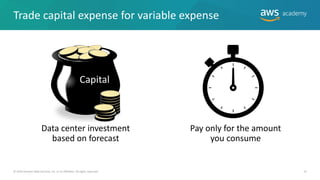
Trade capital expense for variable expense
Capital
Data center investment
based on forecast
Pay only for the amount
you consume
© 2019 Amazon Web Services, Inc. or its Affiliates. All rights reserved. 15
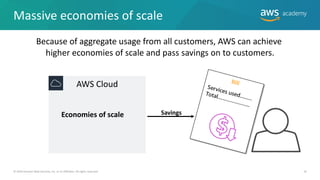
Massive economies of scale
Because of aggregate usage from all customers, AWS can achieve
higher economies of scale and pass savings on to customers.
AWS Cloud
Economies of scale Savings
© 2019 Amazon Web Services, Inc. or its Affiliates. All rights reserved. 16
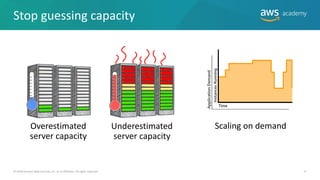
Stop guessing capacity
Overestimated
server capacity
Underestimated
server capacity
Scaling on demand
© 2019 Amazon Web Services, Inc. or its Affiliates. All rights reserved. 17
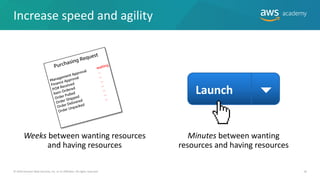
Increase speed and agility
Weeks between wanting resources
and having resources
Launch
Minutes between wanting
resources and having resources
© 2019 Amazon Web Services, Inc. or its Affiliates. All rights reserved. 18
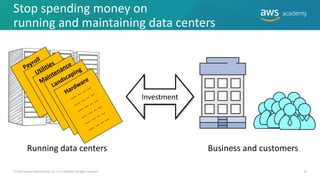
Stop spending money on
running and maintaining data centers
Running data centers
Investment
Business and customers
© 2019 Amazon Web Services, Inc. or its Affiliates. All rights reserved. 19
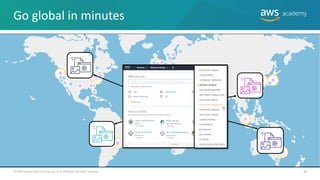
Go global in minutes
© 2019 Amazon Web Services, Inc. or its Affiliates. All rights reserved. 20
Section 2 key
takeaways
• Trade capital expense for variable
expense
• Benefit from massive economies of
scale
• Stop guessing capacity
• Increase speed and agility
• Stop spending money on running
and maintaining data centers
• Go global in minutes
21 © 2019 Amazon Web Services, Inc. or its Affiliates. All rights reserved.
M od u l e 1: Cl ou d Con c e pt s O ve r vi ew
Section 3: Introduction to Amazon Web Services
(AWS)
© 2019 Amazon Web Services, Inc. or its Affiliates. All rights reserved.
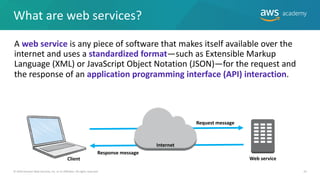
What are web services?
A web service is any piece of software that makes itself available over the
internet and uses a standardized format—such as Extensible Markup
Language (XML) or JavaScript Object Notation (JSON)—for the request and
the response of an application programming interface (API) interaction.
Web service
Client
Response message
Request message
Internet
© 2019 Amazon Web Services, Inc. or its Affiliates. All rights reserved. 23
What is AWS?
• AWS is a secure cloud platform that offers a broad set of global cloud-
based products.
• AWS provides you with on-demand access to compute, storage, network,
database, and other IT resources and management tools.
• AWS offers flexibility.
• You pay only for the individual services you need, for as long as you use
them.
• AWS services work together like building blocks.
© 2019 Amazon Web Services, Inc. or its Affiliates. All rights reserved. 24
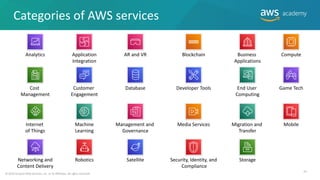
Categories of AWS services
Developer Tools
Security, Identity, and
Compliance
Blockchain
Media Services
Storage
Business
Applications
End User
Computing
Migration and
Transfer
Mobile
Compute
Game Tech
Management and
Governance
Database
AR and VR
Satellite
Networking and
Content Delivery
Internet
of Things
Analytics
Cost
Management
Machine
Learning
Application
Integration
Customer
Engagement
Robotics
© 2019 Amazon Web Services, Inc. or its Affiliates. All rights reserved.
25
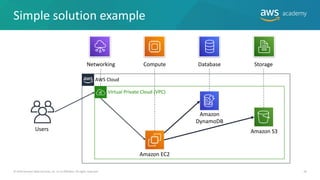
Simple solution example
Networking Compute Storage
Database
AWS Cloud
Virtual Private Cloud (VPC)
Amazon EC2
Amazon S3
Amazon
DynamoDB
Users
© 2019 Amazon Web Services, Inc. or its Affiliates. All rights reserved. 26
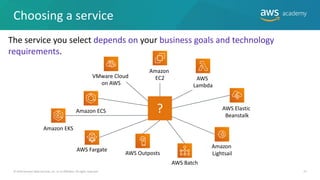
Choosing a service
The service you select depends on your business goals and technology
requirements.
Amazon
Lightsail
AWS Batch
AWS Outposts
VMware Cloud
on AWS
Amazon ECS
Amazon EKS
AWS Fargate
Amazon
EC2 AWS
Lambda
AWS Elastic
Beanstalk
?
© 2019 Amazon Web Services, Inc. or its Affiliates. All rights reserved. 27
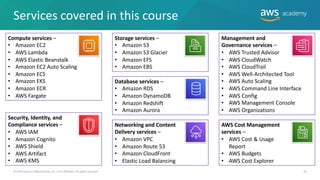
Services covered in this course
AWS Cost Management
services –
• AWS Cost & Usage
Report
• AWS Budgets
• AWS Cost Explorer
Management and
Governance services –
• AWS Trusted Advisor
• AWS CloudWatch
• AWS CloudTrail
• AWS Well-Architected Tool
• AWS Auto Scaling
• AWS Command Line Interface
• AWS Config
• AWS Management Console
• AWS Organizations
Compute services –
• Amazon EC2
• AWS Lambda
• AWS Elastic Beanstalk
• Amazon EC2 Auto Scaling
• Amazon ECS
• Amazon EKS
• Amazon ECR
• AWS Fargate
Networking and Content
Delivery services –
• Amazon VPC
• Amazon Route 53
• Amazon CloudFront
• Elastic Load Balancing
Storage services –
• Amazon S3
• Amazon S3 Glacier
• Amazon EFS
• Amazon EBS
Database services –
• Amazon RDS
• Amazon DynamoDB
• Amazon Redshift
• Amazon Aurora
Security, Identity, and
Compliance services –
• AWS IAM
• Amazon Cognito
• AWS Shield
• AWS Artifact
• AWS KMS
© 2019 Amazon Web Services, Inc. or its Affiliates. All rights reserved. 28
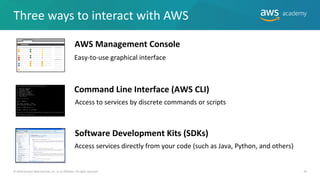
Three ways to interact with AWS
AWS Management Console
Easy-to-use graphical interface
Command Line Interface (AWS CLI)
Access to services by discrete commands or scripts
Software Development Kits (SDKs)
Access services directly from your code (such as Java, Python, and others)
© 2019 Amazon Web Services, Inc. or its Affiliates. All rights reserved. 29
Section 3 key
takeaways
• AWS is a secure cloud platform that offers
a broad set of global cloud-based products
called services that are designed to work
together.
• There are many categories of AWS
services, and each category has many
services to choose from.
• Choose a service based on your business
goals and technology requirements.
• There are three ways to interact with AWS
services.
30 © 2019 Amazon Web Services, Inc. or its Affiliates. All rights reserved.
M od u l e 1: Cl ou d Con c e pt s O ve r vi ew
Section 4: Moving to the AWS Cloud – The AWS Cloud
Adoption Framework (AWS CAF)
© 2019 Amazon Web Services, Inc. or its Affiliates. All rights reserved.
AWS Cloud Adoption Framework (AWS CAF)
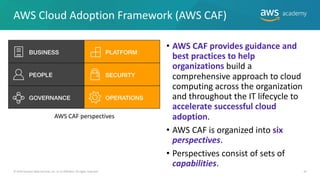
AWS CAF perspectives
• AWS CAF provides guidance and
best practices to help
organizations build a
comprehensive approach to cloud
computing across the organization
and throughout the IT lifecycle to
accelerate successful cloud
adoption.
• AWS CAF is organized into six
perspectives.
• Perspectives consist of sets of
capabilities.
© 2019 Amazon Web Services, Inc. or its Affiliates. All rights reserved. 32
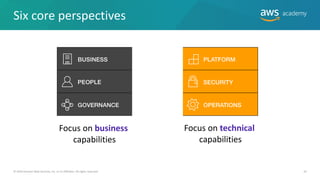
Six core perspectives
Focus on business
capabilities
Focus on technical
capabilities
© 2019 Amazon Web Services, Inc. or its Affiliates. All rights reserved. 33
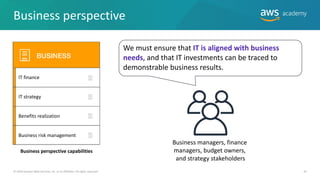
Business perspective
IT finance
IT strategy
Benefits realization
Business risk management
Business perspective capabilities
We must ensure that IT is aligned with business
needs, and that IT investments can be traced to
demonstrable business results.
Business managers, finance
managers, budget owners,
and strategy stakeholders
© 2019 Amazon Web Services, Inc. or its Affiliates. All rights reserved. 34
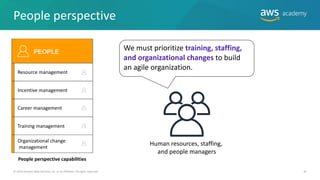
People perspective
Resource management
Incentive management
Career management
Training management
Organizational change
management
People perspective capabilities
We must prioritize training, staffing,
and organizational changes to build
an agile organization.
Human resources, staffing,
and people managers
© 2019 Amazon Web Services, Inc. or its Affiliates. All rights reserved. 35
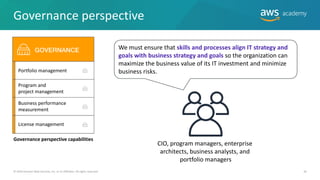
Governance perspective
Portfolio management
Program and
project management
Business performance
measurement
License management
Governance perspective capabilities
We must ensure that skills and processes align IT strategy and
goals with business strategy and goals so the organization can
maximize the business value of its IT investment and minimize
business risks.
CIO, program managers, enterprise
architects, business analysts, and
portfolio managers
© 2019 Amazon Web Services, Inc. or its Affiliates. All rights reserved. 36
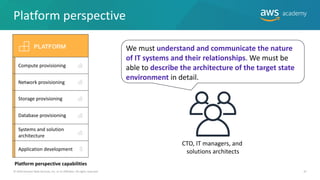
Platform perspective
Compute provisioning
Network provisioning
Storage provisioning
Database provisioning
Systems and solution
architecture
Application development
Platform perspective capabilities
We must understand and communicate the nature
of IT systems and their relationships. We must be
able to describe the architecture of the target state
environment in detail.
CTO, IT managers, and
solutions architects
© 2019 Amazon Web Services, Inc. or its Affiliates. All rights reserved. 37
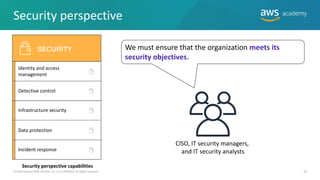
Security perspective
Identity and access
management
Detective control
Infrastructure security
Data protection
Incident response
Security perspective capabilities
We must ensure that the organization meets its
security objectives.
CISO, IT security managers,
and IT security analysts
© 2019 Amazon Web Services, Inc. or its Affiliates. All rights reserved. 38
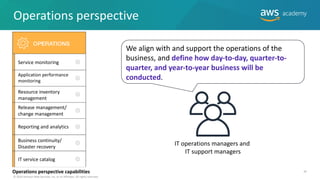
Operations perspective
Service monitoring
Application performance
monitoring
Resource inventory
management
Release management/
change management
Reporting and analytics
Business continuity/
Disaster recovery
IT service catalog
Operations perspective capabilities
We align with and support the operations of the
business, and define how day-to-day, quarter-to-
quarter, and year-to-year business will be
conducted.
IT operations managers and
IT support managers
© 2019 Amazon Web Services, Inc. or its Affiliates. All rights reserved.
39
Section 4 key
takeaways
• Cloud adoption is not instantaneous for
most organizations and requires a
thoughtful, deliberate strategy and
alignment across the whole organization.
• The AWS CAF was created to help
organizations develop efficient and
effective plans for their cloud adoption
journey.
• The AWS CAF organizes guidance into six
areas of focus, called perspectives.
• Perspectives consist of sets of business or
technology capabilities that are the
responsibility of key stakeholders.
40 © 2019 Amazon Web Services, Inc. or its Affiliates. All rights reserved.
M od u l e 1: Cl ou d Con c e pt s O ve r vi ew
Module wrap-up
© 2019 Amazon Web Services, Inc. or its Affiliates. All rights reserved.
Module summary
In summary, in this module you learned how to:
• Define different types of cloud computing models
• Describe six advantages of cloud computing
• Recognize the main AWS service categories and core services
• Review the AWS Cloud Adoption Framework
© 2019 Amazon Web Services, Inc. or its Affiliates. All rights reserved. 42
Complete the knowledge check
© 2019 Amazon Web Services, Inc. or its Affiliates. All rights reserved. 43
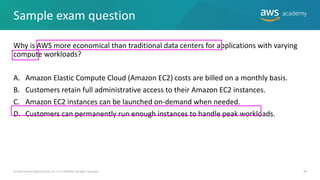
Sample exam question
Why is AWS more economical than traditional data centers for applications with varying
compute workloads?
A. Amazon Elastic Compute Cloud (Amazon EC2) costs are billed on a monthly basis.
B. Customers retain full administrative access to their Amazon EC2 instances.
C. Amazon EC2 instances can be launched on-demand when needed.
D. Customers can permanently run enough instances to handle peak workloads.
© 2019 Amazon Web Services, Inc. or its Affiliates. All rights reserved. 44
Additional resources
• What is AWS? YouTube video
• Cloud computing with AWS website
• Overview of Amazon Web Services whitepaper
• An Overview of the AWS Cloud Adoption Framework whitepaper
• 6 Strategies for Migrating Applications to the Cloud AWS Cloud Enterprise
Strategy blog post
© 2019 Amazon Web Services, Inc. or its Affiliates. All rights reserved. 45
© 2019 Amazon Web Services, Inc. or its affiliates. All rights reserved. This work may not be reproduced or redistributed, in whole or in part, without prior written permission from Amazon
Web Services, Inc. Commercial copying, lending, or selling is prohibited. Corrections or feedback on the course, please email us at: aws-course-feedback@amazon.com. For all other
questions, contact us at: https://aws.amazon.com/contact-us/aws-training/. All trademarks are the property of their owners.
Thank You

AcademyCloudFoundations_Module_01__Cloud

  • 1.
    Module 1: CloudConcepts Overview AWS A ca d e my Cl ou d Fou n d at i on s © 2019 Amazon Web Services, Inc. or its Affiliates. All rights reserved.
  • 2.
    Module overview Topics • Introductionto cloud computing • Advantages of cloud computing • Introduction to Amazon Web Services (AWS) • AWS Cloud Adoption Framework (AWS CAF) Knowledge check © 2019 Amazon Web Services, Inc. or its Affiliates. All rights reserved. 2
  • 3.
    Module objectives After completingthis module, you should be able to: • Define different types of cloud computing models • Describe six advantages of cloud computing • Recognize the main AWS service categories and core services • Review the AWS Cloud Adoption Framework (AWS CAF) © 2019 Amazon Web Services, Inc. or its Affiliates. All rights reserved. 3
  • 4.
    M od ul e 1: Cl ou d Con c e pt s O ve r vi ew Section 1: Introduction to cloud computing © 2019 Amazon Web Services, Inc. or its Affiliates. All rights reserved.
  • 5.
    What is cloudcomputing? © 2019 Amazon Web Services, Inc. or its Affiliates. All rights reserved. 5
  • 6.
    Cloud computing defined Cloudcomputing is the on-demand delivery of compute power, database, storage, applications, and other IT resources via the internet with pay-as- you-go pricing. © 2019 Amazon Web Services, Inc. or its Affiliates. All rights reserved. 6
  • 7.
    Infrastructure as software Cloudcomputing enables you to stop thinking of your infrastructure as hardware, and instead think of (and use) it as software. © 2019 Amazon Web Services, Inc. or its Affiliates. All rights reserved. 7
  • 8.
    Traditional computing model •Infrastructure as hardware • Hardware solutions: • Require space, staff, physical security, planning, capital expenditure • Have a long hardware procurement cycle • Require you to provision capacity by guessing theoretical maximum peaks © 2019 Amazon Web Services, Inc. or its Affiliates. All rights reserved. 8
  • 9.
    Cloud computing model •Infrastructure as software • Software solutions: • Are flexible • Can change more quickly, easily, and cost-effectively than hardware solutions • Eliminate the undifferentiated heavy- lifting tasks © 2019 Amazon Web Services, Inc. or its Affiliates. All rights reserved. 9
  • 10.
    Cloud service models IaaS (infrastructureas a service) More control over IT resources PaaS (platform as a service) SaaS (software as a service) Less control over IT resources © 2019 Amazon Web Services, Inc. or its Affiliates. All rights reserved. 10
  • 11.
    Cloud computing deploymentmodels Cloud Hybrid On-premises (private cloud) © 2019 Amazon Web Services, Inc. or its Affiliates. All rights reserved. 11
  • 12.
    Similarities between AWSand traditional IT Traditional, on-premises IT space AWS Firewalls ACLs Administrators Network ACLs IAM Router Network pipeline Switch Elastic Load Balancing Amazon VPC On-premises servers AMI Amazon EC2 instances RDBMS Security Networking Compute Storage and database Amazon EBS Amazon EFS Amazon S3 Amazon RDS Security groups DAS SAN NAS © 2019 Amazon Web Services, Inc. or its Affiliates. All rights reserved. 12
  • 13.
    Section 1 key takeaways •Cloud computing is the on-demand delivery of IT resources via the internet with pay-as-you-go pricing. • Cloud computing enables you to think of (and use) your infrastructure as software. • There are three cloud service models: IaaS, PaaS, and SaaS. • There are three cloud deployment models: cloud, hybrid, and on-premises or private cloud. • Almost anything you can implement with traditional IT can also be implemented as an AWS cloud computing service. 13 © 2019 Amazon Web Services, Inc. or its Affiliates. All rights reserved.
  • 14.
    M od ul e 1: Cl ou d Con c e pt s O ve r vi ew Section 2: Advantages of cloud computing © 2019 Amazon Web Services, Inc. or its Affiliates. All rights reserved.
  • 15.
    Trade capital expensefor variable expense Capital Data center investment based on forecast Pay only for the amount you consume © 2019 Amazon Web Services, Inc. or its Affiliates. All rights reserved. 15
  • 16.
    Massive economies ofscale Because of aggregate usage from all customers, AWS can achieve higher economies of scale and pass savings on to customers. AWS Cloud Economies of scale Savings © 2019 Amazon Web Services, Inc. or its Affiliates. All rights reserved. 16
  • 17.
    Stop guessing capacity Overestimated servercapacity Underestimated server capacity Scaling on demand © 2019 Amazon Web Services, Inc. or its Affiliates. All rights reserved. 17
  • 18.
    Increase speed andagility Weeks between wanting resources and having resources Launch Minutes between wanting resources and having resources © 2019 Amazon Web Services, Inc. or its Affiliates. All rights reserved. 18
  • 19.
    Stop spending moneyon running and maintaining data centers Running data centers Investment Business and customers © 2019 Amazon Web Services, Inc. or its Affiliates. All rights reserved. 19
  • 20.
    Go global inminutes © 2019 Amazon Web Services, Inc. or its Affiliates. All rights reserved. 20
  • 21.
    Section 2 key takeaways •Trade capital expense for variable expense • Benefit from massive economies of scale • Stop guessing capacity • Increase speed and agility • Stop spending money on running and maintaining data centers • Go global in minutes 21 © 2019 Amazon Web Services, Inc. or its Affiliates. All rights reserved.
  • 22.
    M od ul e 1: Cl ou d Con c e pt s O ve r vi ew Section 3: Introduction to Amazon Web Services (AWS) © 2019 Amazon Web Services, Inc. or its Affiliates. All rights reserved.
  • 23.
    What are webservices? A web service is any piece of software that makes itself available over the internet and uses a standardized format—such as Extensible Markup Language (XML) or JavaScript Object Notation (JSON)—for the request and the response of an application programming interface (API) interaction. Web service Client Response message Request message Internet © 2019 Amazon Web Services, Inc. or its Affiliates. All rights reserved. 23
  • 24.
    What is AWS? •AWS is a secure cloud platform that offers a broad set of global cloud- based products. • AWS provides you with on-demand access to compute, storage, network, database, and other IT resources and management tools. • AWS offers flexibility. • You pay only for the individual services you need, for as long as you use them. • AWS services work together like building blocks. © 2019 Amazon Web Services, Inc. or its Affiliates. All rights reserved. 24
  • 25.
    Categories of AWSservices Developer Tools Security, Identity, and Compliance Blockchain Media Services Storage Business Applications End User Computing Migration and Transfer Mobile Compute Game Tech Management and Governance Database AR and VR Satellite Networking and Content Delivery Internet of Things Analytics Cost Management Machine Learning Application Integration Customer Engagement Robotics © 2019 Amazon Web Services, Inc. or its Affiliates. All rights reserved. 25
  • 26.
    Simple solution example NetworkingCompute Storage Database AWS Cloud Virtual Private Cloud (VPC) Amazon EC2 Amazon S3 Amazon DynamoDB Users © 2019 Amazon Web Services, Inc. or its Affiliates. All rights reserved. 26
  • 27.
    Choosing a service Theservice you select depends on your business goals and technology requirements. Amazon Lightsail AWS Batch AWS Outposts VMware Cloud on AWS Amazon ECS Amazon EKS AWS Fargate Amazon EC2 AWS Lambda AWS Elastic Beanstalk ? © 2019 Amazon Web Services, Inc. or its Affiliates. All rights reserved. 27
  • 28.
    Services covered inthis course AWS Cost Management services – • AWS Cost & Usage Report • AWS Budgets • AWS Cost Explorer Management and Governance services – • AWS Trusted Advisor • AWS CloudWatch • AWS CloudTrail • AWS Well-Architected Tool • AWS Auto Scaling • AWS Command Line Interface • AWS Config • AWS Management Console • AWS Organizations Compute services – • Amazon EC2 • AWS Lambda • AWS Elastic Beanstalk • Amazon EC2 Auto Scaling • Amazon ECS • Amazon EKS • Amazon ECR • AWS Fargate Networking and Content Delivery services – • Amazon VPC • Amazon Route 53 • Amazon CloudFront • Elastic Load Balancing Storage services – • Amazon S3 • Amazon S3 Glacier • Amazon EFS • Amazon EBS Database services – • Amazon RDS • Amazon DynamoDB • Amazon Redshift • Amazon Aurora Security, Identity, and Compliance services – • AWS IAM • Amazon Cognito • AWS Shield • AWS Artifact • AWS KMS © 2019 Amazon Web Services, Inc. or its Affiliates. All rights reserved. 28
  • 29.
    Three ways tointeract with AWS AWS Management Console Easy-to-use graphical interface Command Line Interface (AWS CLI) Access to services by discrete commands or scripts Software Development Kits (SDKs) Access services directly from your code (such as Java, Python, and others) © 2019 Amazon Web Services, Inc. or its Affiliates. All rights reserved. 29
  • 30.
    Section 3 key takeaways •AWS is a secure cloud platform that offers a broad set of global cloud-based products called services that are designed to work together. • There are many categories of AWS services, and each category has many services to choose from. • Choose a service based on your business goals and technology requirements. • There are three ways to interact with AWS services. 30 © 2019 Amazon Web Services, Inc. or its Affiliates. All rights reserved.
  • 31.
    M od ul e 1: Cl ou d Con c e pt s O ve r vi ew Section 4: Moving to the AWS Cloud – The AWS Cloud Adoption Framework (AWS CAF) © 2019 Amazon Web Services, Inc. or its Affiliates. All rights reserved.
  • 32.
    AWS Cloud AdoptionFramework (AWS CAF) AWS CAF perspectives • AWS CAF provides guidance and best practices to help organizations build a comprehensive approach to cloud computing across the organization and throughout the IT lifecycle to accelerate successful cloud adoption. • AWS CAF is organized into six perspectives. • Perspectives consist of sets of capabilities. © 2019 Amazon Web Services, Inc. or its Affiliates. All rights reserved. 32
  • 33.
    Six core perspectives Focuson business capabilities Focus on technical capabilities © 2019 Amazon Web Services, Inc. or its Affiliates. All rights reserved. 33
  • 34.
    Business perspective IT finance ITstrategy Benefits realization Business risk management Business perspective capabilities We must ensure that IT is aligned with business needs, and that IT investments can be traced to demonstrable business results. Business managers, finance managers, budget owners, and strategy stakeholders © 2019 Amazon Web Services, Inc. or its Affiliates. All rights reserved. 34
  • 35.
    People perspective Resource management Incentivemanagement Career management Training management Organizational change management People perspective capabilities We must prioritize training, staffing, and organizational changes to build an agile organization. Human resources, staffing, and people managers © 2019 Amazon Web Services, Inc. or its Affiliates. All rights reserved. 35
  • 36.
    Governance perspective Portfolio management Programand project management Business performance measurement License management Governance perspective capabilities We must ensure that skills and processes align IT strategy and goals with business strategy and goals so the organization can maximize the business value of its IT investment and minimize business risks. CIO, program managers, enterprise architects, business analysts, and portfolio managers © 2019 Amazon Web Services, Inc. or its Affiliates. All rights reserved. 36
  • 37.
    Platform perspective Compute provisioning Networkprovisioning Storage provisioning Database provisioning Systems and solution architecture Application development Platform perspective capabilities We must understand and communicate the nature of IT systems and their relationships. We must be able to describe the architecture of the target state environment in detail. CTO, IT managers, and solutions architects © 2019 Amazon Web Services, Inc. or its Affiliates. All rights reserved. 37
  • 38.
    Security perspective Identity andaccess management Detective control Infrastructure security Data protection Incident response Security perspective capabilities We must ensure that the organization meets its security objectives. CISO, IT security managers, and IT security analysts © 2019 Amazon Web Services, Inc. or its Affiliates. All rights reserved. 38
  • 39.
    Operations perspective Service monitoring Applicationperformance monitoring Resource inventory management Release management/ change management Reporting and analytics Business continuity/ Disaster recovery IT service catalog Operations perspective capabilities We align with and support the operations of the business, and define how day-to-day, quarter-to- quarter, and year-to-year business will be conducted. IT operations managers and IT support managers © 2019 Amazon Web Services, Inc. or its Affiliates. All rights reserved. 39
  • 40.
    Section 4 key takeaways •Cloud adoption is not instantaneous for most organizations and requires a thoughtful, deliberate strategy and alignment across the whole organization. • The AWS CAF was created to help organizations develop efficient and effective plans for their cloud adoption journey. • The AWS CAF organizes guidance into six areas of focus, called perspectives. • Perspectives consist of sets of business or technology capabilities that are the responsibility of key stakeholders. 40 © 2019 Amazon Web Services, Inc. or its Affiliates. All rights reserved.
  • 41.
    M od ul e 1: Cl ou d Con c e pt s O ve r vi ew Module wrap-up © 2019 Amazon Web Services, Inc. or its Affiliates. All rights reserved.
  • 42.
    Module summary In summary,in this module you learned how to: • Define different types of cloud computing models • Describe six advantages of cloud computing • Recognize the main AWS service categories and core services • Review the AWS Cloud Adoption Framework © 2019 Amazon Web Services, Inc. or its Affiliates. All rights reserved. 42
  • 43.
    Complete the knowledgecheck © 2019 Amazon Web Services, Inc. or its Affiliates. All rights reserved. 43
  • 44.
    Sample exam question Whyis AWS more economical than traditional data centers for applications with varying compute workloads? A. Amazon Elastic Compute Cloud (Amazon EC2) costs are billed on a monthly basis. B. Customers retain full administrative access to their Amazon EC2 instances. C. Amazon EC2 instances can be launched on-demand when needed. D. Customers can permanently run enough instances to handle peak workloads. © 2019 Amazon Web Services, Inc. or its Affiliates. All rights reserved. 44
  • 45.
    Additional resources • Whatis AWS? YouTube video • Cloud computing with AWS website • Overview of Amazon Web Services whitepaper • An Overview of the AWS Cloud Adoption Framework whitepaper • 6 Strategies for Migrating Applications to the Cloud AWS Cloud Enterprise Strategy blog post © 2019 Amazon Web Services, Inc. or its Affiliates. All rights reserved. 45
  • 46.
    © 2019 AmazonWeb Services, Inc. or its affiliates. All rights reserved. This work may not be reproduced or redistributed, in whole or in part, without prior written permission from Amazon Web Services, Inc. Commercial copying, lending, or selling is prohibited. Corrections or feedback on the course, please email us at: aws-course-feedback@amazon.com. For all other questions, contact us at: https://aws.amazon.com/contact-us/aws-training/. All trademarks are the property of their owners. Thank You