The Motor Vehicles Act, 1988 shows various clauses and aspects about the vehicle permit.
Under Section 66 (Necessity for permits) the law states that “no owner of a motor vehicle
shall use or permit the use of the vehicle as a transport vehicle in any public place whether
or not such vehicle is actually carrying any passengers or goods save in accordance with
the conditions of a permit granted or countersigned by a Regional or State Transport
Authority or any prescribed authority authorizing him the use of the vehicle in that place
in the manner in which the vehicle is being used.”
Applying Online
at Vahan Website
Payment For National Permit can be done online through the website by clicking on
the tab “Online Payment of National Permit”
In case the payment’s transaction gets stuck or faces an issue then the transaction status can be
checked through the website by clicking on the tab “Check Transaction / Vehicle No/ Bank Ref
No Status”
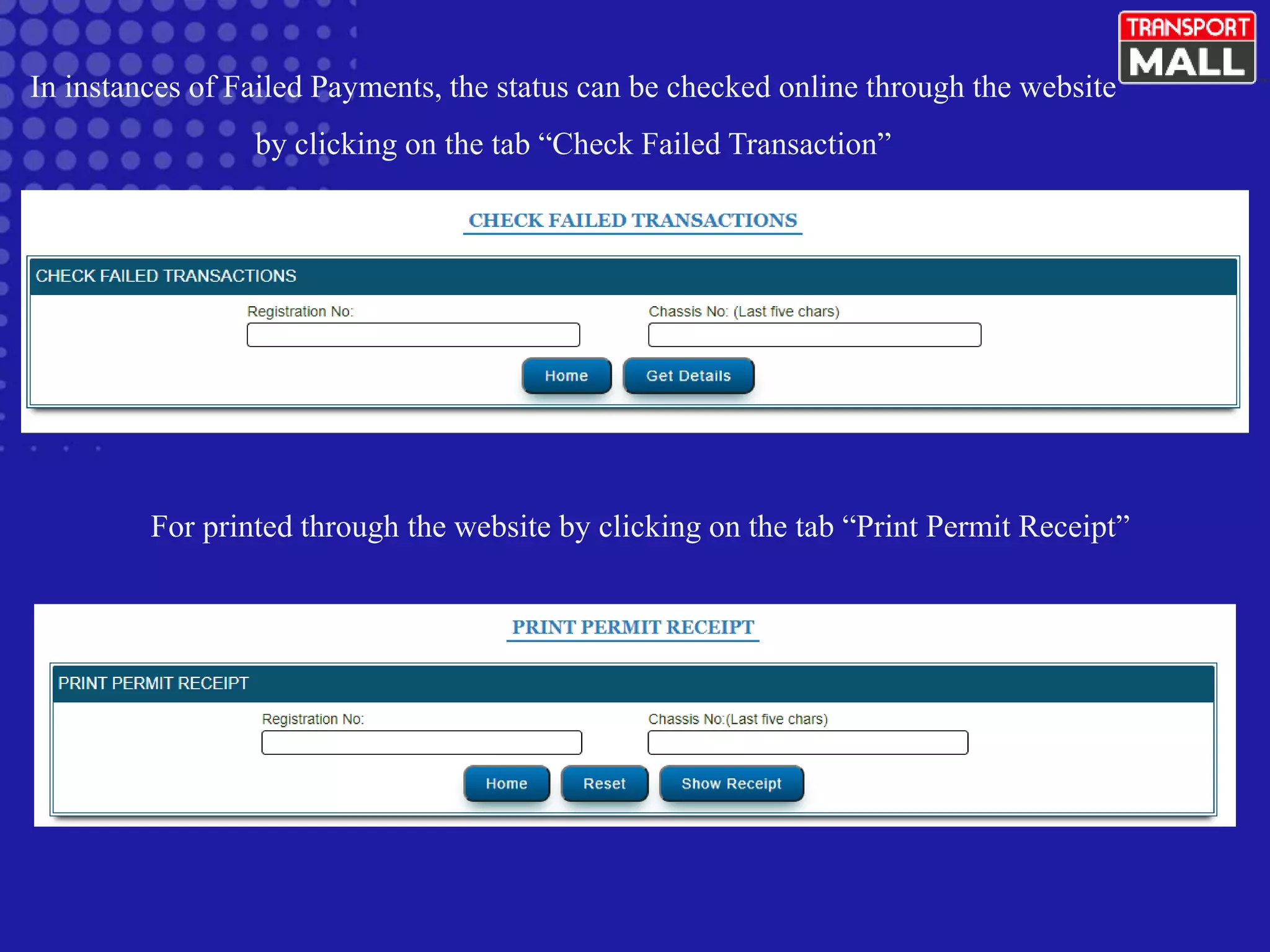
In instances of Failed Payments, the status can be checked online through the website
by clicking on the tab “Check Failed Transaction”
For printed through the website by clicking on the tab “Print Permit Receipt”
What is Motor Vehicle Permit?
If a vehicle has to be transported from one location to another location, it would require a type
of permit. A Vehicle permit is a certificate which would allow a vehicle to travel from one
place to another. Normally permits are termed to be as two, the Local permit and National
Permit. The National permit is also called as All India Permit which is authorized by the
respective State Governments to carry goods to all over India.
If the goods or for the purpose of carrying people from one place to another place locally the
vehicle will require a Local Permit. The charges for both the permits will be by the
government and will differ according to the type of vehicle and the type of permit. Normally
these permits are mandatory for the vehicles that is used for commercial purposes or
transporting of goods or people from one place to another. It can be inter-state or intra-state.
The Documents required for obtaining
Vehicle Permit
⸷ The first requirement is the Application form which is Form 46 or Form 48 which will be available
online to be downloaded or will also be available in the RTO offices.
⸷ While submitting the application form there are several documents to be submitted, the first document
is the Certificate of Registration of the Vehicle.
⸷ The second document which is required is the certificate of the vehicle’s fitness
⸷ Next is the certificate which shows the activeness of the insurance of the vehicle.
⸷ The next certificate is the proof which shows the tax payment according to state which the vehicle is
registered too.
⸷ The next document is of the receipt of the fees which the user has paid for the motor vehicle permit.
⸷ The next is the document showing the Demand Drafts of all the payments for taxes agreed between the
states.
⸷ Next is the document which states whether green tax is paid. This will be according to the rules that are
stated by the government.
Fees For Vehicle Permits
Types Of Permit
⸷ Stage Carriage Permit
⸷ Contract Carriage Permit
⸷ Private Service Vehicles Permit
⸷ Goods Carriage Permit
⸷ Temporary Permit
⸷ Permits for Counter Signatures of Goods transporter
⸷ National Permit
⸷ Tourist Permit
Stage Carriage
Permit
Meaning
Stage Carriage by definition, refers to “A motor vehicle
constructed or adapted to carry more than six passengers
excluding the driver for hire or reward at separate fares paid by
or for individual passengers, either for the whole journey or for
stages of the journey.” As per this definition, any transport
vehicle which is used in the tasks of carrying people
(passengers) from one place to another is regarded as a stage
carriage vehicle. The number of passengers must be more than
six, then only that vehicle will be regarded as a stage carriage
vehicle. The examples of such vehicles are buses, travelers,
mini busses etc.
Application of Stage Carriage Permit
Following are the details which shall be contained in the application of Stage Carriage Permit:
⸷ The route or the number of routes on which the vehicle will move.
⸷ The areas the vehicle will go or move around.
⸷ The vehicle’s type and the seating capacity.
⸷ The number of minimum and maximum daily trips the vehicle will be doing in an area.
⸷ The number of vehicles the vehicle owner or driver has which can be used in case of
emergency.
⸷ The number of vehicles which can be used in replacement of the current vehicle if needed.
⸷ The repair, maintenance of vehicle.
⸷ The address of home of vehicle owner or driver.
⸷ The safety of the passenger’s luggage and the comfort of the passengers.
Conditions To Attain Stage
Carriage Permit
⸷ The vehicle should only be used in the areas that were specified in the application.
⸷ The vehicle should be moving only on the routes that were specified in the application.
⸷ The vehicle must start its operations or tasks from the date specified by the RTA.
⸷ The number of minimum and maximum daily trips must not exceed the said number.
⸷ The time-table of movement of the vehicles as approved by the RTA must be affixed as a
copy on the vehicle, which should also mention the number of stands and halts of the
route the vehicle is following.
⸷ The pickup of the passengers and the drop off the passenger should not be different from
as being approved by the RTA.
⸷ The maximum number of passengers which can be seated in the vehicle should not exceed
the specified limit.
⸷ The maximum weight of luggage the vehicle is carrying should not exceed the approved
limit.
⸷ The weight and nature of luggage of passengers must be carried free of cost by the
vehicle. Also, it is the responsibility of the vehicle owner or driver to make necessary
arrangements for the storage and safety of the luggage.
⸷ The vehicle’s comfort and cleanliness should be at par with the standards being stated by
the RTA for that particular vehicle.
⸷ The fares collected by the vehicle from the passengers for the concerned route must not
exceed the limit as specified by the RTA.
⸷ The Fare schedule as approved by the RTA must be put on the vehicle in form of a copy
of the same. Also, a copy of any special fares should be affixed on the vehicle.
⸷ The tickets issued to the passengers must contain the details of the particulars of the
passengers. The tickets must also contain the fares which are being taken from the
passengers for the journey.
⸷ The vehicle owner or the driver should have an alternate vehicle so that the operations can
keep going and there is no difficulty to the passengers in the case of emergency.
⸷ The vehicle owner or the driver must have a proper place for the upkeep of the vehicle.
Housing, repairing, maintenance work must be undertaken consistently.
⸷ The vehicle can be used as contract carriage if the need arises.
⸷ If the vehicle uses any government premises like bus stop or any other shelter for the
parking or any other area then the fees will have to be paid by the vehicle owner or the
driver.
⸷ The vehicle owner or the driver needs to give all required details or statistics about the
vehicle or any other thing being asked to the RTA at regular intervals.
Contract
Carriage Permit
Meaning
Vehicles which require contract carriage permit are the vehicles
which carry passengers from one place to another for a particular
amount usually called as a fare. The vehicle is used for the purpose
of hiring by the common citizens to go from one place to another.
The contract carriage vehicle picks the passengers from one
decided point or destination and drops them back at the decided or
dedicated point or destination only without stopping in between at
different halts. This is done for a decided amount by the vehicle
owner known as the fare for the trip which will be paid by the
passengers.
Application of Contract Carriage Permit
Following are the details which shall be contained in the application of Contract Carriage Permit:
⸷ The route or the number of routes on which the vehicle will move.
⸷ The areas the vehicle will go or move around.
⸷ The vehicle’s type and the seating capacity.
⸷ The number of minimum and maximum daily trips the vehicle will be doing in an area.
⸷ The number of vehicles the vehicle owner or driver has which can be used in case of
emergency.
⸷ The number of vehicles which can be used in replacement of the current vehicle if needed.
⸷ The repair, maintenance of vehicle.
⸷ The address of home of vehicle owner or driver.
⸷ The safety of the passenger’s luggage and the comfort of the passengers.
Conditions To Attain Contract
Carriage Permit
⸷ The vehicle must move or ply in the areas and routes as specified in the application.
⸷ The maximum number of passengers should not exceed beyond the specified limit and the
maximum weight of the luggage carried must also not exceed the specified limit.
⸷ The fare charged by the contract carriage vehicle (except motor cabs) should not exceed
the decided fares by the RTA.
⸷ The specified fares or rates of fares will only be charged by the motor cabs and the trip
time table must also be exhibited on the vehicle as specified by the RTA.
⸷ For the motor cabs the luggage will be chargeable only if the weight exceeds the specified
luggage limit. Otherwise, the carrying of passenger’s luggage is free and is not chargeable.
⸷ The vehicle’s comfort and cleanliness should be at par with the standards being stated by
the RTA for that particular vehicle.
Private Service
Vehicle Permit
Meaning
The central government has made a scheme for the betterment of the
low-income people that they can earn through renting their motor
cars or motor cycles. For the renting purpose, the vehicle owner may
hire a driver or may drive the vehicle himself/herself. Under the
section 75 named as Scheme for renting of motor cabs, the
government has made it clear that for this renting, the grant, renewal
and revocation of the licensing of the operators will be done. The
Application form for those licenses and permits will be provided in
this scheme. The section contains the fees of the such licenses and
permits; reasons for revocation of grant of the permit; conditions on
which the motor cars and motor cycles can be rented etc.
Application Of Private Vehicle Permit
Following are the details which shall be contained in the application of Private Vehicle Permit:
⸷ The route or the number of routes on which the vehicle will move.
⸷ The areas the vehicle will go or move around.
⸷ The vehicle’s type and the seating capacity.
⸷ The safety of the passenger’s luggage and the comfort of the passengers.
⸷ The repair, maintenance of vehicle.
⸷ The reasons for carrying the passengers.
Conditions To Attain
Private Service Vehicle Permit
⸷ The vehicle should only be used in the areas that were specified in the application.
⸷ The vehicle should be moving only on the routes that were specified in the application.
⸷ The maximum number of passengers should not exceed beyond the specified limit and the
maximum weight of the luggage carried must also not exceed the specified limit.
⸷ The vehicle’s comfort and cleanliness should be at par with the standards being stated by
the RTA for that particular vehicle.
⸷ The vehicle owner or the driver needs to give all required details or statistics about the
vehicle or any other thing being asked to the RTA at regular intervals.
Goods Carriage
Permit
Meaning
Goods Carriage by definition, refers to “any motor vehicle
constructed or adapted for use solely for the carriage of goods, or
any motor vehicle not so constructed or adopted when used for
the carriage of goods”. As per this definition, any transport
vehicle which is used in the tasks of carrying goods from one
place to another is regarded as a goods carriage vehicle. For this
task, the vehicle owner or the driver earns a significant amount
of money which is named as fare. In order to get this vehicle on
road, the permit is required and this makes the vehicle legally
viable for the roads of India. All ICVs, HCVs and LCVs are
covered under this.
Application of Goods Carriage Permit
⸷ Following are the details which shall be contained in the application of Private Vehicle
Permit:
⸷ The route or the number of routes on which the vehicle will move.
⸷ The areas the vehicle will go or move around.
⸷ The vehicle’s type and the vehicle capacity.
⸷ The nature of goods (perishable, durable, consumable etc.) which the vehicle shall carry.
⸷ The fare or the rates that will be charged by the vehicle owners or drivers for carrying the
goods should be declared fairly to the RTA.
⸷ The repair, maintenance of vehicle.
⸷ The address of home of vehicle owner or driver.
⸷ The safety of the passenger’s luggage and the comfort of the passengers
Conditions To Attain
Goods Carriage Permit
⸷ The Goods carrying vehicle should only be used in the areas that were specified in the
application.
⸷ The Goods carrying vehicle should be moving only on the routes that were specified in the
application.
⸷ The vehicle must carry the same type of goods (nature of goods) as specified in the
permit’s application.
⸷ The vehicle must carry the goods at the specified rates by the RTA.
⸷ The vehicle’s comfort and cleanliness should be at par with the standards being stated by
the RTA for that particular vehicle.
⸷ The vehicle owner or the driver must have a proper place for the upkeep of the vehicle.
Housing, repairing, maintenance work must be undertaken consistently.
⸷ The vehicle owner or the driver needs to give all required details or statistics about the
vehicle or any other thing being asked to the RTA at regular intervals.
Temporary
Permit
Meaning
The Section 87 of The Motor Vehicles Act, 1988 is all about the
temporary permits. The RTA or the State Transport Authority
(STA) grants the temporary permit for only four months and this
can be used for the vehicle temporarily for the carrying
passengers on special occasions, for seasonal businesses, for
some specific need and for a pending decision on the application
on the renewal of the permit. For the goods carriage vehicles, in
an exceptional case, the temporary permit can exceed four
months but it doesn’t exceed one year and those reasons would
be in writing with the RTA or the State Transport Authority
(STA).
Permits for Counter
Signatures of Goods
Transporter
Meaning
The permit issued by any RTA is valid for that very region itself i.e., it is valid only
for the state in which it has been issued. For the exceptions and other details, the
section 88 of The Motor Vehicles Act, 1988 is present to provide all answers. For the
goods carriage permit, there stands an exception that if the permit will be considered
valid in another region or state if the excess part of that region or state is within the
length of sixteen kilometers. In this, there is a clause that the starting point and the
ending point of the route must be in the same region or the same state but some part
of the route might lie in any other area or region or state. For example, the truck has
to go from Destination A to Destination B and its route starts in state of Haryana and
ends also in the state of Haryana but for reaching the Destination B the route is from
the middle of Uttar Pradesh, in this case the permit will stand valid if the route which
lies in Uttar Pradesh is within the length of sixteen kilometers.
National
Permit
Meaning
National permit is a permit which is granted by RTA or the State
Transport Authority (STA) to a goods carriage vehicle to operate
through-out India without any objections both. The vehicle then can
move in all the union territories and states. The Application of the
National Permit is made through the Form 48 of The Central Motor
Vehicle Rules, 1989. For the grant of National Permit, Form 49 of
The Central Motor Vehicle Rules, 1989 is being used with a fee and
relevant documents. The fees of the same is in regard to the
different states and union territories of the country. The National
Permit is valid for a period of one year from the date of the making
of the permit by the RTA or the State Transport Authority (STA).
Application Of National Permit
The documents required to be submitted with the application of
National Permit for the Vehicle are Registration Certificate of
the vehicle (RC); Fitness Certificate of the vehicle; Insurance
Certificate of the vehicle; Proof of payment of tax for the current
Quarter to the Home State; Payment receipt of green tax
wherever applicable and fees bank demand draft.
Conditions To Attain
National Permit
⸷ National Permit will not be given to any multi-axle goods carriage vehicle (trailer which
has more than two axles) having age more than 15 years.
⸷ For the puller tractor, if the vehicle is 15 years old, it shall not be given the national
permit.
⸷ National Permit will not be given to any multi-axle trailer (Trailer which has more than
two axles) carrying gross vehicle weight more than 50 tones and is more than 25 years
old (age to be calculated from the date of registration of the vehicle.)
⸷ National Permit will not be given to any modular hydraulic trailer which is more than 25
years old (age to be calculated from the date of registration of the vehicle.)
⸷ The National Permit must have a printed watermark paper which will have a hologram of
the State government or the State Transport Authority which is valid for six months.
⸷ The words ‘National Permit or N/P” are required to be written on the vehicle by the vehicle
owner or the driver in the front and the rear of the vehicle in bold letters. For the trailers, it
is to be written on the rear and left side of the vehicle.
⸷ Vehicles which carry hazardous goods and have national permit are required to get this
written in a painted way in white colour with a display of class label.
⸷ Any vehicle consisting the National Permit must have a Fastag on it.
⸷ Any vehicle consisting the National Permit must have reflective tapes on its body as
mentioned by the rules.
⸷ Any vehicle consisting the National Permit must be fitted with a Vehicle Tracking system as
per the Indian Quality & Safety Standards.
⸷ Any vehicle consisting the National Permit must not pick up or drop down the goods
between the two points of journey if the particular state doesn’t allow.
Tourist Permit
Meaning
The rules about AITP is named as All India Tourist Vehicles
(Authorization or Permit) Rules, 2021 by the MORTH (Ministry
of Road Transport & Highways) and these rules came into force
from 1 April 2021. The AITP will be given to those tourist
vehicles which shall transport passengers along with their
personal luggage from one place to another for a specific fare.
The Ministry here has also made it clear that no tourist vehicle
will be allowed to carry passengers without the AITP present in
electronic or physical form.
Application For Tourist Permit
⸷ The Transport Vehicle Operator needs to submit an application (Form 1) for the grant of the AITP or
for the renewal of the AITP. It should be accompanied by copies of documents.
⸷ Registration Certificate of the Vehicle, Proof of registered address, PAN card; Goods and Services
Tax certificate and a self-declared affidavit declaring that the applicant has sufficient knowledge of
handling tourist vehicles for carrying tourists from airport, railway station and for sight-seeing in all
areas.
⸷ The Vehicle driver needs to submit an application (Form 1A) for the grant of the AITP or for the
renewal of the AITP. It should be accompanied by copies of documents. Registration Certificate of
the Vehicle, Proof of registered address, PAN card; Goods and Services Tax certificate, Valid fitness
certificate; Valid insurance certificate; Valid Pollution under Control Certificate and a self-declared
affidavit declaring that the applicant has sufficient knowledge of handling tourist vehicles for
carrying tourists from airport, railway station and for sight-seeing in all areas.
Conditions To Attain
Tourist Permit
⸷ The Tourist Vehicles which have been granted permit by the RTA or the State Transport
Authority (STA) are required to display “All India Tourist Permit” on rear left side of the
vehicle in white letters in blue background along with the validity of the permit.
⸷ Any tourist vehicle being given the permit will have to carry a list of passengers in
electronic form or in physical form containing the details of the pickup and the drop
location of each passenger. If the list is demanded by any RTA officer, then the list needs
to be shown.
⸷ The vehicle owner or the driver needs to give all required details like journey details or
statistics about the vehicle or any other thing being asked to the RTA at regular intervals.
⸷ The granted AITP can be cancelled by the RTA or the State Transport Authority (STA) if
the tourist vehicle is used for any other purpose or if the permit is attained by a fraud or
misrepresentation or if the vehicle owner acquires the foreign country citizenship.
Motor Vehicle Permit

Motor Vehicle Permit

  • 2.
    The Motor VehiclesAct, 1988 shows various clauses and aspects about the vehicle permit. Under Section 66 (Necessity for permits) the law states that “no owner of a motor vehicle shall use or permit the use of the vehicle as a transport vehicle in any public place whether or not such vehicle is actually carrying any passengers or goods save in accordance with the conditions of a permit granted or countersigned by a Regional or State Transport Authority or any prescribed authority authorizing him the use of the vehicle in that place in the manner in which the vehicle is being used.”
  • 3.
  • 4.
    Payment For NationalPermit can be done online through the website by clicking on the tab “Online Payment of National Permit” In case the payment’s transaction gets stuck or faces an issue then the transaction status can be checked through the website by clicking on the tab “Check Transaction / Vehicle No/ Bank Ref No Status”
  • 5.
    In instances ofFailed Payments, the status can be checked online through the website by clicking on the tab “Check Failed Transaction” For printed through the website by clicking on the tab “Print Permit Receipt”
  • 6.
    What is MotorVehicle Permit? If a vehicle has to be transported from one location to another location, it would require a type of permit. A Vehicle permit is a certificate which would allow a vehicle to travel from one place to another. Normally permits are termed to be as two, the Local permit and National Permit. The National permit is also called as All India Permit which is authorized by the respective State Governments to carry goods to all over India. If the goods or for the purpose of carrying people from one place to another place locally the vehicle will require a Local Permit. The charges for both the permits will be by the government and will differ according to the type of vehicle and the type of permit. Normally these permits are mandatory for the vehicles that is used for commercial purposes or transporting of goods or people from one place to another. It can be inter-state or intra-state.
  • 7.
    The Documents requiredfor obtaining Vehicle Permit ⸷ The first requirement is the Application form which is Form 46 or Form 48 which will be available online to be downloaded or will also be available in the RTO offices. ⸷ While submitting the application form there are several documents to be submitted, the first document is the Certificate of Registration of the Vehicle. ⸷ The second document which is required is the certificate of the vehicle’s fitness ⸷ Next is the certificate which shows the activeness of the insurance of the vehicle. ⸷ The next certificate is the proof which shows the tax payment according to state which the vehicle is registered too. ⸷ The next document is of the receipt of the fees which the user has paid for the motor vehicle permit. ⸷ The next is the document showing the Demand Drafts of all the payments for taxes agreed between the states. ⸷ Next is the document which states whether green tax is paid. This will be according to the rules that are stated by the government.
  • 8.
  • 9.
    Types Of Permit ⸷Stage Carriage Permit ⸷ Contract Carriage Permit ⸷ Private Service Vehicles Permit ⸷ Goods Carriage Permit ⸷ Temporary Permit ⸷ Permits for Counter Signatures of Goods transporter ⸷ National Permit ⸷ Tourist Permit
  • 10.
  • 11.
    Meaning Stage Carriage bydefinition, refers to “A motor vehicle constructed or adapted to carry more than six passengers excluding the driver for hire or reward at separate fares paid by or for individual passengers, either for the whole journey or for stages of the journey.” As per this definition, any transport vehicle which is used in the tasks of carrying people (passengers) from one place to another is regarded as a stage carriage vehicle. The number of passengers must be more than six, then only that vehicle will be regarded as a stage carriage vehicle. The examples of such vehicles are buses, travelers, mini busses etc.
  • 12.
    Application of StageCarriage Permit Following are the details which shall be contained in the application of Stage Carriage Permit: ⸷ The route or the number of routes on which the vehicle will move. ⸷ The areas the vehicle will go or move around. ⸷ The vehicle’s type and the seating capacity. ⸷ The number of minimum and maximum daily trips the vehicle will be doing in an area. ⸷ The number of vehicles the vehicle owner or driver has which can be used in case of emergency. ⸷ The number of vehicles which can be used in replacement of the current vehicle if needed. ⸷ The repair, maintenance of vehicle. ⸷ The address of home of vehicle owner or driver. ⸷ The safety of the passenger’s luggage and the comfort of the passengers.
  • 13.
    Conditions To AttainStage Carriage Permit ⸷ The vehicle should only be used in the areas that were specified in the application. ⸷ The vehicle should be moving only on the routes that were specified in the application. ⸷ The vehicle must start its operations or tasks from the date specified by the RTA. ⸷ The number of minimum and maximum daily trips must not exceed the said number. ⸷ The time-table of movement of the vehicles as approved by the RTA must be affixed as a copy on the vehicle, which should also mention the number of stands and halts of the route the vehicle is following. ⸷ The pickup of the passengers and the drop off the passenger should not be different from as being approved by the RTA. ⸷ The maximum number of passengers which can be seated in the vehicle should not exceed the specified limit.
  • 14.
    ⸷ The maximumweight of luggage the vehicle is carrying should not exceed the approved limit. ⸷ The weight and nature of luggage of passengers must be carried free of cost by the vehicle. Also, it is the responsibility of the vehicle owner or driver to make necessary arrangements for the storage and safety of the luggage. ⸷ The vehicle’s comfort and cleanliness should be at par with the standards being stated by the RTA for that particular vehicle. ⸷ The fares collected by the vehicle from the passengers for the concerned route must not exceed the limit as specified by the RTA. ⸷ The Fare schedule as approved by the RTA must be put on the vehicle in form of a copy of the same. Also, a copy of any special fares should be affixed on the vehicle.
  • 15.
    ⸷ The ticketsissued to the passengers must contain the details of the particulars of the passengers. The tickets must also contain the fares which are being taken from the passengers for the journey. ⸷ The vehicle owner or the driver should have an alternate vehicle so that the operations can keep going and there is no difficulty to the passengers in the case of emergency. ⸷ The vehicle owner or the driver must have a proper place for the upkeep of the vehicle. Housing, repairing, maintenance work must be undertaken consistently. ⸷ The vehicle can be used as contract carriage if the need arises. ⸷ If the vehicle uses any government premises like bus stop or any other shelter for the parking or any other area then the fees will have to be paid by the vehicle owner or the driver. ⸷ The vehicle owner or the driver needs to give all required details or statistics about the vehicle or any other thing being asked to the RTA at regular intervals.
  • 16.
  • 17.
    Meaning Vehicles which requirecontract carriage permit are the vehicles which carry passengers from one place to another for a particular amount usually called as a fare. The vehicle is used for the purpose of hiring by the common citizens to go from one place to another. The contract carriage vehicle picks the passengers from one decided point or destination and drops them back at the decided or dedicated point or destination only without stopping in between at different halts. This is done for a decided amount by the vehicle owner known as the fare for the trip which will be paid by the passengers.
  • 18.
    Application of ContractCarriage Permit Following are the details which shall be contained in the application of Contract Carriage Permit: ⸷ The route or the number of routes on which the vehicle will move. ⸷ The areas the vehicle will go or move around. ⸷ The vehicle’s type and the seating capacity. ⸷ The number of minimum and maximum daily trips the vehicle will be doing in an area. ⸷ The number of vehicles the vehicle owner or driver has which can be used in case of emergency. ⸷ The number of vehicles which can be used in replacement of the current vehicle if needed. ⸷ The repair, maintenance of vehicle. ⸷ The address of home of vehicle owner or driver. ⸷ The safety of the passenger’s luggage and the comfort of the passengers.
  • 19.
    Conditions To AttainContract Carriage Permit ⸷ The vehicle must move or ply in the areas and routes as specified in the application. ⸷ The maximum number of passengers should not exceed beyond the specified limit and the maximum weight of the luggage carried must also not exceed the specified limit. ⸷ The fare charged by the contract carriage vehicle (except motor cabs) should not exceed the decided fares by the RTA. ⸷ The specified fares or rates of fares will only be charged by the motor cabs and the trip time table must also be exhibited on the vehicle as specified by the RTA. ⸷ For the motor cabs the luggage will be chargeable only if the weight exceeds the specified luggage limit. Otherwise, the carrying of passenger’s luggage is free and is not chargeable. ⸷ The vehicle’s comfort and cleanliness should be at par with the standards being stated by the RTA for that particular vehicle.
  • 20.
  • 21.
    Meaning The central governmenthas made a scheme for the betterment of the low-income people that they can earn through renting their motor cars or motor cycles. For the renting purpose, the vehicle owner may hire a driver or may drive the vehicle himself/herself. Under the section 75 named as Scheme for renting of motor cabs, the government has made it clear that for this renting, the grant, renewal and revocation of the licensing of the operators will be done. The Application form for those licenses and permits will be provided in this scheme. The section contains the fees of the such licenses and permits; reasons for revocation of grant of the permit; conditions on which the motor cars and motor cycles can be rented etc.
  • 22.
    Application Of PrivateVehicle Permit Following are the details which shall be contained in the application of Private Vehicle Permit: ⸷ The route or the number of routes on which the vehicle will move. ⸷ The areas the vehicle will go or move around. ⸷ The vehicle’s type and the seating capacity. ⸷ The safety of the passenger’s luggage and the comfort of the passengers. ⸷ The repair, maintenance of vehicle. ⸷ The reasons for carrying the passengers.
  • 23.
    Conditions To Attain PrivateService Vehicle Permit ⸷ The vehicle should only be used in the areas that were specified in the application. ⸷ The vehicle should be moving only on the routes that were specified in the application. ⸷ The maximum number of passengers should not exceed beyond the specified limit and the maximum weight of the luggage carried must also not exceed the specified limit. ⸷ The vehicle’s comfort and cleanliness should be at par with the standards being stated by the RTA for that particular vehicle. ⸷ The vehicle owner or the driver needs to give all required details or statistics about the vehicle or any other thing being asked to the RTA at regular intervals.
  • 24.
  • 25.
    Meaning Goods Carriage bydefinition, refers to “any motor vehicle constructed or adapted for use solely for the carriage of goods, or any motor vehicle not so constructed or adopted when used for the carriage of goods”. As per this definition, any transport vehicle which is used in the tasks of carrying goods from one place to another is regarded as a goods carriage vehicle. For this task, the vehicle owner or the driver earns a significant amount of money which is named as fare. In order to get this vehicle on road, the permit is required and this makes the vehicle legally viable for the roads of India. All ICVs, HCVs and LCVs are covered under this.
  • 26.
    Application of GoodsCarriage Permit ⸷ Following are the details which shall be contained in the application of Private Vehicle Permit: ⸷ The route or the number of routes on which the vehicle will move. ⸷ The areas the vehicle will go or move around. ⸷ The vehicle’s type and the vehicle capacity. ⸷ The nature of goods (perishable, durable, consumable etc.) which the vehicle shall carry. ⸷ The fare or the rates that will be charged by the vehicle owners or drivers for carrying the goods should be declared fairly to the RTA. ⸷ The repair, maintenance of vehicle. ⸷ The address of home of vehicle owner or driver. ⸷ The safety of the passenger’s luggage and the comfort of the passengers
  • 27.
    Conditions To Attain GoodsCarriage Permit ⸷ The Goods carrying vehicle should only be used in the areas that were specified in the application. ⸷ The Goods carrying vehicle should be moving only on the routes that were specified in the application. ⸷ The vehicle must carry the same type of goods (nature of goods) as specified in the permit’s application. ⸷ The vehicle must carry the goods at the specified rates by the RTA. ⸷ The vehicle’s comfort and cleanliness should be at par with the standards being stated by the RTA for that particular vehicle. ⸷ The vehicle owner or the driver must have a proper place for the upkeep of the vehicle. Housing, repairing, maintenance work must be undertaken consistently. ⸷ The vehicle owner or the driver needs to give all required details or statistics about the vehicle or any other thing being asked to the RTA at regular intervals.
  • 28.
  • 29.
    Meaning The Section 87of The Motor Vehicles Act, 1988 is all about the temporary permits. The RTA or the State Transport Authority (STA) grants the temporary permit for only four months and this can be used for the vehicle temporarily for the carrying passengers on special occasions, for seasonal businesses, for some specific need and for a pending decision on the application on the renewal of the permit. For the goods carriage vehicles, in an exceptional case, the temporary permit can exceed four months but it doesn’t exceed one year and those reasons would be in writing with the RTA or the State Transport Authority (STA).
  • 30.
    Permits for Counter Signaturesof Goods Transporter
  • 31.
    Meaning The permit issuedby any RTA is valid for that very region itself i.e., it is valid only for the state in which it has been issued. For the exceptions and other details, the section 88 of The Motor Vehicles Act, 1988 is present to provide all answers. For the goods carriage permit, there stands an exception that if the permit will be considered valid in another region or state if the excess part of that region or state is within the length of sixteen kilometers. In this, there is a clause that the starting point and the ending point of the route must be in the same region or the same state but some part of the route might lie in any other area or region or state. For example, the truck has to go from Destination A to Destination B and its route starts in state of Haryana and ends also in the state of Haryana but for reaching the Destination B the route is from the middle of Uttar Pradesh, in this case the permit will stand valid if the route which lies in Uttar Pradesh is within the length of sixteen kilometers.
  • 32.
  • 33.
    Meaning National permit isa permit which is granted by RTA or the State Transport Authority (STA) to a goods carriage vehicle to operate through-out India without any objections both. The vehicle then can move in all the union territories and states. The Application of the National Permit is made through the Form 48 of The Central Motor Vehicle Rules, 1989. For the grant of National Permit, Form 49 of The Central Motor Vehicle Rules, 1989 is being used with a fee and relevant documents. The fees of the same is in regard to the different states and union territories of the country. The National Permit is valid for a period of one year from the date of the making of the permit by the RTA or the State Transport Authority (STA).
  • 34.
    Application Of NationalPermit The documents required to be submitted with the application of National Permit for the Vehicle are Registration Certificate of the vehicle (RC); Fitness Certificate of the vehicle; Insurance Certificate of the vehicle; Proof of payment of tax for the current Quarter to the Home State; Payment receipt of green tax wherever applicable and fees bank demand draft.
  • 35.
    Conditions To Attain NationalPermit ⸷ National Permit will not be given to any multi-axle goods carriage vehicle (trailer which has more than two axles) having age more than 15 years. ⸷ For the puller tractor, if the vehicle is 15 years old, it shall not be given the national permit. ⸷ National Permit will not be given to any multi-axle trailer (Trailer which has more than two axles) carrying gross vehicle weight more than 50 tones and is more than 25 years old (age to be calculated from the date of registration of the vehicle.) ⸷ National Permit will not be given to any modular hydraulic trailer which is more than 25 years old (age to be calculated from the date of registration of the vehicle.) ⸷ The National Permit must have a printed watermark paper which will have a hologram of the State government or the State Transport Authority which is valid for six months.
  • 36.
    ⸷ The words‘National Permit or N/P” are required to be written on the vehicle by the vehicle owner or the driver in the front and the rear of the vehicle in bold letters. For the trailers, it is to be written on the rear and left side of the vehicle. ⸷ Vehicles which carry hazardous goods and have national permit are required to get this written in a painted way in white colour with a display of class label. ⸷ Any vehicle consisting the National Permit must have a Fastag on it. ⸷ Any vehicle consisting the National Permit must have reflective tapes on its body as mentioned by the rules. ⸷ Any vehicle consisting the National Permit must be fitted with a Vehicle Tracking system as per the Indian Quality & Safety Standards. ⸷ Any vehicle consisting the National Permit must not pick up or drop down the goods between the two points of journey if the particular state doesn’t allow.
  • 37.
  • 38.
    Meaning The rules aboutAITP is named as All India Tourist Vehicles (Authorization or Permit) Rules, 2021 by the MORTH (Ministry of Road Transport & Highways) and these rules came into force from 1 April 2021. The AITP will be given to those tourist vehicles which shall transport passengers along with their personal luggage from one place to another for a specific fare. The Ministry here has also made it clear that no tourist vehicle will be allowed to carry passengers without the AITP present in electronic or physical form.
  • 39.
    Application For TouristPermit ⸷ The Transport Vehicle Operator needs to submit an application (Form 1) for the grant of the AITP or for the renewal of the AITP. It should be accompanied by copies of documents. ⸷ Registration Certificate of the Vehicle, Proof of registered address, PAN card; Goods and Services Tax certificate and a self-declared affidavit declaring that the applicant has sufficient knowledge of handling tourist vehicles for carrying tourists from airport, railway station and for sight-seeing in all areas. ⸷ The Vehicle driver needs to submit an application (Form 1A) for the grant of the AITP or for the renewal of the AITP. It should be accompanied by copies of documents. Registration Certificate of the Vehicle, Proof of registered address, PAN card; Goods and Services Tax certificate, Valid fitness certificate; Valid insurance certificate; Valid Pollution under Control Certificate and a self-declared affidavit declaring that the applicant has sufficient knowledge of handling tourist vehicles for carrying tourists from airport, railway station and for sight-seeing in all areas.
  • 40.
    Conditions To Attain TouristPermit ⸷ The Tourist Vehicles which have been granted permit by the RTA or the State Transport Authority (STA) are required to display “All India Tourist Permit” on rear left side of the vehicle in white letters in blue background along with the validity of the permit. ⸷ Any tourist vehicle being given the permit will have to carry a list of passengers in electronic form or in physical form containing the details of the pickup and the drop location of each passenger. If the list is demanded by any RTA officer, then the list needs to be shown. ⸷ The vehicle owner or the driver needs to give all required details like journey details or statistics about the vehicle or any other thing being asked to the RTA at regular intervals. ⸷ The granted AITP can be cancelled by the RTA or the State Transport Authority (STA) if the tourist vehicle is used for any other purpose or if the permit is attained by a fraud or misrepresentation or if the vehicle owner acquires the foreign country citizenship.