WHAT IS MND?
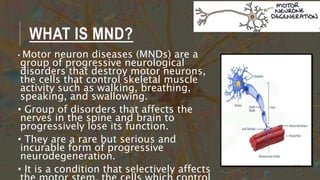
• Motor neuron diseases (MNDs) are a
group of progressive neurological
disorders that destroy motor neurons,
the cells that control skeletal muscle
activity such as walking, breathing,
speaking, and swallowing.
• Group of disorders that affects the
nerves in the spine and brain to
progressively lose its function.
• They are a rare but serious and
incurable form of progressive
neurodegeneration.
• It is a condition that selectively affects
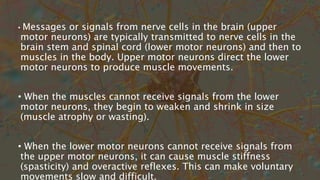
• Messages or signals from nerve cells in the brain (upper
motor neurons) are typically transmitted to nerve cells in the
brain stem and spinal cord (lower motor neurons) and then to
muscles in the body. Upper motor neurons direct the lower
motor neurons to produce muscle movements.
• When the muscles cannot receive signals from the lower
motor neurons, they begin to weaken and shrink in size
(muscle atrophy or wasting).
• When the lower motor neurons cannot receive signals from
the upper motor neurons, it can cause muscle stiffness
(spasticity) and overactive reflexes. This can make voluntary
movements slow and difficult.
PREVALENCE OF MND
• Incidence: 2 per 100 000 per year, with a prevalence
of 6 per 100000.
• It can affect adults of any age but is more likely to
affect people over 50 to 70 years of age.
•Familial ALS accounts for 5% of cases and is usually
inherited as a dominant trait.
• Sex ratio: male/female – 1.5:1
• Mean age of onset – 55 years.
• Mean survival – 3 years (50%).
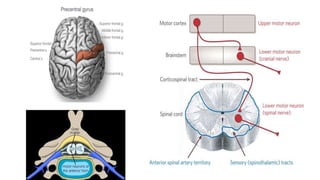
STRUCTURES INVOLVED IN MND
• It is the characteristic degeneration of the motor neurons
which include both the upper and lower motor neurons.
• Different levels of the nervous system are involved:
1. Frontal atrophy in the precentral gyrus
2. The corticobulbar pathway
3. The cranial nerve nuclei
4. The corticospinal tract
5. The anterior horn cell
T H A N K – Y O
U

MOTOR NEURON DISEASE - Presentation Neuro

  • 2.
    WHAT IS MND? •Motor neuron diseases (MNDs) are a group of progressive neurological disorders that destroy motor neurons, the cells that control skeletal muscle activity such as walking, breathing, speaking, and swallowing. • Group of disorders that affects the nerves in the spine and brain to progressively lose its function. • They are a rare but serious and incurable form of progressive neurodegeneration. • It is a condition that selectively affects
  • 3.
    • Messages orsignals from nerve cells in the brain (upper motor neurons) are typically transmitted to nerve cells in the brain stem and spinal cord (lower motor neurons) and then to muscles in the body. Upper motor neurons direct the lower motor neurons to produce muscle movements. • When the muscles cannot receive signals from the lower motor neurons, they begin to weaken and shrink in size (muscle atrophy or wasting). • When the lower motor neurons cannot receive signals from the upper motor neurons, it can cause muscle stiffness (spasticity) and overactive reflexes. This can make voluntary movements slow and difficult.
  • 4.
    PREVALENCE OF MND •Incidence: 2 per 100 000 per year, with a prevalence of 6 per 100000. • It can affect adults of any age but is more likely to affect people over 50 to 70 years of age. •Familial ALS accounts for 5% of cases and is usually inherited as a dominant trait. • Sex ratio: male/female – 1.5:1 • Mean age of onset – 55 years. • Mean survival – 3 years (50%).
  • 5.
    STRUCTURES INVOLVED INMND • It is the characteristic degeneration of the motor neurons which include both the upper and lower motor neurons. • Different levels of the nervous system are involved: 1. Frontal atrophy in the precentral gyrus 2. The corticobulbar pathway 3. The cranial nerve nuclei 4. The corticospinal tract 5. The anterior horn cell
  • 7.
    T H AN K – Y O U