Motivation Theory
Theories of Motivation
2
Some of the most important theories of
motivation are as follows:
1. Maslow’s Need Hierarchy Theory
2. McGregor’s Participation Theory
3. McClelland’s Need Theory
4. Contributions of Elton Mayo
3
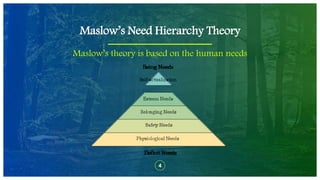
Maslow’s Need Hierarchy Theory
Maslow’s theory is based on the human needs
4
Physiological Needs
5
These needs are basic to human life and,
hence, include food, clothing, shelter, air,
water and necessities of life. These needs
relate to the survival and maintenance of
human life.
Safety Needs
6
After satisfying the physiological needs,
the next needs felt are called safety and
security needs.
These needs find expression in such
desires as economic security and
protection from physical dangers. Meeting
these needs requires more money and,
hence, the individual is prompted to work
more.
Like physiological needs, these become
inactive once they are satisfied.
Social Needs
7
Man is a social being.
Therefore, interested in social interaction,
companionship, belongingness, etc.
It is this socializing and belongingness
why individuals prefer to work in groups
and especially older people go to work.
Esteem Needs
8
These needs refer to self-esteem and self-
respect. They include such needs which
indicate self-confidence, achievement,
competence, knowledge and independence.
The fulfillment of esteem needs leads to self-
confidence, strength and capability of being
useful in the organization. However, inability
to fulfill these needs results in feeling like
inferiority, weakness and helplessness.
Self-Actualization Needs
9
This level represents the culmination of all the
lower, intermediate, and higher needs of
human beings. In other words, the final step
under the need hierarchy model is the need
for self-actualization. This refers to
fulfillment.
self- actualization is the person’s motivation
to transform perception of self into reality
McGregor’s Participation Theory
Douglas McGregor formulated two distinct views of human being based
on participation of workers. The first basically negative, labeled Theory
X, and the other basically positive, labeled Theory Y.
10
Theory X
11
Theory X managers tend to take a pessimistic
view of their people, and assume that they are
naturally unmotivated and dislike work. As a
result, they think that team members need to
be prompted, rewarded, or punished
constantly to make sure that they complete
their tasks.
12
• Dislike their work.
• Avoid responsibility and need constant direction.
• Have to be controlled, forced and threatened to deliver work.
• Need to be supervised at every step.
• Have no incentive to work or ambition, and therefore need to be enticed by
rewards to achieve goals.
According to McGregor, organizations with a Theory X approach tend to have
several tiers of managers and supervisors to oversee and direct workers.
This style of management assumes that workers:
Theory Y
13
Theory Y managers have an optimistic, positive
opinion of their people, and they use a
decentralized, participative management style.
This encourages a more collaborative, trust-based
relationship between managers and their team
members.
People have greater responsibility, and managers
encourage them to develop their skills and suggest
improvements. Appraisals are regular but, unlike
in Theory X organizations, they are used to
encourage open communication rather than
control staff.
Theory Y organizations also give employees
frequent opportunities for promotion.
14
• Happy to work on their own initiative.
• More involved in decision making.
• Self-motivated to complete their tasks.
• Enjoy taking ownership of their work
• Seek and accept responsibility, and need little direction.
• View work as fulfilling and challenging.
• Solve problems creatively and imaginatively.
Theory Y has become more popular among organizations. This reflects workers'
increasing desire for more meaningful careers that provide them with more than
just money.
This style of management assumes that workers:
15
Well-known need-based theory of motivation, as opposed to hierarchy
of needs of satisfaction-dissatisfaction, is the theory developed by
McClelland and his associates.
McClelland’s Need Theory
Theory focuses on Murray’s three needs; achievement, power and
affiliation. In the literature, these three needs are abbreviated “n
Ach”, “n Pow”, and “n Aff” respectively’.
Need for Achievement
16
McClelland found that people with a high
need for achievement perform better than
those with a moderate or low need for
achievement, and noted regional / national
differences in achievement motivation.
17
• High-need achievers have a strong desire to assume personal
responsibility for performing a task for finding a solution to a
problem.
• High-need achievers tend to set moderately difficult goals and take
calculated risks.
• High-need achievers have a strong desire for performance feedback.
McClelland identified the following three characteristics of
high-need achievers:
Need for Power
18
The need for power is concerned with
making an impact on others, the desire
to influence others, the urge to change
people, and the desire to make a
difference in life. People with a high
need for power are people who like to
be in control of people and events. This
results in ultimate satisfaction to man.
19
• A desire to influence and direct somebody else.
• A desire to exercise control over others.
• A concern for maintaining leader-follower relations.
People who have a high need for power are characterized by:
Need for Affiliation
20
The need for affiliation is defined as a
desire to establish and maintain
friendly and warm relations with other
people’. The need for affiliation, in
many ways, is similar to Maslow’s
social needs.
21
• They have a strong desire for acceptance and approval from others.
• They tend to conform to the wishes of those people whose friendship
and companionship they value.
• They value the feelings of others.
The people with high need for affiliation have these
characteristics:
22
Elton Mayo's contribution to management theory helped pave the way
for modern human relations management methods.
Contributions of Elton Mayo
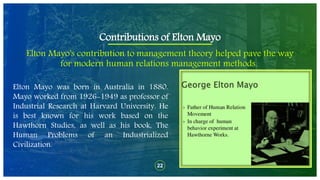
Elton Mayo was born in Australia in 1880.
Mayo worked from 1926-1949 as professor of
Industrial Research at Harvard University. He
is best known for his work based on the
Hawthorn Studies, as well as his book, The
Human Problems of an Industrialized
Civilization.
23
The Hawthorn Studies:
Hawthorn was a Western Electric plant based in Cicero, Illinois. At its peak, the
factory employed close to 40,000 people. The Hawthorn Studies were a large
group of productivity studies conducted between 1927 and 1933 that collected
large data sets.
The very first study that was done concerned workplace lighting. The study sought
to understand if changing lighting conditions resulted in increased or decreased
productivity.
24
To run the experiment two groups were created. A control group and a group with
improved lighting conditions. What happened when lighting was improved for
one group? Well, productivity improved for that group.
But, here’s the strange thing. Productivity also improved in the control group!
When they reduced lighting for one group productivity also increased! Not only
that, but each change (increase or decrease) also lead to increased employee
satisfaction.
He recognized that the worker isn’t a machine and that how they are treated and
their environment is important.
He recognized that work is a group activity and employees have a need for close
relationship and recognition. They have a need for a sense of belonging.
25
Mayo’s Theory of Motivation:
Based on analyzing the data of the Hawthorn Studies, Mayo proposed that
employees aren’t that motivated by pay and environmental factors. Instead,
positive relational factors play a bigger role in productivity.
The importance of group working cannot be overstressed. It is the group that
determines productivity, not pay and not processes.
For example, if someone is working too fast they will be ostracized from the group.
Likewise, if someone is working too slow the same thing will happen.
26
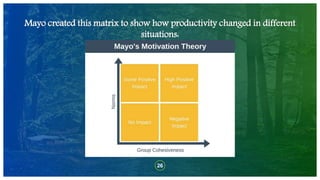
Mayo created this matrix to show how productivity changed in different
situations:
27
You can think of group cohesiveness as being how well the group gets on, their
good relationship. You can think of norms as being whether the group encourages
positive or negative behaviors.
There are four positions in the matrix:
1. Groups with low cohesiveness and low norms
These groups are simply ineffective in terms of productivity.
A team like this wouldn’t last very long. This is because nobody would be motivated
to be productive in any way.
2. Groups with high cohesiveness and low norms
These types of teams have a negative impact on productivity.
Here the team gets on great, but negative behaviors are encouraged rather than
positive ones. Gangs are often cited as examples of this type of group.
28
3. Groups with high norms but low cohesiveness
This type of team can have a limited positive impact on productivity. This is because
each team member will be working towards their own success rather than that of
the team.
If one team member does something great, then good for them, but it doesn’t really
improve the productivity of the rest of the team.
4. Groups with high norms and high cohesiveness
These are the teams that can make the greatest positive impact on productivity. In
this type of team, each team member supports each other to succeed.
People are personally committed to their success and also to the team’s success.
A strong support network forms within this type of team.
29
Using the Model:
To use the model to boost the productivity of your team, you should do the
following:
1. Strong Communication
Communicate regularly with the members of your team. Giving regular feedback is
an important part of this.
2. Group Working
Your team should be working as a group rather than as individuals. If your team is
too big to work as one group then try to break it down into smaller groups.
3. Increased Involvement
Try to have a greater involvement in each team member’s life. Ask how their day has
been? Ask about their weekend and what’s going on at home.

Motivation theory

  • 1.
  • 2.
  • 3.
    Some of themost important theories of motivation are as follows: 1. Maslow’s Need Hierarchy Theory 2. McGregor’s Participation Theory 3. McClelland’s Need Theory 4. Contributions of Elton Mayo 3
  • 4.
    Maslow’s Need HierarchyTheory Maslow’s theory is based on the human needs 4
  • 5.
    Physiological Needs 5 These needsare basic to human life and, hence, include food, clothing, shelter, air, water and necessities of life. These needs relate to the survival and maintenance of human life.
  • 6.
    Safety Needs 6 After satisfyingthe physiological needs, the next needs felt are called safety and security needs. These needs find expression in such desires as economic security and protection from physical dangers. Meeting these needs requires more money and, hence, the individual is prompted to work more. Like physiological needs, these become inactive once they are satisfied.
  • 7.
    Social Needs 7 Man isa social being. Therefore, interested in social interaction, companionship, belongingness, etc. It is this socializing and belongingness why individuals prefer to work in groups and especially older people go to work.
  • 8.
    Esteem Needs 8 These needsrefer to self-esteem and self- respect. They include such needs which indicate self-confidence, achievement, competence, knowledge and independence. The fulfillment of esteem needs leads to self- confidence, strength and capability of being useful in the organization. However, inability to fulfill these needs results in feeling like inferiority, weakness and helplessness.
  • 9.
    Self-Actualization Needs 9 This levelrepresents the culmination of all the lower, intermediate, and higher needs of human beings. In other words, the final step under the need hierarchy model is the need for self-actualization. This refers to fulfillment. self- actualization is the person’s motivation to transform perception of self into reality
  • 10.
    McGregor’s Participation Theory DouglasMcGregor formulated two distinct views of human being based on participation of workers. The first basically negative, labeled Theory X, and the other basically positive, labeled Theory Y. 10
  • 11.
    Theory X 11 Theory Xmanagers tend to take a pessimistic view of their people, and assume that they are naturally unmotivated and dislike work. As a result, they think that team members need to be prompted, rewarded, or punished constantly to make sure that they complete their tasks.
  • 12.
    12 • Dislike theirwork. • Avoid responsibility and need constant direction. • Have to be controlled, forced and threatened to deliver work. • Need to be supervised at every step. • Have no incentive to work or ambition, and therefore need to be enticed by rewards to achieve goals. According to McGregor, organizations with a Theory X approach tend to have several tiers of managers and supervisors to oversee and direct workers. This style of management assumes that workers:
  • 13.
    Theory Y 13 Theory Ymanagers have an optimistic, positive opinion of their people, and they use a decentralized, participative management style. This encourages a more collaborative, trust-based relationship between managers and their team members. People have greater responsibility, and managers encourage them to develop their skills and suggest improvements. Appraisals are regular but, unlike in Theory X organizations, they are used to encourage open communication rather than control staff. Theory Y organizations also give employees frequent opportunities for promotion.
  • 14.
    14 • Happy towork on their own initiative. • More involved in decision making. • Self-motivated to complete their tasks. • Enjoy taking ownership of their work • Seek and accept responsibility, and need little direction. • View work as fulfilling and challenging. • Solve problems creatively and imaginatively. Theory Y has become more popular among organizations. This reflects workers' increasing desire for more meaningful careers that provide them with more than just money. This style of management assumes that workers:
  • 15.
    15 Well-known need-based theoryof motivation, as opposed to hierarchy of needs of satisfaction-dissatisfaction, is the theory developed by McClelland and his associates. McClelland’s Need Theory Theory focuses on Murray’s three needs; achievement, power and affiliation. In the literature, these three needs are abbreviated “n Ach”, “n Pow”, and “n Aff” respectively’.
  • 16.
    Need for Achievement 16 McClellandfound that people with a high need for achievement perform better than those with a moderate or low need for achievement, and noted regional / national differences in achievement motivation.
  • 17.
    17 • High-need achievershave a strong desire to assume personal responsibility for performing a task for finding a solution to a problem. • High-need achievers tend to set moderately difficult goals and take calculated risks. • High-need achievers have a strong desire for performance feedback. McClelland identified the following three characteristics of high-need achievers:
  • 18.
    Need for Power 18 Theneed for power is concerned with making an impact on others, the desire to influence others, the urge to change people, and the desire to make a difference in life. People with a high need for power are people who like to be in control of people and events. This results in ultimate satisfaction to man.
  • 19.
    19 • A desireto influence and direct somebody else. • A desire to exercise control over others. • A concern for maintaining leader-follower relations. People who have a high need for power are characterized by:
  • 20.
    Need for Affiliation 20 Theneed for affiliation is defined as a desire to establish and maintain friendly and warm relations with other people’. The need for affiliation, in many ways, is similar to Maslow’s social needs.
  • 21.
    21 • They havea strong desire for acceptance and approval from others. • They tend to conform to the wishes of those people whose friendship and companionship they value. • They value the feelings of others. The people with high need for affiliation have these characteristics:
  • 22.
    22 Elton Mayo's contributionto management theory helped pave the way for modern human relations management methods. Contributions of Elton Mayo Elton Mayo was born in Australia in 1880. Mayo worked from 1926-1949 as professor of Industrial Research at Harvard University. He is best known for his work based on the Hawthorn Studies, as well as his book, The Human Problems of an Industrialized Civilization.
  • 23.
    23 The Hawthorn Studies: Hawthornwas a Western Electric plant based in Cicero, Illinois. At its peak, the factory employed close to 40,000 people. The Hawthorn Studies were a large group of productivity studies conducted between 1927 and 1933 that collected large data sets. The very first study that was done concerned workplace lighting. The study sought to understand if changing lighting conditions resulted in increased or decreased productivity.
  • 24.
    24 To run theexperiment two groups were created. A control group and a group with improved lighting conditions. What happened when lighting was improved for one group? Well, productivity improved for that group. But, here’s the strange thing. Productivity also improved in the control group! When they reduced lighting for one group productivity also increased! Not only that, but each change (increase or decrease) also lead to increased employee satisfaction. He recognized that the worker isn’t a machine and that how they are treated and their environment is important. He recognized that work is a group activity and employees have a need for close relationship and recognition. They have a need for a sense of belonging.
  • 25.
    25 Mayo’s Theory ofMotivation: Based on analyzing the data of the Hawthorn Studies, Mayo proposed that employees aren’t that motivated by pay and environmental factors. Instead, positive relational factors play a bigger role in productivity. The importance of group working cannot be overstressed. It is the group that determines productivity, not pay and not processes. For example, if someone is working too fast they will be ostracized from the group. Likewise, if someone is working too slow the same thing will happen.
  • 26.
    26 Mayo created thismatrix to show how productivity changed in different situations:
  • 27.
    27 You can thinkof group cohesiveness as being how well the group gets on, their good relationship. You can think of norms as being whether the group encourages positive or negative behaviors. There are four positions in the matrix: 1. Groups with low cohesiveness and low norms These groups are simply ineffective in terms of productivity. A team like this wouldn’t last very long. This is because nobody would be motivated to be productive in any way. 2. Groups with high cohesiveness and low norms These types of teams have a negative impact on productivity. Here the team gets on great, but negative behaviors are encouraged rather than positive ones. Gangs are often cited as examples of this type of group.
  • 28.
    28 3. Groups withhigh norms but low cohesiveness This type of team can have a limited positive impact on productivity. This is because each team member will be working towards their own success rather than that of the team. If one team member does something great, then good for them, but it doesn’t really improve the productivity of the rest of the team. 4. Groups with high norms and high cohesiveness These are the teams that can make the greatest positive impact on productivity. In this type of team, each team member supports each other to succeed. People are personally committed to their success and also to the team’s success. A strong support network forms within this type of team.
  • 29.
    29 Using the Model: Touse the model to boost the productivity of your team, you should do the following: 1. Strong Communication Communicate regularly with the members of your team. Giving regular feedback is an important part of this. 2. Group Working Your team should be working as a group rather than as individuals. If your team is too big to work as one group then try to break it down into smaller groups. 3. Increased Involvement Try to have a greater involvement in each team member’s life. Ask how their day has been? Ask about their weekend and what’s going on at home.

Editor's Notes

  • #7 Prompted-தூண்டியது
  • #8 Companionship- friendship
  • #9 Competence- தகுதி, ஆற்றல்/ inferiority -தாழ்வு
  • #10 culmination – உச்சநிலையாக, peak / Self-Actualization-சுய இயல்பாக்கம்
  • #12 Constantly-always/ pessimistic- எதிலும் கவலை (அ) குறை காண்கிற
  • #13  constant-permanent/ enticed-convince , நம்பச் செய்/ tiers-a row or level of a structure
  • #14 Optimistic- confident/ Appraisals-assessment
  • #26 ostracized – ஒதுக்கப்பட்ட/ Likewise-அதேபோல்
  • #27 cohesiveness –இணக்கத்தன்மை/ norms -விதிமுறைகளை
  • #28 cited -நீதிமன்றத்துக்கு அழை