Marketing Management
Marketing Management-Introduction
Unit-01
1.Introduction
2.Core Concepts of Marketing
3.Nature of Marketing
4.Scope of Marketing
5.Importance of Marketing Management
6.Marketing Concepts/Philosophies
1.Introduction
Marketing Management
According to Philip Kotler, "Marketing Management is the analysis, planning, implementation and control of
programmes designed to bring about desired exchanges with target audiences for the purpose of personal and of
mutual gain. It relies heavily on the adoption and coordination of product, price, promotion and place for achieving
responses.".
Marketing
“Marketing is the economic process by which goods and services are exchanged between the maker and the user,
and their values determined in terms of money prices.”
American Marketing Association [AMA] defined as "the activity, set of institutions, and processes for creating,
communicating, delivering, and exchanging offerings that have value for customers, clients, partners, and society at
large.“
Market
A set up where two or more parties engage in exchange of goods, services and information is called a market.
2.Core Concepts of Marketing
Core concepts of marketing are the essential elements that make the whole marketing system complete. They are
the essence to make a proper marketing system.
1. Need, Want, and Demand
2. Product, Service, and Experience
3. Market
4. Exchange, Transaction, and Relationship
5. Customer Value and Satisfaction
1.Need, Want, and Demand
Need
Describe basic human requirements such as food, air, water, clothing, and shelter.
Want
Needs become wants when they are directed to specific objects that might satisfy the need.
Demand
Demand is a human want that is backed by ability and willingness to buy.
2.Product, Service, and Experience
Product
Product is anything that might satisfy’s people’s needs, wants, and demands. Product may be any physical products,
services, or ideas. For instance, a product is a food, house, clothes, car, etc.
Service
Service is also a kind of product that is mostly intangible and does not specify any particular ownership. For
example, doctor’s services, banking, insurance, transportation, etc.
Experience
Experience is something that customers get after the products and services.
3. Market
A market is a place where all the actual and potential sellers & buyers and products & services are made sale,
purchase, and consume.
4.Exchange, Transaction, and Relationship
Exchange
You may obtain your desired products in many ways. One of the forms is through the exchange. Simply, exchange
means giving or getting something from (to) someone by receiving or offering something in return.
Transaction
The basic unit of exchange in a transaction. For a transaction, there must be two parties one is a giver and another is
a receiver and it must be done in monetary terms.
Relationship
The relationship is a long-term interaction between buyers and sellers. The relationship aims to build mutually
satisfying long-term relations with the company, seller, customers, suppliers, and all the stakeholders.
5.Customer Value and Satisfaction
Customer Value
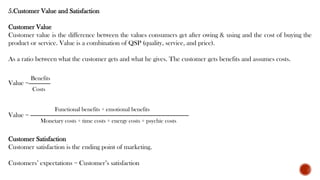
Customer value is the difference between the values consumers get after owing & using and the cost of buying the
product or service. Value is a combination of QSP (quality, service, and price).
As a ratio between what the customer gets and what he gives. The customer gets benefits and assumes costs.
Value =-------------
Value = -----------------------------------------------------------------------------------------------
Customer Satisfaction
Customer satisfaction is the ending point of marketing.
Customers’ expectations = Customer’s satisfaction
Functional benefits + emotional benefits
Monetary costs + time costs + energy costs + psychic costs
Benefits
Costs
3.Nature of Marketing
1.Marketing is an Economic Function
Marketing embraces all the business activities involved in getting goods and services, from the hands of producers
into the hands of final consumers.
2.Marketing is a Legal Process by which Ownership Transfers
In the process of marketing the ownership of goods transfers from the seller to the purchaser or from producer to
the end-user.
3.Marketing is a System of Interacting Business Activities
Marketing is that process through which a business enterprise, institution, or organization interacts with the
customers and stakeholders with the objective to earn a profit, satisfy customers, and manage relationships.
4.Marketing is a Managerial Function
According to the managerial or systems approach - "Marketing is the combination of activities designed to produce
profit through ascertaining, creating, stimulating, and satisfying the needs and/or wants of a selected segment of the
market."
5.Marketing is a Social Process
Marketing is the delivery of a standard of living to society, Knowing and understanding the consumer's changing
needs and wants.
4.Scope of Marketing
1.Study of Consumer Wants and Needs
Goods are produced to satisfy consumer wants. Therefore the study is done to identify consumer needs and wants.
These needs and wants motivate the consumer to purchase.
2.Study of Consumer Behaviour
Marketers perform a study of consumer behavior. Analysis of buyer behavior helps marketers in market
segmentation and targeting.
3.Production Planning and Development
Product planning and development starts with the generation of product ideas and ends with product development
and commercialization. Product planning includes everything from branding and packaging to product line
expansion and contraction.
4.Pricing Policies
The marketer has to determine pricing policies for their products. Pricing policies differ from product to product. It
depends on the level of competition, product life cycle, marketing goals, and objectives, etc.
5.Distribution
The study of distribution channels is important in marketing. For maximum sales and profit, goods are required to
be distributed to the maximum consumers at minimum cost.
6.Promotion
Promotion includes personal selling, sales promotion, and advertising. The right promotion mix is crucial in the
accomplishment of marketing goals.
7.Consumer Satisfaction
The product or service offered must satisfy the consumer. Consumer satisfaction is the major objective of
marketing.
8.Marketing Control
The marketing audit is done to control the marketing activities.
5.Importance of Marketing Management
Marketing management has gained importance to meet increasing competition and the need for improved
methods of distribution to reduce cost and to increase profits. Marketing management today is the most important
function in a commercial and business enterprise.
The following are the other factors showing importance of the marketing management:
1.Introduction of new products in the market.
2.Increasing the production of existing products.
3.Reducing cost of sales and distribution.
4.Export market.
5.Development in the means of communication and modes of transportation within and outside the country.
6.Rise in per capita income and demand for more goods by the consumers.
6.Marketing Concepts/Philosophies
6 Essential Marketing Concepts are:
1.Production Concept
2.Product Concept
3.Selling Concept
4.Marketing Concept
5.Societal Marketing Concept
6.Holistic Marketing Concept
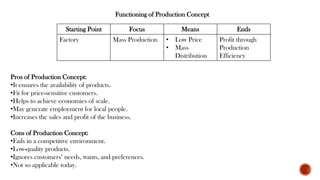
1.Production Concept (Early 1930)
The production concept of marketing assumes that consumers are price sensitive and they buy products that are
widely available at lower costs.
This concept is fit when the demand is higher than supply, labor cost is low, and resources are easily available.
But it won’t work well when the supply is higher than demand, competition is high, and people search for quality
products.
Example: One of the best examples of the production concept of marketing is Ford Company’s Car Model T.
With mass production company was able to sell the car for between $260 to $850 in 1908.
Functioning of Production Concept
Starting Point Focus Means Ends
Factory Mass Production • Low Price
• Mass
Distribution
Profit through
Production
Efficiency
Pros of Production Concept:
•It ensures the availability of products.
•Fit for price-sensitive customers.
•Helps to achieve economies of scale.
•May generate employment for local people.
•Increases the sales and profit of the business.
Cons of Production Concept:
•Fails in a competitive environment.
•Low-quality products.
•Ignores customers’ needs, wants, and preferences.
•Not so applicable today.
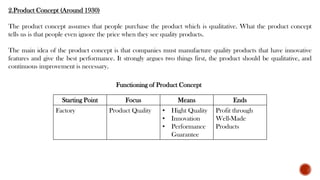
2.Product Concept (Around 1930)
The product concept assumes that people purchase the product which is qualitative. What the product concept
tells us is that people even ignore the price when they see quality products.
The main idea of the product concept is that companies must manufacture quality products that have innovative
features and give the best performance. It strongly argues two things first, the product should be qualitative, and
continuous improvement is necessary.
Functioning of Product Concept
Starting Point Focus Means Ends
Factory Product Quality • Hight Quality
• Innovation
• Performance
Guarantee
Profit through
Well-Made
Products
Pros of Product Concept:
•It ensures quality products.
•Best for quality-sensitive people.
•Helps to gain prestige, position, and status.
•High-income people prefer quality products.
•Helps to gain a competitive position.
•Develops curiosity in people.
Cons of Product Concept:
•It neglects customers’ needs, wants, and preferences.
•Seller’s choice products.
•Low-income and price-conscious people do not prefer it.
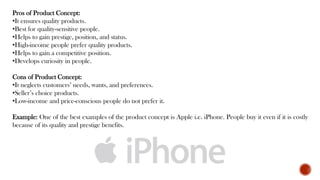
Example: One of the best examples of the product concept is Apple i.e. iPhone. People buy it even if it is costly
because of its quality and prestige benefits.
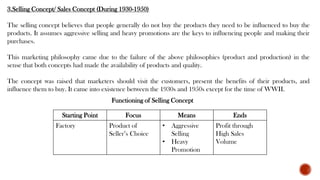
3.Selling Concept/ Sales Concept (During 1930-1950)
The selling concept believes that people generally do not buy the products they need to be influenced to buy the
products. It assumes aggressive selling and heavy promotions are the keys to influencing people and making their
purchases.
This marketing philosophy came due to the failure of the above philosophies (product and production) in the
sense that both concepts had made the availability of products and quality.
The concept was raised that marketers should visit the customers, present the benefits of their products, and
influence them to buy. It came into existence between the 1930s and 1950s except for the time of WWII.
Functioning of Selling Concept
Starting Point Focus Means Ends
Factory Product of
Seller’s Choice
• Aggressive
Selling
• Heavy
Promotion
Profit through
High Sales
Volume
Pros of Selling Concept:
•May increase sales volume and profits.
•Right for products like insurance, expensive cars, expensive clothes, etc.
•Increases the market coverage of the business.
•Free up the stock.
Cons of Selling Concept:
•The selling concept has ignored the customer’s consideration.
•It only focuses on short-term goals achievement.
•It does not value repeat business.
•Wrong assumption people will forget in long run.
Example: The selling of an insurance policy is the right example of this selling concept. The seller or insurance
agent is continually involved in persuading people to buy the insurance policies. And, even if people do not have
the intention to do so they are influenced and purchase.
4.Marketing Concept (Since 1950s)
The marketing concept believes companies’ success relies on customer satisfaction. It explains companies should
first consult consumers about their needs and preferences and based on their choices should produce products.
In fact, the marketing concept is customer-centric marketing philosophy. It gives priority to customers’ needs and
wants and aims to serve what they want and generates better customer value and satisfaction. This concept is fit in
the competitive markets to confront the competition and achieve a better market position.
Functioning of Marketing Concept
Starting Point Focus Means Ends
Target Market Consumers Need Integrated
Marketing
Profit through
Customer
Satisfaction
Pros of Marketing Concept:
•The marketing concept helps to achieve customer satisfaction.
•Increases repetitive buying.
•Ensures long-term success.
•Increases market share.
•Helps to build a good public image.
Cons of Marketing Concept:
•Visiting customers, identifying their needs and wants, and producing their desired products may result in a costly
process.
•Skilled and quality marketers are required.
•It is time-consuming also.
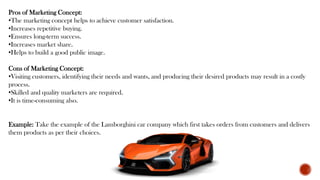
Example: Take the example of the Lamborghini car company which first takes orders from customers and delivers
them products as per their choices.
5.Societal Marketing Concept (Around 1972)
The societal marketing concept holds that companies should think about the long-term interest of customers and
society as a whole while delivering and satisfying customers’ needs and wants. It is a socially responsible marketing
philosophy.
What societal marketing tells us is that while making products and marketing decisions a company must consider
the customer’s interests, their satisfaction, and the welfare of society and the surrounding environment. It states
companies operate in society, they get resources from the environment, and they should repay them.
Functioning of Societal Marketing Concept
Starting Point Focus Means Ends
Target Market Social Needs Protecting and
Supporting
Consumer &
Society
Profit through
Customer &
Social well-being
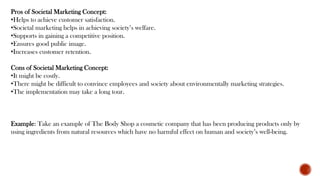
Pros of Societal Marketing Concept:
•Helps to achieve customer satisfaction.
•Societal marketing helps in achieving society’s welfare.
•Supports in gaining a competitive position.
•Ensures good public image.
•Increases customer retention.
Cons of Societal Marketing Concept:
•It might be costly.
•There might be difficult to convince employees and society about environmentally marketing strategies.
•The implementation may take a long tour.
Example: Take an example of The Body Shop a cosmetic company that has been producing products only by
using ingredients from natural resources which have no harmful effect on human and society’s well-being.
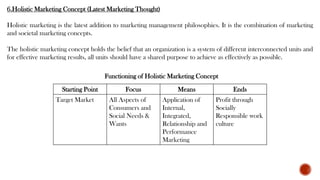
6.Holistic Marketing Concept (Latest Marketing Thought)
Holistic marketing is the latest addition to marketing management philosophies. It is the combination of marketing
and societal marketing concepts.
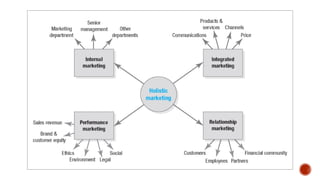
The holistic marketing concept holds the belief that an organization is a system of different interconnected units and
for effective marketing results, all units should have a shared purpose to achieve as effectively as possible.
Functioning of Holistic Marketing Concept
Starting Point Focus Means Ends
Target Market All Aspects of
Consumers and
Social Needs &
Wants
Application of
Internal,
Integrated,
Relationship and
Performance
Marketing
Profit through
Socially
Responsible work
culture
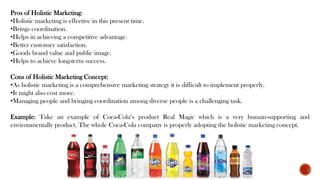
Pros of Holistic Marketing:
•Holistic marketing is effective in this present time.
•Brings coordination.
•Helps in achieving a competitive advantage.
•Better customer satisfaction.
•Goods brand value and public image.
•Helps to achieve long-term success.
Cons of Holistic Marketing Concept:
•As holistic marketing is a comprehensive marketing strategy it is difficult to implement properly.
•It might also cost more.
•Managing people and bringing coordination among diverse people is a challenging task.
Example: Take an example of Coca-Cola‘s product Real Magic which is a very human-supporting and
environmentally product. The whole Coca-Cola company is properly adopting the holistic marketing concept.

Marketing Management Unit01.pdf

  • 1.
  • 2.
    Marketing Management-Introduction Unit-01 1.Introduction 2.Core Conceptsof Marketing 3.Nature of Marketing 4.Scope of Marketing 5.Importance of Marketing Management 6.Marketing Concepts/Philosophies
  • 3.
    1.Introduction Marketing Management According toPhilip Kotler, "Marketing Management is the analysis, planning, implementation and control of programmes designed to bring about desired exchanges with target audiences for the purpose of personal and of mutual gain. It relies heavily on the adoption and coordination of product, price, promotion and place for achieving responses.". Marketing “Marketing is the economic process by which goods and services are exchanged between the maker and the user, and their values determined in terms of money prices.” American Marketing Association [AMA] defined as "the activity, set of institutions, and processes for creating, communicating, delivering, and exchanging offerings that have value for customers, clients, partners, and society at large.“ Market A set up where two or more parties engage in exchange of goods, services and information is called a market.
  • 4.
    2.Core Concepts ofMarketing Core concepts of marketing are the essential elements that make the whole marketing system complete. They are the essence to make a proper marketing system. 1. Need, Want, and Demand 2. Product, Service, and Experience 3. Market 4. Exchange, Transaction, and Relationship 5. Customer Value and Satisfaction 1.Need, Want, and Demand Need Describe basic human requirements such as food, air, water, clothing, and shelter. Want Needs become wants when they are directed to specific objects that might satisfy the need. Demand Demand is a human want that is backed by ability and willingness to buy.
  • 5.
    2.Product, Service, andExperience Product Product is anything that might satisfy’s people’s needs, wants, and demands. Product may be any physical products, services, or ideas. For instance, a product is a food, house, clothes, car, etc. Service Service is also a kind of product that is mostly intangible and does not specify any particular ownership. For example, doctor’s services, banking, insurance, transportation, etc. Experience Experience is something that customers get after the products and services. 3. Market A market is a place where all the actual and potential sellers & buyers and products & services are made sale, purchase, and consume.
  • 6.
    4.Exchange, Transaction, andRelationship Exchange You may obtain your desired products in many ways. One of the forms is through the exchange. Simply, exchange means giving or getting something from (to) someone by receiving or offering something in return. Transaction The basic unit of exchange in a transaction. For a transaction, there must be two parties one is a giver and another is a receiver and it must be done in monetary terms. Relationship The relationship is a long-term interaction between buyers and sellers. The relationship aims to build mutually satisfying long-term relations with the company, seller, customers, suppliers, and all the stakeholders.
  • 7.
    5.Customer Value andSatisfaction Customer Value Customer value is the difference between the values consumers get after owing & using and the cost of buying the product or service. Value is a combination of QSP (quality, service, and price). As a ratio between what the customer gets and what he gives. The customer gets benefits and assumes costs. Value =------------- Value = ----------------------------------------------------------------------------------------------- Customer Satisfaction Customer satisfaction is the ending point of marketing. Customers’ expectations = Customer’s satisfaction Functional benefits + emotional benefits Monetary costs + time costs + energy costs + psychic costs Benefits Costs
  • 8.
    3.Nature of Marketing 1.Marketingis an Economic Function Marketing embraces all the business activities involved in getting goods and services, from the hands of producers into the hands of final consumers. 2.Marketing is a Legal Process by which Ownership Transfers In the process of marketing the ownership of goods transfers from the seller to the purchaser or from producer to the end-user. 3.Marketing is a System of Interacting Business Activities Marketing is that process through which a business enterprise, institution, or organization interacts with the customers and stakeholders with the objective to earn a profit, satisfy customers, and manage relationships. 4.Marketing is a Managerial Function According to the managerial or systems approach - "Marketing is the combination of activities designed to produce profit through ascertaining, creating, stimulating, and satisfying the needs and/or wants of a selected segment of the market." 5.Marketing is a Social Process Marketing is the delivery of a standard of living to society, Knowing and understanding the consumer's changing needs and wants.
  • 9.
    4.Scope of Marketing 1.Studyof Consumer Wants and Needs Goods are produced to satisfy consumer wants. Therefore the study is done to identify consumer needs and wants. These needs and wants motivate the consumer to purchase. 2.Study of Consumer Behaviour Marketers perform a study of consumer behavior. Analysis of buyer behavior helps marketers in market segmentation and targeting. 3.Production Planning and Development Product planning and development starts with the generation of product ideas and ends with product development and commercialization. Product planning includes everything from branding and packaging to product line expansion and contraction. 4.Pricing Policies The marketer has to determine pricing policies for their products. Pricing policies differ from product to product. It depends on the level of competition, product life cycle, marketing goals, and objectives, etc.
  • 10.
    5.Distribution The study ofdistribution channels is important in marketing. For maximum sales and profit, goods are required to be distributed to the maximum consumers at minimum cost. 6.Promotion Promotion includes personal selling, sales promotion, and advertising. The right promotion mix is crucial in the accomplishment of marketing goals. 7.Consumer Satisfaction The product or service offered must satisfy the consumer. Consumer satisfaction is the major objective of marketing. 8.Marketing Control The marketing audit is done to control the marketing activities.
  • 11.
    5.Importance of MarketingManagement Marketing management has gained importance to meet increasing competition and the need for improved methods of distribution to reduce cost and to increase profits. Marketing management today is the most important function in a commercial and business enterprise. The following are the other factors showing importance of the marketing management: 1.Introduction of new products in the market. 2.Increasing the production of existing products. 3.Reducing cost of sales and distribution. 4.Export market. 5.Development in the means of communication and modes of transportation within and outside the country. 6.Rise in per capita income and demand for more goods by the consumers.
  • 12.
    6.Marketing Concepts/Philosophies 6 EssentialMarketing Concepts are: 1.Production Concept 2.Product Concept 3.Selling Concept 4.Marketing Concept 5.Societal Marketing Concept 6.Holistic Marketing Concept 1.Production Concept (Early 1930) The production concept of marketing assumes that consumers are price sensitive and they buy products that are widely available at lower costs. This concept is fit when the demand is higher than supply, labor cost is low, and resources are easily available. But it won’t work well when the supply is higher than demand, competition is high, and people search for quality products. Example: One of the best examples of the production concept of marketing is Ford Company’s Car Model T. With mass production company was able to sell the car for between $260 to $850 in 1908.
  • 13.
    Functioning of ProductionConcept Starting Point Focus Means Ends Factory Mass Production • Low Price • Mass Distribution Profit through Production Efficiency Pros of Production Concept: •It ensures the availability of products. •Fit for price-sensitive customers. •Helps to achieve economies of scale. •May generate employment for local people. •Increases the sales and profit of the business. Cons of Production Concept: •Fails in a competitive environment. •Low-quality products. •Ignores customers’ needs, wants, and preferences. •Not so applicable today.
  • 14.
    2.Product Concept (Around1930) The product concept assumes that people purchase the product which is qualitative. What the product concept tells us is that people even ignore the price when they see quality products. The main idea of the product concept is that companies must manufacture quality products that have innovative features and give the best performance. It strongly argues two things first, the product should be qualitative, and continuous improvement is necessary. Functioning of Product Concept Starting Point Focus Means Ends Factory Product Quality • Hight Quality • Innovation • Performance Guarantee Profit through Well-Made Products
  • 15.
    Pros of ProductConcept: •It ensures quality products. •Best for quality-sensitive people. •Helps to gain prestige, position, and status. •High-income people prefer quality products. •Helps to gain a competitive position. •Develops curiosity in people. Cons of Product Concept: •It neglects customers’ needs, wants, and preferences. •Seller’s choice products. •Low-income and price-conscious people do not prefer it. Example: One of the best examples of the product concept is Apple i.e. iPhone. People buy it even if it is costly because of its quality and prestige benefits.
  • 16.
    3.Selling Concept/ SalesConcept (During 1930-1950) The selling concept believes that people generally do not buy the products they need to be influenced to buy the products. It assumes aggressive selling and heavy promotions are the keys to influencing people and making their purchases. This marketing philosophy came due to the failure of the above philosophies (product and production) in the sense that both concepts had made the availability of products and quality. The concept was raised that marketers should visit the customers, present the benefits of their products, and influence them to buy. It came into existence between the 1930s and 1950s except for the time of WWII. Functioning of Selling Concept Starting Point Focus Means Ends Factory Product of Seller’s Choice • Aggressive Selling • Heavy Promotion Profit through High Sales Volume
  • 17.
    Pros of SellingConcept: •May increase sales volume and profits. •Right for products like insurance, expensive cars, expensive clothes, etc. •Increases the market coverage of the business. •Free up the stock. Cons of Selling Concept: •The selling concept has ignored the customer’s consideration. •It only focuses on short-term goals achievement. •It does not value repeat business. •Wrong assumption people will forget in long run. Example: The selling of an insurance policy is the right example of this selling concept. The seller or insurance agent is continually involved in persuading people to buy the insurance policies. And, even if people do not have the intention to do so they are influenced and purchase.
  • 18.
    4.Marketing Concept (Since1950s) The marketing concept believes companies’ success relies on customer satisfaction. It explains companies should first consult consumers about their needs and preferences and based on their choices should produce products. In fact, the marketing concept is customer-centric marketing philosophy. It gives priority to customers’ needs and wants and aims to serve what they want and generates better customer value and satisfaction. This concept is fit in the competitive markets to confront the competition and achieve a better market position. Functioning of Marketing Concept Starting Point Focus Means Ends Target Market Consumers Need Integrated Marketing Profit through Customer Satisfaction
  • 19.
    Pros of MarketingConcept: •The marketing concept helps to achieve customer satisfaction. •Increases repetitive buying. •Ensures long-term success. •Increases market share. •Helps to build a good public image. Cons of Marketing Concept: •Visiting customers, identifying their needs and wants, and producing their desired products may result in a costly process. •Skilled and quality marketers are required. •It is time-consuming also. Example: Take the example of the Lamborghini car company which first takes orders from customers and delivers them products as per their choices.
  • 20.
    5.Societal Marketing Concept(Around 1972) The societal marketing concept holds that companies should think about the long-term interest of customers and society as a whole while delivering and satisfying customers’ needs and wants. It is a socially responsible marketing philosophy. What societal marketing tells us is that while making products and marketing decisions a company must consider the customer’s interests, their satisfaction, and the welfare of society and the surrounding environment. It states companies operate in society, they get resources from the environment, and they should repay them. Functioning of Societal Marketing Concept Starting Point Focus Means Ends Target Market Social Needs Protecting and Supporting Consumer & Society Profit through Customer & Social well-being
  • 21.
    Pros of SocietalMarketing Concept: •Helps to achieve customer satisfaction. •Societal marketing helps in achieving society’s welfare. •Supports in gaining a competitive position. •Ensures good public image. •Increases customer retention. Cons of Societal Marketing Concept: •It might be costly. •There might be difficult to convince employees and society about environmentally marketing strategies. •The implementation may take a long tour. Example: Take an example of The Body Shop a cosmetic company that has been producing products only by using ingredients from natural resources which have no harmful effect on human and society’s well-being.
  • 22.
    6.Holistic Marketing Concept(Latest Marketing Thought) Holistic marketing is the latest addition to marketing management philosophies. It is the combination of marketing and societal marketing concepts. The holistic marketing concept holds the belief that an organization is a system of different interconnected units and for effective marketing results, all units should have a shared purpose to achieve as effectively as possible. Functioning of Holistic Marketing Concept Starting Point Focus Means Ends Target Market All Aspects of Consumers and Social Needs & Wants Application of Internal, Integrated, Relationship and Performance Marketing Profit through Socially Responsible work culture
  • 24.
    Pros of HolisticMarketing: •Holistic marketing is effective in this present time. •Brings coordination. •Helps in achieving a competitive advantage. •Better customer satisfaction. •Goods brand value and public image. •Helps to achieve long-term success. Cons of Holistic Marketing Concept: •As holistic marketing is a comprehensive marketing strategy it is difficult to implement properly. •It might also cost more. •Managing people and bringing coordination among diverse people is a challenging task. Example: Take an example of Coca-Cola‘s product Real Magic which is a very human-supporting and environmentally product. The whole Coca-Cola company is properly adopting the holistic marketing concept.