Motivation
and Reward
For Students
Creative Learning Project
Develop & Designed: Fraz Haider
Objectives
Participants will be able to (PWBAT):
• Define motivation of the students
• Explain and understand the types of motivation
• Understand the importance of motivation
• Identify the factors that Influence students’
motivation in education
• List the Ideas to improve students’ motivation
• Define reward system
• Identify and understand when is reward system
effective in the classroom
• List and apply the different strategies of student’s
reward
Do-Now
Please answer the questions below
independently:
Q. How do you treat students
when they are not responding to
you? please explain.
Pair-Share
Share what you wrote with the person
next to you.
Share Out
Motivation
Motivation is the process that initiates, guides, and
maintains goal-oriented behaviors. Motivation involves
the biological, emotional, social, and cognitive forces
that activate behavior. In everyday usage, the term
"motivation" is frequently used to describe why a person
does something.
Motivation is the state that can maintain students'
attention and behavior as well as provide more energy to
lead tasks to completion. In education, motivation can
have a variety of effects on students' behavior,
preferences, and results.
Types of Motivation
1. Intrinsic Motivation 2. Extrinsic Motivation
There are 2 types of motivation.
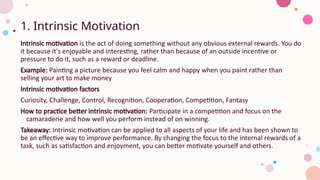
1. Intrinsic Motivation
Intrinsic motivation is the act of doing something without any obvious external rewards. You do
it because it's enjoyable and interesting, rather than because of an outside incentive or
pressure to do it, such as a reward or deadline.
Example: Painting a picture because you feel calm and happy when you paint rather than
selling your art to make money
Intrinsic motivation factors
Curiosity, Challenge, Control, Recognition, Cooperation, Competition, Fantasy
How to practice better intrinsic motivation: Participate in a competition and focus on the
camaraderie and how well you perform instead of on winning.
Takeaway: Intrinsic motivation can be applied to all aspects of your life and has been shown to
be an effective way to improve performance. By changing the focus to the internal rewards of a
task, such as satisfaction and enjoyment, you can better motivate yourself and others.
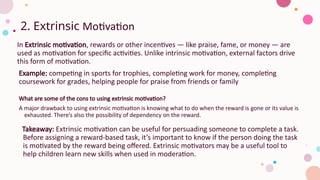
2. Extrinsic Motivation
In Extrinsic motivation, rewards or other incentives — like praise, fame, or money — are
used as motivation for specific activities. Unlike intrinsic motivation, external factors drive
this form of motivation.
Example: competing in sports for trophies, completing work for money, completing
coursework for grades, helping people for praise from friends or family
What are some of the cons to using extrinsic motivation?
A major drawback to using extrinsic motivation is knowing what to do when the reward is gone or its value is
exhausted. There’s also the possibility of dependency on the reward.
Takeaway: Extrinsic motivation can be useful for persuading someone to complete a task.
Before assigning a reward-based task, it’s important to know if the person doing the task
is motivated by the reward being offered. Extrinsic motivators may be a useful tool to
help children learn new skills when used in moderation.
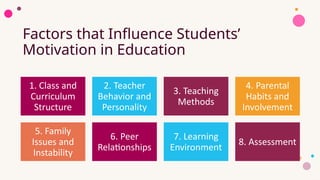
Factors that Influence Students’
Motivation in Education
1. Class and
Curriculum
Structure
2. Teacher
Behavior and
Personality
3. Teaching
Methods
4. Parental
Habits and
Involvement
5. Family
Issues and
Instability
6. Peer
Relationships
7. Learning
Environment
8. Assessment
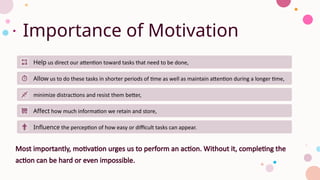
Importance of Motivation
Help us direct our attention toward tasks that need to be done,
Allow us to do these tasks in shorter periods of time as well as maintain attention during a longer time,
minimize distractions and resist them better,
Affect how much information we retain and store,
Influence the perception of how easy or difficult tasks can appear.
Most importantly, motivation urges us to perform an action. Without it, completing the
action can be hard or even impossible.
Different Ideas
To Improve
Students Motivat
ion
Be clear about
learning
objectives
Create a
threat-free
environment
Change your
scenery
Offer varied
experiences
Use positive
competition
Offer rewards
Give students
responsibility
Allow students
to work
together
Give praise
when earned
Encourage
self-reflection
Model
enthusiasm
for learning!
Manage
student
anxiety
Track progress
Make things
fun
Provide
opportunities
for success
Watch the Video
https://www.youtube.com/watch?v=GghmPtItGA4&ab_channel=KINGCEYLO
Reflection of the
Video
Reward System
Reward systems are an effective way in which you can celebrate student achievement and
positive student behaviour. The use of rewards within the classroom are a form of extrinsic
motivation for students, encouraging them to participate cooperatively in academic and social
learning experiences.
"Rewards and incentives can be powerful tools when
used with students in the right way."
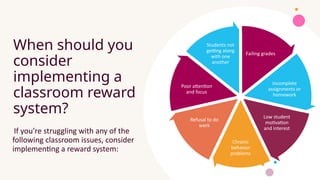
When should you
consider
implementing a
classroom reward
system?
Failing grades
Incomplete
assignments or
homework
Low student
motivation
and interest
Chronic
behavior
problems
Refusal to do
work
Poor attention
and focus
Students not
getting along
with one
another
If you’re struggling with any of the
following classroom issues, consider
implementing a reward system:
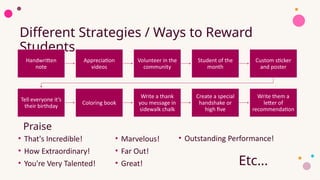
Different Strategies / Ways to Reward
Students
Handwritten
note
Appreciation
videos
Volunteer in the
community
Student of the
month
Custom sticker
and poster
Tell everyone it’s
their birthday
Coloring book
Write a thank
you message in
sidewalk chalk
Create a special
handshake or
high five
Write them a
letter of
recommendation
Praise
• That's Incredible!
• How Extraordinary!
• You're Very Talented!
• Marvelous!
• Far Out!
• Great!
• Outstanding Performance!
Etc...
Activity
Let's practice the distributions of rewards ...
Reflection of
the Activity
Do you have any question?
Yes, Please...
Thank You!

Motivation and Reward - Presentation.pptx

  • 1.
    Motivation and Reward For Students CreativeLearning Project Develop & Designed: Fraz Haider
  • 2.
    Objectives Participants will beable to (PWBAT): • Define motivation of the students • Explain and understand the types of motivation • Understand the importance of motivation • Identify the factors that Influence students’ motivation in education • List the Ideas to improve students’ motivation • Define reward system • Identify and understand when is reward system effective in the classroom • List and apply the different strategies of student’s reward
  • 3.
    Do-Now Please answer thequestions below independently: Q. How do you treat students when they are not responding to you? please explain.
  • 4.
    Pair-Share Share what youwrote with the person next to you.
  • 5.
  • 6.
    Motivation Motivation is theprocess that initiates, guides, and maintains goal-oriented behaviors. Motivation involves the biological, emotional, social, and cognitive forces that activate behavior. In everyday usage, the term "motivation" is frequently used to describe why a person does something. Motivation is the state that can maintain students' attention and behavior as well as provide more energy to lead tasks to completion. In education, motivation can have a variety of effects on students' behavior, preferences, and results.
  • 7.
    Types of Motivation 1.Intrinsic Motivation 2. Extrinsic Motivation There are 2 types of motivation.
  • 8.
    1. Intrinsic Motivation Intrinsicmotivation is the act of doing something without any obvious external rewards. You do it because it's enjoyable and interesting, rather than because of an outside incentive or pressure to do it, such as a reward or deadline. Example: Painting a picture because you feel calm and happy when you paint rather than selling your art to make money Intrinsic motivation factors Curiosity, Challenge, Control, Recognition, Cooperation, Competition, Fantasy How to practice better intrinsic motivation: Participate in a competition and focus on the camaraderie and how well you perform instead of on winning. Takeaway: Intrinsic motivation can be applied to all aspects of your life and has been shown to be an effective way to improve performance. By changing the focus to the internal rewards of a task, such as satisfaction and enjoyment, you can better motivate yourself and others.
  • 9.
    2. Extrinsic Motivation InExtrinsic motivation, rewards or other incentives — like praise, fame, or money — are used as motivation for specific activities. Unlike intrinsic motivation, external factors drive this form of motivation. Example: competing in sports for trophies, completing work for money, completing coursework for grades, helping people for praise from friends or family What are some of the cons to using extrinsic motivation? A major drawback to using extrinsic motivation is knowing what to do when the reward is gone or its value is exhausted. There’s also the possibility of dependency on the reward. Takeaway: Extrinsic motivation can be useful for persuading someone to complete a task. Before assigning a reward-based task, it’s important to know if the person doing the task is motivated by the reward being offered. Extrinsic motivators may be a useful tool to help children learn new skills when used in moderation.
  • 10.
    Factors that InfluenceStudents’ Motivation in Education 1. Class and Curriculum Structure 2. Teacher Behavior and Personality 3. Teaching Methods 4. Parental Habits and Involvement 5. Family Issues and Instability 6. Peer Relationships 7. Learning Environment 8. Assessment
  • 11.
    Importance of Motivation Helpus direct our attention toward tasks that need to be done, Allow us to do these tasks in shorter periods of time as well as maintain attention during a longer time, minimize distractions and resist them better, Affect how much information we retain and store, Influence the perception of how easy or difficult tasks can appear. Most importantly, motivation urges us to perform an action. Without it, completing the action can be hard or even impossible.
  • 12.
    Different Ideas To Improve StudentsMotivat ion Be clear about learning objectives Create a threat-free environment Change your scenery Offer varied experiences Use positive competition Offer rewards Give students responsibility Allow students to work together Give praise when earned Encourage self-reflection Model enthusiasm for learning! Manage student anxiety Track progress Make things fun Provide opportunities for success
  • 13.
  • 14.
  • 15.
    Reward System Reward systemsare an effective way in which you can celebrate student achievement and positive student behaviour. The use of rewards within the classroom are a form of extrinsic motivation for students, encouraging them to participate cooperatively in academic and social learning experiences. "Rewards and incentives can be powerful tools when used with students in the right way."
  • 16.
    When should you consider implementinga classroom reward system? Failing grades Incomplete assignments or homework Low student motivation and interest Chronic behavior problems Refusal to do work Poor attention and focus Students not getting along with one another If you’re struggling with any of the following classroom issues, consider implementing a reward system:
  • 17.
    Different Strategies /Ways to Reward Students Handwritten note Appreciation videos Volunteer in the community Student of the month Custom sticker and poster Tell everyone it’s their birthday Coloring book Write a thank you message in sidewalk chalk Create a special handshake or high five Write them a letter of recommendation Praise • That's Incredible! • How Extraordinary! • You're Very Talented! • Marvelous! • Far Out! • Great! • Outstanding Performance! Etc...
  • 18.
    Activity Let's practice thedistributions of rewards ...
  • 19.
  • 20.
    Do you haveany question? Yes, Please...
  • 21.