
Group
11
Pictures
What is Motion Picture?
Series of still photographs on film,
projected in rapid succession onto a
screen by means of light. Because of the
optical phenomenon known as persistence
of vision, this gives the illusion of actual,
smooth, and continuous movement The
motion picture is a remarkably effective
medium in conveying drama and especially
in the evocation of emotion.
A Walk through the History of
Motion Picture
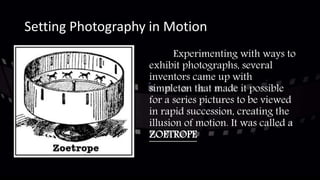
Setting Photography in Motion
Experimenting with ways to
exhibit photographs, several
inventors came up with
simpleton that made it possible
for a series pictures to be viewed
in rapid succession, creating the
illusion of motion. It was called a
ZOETROPE
A wager
Scientific American published a series of pictures
depicting a horse in full gallop, along with instructions to
view them through the Zoetrope.
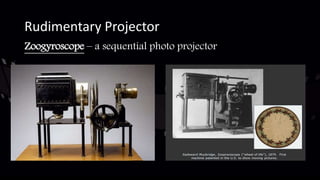
Rudimentary Projector
Zoogyroscope – a sequential photo projector
12 Pictures per Second
Etienne-Jules Marey, studies of
animals in motion drove him to
experiment with photography,
and he fashioned a camera that
could take12 pictures per second
of a moving object. The technique
called chronophotograph.
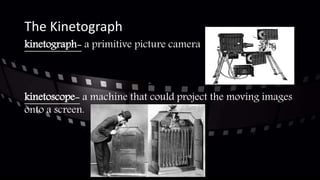
The Kinetograph
kinetograph- a primitive picture camera
kinetoscope- a machine that could project the moving images
onto a screen.
Everyday Images
Cinematography- a projector that could show 16 frames per
second.
Types of Motion Pictures
• Documentary mode in corporate those films relying
primarily on cinemas power to relay events in the world.
• Experimental includes the variety of approaches that have
listed and played with the technological limits and capabilities
of the medium, Including animated (non-photographic) and
computer generated images.
• Fictional this film is based on imagination of the writer of
the film. The characters and events help convince the
audience that the film is real. The audience assume that the
characters and the events is really happening in the reality.
Essential Characteristics of Motion Pictures
Intensity, intimacy, ubiquity
Its intensity derives from its power to hold the complete
attention of the spectator on whatever bit of reality is being shown.
The intimacy of the film image is related to the camera's ability
to see things in greater detail than the eye can.
The impression of ubiquity - being everywhere at once is
achieved in part by the camera's apparent freedom to move from place
to place or to approach or withdraw
Particularity
The language of words lends itself to generalization and
abstraction. Motion pictures, on the other hand, only show
particular things and may also be ambiguous in that it shows
but does not explain.
Neutrality
The world people see around them is strongly
influenced by their emotions and their interests.
What are the Advantages of
Motion Picture?
1. Compel attention
2. Make experience firsthand
3. Edited version of reality
4. Make distant past and present real in the class room
5. Can control time-factor
6. Offers common denominator of experience
7. Can influence and even change attitudes
8. Bring variety into the class room
Role of teacher
1. Select proper film
2. Check everything before showing film
3. Preview film
4. Present film
What are the Disadvantages of
Motion Picture?
• Fixed Pace - cannot be interrupted.
• Still Phenomena - motion picture is sometimes unsuitable to
other topics such as those involving a map, a writing
diagram, etc.
• Misinterpretation - in documentaries and dramatization,
especially, intended messages are quite deep and complex.
• Cost - equipment and materials for motion media are
expensive
Motion pictures

Motion pictures

  • 1.
  • 2.
  • 4.
    What is MotionPicture? Series of still photographs on film, projected in rapid succession onto a screen by means of light. Because of the optical phenomenon known as persistence of vision, this gives the illusion of actual, smooth, and continuous movement The motion picture is a remarkably effective medium in conveying drama and especially in the evocation of emotion.
  • 5.
    A Walk throughthe History of Motion Picture
  • 6.
    Setting Photography inMotion Experimenting with ways to exhibit photographs, several inventors came up with simpleton that made it possible for a series pictures to be viewed in rapid succession, creating the illusion of motion. It was called a ZOETROPE
  • 7.
    A wager Scientific Americanpublished a series of pictures depicting a horse in full gallop, along with instructions to view them through the Zoetrope.
  • 8.
    Rudimentary Projector Zoogyroscope –a sequential photo projector
  • 9.
    12 Pictures perSecond Etienne-Jules Marey, studies of animals in motion drove him to experiment with photography, and he fashioned a camera that could take12 pictures per second of a moving object. The technique called chronophotograph.
  • 10.
    The Kinetograph kinetograph- aprimitive picture camera kinetoscope- a machine that could project the moving images onto a screen.
  • 11.
    Everyday Images Cinematography- aprojector that could show 16 frames per second.
  • 13.
  • 14.
    • Documentary modein corporate those films relying primarily on cinemas power to relay events in the world. • Experimental includes the variety of approaches that have listed and played with the technological limits and capabilities of the medium, Including animated (non-photographic) and computer generated images. • Fictional this film is based on imagination of the writer of the film. The characters and events help convince the audience that the film is real. The audience assume that the characters and the events is really happening in the reality.
  • 15.
    Essential Characteristics ofMotion Pictures Intensity, intimacy, ubiquity Its intensity derives from its power to hold the complete attention of the spectator on whatever bit of reality is being shown. The intimacy of the film image is related to the camera's ability to see things in greater detail than the eye can. The impression of ubiquity - being everywhere at once is achieved in part by the camera's apparent freedom to move from place to place or to approach or withdraw
  • 16.
    Particularity The language ofwords lends itself to generalization and abstraction. Motion pictures, on the other hand, only show particular things and may also be ambiguous in that it shows but does not explain. Neutrality The world people see around them is strongly influenced by their emotions and their interests.
  • 17.
    What are theAdvantages of Motion Picture?
  • 18.
    1. Compel attention 2.Make experience firsthand 3. Edited version of reality 4. Make distant past and present real in the class room 5. Can control time-factor 6. Offers common denominator of experience 7. Can influence and even change attitudes 8. Bring variety into the class room
  • 19.
    Role of teacher 1.Select proper film 2. Check everything before showing film 3. Preview film 4. Present film
  • 20.
    What are theDisadvantages of Motion Picture?
  • 21.
    • Fixed Pace- cannot be interrupted. • Still Phenomena - motion picture is sometimes unsuitable to other topics such as those involving a map, a writing diagram, etc. • Misinterpretation - in documentaries and dramatization, especially, intended messages are quite deep and complex. • Cost - equipment and materials for motion media are expensive