Silent films
Projeccion speed Until the standardization of the projection speed of 24 frames per second for sound films in 1926, silent films were shot at variable speeds, typically anywhere from 16 to 23 frames per second or faster, depending on the year and studio. Sixteen frames per second became the most commonly used speed in the earliest silent films.
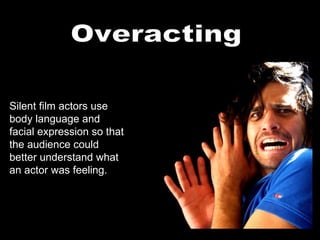
Overacting Silent film actors use body language and facial expression so that the audience could better understand what an actor was feeling.
Music Showings of silent films almost always featured live music, starting with the pianist at the first public projection of movies by the Lumière Brothers on December 28, 1895 in Paris. From the beginning, music was recognized as essential, contributing to the atmosphere and giving the audience vital emotional cues.
Comic situations Silent comedy  refers to a style of acting, related to but distinct from mime, invented to bring comedy into the medium of film in the silent film era (1900s–1920s) before a (synchronized) sound track on film was technologically practicable. Silent comedy is still practiced, albeit much less frequently, but it has influenced comedy in modern media as well.
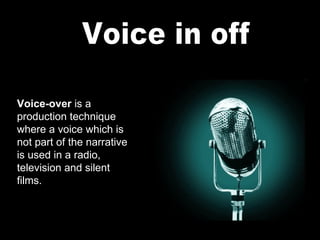
Voice in off Voice-over  is a production technique where a voice which is not part of the narrative is used in a radio, television and silent films.
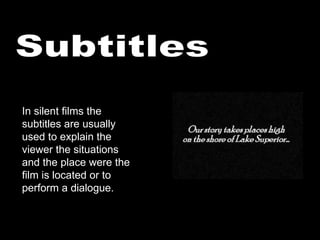
Subtitles In silent films the subtitles are usually used to explain the viewer the situations and the place were the film is located or to perform a dialogue.
David Cabezuelo  and  Sergi Font

Silent film

  • 1.
  • 2.
    Projeccion speed Untilthe standardization of the projection speed of 24 frames per second for sound films in 1926, silent films were shot at variable speeds, typically anywhere from 16 to 23 frames per second or faster, depending on the year and studio. Sixteen frames per second became the most commonly used speed in the earliest silent films.
  • 3.
    Overacting Silent filmactors use body language and facial expression so that the audience could better understand what an actor was feeling.
  • 4.
    Music Showings ofsilent films almost always featured live music, starting with the pianist at the first public projection of movies by the Lumière Brothers on December 28, 1895 in Paris. From the beginning, music was recognized as essential, contributing to the atmosphere and giving the audience vital emotional cues.
  • 5.
    Comic situations Silentcomedy refers to a style of acting, related to but distinct from mime, invented to bring comedy into the medium of film in the silent film era (1900s–1920s) before a (synchronized) sound track on film was technologically practicable. Silent comedy is still practiced, albeit much less frequently, but it has influenced comedy in modern media as well.
  • 6.
    Voice in offVoice-over is a production technique where a voice which is not part of the narrative is used in a radio, television and silent films.
  • 7.
    Subtitles In silentfilms the subtitles are usually used to explain the viewer the situations and the place were the film is located or to perform a dialogue.
  • 8.
    David Cabezuelo and Sergi Font