Introduction to
Motion
Motion is a fundamental concept in physics. It describes the change
in an object's position over time. Understanding motion is crucial for
explaining various phenomena in our daily lives, from the movement
of planets to the flow of traffic.
by shreyash agarwal
Types of Motion
1 Linear Motion
An object moves in a
straight line, with
constant or changing
speed.
2 Rotational Motion
An object moves in a
circular path around a
fixed axis.
3 Periodic Motion
An object repeats its
motion after a fixed time
interval, like a swinging
pendulum.
4 Oscillatory Motion
A special case of
periodic motion where
the object moves back
and forth about a fixed
point, like a vibrating
string.
Uniform Motion
Definition
Motion where an object travels
equal distances in equal intervals
of time, meaning its speed is
constant.
Examples
A car moving at a steady speed on
a straight road, a train traveling at
a constant velocity on a straight
track.
Key Feature
No acceleration, meaning the
velocity remains constant, and the
object doesn't change its speed or
direction.
Non-Uniform Motion
1 Changing Speed
The object accelerates, either increasing or
decreasing its speed over time.
2 Changing Direction
The object changes its path of motion, resulting in a
change in velocity even if the speed remains
constant.
3 Combination
The object simultaneously changes both its speed
and direction, resulting in complex motion.
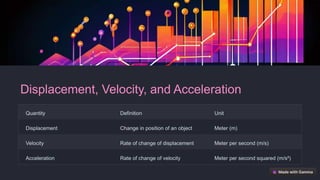
Displacement, Velocity, and Acceleration
Quantity Definition Unit
Displacement Change in position of an object Meter (m)
Velocity Rate of change of displacement Meter per second (m/s)
Acceleration Rate of change of velocity Meter per second squared (m/s²)
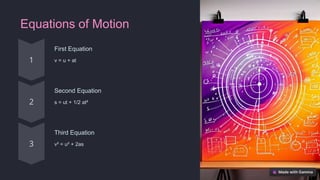
Equations of Motion
First Equation
v = u + at
Second Equation
s = ut + 1/2 at²
Third Equation
v² = u² + 2as
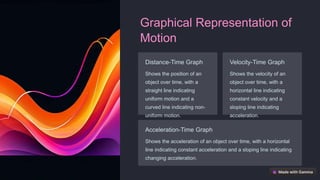
Graphical Representation of
Motion
Distance-Time Graph
Shows the position of an
object over time, with a
straight line indicating
uniform motion and a
curved line indicating non-
uniform motion.
Velocity-Time Graph
Shows the velocity of an
object over time, with a
horizontal line indicating
constant velocity and a
sloping line indicating
acceleration.
Acceleration-Time Graph
Shows the acceleration of an object over time, with a horizontal
line indicating constant acceleration and a sloping line indicating
changing acceleration.
Applications and Real-World
Examples
Vehicle Motion
Understanding motion is essential
for designing and controlling
vehicles.
Space Travel
Motion principles are used to
calculate trajectories and optimize
spacecraft maneuvers.
Sports
Athletes use motion principles to
improve their performance and
techniques.
Earth's Movement
Understanding the motion of the
Earth around the sun explains
seasons and other phenomena.
thankyou
Nilay Mohnot
Kashmir House
3419 9 D

Introduction-to-Motion.pptx mdsfdghdfshgdgs

  • 1.
    Introduction to Motion Motion isa fundamental concept in physics. It describes the change in an object's position over time. Understanding motion is crucial for explaining various phenomena in our daily lives, from the movement of planets to the flow of traffic. by shreyash agarwal
  • 2.
    Types of Motion 1Linear Motion An object moves in a straight line, with constant or changing speed. 2 Rotational Motion An object moves in a circular path around a fixed axis. 3 Periodic Motion An object repeats its motion after a fixed time interval, like a swinging pendulum. 4 Oscillatory Motion A special case of periodic motion where the object moves back and forth about a fixed point, like a vibrating string.
  • 3.
    Uniform Motion Definition Motion wherean object travels equal distances in equal intervals of time, meaning its speed is constant. Examples A car moving at a steady speed on a straight road, a train traveling at a constant velocity on a straight track. Key Feature No acceleration, meaning the velocity remains constant, and the object doesn't change its speed or direction.
  • 4.
    Non-Uniform Motion 1 ChangingSpeed The object accelerates, either increasing or decreasing its speed over time. 2 Changing Direction The object changes its path of motion, resulting in a change in velocity even if the speed remains constant. 3 Combination The object simultaneously changes both its speed and direction, resulting in complex motion.
  • 5.
    Displacement, Velocity, andAcceleration Quantity Definition Unit Displacement Change in position of an object Meter (m) Velocity Rate of change of displacement Meter per second (m/s) Acceleration Rate of change of velocity Meter per second squared (m/s²)
  • 6.
    Equations of Motion FirstEquation v = u + at Second Equation s = ut + 1/2 at² Third Equation v² = u² + 2as
  • 7.
    Graphical Representation of Motion Distance-TimeGraph Shows the position of an object over time, with a straight line indicating uniform motion and a curved line indicating non- uniform motion. Velocity-Time Graph Shows the velocity of an object over time, with a horizontal line indicating constant velocity and a sloping line indicating acceleration. Acceleration-Time Graph Shows the acceleration of an object over time, with a horizontal line indicating constant acceleration and a sloping line indicating changing acceleration.
  • 8.
    Applications and Real-World Examples VehicleMotion Understanding motion is essential for designing and controlling vehicles. Space Travel Motion principles are used to calculate trajectories and optimize spacecraft maneuvers. Sports Athletes use motion principles to improve their performance and techniques. Earth's Movement Understanding the motion of the Earth around the sun explains seasons and other phenomena.
  • 9.