Skip to main content
Recommended
PPTX
UPDATED DAY 1 - INTRO TO TRANSLATIONAL AND ROTATIONAL MOTION.pptx
PPTX
Simple_and_Compound_Machines_with_Images.pptx
PPTX
inbound8356427127086896501.pptxjshsbdbdbsbsbsb
PPTX
Lesson 5 Motion_Lesson_Presentation.pptx
PPTX
General Science_Lecture 3.pptxxxxxxxxxxxxxxxxxxxxxx
PPTX
SOUND-AND-LIGHT ........................
PPTX
PDF
PHYSICS-IN-DAILY-LIFE (explanations on we do it)
PPTX
Simple and Compound Machine bjkkkkkkk.pptx
PDF
Hydraulic-Systems PPT ABOUT HYDRAULICSYSYTEMS
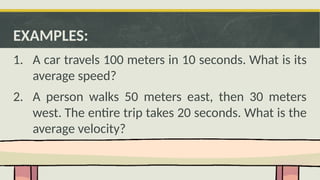
PPTX
Translational and Rotational Motion.pptx
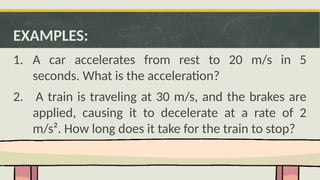
PPTX
Comparing Translational and Rotational Motion.pptx
PPTX
Connecting Linear and Angular Quantities in Human Movement.pptx
PPTX
General Science-Lesson 12 Safety practices
PPTX
Understanding Hydraulic Systems: Fluid Power Principles and Applications
PPTX
The Physics of Fluids_Gen Science.pptxThe Physics of Fluids_Gen Science.pptx
PPTX
Exploring Linear and Angular Quantities and Ergonomic Design.pptx
PPTX
Buoyancy, Archimedes' principle, and Pascal's.pptx
PDF
LESSON 4 - HYDRAULICS general science 1st quarter
PPTX
Lesson3. Simple and Compound Machines.pptx
PPTX
Physics in Daily Lifeeeeeeeeeeeeeee.pptx
PPT
Lesson 1_Newton's Laws of Motion.ppt
PPTX
Innovations in Sound and Light Technology.pptx
PPTX
Lesson 4. Efficiency of simple and compound machine.pptx
PDF
G11-General-Science.pdf powerpoint presentation
PPTX
How Physics Enhances Our Quality of Life.pptx
PPT
Projectile Motion Science 9 Quarter 4.ppt
PPTX
Science VII: Quarter I: Lesson 1:Free body diagram
PPTX
Comprehensive Comparative Study of Translational and Rotational Motion in Phy...
PPTX
Comprehensive Exploration of Motion: Principles, Types, and Applications
More Related Content
PPTX
UPDATED DAY 1 - INTRO TO TRANSLATIONAL AND ROTATIONAL MOTION.pptx
PPTX
Simple_and_Compound_Machines_with_Images.pptx
PPTX
inbound8356427127086896501.pptxjshsbdbdbsbsbsb
PPTX
Lesson 5 Motion_Lesson_Presentation.pptx
PPTX
General Science_Lecture 3.pptxxxxxxxxxxxxxxxxxxxxxx
PPTX
SOUND-AND-LIGHT ........................
PPTX
PDF
PHYSICS-IN-DAILY-LIFE (explanations on we do it)
What's hot
PPTX
Simple and Compound Machine bjkkkkkkk.pptx
PDF
Hydraulic-Systems PPT ABOUT HYDRAULICSYSYTEMS
PPTX
Translational and Rotational Motion.pptx
PPTX
Comparing Translational and Rotational Motion.pptx
PPTX
Connecting Linear and Angular Quantities in Human Movement.pptx
PPTX
General Science-Lesson 12 Safety practices
PPTX
Understanding Hydraulic Systems: Fluid Power Principles and Applications
PPTX
The Physics of Fluids_Gen Science.pptxThe Physics of Fluids_Gen Science.pptx
PPTX
Exploring Linear and Angular Quantities and Ergonomic Design.pptx
PPTX
Buoyancy, Archimedes' principle, and Pascal's.pptx
PDF
LESSON 4 - HYDRAULICS general science 1st quarter
PPTX
Lesson3. Simple and Compound Machines.pptx
PPTX
Physics in Daily Lifeeeeeeeeeeeeeee.pptx
PPT
Lesson 1_Newton's Laws of Motion.ppt
PPTX
Innovations in Sound and Light Technology.pptx
PPTX
Lesson 4. Efficiency of simple and compound machine.pptx
PDF
G11-General-Science.pdf powerpoint presentation
PPTX
How Physics Enhances Our Quality of Life.pptx
PPT
Projectile Motion Science 9 Quarter 4.ppt
PPTX
Science VII: Quarter I: Lesson 1:Free body diagram
Similar to GenSci-Translational-Motion the same as it
PPTX
Comprehensive Comparative Study of Translational and Rotational Motion in Phy...
PPTX
Comprehensive Exploration of Motion: Principles, Types, and Applications
PPTX
Comprehensive Physics Lesson on Translational and Rotational Motion Applications
PPTX
Comprehensive Guide to Motion: Types, Characteristics, and Real-World Applica...
PPTX
Translational and Rotational Motions.pptx
PPTX
THE KINEMATICS (GRADE 12 STEM STRAND).pptx
PPTX
PPTX
Motion_Class9_Presentation (CBSE Class 9 presentation on Motion)
PPTX
Introduction to Kinematics
PPTX
Comprehensive Introduction to Kinematics: Motion, Speed, Velocity, and Angula...
PPTX
Kinematics Physics Chapter Grade -9.pptx
PPTX
Introduction to motion for 2º ESO stu.pptx
PPTX
Understanding Motion: Types, Principles, and Real-Life Applications
PDF
Comprehensive Exploration of Translational and Rotational Motion in Grade 11 ...
PPTX
KINEMATICS. Describes motion in terms of displacements, velocity and accelera...
PDF
Chapter-4-Describing-Motion-Around-Us.pdf/Class 9 Science | Study Revision No...
PPTX
Introduction to Motion for Grade 8 Physics Students.pptx
PPTX
Comprehensive Overview of Translational and Rotational Motion Principles and ...
PDF
Ch 8 Motion 1 SET2.pdf important for class
PPTX
Recently uploaded
PPTX
Religious_Secular_Architecture of Ancient India
PDF
Comprehensive Overview of Artificial Intelligence Fundamentals and Applications
PDF
Comprehensive Guide to DepEd's ILAW Framework for Effective Lesson Planning
PDF
Comprehensive material on Protected cultivation and post-harvest technologies
PDF
Game-Based Learning (RPGBL), Task-Based Language Teaching (TBLT), and generat...
PPTX
Syllabus_World Heritage Sites and Archaeological Monuments in India
PPTX
World Heritage Archaeological Sites & Monuments in India: Cultural, Natural, ...
PDF
Introduction to Databases,E-R model and Relational Model U1
PPTX
Syllabus_Early_Indian_Architecture_MA_Sem1.pptx
PPTX
Geography Grade 11 - Term 3 revision - Development Geography.pptx
PPTX
Design Principles, Elements, and Tools for Effective Manipulative-Based Prese...
PPTX
Making First Impression by Sandeep K Sharma
PDF
Overview of Human Anatomy and Physiology
PPTX
Natural Farming by Neha Nevendra
PPTX
Bertrand Russell and Ludwig Wittgenstein: Foundations of Analytic Philosophy ...
PDF
INDUSTRIAL PHARMACY II (BP702T) UNIT 3 (IP2)
PPTX
Comprehensive Life and Career Skills Exam for Grade 11 Students
PPTX
ppt-guidelines-eligibility-2026-2.pptxHH
PDF
The Atmosphere: An Introduction to Meteorology, 14th Edition pdf
PDF
Revisiting RPGBL Curriculum in the age of AI.pdf
GenSci-Translational-Motion the same as it 1. 2. 3. 4. 5. TRUE OR FALSE?
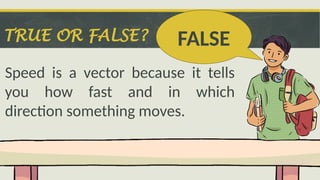
Speed is a vector because it tells
you how fast and in which
direction something moves.
FALSE
6. 7. TRUE OR FALSE?
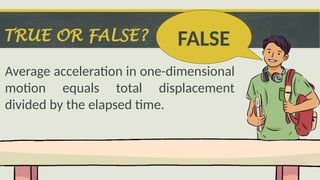
Average acceleration in one-dimensional
motion equals total displacement
divided by the elapsed time.
FALSE
8. TRUE OR FALSE?
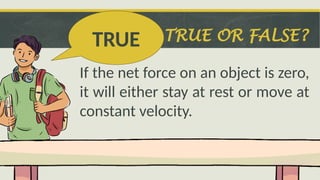
If the net force on an object is zero,
it will either stay at rest or move at
constant velocity.
TRUE
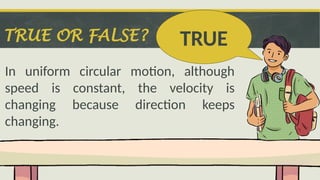
9. 10. 11. TRUE OR FALSE?
In uniform circular motion, although
speed is constant, the velocity is
changing because direction keeps
changing.
TRUE
12. 13. 14. - What do you
observe on the
ball?
- On the box?
15. MOTION
Motion – refers to the action or process
of changing place or position. It describes
how objects move including their speed,
direction and acceleration. It is the
change with time of the position or
orientation of a body
16. 2 TYPES OF MOTION
1. Translational Motion
2. Rotational Motion
17. Translational Motion
Translational motion – refers to the
movement of an object from one point to
another in a straight / curve line. It
involves analyzing activities like jumps
and falls using equations to calculate
distances, heights, and velocities.
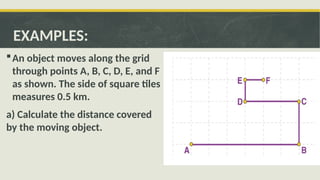
18. 19. EXAMPLES:
An object moves along the grid
through points A, B, C, D, E, and F
as shown. The side of square tiles
measures 0.5 km.
a) Calculate the distance covered
by the moving object.
20. Speed and Velocity
Speed – the rate of change of distance
(distance/time)
Velocity – the rate of change of
displacement (displacement/time)
21. EXAMPLES:
1. A car travels 100 meters in 10 seconds. What is its
average speed?
2. A person walks 50 meters east, then 30 meters
west. The entire trip takes 20 seconds. What is the
average velocity?
22. Acceleration
Acceleration – the rate of change of
velocity (velocity/time)
҉ Acceleration can be positive (speeding up),
negative (slowing down), or zero (constant velocity).
23. EXAMPLES:
1. A car accelerates from rest to 20 m/s in 5
seconds. What is the acceleration?
2. A train is traveling at 30 m/s, and the brakes are
applied, causing it to decelerate at a rate of 2
m/s². How long does it take for the train to stop?
24. 



 Most read
 Most read