Part 3

Leading

Chapter 9

Group Development
and Team Building

Mosley • Pietri
PowerPoint Presentation by Charlie Cook
The University of West Alabama

© 2008 Thomson/South-Western
All rights reserved.
Learning Objectives
Learning Objectives
After reading and studying this chapter, you should
be able to:
1. Identify the stages of group development.
2. Compare the advantages and limitations of groups.
3. Describe the variables that determine a group’s
effectiveness.
4. Determine what is involved in team building.
5. Describe what made team building successful at
Resort Quest.
6. Describe the GE approach.
© 2008 Thomson/SouthWestern. All rights reserved.

9–2
Learning Objectives (cont’d)
After reading and studying this chapter, you should
be able to:
7. Describe what made teambuilding successful in the
nonprofit area.
8. Describe how to work with self-managing work groups.

© 2008 Thomson/SouthWestern. All rights reserved.

9–3
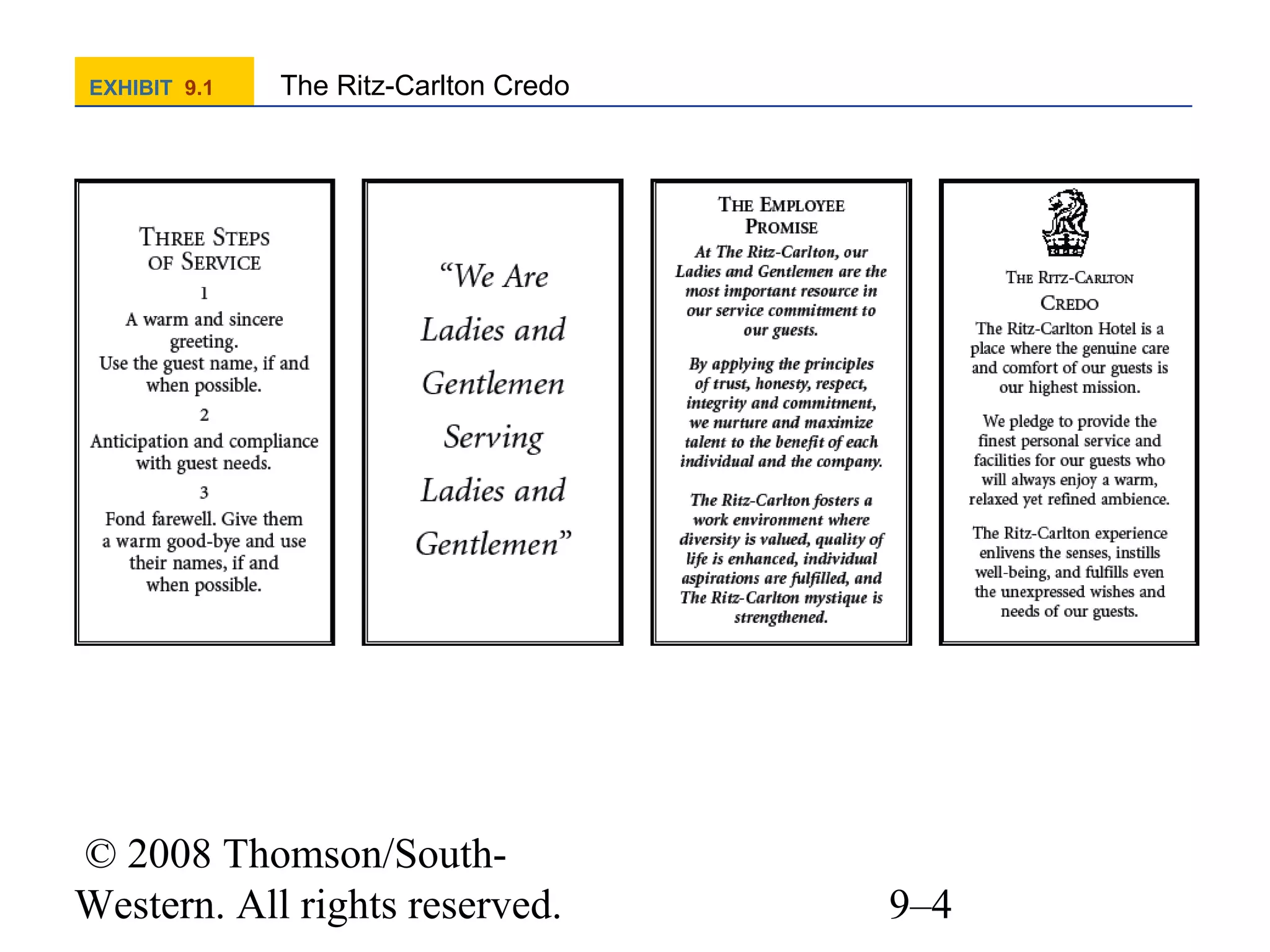
EXHIBIT 9.1

The Ritz-Carlton Credo

© 2008 Thomson/SouthWestern. All rights reserved.

9–4
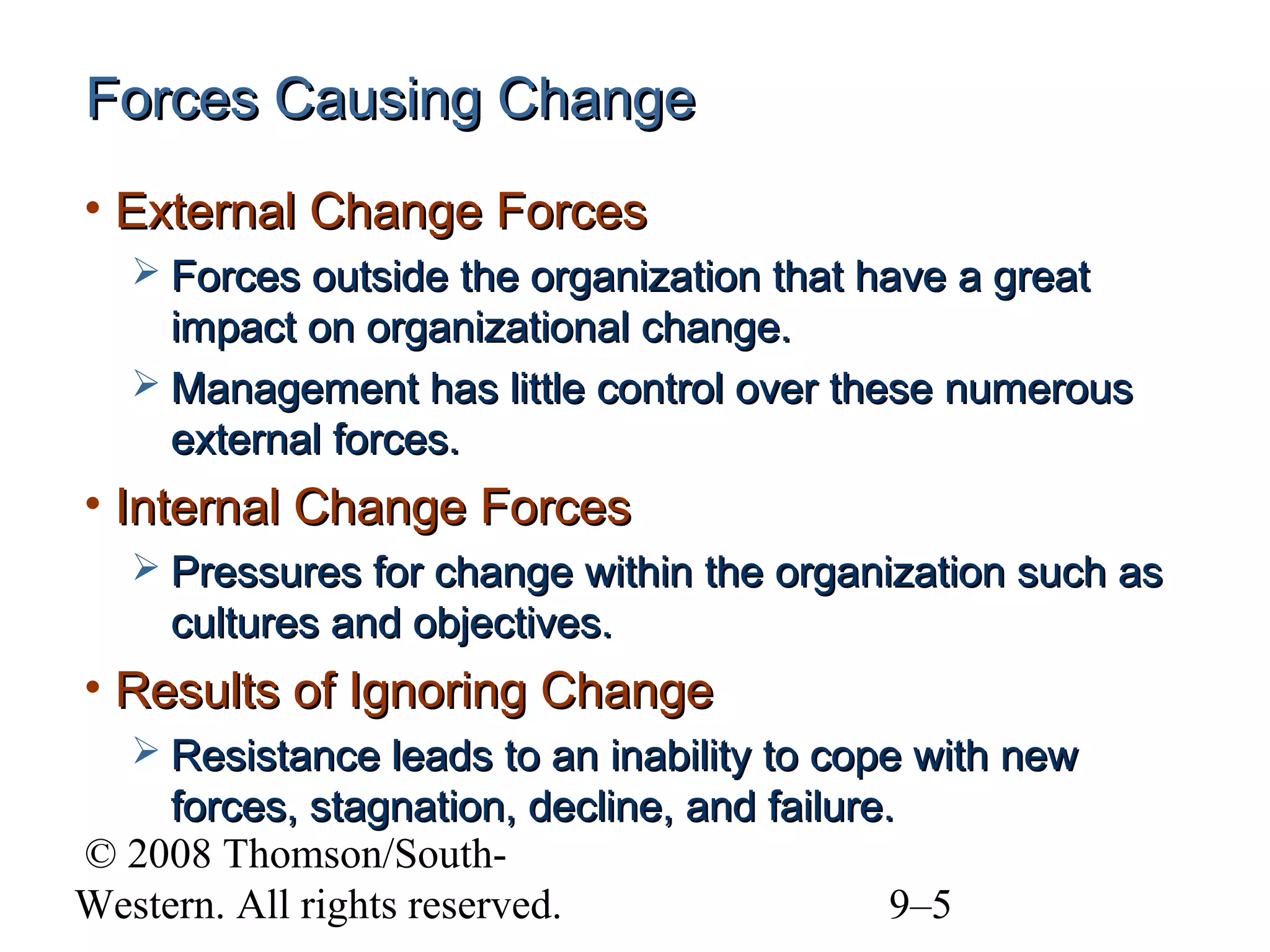
Forces Causing Change
• External Change Forces
 Forces outside the organization that have a great

impact on organizational change.
 Management has little control over these numerous
external forces.

• Internal Change Forces
 Pressures for change within the organization such as

cultures and objectives.

• Results of Ignoring Change
 Resistance leads to an inability to cope with new

forces, stagnation, decline, and failure.
© 2008 Thomson/SouthWestern. All rights reserved.
9–5
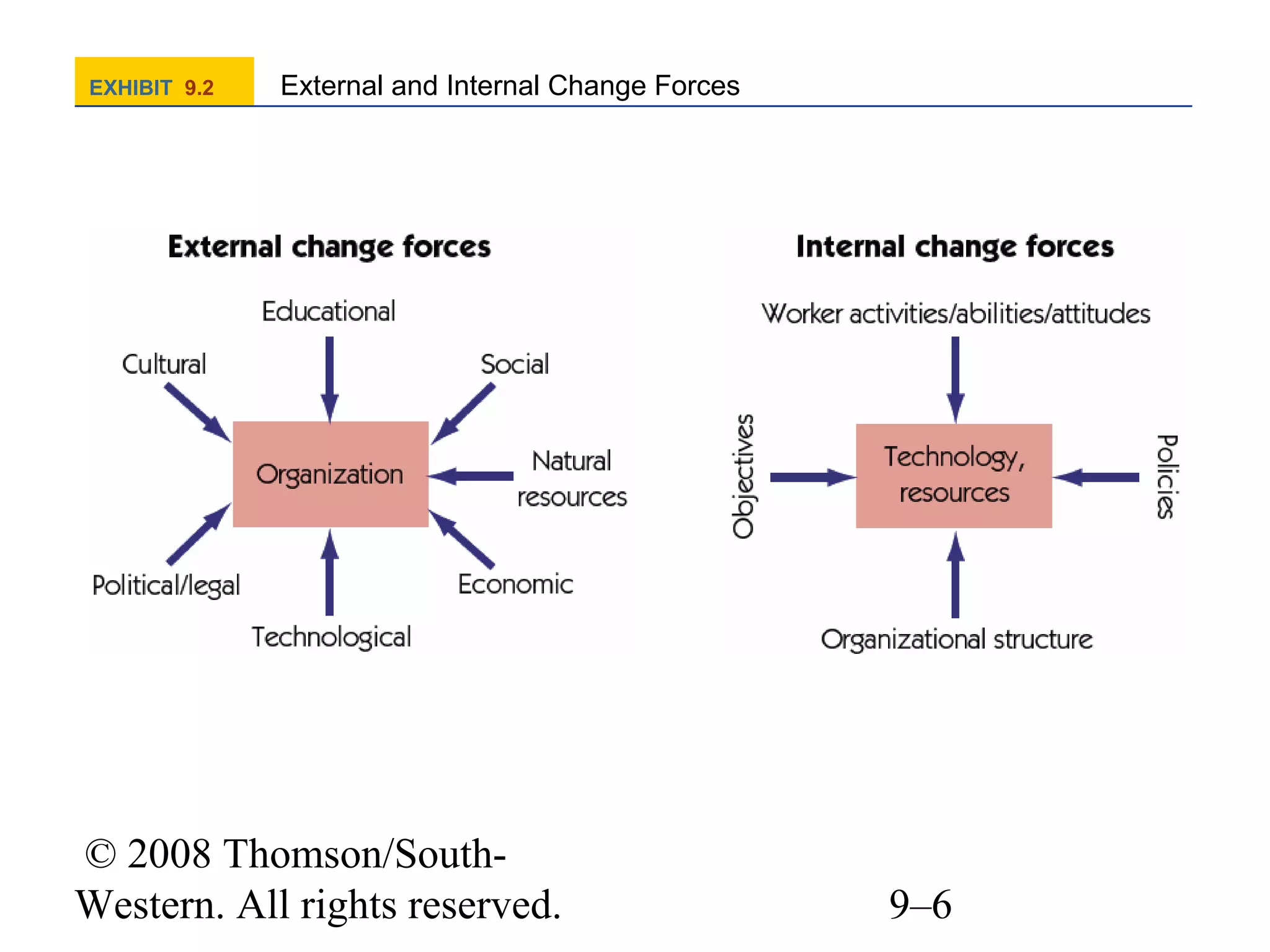
EXHIBIT 9.2

External and Internal Change Forces

© 2008 Thomson/SouthWestern. All rights reserved.

9–6
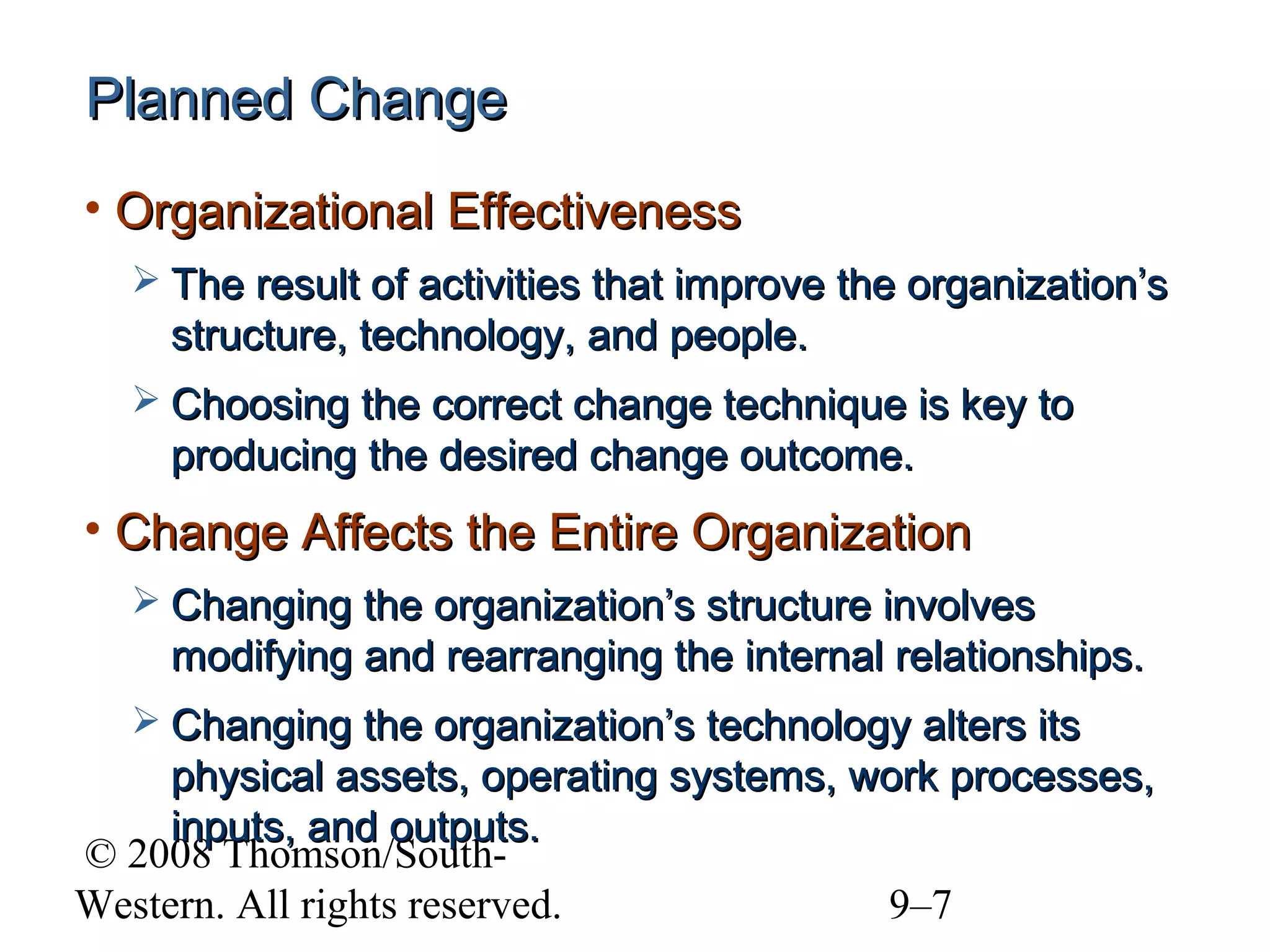
Planned Change
• Organizational Effectiveness
 The result of activities that improve the organization’s

structure, technology, and people.
 Choosing the correct change technique is key to

producing the desired change outcome.

• Change Affects the Entire Organization
 Changing the organization’s structure involves

modifying and rearranging the internal relationships.
 Changing the organization’s technology alters its

physical assets, operating systems, work processes,
inputs, and outputs.
© 2008 Thomson/SouthWestern. All rights reserved.
9–7
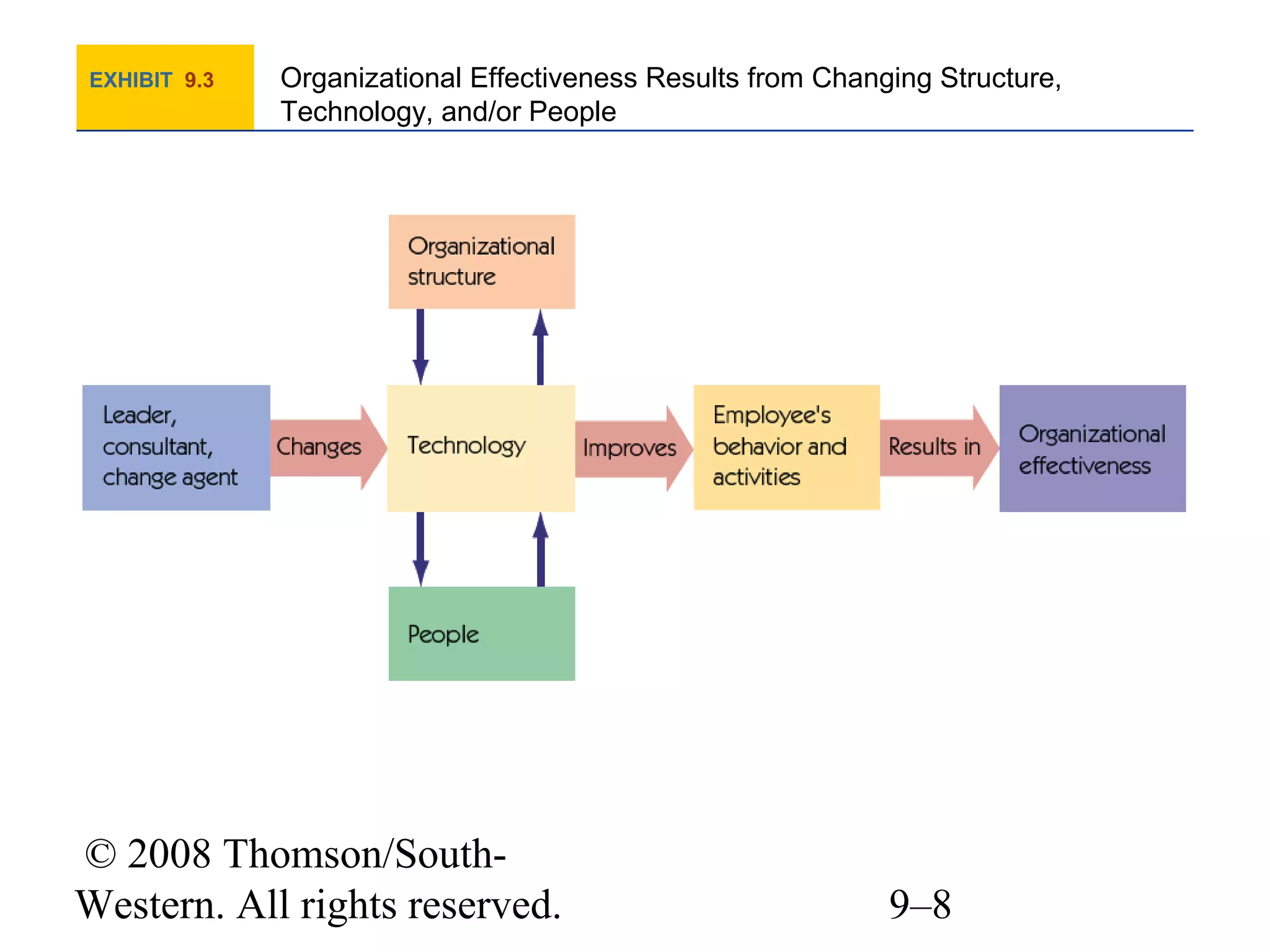
EXHIBIT 9.3

Organizational Effectiveness Results from Changing Structure,
Technology, and/or People

© 2008 Thomson/SouthWestern. All rights reserved.

9–8
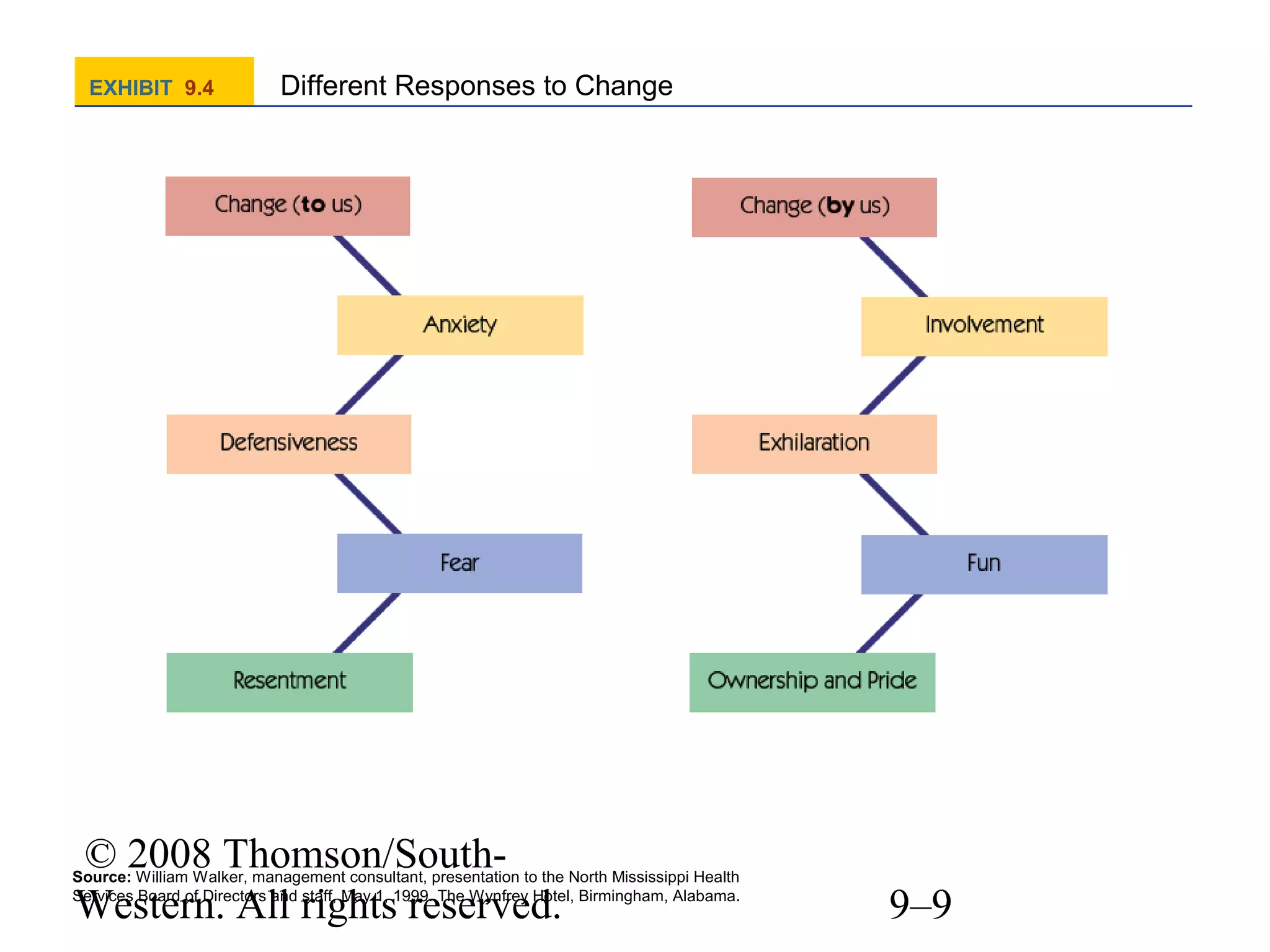
EXHIBIT 9.4

Different Responses to Change

© 2008 Thomson/SouthWestern. All rights reserved.

Source: William Walker, management consultant, presentation to the North Mississippi Health
Services Board of Directors and staff, May 1, 1999. The Wynfrey Hotel, Birmingham, Alabama.

9–9
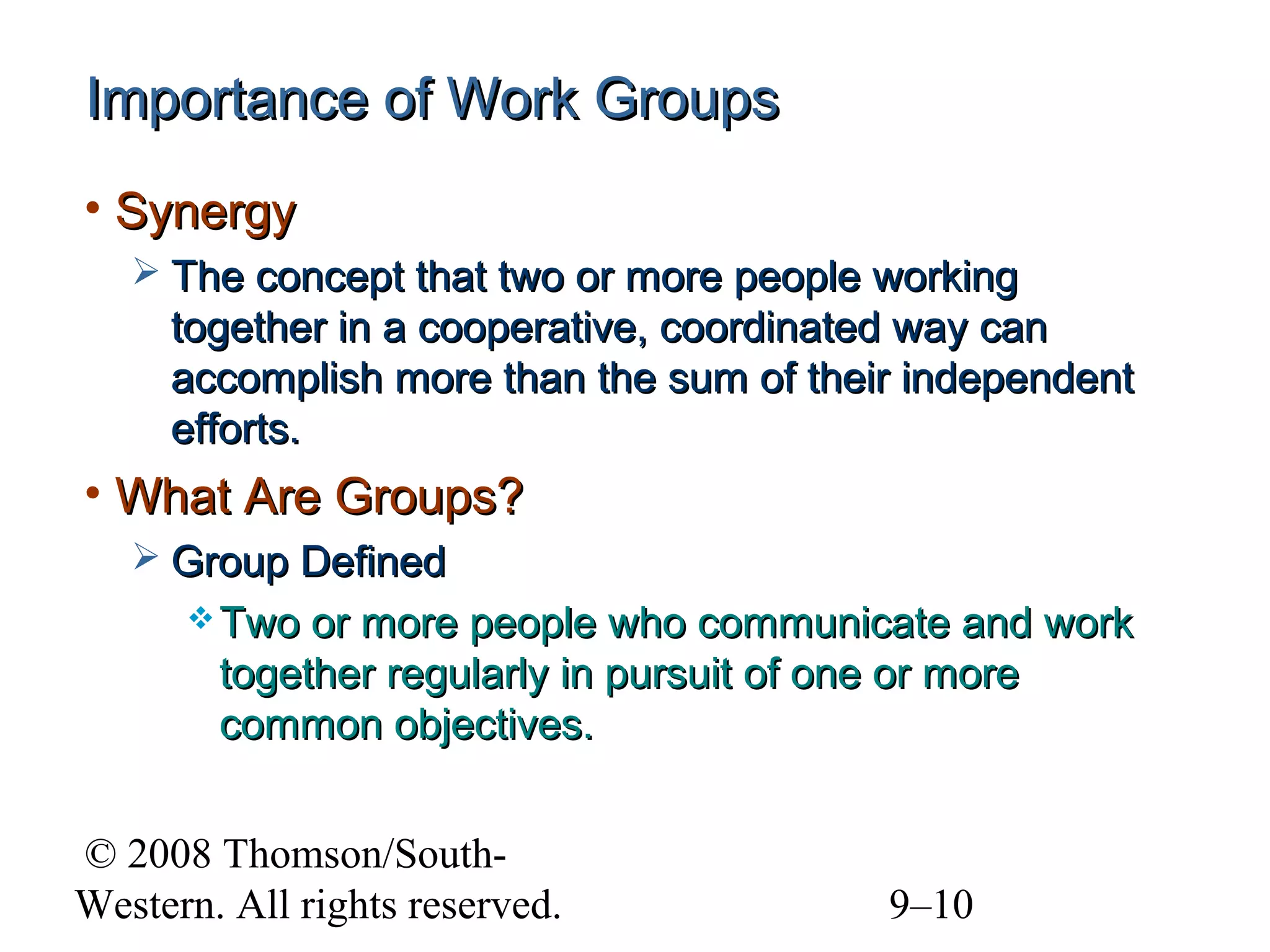
Importance of Work Groups
• Synergy
 The concept that two or more people working

together in a cooperative, coordinated way can
accomplish more than the sum of their independent
efforts.

• What Are Groups?
 Group Defined
 Two

or more people who communicate and work
together regularly in pursuit of one or more
common objectives.

© 2008 Thomson/SouthWestern. All rights reserved.

9–10
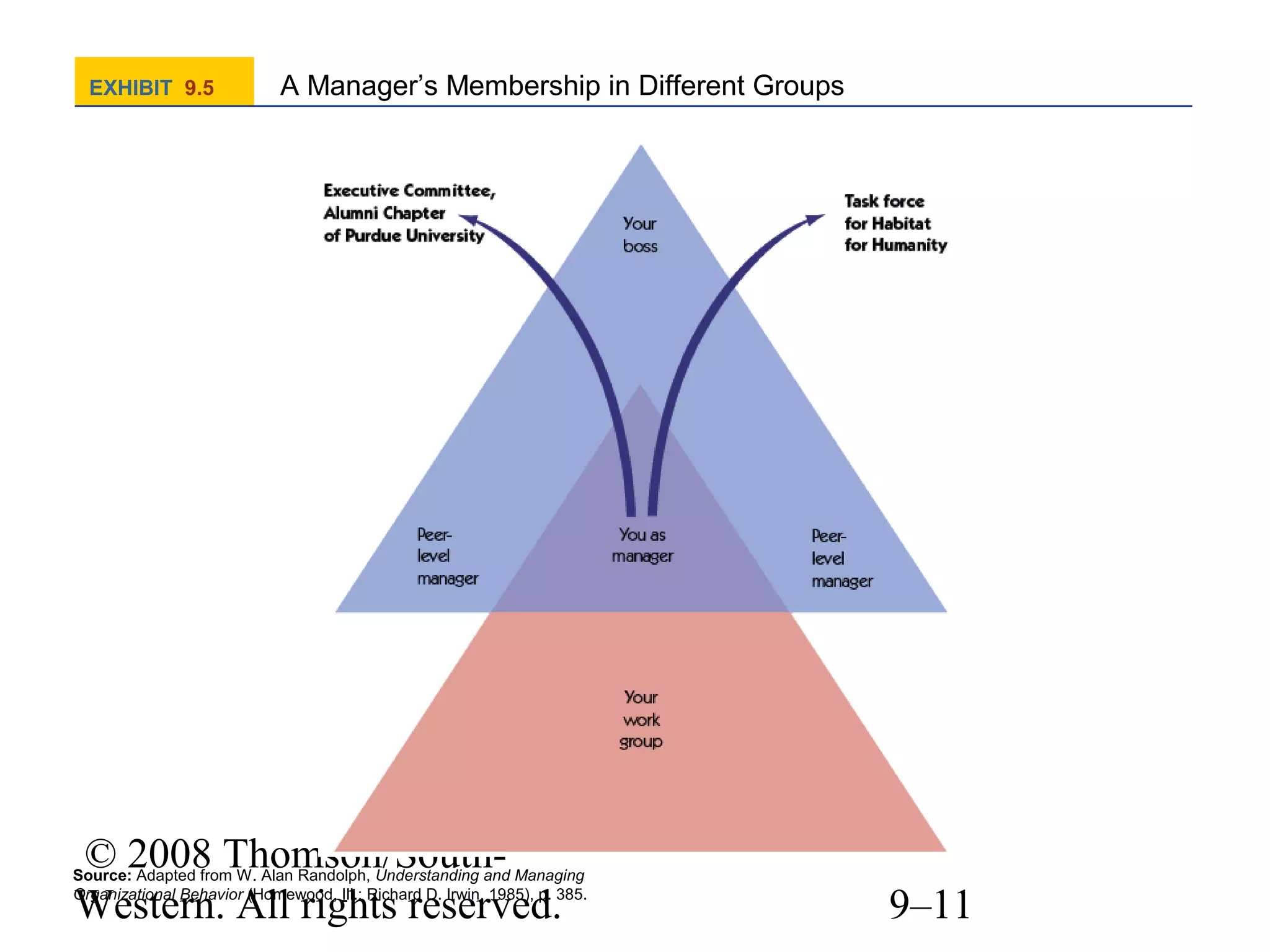
EXHIBIT 9.5

A Manager’s Membership in Different Groups

© 2008 Thomson/SouthWestern. All rights reserved.

Source: Adapted from W. Alan Randolph, Understanding and Managing
Organizational Behavior (Homewood, Ill.: Richard D. Irwin, 1985), p. 385.

9–11
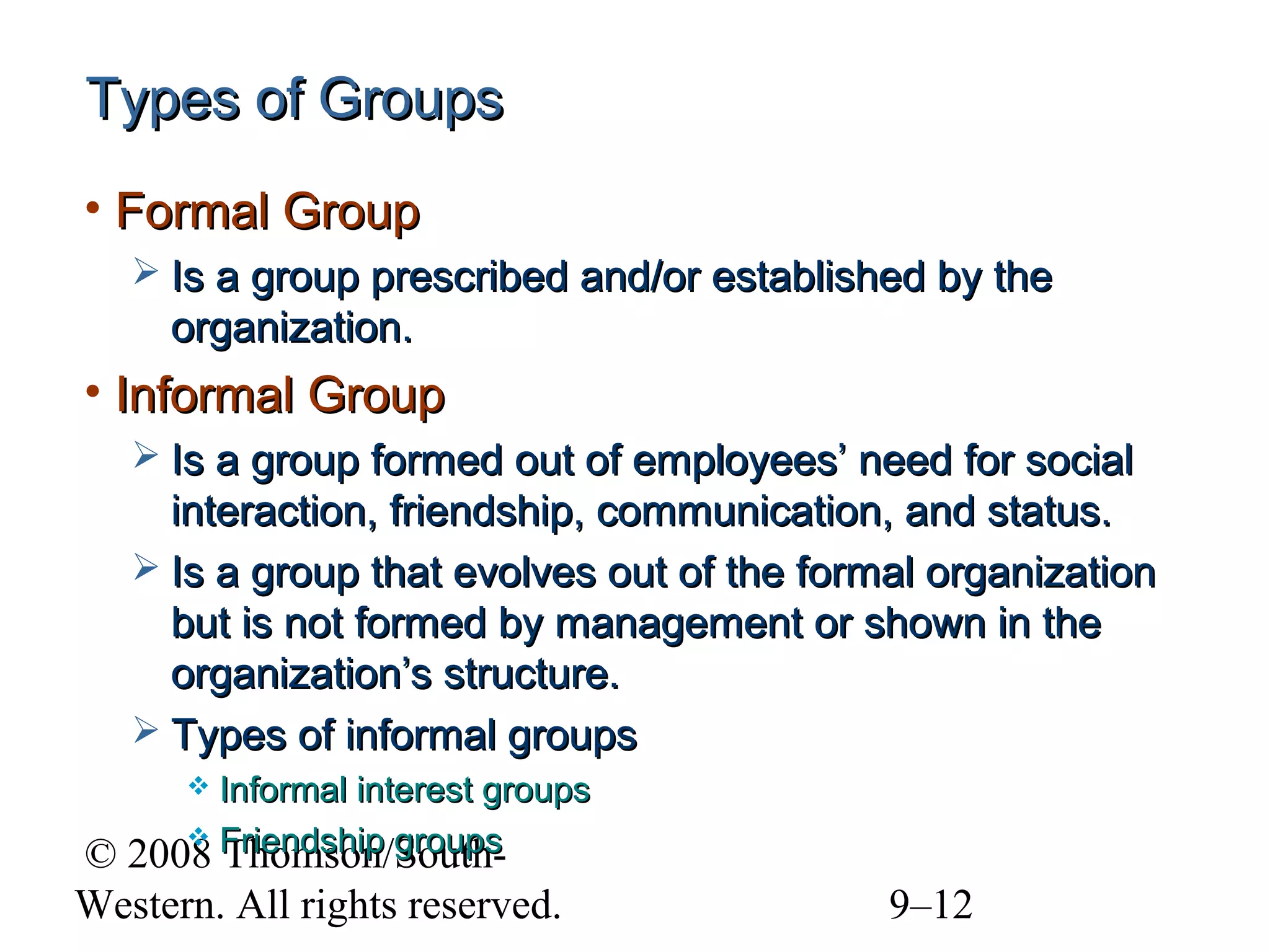
Types of Groups
• Formal Group
 Is a group prescribed and/or established by the

organization.

• Informal Group
 Is a group formed out of employees’ need for social

interaction, friendship, communication, and status.
 Is a group that evolves out of the formal organization
but is not formed by management or shown in the
organization’s structure.
 Types of informal groups
Informal interest groups
 Friendship groups
2008 Thomson/South

©
Western. All rights reserved.

9–12
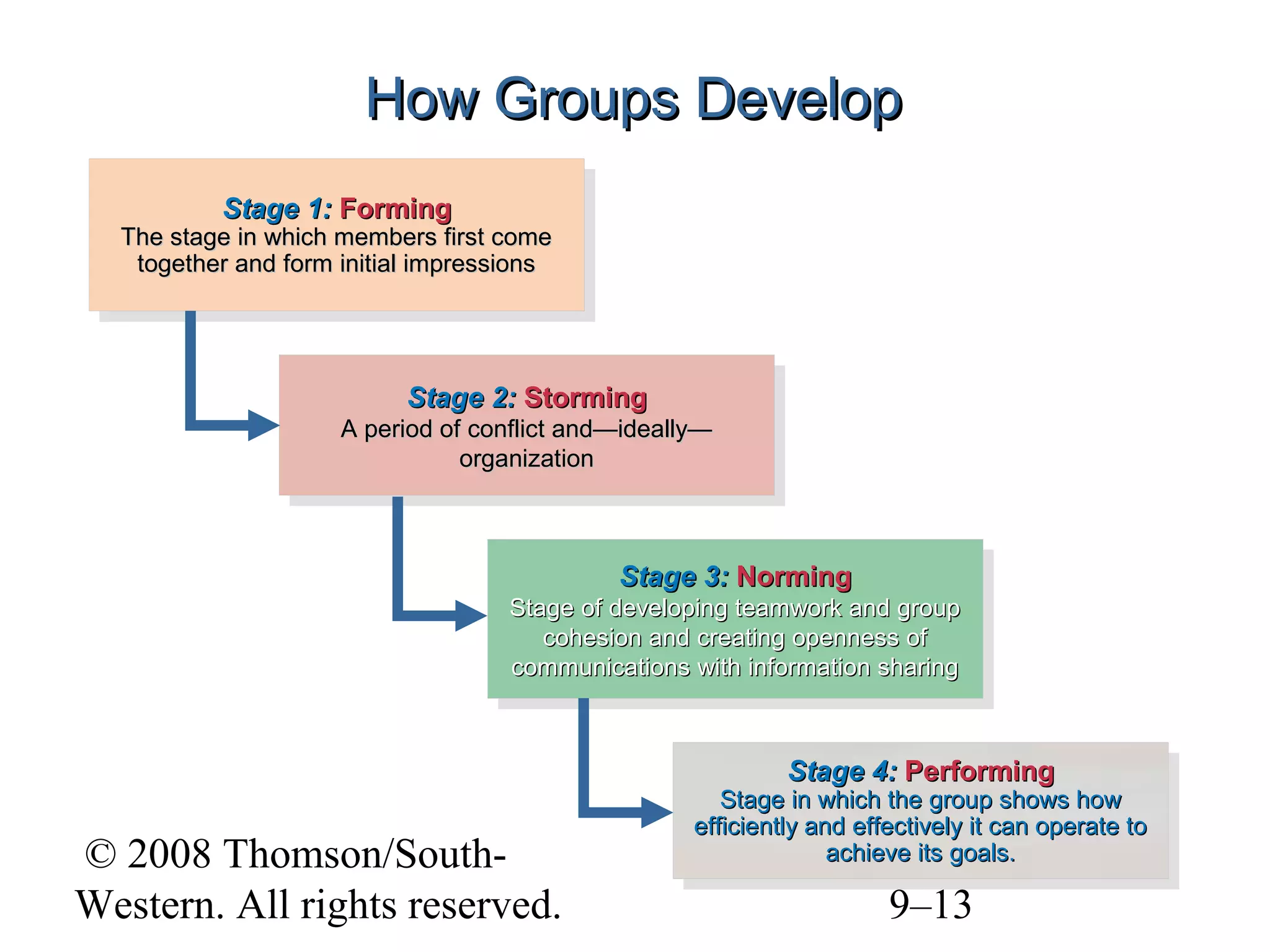
How Groups Develop
Stage 1: Forming
Stage 1: Forming

The stage in which members first come
together and form initial impressions

Stage 2: Storming
Stage 2: Storming

A period of conflict and—ideally—
organization
organization

Stage 3: Norming
Stage 3: Norming

Stage of developing teamwork and group
cohesion and creating openness of
communications with information sharing

Stage 4: Performing
Stage 4: Performing

© 2008 Thomson/SouthWestern. All rights reserved.

Stage in which the group shows how
efficiently and effectively ititcan operate to
efficiently and effectively can operate to
achieve its goals.
achieve its goals.

9–13
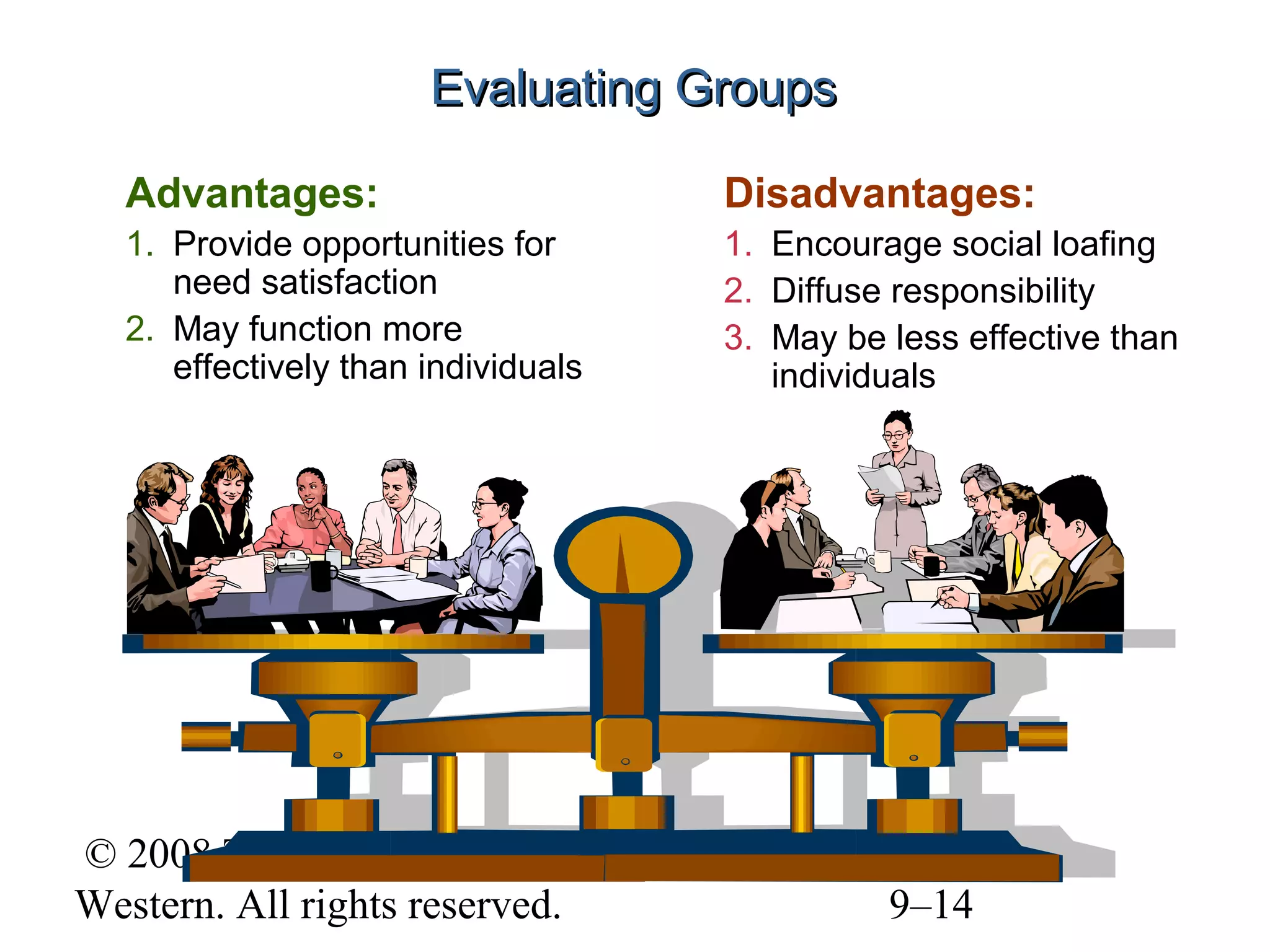
Evaluating Groups
Advantages:

Disadvantages:

1. Provide opportunities for
need satisfaction
2. May function more
effectively than individuals

1. Encourage social loafing
2. Diffuse responsibility
3. May be less effective than
individuals

© 2008 Thomson/SouthWestern. All rights reserved.

9–14
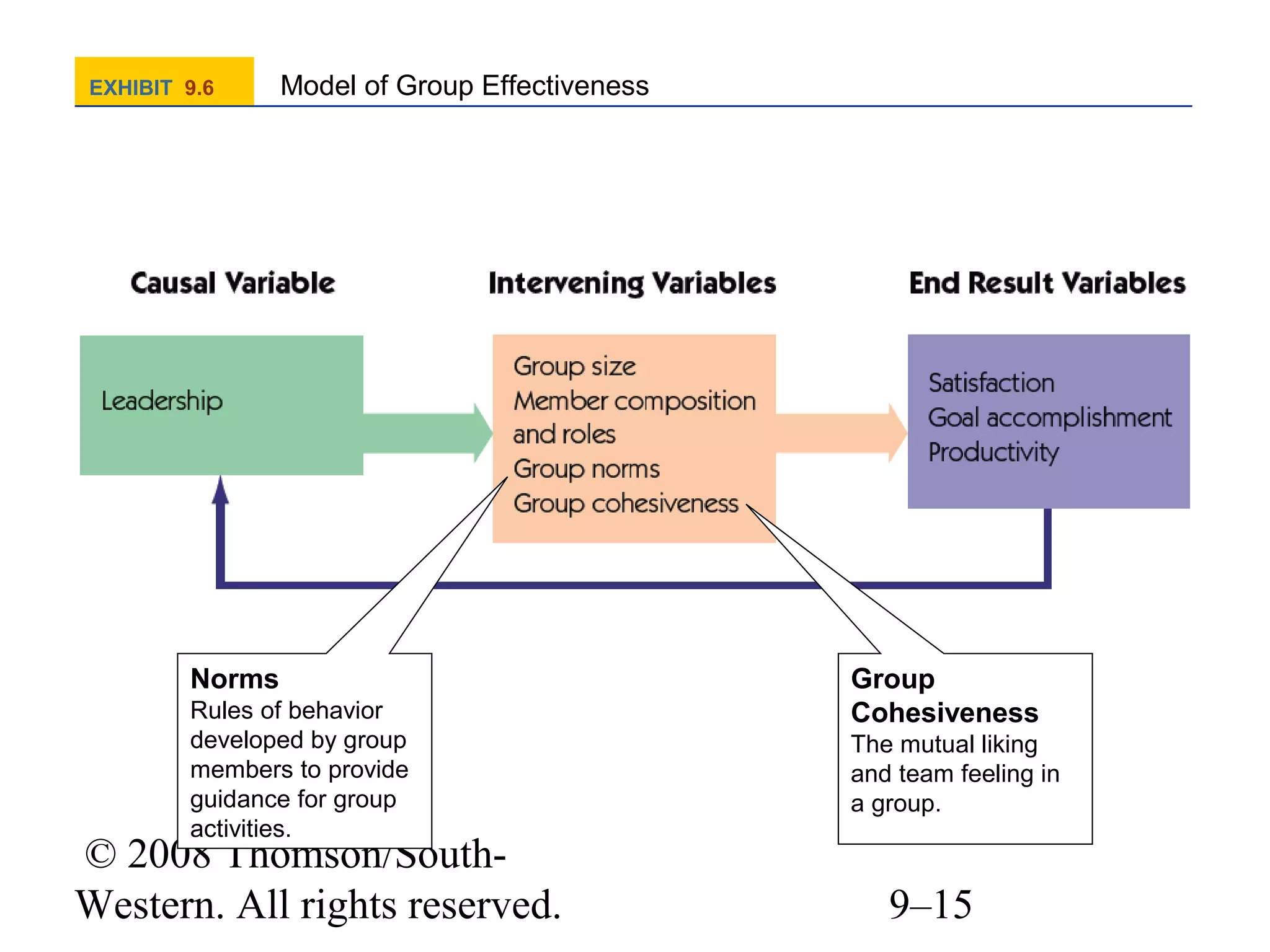
EXHIBIT 9.6

Model of Group Effectiveness

Norms
Rules of behavior
developed by group
members to provide
guidance for group
activities.

© 2008 Thomson/SouthWestern. All rights reserved.

Group
Cohesiveness
The mutual liking
and team feeling in
a group.

9–15
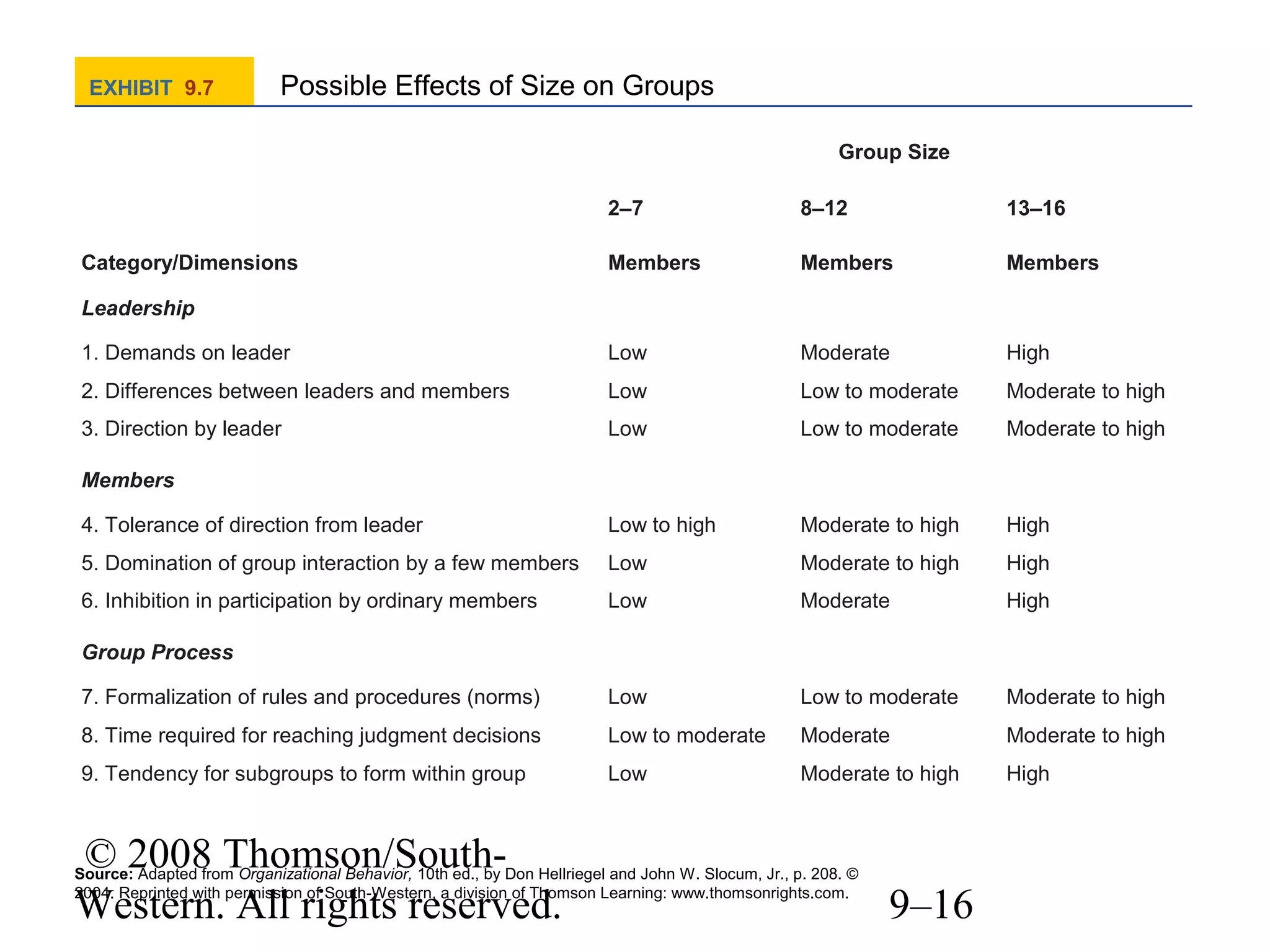
EXHIBIT 9.7

Possible Effects of Size on Groups
Group Size
2–7

8–12

13–16

Members

Members

Members

1. Demands on leader

Low

Moderate

High

2. Differences between leaders and members

Low

Low to moderate

Moderate to high

3. Direction by leader

Low

Low to moderate

Moderate to high

4. Tolerance of direction from leader

Low to high

Moderate to high

High

5. Domination of group interaction by a few members

Low

Moderate to high

High

6. Inhibition in participation by ordinary members

Low

Moderate

High

7. Formalization of rules and procedures (norms)

Low

Low to moderate

Moderate to high

8. Time required for reaching judgment decisions

Low to moderate

Moderate

Moderate to high

9. Tendency for subgroups to form within group

Low

Moderate to high

High

Category/Dimensions
Leadership

Members

Group Process

© 2008 Thomson/SouthWestern. All rights reserved.

Source: Adapted from Organizational Behavior, 10th ed., by Don Hellriegel and John W. Slocum, Jr., p. 208. ©
2004. Reprinted with permission of South-Western, a division of Thomson Learning: www.thomsonrights.com.

9–16
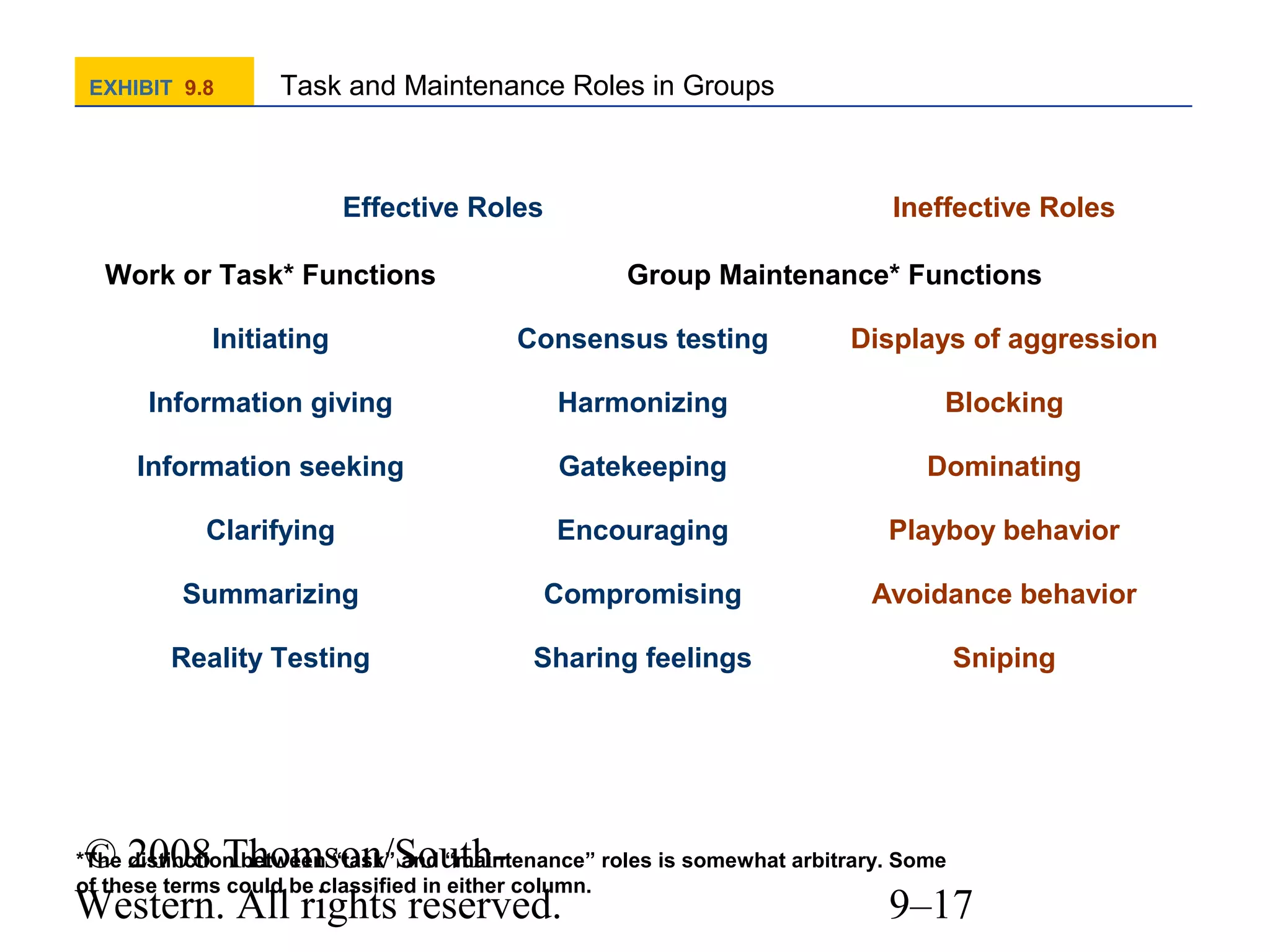
EXHIBIT 9.8

Task and Maintenance Roles in Groups

Effective Roles

Ineffective Roles

Work or Task* Functions

Group Maintenance* Functions

Initiating

Consensus testing

Displays of aggression

Information giving

Harmonizing

Blocking

Information seeking

Gatekeeping

Dominating

Clarifying

Encouraging

Playboy behavior

Summarizing

Compromising

Avoidance behavior

Reality Testing

Sharing feelings

Sniping

© 2008 Thomson/SouthWestern. All rights reserved.

*The distinction between “task” and “maintenance” roles is somewhat arbitrary. Some
of these terms could be classified in either column.

9–17
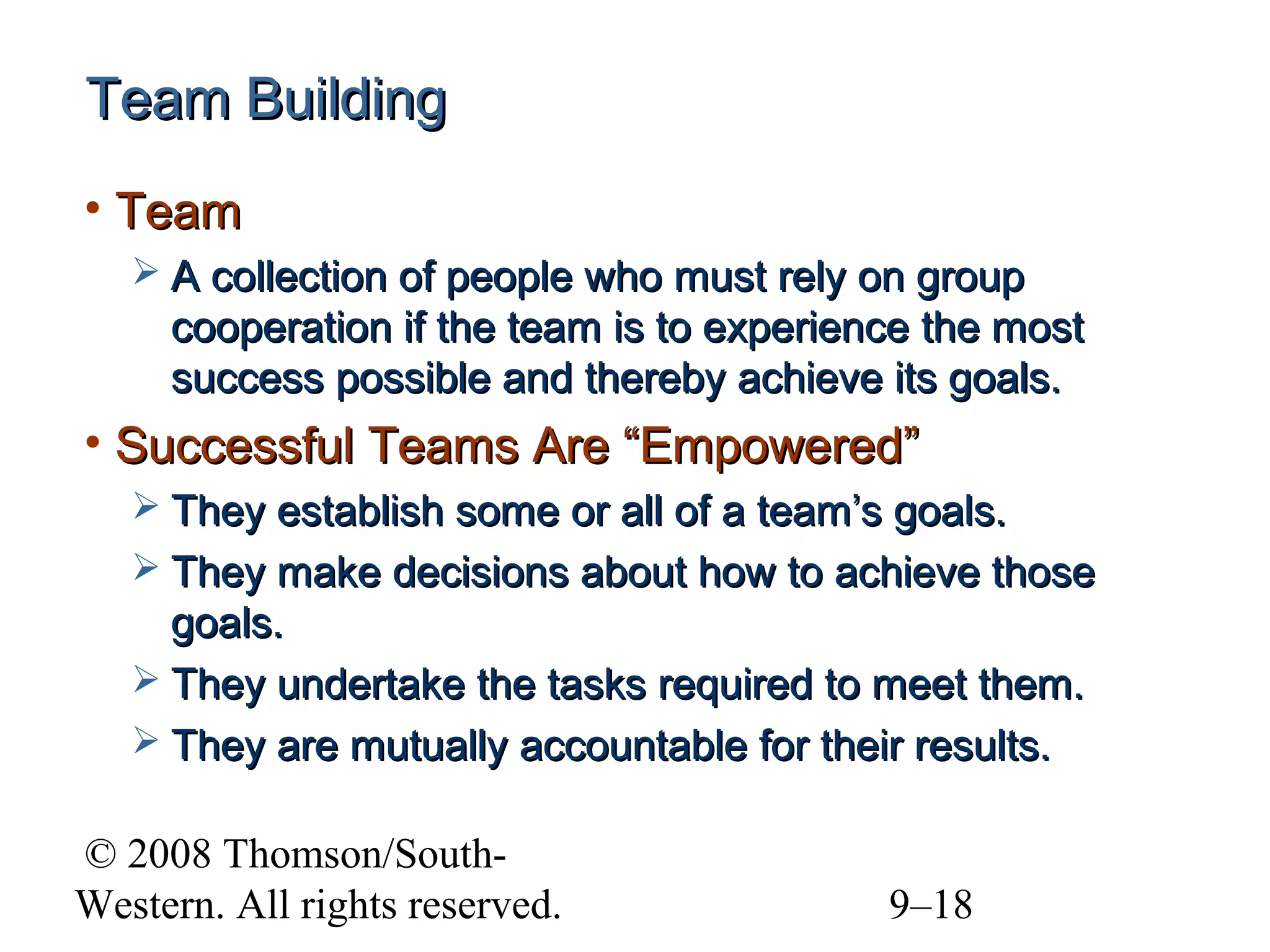
Team Building
• Team
 A collection of people who must rely on group

cooperation if the team is to experience the most
success possible and thereby achieve its goals.

• Successful Teams Are “Empowered”
 They establish some or all of a team’s goals.
 They make decisions about how to achieve those

goals.
 They undertake the tasks required to meet them.
 They are mutually accountable for their results.
© 2008 Thomson/SouthWestern. All rights reserved.

9–18
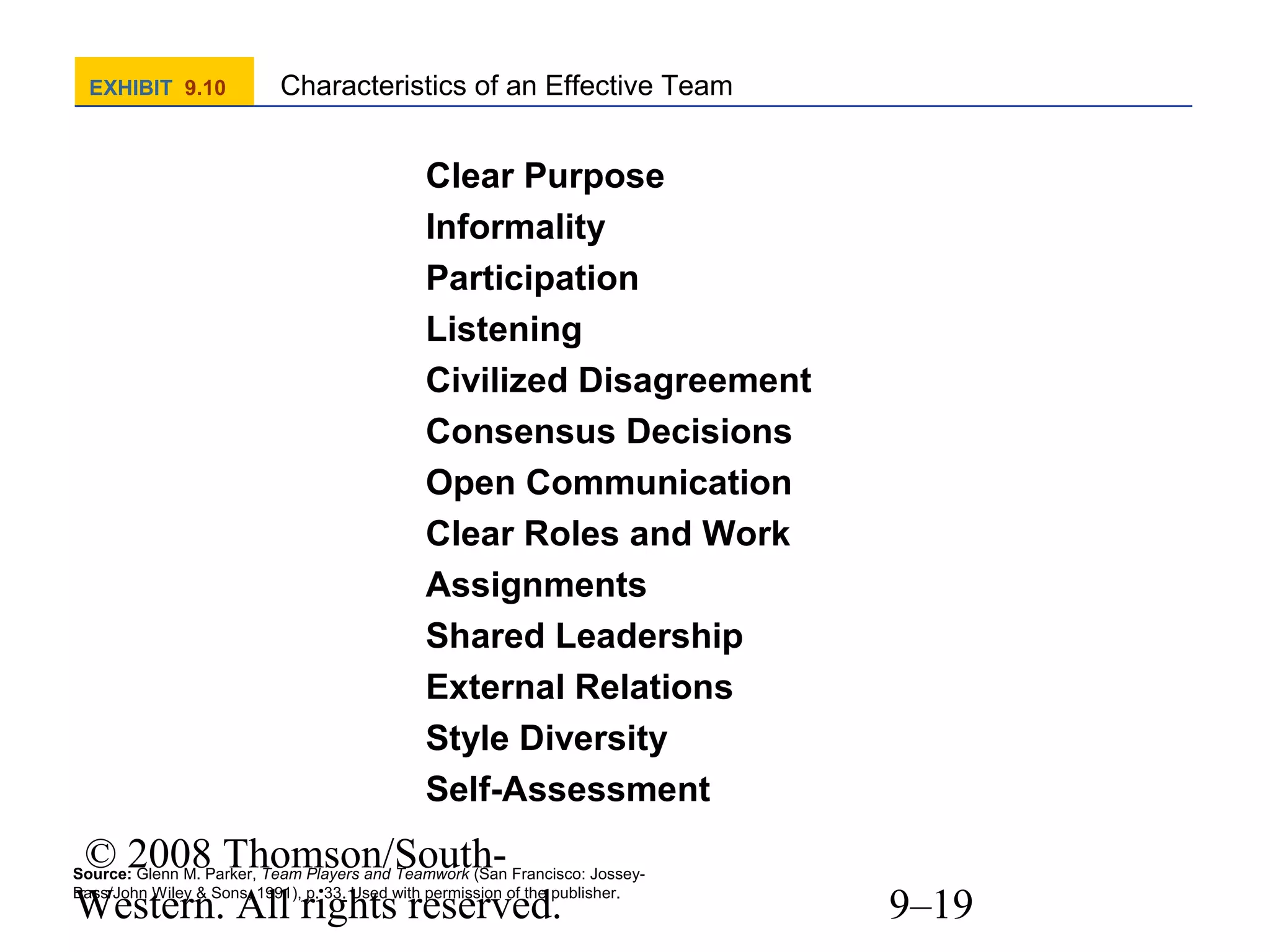
EXHIBIT 9.10

Characteristics of an Effective Team

Clear Purpose
Informality
Participation
Listening
Civilized Disagreement
Consensus Decisions
Open Communication
Clear Roles and Work
Assignments
Shared Leadership
External Relations
Style Diversity
Self-Assessment

© 2008 Thomson/SouthWestern. All rights reserved.

Source: Glenn M. Parker, Team Players and Teamwork (San Francisco: JosseyBass/John Wiley & Sons, 1991), p. 33. Used with permission of the publisher.

9–19
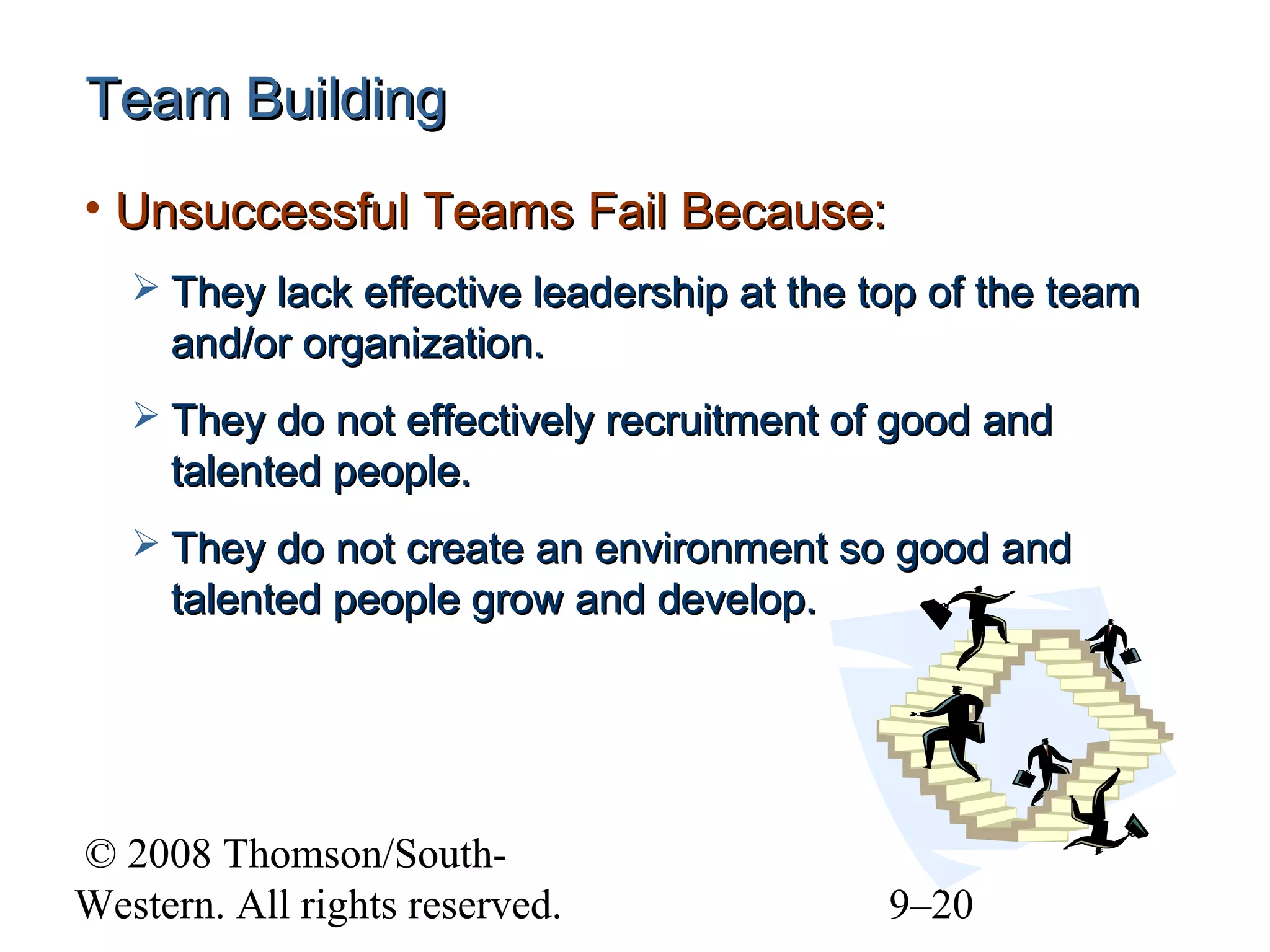
Team Building
• Unsuccessful Teams Fail Because:
 They lack effective leadership at the top of the team

and/or organization.
 They do not effectively recruitment of good and

talented people.
 They do not create an environment so good and

talented people grow and develop.

© 2008 Thomson/SouthWestern. All rights reserved.

9–20
EXHIBIT 9.11

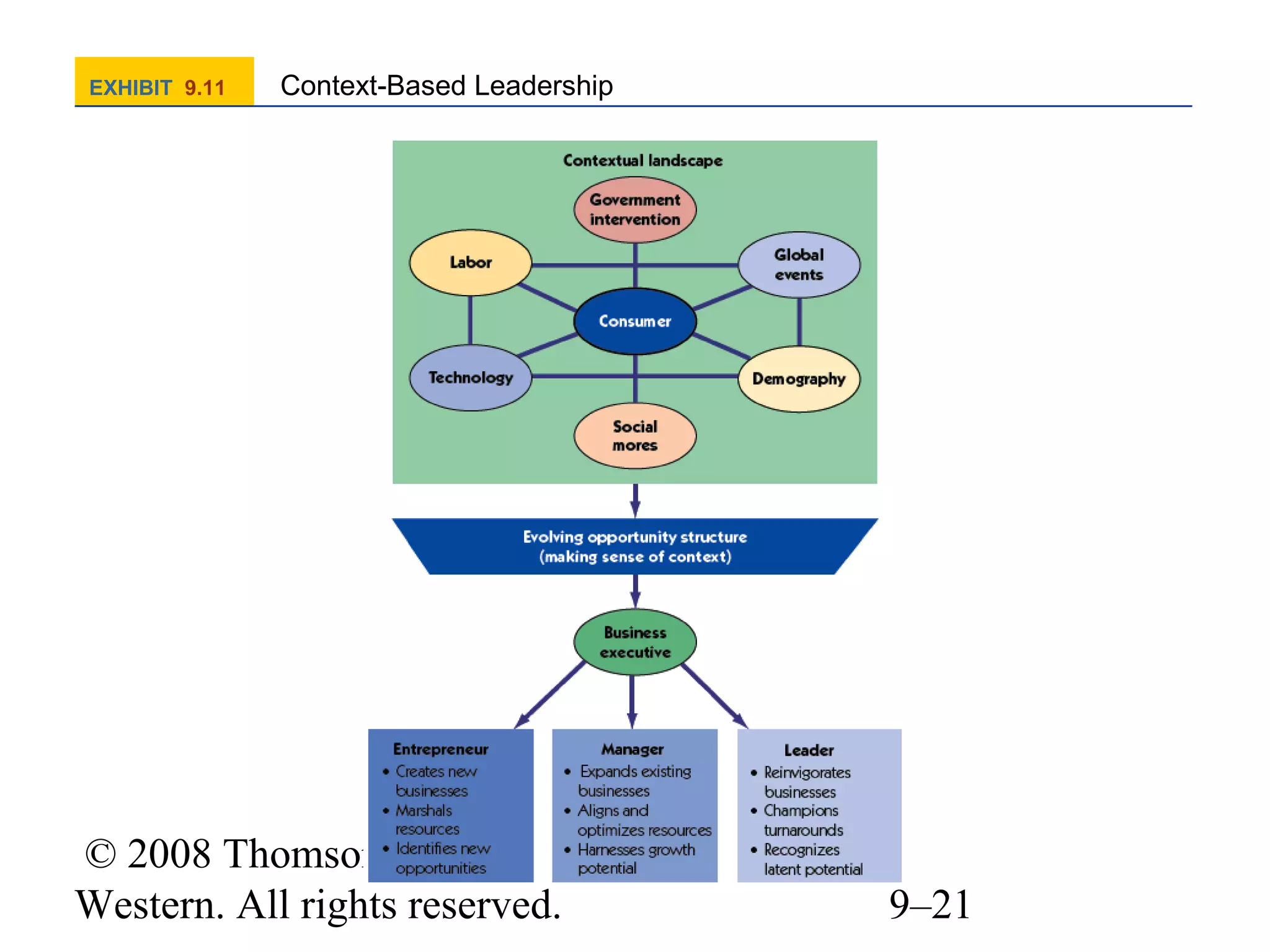
Context-Based Leadership

© 2008 Thomson/SouthWestern. All rights reserved.

9–21
EXHIBIT 9.12

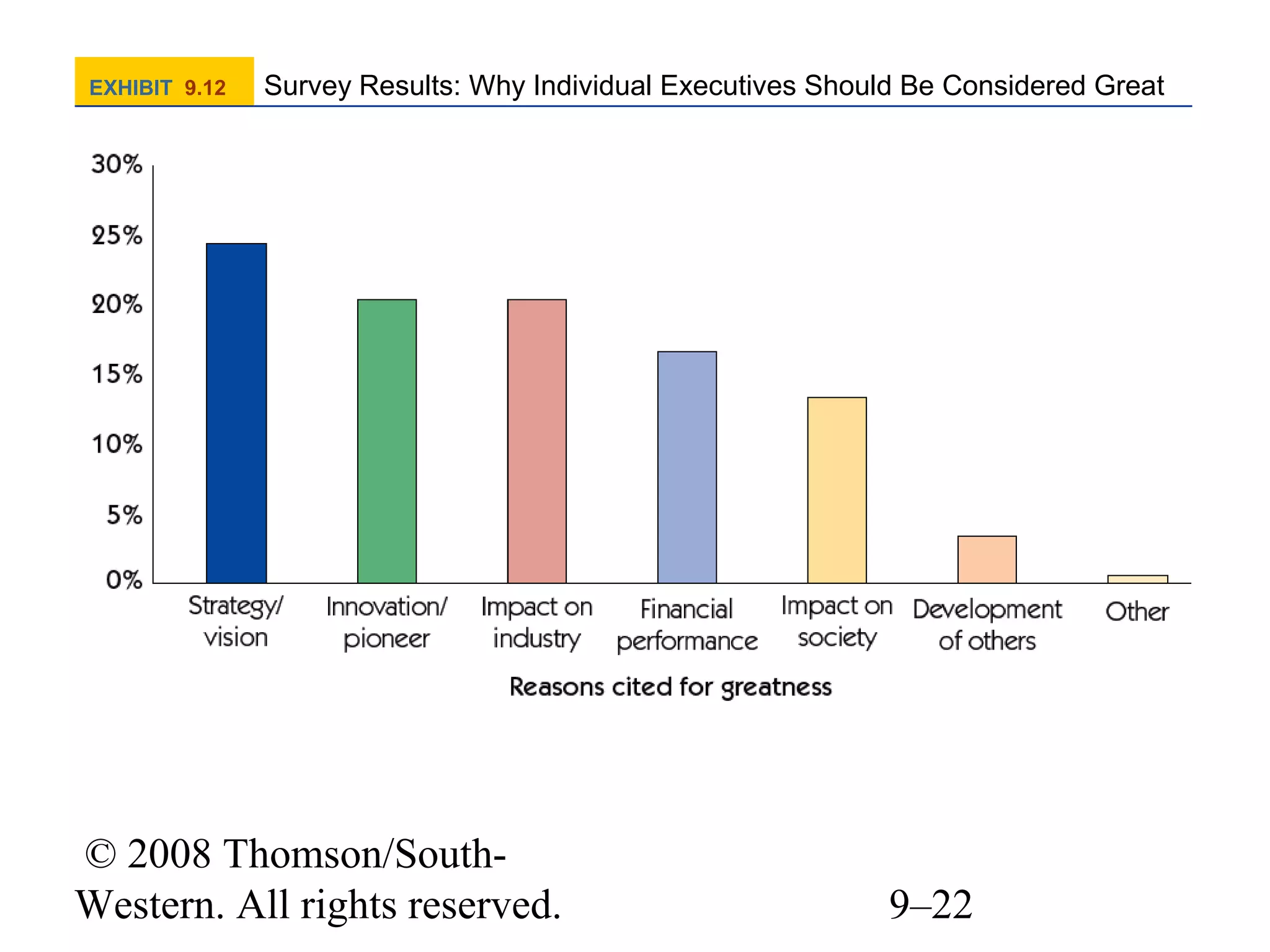
Survey Results: Why Individual Executives Should Be Considered Great

© 2008 Thomson/SouthWestern. All rights reserved.

9–22
EXHIBIT 9.13

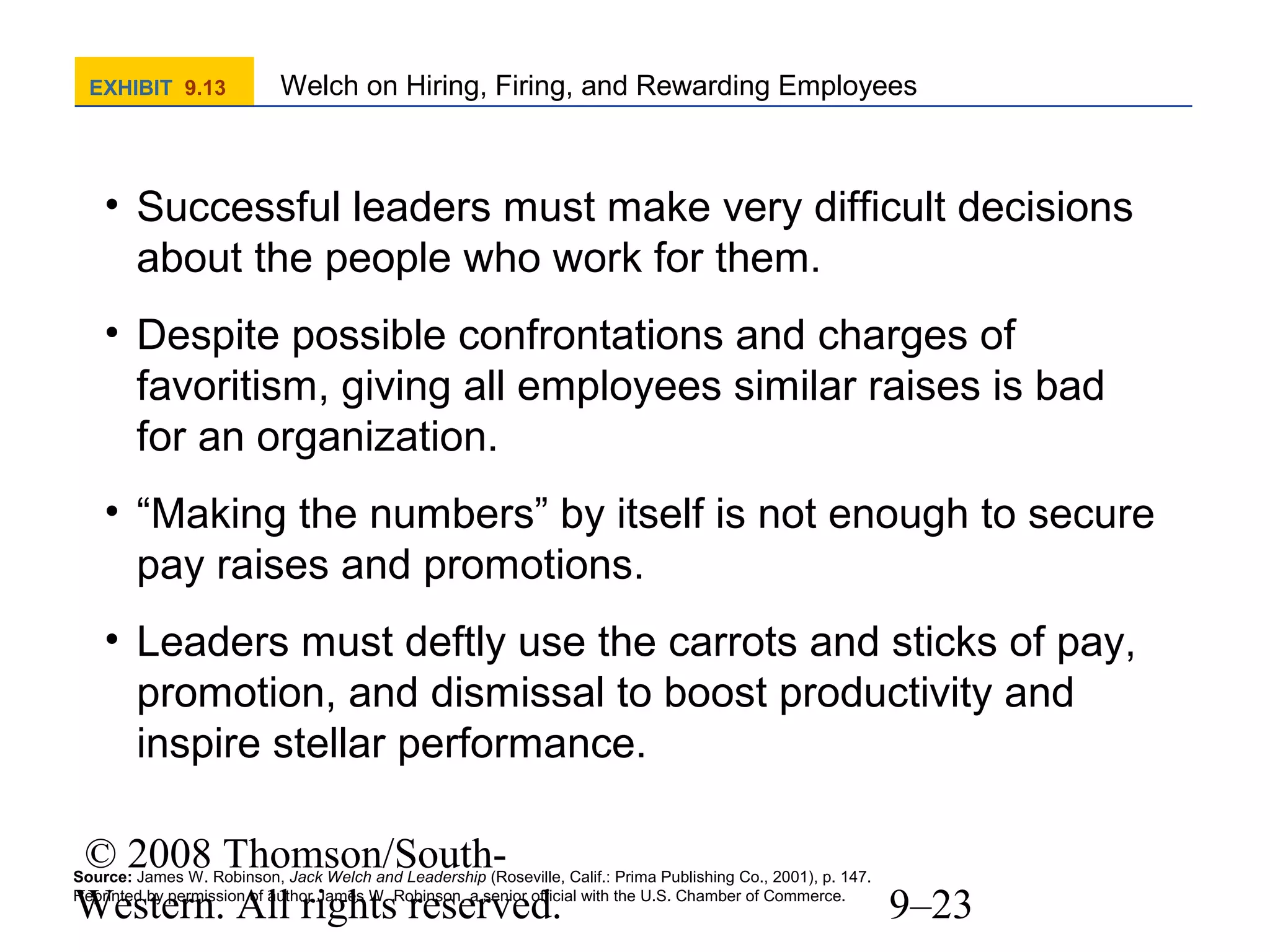
Welch on Hiring, Firing, and Rewarding Employees

• Successful leaders must make very difficult decisions
about the people who work for them.
• Despite possible confrontations and charges of
favoritism, giving all employees similar raises is bad
for an organization.
• “Making the numbers” by itself is not enough to secure
pay raises and promotions.
• Leaders must deftly use the carrots and sticks of pay,
promotion, and dismissal to boost productivity and
inspire stellar performance.
© 2008 Thomson/SouthWestern. All rights reserved.

Source: James W. Robinson, Jack Welch and Leadership (Roseville, Calif.: Prima Publishing Co., 2001), p. 147.
Reprinted by permission of author James W. Robinson, a senior official with the U.S. Chamber of Commerce.

9–23
EXHIBIT 9.14

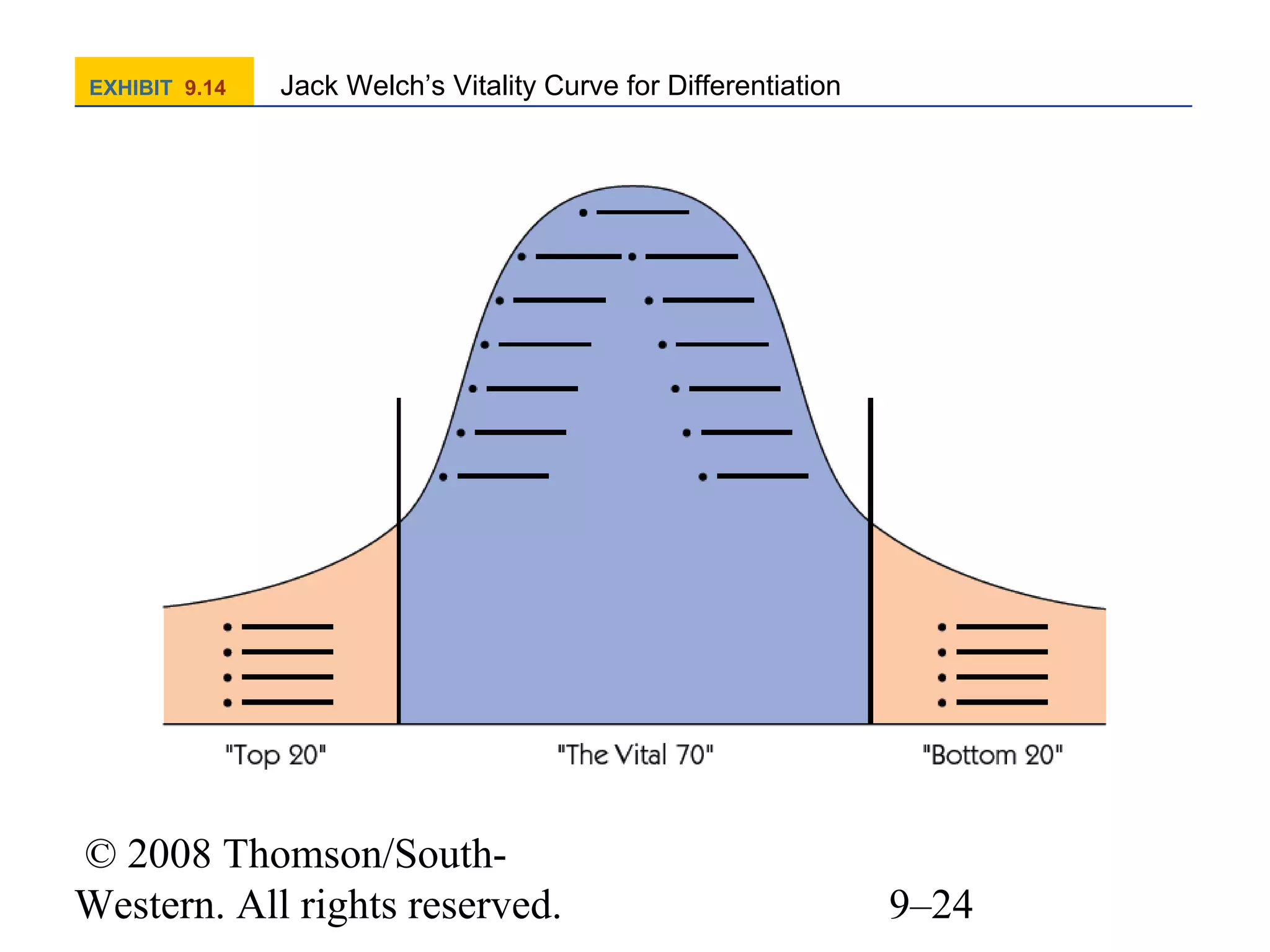
Jack Welch’s Vitality Curve for Differentiation

© 2008 Thomson/SouthWestern. All rights reserved.

9–24
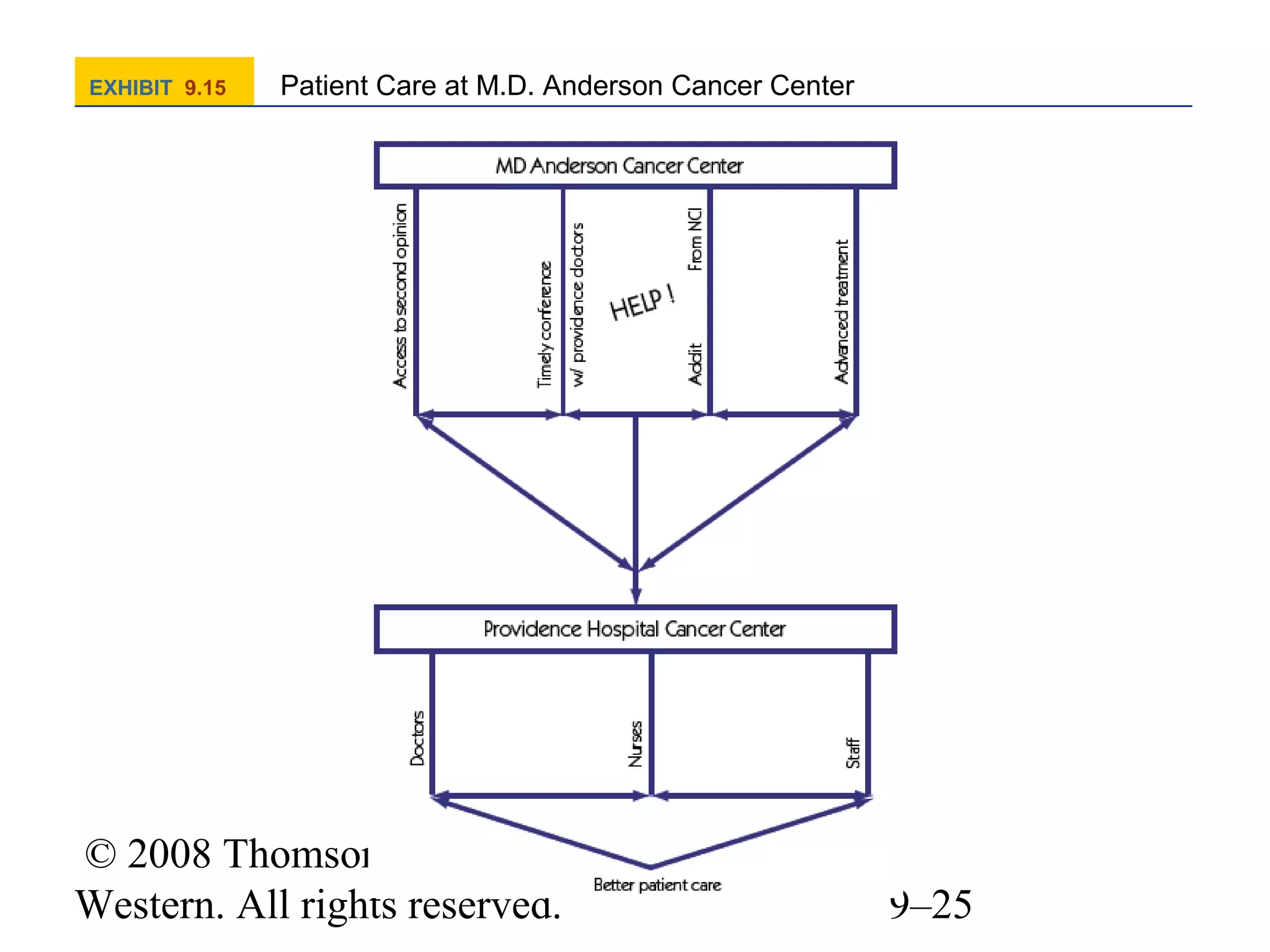
EXHIBIT 9.15

Patient Care at M.D. Anderson Cancer Center

© 2008 Thomson/SouthWestern. All rights reserved.

9–25
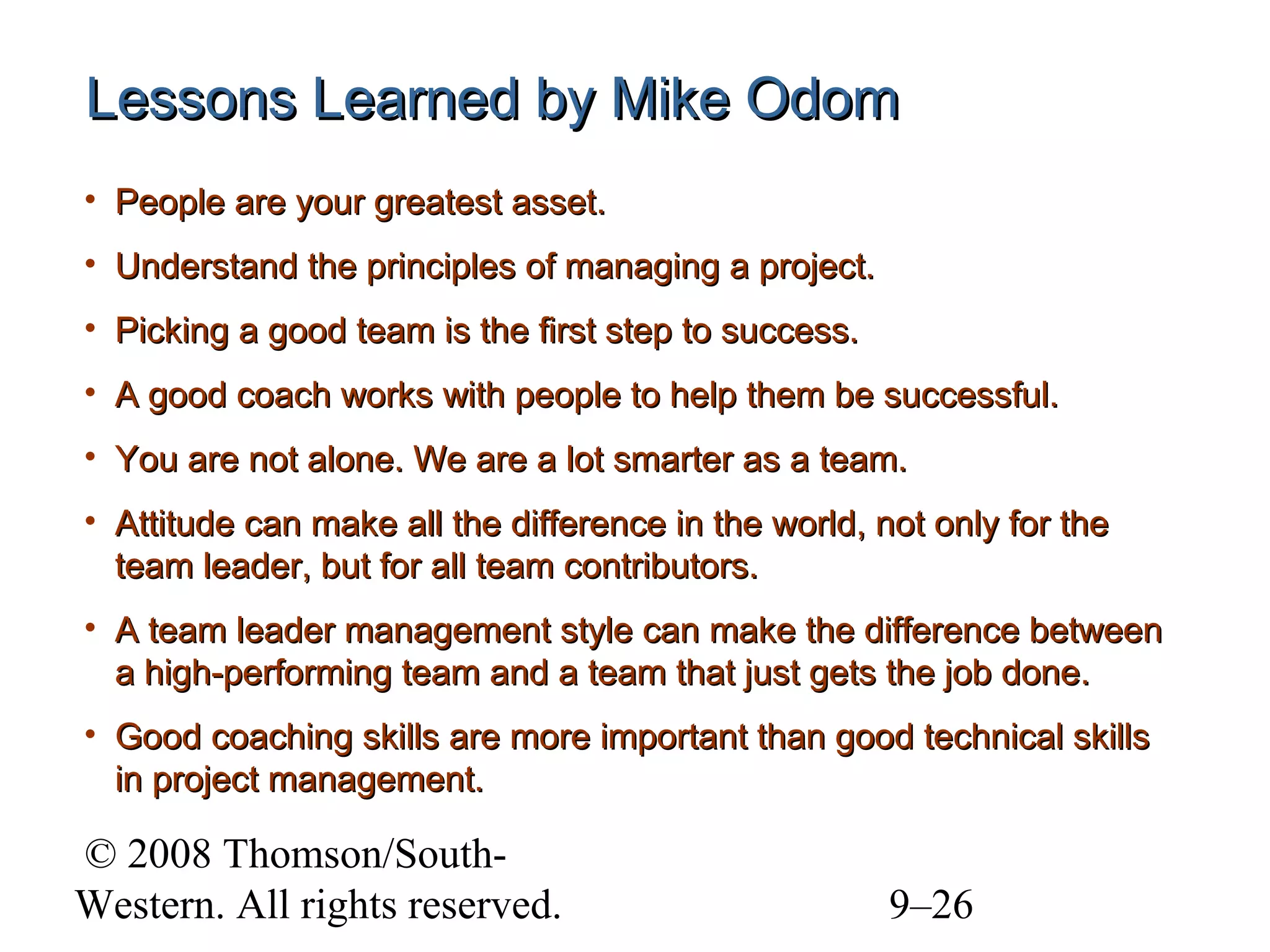
Lessons Learned by Mike Odom
• People are your greatest asset.
• Understand the principles of managing a project.
• Picking a good team is the first step to success.
• A good coach works with people to help them be successful.
• You are not alone. We are a lot smarter as a team.
• Attitude can make all the difference in the world, not only for the
team leader, but for all team contributors.
• A team leader management style can make the difference between
a high-performing team and a team that just gets the job done.
• Good coaching skills are more important than good technical skills
in project management.

© 2008 Thomson/SouthWestern. All rights reserved.

9–26
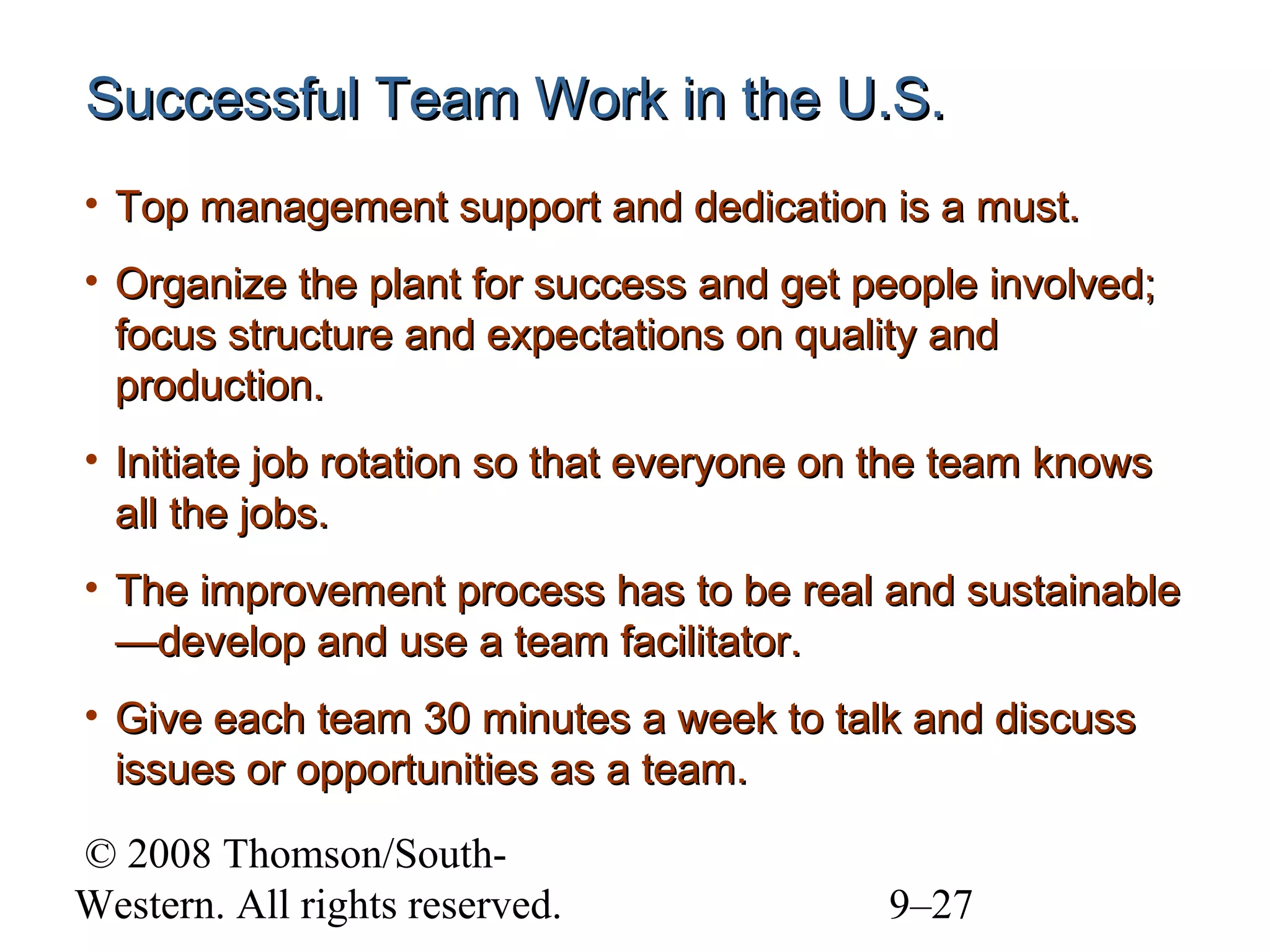
Successful Team Work in the U.S.
• Top management support and dedication is a must.
• Organize the plant for success and get people involved;
focus structure and expectations on quality and
production.
• Initiate job rotation so that everyone on the team knows
all the jobs.
• The improvement process has to be real and sustainable
—develop and use a team facilitator.
• Give each team 30 minutes a week to talk and discuss
issues or opportunities as a team.
© 2008 Thomson/SouthWestern. All rights reserved.

9–27
Important Terms
Important Terms
•
•
•
•
•
•
•
•
•
•
•
•
•

adaptive challenges
external change forces
formal group
group
group cohesiveness
informal group
internal change forces
norms
organizational effectiveness
proactive (planned) process of change
self-managing work teams
synergy
team

© 2008 Thomson/SouthWestern. All rights reserved.

9–28

BUS 51 - Mosley7e ch09

  • 1.
    Part 3 Leading Chapter 9 GroupDevelopment and Team Building Mosley • Pietri PowerPoint Presentation by Charlie Cook The University of West Alabama © 2008 Thomson/South-Western All rights reserved.
  • 2.
    Learning Objectives Learning Objectives Afterreading and studying this chapter, you should be able to: 1. Identify the stages of group development. 2. Compare the advantages and limitations of groups. 3. Describe the variables that determine a group’s effectiveness. 4. Determine what is involved in team building. 5. Describe what made team building successful at Resort Quest. 6. Describe the GE approach. © 2008 Thomson/SouthWestern. All rights reserved. 9–2
  • 3.
    Learning Objectives (cont’d) LearningObjectives (cont’d) After reading and studying this chapter, you should be able to: 7. Describe what made teambuilding successful in the nonprofit area. 8. Describe how to work with self-managing work groups. © 2008 Thomson/SouthWestern. All rights reserved. 9–3
  • 4.
    EXHIBIT 9.1 The Ritz-CarltonCredo © 2008 Thomson/SouthWestern. All rights reserved. 9–4
  • 5.
    Forces Causing Change •External Change Forces  Forces outside the organization that have a great impact on organizational change.  Management has little control over these numerous external forces. • Internal Change Forces  Pressures for change within the organization such as cultures and objectives. • Results of Ignoring Change  Resistance leads to an inability to cope with new forces, stagnation, decline, and failure. © 2008 Thomson/SouthWestern. All rights reserved. 9–5
  • 6.
    EXHIBIT 9.2 External andInternal Change Forces © 2008 Thomson/SouthWestern. All rights reserved. 9–6
  • 7.
    Planned Change • OrganizationalEffectiveness  The result of activities that improve the organization’s structure, technology, and people.  Choosing the correct change technique is key to producing the desired change outcome. • Change Affects the Entire Organization  Changing the organization’s structure involves modifying and rearranging the internal relationships.  Changing the organization’s technology alters its physical assets, operating systems, work processes, inputs, and outputs. © 2008 Thomson/SouthWestern. All rights reserved. 9–7
  • 8.
    EXHIBIT 9.3 Organizational EffectivenessResults from Changing Structure, Technology, and/or People © 2008 Thomson/SouthWestern. All rights reserved. 9–8
  • 9.
    EXHIBIT 9.4 Different Responsesto Change © 2008 Thomson/SouthWestern. All rights reserved. Source: William Walker, management consultant, presentation to the North Mississippi Health Services Board of Directors and staff, May 1, 1999. The Wynfrey Hotel, Birmingham, Alabama. 9–9
  • 10.
    Importance of WorkGroups • Synergy  The concept that two or more people working together in a cooperative, coordinated way can accomplish more than the sum of their independent efforts. • What Are Groups?  Group Defined  Two or more people who communicate and work together regularly in pursuit of one or more common objectives. © 2008 Thomson/SouthWestern. All rights reserved. 9–10
  • 11.
    EXHIBIT 9.5 A Manager’sMembership in Different Groups © 2008 Thomson/SouthWestern. All rights reserved. Source: Adapted from W. Alan Randolph, Understanding and Managing Organizational Behavior (Homewood, Ill.: Richard D. Irwin, 1985), p. 385. 9–11
  • 12.
    Types of Groups •Formal Group  Is a group prescribed and/or established by the organization. • Informal Group  Is a group formed out of employees’ need for social interaction, friendship, communication, and status.  Is a group that evolves out of the formal organization but is not formed by management or shown in the organization’s structure.  Types of informal groups Informal interest groups  Friendship groups 2008 Thomson/South © Western. All rights reserved. 9–12
  • 13.
    How Groups Develop Stage1: Forming Stage 1: Forming The stage in which members first come The stage in which members first come together and form initial impressions together and form initial impressions Stage 2: Storming Stage 2: Storming A period of conflict and—ideally— A period of conflict and—ideally— organization organization Stage 3: Norming Stage 3: Norming Stage of developing teamwork and group Stage of developing teamwork and group cohesion and creating openness of cohesion and creating openness of communications with information sharing communications with information sharing Stage 4: Performing Stage 4: Performing © 2008 Thomson/SouthWestern. All rights reserved. Stage in which the group shows how Stage in which the group shows how efficiently and effectively ititcan operate to efficiently and effectively can operate to achieve its goals. achieve its goals. 9–13
  • 14.
    Evaluating Groups Advantages: Disadvantages: 1. Provideopportunities for need satisfaction 2. May function more effectively than individuals 1. Encourage social loafing 2. Diffuse responsibility 3. May be less effective than individuals © 2008 Thomson/SouthWestern. All rights reserved. 9–14
  • 15.
    EXHIBIT 9.6 Model ofGroup Effectiveness Norms Rules of behavior developed by group members to provide guidance for group activities. © 2008 Thomson/SouthWestern. All rights reserved. Group Cohesiveness The mutual liking and team feeling in a group. 9–15
  • 16.
    EXHIBIT 9.7 Possible Effectsof Size on Groups Group Size 2–7 8–12 13–16 Members Members Members 1. Demands on leader Low Moderate High 2. Differences between leaders and members Low Low to moderate Moderate to high 3. Direction by leader Low Low to moderate Moderate to high 4. Tolerance of direction from leader Low to high Moderate to high High 5. Domination of group interaction by a few members Low Moderate to high High 6. Inhibition in participation by ordinary members Low Moderate High 7. Formalization of rules and procedures (norms) Low Low to moderate Moderate to high 8. Time required for reaching judgment decisions Low to moderate Moderate Moderate to high 9. Tendency for subgroups to form within group Low Moderate to high High Category/Dimensions Leadership Members Group Process © 2008 Thomson/SouthWestern. All rights reserved. Source: Adapted from Organizational Behavior, 10th ed., by Don Hellriegel and John W. Slocum, Jr., p. 208. © 2004. Reprinted with permission of South-Western, a division of Thomson Learning: www.thomsonrights.com. 9–16
  • 17.
    EXHIBIT 9.8 Task andMaintenance Roles in Groups Effective Roles Ineffective Roles Work or Task* Functions Group Maintenance* Functions Initiating Consensus testing Displays of aggression Information giving Harmonizing Blocking Information seeking Gatekeeping Dominating Clarifying Encouraging Playboy behavior Summarizing Compromising Avoidance behavior Reality Testing Sharing feelings Sniping © 2008 Thomson/SouthWestern. All rights reserved. *The distinction between “task” and “maintenance” roles is somewhat arbitrary. Some of these terms could be classified in either column. 9–17
  • 18.
    Team Building • Team A collection of people who must rely on group cooperation if the team is to experience the most success possible and thereby achieve its goals. • Successful Teams Are “Empowered”  They establish some or all of a team’s goals.  They make decisions about how to achieve those goals.  They undertake the tasks required to meet them.  They are mutually accountable for their results. © 2008 Thomson/SouthWestern. All rights reserved. 9–18
  • 19.
    EXHIBIT 9.10 Characteristics ofan Effective Team Clear Purpose Informality Participation Listening Civilized Disagreement Consensus Decisions Open Communication Clear Roles and Work Assignments Shared Leadership External Relations Style Diversity Self-Assessment © 2008 Thomson/SouthWestern. All rights reserved. Source: Glenn M. Parker, Team Players and Teamwork (San Francisco: JosseyBass/John Wiley & Sons, 1991), p. 33. Used with permission of the publisher. 9–19
  • 20.
    Team Building • UnsuccessfulTeams Fail Because:  They lack effective leadership at the top of the team and/or organization.  They do not effectively recruitment of good and talented people.  They do not create an environment so good and talented people grow and develop. © 2008 Thomson/SouthWestern. All rights reserved. 9–20
  • 21.
    EXHIBIT 9.11 Context-Based Leadership ©2008 Thomson/SouthWestern. All rights reserved. 9–21
  • 22.
    EXHIBIT 9.12 Survey Results:Why Individual Executives Should Be Considered Great © 2008 Thomson/SouthWestern. All rights reserved. 9–22
  • 23.
    EXHIBIT 9.13 Welch onHiring, Firing, and Rewarding Employees • Successful leaders must make very difficult decisions about the people who work for them. • Despite possible confrontations and charges of favoritism, giving all employees similar raises is bad for an organization. • “Making the numbers” by itself is not enough to secure pay raises and promotions. • Leaders must deftly use the carrots and sticks of pay, promotion, and dismissal to boost productivity and inspire stellar performance. © 2008 Thomson/SouthWestern. All rights reserved. Source: James W. Robinson, Jack Welch and Leadership (Roseville, Calif.: Prima Publishing Co., 2001), p. 147. Reprinted by permission of author James W. Robinson, a senior official with the U.S. Chamber of Commerce. 9–23
  • 24.
    EXHIBIT 9.14 Jack Welch’sVitality Curve for Differentiation © 2008 Thomson/SouthWestern. All rights reserved. 9–24
  • 25.
    EXHIBIT 9.15 Patient Careat M.D. Anderson Cancer Center © 2008 Thomson/SouthWestern. All rights reserved. 9–25
  • 26.
    Lessons Learned byMike Odom • People are your greatest asset. • Understand the principles of managing a project. • Picking a good team is the first step to success. • A good coach works with people to help them be successful. • You are not alone. We are a lot smarter as a team. • Attitude can make all the difference in the world, not only for the team leader, but for all team contributors. • A team leader management style can make the difference between a high-performing team and a team that just gets the job done. • Good coaching skills are more important than good technical skills in project management. © 2008 Thomson/SouthWestern. All rights reserved. 9–26
  • 27.
    Successful Team Workin the U.S. • Top management support and dedication is a must. • Organize the plant for success and get people involved; focus structure and expectations on quality and production. • Initiate job rotation so that everyone on the team knows all the jobs. • The improvement process has to be real and sustainable —develop and use a team facilitator. • Give each team 30 minutes a week to talk and discuss issues or opportunities as a team. © 2008 Thomson/SouthWestern. All rights reserved. 9–27
  • 28.
    Important Terms Important Terms • • • • • • • • • • • • • adaptivechallenges external change forces formal group group group cohesiveness informal group internal change forces norms organizational effectiveness proactive (planned) process of change self-managing work teams synergy team © 2008 Thomson/SouthWestern. All rights reserved. 9–28

Editor's Notes