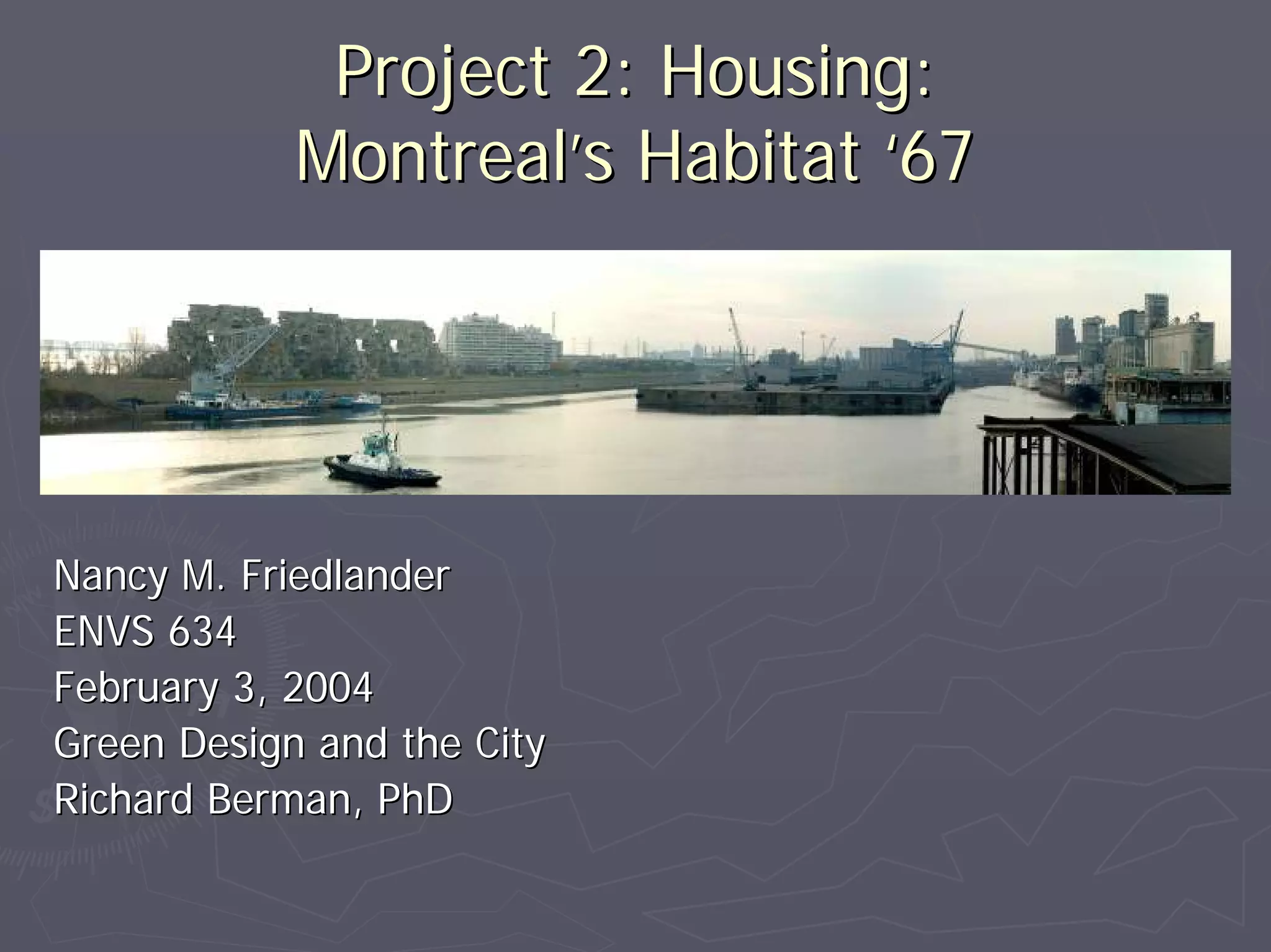
Project 2: Housing:
            Montreal’s Habitat ‘67


Nancy M. Friedlander
ENVS 634
February 3, 2004
Green Design and the City
Richard Berman, PhD
"originality in itself cannot
    be the criterion for
 measuring excellence in
       architecture."
        --moshe safdie
History
► Canadian   Government agreed to build his design
  at the 1967 World’s Fair in Montreal
► Expo's Habitat '67 is among the strangest housing
  developments Montreal has ever seen. Moshe
  Safdie's creation - a four-block long row of 158
  prefabricated rectangular houses stacked
  seemingly randomly in a pyramid - is both highly
  praised and harshly criticized by architects,
  planners and politicians.
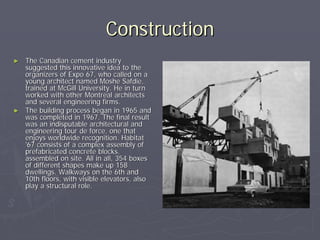
Construction
► The Canadian cement industry
  suggested this innovative idea to the
  organizers of Expo 67, who called on a
  young architect named Moshe Safdie,
  trained at McGill University. He in turn
  worked with other Montreal architects
  and several engineering firms.
► The building process began in 1965 and
  was completed in 1967. The final result
  was an indisputable architectural and
  engineering tour de force, one that
  enjoys worldwide recognition. Habitat
  '67 consists of a complex assembly of
  prefabricated concrete blocks,
  assembled on site. All in all, 354 boxes
  of different shapes make up 158
  dwellings. Walkways on the 6th and
  10th floors, with visible elevators, also
  play a structural role.
► The project was marked from the very beginning
 by a strong desire to innovate, in both the
 approach to construction and the approach to
 living. Habitat '67, to use Le Corbusier's
 expression, is a unique "machine for living in."
 Indeed, the project very quickly became a
 symbol of modern architecture. Its concrete
 boxes, resembling containers, and its location in
 the port across from the historic city centre and
 the new downtown, show how a city that has
 always been so closely connected to its river has
 contributed to modernism.
Expo ‘67
► Habitat'sapartments were made from 354 boxes
  or "modules". Apartments were built from
  between one and eight boxes, depending on the
  size. The original plans called for 1,000 units.
  • Safdie was commissioned to design other
  Habitats around the world: New York (1967),
  Puerto Rico (1968), Israel (1969), Rochester
  (1971) and Tehran (1976). None was ever
  completed.
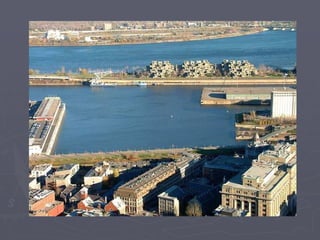
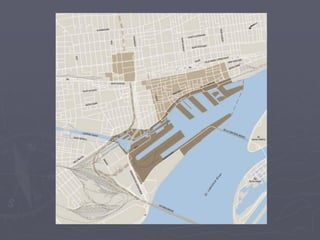
► Across from the old port, in the waters of
 the St. Lawrence, on the Cité du Havre pier,
 stands an exceptional modern architectural
 complex.
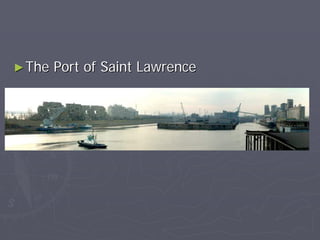
► The   Port of Saint Lawrence
Facts
► Originally   designed to be a city, not a
  complex.
► Experimental apartment complex.
► 158 unit community comprises 354
  prefabricated concrete boxes stacked in a
  staggered pattern: a Modern version of an
  Italian Hill town.
► Habitat is the only Expo 67 building still
  being used for its original purpose.
► For each home, the design incorporates a
  garden located atop the roof of the unit
  below.
► Covered walkways weave throughout the
  project and contribute to the sense of
  community, which was one of Safdie's
  primary goals.
About the Architect
► Moshe   Safdie.
► Born in Haifa, Israel in 1938.
► Trained at McGill University in Montreal from
  1955 until 1961.
► After working two years in the office of
  Louis I. Kahn, he started his own practice in
  Montreal.
► Designed Habitat at age 25 for his Graduate
  Thesis Project.
About the Architect cont…
►   Later, he moved to the U.S. where he established an
    practice and taught at Harvard.
►   Influenced by his graduate thesis, Safdie refined a series of
    "Habitat" designs which revolved around a cellular housing
    scheme.
►   Initially his ideas proved expensive and difficult to
    construct, but Safdie introduced the cellular scheme in
    several areas including New York and Puerto Rico where
    his ideas were successfully initiated.
►   His Israeli period also produced a number of impressive
    urban insertion projects and various town-planning
    schemes.
Other Habitats
► NYC
► Puerto   Rico
Commentary
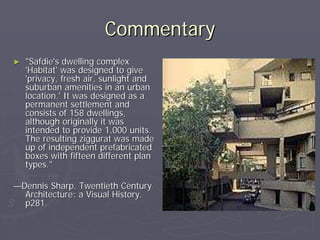
►   "Safdie's dwelling complex
    'Habitat' was designed to give
    'privacy, fresh air, sunlight and
    suburban amenities in an urban
    location.' It was designed as a
    permanent settlement and
    consists of 158 dwellings,
    although originally it was
    intended to provide 1,000 units.
    The resulting ziggurat was made
    up of independent prefabricated
    boxes with fifteen different plan
    types."

—Dennis Sharp. Twentieth Century
  Architecture: a Visual History.
  p281.
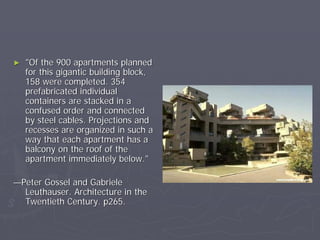
►   "Of the 900 apartments planned
    for this gigantic building block,
    158 were completed. 354
    prefabricated individual
    containers are stacked in a
    confused order and connected
    by steel cables. Projections and
    recesses are organized in such a
    way that each apartment has a
    balcony on the roof of the
    apartment immediately below."

—Peter Gossel and Gabriele
  Leuthauser. Architecture in the
  Twentieth Century. p265.
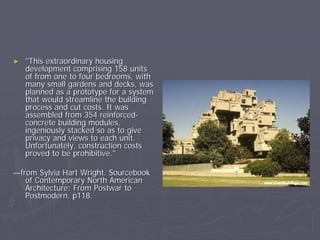
►   "This extraordinary housing
    development comprising 158 units
    of from one to four bedrooms, with
    many small gardens and decks, was
    planned as a prototype for a system
    that would streamline the building
    process and cut costs. It was
    assembled from 354 reinforced-
    concrete building modules,
    ingeniously stacked so as to give
    privacy and views to each unit.
    Unfortunately, construction costs
    proved to be prohibitive."

—from Sylvia Hart Wright. Sourcebook
   of Contemporary North American
   Architecture: From Postwar to
   Postmodern. p118.
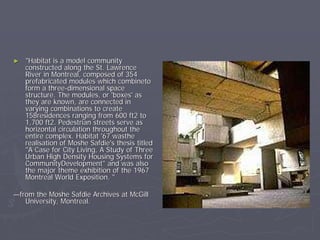
►   "Habitat is a model community
    constructed along the St. Lawrence
    River in Montreal, composed of 354
    prefabricated modules which combineto
    form a three-dimensional space
    structure. The modules, or 'boxes' as
    they are known, are connected in
    varying combinations to create
    158residences ranging from 600 ft2 to
    1,700 ft2. Pedestrian streets serve as
    horizontal circulation throughout the
    entire complex. Habitat '67 wasthe
    realisation of Moshe Safdie's thesis titled
    "A Case for City Living, A Study of Three
    Urban High Density Housing Systems for
    CommunityDevelopment" and was also
    the major theme exhibition of the 1967
    Montreal World Exposition. "

—from the Moshe Safdie Archives at McGill
   University, Montreal.
References
►   Residential Architect. Meghan Drueding. 2002 . “The box rebellion: Habitat
    ’67, Montreal.” The Gale Group, Inc.
►   Moshe Safdie Peabody Essex Addition", by Michael Crosbie, Architecture Week
    No. 159, 2003.0820, pD1.1.
►   "Moshe Safdie in Israel", by Lili Eylon, Architecture Week No. 113, 2002.0904,
    pC1.1.
►   Moshe Safdie (Editor), Irena Zantovska Murray (Editor). Moshe Safdie :
    Buildings and Projects, 1967-1992. Montreal: McGill Queens University Press,
    May 1996. Inventory (on CD-ROM) by Laura E. Dent and Percy Johnson. ISBN
    0-7735-1510-0. — Book and CD-ROM combo, produced by the Moshe Safdie
    archives.
►   Moshe Safdie. Beyond Habitat. ASIN 0-0021-1580-8.
►   Moshe Safdie. Form and Purpose. ASIN 0-3953-1663-4.
►   Dennis Sharp. The Illustrated Encyclopedia of Architects and Architecture. New
    York: Quatro Publishing, 1991. ISBN 0-8230-2539-X. NA40.I45. p133.
References, Continued
►   Muriel Emanuel, ed. Contemporary Architects. New York: St. Martin's Press, 1980. ISBN 0-312-16635-
    4. p701.
►   Kenneth Frampton and Futagawa Yukio. Modern Architecture in Color. New York: The Viking Press,
    1971. color photo of exterior, p493, plate 107.
►   Photo courtesy of Graetz. PCD.2286.1012.0904.078.
►   Photo courtesy of Timothy Hursley. PCD.2286.1012.0904.090.
►   Johnson Architectural Images. Copyrighted slides in the Artifice Collection.
►   Udo Kultermann. Architecture in the 20th Century. New York: Van Nostrand Reinhold, 1993. ISBN 0-
    442-00942-9. LC 92-26734. NA680.K7913 1993. exterior aerial photo of rear of building, f138, p129.
►   Lawrence A. Martin, University of Oregon. Slide from photographer's collection, September 1993.
    PCD.3235.1012.0545.008. PCD.3235.1012.0545.009. PCD.3235.1012.0545.010.
    PCD.3235.1012.0545.015.
►   Photos courtesy of MSA. PCD.2286.1012.0904.082. PCD.2286.1012.0904.083.
    PCD.2286.1012.0904.080.
►   Leland M. Roth. A Concise History of American Architecture. New York: Harper and Row, Publishers,
    1979. ISBN 0-06-430086-2. NA705.R67 1979. discussion, p327-328, exterior photo from distance,
    f282, p327.
►   Moshe Safdie. For Everyone a Garden. Cambridge, MA: The MIT Press, 1974. plaza level plan, p66.
    section, p68. plan of one bedroom unit with terrace, p74. plan of three or four bedroom unit, p75.
    exploded axonometric, p75.
►   Kevin Matthews. The Great Buildings Collection on CD-ROM. Artifice, 2001. ISBN 0-9667098-4-5.—
►   http://archives.cbc.ca/IDCC-1-69-100-543/life_society/expo_67/
Habitat Today
► Some  units have been
  remodeled to combine
  neighboring
  apartments; 150
  households now call
  the complex home.
► 2002 marked the 35th
  anniversary of Safdie's
  achievement.

Habitat (friedlander)

  • 1.
    Project 2: Housing: Montreal’s Habitat ‘67 Nancy M. Friedlander ENVS 634 February 3, 2004 Green Design and the City Richard Berman, PhD
  • 2.
    "originality in itselfcannot be the criterion for measuring excellence in architecture." --moshe safdie
  • 4.
    History ► Canadian Government agreed to build his design at the 1967 World’s Fair in Montreal ► Expo's Habitat '67 is among the strangest housing developments Montreal has ever seen. Moshe Safdie's creation - a four-block long row of 158 prefabricated rectangular houses stacked seemingly randomly in a pyramid - is both highly praised and harshly criticized by architects, planners and politicians.
  • 5.
    Construction ► The Canadiancement industry suggested this innovative idea to the organizers of Expo 67, who called on a young architect named Moshe Safdie, trained at McGill University. He in turn worked with other Montreal architects and several engineering firms. ► The building process began in 1965 and was completed in 1967. The final result was an indisputable architectural and engineering tour de force, one that enjoys worldwide recognition. Habitat '67 consists of a complex assembly of prefabricated concrete blocks, assembled on site. All in all, 354 boxes of different shapes make up 158 dwellings. Walkways on the 6th and 10th floors, with visible elevators, also play a structural role.
  • 6.
    ► The projectwas marked from the very beginning by a strong desire to innovate, in both the approach to construction and the approach to living. Habitat '67, to use Le Corbusier's expression, is a unique "machine for living in." Indeed, the project very quickly became a symbol of modern architecture. Its concrete boxes, resembling containers, and its location in the port across from the historic city centre and the new downtown, show how a city that has always been so closely connected to its river has contributed to modernism.
  • 8.
    Expo ‘67 ► Habitat'sapartmentswere made from 354 boxes or "modules". Apartments were built from between one and eight boxes, depending on the size. The original plans called for 1,000 units. • Safdie was commissioned to design other Habitats around the world: New York (1967), Puerto Rico (1968), Israel (1969), Rochester (1971) and Tehran (1976). None was ever completed.
  • 9.
    ► Across fromthe old port, in the waters of the St. Lawrence, on the Cité du Havre pier, stands an exceptional modern architectural complex.
  • 10.
    ► The Port of Saint Lawrence
  • 11.
    Facts ► Originally designed to be a city, not a complex. ► Experimental apartment complex. ► 158 unit community comprises 354 prefabricated concrete boxes stacked in a staggered pattern: a Modern version of an Italian Hill town. ► Habitat is the only Expo 67 building still being used for its original purpose.
  • 12.
    ► For eachhome, the design incorporates a garden located atop the roof of the unit below. ► Covered walkways weave throughout the project and contribute to the sense of community, which was one of Safdie's primary goals.
  • 13.
    About the Architect ►Moshe Safdie. ► Born in Haifa, Israel in 1938. ► Trained at McGill University in Montreal from 1955 until 1961. ► After working two years in the office of Louis I. Kahn, he started his own practice in Montreal. ► Designed Habitat at age 25 for his Graduate Thesis Project.
  • 14.
    About the Architectcont… ► Later, he moved to the U.S. where he established an practice and taught at Harvard. ► Influenced by his graduate thesis, Safdie refined a series of "Habitat" designs which revolved around a cellular housing scheme. ► Initially his ideas proved expensive and difficult to construct, but Safdie introduced the cellular scheme in several areas including New York and Puerto Rico where his ideas were successfully initiated. ► His Israeli period also produced a number of impressive urban insertion projects and various town-planning schemes.
  • 15.
  • 16.
    Commentary ► "Safdie's dwelling complex 'Habitat' was designed to give 'privacy, fresh air, sunlight and suburban amenities in an urban location.' It was designed as a permanent settlement and consists of 158 dwellings, although originally it was intended to provide 1,000 units. The resulting ziggurat was made up of independent prefabricated boxes with fifteen different plan types." —Dennis Sharp. Twentieth Century Architecture: a Visual History. p281.
  • 17.
    "Of the 900 apartments planned for this gigantic building block, 158 were completed. 354 prefabricated individual containers are stacked in a confused order and connected by steel cables. Projections and recesses are organized in such a way that each apartment has a balcony on the roof of the apartment immediately below." —Peter Gossel and Gabriele Leuthauser. Architecture in the Twentieth Century. p265.
  • 18.
    "This extraordinary housing development comprising 158 units of from one to four bedrooms, with many small gardens and decks, was planned as a prototype for a system that would streamline the building process and cut costs. It was assembled from 354 reinforced- concrete building modules, ingeniously stacked so as to give privacy and views to each unit. Unfortunately, construction costs proved to be prohibitive." —from Sylvia Hart Wright. Sourcebook of Contemporary North American Architecture: From Postwar to Postmodern. p118.
  • 19.
    "Habitat is a model community constructed along the St. Lawrence River in Montreal, composed of 354 prefabricated modules which combineto form a three-dimensional space structure. The modules, or 'boxes' as they are known, are connected in varying combinations to create 158residences ranging from 600 ft2 to 1,700 ft2. Pedestrian streets serve as horizontal circulation throughout the entire complex. Habitat '67 wasthe realisation of Moshe Safdie's thesis titled "A Case for City Living, A Study of Three Urban High Density Housing Systems for CommunityDevelopment" and was also the major theme exhibition of the 1967 Montreal World Exposition. " —from the Moshe Safdie Archives at McGill University, Montreal.
  • 20.
    References ► Residential Architect. Meghan Drueding. 2002 . “The box rebellion: Habitat ’67, Montreal.” The Gale Group, Inc. ► Moshe Safdie Peabody Essex Addition", by Michael Crosbie, Architecture Week No. 159, 2003.0820, pD1.1. ► "Moshe Safdie in Israel", by Lili Eylon, Architecture Week No. 113, 2002.0904, pC1.1. ► Moshe Safdie (Editor), Irena Zantovska Murray (Editor). Moshe Safdie : Buildings and Projects, 1967-1992. Montreal: McGill Queens University Press, May 1996. Inventory (on CD-ROM) by Laura E. Dent and Percy Johnson. ISBN 0-7735-1510-0. — Book and CD-ROM combo, produced by the Moshe Safdie archives. ► Moshe Safdie. Beyond Habitat. ASIN 0-0021-1580-8. ► Moshe Safdie. Form and Purpose. ASIN 0-3953-1663-4. ► Dennis Sharp. The Illustrated Encyclopedia of Architects and Architecture. New York: Quatro Publishing, 1991. ISBN 0-8230-2539-X. NA40.I45. p133.
  • 21.
    References, Continued ► Muriel Emanuel, ed. Contemporary Architects. New York: St. Martin's Press, 1980. ISBN 0-312-16635- 4. p701. ► Kenneth Frampton and Futagawa Yukio. Modern Architecture in Color. New York: The Viking Press, 1971. color photo of exterior, p493, plate 107. ► Photo courtesy of Graetz. PCD.2286.1012.0904.078. ► Photo courtesy of Timothy Hursley. PCD.2286.1012.0904.090. ► Johnson Architectural Images. Copyrighted slides in the Artifice Collection. ► Udo Kultermann. Architecture in the 20th Century. New York: Van Nostrand Reinhold, 1993. ISBN 0- 442-00942-9. LC 92-26734. NA680.K7913 1993. exterior aerial photo of rear of building, f138, p129. ► Lawrence A. Martin, University of Oregon. Slide from photographer's collection, September 1993. PCD.3235.1012.0545.008. PCD.3235.1012.0545.009. PCD.3235.1012.0545.010. PCD.3235.1012.0545.015. ► Photos courtesy of MSA. PCD.2286.1012.0904.082. PCD.2286.1012.0904.083. PCD.2286.1012.0904.080. ► Leland M. Roth. A Concise History of American Architecture. New York: Harper and Row, Publishers, 1979. ISBN 0-06-430086-2. NA705.R67 1979. discussion, p327-328, exterior photo from distance, f282, p327. ► Moshe Safdie. For Everyone a Garden. Cambridge, MA: The MIT Press, 1974. plaza level plan, p66. section, p68. plan of one bedroom unit with terrace, p74. plan of three or four bedroom unit, p75. exploded axonometric, p75. ► Kevin Matthews. The Great Buildings Collection on CD-ROM. Artifice, 2001. ISBN 0-9667098-4-5.— ► http://archives.cbc.ca/IDCC-1-69-100-543/life_society/expo_67/
  • 22.
    Habitat Today ► Some units have been remodeled to combine neighboring apartments; 150 households now call the complex home. ► 2002 marked the 35th anniversary of Safdie's achievement.