ASSIGNMENT # 1 
SAAD ASAD KHAN 
EE - 122064 
EE - 4A 
INTRODUCTION: 
The MOSFET that stands for metal–oxide–semiconductor field-effect transistor is a 
type of transistor used for amplifying or switching electronic signals. 
It is a four terminal device which are: 
1. Source (S) 
2. Gate (G) 
3. Drain (D) 
4. Body (B) 
CONSTRUCTION: 
It is made up of Metal Oxide gate electrode which is electrically insulated from the main 
semiconductor N-channel or P-channel by a very thin layer of insulating material usually silicon 
dioxide, commonly known as glass. 
STRUCTURES: 
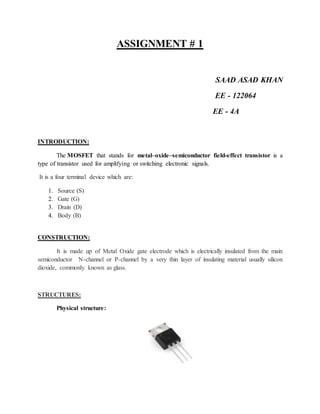
Physical structure:
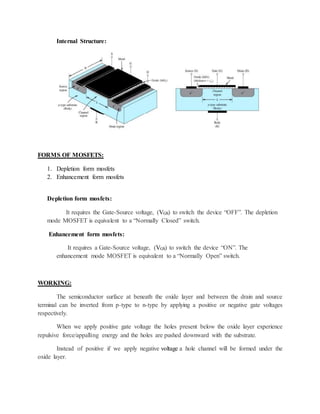
Internal Structure: 
FORMS OF MOSFETS: 
1. Depletion form mosfets 
2. Enhancement form mosfets 
Depletion form mosfets: 
It requires the Gate-Source voltage, (VGS) to switch the device “OFF”. The depletion 
mode MOSFET is equivalent to a “Normally Closed” switch. 
Enhancement form mosfets: 
It requires a Gate-Source voltage, (VGS) to switch the device “ON”. The 
enhancement mode MOSFET is equivalent to a “Normally Open” switch. 
WORKING: 
The semiconductor surface at beneath the oxide layer and between the drain and source 
terminal can be inverted from p-type to n-type by applying a positive or negative gate voltages 
respectively. 
When we apply positive gate voltage the holes present below the oxide layer experience 
repulsive force/appalling energy and the holes are pushed downward with the substrate. 
Instead of positive if we apply negative voltage a hole channel will be formed under the 
oxide layer.
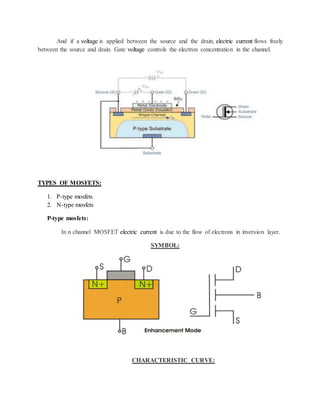
And if a voltage is applied between the source and the drain, electric current flows freely 
between the source and drain. Gate voltage controls the electron concentration in the channel. 
TYPES OF MOSFETS: 
1. P-type mosfets 
2. N-type mosfets 
P-type mosfets: 
In n channel MOSFET electric current is due to the flow of electrons in inversion layer. 
SYMBOL: 
CHARACTERISTIC CURVE:
N-type mosfets: 
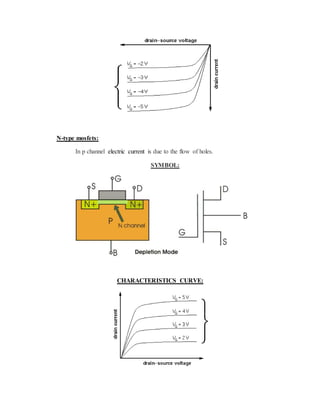
In p channel electric current is due to the flow of holes. 
SYMBOL: 
CHARACTERISTICS CURVE:
MODES OF OPERATION: 
1. Operation with zero gate voltage: 
It implies that with zero voltage at both ends there is tremendous (huge) amount 
of resistance (of order 1012Ω) 
2. Operation with creating a channel for current flow: 
It Implies that C = CoxWL 
3. Operation with applying a small Vds: 
It implies that rds= 1/(μnCox)(W/L)(Vgs – Vt) 
4. Operation with Vds is increased: 
It implies that Id = K'n(W/L)[(Vgs-V1)*Vds – ½(Vds)^2] 
5. Operation with Vds > Vov: 
It implies that Id = 1/2K'n(W/L)*(Vgs – V1)2 
6. Operation with MOS transistor in the sub threshold region: 
It implies that Vgs < Vd 
CHARACTERISTICS OF MOSFETS: 
1. The Id – Vds characteristic 
2. The Id – Vgs characteristic 
3. The finite output resistance in Saturation characteristic 
4. The voltage transfer characteristic (VTC) 
5. The biasing characteristic 
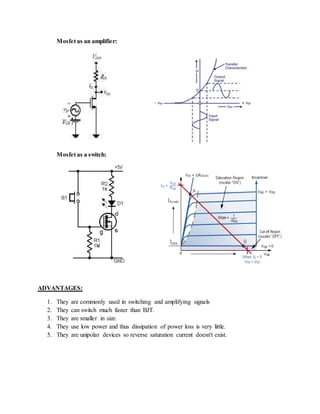
CONFIGURATIONS OF MOSFETS: 
1. Mosfet as an amplifier 
2. Mosfet as a switch
Mosfet as an amplifier: 
Mosfet as a switch: 
ADVANTAGES: 
1. They are commonly used in switching and amplifying signals 
2. They can switch much faster than BJT. 
3. They are smaller in size. 
4. They use low power and thus dissipation of power loss is very little. 
5. They are unipolar devices so reverse saturation current doesn't exist.
DISADVANTAGES: 
1. They don’t have higher power ratings. 
2. They are not easy handle because of its size. 
3. They are very sensitive to electrostatic charge so it can destroy, means it is not so robust. 
REFERENCES: 
http://en.wikipedia.org/wiki/MOSFET 
http://www.electronics-tutorials.ws/transistor/tran_6.html 
http://www.answers.com/Q/What_are_the_advantages_and_disadvantages_of_a_MOSFET

Mosfets

  • 1.
    ASSIGNMENT # 1 SAAD ASAD KHAN EE - 122064 EE - 4A INTRODUCTION: The MOSFET that stands for metal–oxide–semiconductor field-effect transistor is a type of transistor used for amplifying or switching electronic signals. It is a four terminal device which are: 1. Source (S) 2. Gate (G) 3. Drain (D) 4. Body (B) CONSTRUCTION: It is made up of Metal Oxide gate electrode which is electrically insulated from the main semiconductor N-channel or P-channel by a very thin layer of insulating material usually silicon dioxide, commonly known as glass. STRUCTURES: Physical structure:
  • 2.
    Internal Structure: FORMSOF MOSFETS: 1. Depletion form mosfets 2. Enhancement form mosfets Depletion form mosfets: It requires the Gate-Source voltage, (VGS) to switch the device “OFF”. The depletion mode MOSFET is equivalent to a “Normally Closed” switch. Enhancement form mosfets: It requires a Gate-Source voltage, (VGS) to switch the device “ON”. The enhancement mode MOSFET is equivalent to a “Normally Open” switch. WORKING: The semiconductor surface at beneath the oxide layer and between the drain and source terminal can be inverted from p-type to n-type by applying a positive or negative gate voltages respectively. When we apply positive gate voltage the holes present below the oxide layer experience repulsive force/appalling energy and the holes are pushed downward with the substrate. Instead of positive if we apply negative voltage a hole channel will be formed under the oxide layer.
  • 3.
    And if avoltage is applied between the source and the drain, electric current flows freely between the source and drain. Gate voltage controls the electron concentration in the channel. TYPES OF MOSFETS: 1. P-type mosfets 2. N-type mosfets P-type mosfets: In n channel MOSFET electric current is due to the flow of electrons in inversion layer. SYMBOL: CHARACTERISTIC CURVE:
  • 4.
    N-type mosfets: Inp channel electric current is due to the flow of holes. SYMBOL: CHARACTERISTICS CURVE:
  • 5.
    MODES OF OPERATION: 1. Operation with zero gate voltage: It implies that with zero voltage at both ends there is tremendous (huge) amount of resistance (of order 1012Ω) 2. Operation with creating a channel for current flow: It Implies that C = CoxWL 3. Operation with applying a small Vds: It implies that rds= 1/(μnCox)(W/L)(Vgs – Vt) 4. Operation with Vds is increased: It implies that Id = K'n(W/L)[(Vgs-V1)*Vds – ½(Vds)^2] 5. Operation with Vds > Vov: It implies that Id = 1/2K'n(W/L)*(Vgs – V1)2 6. Operation with MOS transistor in the sub threshold region: It implies that Vgs < Vd CHARACTERISTICS OF MOSFETS: 1. The Id – Vds characteristic 2. The Id – Vgs characteristic 3. The finite output resistance in Saturation characteristic 4. The voltage transfer characteristic (VTC) 5. The biasing characteristic CONFIGURATIONS OF MOSFETS: 1. Mosfet as an amplifier 2. Mosfet as a switch
  • 6.
    Mosfet as anamplifier: Mosfet as a switch: ADVANTAGES: 1. They are commonly used in switching and amplifying signals 2. They can switch much faster than BJT. 3. They are smaller in size. 4. They use low power and thus dissipation of power loss is very little. 5. They are unipolar devices so reverse saturation current doesn't exist.
  • 7.
    DISADVANTAGES: 1. Theydon’t have higher power ratings. 2. They are not easy handle because of its size. 3. They are very sensitive to electrostatic charge so it can destroy, means it is not so robust. REFERENCES: http://en.wikipedia.org/wiki/MOSFET http://www.electronics-tutorials.ws/transistor/tran_6.html http://www.answers.com/Q/What_are_the_advantages_and_disadvantages_of_a_MOSFET