GENETIC CHIMERISM
in Humans
Name : Rishika Maji
Course : BSc.(H) Zoology
Year : 3rd Year
Semester : 5th sem
Roll no. : 18/154
Subject : Principles of Genetics
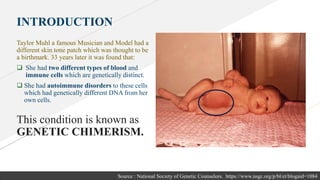
This condition is known as
GENETIC CHIMERISM.
Taylor Muhl a famous Musician and Model had a
different skin tone patch which was thought to be
a birthmark. 33 years later it was found that:
 She had two different types of blood and
immune cells which are genetically distinct.
 She had autoimmune disorders to these cells
which had genetically different DNA from her
own cells.
Source : National Society of Genetic Counselors. https://www.nsgc.org/p/bl/et/blogaid=1084
INTRODUCTION
Chimerism
What is Genetic Chimerism?
Chimera
• Chimera, in genetics is an organism or
tissue that contains at least two
different sets of DNA.
• They have two genetically distinct
types of cells. They are single organism
made up of two more genetically distinct
individuals of the same species.
• Organisms that are chimeras exhibit
what is known as chimerism.
History
• The word Chimera comes from the
“Chimera” of Greek mythology, a fire-
breathing monster that was part lion, part
goat, and part dragon. [Britannica]
• Human chimeras were first discovered
with the advent of blood typing when it
was found that some people had more
than one blood type.
Add a footer
Tetragametic Chimerism
Fusion of four Gametes
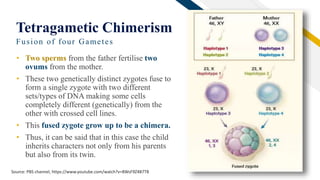
• Two sperms from the father fertilise two
ovums from the mother.
• These two genetically distinct zygotes fuse to
form a single zygote with two different
sets/types of DNA making some cells
completely different (genetically) from the
other with crossed cell lines.
• This fused zygote grow up to be a chimera.
• Thus, it can be said that in this case the child
inherits characters not only from his parents
but also from its twin.
Source: PBS channel, https://www.youtube.com/watch?v=8WsF9Z4B7T8
Tetragametic Chimerism
Fusion of four Gametes
Source: PBS channel, https://www.youtube.com/watch?v=8WsF9Z4B7T8
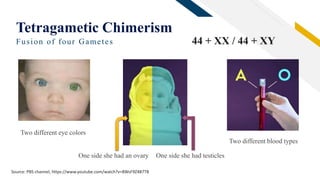
Two different eye colors
One side she had an ovary One side she had testicles
Two different blood types
44 + XX / 44 + XY
Twin Chimerism
Fusion of cells from a different embryo
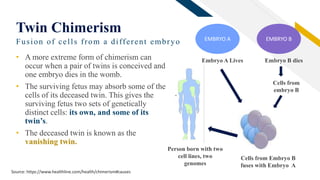
• A more extreme form of chimerism can
occur when a pair of twins is conceived and
one embryo dies in the womb.
• The surviving fetus may absorb some of the
cells of its deceased twin. This gives the
surviving fetus two sets of genetically
distinct cells: its own, and some of its
twin’s.
• The deceased twin is known as the
vanishing twin.
Source: https://www.healthline.com/health/chimerism#causes
EMBRYO A EMBRYO B
Embryo B dies
Cells from
embryo B
Embryo A Lives
Cells from Embryo B
fuses with Embryo A
Person born with two
cell lines, two
genomes
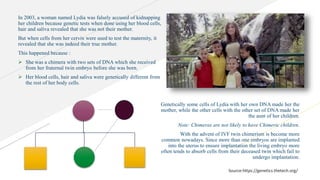
In 2003, a woman named Lydia was falsely accused of kidnapping
her children because genetic tests when done using her blood cells,
hair and saliva revealed that she was not their mother.
But when cells from her cervix were used to test the maternity, it
revealed that she was indeed their true mother.
This happened because :
 She was a chimera with two sets of DNA which she received
from her fraternal twin embryo before she was born.
 Her blood cells, hair and saliva were genetically different from
the rest of her body cells.
Genetically some cells of Lydia with her own DNA made her the
mother, while the other cells with the other set of DNA made her
the aunt of her children.
Note: Chimeras are not likely to have Chimeric children.
With the advent of IVF twin chimerism is become more
common nowadays. Since more than one embryos are implanted
into the uterus to ensure implantation the living embryo more
often tends to absorb cells from their deceased twin which fail to
undergo implantation.
Source:https://genetics.thetech.org/
Feto-maternal Microchimerism
Absorption of DNA from fetus to mother
Source: Tan, K. H., Zeng, X. X., Sasajala, P., Yeo, A., & Udolph, G. (2011). Fetomaternal microchimerism. Chimerism, 2(1), 16–18. https://doi.org/10.4161/chim.14692
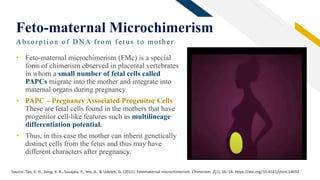
• Feto-maternal microchimerism (FMc) is a special
form of chimerism observed in placental vertebrates
in whom a small number of fetal cells called
PAPCs migrate into the mother and integrate into
maternal organs during pregnancy.
• PAPC – Pregnancy Associated Progenitor Cells
These are fetal cells found in the mothers that have
progenitor cell-like features such as multilineage
differentiation potential.
• Thus, in this case the mother can inherit genetically
distinct cells from the fetus and thus may have
different characters after pregnancy.
Feto-maternal Microchimerism
Absorption of DNA from fetus to mother
A common phenomenon where fetal cells from the
fetus enter into maternal the bloodstream and settle
in the brain of the mother.
A particular gene present only
in Y Chromosome found in
the brains of the mothers once
pregnant with sons.
Source: PBS channel, https://www.youtube.com/watch?v=8WsF9Z4B7T8
Inference : Feto-
Maternal
Microchimerism with
transfer of genetically
distinct DNA in
PAPCs which
normally should not be
present from offspring
to mother resulting in
the mother having two
different sets of DNA
with multilineage
potential.
Common Symptoms of Chimerism
• Hyperpigmentation/ Hypopigmentation in patches on the skin.
• Different blood types in the same individual.
• Two different coloured eyes.
• Hermaphroditism with genitals that have both male and female
parts (intersex) thus making them infertile.
• Autoimmune disorders.
Add a footer
The symptoms of chimerism vary from person to person. It may happen that the person never knows
that he/she is a chimera. But certain cases have evident chimeric symptoms such as:
Other types of chimerism
TYPE ABOUT
Haematopoietic chimerism
Two genetic cell lineages contribute to the formation of two different types of
blood (hematopoietic) system. Two different blood types.
Transfusion-associated
microchimerism
Formation of chimeras due to organ transplantation or blood transfusion
Androgenetic Chimerism
Made up of cells that contain the normal combination of maternal and
paternal chromosomes and cells that contain two sets of paternal
chromosomes (paternal isodisomy).
Macrochimerism
Implies complete elimination of recipient cell lineages and replacement by
the population of the recipient cells by 100% in a specific part of the body.
Add a footer
Conclusion
• Severe autoimmune disorders especially in Feto-maternal
microchimerism due to presence of cells with different DNA
which may be recognized as a foreign antigen and generate an
autoimmune response, like MS.
• But it has also been found that chimerism can be helpful because
of cells with multipotential lineage.
Chimerism cannot be diagnosed easily and in most cases this phenomenon is harmless. But in certain
extreme cases it can cause :
Thank You.

Genetic Chimerism

  • 1.
    GENETIC CHIMERISM in Humans Name: Rishika Maji Course : BSc.(H) Zoology Year : 3rd Year Semester : 5th sem Roll no. : 18/154 Subject : Principles of Genetics
  • 2.
    This condition isknown as GENETIC CHIMERISM. Taylor Muhl a famous Musician and Model had a different skin tone patch which was thought to be a birthmark. 33 years later it was found that:  She had two different types of blood and immune cells which are genetically distinct.  She had autoimmune disorders to these cells which had genetically different DNA from her own cells. Source : National Society of Genetic Counselors. https://www.nsgc.org/p/bl/et/blogaid=1084 INTRODUCTION
  • 3.
    Chimerism What is GeneticChimerism? Chimera • Chimera, in genetics is an organism or tissue that contains at least two different sets of DNA. • They have two genetically distinct types of cells. They are single organism made up of two more genetically distinct individuals of the same species. • Organisms that are chimeras exhibit what is known as chimerism. History • The word Chimera comes from the “Chimera” of Greek mythology, a fire- breathing monster that was part lion, part goat, and part dragon. [Britannica] • Human chimeras were first discovered with the advent of blood typing when it was found that some people had more than one blood type. Add a footer
  • 4.
    Tetragametic Chimerism Fusion offour Gametes • Two sperms from the father fertilise two ovums from the mother. • These two genetically distinct zygotes fuse to form a single zygote with two different sets/types of DNA making some cells completely different (genetically) from the other with crossed cell lines. • This fused zygote grow up to be a chimera. • Thus, it can be said that in this case the child inherits characters not only from his parents but also from its twin. Source: PBS channel, https://www.youtube.com/watch?v=8WsF9Z4B7T8
  • 5.
    Tetragametic Chimerism Fusion offour Gametes Source: PBS channel, https://www.youtube.com/watch?v=8WsF9Z4B7T8 Two different eye colors One side she had an ovary One side she had testicles Two different blood types 44 + XX / 44 + XY
  • 6.
    Twin Chimerism Fusion ofcells from a different embryo • A more extreme form of chimerism can occur when a pair of twins is conceived and one embryo dies in the womb. • The surviving fetus may absorb some of the cells of its deceased twin. This gives the surviving fetus two sets of genetically distinct cells: its own, and some of its twin’s. • The deceased twin is known as the vanishing twin. Source: https://www.healthline.com/health/chimerism#causes EMBRYO A EMBRYO B Embryo B dies Cells from embryo B Embryo A Lives Cells from Embryo B fuses with Embryo A Person born with two cell lines, two genomes
  • 7.
    In 2003, awoman named Lydia was falsely accused of kidnapping her children because genetic tests when done using her blood cells, hair and saliva revealed that she was not their mother. But when cells from her cervix were used to test the maternity, it revealed that she was indeed their true mother. This happened because :  She was a chimera with two sets of DNA which she received from her fraternal twin embryo before she was born.  Her blood cells, hair and saliva were genetically different from the rest of her body cells. Genetically some cells of Lydia with her own DNA made her the mother, while the other cells with the other set of DNA made her the aunt of her children. Note: Chimeras are not likely to have Chimeric children. With the advent of IVF twin chimerism is become more common nowadays. Since more than one embryos are implanted into the uterus to ensure implantation the living embryo more often tends to absorb cells from their deceased twin which fail to undergo implantation. Source:https://genetics.thetech.org/
  • 8.
    Feto-maternal Microchimerism Absorption ofDNA from fetus to mother Source: Tan, K. H., Zeng, X. X., Sasajala, P., Yeo, A., & Udolph, G. (2011). Fetomaternal microchimerism. Chimerism, 2(1), 16–18. https://doi.org/10.4161/chim.14692 • Feto-maternal microchimerism (FMc) is a special form of chimerism observed in placental vertebrates in whom a small number of fetal cells called PAPCs migrate into the mother and integrate into maternal organs during pregnancy. • PAPC – Pregnancy Associated Progenitor Cells These are fetal cells found in the mothers that have progenitor cell-like features such as multilineage differentiation potential. • Thus, in this case the mother can inherit genetically distinct cells from the fetus and thus may have different characters after pregnancy.
  • 9.
    Feto-maternal Microchimerism Absorption ofDNA from fetus to mother A common phenomenon where fetal cells from the fetus enter into maternal the bloodstream and settle in the brain of the mother. A particular gene present only in Y Chromosome found in the brains of the mothers once pregnant with sons. Source: PBS channel, https://www.youtube.com/watch?v=8WsF9Z4B7T8 Inference : Feto- Maternal Microchimerism with transfer of genetically distinct DNA in PAPCs which normally should not be present from offspring to mother resulting in the mother having two different sets of DNA with multilineage potential.
  • 10.
    Common Symptoms ofChimerism • Hyperpigmentation/ Hypopigmentation in patches on the skin. • Different blood types in the same individual. • Two different coloured eyes. • Hermaphroditism with genitals that have both male and female parts (intersex) thus making them infertile. • Autoimmune disorders. Add a footer The symptoms of chimerism vary from person to person. It may happen that the person never knows that he/she is a chimera. But certain cases have evident chimeric symptoms such as:
  • 11.
    Other types ofchimerism TYPE ABOUT Haematopoietic chimerism Two genetic cell lineages contribute to the formation of two different types of blood (hematopoietic) system. Two different blood types. Transfusion-associated microchimerism Formation of chimeras due to organ transplantation or blood transfusion Androgenetic Chimerism Made up of cells that contain the normal combination of maternal and paternal chromosomes and cells that contain two sets of paternal chromosomes (paternal isodisomy). Macrochimerism Implies complete elimination of recipient cell lineages and replacement by the population of the recipient cells by 100% in a specific part of the body. Add a footer
  • 12.
    Conclusion • Severe autoimmunedisorders especially in Feto-maternal microchimerism due to presence of cells with different DNA which may be recognized as a foreign antigen and generate an autoimmune response, like MS. • But it has also been found that chimerism can be helpful because of cells with multipotential lineage. Chimerism cannot be diagnosed easily and in most cases this phenomenon is harmless. But in certain extreme cases it can cause :
  • 13.