Post Merger Integration Toolkit
Overview and 3-Phase Approach
Created by ex-McKinsey, Deloitte &
BCG Strategy Consultants
Context
The advantages & disadvantages of an organic growth strategy
2
Organic Growth
Strategy
Description Advantages Disadvantages
Often perceived as the
default growth option
for companies, an
organic growth
strategy relies on
developing a
company’s internal
resources and
capabilities
• Provides deeper first-hand
knowledge that is likely to
be internalized in the
company
• Helps spread investment
over time and reduce
upfront commitment
• There are no availability
constraints, that is to say
that the company is not
dependent on the
availability of suitable
acquisition targets or
potential alliance partners
• Strategic independence
• Creation of new activities
within the existing culture
environment
• Can be slow, expensive,
and risky
• Difficult to use existing
capabilities as the platform
for major leaps in terms of
innovation, diversification,
or internationalization
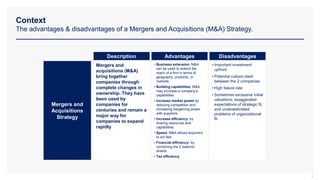
Context
The advantages & disadvantages of a Mergers and Acquisitions (M&A) Strategy.
3
Mergers and
Acquisitions
Strategy
Description Advantages Disadvantages
Mergers and
acquisitions (M&A)
bring together
companies through
complete changes in
ownership. They have
been used by
companies for
centuries and remain a
major way for
companies to expand
rapidly
• Business extension: M&A
can be used to extend the
reach of a firm in terms of
geography, products, or
markets
• Building capabilities: M&A
may increase a company’s
capabilities
• Increase market power by
reducing competition and
increasing bargaining power
with suppliers
• Increase efficiency: by
sharing resources and
capabilities
• Speed: M&A allows acquirers
to act fast
• Financial efficiency: by
combining the 2 balance
sheets
• Tax efficiency
• Important investment
upfront
• Potential culture clash
between the 2 companies
• High failure rate
• Sometimes excessive initial
valuations, exaggerated
expectations of strategic fit,
and underestimated
problems of organizational
fit
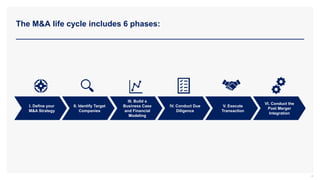
The M&A life cycle includes 6 phases:
4
II. Identify Target
Companies
III. Build a
Business Case
and Financial
Modeling
IV. Conduct Due
Diligence
V. Execute
Transaction
VI. Conduct the
Post Merger
Integration
I. Define your
M&A Strategy
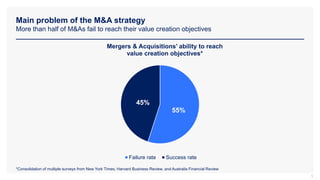
Main problem of the M&A strategy
More than half of M&As fail to reach their value creation objectives
5
55%
45%
Mergers & Acquisitions’ ability to reach
value creation objectives*
Failure rate Success rate
*Consolidation of multiple surveys from New York Times, Harvard Business Review, and Australia Financial Review
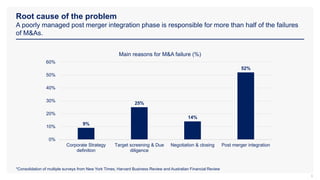
Root cause of the problem
A poorly managed post merger integration phase is responsible for more than half of the failures
of M&As.
6
*Consolidation of multiple surveys from New York Times, Harvard Business Review and Australian Financial Review
9%
25%
14%
52%
0%
10%
20%
30%
40%
50%
60%
Corporate Strategy
definition
Target screening & Due
diligence
Negotiation & closing Post merger integration
Main reasons for M&A failure (%)
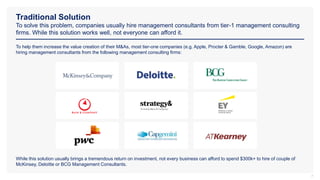
Traditional Solution
To solve this problem, companies usually hire management consultants from tier-1 management consulting
firms. While this solution works well, not everyone can afford it.
7
To help them increase the value creation of their M&As, most tier-one companies (e.g. Apple, Procter & Gamble, Google, Amazon) are
hiring management consultants from the following management consulting firms:
While this solution usually brings a tremendous return on investment, not every business can afford to spend $300k+ to hire of couple of
McKinsey, Deloitte or BCG Management Consultants.
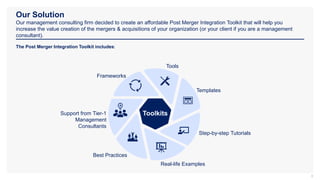
Our Solution
Our management consulting firm decided to create an affordable Post Merger Integration Toolkit that will help you
increase the value creation of the mergers & acquisitions of your organization (or your client if you are a management
consultant).
8
The Post Merger Integration Toolkit includes:
Toolkits
Tools
Templates
Step-by-step Tutorials
Real-life Examples
Best Practices
Support from Tier-1
Management
Consultants
Frameworks
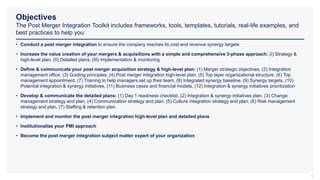
Objectives
The Post Merger Integration Toolkit includes frameworks, tools, templates, tutorials, real-life examples, and
best practices to help you:
9
• Conduct a post merger integration to ensure the company reaches its cost and revenue synergy targets
• Increase the value creation of your mergers & acquisitions with a simple and comprehensive 3-phase approach: (I) Strategy &
high-level plan, (II) Detailed plans, (III) Implementation & monitoring
• Define & communicate your post merger acquisition strategy & high-level plan: (1) Merger strategic objectives, (2) Integration
management office, (3) Guiding principles, (4) Post merger integration high-level plan, (5) Top layer organizational structure, (6) Top
management appointment, (7) Training to help managers set up their team, (8) Integrated synergy baseline, (9) Synergy targets, (10)
Potential integration & synergy initiatives, (11) Business cases and financial models, (12) Integration & synergy initiatives prioritization
• Develop & communicate the detailed plans: (1) Day 1 readiness checklist, (2) Integration & synergy initiatives plan, (3) Change
management strategy and plan, (4) Communication strategy and plan, (5) Culture integration strategy and plan, (6) Risk management
strategy and plan, (7) Staffing & retention plan
• Implement and monitor the post merger integration high-level plan and detailed plans
• Institutionalize your PMI approach
• Become the post merger integration subject matter expert of your organization
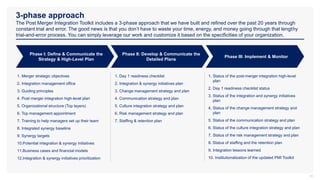
3-phase approach
The Post Merger Integration Toolkit includes a 3-phase approach that we have built and refined over the past 20 years through
constant trial and error. The good news is that you don’t have to waste your time, energy, and money going through that lengthy
trial-and-error process. You can simply leverage our work and customize it based on the specificities of your organization.
10
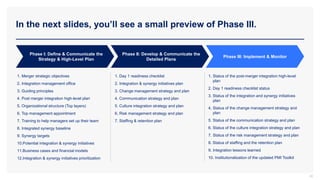
Phase I: Define & Communicate the
Strategy & High-Level Plan
Phase II: Develop & Communicate the
Detailed Plans
Phase III: Implement & Monitor
1. Merger strategic objectives
2. Integration management office
3. Guiding principles
4. Post merger integration high-level plan
5. Organizational structure (Top layers)
6. Top management appointment
7. Training to help managers set up their team
8. Integrated synergy baseline
9. Synergy targets
10.Potential integration & synergy initiatives
11.Business cases and financial models
12.Integration & synergy initiatives prioritization
1. Status of the post-merger integration high-level
plan
2. Day 1 readiness checklist status
3. Status of the integration and synergy initiatives
plan
4. Status of the change management strategy and
plan
5. Status of the communication strategy and plan
6. Status of the culture integration strategy and plan
7. Status of the risk management strategy and plan
8. Status of staffing and the retention plan
9. Integration lessons learned
10. Institutionalization of the updated PMI Toolkit
1. Day 1 readiness checklist
2. Integration & synergy initiatives plan
3. Change management strategy and plan
4. Communication strategy and plan
5. Culture integration strategy and plan
6. Risk management strategy and plan
7. Staffing & retention plan
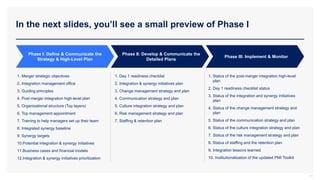
In the next slides, you’ll see a small preview of Phase I
11
Phase I: Define & Communicate the
Strategy & High-Level Plan
Phase II: Develop & Communicate the
Detailed Plans
Phase III: Implement & Monitor
1. Merger strategic objectives
2. Integration management office
3. Guiding principles
4. Post merger integration high-level plan
5. Organizational structure (Top layers)
6. Top management appointment
7. Training to help managers set up their team
8. Integrated synergy baseline
9. Synergy targets
10.Potential integration & synergy initiatives
11.Business cases and financial models
12.Integration & synergy initiatives prioritization
1. Status of the post-merger integration high-level
plan
2. Day 1 readiness checklist status
3. Status of the integration and synergy initiatives
plan
4. Status of the change management strategy and
plan
5. Status of the communication strategy and plan
6. Status of the culture integration strategy and plan
7. Status of the risk management strategy and plan
8. Status of staffing and the retention plan
9. Integration lessons learned
10. Institutionalization of the updated PMI Toolkit
1. Day 1 readiness checklist
2. Integration & synergy initiatives plan
3. Change management strategy and plan
4. Communication strategy and plan
5. Culture integration strategy and plan
6. Risk management strategy and plan
7. Staffing & retention plan
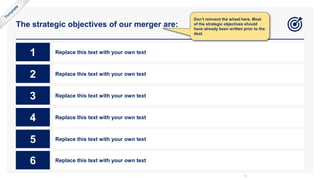
The strategic objectives of our merger are:
12
1 Replace this text with your own text
2 Replace this text with your own text
3 Replace this text with your own text
4 Replace this text with your own text
5 Replace this text with your own text
6 Replace this text with your own text
Don’t reinvent the wheel here. Most
of the strategic objectives should
have already been written prior to the
deal.
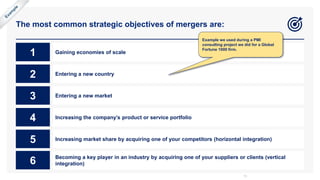
The most common strategic objectives of mergers are:
13
1 Gaining economies of scale
2 Entering a new country
3 Entering a new market
4 Increasing the company’s product or service portfolio
5 Increasing market share by acquiring one of your competitors (horizontal integration)
6 Becoming a key player in an industry by acquiring one of your suppliers or clients (vertical
integration)
Example we used during a PMI
consulting project we did for a Global
Fortune 1000 firm.
We decided to create an Integration Management Office that will be
responsible for the success of the integration
14
The Integration Management Office will oversee the post Merger Integration and be responsible for its success. It
includes 7 [replace this number with your own number] executives representing both [insert name of the acquiring
company] and [insert name of the acquired company]:
Integration Management
Officer
[Insert name]
Integration and
Synergy Initiatives
[Insert name]
Change
Management
[Insert name]
Culture
[Insert name]
Risk Management
[Insert name]
Communication
[Insert name]
Training
[Insert name]
This is only an example. You may
decide to emphasize different areas
and adjust the size of the integration
Management Office.
We identified 8 [insert your own number] guiding principles for post
merger integration
15
1 Insert your own guiding principle
2 Insert your own guiding principle
3 Insert your own guiding principle
4 Insert your own guiding principle
7 Insert your own guiding principle
5 Insert your own guiding principle
8 Insert your own guiding principle
6 Insert your own guiding principle
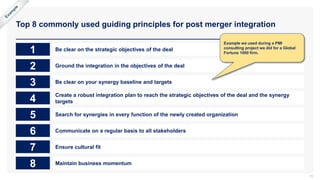
Top 8 commonly used guiding principles for post merger integration
16
1 Be clear on the strategic objectives of the deal
2 Ground the integration in the objectives of the deal
3 Be clear on your synergy baseline and targets
4 Create a robust integration plan to reach the strategic objectives of the deal and the synergy
targets
7 Ensure cultural fit
5 Search for synergies in every function of the newly created organization
8 Maintain business momentum
6 Communicate on a regular basis to all stakeholders
Example we used during a PMI
consulting project we did for a Global
Fortune 1000 firm.
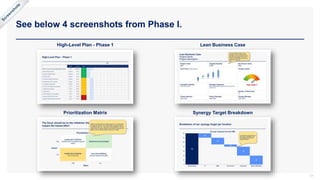
See below 4 screenshots from Phase I.
17
High-Level Plan - Phase 1
Prioritization Matrix
Lean Business Case
Synergy Target Breakdown
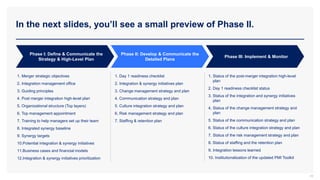
In the next slides, you’ll see a small preview of Phase II.
18
Phase I: Define & Communicate the
Strategy & High-Level Plan
Phase II: Develop & Communicate the
Detailed Plans
Phase III: Implement & Monitor
1. Merger strategic objectives
2. Integration management office
3. Guiding principles
4. Post merger integration high-level plan
5. Organizational structure (Top layers)
6. Top management appointment
7. Training to help managers set up their team
8. Integrated synergy baseline
9. Synergy targets
10.Potential integration & synergy initiatives
11.Business cases and financial models
12.Integration & synergy initiatives prioritization
1. Status of the post-merger integration high-level
plan
2. Day 1 readiness checklist status
3. Status of the integration and synergy initiatives
plan
4. Status of the change management strategy and
plan
5. Status of the communication strategy and plan
6. Status of the culture integration strategy and plan
7. Status of the risk management strategy and plan
8. Status of staffing and the retention plan
9. Integration lessons learned
10. Institutionalization of the updated PMI Toolkit
1. Day 1 readiness checklist
2. Integration & synergy initiatives plan
3. Change management strategy and plan
4. Communication strategy and plan
5. Culture integration strategy and plan
6. Risk management strategy and plan
7. Staffing & retention plan
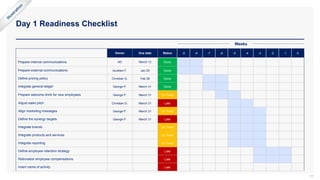
Day 1 Readiness Checklist
19
Owner Due date Status -9 -8 -7 -6 -5 -4 -3 -2 -1 0
Prepare internal communications AD March 12 Done
Prepare external communications Aurelien F. Jan 20 Done
Define pricing policy Christian G. Feb 28 Done
Integrate general ledger George P. March 31 Done
Prepare welcome drink for new employees George P. March 31 On Track
Adjust sales pitch Christian G. March 31 Late
Align marketing messages George P. March 31 On Track
Define the synergy targets George P. March 31 Late
Integrate brands On Track
Integrate products and services On Track
Integrate reporting On Track
Define employee retention strategy Late
Rationalize employee compensations Late
Insert name of activity Late
Weeks
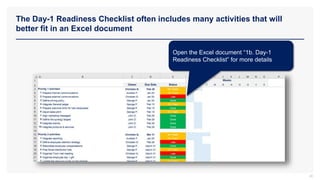
The Day-1 Readiness Checklist often includes many activities that will
better fit in an Excel document
20
Open the Excel document “1b. Day-1
Readiness Checklist” for more details
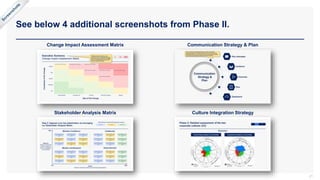
See below 4 additional screenshots from Phase II.
21
Change Impact Assessment Matrix
Stakeholder Analysis Matrix
Communication Strategy & Plan
Culture Integration Strategy
In the next slides, you’ll see a small preview of Phase III.
22
Phase I: Define & Communicate the
Strategy & High-Level Plan
Phase II: Develop & Communicate the
Detailed Plans
Phase III: Implement & Monitor
1. Merger strategic objectives
2. Integration management office
3. Guiding principles
4. Post merger integration high-level plan
5. Organizational structure (Top layers)
6. Top management appointment
7. Training to help managers set up their team
8. Integrated synergy baseline
9. Synergy targets
10.Potential integration & synergy initiatives
11.Business cases and financial models
12.Integration & synergy initiatives prioritization
1. Status of the post-merger integration high-level
plan
2. Day 1 readiness checklist status
3. Status of the integration and synergy initiatives
plan
4. Status of the change management strategy and
plan
5. Status of the communication strategy and plan
6. Status of the culture integration strategy and plan
7. Status of the risk management strategy and plan
8. Status of staffing and the retention plan
9. Integration lessons learned
10. Institutionalization of the updated PMI Toolkit
1. Day 1 readiness checklist
2. Integration & synergy initiatives plan
3. Change management strategy and plan
4. Communication strategy and plan
5. Culture integration strategy and plan
6. Risk management strategy and plan
7. Staffing & retention plan
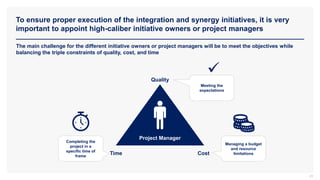
To ensure proper execution of the integration and synergy initiatives, it is very
important to appoint high-caliber initiative owners or project managers
23
Project Manager
Quality
Cost
Time
Meeting the
expectations
Managing a budget
and resource
limitations
Completing the
project in a
specific time of
frame

The main challenge for the different initiative owners or project managers will be to meet the objectives while
balancing the triple constraints of quality, cost, and time
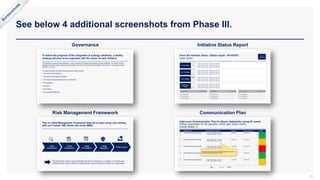
See below 4 additional screenshots from Phase III.
24
Governance
Risk Management Framework
Initiative Status Report
Communication Plan
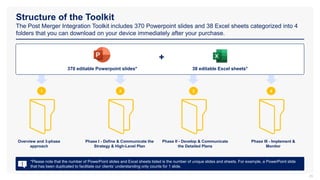
Structure of the Toolkit
The Post Merger Integration Toolkit includes 370 Powerpoint slides and 38 Excel sheets categorized into 4
folders that you can download on your device immediately after your purchase.
25
1 2 3 4
Overview and 3-phase
approach
Phase I - Define & Communicate the
Strategy & High-Level Plan
Phase II - Develop & Communicate
the Detailed Plans
Phase III - Implement &
Monitor
370 editable Powerpoint slides* 38 editable Excel sheets*
+
*Please note that the number of PowerPoint slides and Excel sheets listed is the number of unique slides and sheets. For example, a PowerPoint slide
that has been duplicated to facilitate our clients’ understanding only counts for 1 slide.
Interested in more than 1 Toolkit? You can access all our Toolkits for half the
price with the Gold Business & Consulting Package
www.slidebooks.com
Gold Business & Consulting Package
Learn More
26
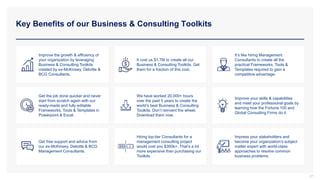
Key Benefits of our Business & Consulting Toolkits
27
Improve the growth & efficiency of
your organization by leveraging
Business & Consulting Toolkits
created by ex-McKinsey, Deloitte &
BCG Consultants.
It cost us $1.7M to create all our
Business & Consulting Toolkits. Get
them for a fraction of this cost.
It’s like hiring Management
Consultants to create all the
practical Frameworks, Tools &
Templates required to gain a
competitive advantage.
Get the job done quicker and never
start from scratch again with our
ready-made and fully editable
Frameworks, Tools & Templates in
Powerpoint & Excel.
We have worked 20,000+ hours
over the past 5 years to create the
world’s best Business & Consulting
Toolkits. Don’t reinvent the wheel.
Download them now.
Improve your skills & capabilities
and meet your professional goals by
learning how the Fortune 100 and
Global Consulting Firms do it.
Get free support and advice from
our ex-McKinsey, Deloitte & BCG
Management Consultants.
Hiring top-tier Consultants for a
management consulting project
would cost you $300k+. That’s a lot
more expensive than purchasing our
Toolkits.
Impress your stakeholders and
become your organization’s subject
matter expert with world-class
approaches to resolve common
business problems.
What our clients say about our Toolkits
Reviews imported from Facebooks, Amazon and Klaviyo
28
See more reviews >
29
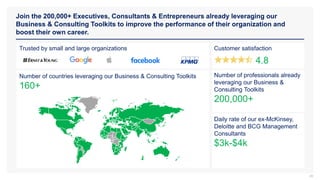
Trusted by small and large organizations Customer satisfaction
Number of countries leveraging our Business & Consulting Toolkits
160+
Number of professionals already
leveraging our Business &
Consulting Toolkits
200,000+
4.8
Daily rate of our ex-McKinsey,
Deloitte and BCG Management
Consultants
$3k-$4k
Join the 200,000+ Executives, Consultants & Entrepreneurs already leveraging our
Business & Consulting Toolkits to improve the performance of their organization and
boost their own career.
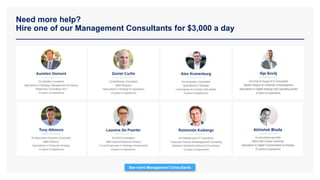
Need more help?
Hire one of our Management Consultants for $3,000 a day
See more Management Consultants
This was just a small preview.
www.slidebooks.com
31

Post Merger Integration Toolkit - Overview and 3-Phase Approach.pptx

  • 1.
    Post Merger IntegrationToolkit Overview and 3-Phase Approach Created by ex-McKinsey, Deloitte & BCG Strategy Consultants
  • 2.
    Context The advantages &disadvantages of an organic growth strategy 2 Organic Growth Strategy Description Advantages Disadvantages Often perceived as the default growth option for companies, an organic growth strategy relies on developing a company’s internal resources and capabilities • Provides deeper first-hand knowledge that is likely to be internalized in the company • Helps spread investment over time and reduce upfront commitment • There are no availability constraints, that is to say that the company is not dependent on the availability of suitable acquisition targets or potential alliance partners • Strategic independence • Creation of new activities within the existing culture environment • Can be slow, expensive, and risky • Difficult to use existing capabilities as the platform for major leaps in terms of innovation, diversification, or internationalization
  • 3.
    Context The advantages &disadvantages of a Mergers and Acquisitions (M&A) Strategy. 3 Mergers and Acquisitions Strategy Description Advantages Disadvantages Mergers and acquisitions (M&A) bring together companies through complete changes in ownership. They have been used by companies for centuries and remain a major way for companies to expand rapidly • Business extension: M&A can be used to extend the reach of a firm in terms of geography, products, or markets • Building capabilities: M&A may increase a company’s capabilities • Increase market power by reducing competition and increasing bargaining power with suppliers • Increase efficiency: by sharing resources and capabilities • Speed: M&A allows acquirers to act fast • Financial efficiency: by combining the 2 balance sheets • Tax efficiency • Important investment upfront • Potential culture clash between the 2 companies • High failure rate • Sometimes excessive initial valuations, exaggerated expectations of strategic fit, and underestimated problems of organizational fit
  • 4.
    The M&A lifecycle includes 6 phases: 4 II. Identify Target Companies III. Build a Business Case and Financial Modeling IV. Conduct Due Diligence V. Execute Transaction VI. Conduct the Post Merger Integration I. Define your M&A Strategy
  • 5.
    Main problem ofthe M&A strategy More than half of M&As fail to reach their value creation objectives 5 55% 45% Mergers & Acquisitions’ ability to reach value creation objectives* Failure rate Success rate *Consolidation of multiple surveys from New York Times, Harvard Business Review, and Australia Financial Review
  • 6.
    Root cause ofthe problem A poorly managed post merger integration phase is responsible for more than half of the failures of M&As. 6 *Consolidation of multiple surveys from New York Times, Harvard Business Review and Australian Financial Review 9% 25% 14% 52% 0% 10% 20% 30% 40% 50% 60% Corporate Strategy definition Target screening & Due diligence Negotiation & closing Post merger integration Main reasons for M&A failure (%)
  • 7.
    Traditional Solution To solvethis problem, companies usually hire management consultants from tier-1 management consulting firms. While this solution works well, not everyone can afford it. 7 To help them increase the value creation of their M&As, most tier-one companies (e.g. Apple, Procter & Gamble, Google, Amazon) are hiring management consultants from the following management consulting firms: While this solution usually brings a tremendous return on investment, not every business can afford to spend $300k+ to hire of couple of McKinsey, Deloitte or BCG Management Consultants.
  • 8.
    Our Solution Our managementconsulting firm decided to create an affordable Post Merger Integration Toolkit that will help you increase the value creation of the mergers & acquisitions of your organization (or your client if you are a management consultant). 8 The Post Merger Integration Toolkit includes: Toolkits Tools Templates Step-by-step Tutorials Real-life Examples Best Practices Support from Tier-1 Management Consultants Frameworks
  • 9.
    Objectives The Post MergerIntegration Toolkit includes frameworks, tools, templates, tutorials, real-life examples, and best practices to help you: 9 • Conduct a post merger integration to ensure the company reaches its cost and revenue synergy targets • Increase the value creation of your mergers & acquisitions with a simple and comprehensive 3-phase approach: (I) Strategy & high-level plan, (II) Detailed plans, (III) Implementation & monitoring • Define & communicate your post merger acquisition strategy & high-level plan: (1) Merger strategic objectives, (2) Integration management office, (3) Guiding principles, (4) Post merger integration high-level plan, (5) Top layer organizational structure, (6) Top management appointment, (7) Training to help managers set up their team, (8) Integrated synergy baseline, (9) Synergy targets, (10) Potential integration & synergy initiatives, (11) Business cases and financial models, (12) Integration & synergy initiatives prioritization • Develop & communicate the detailed plans: (1) Day 1 readiness checklist, (2) Integration & synergy initiatives plan, (3) Change management strategy and plan, (4) Communication strategy and plan, (5) Culture integration strategy and plan, (6) Risk management strategy and plan, (7) Staffing & retention plan • Implement and monitor the post merger integration high-level plan and detailed plans • Institutionalize your PMI approach • Become the post merger integration subject matter expert of your organization
  • 10.
    3-phase approach The PostMerger Integration Toolkit includes a 3-phase approach that we have built and refined over the past 20 years through constant trial and error. The good news is that you don’t have to waste your time, energy, and money going through that lengthy trial-and-error process. You can simply leverage our work and customize it based on the specificities of your organization. 10 Phase I: Define & Communicate the Strategy & High-Level Plan Phase II: Develop & Communicate the Detailed Plans Phase III: Implement & Monitor 1. Merger strategic objectives 2. Integration management office 3. Guiding principles 4. Post merger integration high-level plan 5. Organizational structure (Top layers) 6. Top management appointment 7. Training to help managers set up their team 8. Integrated synergy baseline 9. Synergy targets 10.Potential integration & synergy initiatives 11.Business cases and financial models 12.Integration & synergy initiatives prioritization 1. Status of the post-merger integration high-level plan 2. Day 1 readiness checklist status 3. Status of the integration and synergy initiatives plan 4. Status of the change management strategy and plan 5. Status of the communication strategy and plan 6. Status of the culture integration strategy and plan 7. Status of the risk management strategy and plan 8. Status of staffing and the retention plan 9. Integration lessons learned 10. Institutionalization of the updated PMI Toolkit 1. Day 1 readiness checklist 2. Integration & synergy initiatives plan 3. Change management strategy and plan 4. Communication strategy and plan 5. Culture integration strategy and plan 6. Risk management strategy and plan 7. Staffing & retention plan
  • 11.
    In the nextslides, you’ll see a small preview of Phase I 11 Phase I: Define & Communicate the Strategy & High-Level Plan Phase II: Develop & Communicate the Detailed Plans Phase III: Implement & Monitor 1. Merger strategic objectives 2. Integration management office 3. Guiding principles 4. Post merger integration high-level plan 5. Organizational structure (Top layers) 6. Top management appointment 7. Training to help managers set up their team 8. Integrated synergy baseline 9. Synergy targets 10.Potential integration & synergy initiatives 11.Business cases and financial models 12.Integration & synergy initiatives prioritization 1. Status of the post-merger integration high-level plan 2. Day 1 readiness checklist status 3. Status of the integration and synergy initiatives plan 4. Status of the change management strategy and plan 5. Status of the communication strategy and plan 6. Status of the culture integration strategy and plan 7. Status of the risk management strategy and plan 8. Status of staffing and the retention plan 9. Integration lessons learned 10. Institutionalization of the updated PMI Toolkit 1. Day 1 readiness checklist 2. Integration & synergy initiatives plan 3. Change management strategy and plan 4. Communication strategy and plan 5. Culture integration strategy and plan 6. Risk management strategy and plan 7. Staffing & retention plan
  • 12.
    The strategic objectivesof our merger are: 12 1 Replace this text with your own text 2 Replace this text with your own text 3 Replace this text with your own text 4 Replace this text with your own text 5 Replace this text with your own text 6 Replace this text with your own text Don’t reinvent the wheel here. Most of the strategic objectives should have already been written prior to the deal.
  • 13.
    The most commonstrategic objectives of mergers are: 13 1 Gaining economies of scale 2 Entering a new country 3 Entering a new market 4 Increasing the company’s product or service portfolio 5 Increasing market share by acquiring one of your competitors (horizontal integration) 6 Becoming a key player in an industry by acquiring one of your suppliers or clients (vertical integration) Example we used during a PMI consulting project we did for a Global Fortune 1000 firm.
  • 14.
    We decided tocreate an Integration Management Office that will be responsible for the success of the integration 14 The Integration Management Office will oversee the post Merger Integration and be responsible for its success. It includes 7 [replace this number with your own number] executives representing both [insert name of the acquiring company] and [insert name of the acquired company]: Integration Management Officer [Insert name] Integration and Synergy Initiatives [Insert name] Change Management [Insert name] Culture [Insert name] Risk Management [Insert name] Communication [Insert name] Training [Insert name] This is only an example. You may decide to emphasize different areas and adjust the size of the integration Management Office.
  • 15.
    We identified 8[insert your own number] guiding principles for post merger integration 15 1 Insert your own guiding principle 2 Insert your own guiding principle 3 Insert your own guiding principle 4 Insert your own guiding principle 7 Insert your own guiding principle 5 Insert your own guiding principle 8 Insert your own guiding principle 6 Insert your own guiding principle
  • 16.
    Top 8 commonlyused guiding principles for post merger integration 16 1 Be clear on the strategic objectives of the deal 2 Ground the integration in the objectives of the deal 3 Be clear on your synergy baseline and targets 4 Create a robust integration plan to reach the strategic objectives of the deal and the synergy targets 7 Ensure cultural fit 5 Search for synergies in every function of the newly created organization 8 Maintain business momentum 6 Communicate on a regular basis to all stakeholders Example we used during a PMI consulting project we did for a Global Fortune 1000 firm.
  • 17.
    See below 4screenshots from Phase I. 17 High-Level Plan - Phase 1 Prioritization Matrix Lean Business Case Synergy Target Breakdown
  • 18.
    In the nextslides, you’ll see a small preview of Phase II. 18 Phase I: Define & Communicate the Strategy & High-Level Plan Phase II: Develop & Communicate the Detailed Plans Phase III: Implement & Monitor 1. Merger strategic objectives 2. Integration management office 3. Guiding principles 4. Post merger integration high-level plan 5. Organizational structure (Top layers) 6. Top management appointment 7. Training to help managers set up their team 8. Integrated synergy baseline 9. Synergy targets 10.Potential integration & synergy initiatives 11.Business cases and financial models 12.Integration & synergy initiatives prioritization 1. Status of the post-merger integration high-level plan 2. Day 1 readiness checklist status 3. Status of the integration and synergy initiatives plan 4. Status of the change management strategy and plan 5. Status of the communication strategy and plan 6. Status of the culture integration strategy and plan 7. Status of the risk management strategy and plan 8. Status of staffing and the retention plan 9. Integration lessons learned 10. Institutionalization of the updated PMI Toolkit 1. Day 1 readiness checklist 2. Integration & synergy initiatives plan 3. Change management strategy and plan 4. Communication strategy and plan 5. Culture integration strategy and plan 6. Risk management strategy and plan 7. Staffing & retention plan
  • 19.
    Day 1 ReadinessChecklist 19 Owner Due date Status -9 -8 -7 -6 -5 -4 -3 -2 -1 0 Prepare internal communications AD March 12 Done Prepare external communications Aurelien F. Jan 20 Done Define pricing policy Christian G. Feb 28 Done Integrate general ledger George P. March 31 Done Prepare welcome drink for new employees George P. March 31 On Track Adjust sales pitch Christian G. March 31 Late Align marketing messages George P. March 31 On Track Define the synergy targets George P. March 31 Late Integrate brands On Track Integrate products and services On Track Integrate reporting On Track Define employee retention strategy Late Rationalize employee compensations Late Insert name of activity Late Weeks
  • 20.
    The Day-1 ReadinessChecklist often includes many activities that will better fit in an Excel document 20 Open the Excel document “1b. Day-1 Readiness Checklist” for more details
  • 21.
    See below 4additional screenshots from Phase II. 21 Change Impact Assessment Matrix Stakeholder Analysis Matrix Communication Strategy & Plan Culture Integration Strategy
  • 22.
    In the nextslides, you’ll see a small preview of Phase III. 22 Phase I: Define & Communicate the Strategy & High-Level Plan Phase II: Develop & Communicate the Detailed Plans Phase III: Implement & Monitor 1. Merger strategic objectives 2. Integration management office 3. Guiding principles 4. Post merger integration high-level plan 5. Organizational structure (Top layers) 6. Top management appointment 7. Training to help managers set up their team 8. Integrated synergy baseline 9. Synergy targets 10.Potential integration & synergy initiatives 11.Business cases and financial models 12.Integration & synergy initiatives prioritization 1. Status of the post-merger integration high-level plan 2. Day 1 readiness checklist status 3. Status of the integration and synergy initiatives plan 4. Status of the change management strategy and plan 5. Status of the communication strategy and plan 6. Status of the culture integration strategy and plan 7. Status of the risk management strategy and plan 8. Status of staffing and the retention plan 9. Integration lessons learned 10. Institutionalization of the updated PMI Toolkit 1. Day 1 readiness checklist 2. Integration & synergy initiatives plan 3. Change management strategy and plan 4. Communication strategy and plan 5. Culture integration strategy and plan 6. Risk management strategy and plan 7. Staffing & retention plan
  • 23.
    To ensure properexecution of the integration and synergy initiatives, it is very important to appoint high-caliber initiative owners or project managers 23 Project Manager Quality Cost Time Meeting the expectations Managing a budget and resource limitations Completing the project in a specific time of frame  The main challenge for the different initiative owners or project managers will be to meet the objectives while balancing the triple constraints of quality, cost, and time
  • 24.
    See below 4additional screenshots from Phase III. 24 Governance Risk Management Framework Initiative Status Report Communication Plan
  • 25.
    Structure of theToolkit The Post Merger Integration Toolkit includes 370 Powerpoint slides and 38 Excel sheets categorized into 4 folders that you can download on your device immediately after your purchase. 25 1 2 3 4 Overview and 3-phase approach Phase I - Define & Communicate the Strategy & High-Level Plan Phase II - Develop & Communicate the Detailed Plans Phase III - Implement & Monitor 370 editable Powerpoint slides* 38 editable Excel sheets* + *Please note that the number of PowerPoint slides and Excel sheets listed is the number of unique slides and sheets. For example, a PowerPoint slide that has been duplicated to facilitate our clients’ understanding only counts for 1 slide.
  • 26.
    Interested in morethan 1 Toolkit? You can access all our Toolkits for half the price with the Gold Business & Consulting Package www.slidebooks.com Gold Business & Consulting Package Learn More 26
  • 27.
    Key Benefits ofour Business & Consulting Toolkits 27 Improve the growth & efficiency of your organization by leveraging Business & Consulting Toolkits created by ex-McKinsey, Deloitte & BCG Consultants. It cost us $1.7M to create all our Business & Consulting Toolkits. Get them for a fraction of this cost. It’s like hiring Management Consultants to create all the practical Frameworks, Tools & Templates required to gain a competitive advantage. Get the job done quicker and never start from scratch again with our ready-made and fully editable Frameworks, Tools & Templates in Powerpoint & Excel. We have worked 20,000+ hours over the past 5 years to create the world’s best Business & Consulting Toolkits. Don’t reinvent the wheel. Download them now. Improve your skills & capabilities and meet your professional goals by learning how the Fortune 100 and Global Consulting Firms do it. Get free support and advice from our ex-McKinsey, Deloitte & BCG Management Consultants. Hiring top-tier Consultants for a management consulting project would cost you $300k+. That’s a lot more expensive than purchasing our Toolkits. Impress your stakeholders and become your organization’s subject matter expert with world-class approaches to resolve common business problems.
  • 28.
    What our clientssay about our Toolkits Reviews imported from Facebooks, Amazon and Klaviyo 28 See more reviews >
  • 29.
    29 Trusted by smalland large organizations Customer satisfaction Number of countries leveraging our Business & Consulting Toolkits 160+ Number of professionals already leveraging our Business & Consulting Toolkits 200,000+ 4.8 Daily rate of our ex-McKinsey, Deloitte and BCG Management Consultants $3k-$4k Join the 200,000+ Executives, Consultants & Entrepreneurs already leveraging our Business & Consulting Toolkits to improve the performance of their organization and boost their own career.
  • 30.
    Need more help? Hireone of our Management Consultants for $3,000 a day See more Management Consultants
  • 31.
    This was justa small preview. www.slidebooks.com 31