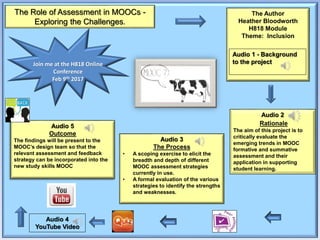
The Role of Assessment in MOOCs -
Exploring the Challenges.
Audio 2
Rationale
The aim of this project is to
critically evaluate the
emerging trends in MOOC
formative and summative
assessment and their
application in supporting
student learning.
The Author
Heather Bloodworth
H818 Module
Theme: Inclusion
Audio 3
The Process
• A scoping exercise to elicit the
breadth and depth of different
MOOC assessment strategies
currently in use.
• A formal evaluation of the various
strategies to identify the strengths
and weaknesses.
Audio 5
Outcome
The findings will be present to the
MOOC’s design team so that the
relevant assessment and feedback
strategy can be incorporated into the
new study skills MOOC
Join me at the H818 Online
Conference
Feb 9th 2017
Audio 1 - Background
to the project
Audio 4
YouTube Video
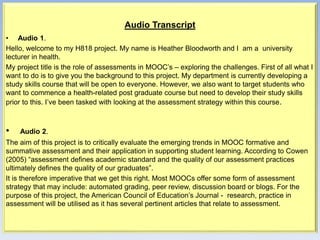
Audio Transcript
• Audio 1.
Hello, welcome to my H818 project. My name is Heather Bloodworth and I am a university
lecturer in health.
My project title is the role of assessments in MOOC’s – exploring the challenges. First of all what I
want to do is to give you the background to this project. My department is currently developing a
study skills course that will be open to everyone. However, we also want to target students who
want to commence a health-related post graduate course but need to develop their study skills
prior to this. I’ve been tasked with looking at the assessment strategy within this course.
• Audio 2.
The aim of this project is to critically evaluate the emerging trends in MOOC formative and
summative assessment and their application in supporting student learning. According to Cowen
(2005) “assessment defines academic standard and the quality of our assessment practices
ultimately defines the quality of our graduates”.
It is therefore imperative that we get this right. Most MOOCs offer some form of assessment
strategy that may include: automated grading, peer review, discussion board or blogs. For the
purpose of this project, the American Council of Education’s Journal - research, practice in
assessment will be utilised as it has several pertinent articles that relate to assessment.
• Audio 3.
A scoping exercise will be undertaken to elicit the breadth and depth of the different
MOOC assessment strategies currently in use and then a formal evaluation of the
various evaluation strategies will be done to identify their various strengths and
weaknesses.
• Audio 4.
This YouTube video gives us an insight into some of the issues that designers/
lecturers face when trying to find suitable assessment methods that can be
incorporated/integrated into a MOOC.
• Audio 5.
Finally, I will be presenting my project and its findings, not only to the local MOOC
design team but also to the H818 online conference on the 9th February.
Sources
• Balfour, S. (2013) ‘Assessing writing in
MOOCs: automated essay scoring and
calibrated peer review’, Research & Practice
in Assessment, vol. 8 , pp 40-48 [online]
Available at http://rpajournal.com/dev/wp-
content/uploads/2013/05/SF4.pdf (last
accessed 2 December 2016).
• Cowan, J. (2005) ‘Designing assessment to
enhance student learning’[online]. Available
at
http://www.heacademy.ac.uk/assets/ps/docu
ments/practice_guides/practice_guides/
ps0069_designing_assessment_to_improve_
physical_sciences_learning accessed (last
accessed 13 Dec 2016).
• Sandee, C. (2013) ‘Assessment’s place in the
new MOOC world’, Research &Practice in
Assessment, vol. 8,pp 5-11[online]. Available
at http://www.rpajournal.com/dev/wp-
content/uploads/2013/05/SF1.pdf. (last
accessed 2 December 2016).
Accessibility
You can access the poster through: Cloudworks:
http://cloudworks.ac.uk/cloud/view/10175
Slide Share:
http://www.slideshare.net/upload?from_source=l
oggedin_profile
PowToon:
https://www.powtoon.com/online-
presentation/fRYaEoQ2WRk/?mode=movie#/
Affiliation
Heather Bloodworth
Lecturer in Nursing
School of Healthcare Science
Bangor University
Gwynedd
North Wales

MOOC Assessments

  • 1.
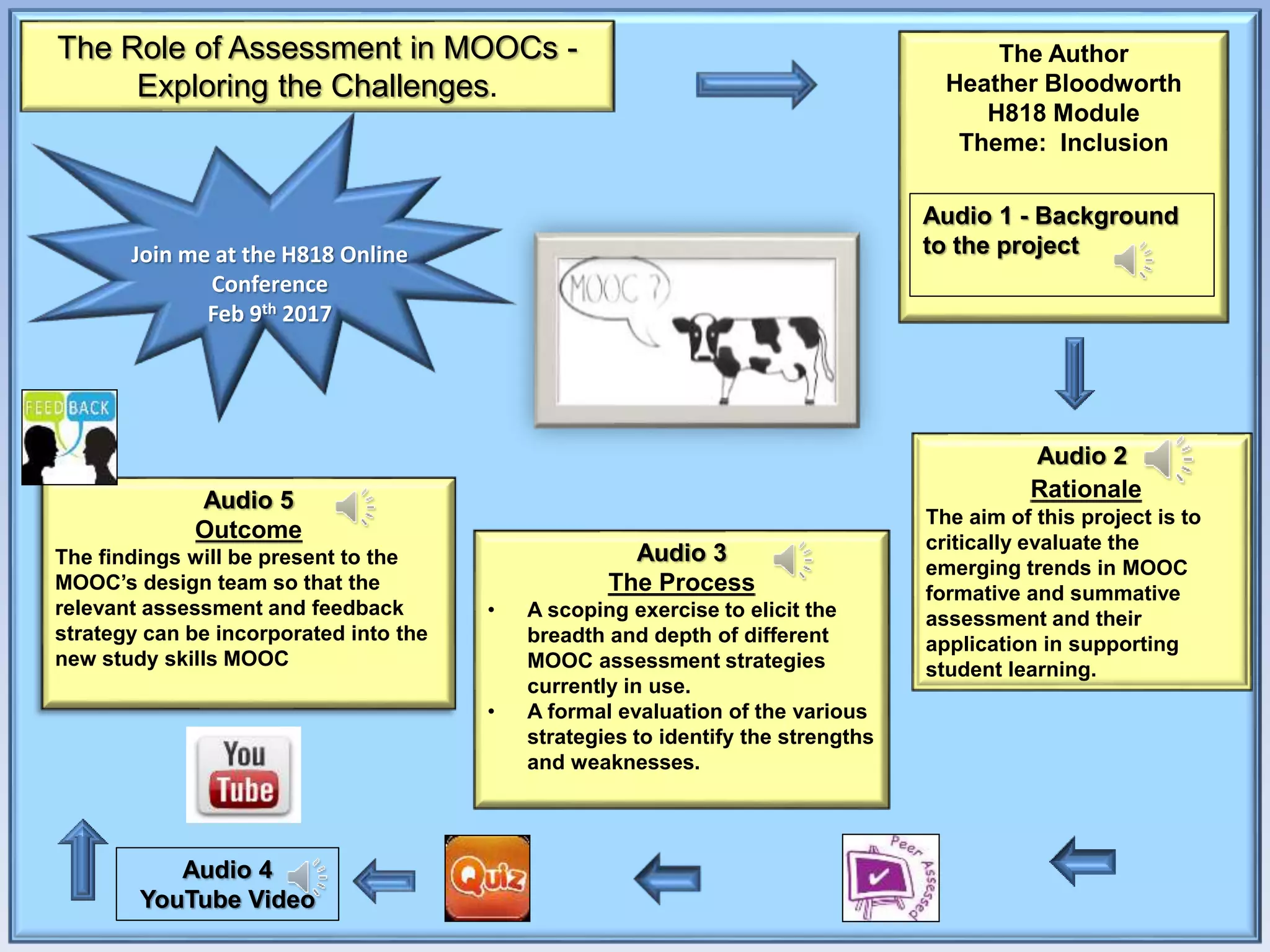
    The Role ofAssessment in MOOCs - Exploring the Challenges. Audio 2 Rationale The aim of this project is to critically evaluate the emerging trends in MOOC formative and summative assessment and their application in supporting student learning. The Author Heather Bloodworth H818 Module Theme: Inclusion Audio 3 The Process • A scoping exercise to elicit the breadth and depth of different MOOC assessment strategies currently in use. • A formal evaluation of the various strategies to identify the strengths and weaknesses. Audio 5 Outcome The findings will be present to the MOOC’s design team so that the relevant assessment and feedback strategy can be incorporated into the new study skills MOOC Join me at the H818 Online Conference Feb 9th 2017 Audio 1 - Background to the project Audio 4 YouTube Video
  • 2.
    Audio Transcript • Audio1. Hello, welcome to my H818 project. My name is Heather Bloodworth and I am a university lecturer in health. My project title is the role of assessments in MOOC’s – exploring the challenges. First of all what I want to do is to give you the background to this project. My department is currently developing a study skills course that will be open to everyone. However, we also want to target students who want to commence a health-related post graduate course but need to develop their study skills prior to this. I’ve been tasked with looking at the assessment strategy within this course. • Audio 2. The aim of this project is to critically evaluate the emerging trends in MOOC formative and summative assessment and their application in supporting student learning. According to Cowen (2005) “assessment defines academic standard and the quality of our assessment practices ultimately defines the quality of our graduates”. It is therefore imperative that we get this right. Most MOOCs offer some form of assessment strategy that may include: automated grading, peer review, discussion board or blogs. For the purpose of this project, the American Council of Education’s Journal - research, practice in assessment will be utilised as it has several pertinent articles that relate to assessment.
  • 3.
    • Audio 3. Ascoping exercise will be undertaken to elicit the breadth and depth of the different MOOC assessment strategies currently in use and then a formal evaluation of the various evaluation strategies will be done to identify their various strengths and weaknesses. • Audio 4. This YouTube video gives us an insight into some of the issues that designers/ lecturers face when trying to find suitable assessment methods that can be incorporated/integrated into a MOOC. • Audio 5. Finally, I will be presenting my project and its findings, not only to the local MOOC design team but also to the H818 online conference on the 9th February.
  • 4.
    Sources • Balfour, S.(2013) ‘Assessing writing in MOOCs: automated essay scoring and calibrated peer review’, Research & Practice in Assessment, vol. 8 , pp 40-48 [online] Available at http://rpajournal.com/dev/wp- content/uploads/2013/05/SF4.pdf (last accessed 2 December 2016). • Cowan, J. (2005) ‘Designing assessment to enhance student learning’[online]. Available at http://www.heacademy.ac.uk/assets/ps/docu ments/practice_guides/practice_guides/ ps0069_designing_assessment_to_improve_ physical_sciences_learning accessed (last accessed 13 Dec 2016). • Sandee, C. (2013) ‘Assessment’s place in the new MOOC world’, Research &Practice in Assessment, vol. 8,pp 5-11[online]. Available at http://www.rpajournal.com/dev/wp- content/uploads/2013/05/SF1.pdf. (last accessed 2 December 2016). Accessibility You can access the poster through: Cloudworks: http://cloudworks.ac.uk/cloud/view/10175 Slide Share: http://www.slideshare.net/upload?from_source=l oggedin_profile PowToon: https://www.powtoon.com/online- presentation/fRYaEoQ2WRk/?mode=movie#/ Affiliation Heather Bloodworth Lecturer in Nursing School of Healthcare Science Bangor University Gwynedd North Wales