Computational Models for Predicting Human Toxicities


                                   Sean Ekins

                 Collaborations in Chemistry, Fuquay-Varina, NC.

                      Collaborative Drug Discovery, Burlingame, CA.
    School of Pharmacy, Department of Pharmaceutical Sciences, University of Maryland.
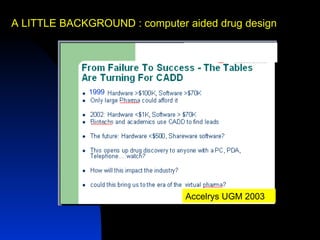
A LITTLE BACKGROUND : computer aided drug design


              1999


                               Accelrys UGM 2003
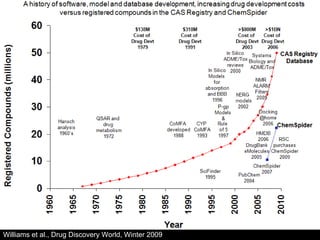
The future: crowdsourced drug discovery


Williams et al., Drug Discovery World, Winter 2009
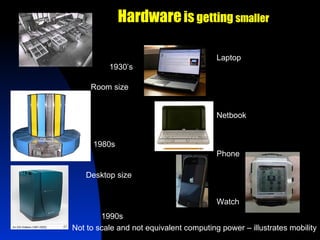
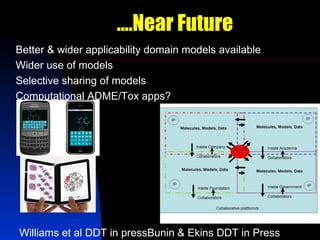
Hardware is getting smaller

                                         Laptop
          1930’s

     Room size


                                         Netbook


      1980s
                                         Phone

   Desktop size


                                         Watch
        1990s
Not to scale and not equivalent computing power – illustrates mobility
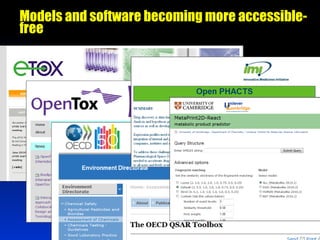
Models and software becoming more accessible-
free
Driving change

              Pharma reached a productivity tipping point
                    Cost of drug development high
                    Failure in clinic due to toxicity
Initiatives like REACH, ToxCast etc need to screen many molecules
                        Reduce use of animals

     How to predict failure earlier – are we at a turning point?
Examples of Models for Human Toxicities


   Drug induced liver injury (DILI)
   Time dependent inhibition of P450 3A4
   Transporters – hOCTN2
   PXR and ToxCast
   Precompetitive pharma models
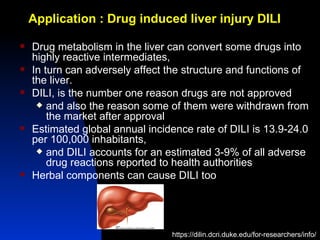
Application : Drug induced liver injury DILI

   Drug metabolism in the liver can convert some drugs into
    highly reactive intermediates,
   In turn can adversely affect the structure and functions of
    the liver.
   DILI, is the number one reason drugs are not approved
      and also the reason some of them were withdrawn from
        the market after approval
   Estimated global annual incidence rate of DILI is 13.9-24.0
    per 100,000 inhabitants,
      and DILI accounts for an estimated 3-9% of all adverse
        drug reactions reported to health authorities
   Herbal components can cause DILI too


                                 https://dilin.dcri.duke.edu/for-researchers/info/
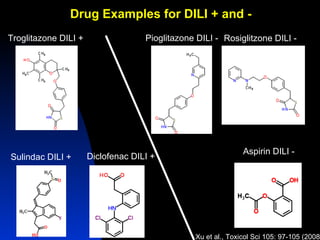
Drug Examples for DILI + and -
Troglitazone DILI +                 Pioglitazone DILI - Rosiglitzone DILI -


                                                               Aspirin DILI -
Sulindac DILI +       Diclofenac DILI +


                                                Xu et al., Toxicol Sci 105: 97-105 (2008)
Limitations of DILI?

   Compound has to physically have been made and be
    available for testing.
   The screening system is still relatively low throughput
    compared with any primary screens
   Whole compound or vendor libraries cannot be cost
    effectively screened for prioritization.
   Screening system should be representative of the human
    organ including drug metabolism capability.
   Prediction of human therapeutic Cmax is often imprecise before
    clinical testing in actual patients.


Ekins, Williams and Xu, Drug Metab Dispos 38: 2302-2308, 2010
DILI Computational Models

   74 compounds - classification models (linear discriminant analysis, artificial neural
    networks, and machine learning algorithms (OneR))
        Internal cross-validation (accuracy 84%, sensitivity 78%, and specificity 90%). Testing
         on 6 and 13 compounds, respectively > 80% accuracy.

                    (Cruz-Monteagudo et al., J Comput Chem 29: 533-549, 2008).

   A second study used binary QSAR (248 active and 283 inactive) Support vector
    machine models –
        external 5-fold cross-validation procedures and 78% accuracy for a set of 18
         compounds

                     (Fourches et al., Chem Res Toxicol 23: 171-183, 2010).

   A third study created a knowledge base with structural alerts from 1266 chemicals.
        Alerts created were used to predict results for 626 Pfizer compounds (sensitivity of
         46%, specificity of 73%, and concordance of 56% for the latest version)

                    (Greene et al., Chem Res Toxicol 23: 1215-1222, 2010).
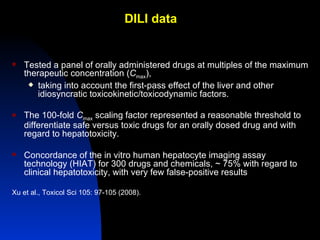
DILI data


   Tested a panel of orally administered drugs at multiples of the maximum
    therapeutic concentration (Cmax),
      taking into account the first-pass effect of the liver and other
        idiosyncratic toxicokinetic/toxicodynamic factors.

   The 100-fold Cmax scaling factor represented a reasonable threshold to
    differentiate safe versus toxic drugs for an orally dosed drug and with
    regard to hepatotoxicity.

   Concordance of the in vitro human hepatocyte imaging assay
    technology (HIAT) for 300 drugs and chemicals, ~ 75% with regard to
    clinical hepatotoxicity, with very few false-positive results

Xu et al., Toxicol Sci 105: 97-105 (2008).
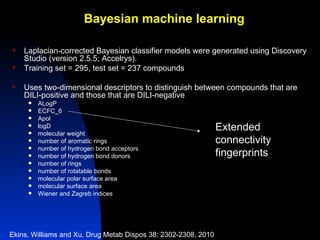
Bayesian machine learning

   Laplacian-corrected Bayesian classifier models were generated using Discovery
    Studio (version 2.5.5; Accelrys).
   Training set = 295, test set = 237 compounds

   Uses two-dimensional descriptors to distinguish between compounds that are
    DILI-positive and those that are DILI-negative
        ALogP
        ECFC_6
        Apol
     
     
         logD
         molecular weight
                                                                Extended
        number of aromatic rings                               connectivity
        number of hydrogen bond acceptors
        number of hydrogen bond donors                         fingerprints
        number of rings
        number of rotatable bonds
        molecular polar surface area
        molecular surface area
        Wiener and Zagreb indices


Ekins, Williams and Xu, Drug Metab Dispos 38: 2302-2308, 2010
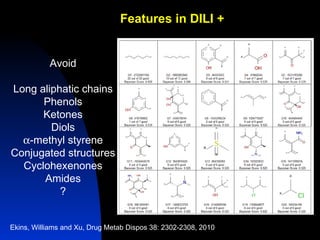
Features in DILI +


           Avoid

Long aliphatic chains
      Phenols
      Ketones
        Diols
  α-methyl styrene
Conjugated structures
  Cyclohexenones
      Amides
          ?


Ekins, Williams and Xu, Drug Metab Dispos 38: 2302-2308, 2010
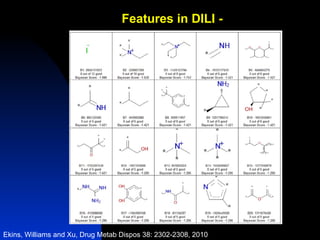
Features in DILI -


Ekins, Williams and Xu, Drug Metab Dispos 38: 2302-2308, 2010
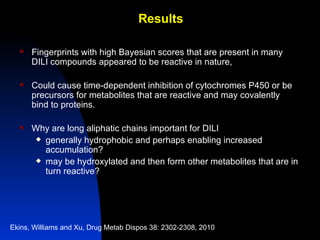
Results

     Fingerprints with high Bayesian scores that are present in many
      DILI compounds appeared to be reactive in nature,

     Could cause time-dependent inhibition of cytochromes P450 or be
      precursors for metabolites that are reactive and may covalently
      bind to proteins.

     Why are long aliphatic chains important for DILI
       generally hydrophobic and perhaps enabling increased
        accumulation?
       may be hydroxylated and then form other metabolites that are in
        turn reactive?


Ekins, Williams and Xu, Drug Metab Dispos 38: 2302-2308, 2010
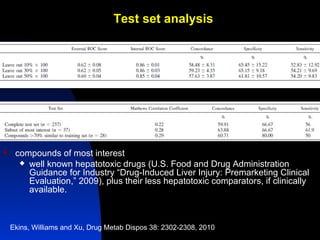
Test set analysis


    compounds of most interest
       well known hepatotoxic drugs (U.S. Food and Drug Administration
        Guidance for Industry “Drug-Induced Liver Injury: Premarketing Clinical
        Evaluation,” 2009), plus their less hepatotoxic comparators, if clinically
        available.


    Ekins, Williams and Xu, Drug Metab Dispos 38: 2302-2308, 2010
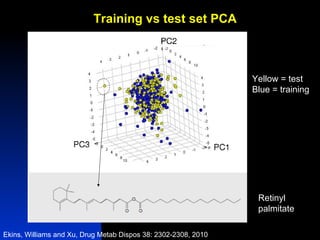
Training vs test set PCA


                                                                Yellow = test
                                                                Blue = training


                                                                 Retinyl
                                                                 palmitate

Ekins, Williams and Xu, Drug Metab Dispos 38: 2302-2308, 2010
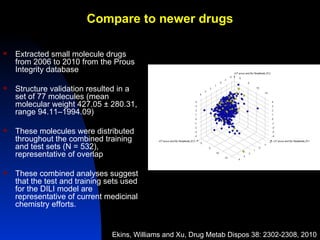
Compare to newer drugs

   Extracted small molecule drugs
    from 2006 to 2010 from the Prous
    Integrity database

   Structure validation resulted in a
    set of 77 molecules (mean
    molecular weight 427.05 ± 280.31,
    range 94.11–1994.09)

   These molecules were distributed
    throughout the combined training
    and test sets (N = 532),
    representative of overlap

   These combined analyses suggest
    that the test and training sets used
    for the DILI model are
    representative of current medicinal
    chemistry efforts.


                                Ekins, Williams and Xu, Drug Metab Dispos 38: 2302-2308, 2010
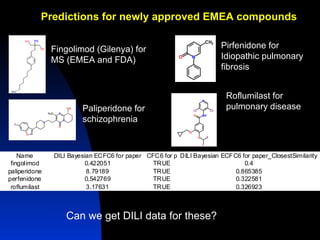
Predictions for newly approved EMEA compounds

               Fingolimod (Gilenya) for                                Pirfenidone for
               MS (EMEA and FDA)                                       Idiopathic pulmonary
                                                                       fibrosis


                                                                         Roflumilast for
                        Paliperidone for                                 pulmonary disease
                        schizophrenia


    Name       DILI Bayesian ECFC6 Bayes ian ECFC6 for paper#PredictionECFC6 for paper_ClosestSimilarity
                                DILI for paper           DILI Bayesian
 fingolimod               0.422051              TRUE                          0.4
paliperidone              8.79189               TRUE                       0.865385
perfenidone               0.542769              TRUE                       0.322581
 roflumilast              3.17631               TRUE                       0.326923


                   Can we get DILI data for these?
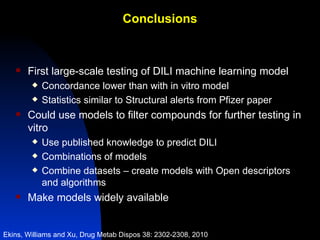
Conclusions


      First large-scale testing of DILI machine learning model
           Concordance lower than with in vitro model
           Statistics similar to Structural alerts from Pfizer paper
      Could use models to filter compounds for further testing in
       vitro
           Use published knowledge to predict DILI
           Combinations of models
           Combine datasets – create models with Open descriptors
            and algorithms
      Make models widely available


Ekins, Williams and Xu, Drug Metab Dispos 38: 2302-2308, 2010
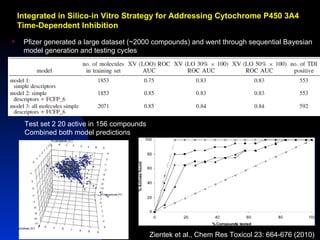
Integrated in Silico-in Vitro Strategy for Addressing Cytochrome P450 3A4
    Time-Dependent Inhibition
    Pfizer generated a large dataset (~2000 compounds) and went through sequential Bayesian
     model generation and testing cycles


     Test set 2 20 active in 156 compounds
     Combined both model predictions


                                             Zientek et al., Chem Res Toxicol 23: 664-676 (2010)
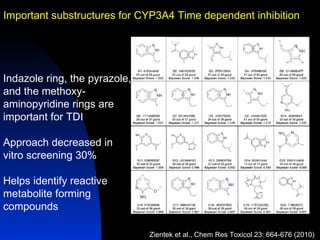
Important substructures for CYP3A4 Time dependent inhibition


Indazole ring, the pyrazole,
and the methoxy-
aminopyridine rings are
important for TDI

Approach decreased in
vitro screening 30%

Helps identify reactive
metabolite forming
compounds

                               Zientek et al., Chem Res Toxicol 23: 664-676 (2010)
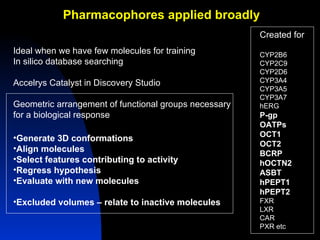
Pharmacophores applied broadly
                                                       Created for
Ideal when we have few molecules for training          CYP2B6
In silico database searching                           CYP2C9
                                                       CYP2D6
Accelrys Catalyst in Discovery Studio                  CYP3A4
                                                       CYP3A5
                                                       CYP3A7
Geometric arrangement of functional groups necessary   hERG
for a biological response                              P-gp
                                                       OATPs
•Generate 3D conformations                             OCT1
                                                       OCT2
•Align molecules
                                                       BCRP
•Select features contributing to activity              hOCTN2
•Regress hypothesis                                    ASBT
•Evaluate with new molecules                           hPEPT1
                                                       hPEPT2
•Excluded volumes – relate to inactive molecules       FXR
                                                       LXR
                                                       CAR
                                                       PXR etc
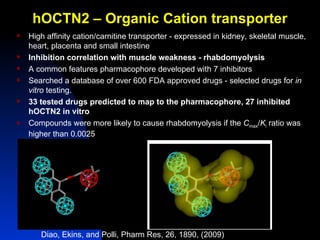
hOCTN2 – Organic Cation transporter
   High affinity cation/carnitine transporter - expressed in kidney, skeletal muscle,
    heart, placenta and small intestine
   Inhibition correlation with muscle weakness - rhabdomyolysis
   A common features pharmacophore developed with 7 inhibitors
   Searched a database of over 600 FDA approved drugs - selected drugs for in
    vitro testing.
   33 tested drugs predicted to map to the pharmacophore, 27 inhibited
    hOCTN2 in vitro
   Compounds were more likely to cause rhabdomyolysis if the Cmax/Ki ratio was
    higher than 0.0025


       Diao, Ekins, and Polli, Pharm Res, 26, 1890, (2009)
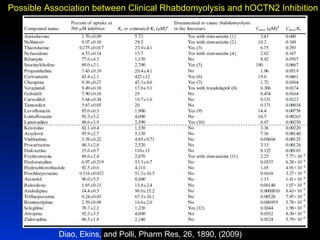
Possible Association between Clinical Rhabdomyolysis and hOCTN2 Inhibition


            Diao, Ekins, and Polli, Pharm Res, 26, 1890, (2009)
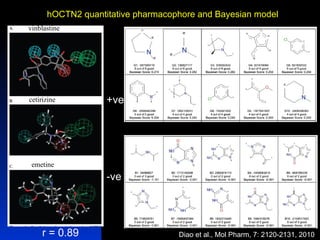
hOCTN2 quantitative pharmacophore and Bayesian model
vinblastine


cetirizine         +ve


 emetine
                   -ve


     r = 0.89                      Diao et al., Mol Pharm, 7: 2120-2131, 2010
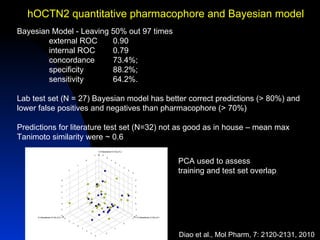
hOCTN2 quantitative pharmacophore and Bayesian model
Bayesian Model - Leaving 50% out 97 times
        external ROC     0.90
        internal ROC     0.79
        concordance      73.4%;
        specificity      88.2%;
        sensitivity      64.2%.

Lab test set (N = 27) Bayesian model has better correct predictions (> 80%) and
lower false positives and negatives than pharmacophore (> 70%)

Predictions for literature test set (N=32) not as good as in house – mean max
Tanimoto similarity were ~ 0.6


                                             PCA used to assess
                                             training and test set overlap


                                             Diao et al., Mol Pharm, 7: 2120-2131, 2010
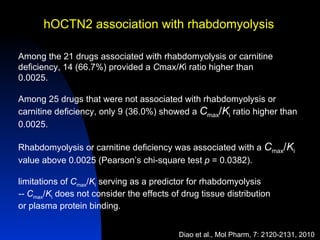
hOCTN2 association with rhabdomyolysis

Among the 21 drugs associated with rhabdomyolysis or carnitine
deficiency, 14 (66.7%) provided a Cmax/Ki ratio higher than
0.0025.

Among 25 drugs that were not associated with rhabdomyolysis or
carnitine deficiency, only 9 (36.0%) showed a Cmax/Ki ratio higher than
0.0025.

Rhabdomyolysis or carnitine deficiency was associated with a Cmax/Ki
value above 0.0025 (Pearson’s chi-square test p = 0.0382).

limitations of Cmax/Ki serving as a predictor for rhabdomyolysis
-- Cmax/Ki does not consider the effects of drug tissue distribution
or plasma protein binding.


                                           Diao et al., Mol Pharm, 7: 2120-2131, 2010
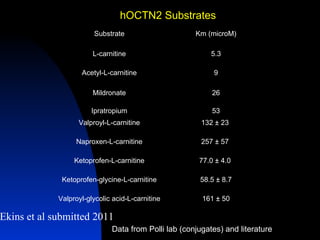
hOCTN2 Substrates
                        Substrate                     Km (microM)

                        L-carnitine                        5.3

                    Acetyl-L-carnitine                     9

                        Mildronate                         26

                        Ipratropium                        53
                   Valproyl-L-carnitine                 132 ± 23

                  Naproxen-L-carnitine                  257 ± 57

                  Ketoprofen-L-carnitine               77.0 ± 4.0

              Ketoprofen-glycine-L-carnitine           58.5 ± 8.7

             Valproyl-glycolic acid-L-carnitine         161 ± 50

Ekins et al submitted 2011
                              Data from Polli lab (conjugates) and literature
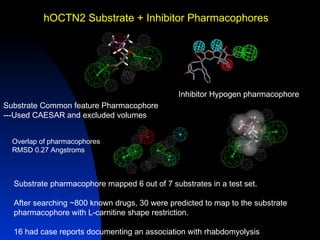
hOCTN2 Substrate + Inhibitor Pharmacophores


                                               Inhibitor Hypogen pharmacophore
Substrate Common feature Pharmacophore
---Used CAESAR and excluded volumes


  Overlap of pharmacophores
  RMSD 0.27 Angstroms


  Substrate pharmacophore mapped 6 out of 7 substrates in a test set.

  After searching ~800 known drugs, 30 were predicted to map to the substrate
  pharmacophore with L-carnitine shape restriction.

  16 had case reports documenting an association with rhabdomyolysis
Growing role for PXR agonists
   Interaction between hyperforin in St Johns Wort and irinotecan
    = reduces efficacy

   Ablating the inflammatory response mediated by exogenous toxins e.g.
    inflammatory diseases of the bowel

   Cholesterol metabolism pathway control - a negative effect

   Mediating blood-brain barrier efflux of drugs modulation of efflux
    transporters e.g. mdr1 and mrp2.
   Decrease retention of CNS drugs e.g. anti-epileptics and pain killers,
    decreasing efficacy


   PXR induces cell growth and is pro-carcinogenic
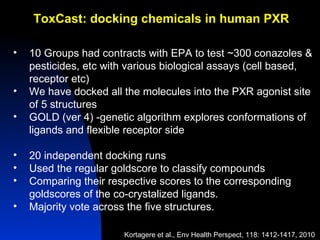
ToxCast: docking chemicals in human PXR

•   10 Groups had contracts with EPA to test ~300 conazoles &
    pesticides, etc with various biological assays (cell based,
    receptor etc)
•   We have docked all the molecules into the PXR agonist site
    of 5 structures
•   GOLD (ver 4) -genetic algorithm explores conformations of
    ligands and flexible receptor side

•   20 independent docking runs
•   Used the regular goldscore to classify compounds
•   Comparing their respective scores to the corresponding
    goldscores of the co-crystalized ligands.
•   Majority vote across the five structures.

                       Kortagere et al., Env Health Perspect, 118: 1412-1417, 2010
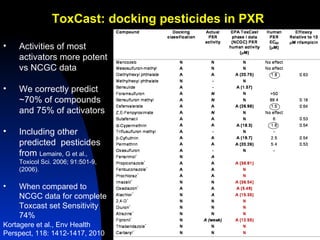
ToxCast: docking pesticides in PXR

•   Activities of most
    activators more potent
    vs NCGC data

•   We correctly predict
    ~70% of compounds
    and 75% of activators

•   Including other
    predicted pesticides
    from Lemaire, G et al.,
    Toxicol Sci. 2006; 91:501-9,
    (2006).

•   When compared to
    NCGC data for complete
    Toxcast set Sensitivity
    74%
Kortagere et al., Env Health
Perspect, 118: 1412-1417, 2010
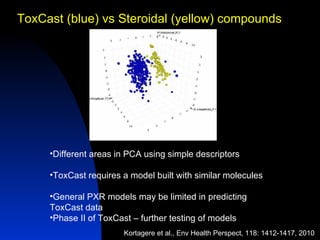
ToxCast (blue) vs Steroidal (yellow) compounds


     •Different areas in PCA using simple descriptors

     •ToxCast requires a model built with similar molecules

     •General PXR models may be limited in predicting
     ToxCast data
     •Phase II of ToxCast – further testing of models
                       Kortagere et al., Env Health Perspect, 118: 1412-1417, 2010
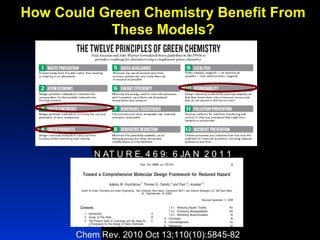
How Could Green Chemistry Benefit From
           These Models?


      …


           N AT U R E, 4 6 9: 6 JA N 2 0 1 1


       Chem Rev. 2010 Oct 13;110(10):5845-82
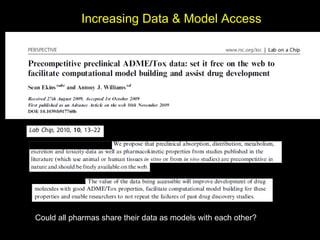
Increasing Data & Model Access


Could all pharmas share their data as models with each other?
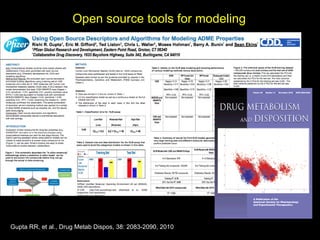
Open source tools for modeling


Gupta RR, et al., Drug Metab Dispos, 38: 2083-2090, 2010
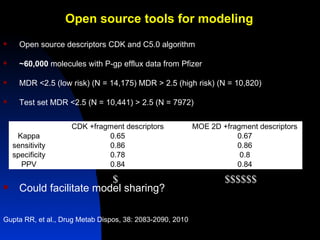
Open source tools for modeling
     Open source descriptors CDK and C5.0 algorithm

     ~60,000 molecules with P-gp efflux data from Pfizer

     MDR <2.5 (low risk) (N = 14,175) MDR > 2.5 (high risk) (N = 10,820)

     Test set MDR <2.5 (N = 10,441) > 2.5 (N = 7972)

                    CDK +fragment descriptors              MOE 2D +fragment descriptors
     Kappa                   0.65                                     0.67
    sensitivity              0.86                                     0.86
    specificity              0.78                                      0.8
      PPV                    0.84                                     0.84

                          $                                        $$$$$$
     Could facilitate model sharing?

Gupta RR, et al., Drug Metab Dispos, 38: 2083-2090, 2010
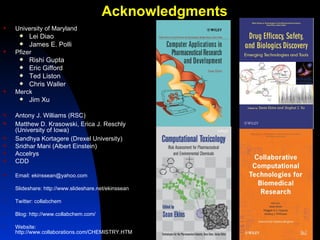
….Near Future
Better & wider applicability domain models available
Wider use of models
Selective sharing of models
Computational ADME/Tox apps?


Williams et al DDT in pressBunin & Ekins DDT in Press
Acknowledgments
   University of Maryland
        Lei Diao
        James E. Polli
   Pfizer
        Rishi Gupta
        Eric Gifford
        Ted Liston
        Chris Waller
   Merck
        Jim Xu

   Antony J. Williams (RSC)
   Matthew D. Krasowski, Erica J. Reschly
    (University of Iowa)
   Sandhya Kortagere (Drexel University)
   Sridhar Mani (Albert Einstein)
   Accelrys
   CDD

   Email: ekinssean@yahoo.com

•   Slideshare: http://www.slideshare.net/ekinssean

•   Twitter: collabchem

•   Blog: http://www.collabchem.com/

•   Website:
    http://www.collaborations.com/CHEMISTRY.HTM
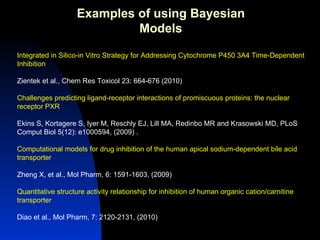
Bayesian machine learning

Bayesian classification is a simple probabilistic classification model. It is based on
Bayes’ theorem


h is the hypothesis or model
d is the observed data
p(h) is the prior belief (probability of hypothesis h before observing any data)
p(d) is the data evidence (marginal probability of the data)
p(d|h) is the likelihood (probability of data d if hypothesis h is true)
p(h|d) is the posterior probability (probability of hypothesis h being true given the
observed data d)

A weight is calculated for each feature using a Laplacian-adjusted probability
estimate to account for the different sampling frequencies of different features.

The weights are summed to provide a probability estimate

Ekins, Williams and Xu, Drug Metab Dispos 38: 2302-2308, 2010
Examples of using Bayesian
                             Models

Integrated in Silico-in Vitro Strategy for Addressing Cytochrome P450 3A4 Time-Dependent
Inhibition

Zientek et al., Chem Res Toxicol 23: 664-676 (2010)

Challenges predicting ligand-receptor interactions of promiscuous proteins: the nuclear
receptor PXR

Ekins S, Kortagere S, Iyer M, Reschly EJ, Lill MA, Redinbo MR and Krasowski MD, PLoS
Comput Biol 5(12): e1000594, (2009) .

Computational models for drug inhibition of the human apical sodium-dependent bile acid
transporter

Zheng X, et al., Mol Pharm, 6: 1591-1603, (2009)

Quantitative structure activity relationship for inhibition of human organic cation/carnitine
transporter

Diao et al., Mol Pharm, 7: 2120-2131, (2010)

Montreal 8th world congress

  • 1.
    Computational Models forPredicting Human Toxicities Sean Ekins Collaborations in Chemistry, Fuquay-Varina, NC. Collaborative Drug Discovery, Burlingame, CA. School of Pharmacy, Department of Pharmaceutical Sciences, University of Maryland.
  • 2.
    A LITTLE BACKGROUND: computer aided drug design 1999 Accelrys UGM 2003
  • 3.
    The future: crowdsourceddrug discovery Williams et al., Drug Discovery World, Winter 2009
  • 4.
    Hardware is gettingsmaller Laptop 1930’s Room size Netbook 1980s Phone Desktop size Watch 1990s Not to scale and not equivalent computing power – illustrates mobility
  • 5.
    Models and softwarebecoming more accessible- free
  • 6.
    Driving change Pharma reached a productivity tipping point Cost of drug development high Failure in clinic due to toxicity Initiatives like REACH, ToxCast etc need to screen many molecules Reduce use of animals How to predict failure earlier – are we at a turning point?
  • 7.
    Examples of Modelsfor Human Toxicities  Drug induced liver injury (DILI)  Time dependent inhibition of P450 3A4  Transporters – hOCTN2  PXR and ToxCast  Precompetitive pharma models
  • 8.
    Application : Druginduced liver injury DILI  Drug metabolism in the liver can convert some drugs into highly reactive intermediates,  In turn can adversely affect the structure and functions of the liver.  DILI, is the number one reason drugs are not approved  and also the reason some of them were withdrawn from the market after approval  Estimated global annual incidence rate of DILI is 13.9-24.0 per 100,000 inhabitants,  and DILI accounts for an estimated 3-9% of all adverse drug reactions reported to health authorities  Herbal components can cause DILI too https://dilin.dcri.duke.edu/for-researchers/info/
  • 9.
    Drug Examples forDILI + and - Troglitazone DILI + Pioglitazone DILI - Rosiglitzone DILI - Aspirin DILI - Sulindac DILI + Diclofenac DILI + Xu et al., Toxicol Sci 105: 97-105 (2008)
  • 10.
    Limitations of DILI?  Compound has to physically have been made and be available for testing.  The screening system is still relatively low throughput compared with any primary screens  Whole compound or vendor libraries cannot be cost effectively screened for prioritization.  Screening system should be representative of the human organ including drug metabolism capability.  Prediction of human therapeutic Cmax is often imprecise before clinical testing in actual patients. Ekins, Williams and Xu, Drug Metab Dispos 38: 2302-2308, 2010
  • 11.
    DILI Computational Models  74 compounds - classification models (linear discriminant analysis, artificial neural networks, and machine learning algorithms (OneR))  Internal cross-validation (accuracy 84%, sensitivity 78%, and specificity 90%). Testing on 6 and 13 compounds, respectively > 80% accuracy. (Cruz-Monteagudo et al., J Comput Chem 29: 533-549, 2008).  A second study used binary QSAR (248 active and 283 inactive) Support vector machine models –  external 5-fold cross-validation procedures and 78% accuracy for a set of 18 compounds (Fourches et al., Chem Res Toxicol 23: 171-183, 2010).  A third study created a knowledge base with structural alerts from 1266 chemicals.  Alerts created were used to predict results for 626 Pfizer compounds (sensitivity of 46%, specificity of 73%, and concordance of 56% for the latest version) (Greene et al., Chem Res Toxicol 23: 1215-1222, 2010).
  • 12.
    DILI data  Tested a panel of orally administered drugs at multiples of the maximum therapeutic concentration (Cmax),  taking into account the first-pass effect of the liver and other idiosyncratic toxicokinetic/toxicodynamic factors.  The 100-fold Cmax scaling factor represented a reasonable threshold to differentiate safe versus toxic drugs for an orally dosed drug and with regard to hepatotoxicity.  Concordance of the in vitro human hepatocyte imaging assay technology (HIAT) for 300 drugs and chemicals, ~ 75% with regard to clinical hepatotoxicity, with very few false-positive results Xu et al., Toxicol Sci 105: 97-105 (2008).
  • 13.
    Bayesian machine learning  Laplacian-corrected Bayesian classifier models were generated using Discovery Studio (version 2.5.5; Accelrys).  Training set = 295, test set = 237 compounds  Uses two-dimensional descriptors to distinguish between compounds that are DILI-positive and those that are DILI-negative  ALogP  ECFC_6  Apol   logD molecular weight Extended  number of aromatic rings connectivity  number of hydrogen bond acceptors  number of hydrogen bond donors fingerprints  number of rings  number of rotatable bonds  molecular polar surface area  molecular surface area  Wiener and Zagreb indices Ekins, Williams and Xu, Drug Metab Dispos 38: 2302-2308, 2010
  • 14.
    Features in DILI+ Avoid Long aliphatic chains Phenols Ketones Diols α-methyl styrene Conjugated structures Cyclohexenones Amides ? Ekins, Williams and Xu, Drug Metab Dispos 38: 2302-2308, 2010
  • 15.
    Features in DILI- Ekins, Williams and Xu, Drug Metab Dispos 38: 2302-2308, 2010
  • 16.
    Results  Fingerprints with high Bayesian scores that are present in many DILI compounds appeared to be reactive in nature,  Could cause time-dependent inhibition of cytochromes P450 or be precursors for metabolites that are reactive and may covalently bind to proteins.  Why are long aliphatic chains important for DILI  generally hydrophobic and perhaps enabling increased accumulation?  may be hydroxylated and then form other metabolites that are in turn reactive? Ekins, Williams and Xu, Drug Metab Dispos 38: 2302-2308, 2010
  • 17.
    Test set analysis  compounds of most interest  well known hepatotoxic drugs (U.S. Food and Drug Administration Guidance for Industry “Drug-Induced Liver Injury: Premarketing Clinical Evaluation,” 2009), plus their less hepatotoxic comparators, if clinically available. Ekins, Williams and Xu, Drug Metab Dispos 38: 2302-2308, 2010
  • 18.
    Training vs testset PCA Yellow = test Blue = training Retinyl palmitate Ekins, Williams and Xu, Drug Metab Dispos 38: 2302-2308, 2010
  • 19.
    Compare to newerdrugs  Extracted small molecule drugs from 2006 to 2010 from the Prous Integrity database  Structure validation resulted in a set of 77 molecules (mean molecular weight 427.05 ± 280.31, range 94.11–1994.09)  These molecules were distributed throughout the combined training and test sets (N = 532), representative of overlap  These combined analyses suggest that the test and training sets used for the DILI model are representative of current medicinal chemistry efforts. Ekins, Williams and Xu, Drug Metab Dispos 38: 2302-2308, 2010
  • 20.
    Predictions for newlyapproved EMEA compounds Fingolimod (Gilenya) for Pirfenidone for MS (EMEA and FDA) Idiopathic pulmonary fibrosis Roflumilast for Paliperidone for pulmonary disease schizophrenia Name DILI Bayesian ECFC6 Bayes ian ECFC6 for paper#PredictionECFC6 for paper_ClosestSimilarity DILI for paper DILI Bayesian fingolimod 0.422051 TRUE 0.4 paliperidone 8.79189 TRUE 0.865385 perfenidone 0.542769 TRUE 0.322581 roflumilast 3.17631 TRUE 0.326923 Can we get DILI data for these?
  • 21.
    Conclusions  First large-scale testing of DILI machine learning model  Concordance lower than with in vitro model  Statistics similar to Structural alerts from Pfizer paper  Could use models to filter compounds for further testing in vitro  Use published knowledge to predict DILI  Combinations of models  Combine datasets – create models with Open descriptors and algorithms  Make models widely available Ekins, Williams and Xu, Drug Metab Dispos 38: 2302-2308, 2010
  • 22.
    Integrated in Silico-inVitro Strategy for Addressing Cytochrome P450 3A4 Time-Dependent Inhibition  Pfizer generated a large dataset (~2000 compounds) and went through sequential Bayesian model generation and testing cycles Test set 2 20 active in 156 compounds Combined both model predictions Zientek et al., Chem Res Toxicol 23: 664-676 (2010)
  • 23.
    Important substructures forCYP3A4 Time dependent inhibition Indazole ring, the pyrazole, and the methoxy- aminopyridine rings are important for TDI Approach decreased in vitro screening 30% Helps identify reactive metabolite forming compounds Zientek et al., Chem Res Toxicol 23: 664-676 (2010)
  • 24.
    Pharmacophores applied broadly Created for Ideal when we have few molecules for training CYP2B6 In silico database searching CYP2C9 CYP2D6 Accelrys Catalyst in Discovery Studio CYP3A4 CYP3A5 CYP3A7 Geometric arrangement of functional groups necessary hERG for a biological response P-gp OATPs •Generate 3D conformations OCT1 OCT2 •Align molecules BCRP •Select features contributing to activity hOCTN2 •Regress hypothesis ASBT •Evaluate with new molecules hPEPT1 hPEPT2 •Excluded volumes – relate to inactive molecules FXR LXR CAR PXR etc
  • 25.
    hOCTN2 – OrganicCation transporter  High affinity cation/carnitine transporter - expressed in kidney, skeletal muscle, heart, placenta and small intestine  Inhibition correlation with muscle weakness - rhabdomyolysis  A common features pharmacophore developed with 7 inhibitors  Searched a database of over 600 FDA approved drugs - selected drugs for in vitro testing.  33 tested drugs predicted to map to the pharmacophore, 27 inhibited hOCTN2 in vitro  Compounds were more likely to cause rhabdomyolysis if the Cmax/Ki ratio was higher than 0.0025 Diao, Ekins, and Polli, Pharm Res, 26, 1890, (2009)
  • 26.
    Possible Association betweenClinical Rhabdomyolysis and hOCTN2 Inhibition Diao, Ekins, and Polli, Pharm Res, 26, 1890, (2009)
  • 27.
    hOCTN2 quantitative pharmacophoreand Bayesian model vinblastine cetirizine +ve emetine -ve r = 0.89 Diao et al., Mol Pharm, 7: 2120-2131, 2010
  • 28.
    hOCTN2 quantitative pharmacophoreand Bayesian model Bayesian Model - Leaving 50% out 97 times external ROC 0.90 internal ROC 0.79 concordance 73.4%; specificity 88.2%; sensitivity 64.2%. Lab test set (N = 27) Bayesian model has better correct predictions (> 80%) and lower false positives and negatives than pharmacophore (> 70%) Predictions for literature test set (N=32) not as good as in house – mean max Tanimoto similarity were ~ 0.6 PCA used to assess training and test set overlap Diao et al., Mol Pharm, 7: 2120-2131, 2010
  • 29.
    hOCTN2 association withrhabdomyolysis Among the 21 drugs associated with rhabdomyolysis or carnitine deficiency, 14 (66.7%) provided a Cmax/Ki ratio higher than 0.0025. Among 25 drugs that were not associated with rhabdomyolysis or carnitine deficiency, only 9 (36.0%) showed a Cmax/Ki ratio higher than 0.0025. Rhabdomyolysis or carnitine deficiency was associated with a Cmax/Ki value above 0.0025 (Pearson’s chi-square test p = 0.0382). limitations of Cmax/Ki serving as a predictor for rhabdomyolysis -- Cmax/Ki does not consider the effects of drug tissue distribution or plasma protein binding. Diao et al., Mol Pharm, 7: 2120-2131, 2010
  • 30.
    hOCTN2 Substrates Substrate Km (microM) L-carnitine 5.3 Acetyl-L-carnitine 9 Mildronate 26 Ipratropium 53 Valproyl-L-carnitine 132 ± 23 Naproxen-L-carnitine 257 ± 57 Ketoprofen-L-carnitine 77.0 ± 4.0 Ketoprofen-glycine-L-carnitine 58.5 ± 8.7 Valproyl-glycolic acid-L-carnitine 161 ± 50 Ekins et al submitted 2011 Data from Polli lab (conjugates) and literature
  • 31.
    hOCTN2 Substrate +Inhibitor Pharmacophores Inhibitor Hypogen pharmacophore Substrate Common feature Pharmacophore ---Used CAESAR and excluded volumes Overlap of pharmacophores RMSD 0.27 Angstroms Substrate pharmacophore mapped 6 out of 7 substrates in a test set. After searching ~800 known drugs, 30 were predicted to map to the substrate pharmacophore with L-carnitine shape restriction. 16 had case reports documenting an association with rhabdomyolysis
  • 32.
    Growing role forPXR agonists  Interaction between hyperforin in St Johns Wort and irinotecan = reduces efficacy  Ablating the inflammatory response mediated by exogenous toxins e.g. inflammatory diseases of the bowel  Cholesterol metabolism pathway control - a negative effect  Mediating blood-brain barrier efflux of drugs modulation of efflux transporters e.g. mdr1 and mrp2.  Decrease retention of CNS drugs e.g. anti-epileptics and pain killers, decreasing efficacy  PXR induces cell growth and is pro-carcinogenic
  • 33.
    ToxCast: docking chemicalsin human PXR • 10 Groups had contracts with EPA to test ~300 conazoles & pesticides, etc with various biological assays (cell based, receptor etc) • We have docked all the molecules into the PXR agonist site of 5 structures • GOLD (ver 4) -genetic algorithm explores conformations of ligands and flexible receptor side • 20 independent docking runs • Used the regular goldscore to classify compounds • Comparing their respective scores to the corresponding goldscores of the co-crystalized ligands. • Majority vote across the five structures. Kortagere et al., Env Health Perspect, 118: 1412-1417, 2010
  • 34.
    ToxCast: docking pesticidesin PXR • Activities of most activators more potent vs NCGC data • We correctly predict ~70% of compounds and 75% of activators • Including other predicted pesticides from Lemaire, G et al., Toxicol Sci. 2006; 91:501-9, (2006). • When compared to NCGC data for complete Toxcast set Sensitivity 74% Kortagere et al., Env Health Perspect, 118: 1412-1417, 2010
  • 35.
    ToxCast (blue) vsSteroidal (yellow) compounds •Different areas in PCA using simple descriptors •ToxCast requires a model built with similar molecules •General PXR models may be limited in predicting ToxCast data •Phase II of ToxCast – further testing of models Kortagere et al., Env Health Perspect, 118: 1412-1417, 2010
  • 36.
    How Could GreenChemistry Benefit From These Models? … N AT U R E, 4 6 9: 6 JA N 2 0 1 1 Chem Rev. 2010 Oct 13;110(10):5845-82
  • 37.
    Increasing Data &Model Access Could all pharmas share their data as models with each other?
  • 38.
    Open source toolsfor modeling Gupta RR, et al., Drug Metab Dispos, 38: 2083-2090, 2010
  • 39.
    Open source toolsfor modeling  Open source descriptors CDK and C5.0 algorithm  ~60,000 molecules with P-gp efflux data from Pfizer  MDR <2.5 (low risk) (N = 14,175) MDR > 2.5 (high risk) (N = 10,820)  Test set MDR <2.5 (N = 10,441) > 2.5 (N = 7972) CDK +fragment descriptors MOE 2D +fragment descriptors Kappa 0.65 0.67 sensitivity 0.86 0.86 specificity 0.78 0.8 PPV 0.84 0.84 $ $$$$$$  Could facilitate model sharing? Gupta RR, et al., Drug Metab Dispos, 38: 2083-2090, 2010
  • 40.
    ….Near Future Better &wider applicability domain models available Wider use of models Selective sharing of models Computational ADME/Tox apps? Williams et al DDT in pressBunin & Ekins DDT in Press
  • 41.
    Acknowledgments  University of Maryland  Lei Diao  James E. Polli  Pfizer  Rishi Gupta  Eric Gifford  Ted Liston  Chris Waller  Merck  Jim Xu  Antony J. Williams (RSC)  Matthew D. Krasowski, Erica J. Reschly (University of Iowa)  Sandhya Kortagere (Drexel University)  Sridhar Mani (Albert Einstein)  Accelrys  CDD  Email: ekinssean@yahoo.com • Slideshare: http://www.slideshare.net/ekinssean • Twitter: collabchem • Blog: http://www.collabchem.com/ • Website: http://www.collaborations.com/CHEMISTRY.HTM
  • 42.
    Bayesian machine learning Bayesianclassification is a simple probabilistic classification model. It is based on Bayes’ theorem h is the hypothesis or model d is the observed data p(h) is the prior belief (probability of hypothesis h before observing any data) p(d) is the data evidence (marginal probability of the data) p(d|h) is the likelihood (probability of data d if hypothesis h is true) p(h|d) is the posterior probability (probability of hypothesis h being true given the observed data d) A weight is calculated for each feature using a Laplacian-adjusted probability estimate to account for the different sampling frequencies of different features. The weights are summed to provide a probability estimate Ekins, Williams and Xu, Drug Metab Dispos 38: 2302-2308, 2010
  • 43.
    Examples of usingBayesian Models Integrated in Silico-in Vitro Strategy for Addressing Cytochrome P450 3A4 Time-Dependent Inhibition Zientek et al., Chem Res Toxicol 23: 664-676 (2010) Challenges predicting ligand-receptor interactions of promiscuous proteins: the nuclear receptor PXR Ekins S, Kortagere S, Iyer M, Reschly EJ, Lill MA, Redinbo MR and Krasowski MD, PLoS Comput Biol 5(12): e1000594, (2009) . Computational models for drug inhibition of the human apical sodium-dependent bile acid transporter Zheng X, et al., Mol Pharm, 6: 1591-1603, (2009) Quantitative structure activity relationship for inhibition of human organic cation/carnitine transporter Diao et al., Mol Pharm, 7: 2120-2131, (2010)

Editor's Notes

  • #4 CDD Experienced Team Innovates and Executes Barry Bunin, PhD (Pres. &amp; Cofounder as first Eli Lilly EIR) Libraria (CEO, Pres.-CSO), Arris Pharmaceuticals (Sr. Scientist), Genentech, UC Berkeley (Ellman), Columbia University, author. Moses Hohman, PhD (Director Software Engineering) Northwestern Assoc. Director of Bioinformatics, Thoughtworks, Inc., U of Chicago (PhD), Harvard ( magna cum laude, Physics) Sylvia Ernst, PhD (Director Community Growth &amp; Sales) Left 800-lb Gorillas: Accelrys-Scitegic, MDL-Elsevier-Beilstein Peter Cohan (BOD &amp; Overall Sales Strategy) Symyx (VP Bus Dev &amp; President-Discovery Tools), MDL (VP Customer Marketing), www.secondderivative.com, author. Omidyar Network, Founders Fund, &amp; Lilly (BOD observers) WSGR (Corporate Counsel), Rina Accountancy (GAAP compliance) Partners: Hub Consortium Members, ChemAxon, DNDi, MMV, Sandler Center… CDD SAB: Christopher Lipinski PhD, James McKerrow, MD PhD, David Roos PhD, Adam Renslo PhD, Wes Van Voorhis, MD PhD