CSC 101
Introduction to Computing
Lecture 6
1
Output Devices
 Display screens were uncommon till
1960’s
 Now, computers can communicate
information to you in several ways
 Reading, Seeing, watching and listening
 Modern display and sound systems
 computers are easier to use
 data is easier to manage, and
 information is easier to access
 Monitors and Sound Systems
2
Monitors
 Most common output device
 Connects to the video card or controller
 Two types
 Cathode Ray Tube (CRT)
 Flat-panel
 Categorized by color output
 Monochrome
 One color with black background
 Grayscale
 Varying degrees of gray
 Color
 Display 4 to 16 million colors
3
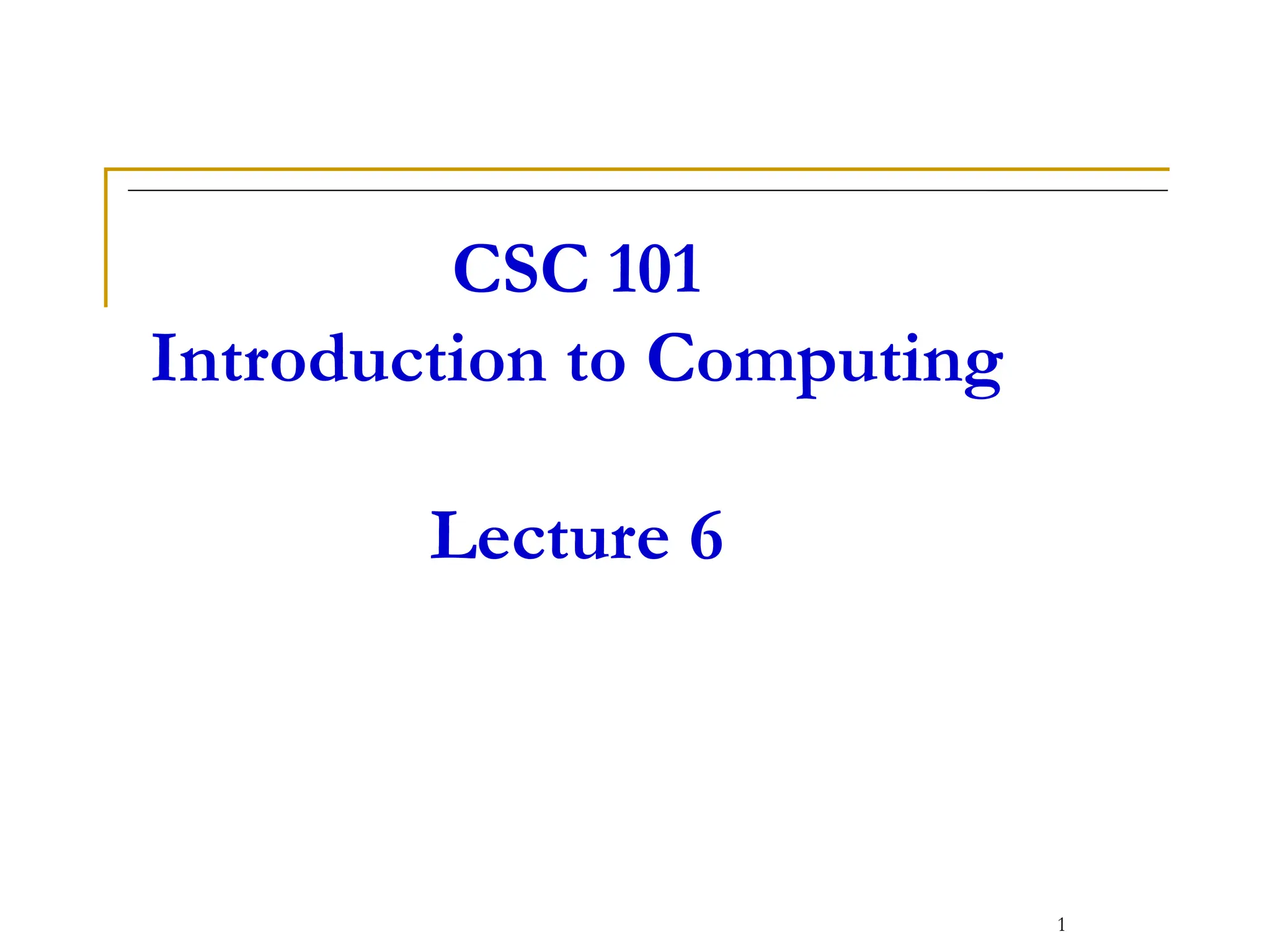
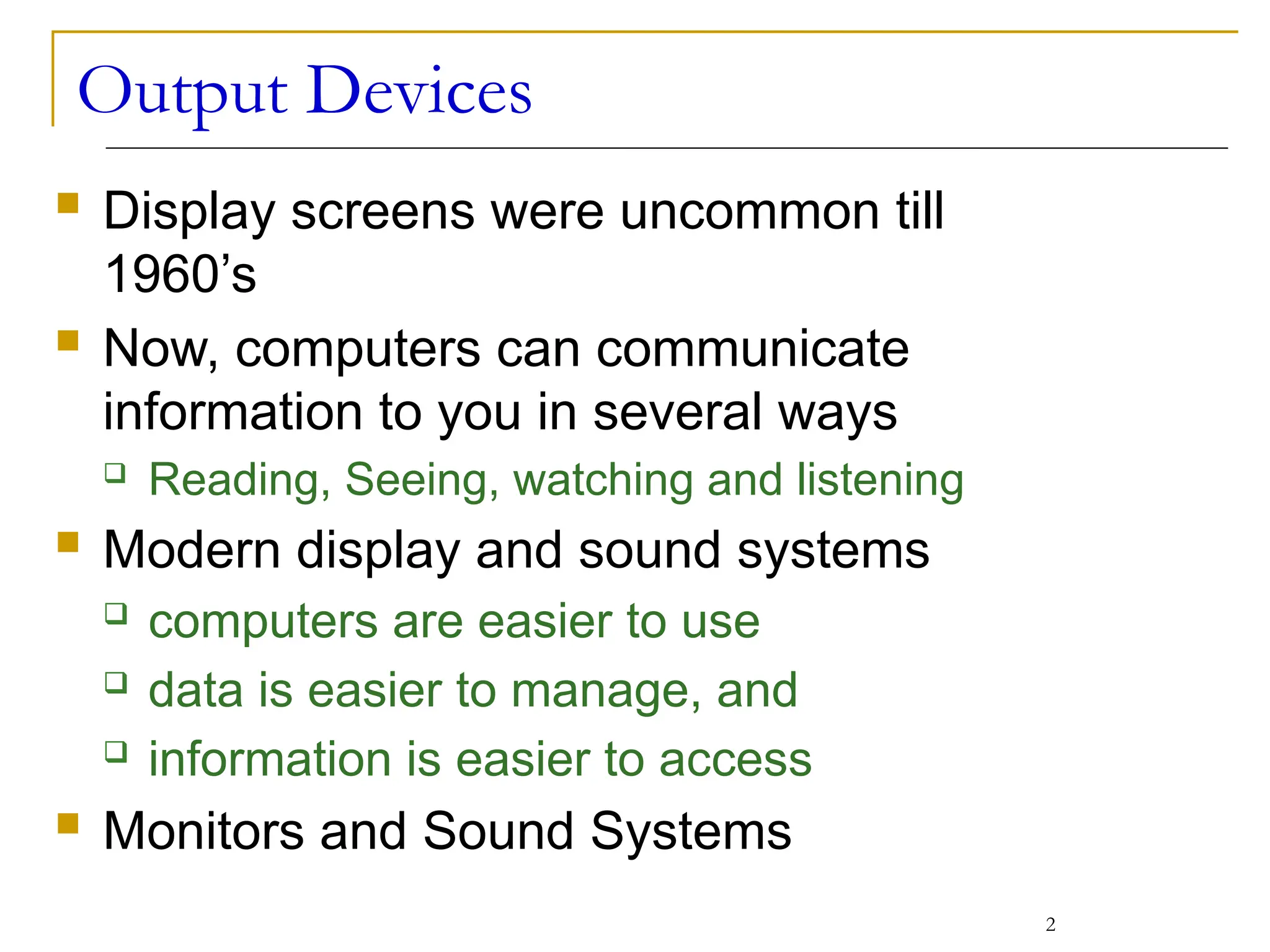
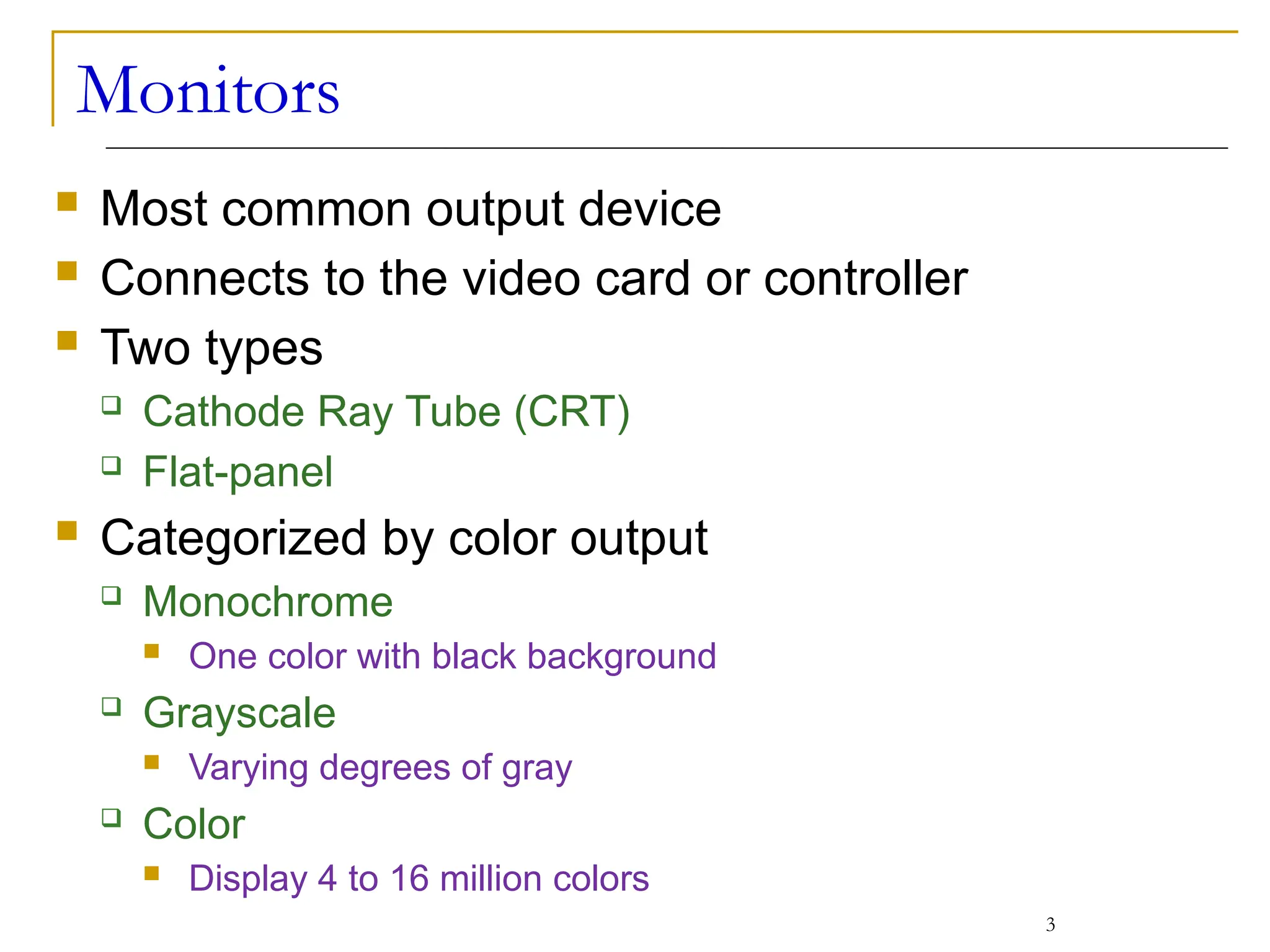
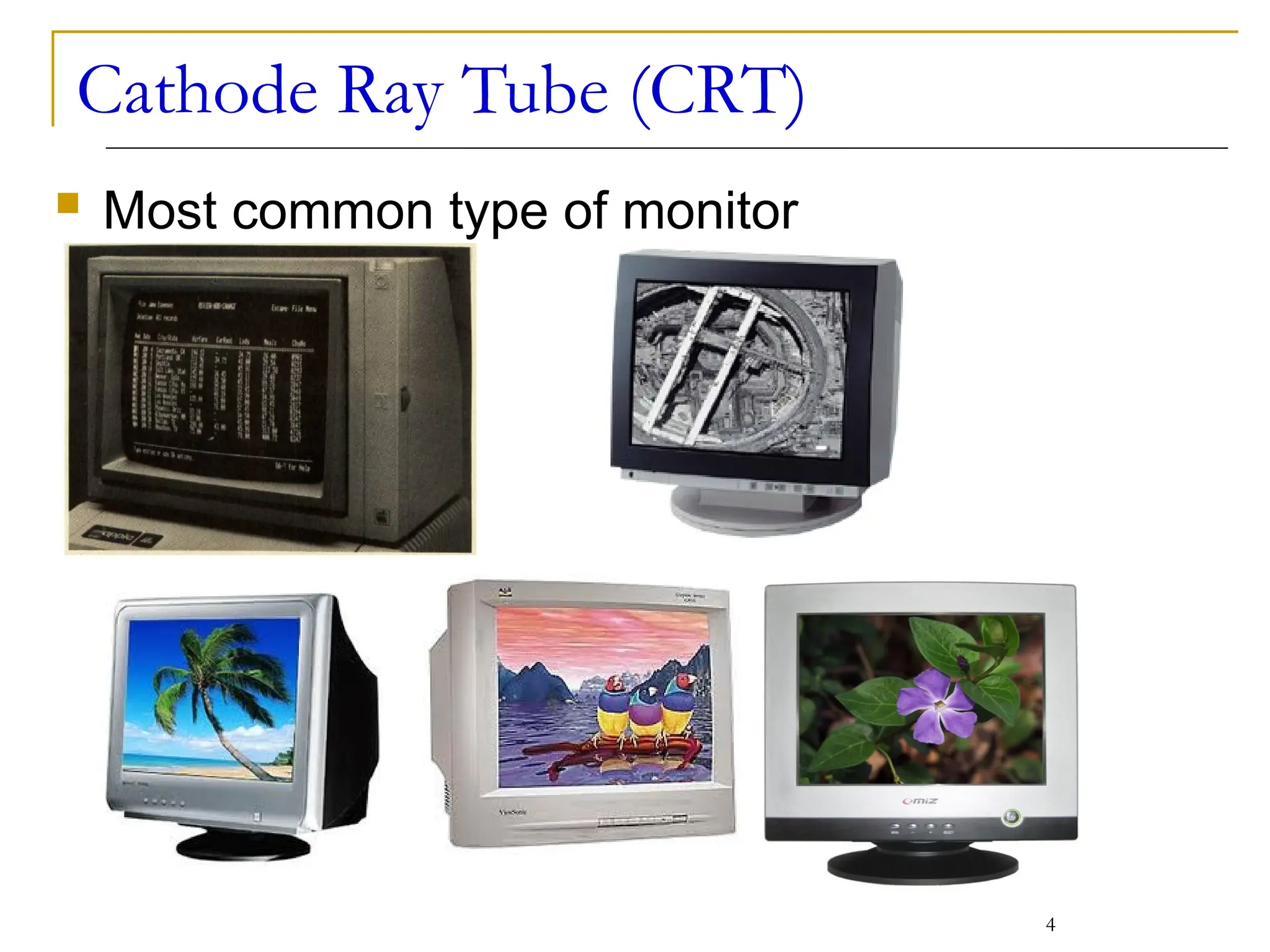
Cathode Ray Tube (CRT)
 Most common type of monitor
4
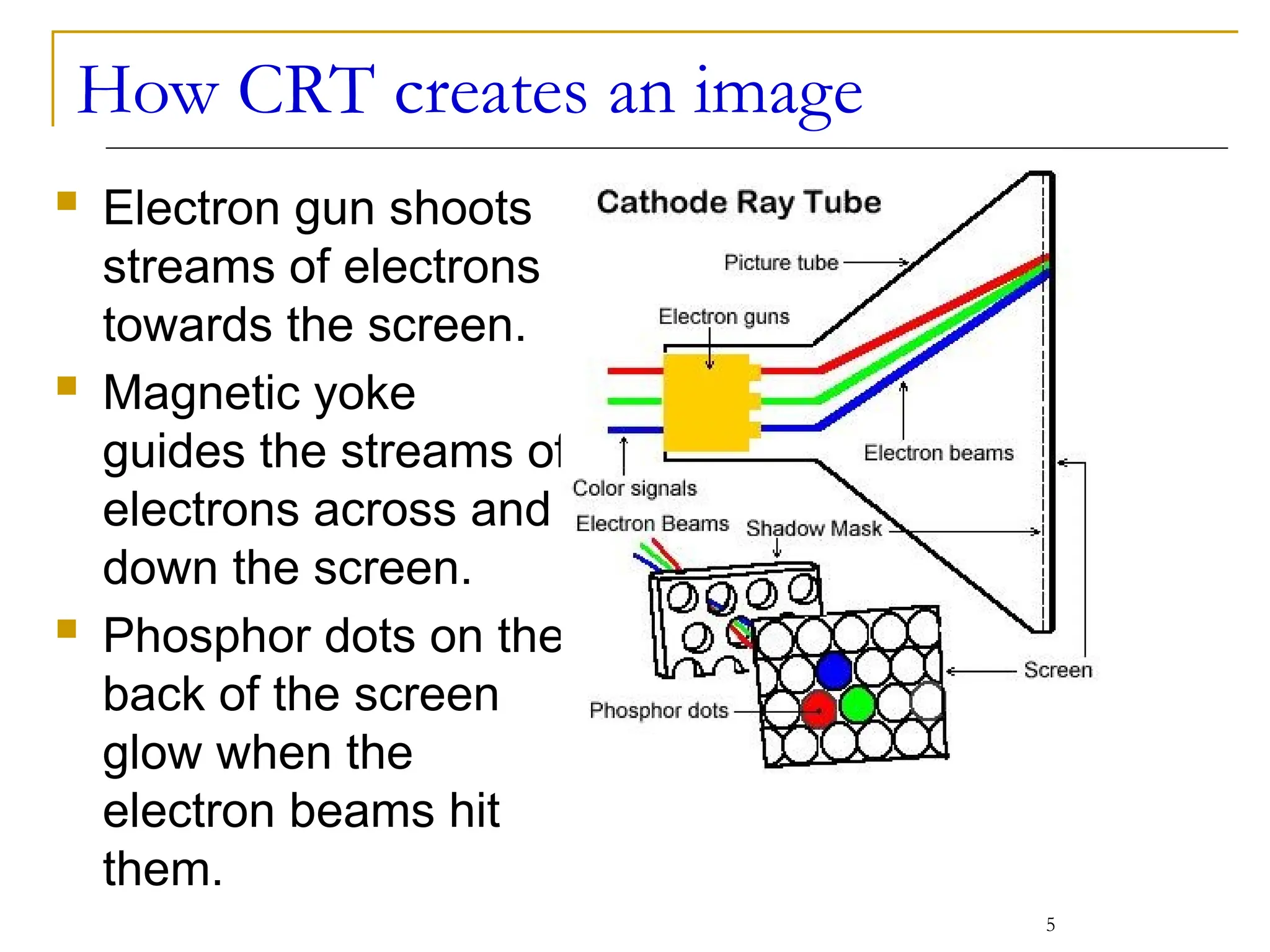
How CRT creates an image
 Electron gun shoots
streams of electrons
towards the screen.
 Magnetic yoke
guides the streams of
electrons across and
down the screen.
 Phosphor dots on the
back of the screen
glow when the
electron beams hit
them.
5
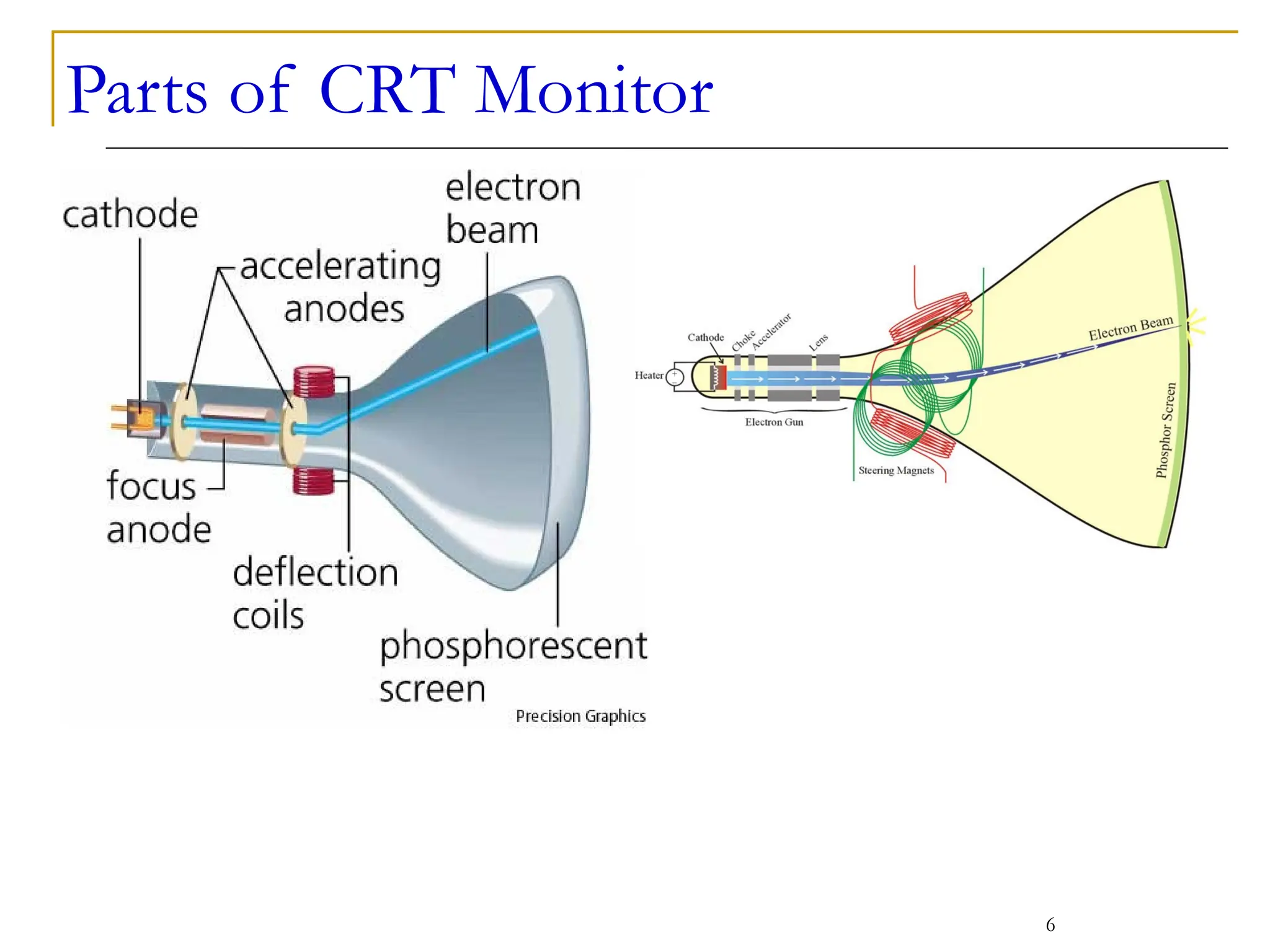
Parts of CRT Monitor
6
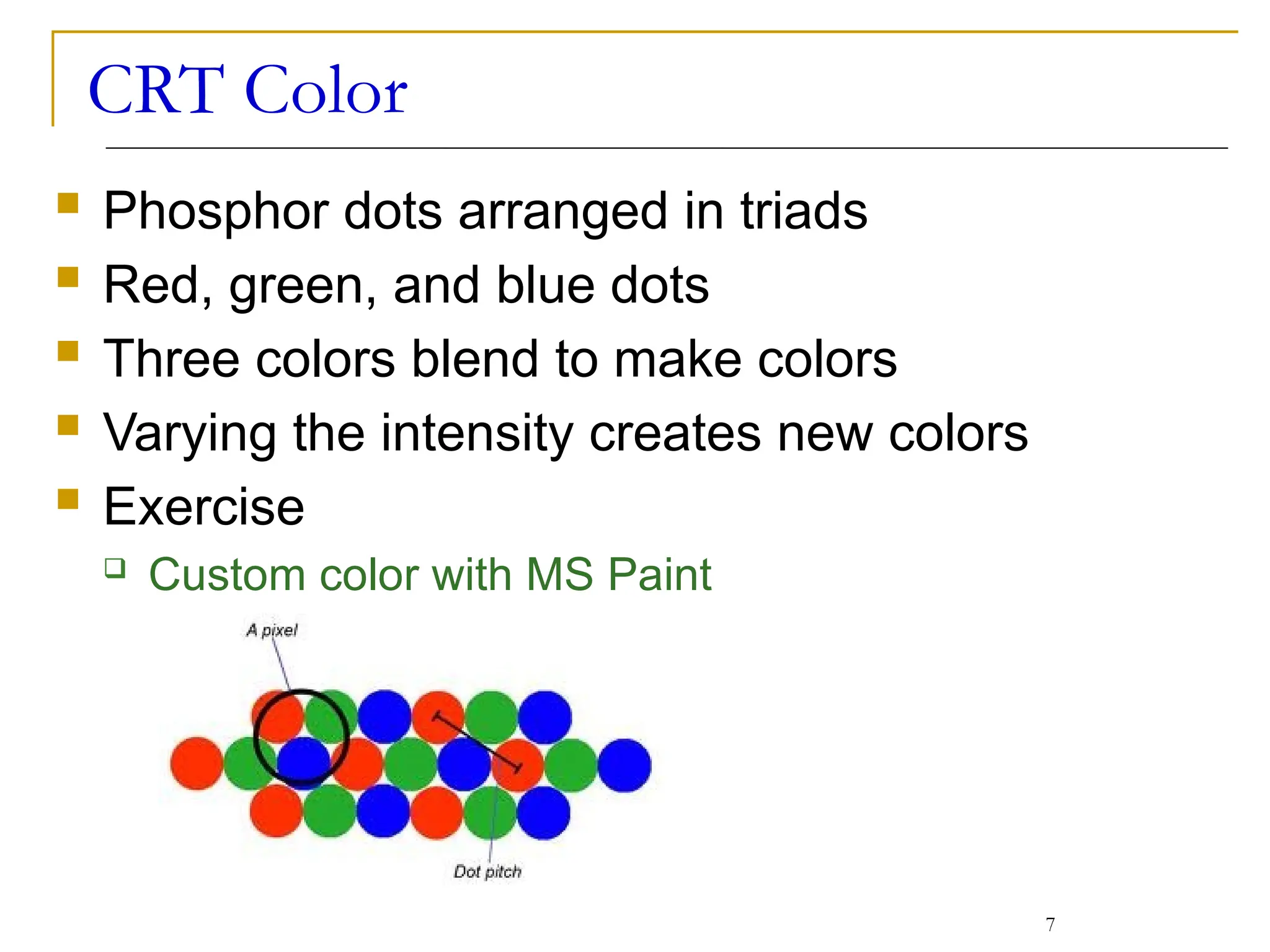
CRT Color
 Phosphor dots arranged in triads
 Red, green, and blue dots
 Three colors blend to make colors
 Varying the intensity creates new colors
 Exercise
 Custom color with MS Paint
7
CRT Disadvantages
 Very large
 Very heavy
 Use a lot of electricity
8
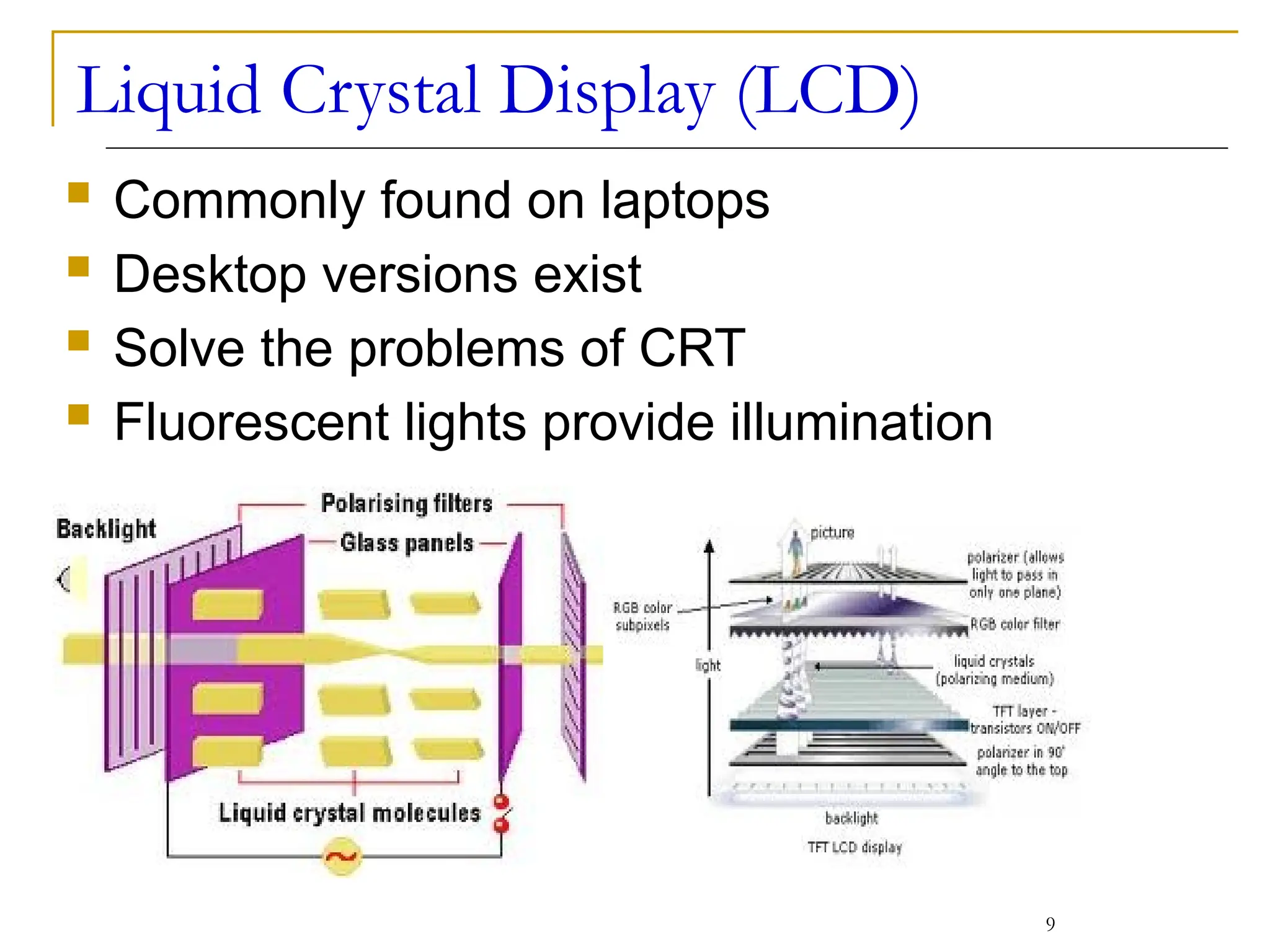
Liquid Crystal Display (LCD)
 Commonly found on laptops
 Desktop versions exist
 Solve the problems of CRT
 Fluorescent lights provide illumination
9
Types of LCD
 Passive Matrix LCD
 Active Matrix LCD
10
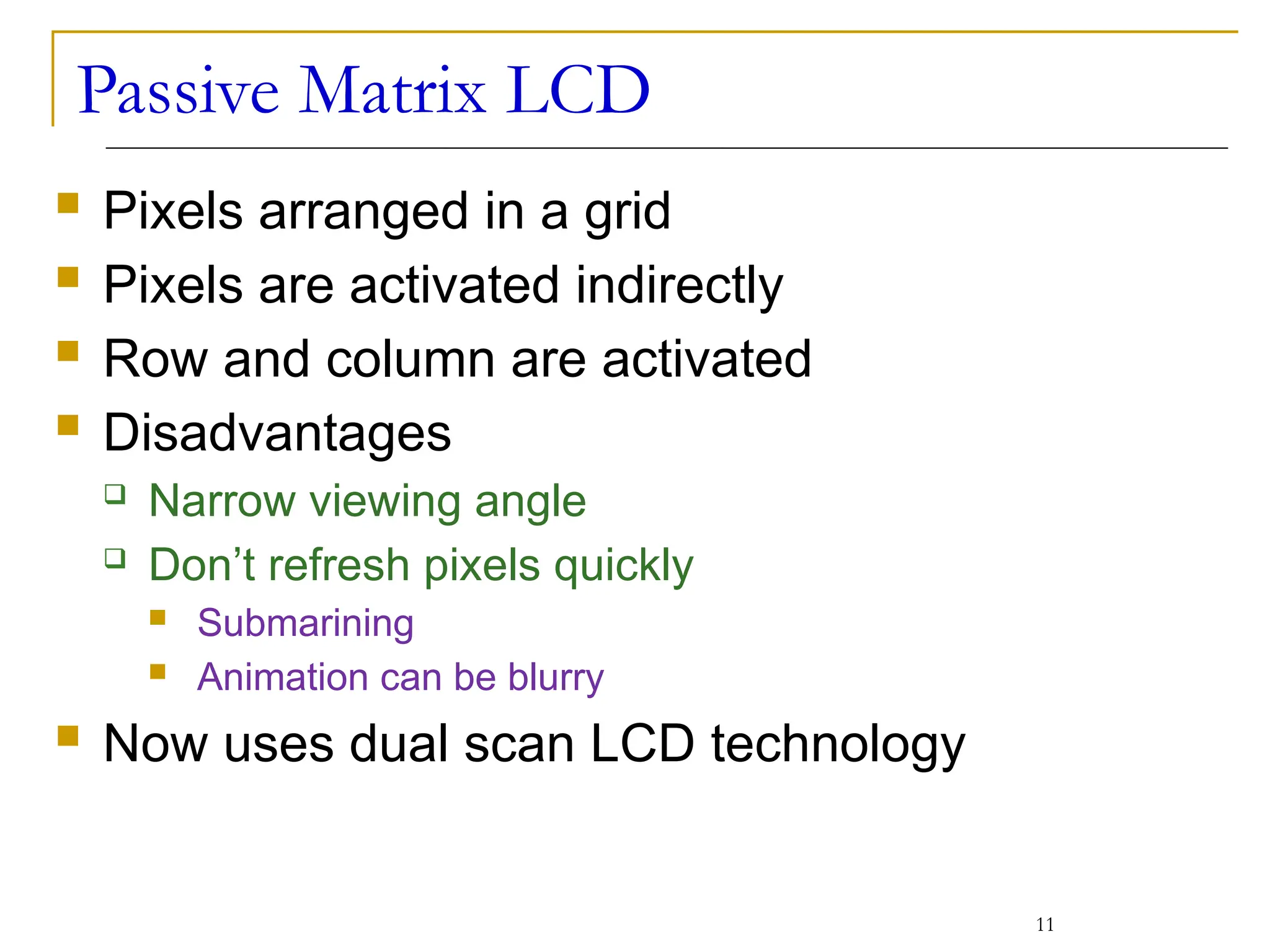
Passive Matrix LCD
 Pixels arranged in a grid
 Pixels are activated indirectly
 Row and column are activated
 Disadvantages
 Narrow viewing angle
 Don’t refresh pixels quickly
 Submarining
 Animation can be blurry
 Now uses dual scan LCD technology
11
Active Matrix LCD
12
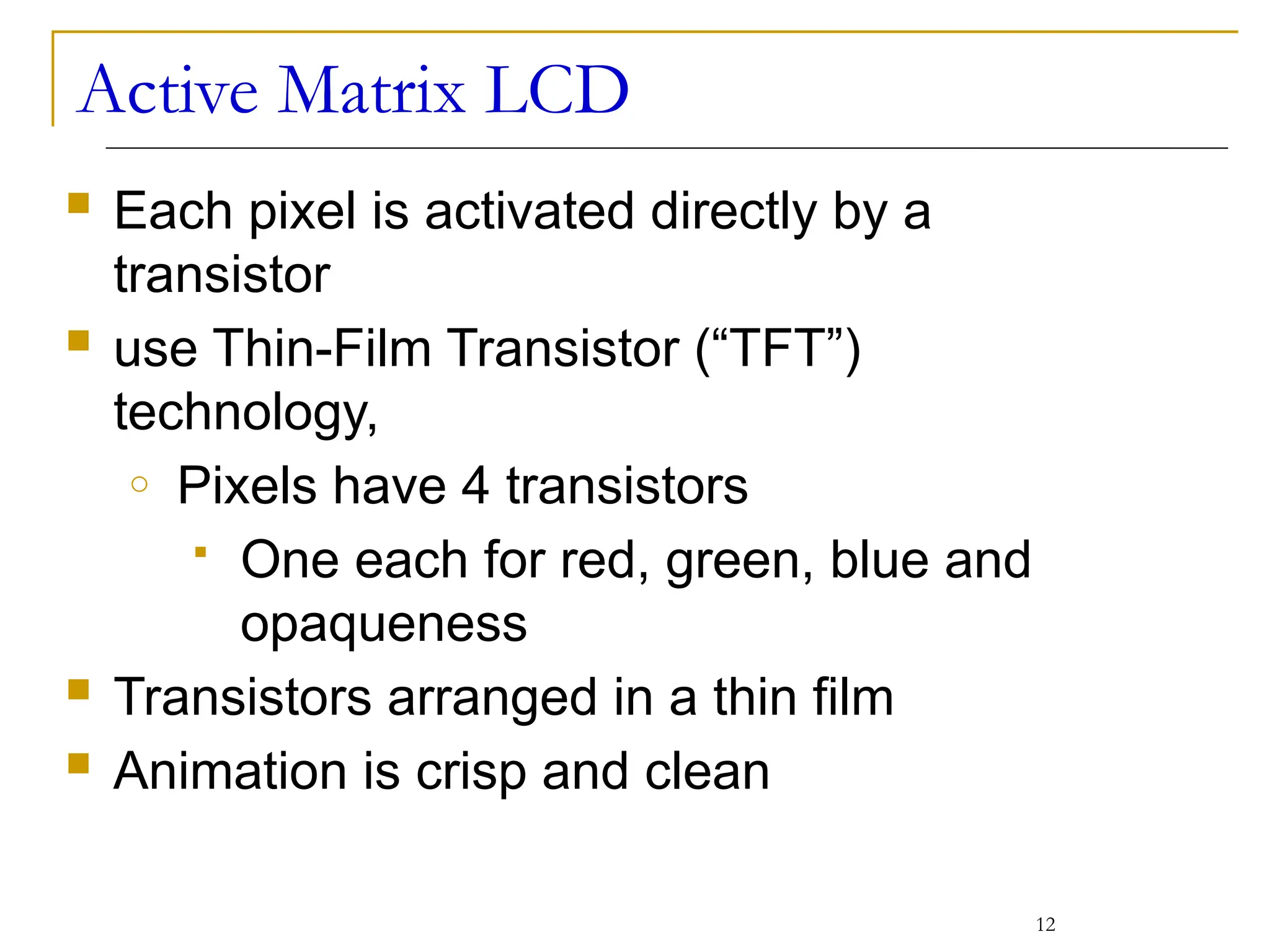
 Each pixel is activated directly by a
transistor
 use Thin-Film Transistor (“TFT”)
technology,
o Pixels have 4 transistors
 One each for red, green, blue and
opaqueness
 Transistors arranged in a thin film
 Animation is crisp and clean
Drawbacks of LCD
 Image can be difficult to see in bright light
 Smaller viewing angle
 Must sit directly in front of screen
 More expensive than CRT
 Can be more fragile than CRT
13
Plasma Display Panel (PDP)
 Utilizes small cells containing
electrically charged ionized gases
called fluorescent lamps
 Advantages
 Better picture quality
 Wider viewing angles
 Less visible motion blur
 Disadvantages
 Screen burn-in
 Uses more electricity than LCDs
14
Light Emitting Diodes (LED)
 uses light-emitting diodes as a video
display
 produce images with greater dynamic
contrast;
 can be extremely slim, some screens less
than half an inch (0.92 cm) thick;[6]
 produce less environmental pollution on
disposal;
 are more expensive;
 have typically 20 to 30% lower power
consumption
15
Other Types of Monitors
 Paper-white displays
 High contrast between fore and background
 Electro-luminescent displays (ELD)
 Similar to LCD
 phosphorescent film held between two sheets of
glass.
 A grid of wires sends current through the film to
create an image
16
Comparing Monitors
 Monitors impacts user effectiveness
 Monitors should have
 Crisp text
 Clear graphics
 Adjustable controls
 Clear edges
 Comparison specifications
 Size
 Resolution
 Refresh rate
 Dot Pitch
17
Size of Monitor
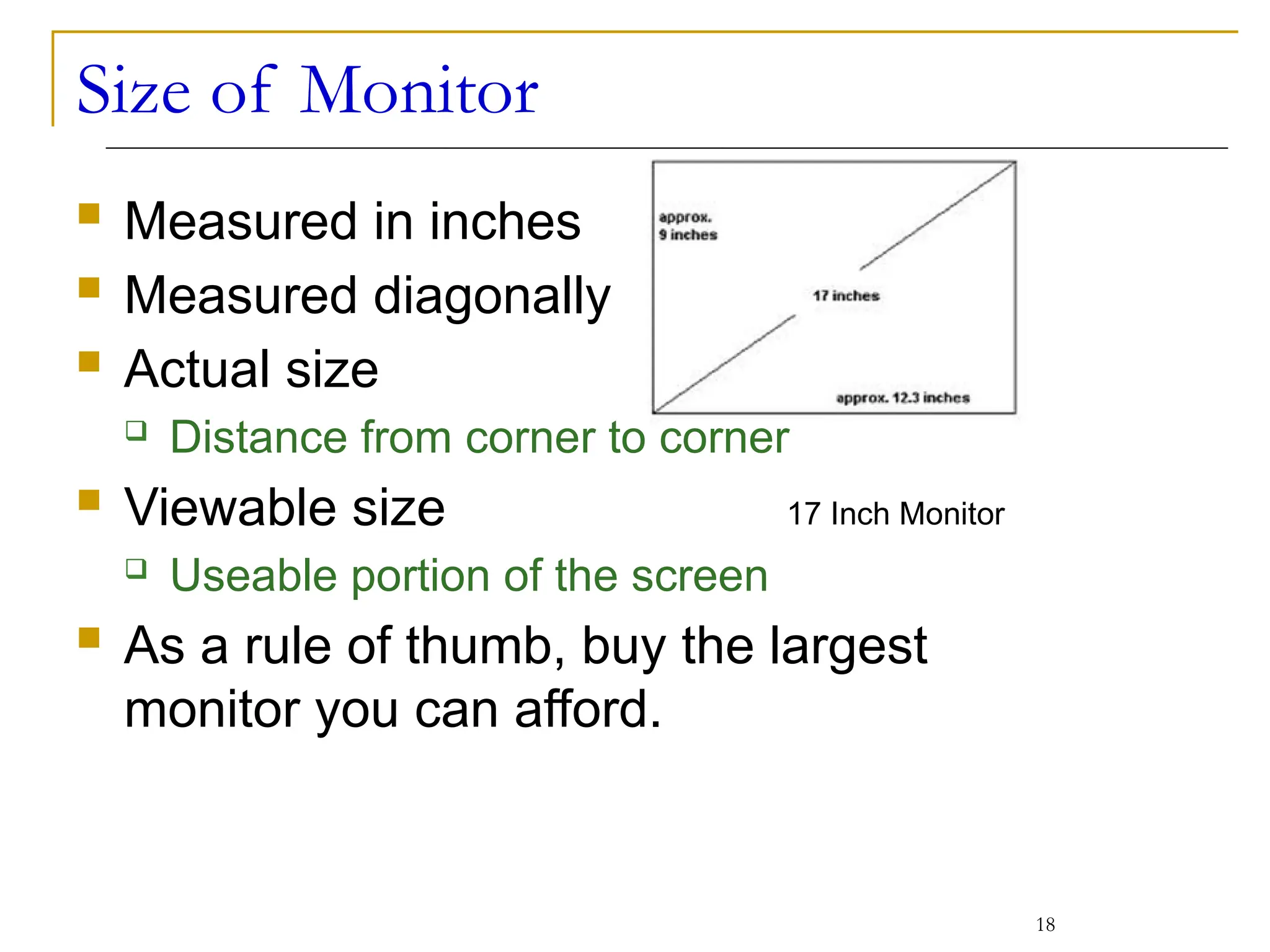
 Measured in inches
 Measured diagonally
 Actual size
 Distance from corner to corner
 Viewable size
 Useable portion of the screen
 As a rule of thumb, buy the largest
monitor you can afford.
18
17 Inch Monitor
Resolution
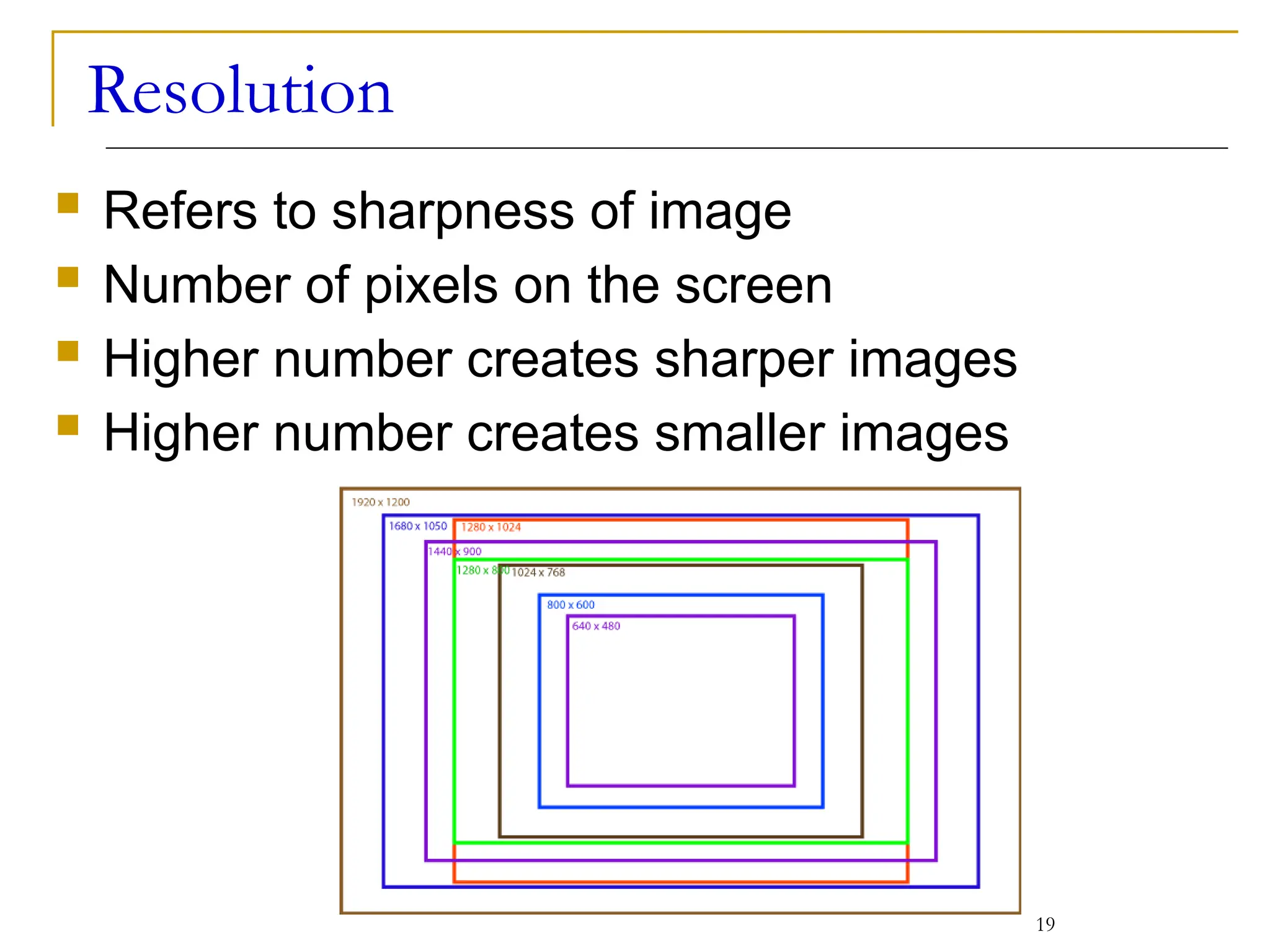
 Refers to sharpness of image
 Number of pixels on the screen
 Higher number creates sharper images
 Higher number creates smaller images
19
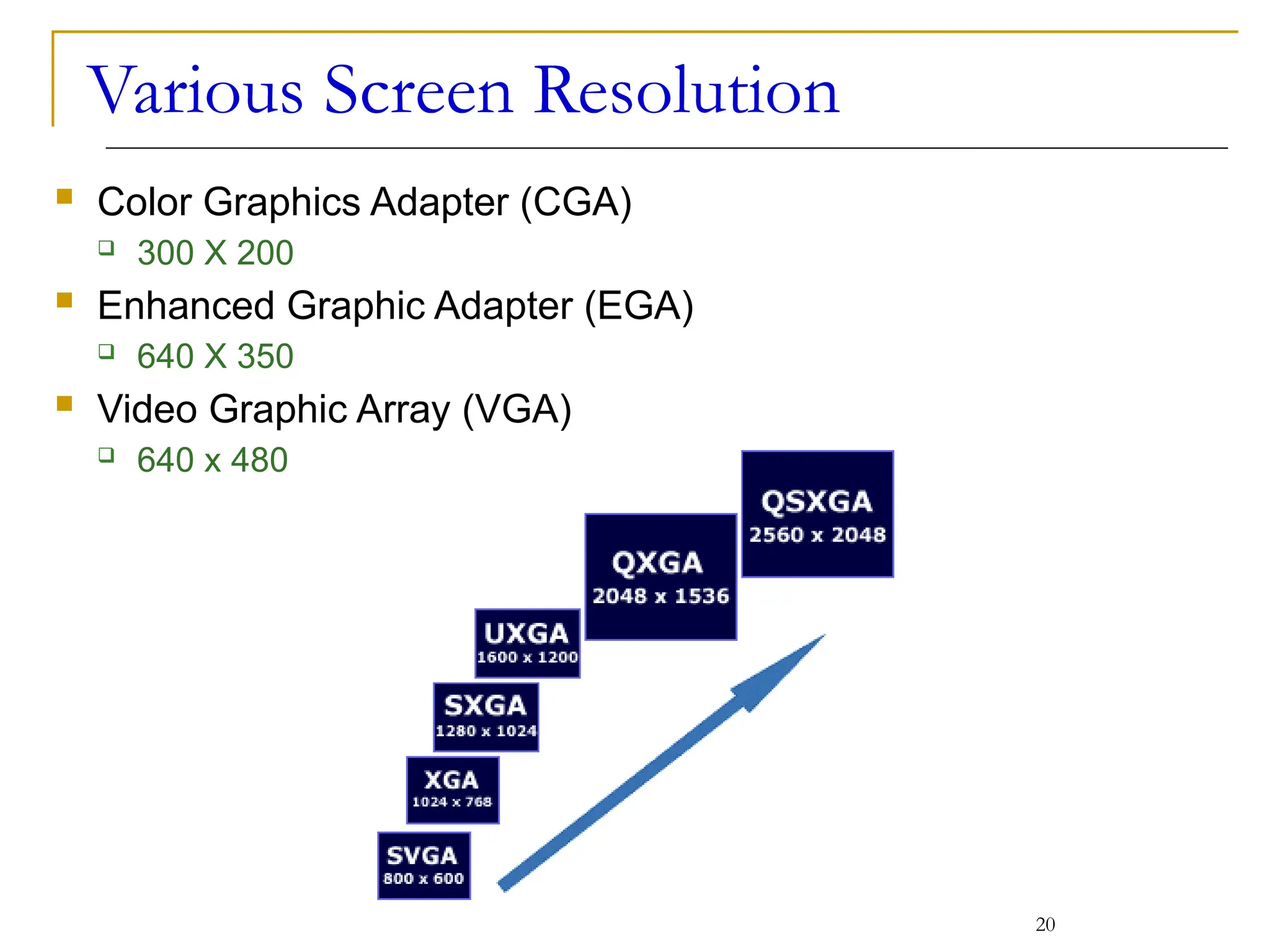
Various Screen Resolution
 Color Graphics Adapter (CGA)
 300 X 200
 Enhanced Graphic Adapter (EGA)
 640 X 350
 Video Graphic Array (VGA)
 640 x 480
20
Refresh Rate
 Number of time the screen is redrawn
 Measured in Hertz (Hz)
 Modern equipment sets this automatically
 Improper settings can cause eyestrain
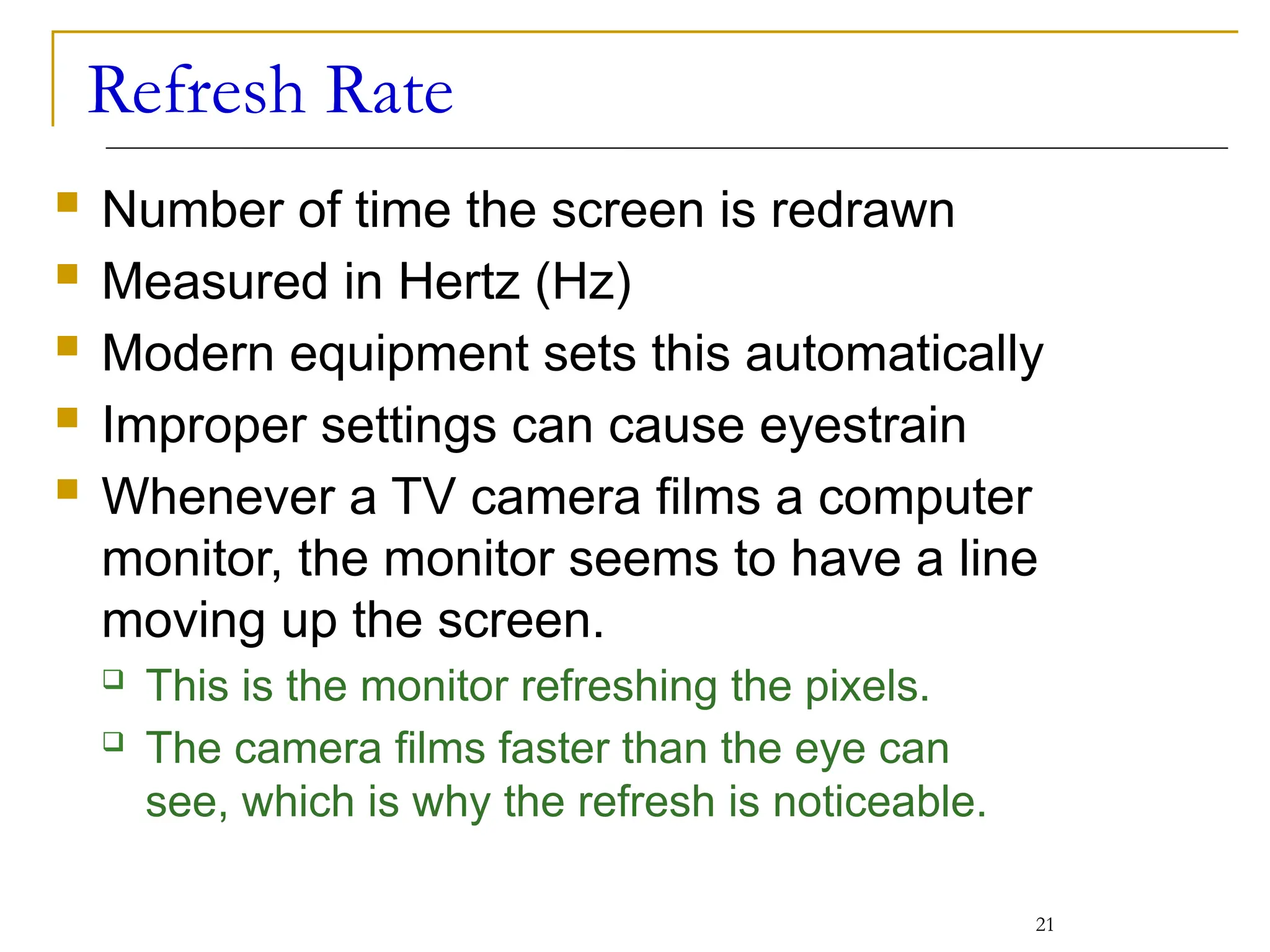
 Whenever a TV camera films a computer
monitor, the monitor seems to have a line
moving up the screen.
 This is the monitor refreshing the pixels.
 The camera films faster than the eye can
see, which is why the refresh is noticeable.
21
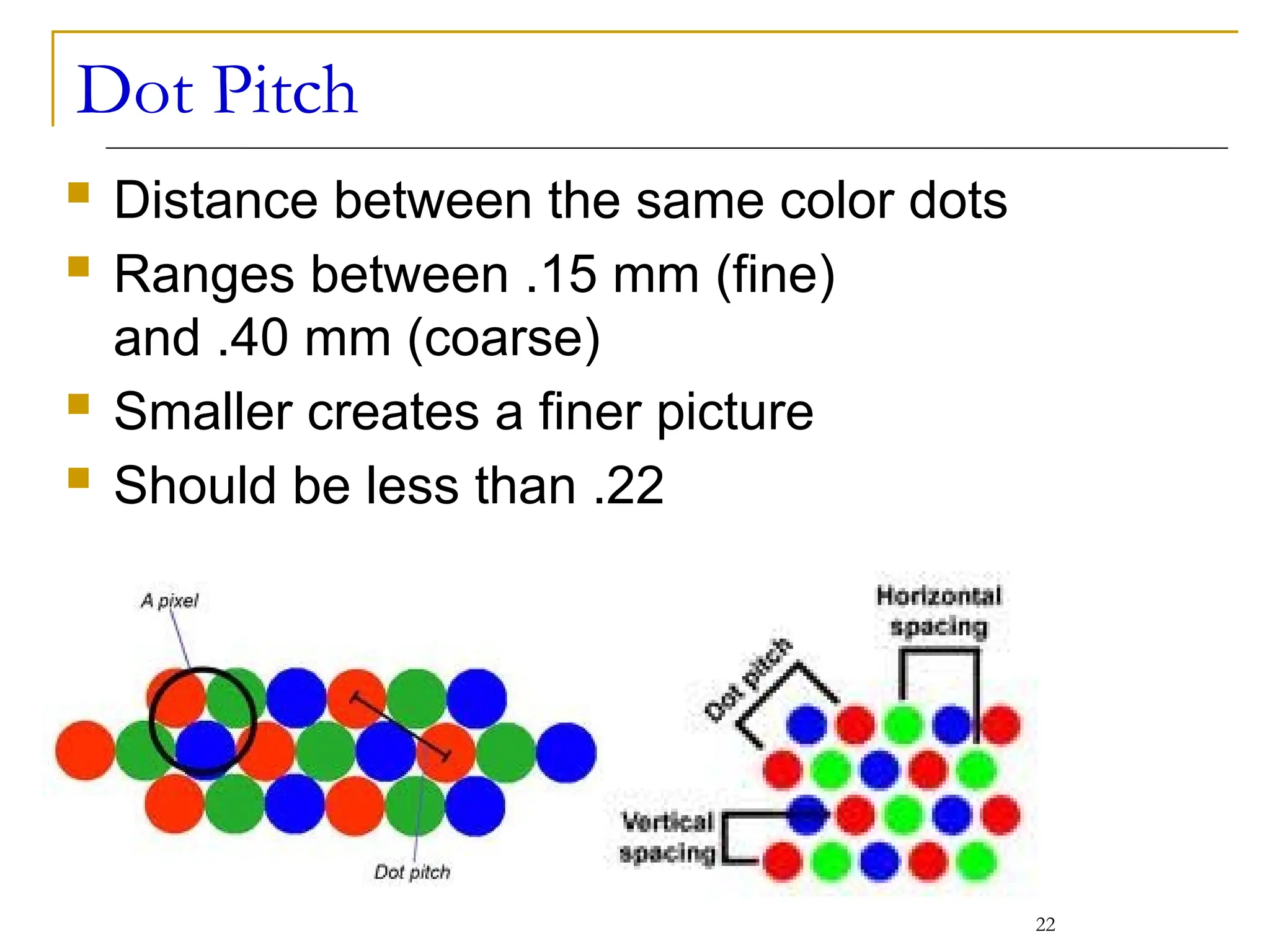
Dot Pitch
 Distance between the same color dots
 Ranges between .15 mm (fine)
and .40 mm (coarse)
 Smaller creates a finer picture
 Should be less than .22
22
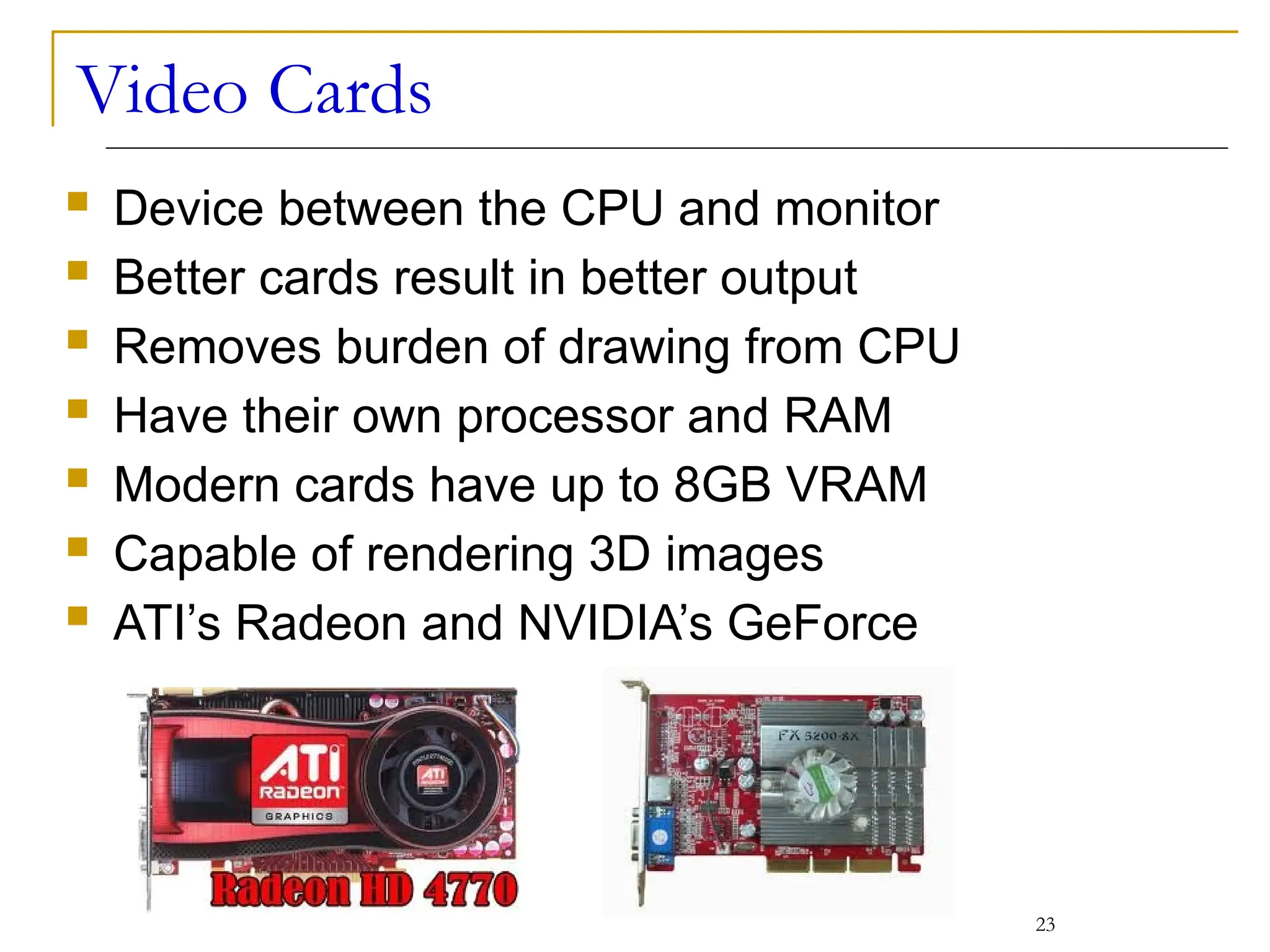
Video Cards
 Device between the CPU and monitor
 Better cards result in better output
 Removes burden of drawing from CPU
 Have their own processor and RAM
 Modern cards have up to 8GB VRAM
 Capable of rendering 3D images
 ATI’s Radeon and NVIDIA’s GeForce
23
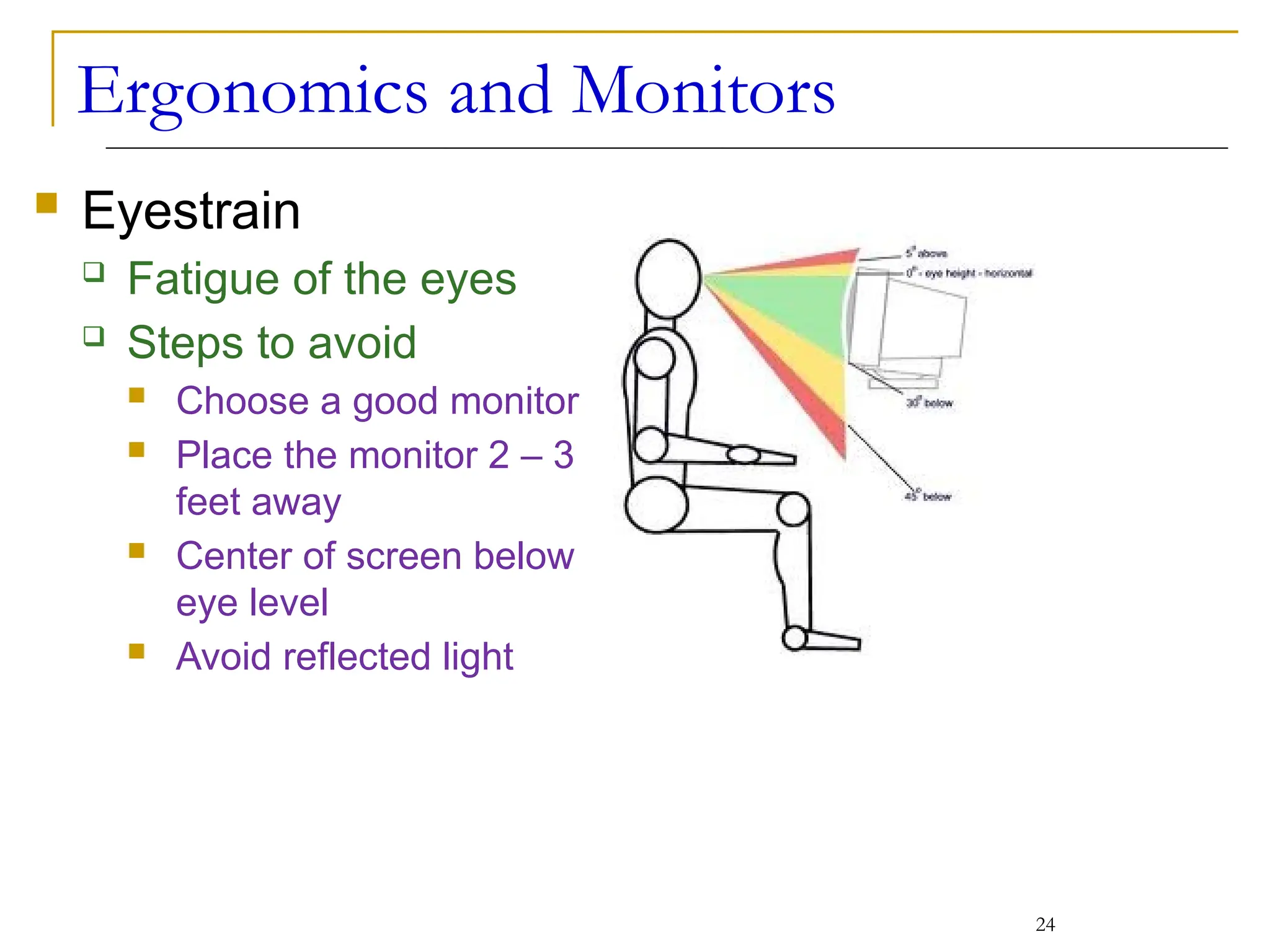
Ergonomics and Monitors
 Eyestrain
 Fatigue of the eyes
 Steps to avoid
 Choose a good monitor
 Place the monitor 2 – 3
feet away
 Center of screen below
eye level
 Avoid reflected light
24
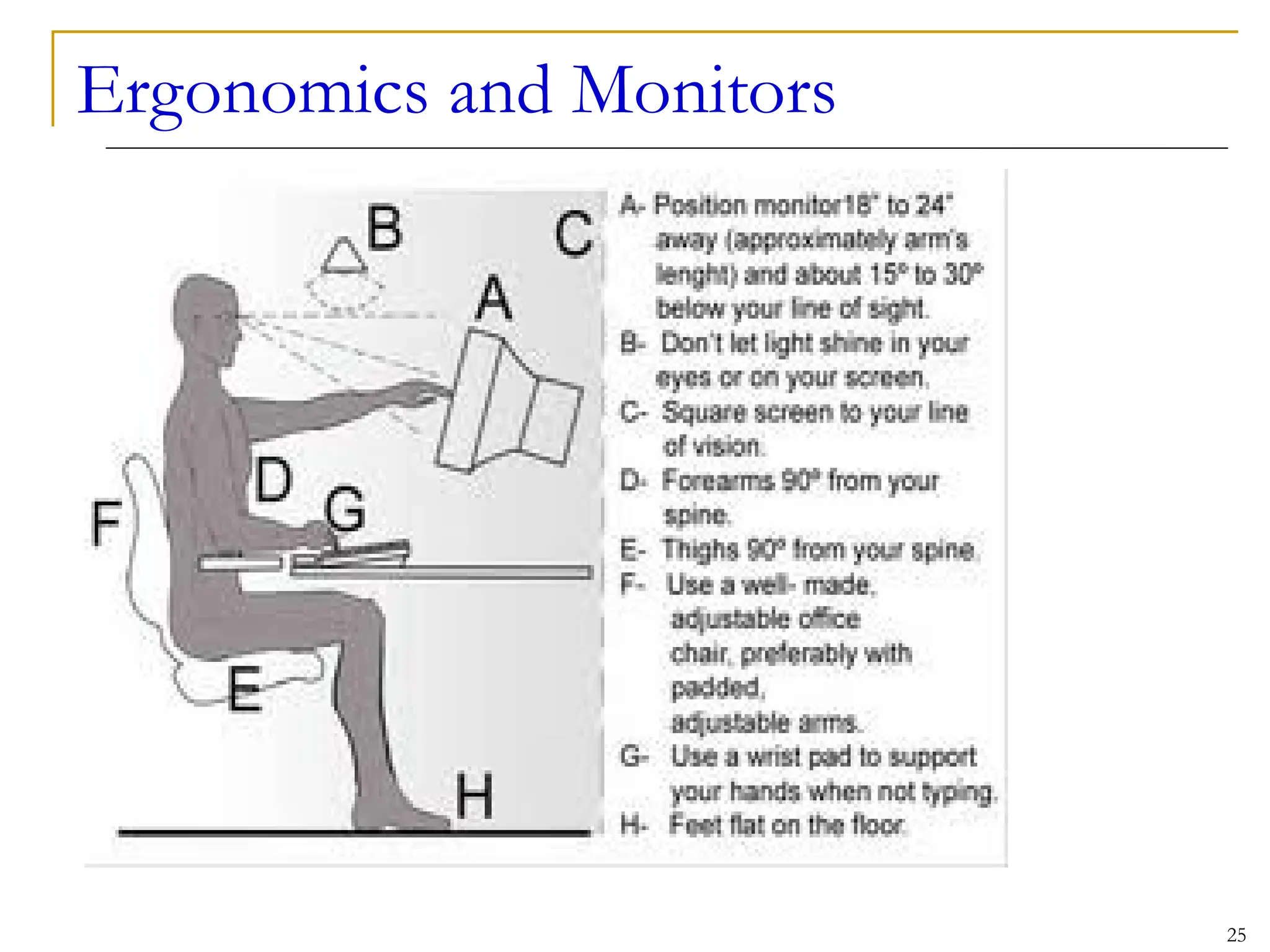
Ergonomics and Monitors
25
Electronic Magnetic field (EMF)
 Generated by all electronic devices
 EMF may be detrimental to health
 Steps to avoid
 Keep the computer at arms length
 Take frequent breaks
 Use an LCD monitor
26
Data Projectors
 Replaced overhead and slide projectors
 Project image onto wall or screen
 LCD projectors
 Most common type of projector
 Small LCD screen
 Very bright light
 Require a darkened room
27
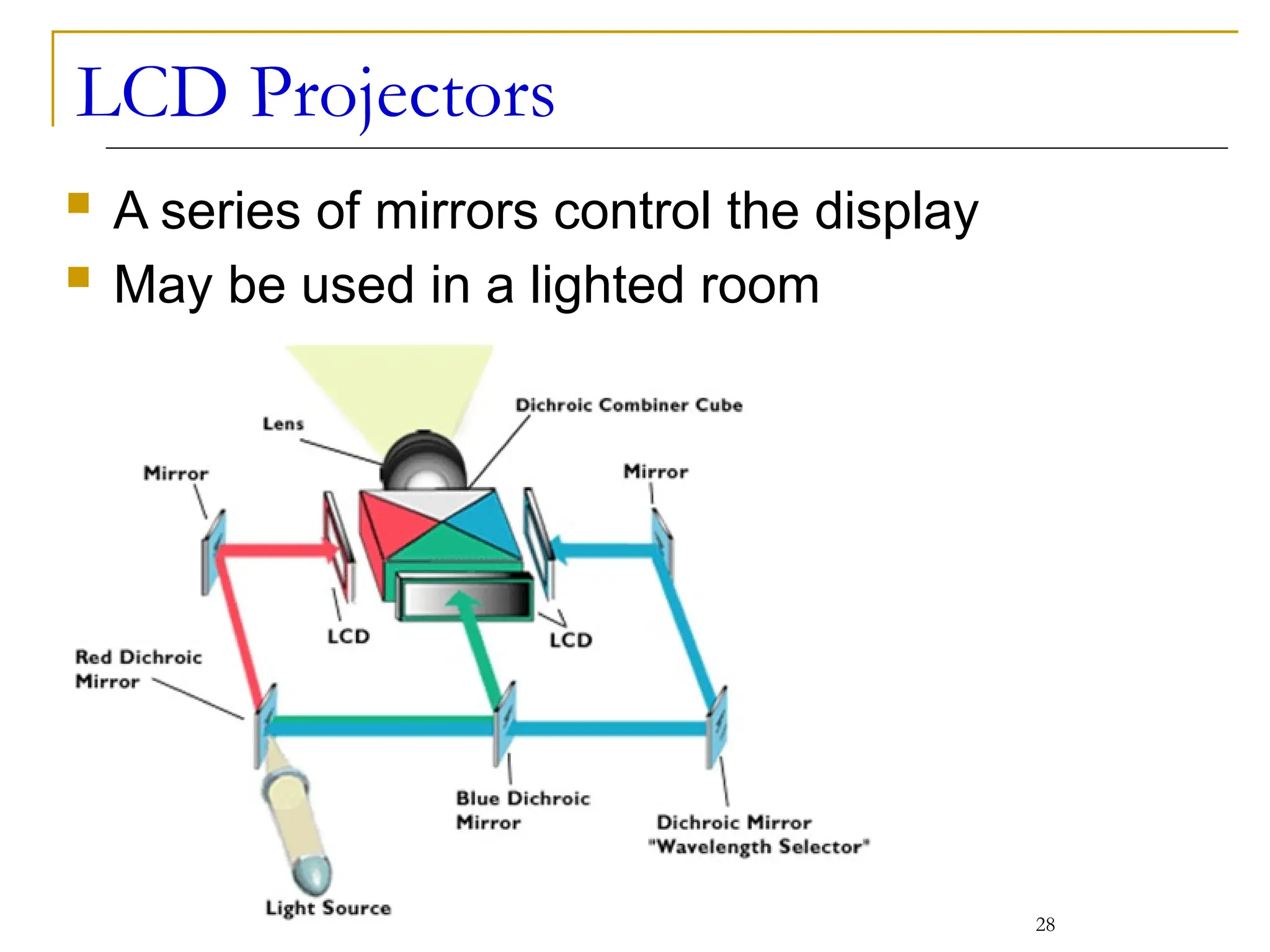
LCD Projectors
 A series of mirrors control the display
 May be used in a lighted room
28
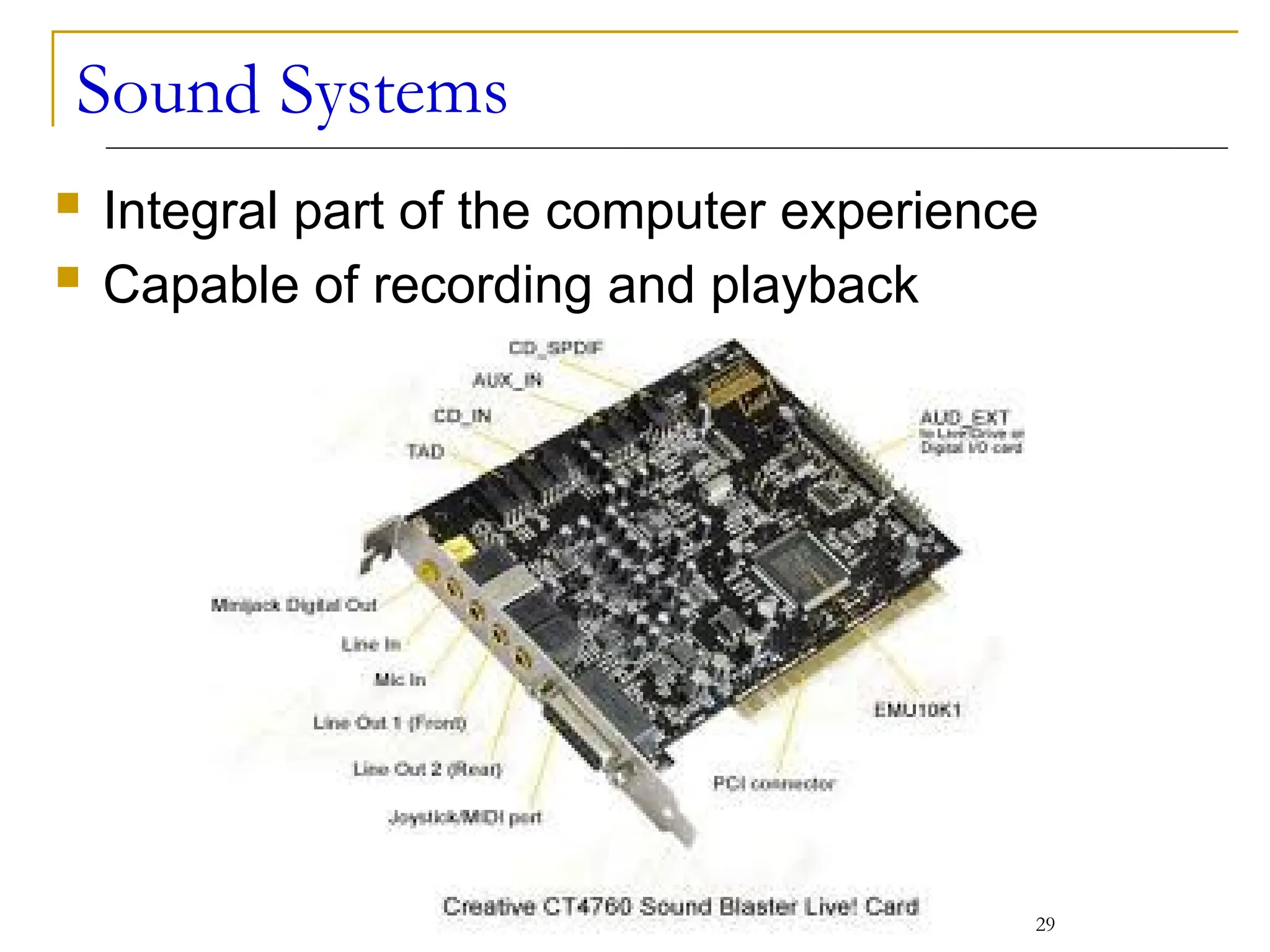
Sound Systems
 Integral part of the computer experience
 Capable of recording and playback
29
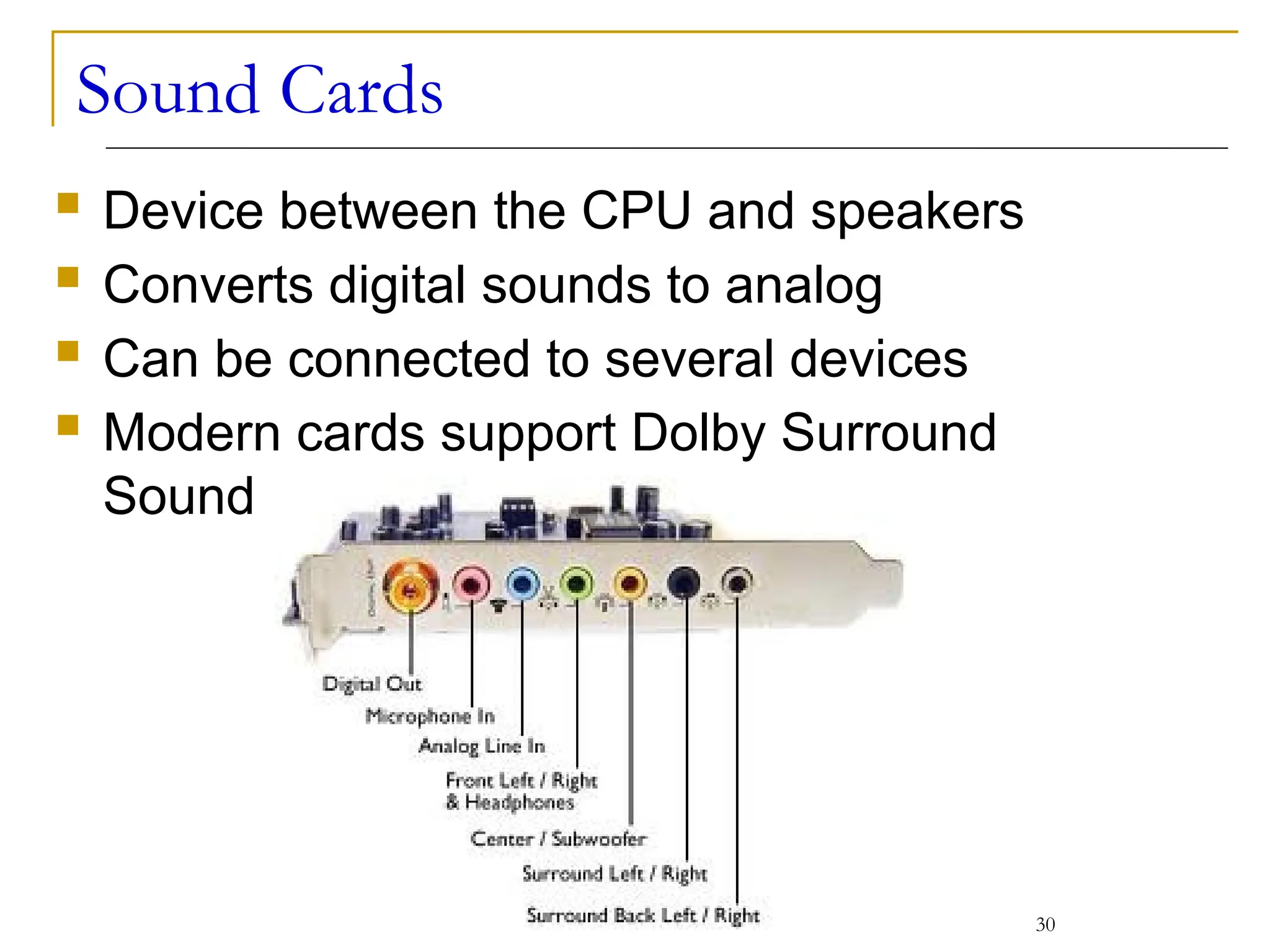
Sound Cards
 Device between the CPU and speakers
 Converts digital sounds to analog
 Can be connected to several devices
 Modern cards support Dolby Surround
Sound
30
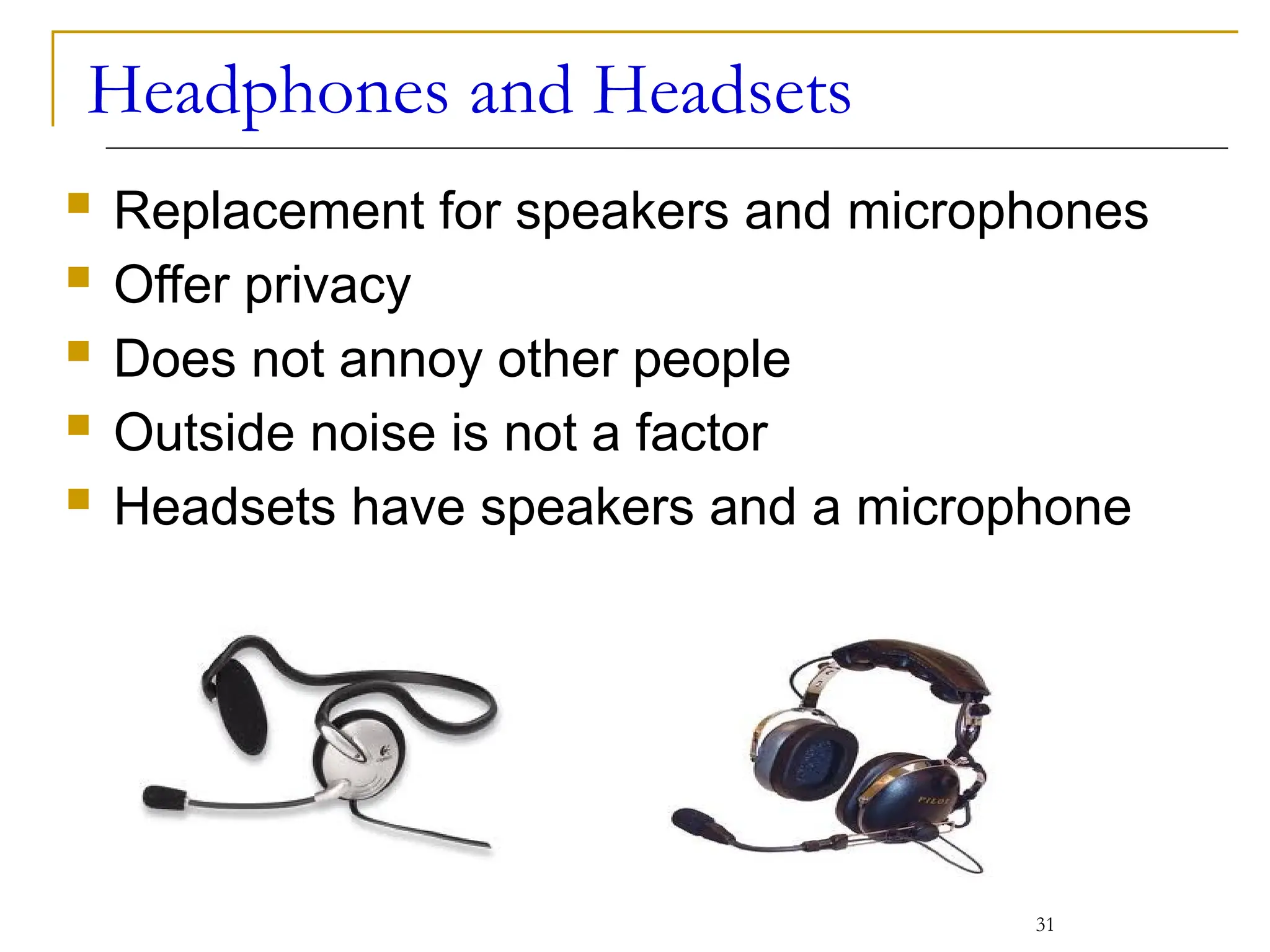
Headphones and Headsets
 Replacement for speakers and microphones
 Offer privacy
 Does not annoy other people
 Outside noise is not a factor
 Headsets have speakers and a microphone
31

COMPUTER SCIENCEBASIC LECTURE Lecture_5.pptxlecture_6.pptx

  • 1.
    CSC 101 Introduction toComputing Lecture 6 1
  • 2.
    Output Devices  Displayscreens were uncommon till 1960’s  Now, computers can communicate information to you in several ways  Reading, Seeing, watching and listening  Modern display and sound systems  computers are easier to use  data is easier to manage, and  information is easier to access  Monitors and Sound Systems 2
  • 3.
    Monitors  Most commonoutput device  Connects to the video card or controller  Two types  Cathode Ray Tube (CRT)  Flat-panel  Categorized by color output  Monochrome  One color with black background  Grayscale  Varying degrees of gray  Color  Display 4 to 16 million colors 3
  • 4.
    Cathode Ray Tube(CRT)  Most common type of monitor 4
  • 5.
    How CRT createsan image  Electron gun shoots streams of electrons towards the screen.  Magnetic yoke guides the streams of electrons across and down the screen.  Phosphor dots on the back of the screen glow when the electron beams hit them. 5
  • 6.
    Parts of CRTMonitor 6
  • 7.
    CRT Color  Phosphordots arranged in triads  Red, green, and blue dots  Three colors blend to make colors  Varying the intensity creates new colors  Exercise  Custom color with MS Paint 7
  • 8.
    CRT Disadvantages  Verylarge  Very heavy  Use a lot of electricity 8
  • 9.
    Liquid Crystal Display(LCD)  Commonly found on laptops  Desktop versions exist  Solve the problems of CRT  Fluorescent lights provide illumination 9
  • 10.
    Types of LCD Passive Matrix LCD  Active Matrix LCD 10
  • 11.
    Passive Matrix LCD Pixels arranged in a grid  Pixels are activated indirectly  Row and column are activated  Disadvantages  Narrow viewing angle  Don’t refresh pixels quickly  Submarining  Animation can be blurry  Now uses dual scan LCD technology 11
  • 12.
    Active Matrix LCD 12 Each pixel is activated directly by a transistor  use Thin-Film Transistor (“TFT”) technology, o Pixels have 4 transistors  One each for red, green, blue and opaqueness  Transistors arranged in a thin film  Animation is crisp and clean
  • 13.
    Drawbacks of LCD Image can be difficult to see in bright light  Smaller viewing angle  Must sit directly in front of screen  More expensive than CRT  Can be more fragile than CRT 13
  • 14.
    Plasma Display Panel(PDP)  Utilizes small cells containing electrically charged ionized gases called fluorescent lamps  Advantages  Better picture quality  Wider viewing angles  Less visible motion blur  Disadvantages  Screen burn-in  Uses more electricity than LCDs 14
  • 15.
    Light Emitting Diodes(LED)  uses light-emitting diodes as a video display  produce images with greater dynamic contrast;  can be extremely slim, some screens less than half an inch (0.92 cm) thick;[6]  produce less environmental pollution on disposal;  are more expensive;  have typically 20 to 30% lower power consumption 15
  • 16.
    Other Types ofMonitors  Paper-white displays  High contrast between fore and background  Electro-luminescent displays (ELD)  Similar to LCD  phosphorescent film held between two sheets of glass.  A grid of wires sends current through the film to create an image 16
  • 17.
    Comparing Monitors  Monitorsimpacts user effectiveness  Monitors should have  Crisp text  Clear graphics  Adjustable controls  Clear edges  Comparison specifications  Size  Resolution  Refresh rate  Dot Pitch 17
  • 18.
    Size of Monitor Measured in inches  Measured diagonally  Actual size  Distance from corner to corner  Viewable size  Useable portion of the screen  As a rule of thumb, buy the largest monitor you can afford. 18 17 Inch Monitor
  • 19.
    Resolution  Refers tosharpness of image  Number of pixels on the screen  Higher number creates sharper images  Higher number creates smaller images 19
  • 20.
    Various Screen Resolution Color Graphics Adapter (CGA)  300 X 200  Enhanced Graphic Adapter (EGA)  640 X 350  Video Graphic Array (VGA)  640 x 480 20
  • 21.
    Refresh Rate  Numberof time the screen is redrawn  Measured in Hertz (Hz)  Modern equipment sets this automatically  Improper settings can cause eyestrain  Whenever a TV camera films a computer monitor, the monitor seems to have a line moving up the screen.  This is the monitor refreshing the pixels.  The camera films faster than the eye can see, which is why the refresh is noticeable. 21
  • 22.
    Dot Pitch  Distancebetween the same color dots  Ranges between .15 mm (fine) and .40 mm (coarse)  Smaller creates a finer picture  Should be less than .22 22
  • 23.
    Video Cards  Devicebetween the CPU and monitor  Better cards result in better output  Removes burden of drawing from CPU  Have their own processor and RAM  Modern cards have up to 8GB VRAM  Capable of rendering 3D images  ATI’s Radeon and NVIDIA’s GeForce 23
  • 24.
    Ergonomics and Monitors Eyestrain  Fatigue of the eyes  Steps to avoid  Choose a good monitor  Place the monitor 2 – 3 feet away  Center of screen below eye level  Avoid reflected light 24
  • 25.
  • 26.
    Electronic Magnetic field(EMF)  Generated by all electronic devices  EMF may be detrimental to health  Steps to avoid  Keep the computer at arms length  Take frequent breaks  Use an LCD monitor 26
  • 27.
    Data Projectors  Replacedoverhead and slide projectors  Project image onto wall or screen  LCD projectors  Most common type of projector  Small LCD screen  Very bright light  Require a darkened room 27
  • 28.
    LCD Projectors  Aseries of mirrors control the display  May be used in a lighted room 28
  • 29.
    Sound Systems  Integralpart of the computer experience  Capable of recording and playback 29
  • 30.
    Sound Cards  Devicebetween the CPU and speakers  Converts digital sounds to analog  Can be connected to several devices  Modern cards support Dolby Surround Sound 30
  • 31.
    Headphones and Headsets Replacement for speakers and microphones  Offer privacy  Does not annoy other people  Outside noise is not a factor  Headsets have speakers and a microphone 31

Editor's Notes

  • #7 Teaching tip Unless your students have spend a lot of time with HTML or graphics colors, they will have a hard time grasping how RGB values work. The best methods are to show them various colors and then let them experiment. The website www.lynda.com/hue.html provides decimal-value examples of RGB values. Once the students have seen different colors, open MS Paint and let the students develop their own colors. Challenge them to build pink, orange, brown and any of their favorite colors
  • #13 Insider information The limited viewing angle can be an advantage. For high security systems, low viewing angles stop casual glances at the screen.
  • #18 Teaching tip It is helpful to draw the relationship between viewable and actual size.
  • #19 Insider information Many CRT’s are capable of supporting several resolutions. LCD monitors in contrast often can only support one or two resolutions. The reason are the transistors on the LCD cannot move, while the electron gun on the CRT can simply aim for a smaller pixel. If you are in a computer class, stop and have students adjust their resolution on the screen. The simplest method is to right click the desktop and select properties. Click the settings tab, and adjust the slider. As the students are experimenting, have a student answer why larger resolution numbers make smaller images. The answer is higher resolutions draw with smaller pixels.
  • #21 Insider information Whenever a TV camera films a computer monitor, the monitor seems to have a line moving up the screen. This is the monitor refreshing the pixels. The camera films faster than the eye can see, which is why the refresh is noticeable.
  • #23 Insider information The two leading video card families are ATI’s Radeon and NVIDIA’s GeForce line. Both offer exceptional graphics cards ranging from $50 to $600.
  • #26 Teaching tip Point out to the students that no conclusive study exists that directly list EMF as a cause of cancer, reduced muscle tone or reduced brain function. For more information see http://www.hhs.gov/ and search for EMF.
  • #30 Insider Information Sound Blaster is the primary manufacturer of sound cards. Exceptional models start at around $30.00.
  • #31 Insider information The PS2 game SOCOM II Navy Seals includes a USB headset to allow verbal communication with other team members.