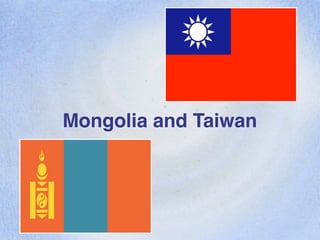
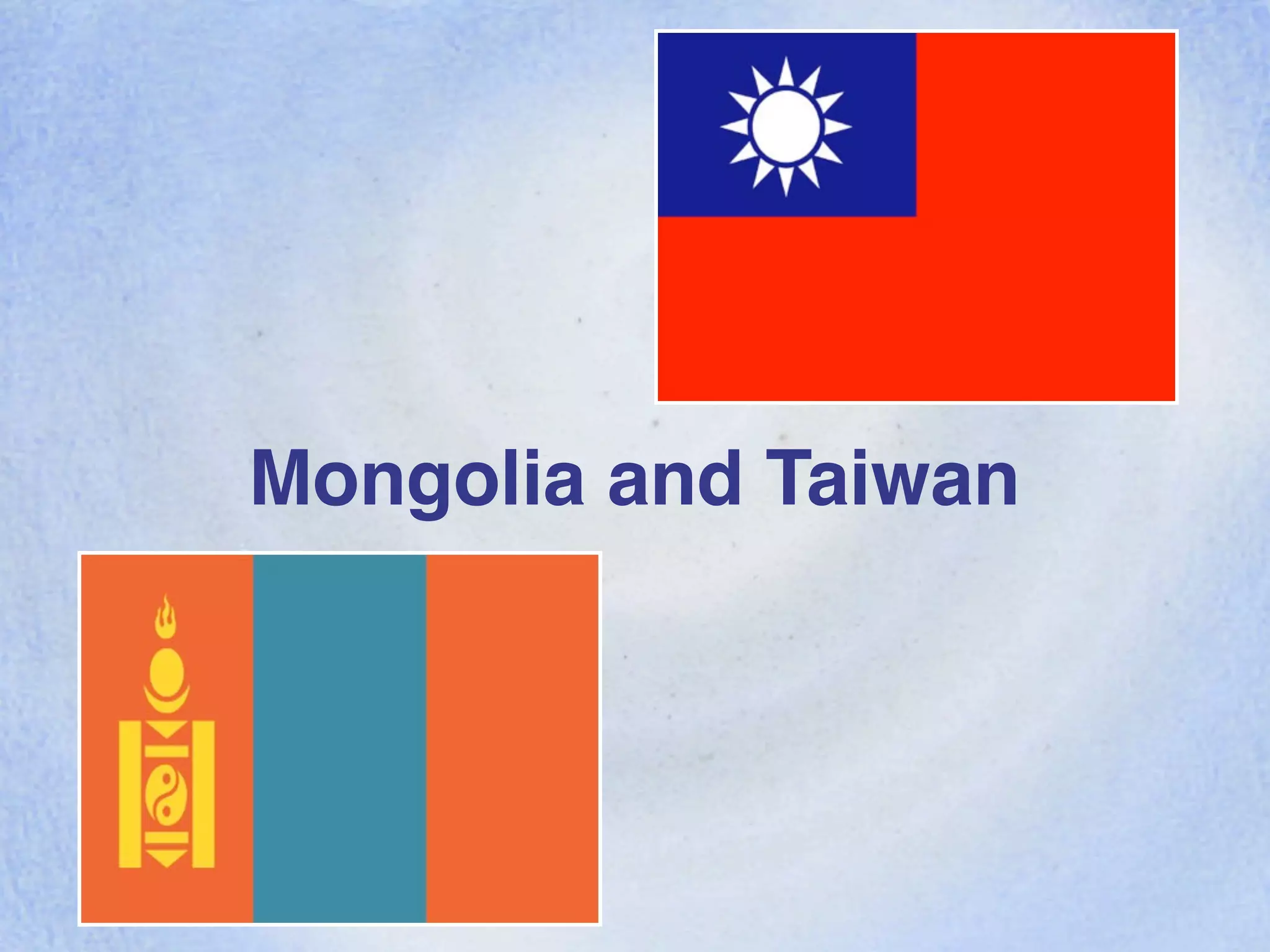
Mongolia and Taiwan
Mongolia: Location
Mongolia: Location
Mongolia: Location
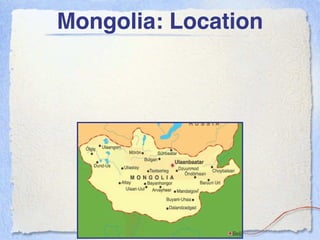
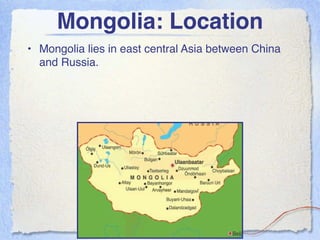
• Mongolia lies in east central Asia between China
  and Russia.
Mongolia: Location
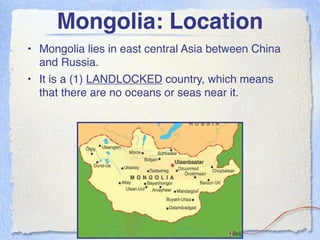
• Mongolia lies in east central Asia between China
  and Russia.
• It is a (1) LANDLOCKED country, which means
  that there are no oceans or seas near it.
Mongolia: Location
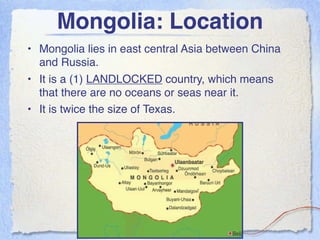
• Mongolia lies in east central Asia between China
  and Russia.
• It is a (1) LANDLOCKED country, which means
  that there are no oceans or seas near it.
• It is twice the size of Texas.
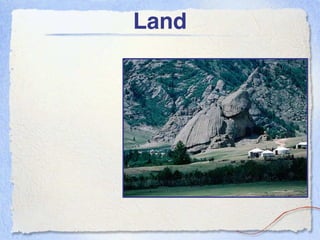
Land
Land
Land
• Rugged mountains
  and high (2)
  PLATEAUS cover
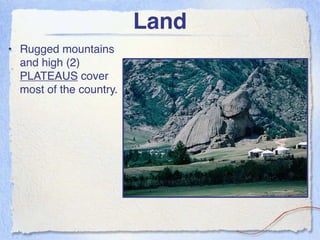
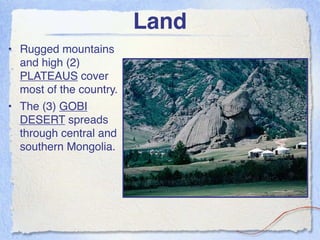
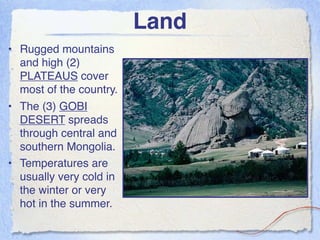
  most of the country.
Land
• Rugged mountains
  and high (2)
  PLATEAUS cover
  most of the country.
• The (3) GOBI
  DESERT spreads
  through central and
  southern Mongolia.
Land
• Rugged mountains
  and high (2)
  PLATEAUS cover
  most of the country.
• The (3) GOBI
  DESERT spreads
  through central and
  southern Mongolia.
• Temperatures are
  usually very cold in
  the winter or very
  hot in the summer.
Economy
Economy
Economy
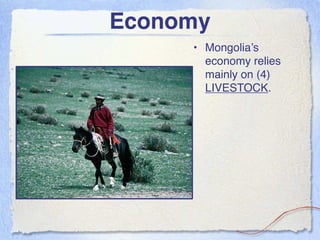
     • Mongolia’s
       economy relies
       mainly on (4)
       LIVESTOCK.
Economy
     • Mongolia’s
       economy relies
       mainly on (4)
       LIVESTOCK.
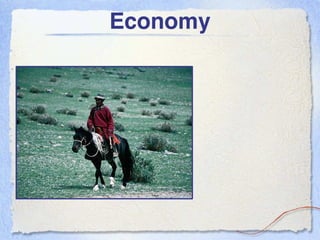
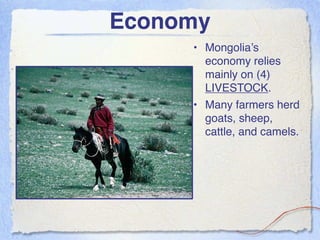
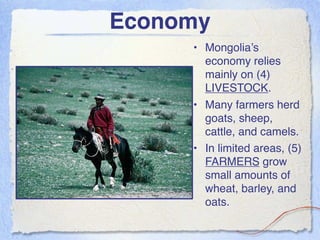
     • Many farmers herd
       goats, sheep,
       cattle, and camels.
Economy
     • Mongolia’s
       economy relies
       mainly on (4)
       LIVESTOCK.
     • Many farmers herd
       goats, sheep,
       cattle, and camels.
     • In limited areas, (5)
       FARMERS grow
       small amounts of
       wheat, barley, and
       oats.
People
People
People
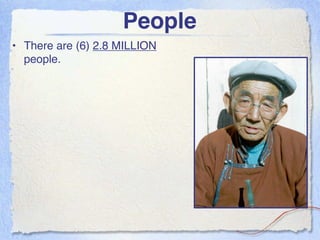
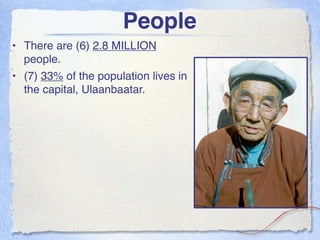
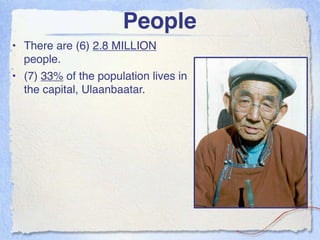
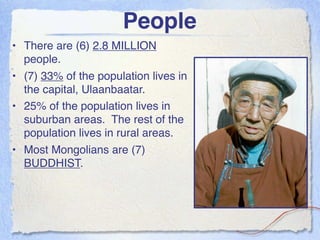
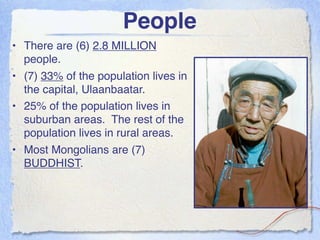
• There are (6) 2.8 MILLION
  people.
People
• There are (6) 2.8 MILLION
  people.
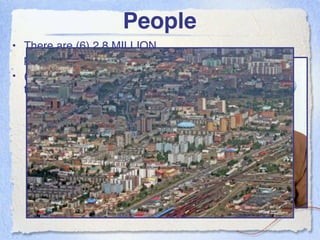
• (7) 33% of the population lives in
  the capital, Ulaanbaatar.
People
• There are (6) 2.8 MILLION
  people.
• (7) 33% of the population lives in
  the capital, Ulaanbaatar.
People
• There are (6) 2.8 MILLION
  people.
• (7) 33% of the population lives in
  the capital, Ulaanbaatar.
People
• There are (6) 2.8 MILLION
  people.
• (7) 33% of the population lives in
  the capital, Ulaanbaatar.
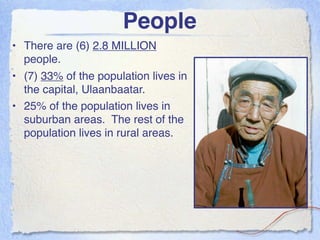
• 25% of the population lives in
  suburban areas. The rest of the
  population lives in rural areas.
People
• There are (6) 2.8 MILLION
  people.
• (7) 33% of the population lives in
  the capital, Ulaanbaatar.
• 25% of the population lives in
  suburban areas. The rest of the
  population lives in rural areas.
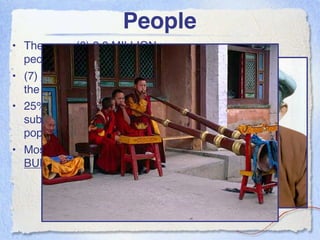
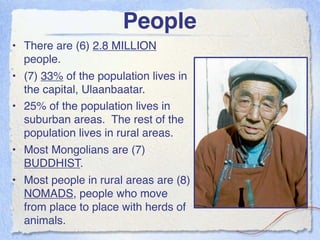
• Most Mongolians are (7)
  BUDDHIST.
People
• There are (6) 2.8 MILLION
  people.
• (7) 33% of the population lives in
  the capital, Ulaanbaatar.
• 25% of the population lives in
  suburban areas. The rest of the
  population lives in rural areas.
• Most Mongolians are (7)
  BUDDHIST.
People
• There are (6) 2.8 MILLION
  people.
• (7) 33% of the population lives in
  the capital, Ulaanbaatar.
• 25% of the population lives in
  suburban areas. The rest of the
  population lives in rural areas.
• Most Mongolians are (7)
  BUDDHIST.
People
• There are (6) 2.8 MILLION
  people.
• (7) 33% of the population lives in
  the capital, Ulaanbaatar.
• 25% of the population lives in
  suburban areas. The rest of the
  population lives in rural areas.
• Most Mongolians are (7)
  BUDDHIST.
• Most people in rural areas are (8)
  NOMADS, people who move
  from place to place with herds of
  animals.
People
People
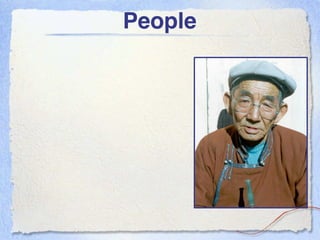
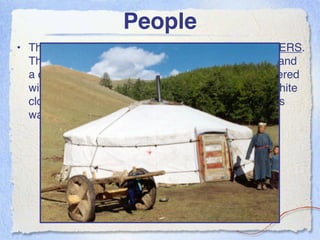
• These people live in traditional homes called (9) GERS.
  These are tents with wooden lattice, a roof frame, and
  a door. Its average size is 18 feet wide and is covered
  with one or more layers of sheep-wool felt and a white
  cloth. It’s easy to dismantle and put together and is
  warm in the winter and cool in the summer.
People
• These people live in traditional homes called (9) GERS.
  These are tents with wooden lattice, a roof frame, and
  a door. Its average size is 18 feet wide and is covered
  with one or more layers of sheep-wool felt and a white
  cloth. It’s easy to dismantle and put together and is
  warm in the winter and cool in the summer.
People
• These people live in traditional homes called (9) GERS.
  These are tents with wooden lattice, a roof frame, and
  a door. Its average size is 18 feet wide and is covered
  with one or more layers of sheep-wool felt and a white
  cloth. It’s easy to dismantle and put together and is
  warm in the winter and cool in the summer.
People
• These people live in traditional homes called (9) GERS.
  These are tents with wooden lattice, a roof frame, and
  a door. Its average size is 18 feet wide and is covered
  with one or more layers of sheep-wool felt and a white
  cloth. It’s easy to dismantle and put together and is
  warm in the winter and cool in the summer.
• Most Mongolians live with their immediate family; (10)
  GRANDPARENTS live with their youngest son.
  Grandparents are treated with great respect for their
  wisdom and life experience.
People
• These people live in traditional homes called (9) GERS.
  These are tents with wooden lattice, a roof frame, and
  a door. Its average size is 18 feet wide and is covered
  with one or more layers of sheep-wool felt and a white
  cloth. It’s easy to dismantle and put together and is
  warm in the winter and cool in the summer.
• Most Mongolians live with their immediate family; (10)
  GRANDPARENTS live with their youngest son.
  Grandparents are treated with great respect for their
  wisdom and life experience.
• Public school is provided for children starting at age 7.
  It lasts for eight years.
Did you know?
Did you know?
Did you know?
     • Mongolia is called the Land of
       the Blue Sky because it
       averages (11) 257 cloudless
       days a year.
Did you know?
     • Mongolia is called the Land of
       the Blue Sky because it
       averages (11) 257 cloudless
       days a year.
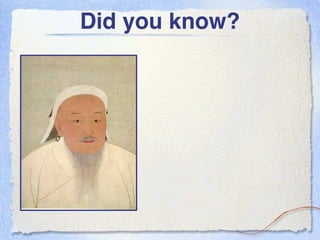
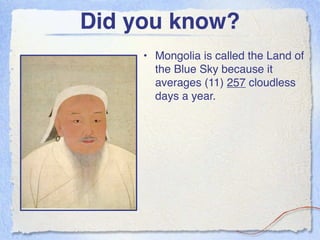
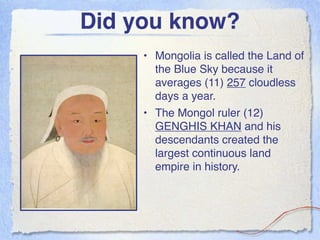
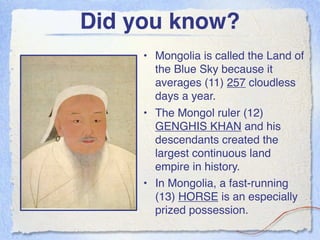
     • The Mongol ruler (12)
       GENGHIS KHAN and his
       descendants created the
       largest continuous land
       empire in history.
Did you know?
     • Mongolia is called the Land of
       the Blue Sky because it
       averages (11) 257 cloudless
       days a year.
     • The Mongol ruler (12)
       GENGHIS KHAN and his
       descendants created the
       largest continuous land
       empire in history.
     • In Mongolia, a fast-running
       (13) HORSE is an especially
       prized possession.
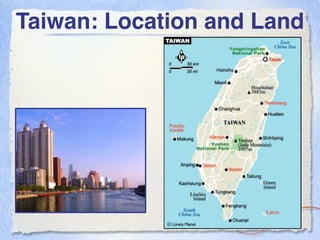
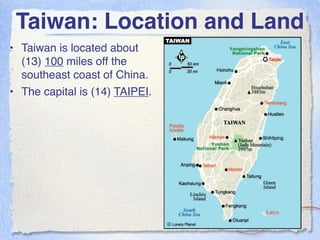
Taiwan: Location and Land
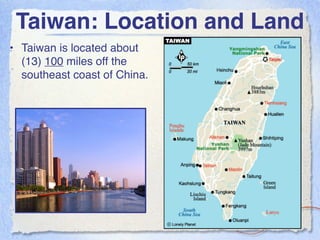
• Taiwan is located about
  (13) 100 miles off the
  southeast coast of China.
Taiwan: Location and Land
• Taiwan is located about
  (13) 100 miles off the
  southeast coast of China.
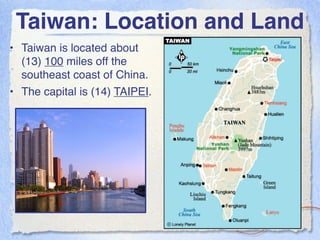
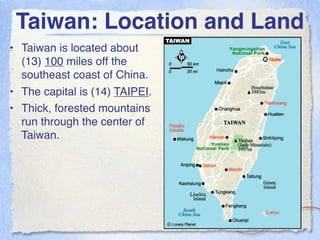
• The capital is (14) TAIPEI.
Taiwan: Location and Land
• Taiwan is located about
  (13) 100 miles off the
  southeast coast of China.
• The capital is (14) TAIPEI.
Taiwan: Location and Land
• Taiwan is located about
  (13) 100 miles off the
  southeast coast of China.
• The capital is (14) TAIPEI.
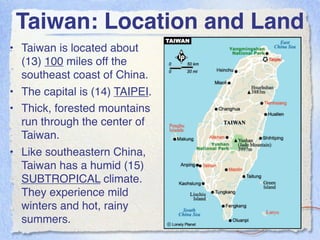
• Thick, forested mountains
  run through the center of
  Taiwan.
Taiwan: Location and Land
• Taiwan is located about
  (13) 100 miles off the
  southeast coast of China.
• The capital is (14) TAIPEI.
• Thick, forested mountains
  run through the center of
  Taiwan.
• Like southeastern China,
  Taiwan has a humid (15)
  SUBTROPICAL climate.
  They experience mild
  winters and hot, rainy
  summers.
History
History


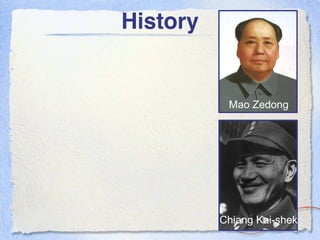
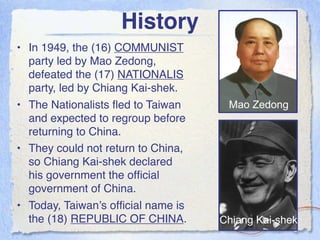
           Mao Zedong


          Chiang Kai-shek
History
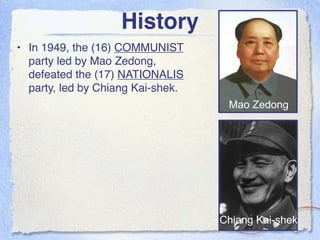
• In 1949, the (16) COMMUNIST
  party led by Mao Zedong,
  defeated the (17) NATIONALIS
  party, led by Chiang Kai-shek.
                                    Mao Zedong


                                   Chiang Kai-shek
History
• In 1949, the (16) COMMUNIST
  party led by Mao Zedong,
  defeated the (17) NATIONALIS
  party, led by Chiang Kai-shek.
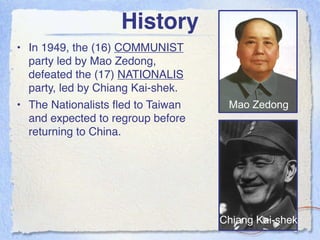
• The Nationalists fled to Taiwan    Mao Zedong
  and expected to regroup before
  returning to China.


                                   Chiang Kai-shek
History
• In 1949, the (16) COMMUNIST
  party led by Mao Zedong,
  defeated the (17) NATIONALIS
  party, led by Chiang Kai-shek.
• The Nationalists fled to Taiwan     Mao Zedong
  and expected to regroup before
  returning to China.
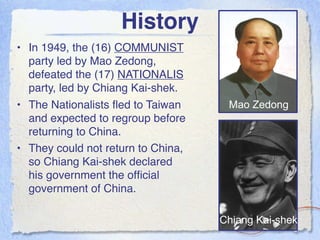
• They could not return to China,
  so Chiang Kai-shek declared
  his government the official
  government of China.

                                    Chiang Kai-shek
History
• In 1949, the (16) COMMUNIST
  party led by Mao Zedong,
  defeated the (17) NATIONALIS
  party, led by Chiang Kai-shek.
• The Nationalists fled to Taiwan     Mao Zedong
  and expected to regroup before
  returning to China.
• They could not return to China,
  so Chiang Kai-shek declared
  his government the official
  government of China.
• Today, Taiwan’s official name is
  the (18) REPUBLIC OF CHINA.       Chiang Kai-shek
Economy
Economy
Economy
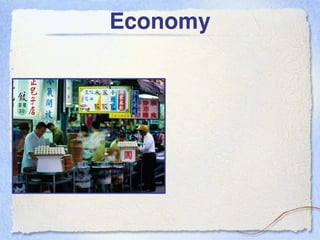
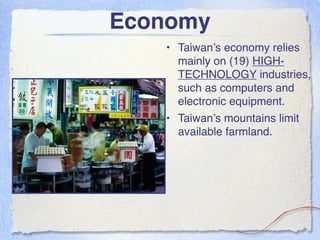
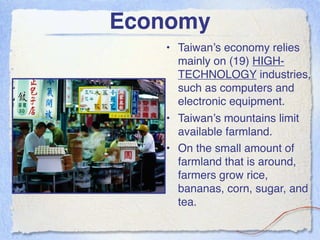
   • Taiwan’s economy relies
     mainly on (19) HIGH-
     TECHNOLOGY industries,
     such as computers and
     electronic equipment.
Economy
   • Taiwan’s economy relies
     mainly on (19) HIGH-
     TECHNOLOGY industries,
     such as computers and
     electronic equipment.
   • Taiwan’s mountains limit
     available farmland.
Economy
   • Taiwan’s economy relies
     mainly on (19) HIGH-
     TECHNOLOGY industries,
     such as computers and
     electronic equipment.
   • Taiwan’s mountains limit
     available farmland.
   • On the small amount of
     farmland that is around,
     farmers grow rice,
     bananas, corn, sugar, and
     tea.
People
People
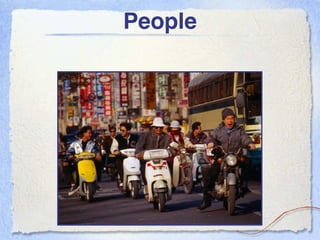
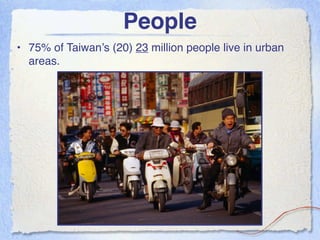
• 75% of Taiwan’s (20) 23 million people live in urban
  areas.
People
• 75% of Taiwan’s (20) 23 million people live in urban
  areas.
People
• 75% of Taiwan’s (20) 23 million people live in urban
  areas.
• Taipei, the capital city, has over (21) 7 million people.
People
• 75% of Taiwan’s (20) 23 million people live in urban
  areas.
• Taipei, the capital city, has over (21) 7 million people.
• The official language is (22) MANDARIN CHINESE.
  Most residents also speak Taiwanese.
People
• 75% of Taiwan’s (20) 23 million people live in urban
  areas.
• Taipei, the capital city, has over (21) 7 million people.
• The official language is (22) MANDARIN CHINESE.
  Most residents also speak Taiwanese.
• (23) 93% of people practice a combination of
  Buddhism, Confucianism, and Daoism.
People
• 75% of Taiwan’s (20) 23 million people live in urban
  areas.
• Taipei, the capital city, has over (21) 7 million people.
• The official language is (22) MANDARIN CHINESE.
  Most residents also speak Taiwanese.
• (23) 93% of people practice a combination of
  Buddhism, Confucianism, and Daoism.
• Education is free for nine years. Then students must
  pass exams to get into high school. Students will then
  study up to (24) 16 hours a day, seven days a week, for
  an entire year in order to pass a test to get in to
  University.
Did you know?
Did you know?
• It is impolite to wink.
Did you know?
• It is impolite to wink.
• (25) BASEBALL is a popular sport.
Did you know?
• It is impolite to wink.
• (25) BASEBALL is a popular sport.
• 85-90% of young adults wear eyeglasses, probably
  because of the emphasis on studying.
Did you know?
• It is impolite to wink.
• (25) BASEBALL is a popular sport.
• 85-90% of young adults wear eyeglasses, probably
  because of the emphasis on studying.
• Loud or boisterous behavior is considered in poor
  taste.

Mongolia and Taiwan

  • 1.
  • 2.
  • 3.
  • 4.
    Mongolia: Location • Mongolialies in east central Asia between China and Russia.
  • 5.
    Mongolia: Location • Mongolialies in east central Asia between China and Russia. • It is a (1) LANDLOCKED country, which means that there are no oceans or seas near it.
  • 6.
    Mongolia: Location • Mongolialies in east central Asia between China and Russia. • It is a (1) LANDLOCKED country, which means that there are no oceans or seas near it. • It is twice the size of Texas.
  • 7.
  • 8.
  • 9.
    Land • Rugged mountains and high (2) PLATEAUS cover most of the country.
  • 10.
    Land • Rugged mountains and high (2) PLATEAUS cover most of the country. • The (3) GOBI DESERT spreads through central and southern Mongolia.
  • 11.
    Land • Rugged mountains and high (2) PLATEAUS cover most of the country. • The (3) GOBI DESERT spreads through central and southern Mongolia. • Temperatures are usually very cold in the winter or very hot in the summer.
  • 12.
  • 13.
  • 14.
    Economy • Mongolia’s economy relies mainly on (4) LIVESTOCK.
  • 15.
    Economy • Mongolia’s economy relies mainly on (4) LIVESTOCK. • Many farmers herd goats, sheep, cattle, and camels.
  • 16.
    Economy • Mongolia’s economy relies mainly on (4) LIVESTOCK. • Many farmers herd goats, sheep, cattle, and camels. • In limited areas, (5) FARMERS grow small amounts of wheat, barley, and oats.
  • 17.
  • 18.
  • 19.
    People • There are(6) 2.8 MILLION people.
  • 20.
    People • There are(6) 2.8 MILLION people. • (7) 33% of the population lives in the capital, Ulaanbaatar.
  • 21.
    People • There are(6) 2.8 MILLION people. • (7) 33% of the population lives in the capital, Ulaanbaatar.
  • 22.
    People • There are(6) 2.8 MILLION people. • (7) 33% of the population lives in the capital, Ulaanbaatar.
  • 23.
    People • There are(6) 2.8 MILLION people. • (7) 33% of the population lives in the capital, Ulaanbaatar. • 25% of the population lives in suburban areas. The rest of the population lives in rural areas.
  • 24.
    People • There are(6) 2.8 MILLION people. • (7) 33% of the population lives in the capital, Ulaanbaatar. • 25% of the population lives in suburban areas. The rest of the population lives in rural areas. • Most Mongolians are (7) BUDDHIST.
  • 25.
    People • There are(6) 2.8 MILLION people. • (7) 33% of the population lives in the capital, Ulaanbaatar. • 25% of the population lives in suburban areas. The rest of the population lives in rural areas. • Most Mongolians are (7) BUDDHIST.
  • 26.
    People • There are(6) 2.8 MILLION people. • (7) 33% of the population lives in the capital, Ulaanbaatar. • 25% of the population lives in suburban areas. The rest of the population lives in rural areas. • Most Mongolians are (7) BUDDHIST.
  • 27.
    People • There are(6) 2.8 MILLION people. • (7) 33% of the population lives in the capital, Ulaanbaatar. • 25% of the population lives in suburban areas. The rest of the population lives in rural areas. • Most Mongolians are (7) BUDDHIST. • Most people in rural areas are (8) NOMADS, people who move from place to place with herds of animals.
  • 28.
  • 29.
    People • These peoplelive in traditional homes called (9) GERS. These are tents with wooden lattice, a roof frame, and a door. Its average size is 18 feet wide and is covered with one or more layers of sheep-wool felt and a white cloth. It’s easy to dismantle and put together and is warm in the winter and cool in the summer.
  • 30.
    People • These peoplelive in traditional homes called (9) GERS. These are tents with wooden lattice, a roof frame, and a door. Its average size is 18 feet wide and is covered with one or more layers of sheep-wool felt and a white cloth. It’s easy to dismantle and put together and is warm in the winter and cool in the summer.
  • 31.
    People • These peoplelive in traditional homes called (9) GERS. These are tents with wooden lattice, a roof frame, and a door. Its average size is 18 feet wide and is covered with one or more layers of sheep-wool felt and a white cloth. It’s easy to dismantle and put together and is warm in the winter and cool in the summer.
  • 32.
    People • These peoplelive in traditional homes called (9) GERS. These are tents with wooden lattice, a roof frame, and a door. Its average size is 18 feet wide and is covered with one or more layers of sheep-wool felt and a white cloth. It’s easy to dismantle and put together and is warm in the winter and cool in the summer. • Most Mongolians live with their immediate family; (10) GRANDPARENTS live with their youngest son. Grandparents are treated with great respect for their wisdom and life experience.
  • 33.
    People • These peoplelive in traditional homes called (9) GERS. These are tents with wooden lattice, a roof frame, and a door. Its average size is 18 feet wide and is covered with one or more layers of sheep-wool felt and a white cloth. It’s easy to dismantle and put together and is warm in the winter and cool in the summer. • Most Mongolians live with their immediate family; (10) GRANDPARENTS live with their youngest son. Grandparents are treated with great respect for their wisdom and life experience. • Public school is provided for children starting at age 7. It lasts for eight years.
  • 34.
  • 35.
  • 36.
    Did you know? • Mongolia is called the Land of the Blue Sky because it averages (11) 257 cloudless days a year.
  • 37.
    Did you know? • Mongolia is called the Land of the Blue Sky because it averages (11) 257 cloudless days a year. • The Mongol ruler (12) GENGHIS KHAN and his descendants created the largest continuous land empire in history.
  • 38.
    Did you know? • Mongolia is called the Land of the Blue Sky because it averages (11) 257 cloudless days a year. • The Mongol ruler (12) GENGHIS KHAN and his descendants created the largest continuous land empire in history. • In Mongolia, a fast-running (13) HORSE is an especially prized possession.
  • 39.
  • 40.
  • 41.
    Taiwan: Location andLand • Taiwan is located about (13) 100 miles off the southeast coast of China.
  • 42.
    Taiwan: Location andLand • Taiwan is located about (13) 100 miles off the southeast coast of China. • The capital is (14) TAIPEI.
  • 43.
    Taiwan: Location andLand • Taiwan is located about (13) 100 miles off the southeast coast of China. • The capital is (14) TAIPEI.
  • 44.
    Taiwan: Location andLand • Taiwan is located about (13) 100 miles off the southeast coast of China. • The capital is (14) TAIPEI. • Thick, forested mountains run through the center of Taiwan.
  • 45.
    Taiwan: Location andLand • Taiwan is located about (13) 100 miles off the southeast coast of China. • The capital is (14) TAIPEI. • Thick, forested mountains run through the center of Taiwan. • Like southeastern China, Taiwan has a humid (15) SUBTROPICAL climate. They experience mild winters and hot, rainy summers.
  • 46.
  • 47.
    History Mao Zedong Chiang Kai-shek
  • 48.
    History • In 1949,the (16) COMMUNIST party led by Mao Zedong, defeated the (17) NATIONALIS party, led by Chiang Kai-shek. Mao Zedong Chiang Kai-shek
  • 49.
    History • In 1949,the (16) COMMUNIST party led by Mao Zedong, defeated the (17) NATIONALIS party, led by Chiang Kai-shek. • The Nationalists fled to Taiwan Mao Zedong and expected to regroup before returning to China. Chiang Kai-shek
  • 50.
    History • In 1949,the (16) COMMUNIST party led by Mao Zedong, defeated the (17) NATIONALIS party, led by Chiang Kai-shek. • The Nationalists fled to Taiwan Mao Zedong and expected to regroup before returning to China. • They could not return to China, so Chiang Kai-shek declared his government the official government of China. Chiang Kai-shek
  • 51.
    History • In 1949,the (16) COMMUNIST party led by Mao Zedong, defeated the (17) NATIONALIS party, led by Chiang Kai-shek. • The Nationalists fled to Taiwan Mao Zedong and expected to regroup before returning to China. • They could not return to China, so Chiang Kai-shek declared his government the official government of China. • Today, Taiwan’s official name is the (18) REPUBLIC OF CHINA. Chiang Kai-shek
  • 52.
  • 53.
  • 54.
    Economy • Taiwan’s economy relies mainly on (19) HIGH- TECHNOLOGY industries, such as computers and electronic equipment.
  • 55.
    Economy • Taiwan’s economy relies mainly on (19) HIGH- TECHNOLOGY industries, such as computers and electronic equipment. • Taiwan’s mountains limit available farmland.
  • 56.
    Economy • Taiwan’s economy relies mainly on (19) HIGH- TECHNOLOGY industries, such as computers and electronic equipment. • Taiwan’s mountains limit available farmland. • On the small amount of farmland that is around, farmers grow rice, bananas, corn, sugar, and tea.
  • 57.
  • 58.
    People • 75% ofTaiwan’s (20) 23 million people live in urban areas.
  • 59.
    People • 75% ofTaiwan’s (20) 23 million people live in urban areas.
  • 60.
    People • 75% ofTaiwan’s (20) 23 million people live in urban areas. • Taipei, the capital city, has over (21) 7 million people.
  • 61.
    People • 75% ofTaiwan’s (20) 23 million people live in urban areas. • Taipei, the capital city, has over (21) 7 million people. • The official language is (22) MANDARIN CHINESE. Most residents also speak Taiwanese.
  • 62.
    People • 75% ofTaiwan’s (20) 23 million people live in urban areas. • Taipei, the capital city, has over (21) 7 million people. • The official language is (22) MANDARIN CHINESE. Most residents also speak Taiwanese. • (23) 93% of people practice a combination of Buddhism, Confucianism, and Daoism.
  • 63.
    People • 75% ofTaiwan’s (20) 23 million people live in urban areas. • Taipei, the capital city, has over (21) 7 million people. • The official language is (22) MANDARIN CHINESE. Most residents also speak Taiwanese. • (23) 93% of people practice a combination of Buddhism, Confucianism, and Daoism. • Education is free for nine years. Then students must pass exams to get into high school. Students will then study up to (24) 16 hours a day, seven days a week, for an entire year in order to pass a test to get in to University.
  • 64.
  • 65.
    Did you know? •It is impolite to wink.
  • 66.
    Did you know? •It is impolite to wink. • (25) BASEBALL is a popular sport.
  • 67.
    Did you know? •It is impolite to wink. • (25) BASEBALL is a popular sport. • 85-90% of young adults wear eyeglasses, probably because of the emphasis on studying.
  • 68.
    Did you know? •It is impolite to wink. • (25) BASEBALL is a popular sport. • 85-90% of young adults wear eyeglasses, probably because of the emphasis on studying. • Loud or boisterous behavior is considered in poor taste.