Germany, Switzerland, and
        Austria
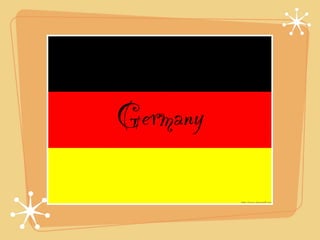
Germany
Germany
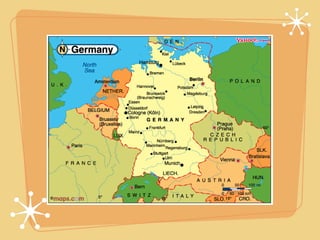
Germany - Location and Land
Germany is about the size of (1)
MONTANA.
Germany - Location and Land
Germany is about the size of (1)
MONTANA.
In the south are the (2) ALPS where the
Danube River begins.
Germany - Location and Land
Germany is about the size of (1)
MONTANA.
In the south are the (2) ALPS where the
Danube River begins.
In the north is the (3) RHINE RIVER, which
forms part of the border with France.
Germany - Location and Land
Germany is about the size of (1)
MONTANA.
In the south are the (2) ALPS where the
Danube River begins.
In the north is the (3) RHINE RIVER, which
forms part of the border with France.
(5) HAMBURG, the largest port city, is in
the west on the Elbe River.
Economy
Economy
Germany imports about (6) 1/3 of its food.
Economy
Germany imports about (6) 1/3 of its food.
It is a leading exporter of (7) BEER,
CHEESE AND WINE.
Economy
Germany imports about (6) 1/3 of its food.
It is a leading exporter of (7) BEER,
CHEESE AND WINE.
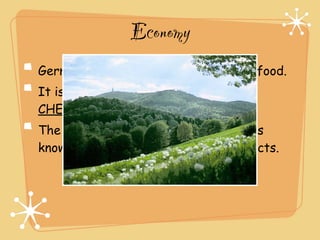
The Black Forest, north of the Alps, is
known for its scenery and wood products.
Economy
Germany imports about (6) 1/3 of its food.
It is a leading exporter of (7) BEER,
CHEESE AND WINE.
The Black Forest, north of the Alps, is
known for its scenery and wood products.
Economy
Germany imports about (6) 1/3 of its food.
It is a leading exporter of (7) BEER,
CHEESE AND WINE.
The Black Forest, north of the Alps, is
known for its scenery and wood products.
Economy
Germany imports about (6) 1/3 of its food.
It is a leading exporter of (7) BEER,
CHEESE AND WINE.
The Black Forest, north of the Alps, is
known for its scenery and wood products.
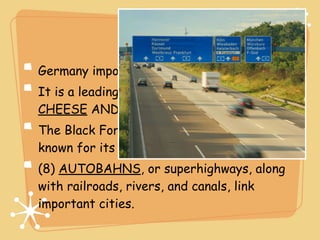
(8) AUTOBAHNS, or superhighways, along
with railroads, rivers, and canals, link
important cities.
Economy
Germany imports about (6) 1/3 of its food.
It is a leading exporter of (7) BEER,
CHEESE AND WINE.
The Black Forest, north of the Alps, is
known for its scenery and wood products.
(8) AUTOBAHNS, or superhighways, along
with railroads, rivers, and canals, link
important cities.
Government
Government
Like the US, Germany is a (9) FEDERAL
REPUBLIC: the national and state
governments share power.
Government
Like the US, Germany is a (9) FEDERAL
REPUBLIC: the national and state
governments share power.
They have an elected (10) PRESIDENT to
carry out ceremonial duties.
Government
Like the US, Germany is a (9) FEDERAL
REPUBLIC: the national and state
governments share power.
They have an elected (10) PRESIDENT to
carry out ceremonial duties.
They also have a (11) CHANCELLOR who is
chosen by one of the two houses of
parliament and he or she runs the
government.
Reunification
Reunification
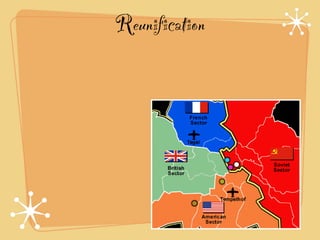
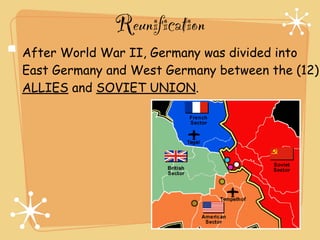
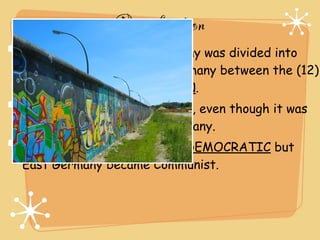
After World War II, Germany was divided into
East Germany and West Germany between the (12)
ALLIES and SOVIET UNION.
Reunification
After World War II, Germany was divided into
East Germany and West Germany between the (12)
ALLIES and SOVIET UNION.
Reunification
After World War II, Germany was divided into
East Germany and West Germany between the (12)
ALLIES and SOVIET UNION.
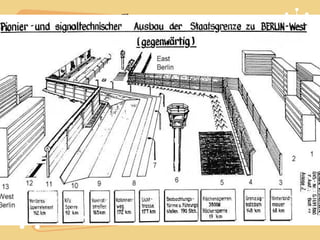
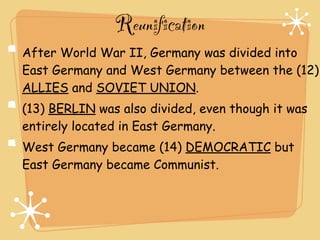
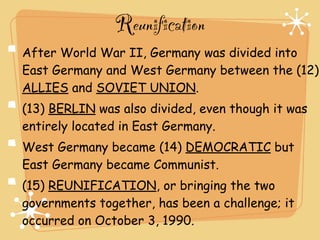
(13) BERLIN was also divided, even though it was
entirely located in East Germany.
Reunification
After World War II, Germany was divided into
East Germany and West Germany between the (12)
ALLIES and SOVIET UNION.
(13) BERLIN was also divided, even though it was
entirely located in East Germany.
West Germany became (14) DEMOCRATIC but
East Germany became Communist.
Reunification
After World War II, Germany was divided into
East Germany and West Germany between the (12)
ALLIES and SOVIET UNION.
(13) BERLIN was also divided, even though it was
entirely located in East Germany.
West Germany became (14) DEMOCRATIC but
East Germany became Communist.
Reunification
After World War II, Germany was divided into
East Germany and West Germany between the (12)
ALLIES and SOVIET UNION.
(13) BERLIN was also divided, even though it was
entirely located in East Germany.
West Germany became (14) DEMOCRATIC but
East Germany became Communist.
Reunification
After World War II, Germany was divided into
East Germany and West Germany between the (12)
ALLIES and SOVIET UNION.
(13) BERLIN was also divided, even though it was
entirely located in East Germany.
West Germany became (14) DEMOCRATIC but
East Germany became Communist.
Reunification
After World War II, Germany was divided into
East Germany and West Germany between the (12)
ALLIES and SOVIET UNION.
(13) BERLIN was also divided, even though it was
entirely located in East Germany.
West Germany became (14) DEMOCRATIC but
East Germany became Communist.
Reunification
After World War II, Germany was divided into
East Germany and West Germany between the (12)
ALLIES and SOVIET UNION.
(13) BERLIN was also divided, even though it was
entirely located in East Germany.
West Germany became (14) DEMOCRATIC but
East Germany became Communist.
(15) REUNIFICATION, or bringing the two
governments together, has been a challenge; it
occurred on October 3, 1990.
People
People
(16) GERMAN, their language, is related to
English.
People
(16) GERMAN, their language, is related to
English.
(17) PROTESTANTISM began in Germany
when a monk, Martin Luther, led a protest
against things the Catholic Church was
doing.
People
(16) GERMAN, their language, is related to
English.
(17) PROTESTANTISM began in Germany
when a monk, Martin Luther, led a protest
against things the Catholic Church was
doing.
Today, both Protestants and Catholics live
in Germany.
People
(16) GERMAN, their language, is related to
English.
(17) PROTESTANTISM began in Germany
when a monk, Martin Luther, led a protest
against things the Catholic Church was
doing.
Today, both Protestants and Catholics live
in Germany.
Famous Germans include Johann Sebastian
Bach and Ludwig Van Beethoven.
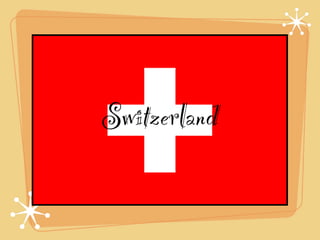
Switzerland
Switzerland
Government
Government

Switzerland has had a democracy for (18)
700 YEARS.
Government

Switzerland has had a democracy for (18)
700 YEARS.
Because of its location, Switzerland has
practiced (19) NEUTRALITY - refusing to
take sides in disagreements and wars
between countries.
Land
Land
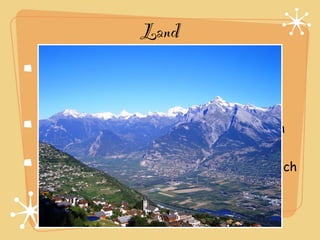
The Alps are a (20) CONTINENTAL
DIVIDE. This is a high place from which
rivers flow in different directions.
Land
The Alps are a (20) CONTINENTAL
DIVIDE. This is a high place from which
rivers flow in different directions.
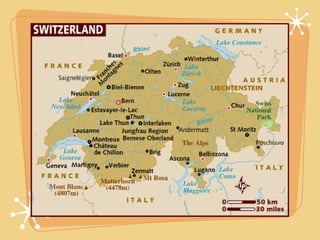
The Rhine and Rhone (21) RIVERS begin in
the Alps.
Land
The Alps are a (20) CONTINENTAL
DIVIDE. This is a high place from which
rivers flow in different directions.
The Rhine and Rhone (21) RIVERS begin in
the Alps.
A high plateau between mountains holds rich
farmlands, industries, the capital (22)
BERN, and the largest city, Zurich.
Land
The Alps are a (20) CONTINENTAL
DIVIDE. This is a high place from which
rivers flow in different directions.
The Rhine and Rhone (21) RIVERS begin in
the Alps.
A high plateau between mountains holds rich
farmlands, industries, the capital (22)
BERN, and the largest city, Zurich.
Economy
Economy
Switzerland has few natural resources.
Economy
Switzerland has few natural resources.
However, it imports resources and makes
high-quality goods such as (23) CLOCKS,
watches, and electronic equipment.
Economy
Switzerland has few natural resources.
However, it imports resources and makes
high-quality goods such as (23) CLOCKS,
watches, and electronic equipment.
Chemicals, gourmet chocolate, and gourmet
cheese are also produced.
Economy
Switzerland has few natural resources.
However, it imports resources and makes
high-quality goods such as (23) CLOCKS,
watches, and electronic equipment.
Chemicals, gourmet chocolate, and gourmet
cheese are also produced.
Other important industries are (24)
TOURISM, banking, and insurance.
People
People


There are many different ethnic groups and
religions.
People


There are many different ethnic groups and
religions.
There are (25) FOUR national languages.
Austria
Austria
Land
Land


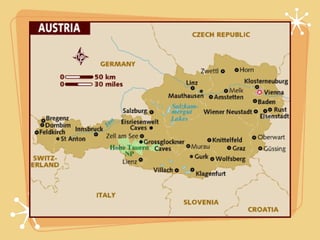
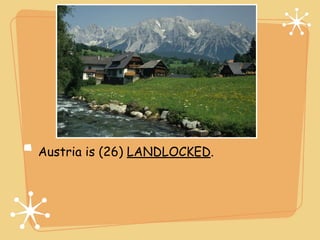
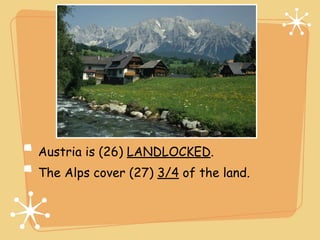
Austria is (26) LANDLOCKED.
Land


Austria is (26) LANDLOCKED.
Land


Austria is (26) LANDLOCKED.
The Alps cover (27) 3/4 of the land.
Economy
Economy
Rivers proved hydroelectric power and the
mountains provide (28) TIMBER.
Economy
Rivers proved hydroelectric power and the
mountains provide (28) TIMBER.
Tourism is extremely important.
Economy
Rivers proved hydroelectric power and the
mountains provide (28) TIMBER.
Tourism is extremely important.
Factories produce machinery, chemicals,
metals, and vehicles.
Economy
Rivers proved hydroelectric power and the
mountains provide (28) TIMBER.
Tourism is extremely important.
Factories produce machinery, chemicals,
metals, and vehicles.
Farmers raise dairy cattle, livestock, sugar
beets, grains, potatoes, and fruits.
People
People
Most Austrians live in cities and towns and
work in manufacturing or service jobs.
People
Most Austrians live in cities and towns and
work in manufacturing or service jobs.
Most people speak (29) GERMAN.
People
Most Austrians live in cities and towns and
work in manufacturing or service jobs.
Most people speak (29) GERMAN.
80% of people are Roman Catholic.
People
Most Austrians live in cities and towns and
work in manufacturing or service jobs.
Most people speak (29) GERMAN.
80% of people are Roman Catholic.
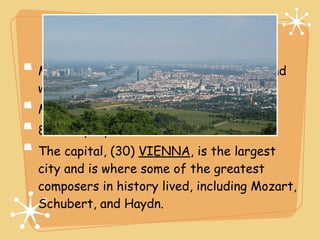
The capital, (30) VIENNA, is the largest
city and is where some of the greatest
composers in history lived, including Mozart,
Schubert, and Haydn.
People
Most Austrians live in cities and towns and
work in manufacturing or service jobs.
Most people speak (29) GERMAN.
80% of people are Roman Catholic.
The capital, (30) VIENNA, is the largest
city and is where some of the greatest
composers in history lived, including Mozart,
Schubert, and Haydn.

Germany, Switzerland, Austria

  • 1.
  • 2.
  • 3.
  • 4.
  • 5.
    Germany - Locationand Land Germany is about the size of (1) MONTANA.
  • 6.
    Germany - Locationand Land Germany is about the size of (1) MONTANA. In the south are the (2) ALPS where the Danube River begins.
  • 7.
    Germany - Locationand Land Germany is about the size of (1) MONTANA. In the south are the (2) ALPS where the Danube River begins. In the north is the (3) RHINE RIVER, which forms part of the border with France.
  • 8.
    Germany - Locationand Land Germany is about the size of (1) MONTANA. In the south are the (2) ALPS where the Danube River begins. In the north is the (3) RHINE RIVER, which forms part of the border with France. (5) HAMBURG, the largest port city, is in the west on the Elbe River.
  • 9.
  • 10.
    Economy Germany imports about(6) 1/3 of its food.
  • 11.
    Economy Germany imports about(6) 1/3 of its food. It is a leading exporter of (7) BEER, CHEESE AND WINE.
  • 12.
    Economy Germany imports about(6) 1/3 of its food. It is a leading exporter of (7) BEER, CHEESE AND WINE. The Black Forest, north of the Alps, is known for its scenery and wood products.
  • 13.
    Economy Germany imports about(6) 1/3 of its food. It is a leading exporter of (7) BEER, CHEESE AND WINE. The Black Forest, north of the Alps, is known for its scenery and wood products.
  • 14.
    Economy Germany imports about(6) 1/3 of its food. It is a leading exporter of (7) BEER, CHEESE AND WINE. The Black Forest, north of the Alps, is known for its scenery and wood products.
  • 15.
    Economy Germany imports about(6) 1/3 of its food. It is a leading exporter of (7) BEER, CHEESE AND WINE. The Black Forest, north of the Alps, is known for its scenery and wood products. (8) AUTOBAHNS, or superhighways, along with railroads, rivers, and canals, link important cities.
  • 16.
    Economy Germany imports about(6) 1/3 of its food. It is a leading exporter of (7) BEER, CHEESE AND WINE. The Black Forest, north of the Alps, is known for its scenery and wood products. (8) AUTOBAHNS, or superhighways, along with railroads, rivers, and canals, link important cities.
  • 17.
  • 18.
    Government Like the US,Germany is a (9) FEDERAL REPUBLIC: the national and state governments share power.
  • 19.
    Government Like the US,Germany is a (9) FEDERAL REPUBLIC: the national and state governments share power. They have an elected (10) PRESIDENT to carry out ceremonial duties.
  • 20.
    Government Like the US,Germany is a (9) FEDERAL REPUBLIC: the national and state governments share power. They have an elected (10) PRESIDENT to carry out ceremonial duties. They also have a (11) CHANCELLOR who is chosen by one of the two houses of parliament and he or she runs the government.
  • 21.
  • 22.
    Reunification After World WarII, Germany was divided into East Germany and West Germany between the (12) ALLIES and SOVIET UNION.
  • 23.
    Reunification After World WarII, Germany was divided into East Germany and West Germany between the (12) ALLIES and SOVIET UNION.
  • 24.
    Reunification After World WarII, Germany was divided into East Germany and West Germany between the (12) ALLIES and SOVIET UNION. (13) BERLIN was also divided, even though it was entirely located in East Germany.
  • 25.
    Reunification After World WarII, Germany was divided into East Germany and West Germany between the (12) ALLIES and SOVIET UNION. (13) BERLIN was also divided, even though it was entirely located in East Germany. West Germany became (14) DEMOCRATIC but East Germany became Communist.
  • 26.
    Reunification After World WarII, Germany was divided into East Germany and West Germany between the (12) ALLIES and SOVIET UNION. (13) BERLIN was also divided, even though it was entirely located in East Germany. West Germany became (14) DEMOCRATIC but East Germany became Communist.
  • 27.
    Reunification After World WarII, Germany was divided into East Germany and West Germany between the (12) ALLIES and SOVIET UNION. (13) BERLIN was also divided, even though it was entirely located in East Germany. West Germany became (14) DEMOCRATIC but East Germany became Communist.
  • 28.
    Reunification After World WarII, Germany was divided into East Germany and West Germany between the (12) ALLIES and SOVIET UNION. (13) BERLIN was also divided, even though it was entirely located in East Germany. West Germany became (14) DEMOCRATIC but East Germany became Communist.
  • 29.
    Reunification After World WarII, Germany was divided into East Germany and West Germany between the (12) ALLIES and SOVIET UNION. (13) BERLIN was also divided, even though it was entirely located in East Germany. West Germany became (14) DEMOCRATIC but East Germany became Communist.
  • 30.
    Reunification After World WarII, Germany was divided into East Germany and West Germany between the (12) ALLIES and SOVIET UNION. (13) BERLIN was also divided, even though it was entirely located in East Germany. West Germany became (14) DEMOCRATIC but East Germany became Communist. (15) REUNIFICATION, or bringing the two governments together, has been a challenge; it occurred on October 3, 1990.
  • 31.
  • 32.
    People (16) GERMAN, theirlanguage, is related to English.
  • 33.
    People (16) GERMAN, theirlanguage, is related to English. (17) PROTESTANTISM began in Germany when a monk, Martin Luther, led a protest against things the Catholic Church was doing.
  • 34.
    People (16) GERMAN, theirlanguage, is related to English. (17) PROTESTANTISM began in Germany when a monk, Martin Luther, led a protest against things the Catholic Church was doing. Today, both Protestants and Catholics live in Germany.
  • 35.
    People (16) GERMAN, theirlanguage, is related to English. (17) PROTESTANTISM began in Germany when a monk, Martin Luther, led a protest against things the Catholic Church was doing. Today, both Protestants and Catholics live in Germany. Famous Germans include Johann Sebastian Bach and Ludwig Van Beethoven.
  • 36.
  • 37.
  • 38.
  • 39.
    Government Switzerland has hada democracy for (18) 700 YEARS.
  • 40.
    Government Switzerland has hada democracy for (18) 700 YEARS. Because of its location, Switzerland has practiced (19) NEUTRALITY - refusing to take sides in disagreements and wars between countries.
  • 41.
  • 42.
    Land The Alps area (20) CONTINENTAL DIVIDE. This is a high place from which rivers flow in different directions.
  • 43.
    Land The Alps area (20) CONTINENTAL DIVIDE. This is a high place from which rivers flow in different directions. The Rhine and Rhone (21) RIVERS begin in the Alps.
  • 44.
    Land The Alps area (20) CONTINENTAL DIVIDE. This is a high place from which rivers flow in different directions. The Rhine and Rhone (21) RIVERS begin in the Alps. A high plateau between mountains holds rich farmlands, industries, the capital (22) BERN, and the largest city, Zurich.
  • 45.
    Land The Alps area (20) CONTINENTAL DIVIDE. This is a high place from which rivers flow in different directions. The Rhine and Rhone (21) RIVERS begin in the Alps. A high plateau between mountains holds rich farmlands, industries, the capital (22) BERN, and the largest city, Zurich.
  • 46.
  • 47.
    Economy Switzerland has fewnatural resources.
  • 48.
    Economy Switzerland has fewnatural resources. However, it imports resources and makes high-quality goods such as (23) CLOCKS, watches, and electronic equipment.
  • 49.
    Economy Switzerland has fewnatural resources. However, it imports resources and makes high-quality goods such as (23) CLOCKS, watches, and electronic equipment. Chemicals, gourmet chocolate, and gourmet cheese are also produced.
  • 50.
    Economy Switzerland has fewnatural resources. However, it imports resources and makes high-quality goods such as (23) CLOCKS, watches, and electronic equipment. Chemicals, gourmet chocolate, and gourmet cheese are also produced. Other important industries are (24) TOURISM, banking, and insurance.
  • 51.
  • 52.
    People There are manydifferent ethnic groups and religions.
  • 53.
    People There are manydifferent ethnic groups and religions. There are (25) FOUR national languages.
  • 54.
  • 55.
  • 56.
  • 57.
  • 58.
  • 59.
    Land Austria is (26)LANDLOCKED. The Alps cover (27) 3/4 of the land.
  • 60.
  • 61.
    Economy Rivers proved hydroelectricpower and the mountains provide (28) TIMBER.
  • 62.
    Economy Rivers proved hydroelectricpower and the mountains provide (28) TIMBER. Tourism is extremely important.
  • 63.
    Economy Rivers proved hydroelectricpower and the mountains provide (28) TIMBER. Tourism is extremely important. Factories produce machinery, chemicals, metals, and vehicles.
  • 64.
    Economy Rivers proved hydroelectricpower and the mountains provide (28) TIMBER. Tourism is extremely important. Factories produce machinery, chemicals, metals, and vehicles. Farmers raise dairy cattle, livestock, sugar beets, grains, potatoes, and fruits.
  • 65.
  • 66.
    People Most Austrians livein cities and towns and work in manufacturing or service jobs.
  • 67.
    People Most Austrians livein cities and towns and work in manufacturing or service jobs. Most people speak (29) GERMAN.
  • 68.
    People Most Austrians livein cities and towns and work in manufacturing or service jobs. Most people speak (29) GERMAN. 80% of people are Roman Catholic.
  • 69.
    People Most Austrians livein cities and towns and work in manufacturing or service jobs. Most people speak (29) GERMAN. 80% of people are Roman Catholic. The capital, (30) VIENNA, is the largest city and is where some of the greatest composers in history lived, including Mozart, Schubert, and Haydn.
  • 70.
    People Most Austrians livein cities and towns and work in manufacturing or service jobs. Most people speak (29) GERMAN. 80% of people are Roman Catholic. The capital, (30) VIENNA, is the largest city and is where some of the greatest composers in history lived, including Mozart, Schubert, and Haydn.

Editor's Notes