INTRODUCTION
The Mongols are an East-Central Asian ethnic group native to Mongolia and
China's Inner Mongolia Autonomous Region.
They also live as minorities in other regions of China (e.g. Xinjiang), as well
as in Russia.
Mongolian people belonging to the Buryat and Kalmyk subgroups live
predominantly in the Russian federal subjects of Buryatia and Kalmykia.
The Mongols are bound together by a common heritage and ethnic identity.
Their indigenous dialects are collectively known as the Mongolian language.
The ancestors of the modern-day Mongols are referred to as Proto-
Mongols.
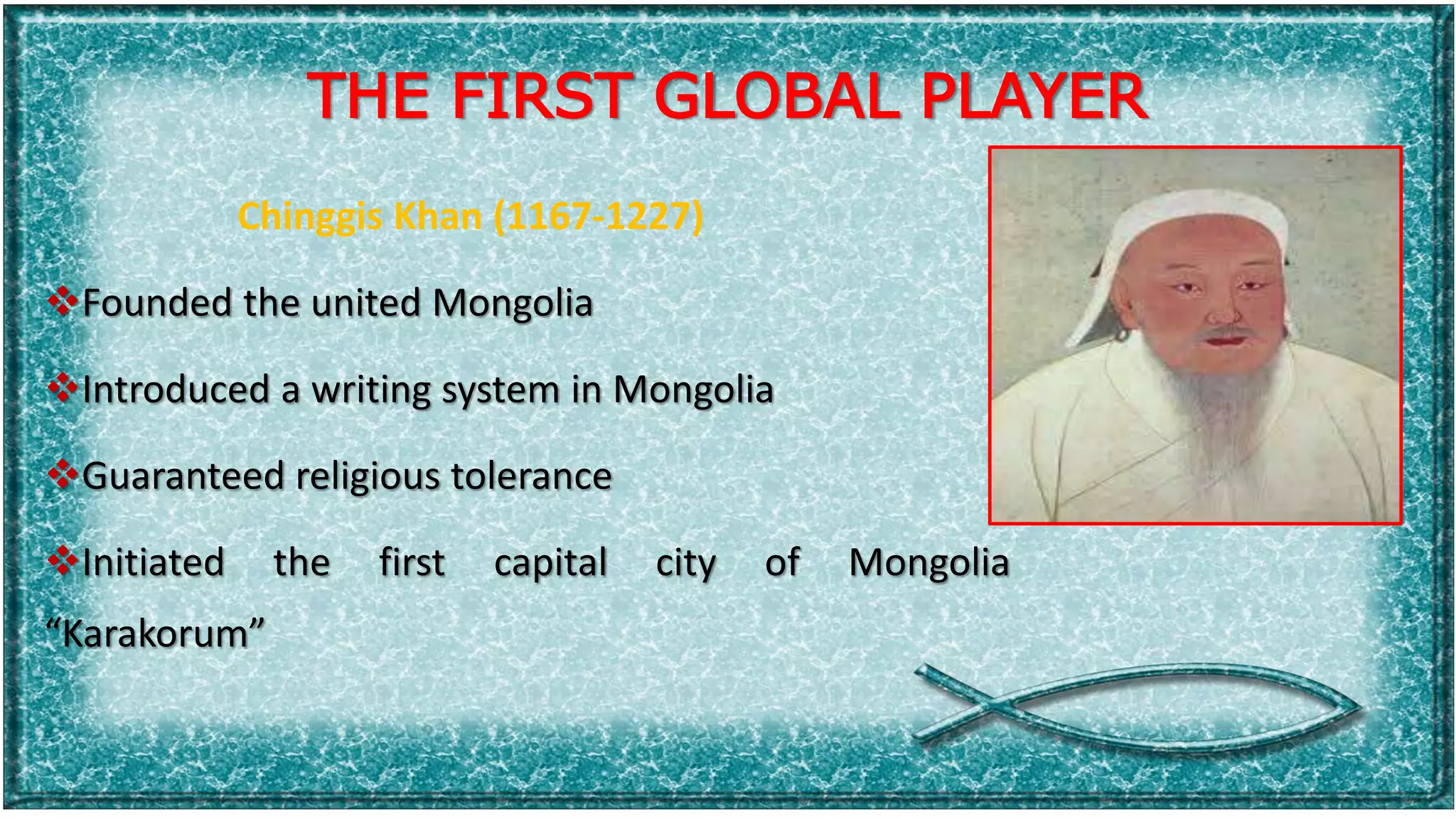
THE FIRST GLOBAL PLAYER
Chinggis Khan (1167-1227)
Founded the united Mongolia
Introduced a writing system in Mongolia
Guaranteed religious tolerance
Initiated the first capital city of Mongolia
“Karakorum”
RELIGION
Today the main population of Mongolians are Tibetan Buddhists , but there
is still some Shamanism, Christianity and Kazak Muslim people living in
Mongolia
SHELTER
The Mongolian ger or yurt, is tent made, though simple in looks, is made to
be taken apart, and can hold beautiful rugs and other Mongolian treasures
inside.
Mongolia and living in what is, basically, a tent.
ECONOMY
For Mongolian economy they have been highly influenced by their
neighbors.
They mainly export Cattle (35%) and Wool (40%) but they also export dairy,
fur and hides.
They have a newspaper known as Unen, or Truth
CLOTHES
These Nomads dress warmly for the cold winter in leather boots and some
even wear the loouz, traditional headwear.
They also wear a traditional outfit called the dell, made from wool or silk.
GEOGRAPHY
Mongolia is a land- locked country with their capital city being Ulaanbaatar-
also their the largest city.
Part of centeral Asia, North of China and South of Russia, this country in
Asia is 1,564,116 in total area - slightly smaller than Alaska.
The Altay Mountains and Gobi Desert are also located in this country, as
well as the Mongolian Plateua.
RECREATION
Mongolians are fond of the outdoors and enjoy active activities such as
Wrestling, Arrow, Shooting and horse racing.
These are activities they have been good at since ancient times, and
continue to enjoy and compete in today.
BELIEFS
Mongolians believe in the fire, water and kitchen God.
They also believe in certain things being tabooed or forbidden.
One taboo is bathing or washing dirty items in a river.
This is tabooed because water is a God to these people.
You would never wash anything in your God, would you?
EDUCATION + VALUES + WORK
Mongolians typically get 12 years of school education and there they teach
their students about their history and values.
Mongolians highly value peace.
Many Mongolians end up as teachers, police workers, herders and people
involved in the health department.
CUSTOMS
Mongolians celebrate Independence Day on the 26th of November and
White Moon, which is a celebration of the coming of spring.
November 26 is a national Mongolian holiday.
November 26, 1924 was the day that Mongolia declared itself as an
independent country with the adoption of its first constitution.
Mongol tribes
Mongol tribes
Mongol tribes

Mongol tribes

  • 2.
    INTRODUCTION The Mongols arean East-Central Asian ethnic group native to Mongolia and China's Inner Mongolia Autonomous Region. They also live as minorities in other regions of China (e.g. Xinjiang), as well as in Russia. Mongolian people belonging to the Buryat and Kalmyk subgroups live predominantly in the Russian federal subjects of Buryatia and Kalmykia. The Mongols are bound together by a common heritage and ethnic identity. Their indigenous dialects are collectively known as the Mongolian language. The ancestors of the modern-day Mongols are referred to as Proto- Mongols.
  • 3.
    THE FIRST GLOBALPLAYER Chinggis Khan (1167-1227) Founded the united Mongolia Introduced a writing system in Mongolia Guaranteed religious tolerance Initiated the first capital city of Mongolia “Karakorum”
  • 4.
    RELIGION Today the mainpopulation of Mongolians are Tibetan Buddhists , but there is still some Shamanism, Christianity and Kazak Muslim people living in Mongolia
  • 5.
    SHELTER The Mongolian geror yurt, is tent made, though simple in looks, is made to be taken apart, and can hold beautiful rugs and other Mongolian treasures inside. Mongolia and living in what is, basically, a tent.
  • 6.
    ECONOMY For Mongolian economythey have been highly influenced by their neighbors. They mainly export Cattle (35%) and Wool (40%) but they also export dairy, fur and hides. They have a newspaper known as Unen, or Truth
  • 7.
    CLOTHES These Nomads dresswarmly for the cold winter in leather boots and some even wear the loouz, traditional headwear. They also wear a traditional outfit called the dell, made from wool or silk.
  • 8.
    GEOGRAPHY Mongolia is aland- locked country with their capital city being Ulaanbaatar- also their the largest city. Part of centeral Asia, North of China and South of Russia, this country in Asia is 1,564,116 in total area - slightly smaller than Alaska. The Altay Mountains and Gobi Desert are also located in this country, as well as the Mongolian Plateua.
  • 9.
    RECREATION Mongolians are fondof the outdoors and enjoy active activities such as Wrestling, Arrow, Shooting and horse racing. These are activities they have been good at since ancient times, and continue to enjoy and compete in today.
  • 10.
    BELIEFS Mongolians believe inthe fire, water and kitchen God. They also believe in certain things being tabooed or forbidden. One taboo is bathing or washing dirty items in a river. This is tabooed because water is a God to these people. You would never wash anything in your God, would you?
  • 11.
    EDUCATION + VALUES+ WORK Mongolians typically get 12 years of school education and there they teach their students about their history and values. Mongolians highly value peace. Many Mongolians end up as teachers, police workers, herders and people involved in the health department.
  • 12.
    CUSTOMS Mongolians celebrate IndependenceDay on the 26th of November and White Moon, which is a celebration of the coming of spring. November 26 is a national Mongolian holiday. November 26, 1924 was the day that Mongolia declared itself as an independent country with the adoption of its first constitution.