













Tweet tonight using #MongoDB to be
entered to win a t-shirt!
Welcome to MongoDB Evenings DC!
Agenda
6:00pm: Pizza, Beer & Soft Drinks
6:30pm: Welcome
Andrew Lockman, Enterprise Account Executive, MongoDB
6:40pm: MongoDB: The New Default Database for Giant Ideas
Gary Taylor, Senior Solutions Architect, MongoDB
7:30pm: Get MEAN and Lean with Docker and Kubernetes
Vadim Polyakov, Director of Enterprise Architecture, Inovalon
8:15pm: Announcements
Q&A
#MongoDB
@1776
MongoDB World
Pre-conference training: June 27th
Conference: June 28th-29th
Hilton Midtown
1335 6th Avenue
New York, NY 10019
Who’s Speaking (partial list)
Who’s Speaking
Code “AndrewLockman” gets 25% off
Early Bird Registration Ends May 13, 2016
June 29 - 29, 2016
New York, NY
www.mongodbworld.com
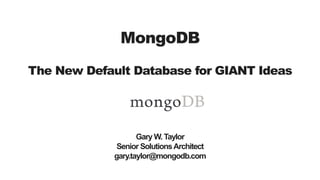
MongoDB
The New Default Database for GIANT Ideas
Gary W.Taylor
Senior SolutionsArchitect
gary.taylor@mongodb.com
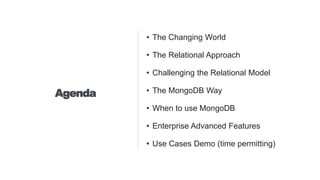
Agenda
• The Changing World
• The Relational Approach
• Challenging the Relational Model
• The MongoDB Way
• When to use MongoDB
• Enterprise Advanced Features
• Use Cases Demo (time permitting)
The Changing World
Remember these?
Or these?
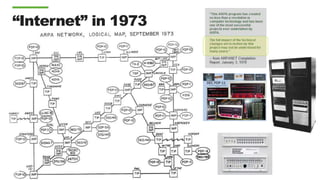
“Internet” in 1973
Internet Today
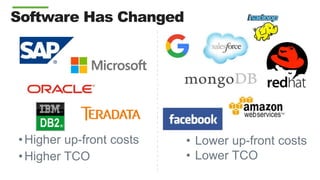
Software Has Changed
•Higher up-front costs
•Higher TCO
• Lower up-front costs
• Lower TCO
Data Has Changed
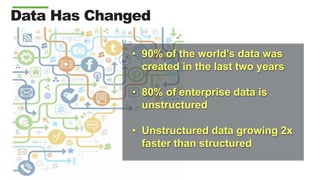
• 90% of the world’s data was
created in the last two years
• 80% of enterprise data is
unstructured
• Unstructured data growing 2x
faster than structured
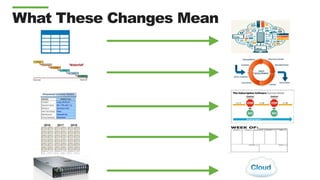
What These Changes Mean
YEARS
ITERATIVE
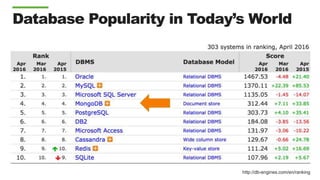
Database Popularity in Today’s World
http://db-engines.com/en/ranking
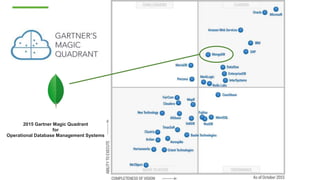
2015 Gartner Magic Quadrant
for
Operational Database Management Systems
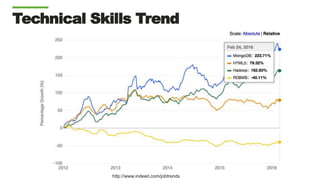
Technical Skills Trend
http://www.indeed.com/jobtrends
The Relational Approach
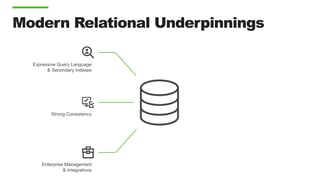
Modern Relational Underpinnings
Expressive Query Language
& Secondary Indexes
Strong Consistency
Enterprise Management
& Integrations
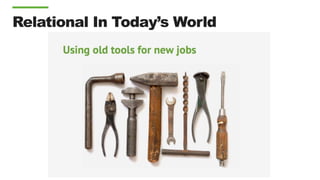
Relational In Today’s World
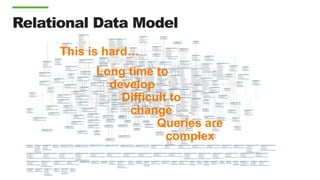
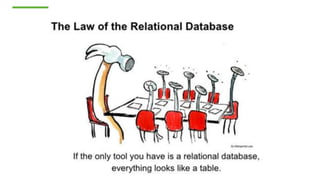
Relational Data Model
This is hard…
Long time to
develop
Queries are
complex
Difficult to
change
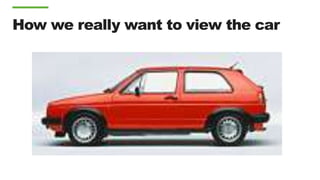
Car – A Relational View
How we really want to view the car
Challenging the Relational
Model
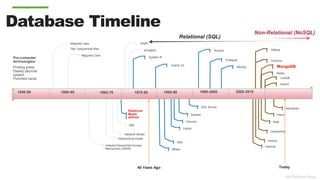
Database Timeline
Magnetic tape
“flat” (sequential) files
Pre-computer
technologies:
Printing press
Dewey decimal
system
Punched cards
Magnetic Disk
IMS
Relational
Model
defined
Indexed-Sequential Access
Mechanism (ISAM)
Network Model
IDMS
ADABAS
System R
Oracle V2
Ingres
dBase
DB2
Informix
Sybase
SQL Server
Access
Postgres
MySQL
Cassandra
Hadoop
Vertica
Riak
HBase
Dynamo
MongoDB
Redis
VoltDB
Hana
Neo4J
Aerospike
Hierarchical model
1960-701940-50 1950-60 1970-80 1980-90 1990-2000 2000-2010
Dell Software Group
40 Years Ago Today
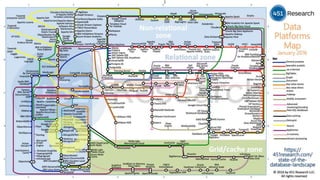
Relational (SQL)
Non-Relational (NoSQL)
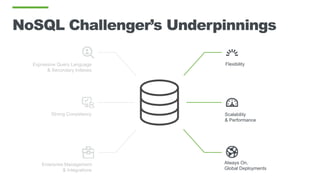
NoSQL Challenger’s Underpinnings
Scalability
& Performance
Always On,
Global Deployments
FlexibilityExpressive Query Language
& Secondary Indexes
Strong Consistency
Enterprise Management
& Integrations
The MongoDB Way
What’s MongoDB? (short version)
• MongoDB (from “humongous”) is a full-featured scalable, high-performance and
developer friendly open source document-oriented database.
• Instead of storing your data in tables and rows as you would with a relational database, in
MongoDB you store JSON-like documents with dynamic schemas.
• MongoDB bridges the gap between key-value stores (which are fast and
scalable) and relational databases (which have rich functionality).
• Using BSON (binary JSON), developers can easily map to modern object-oriented languages
without a complicated ORM layer.
• This new data model simplifies coding significantly, and also improves performance by
grouping relevant data together internally.
What’s MongoDB for
•We’re for modern, mission-critical and
the previously impossible
•We’re for #GIANTideas
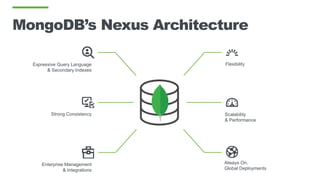
MongoDB’s Nexus Architecture
Scalability
& Performance
Always On,
Global Deployments
FlexibilityExpressive Query Language
& Secondary Indexes
Strong Consistency
Enterprise Management
& Integrations
{
first_name: "Paul",
surname: "Miller",
cell: 447557505611,
city: "London",
{
"type": "Point”, "location”: [-
0.145280,51.510907]
},
Profession: ["banking", "finance",
"trader"],
cars: [
{ model: "Bentley",
year: 1973,
value: 100000, … },
{ model: "Rolls Royce",
year: 1965,
value: 330000, … }
]
}
MongoDB
Document Model
RDBMS
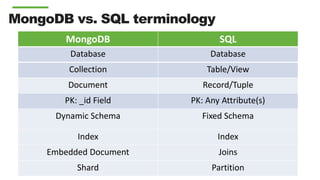
MongoDB vs. SQL terminology
MongoDB SQL
Database Database
Collection Table/View
Document Record/Tuple
PK: _id Field PK: Any Attribute(s)
Dynamic Schema Fixed Schema
Index Index
Embedded Document Joins
Shard Partition
Documents are Rich Data Structures{
first_name: "Paul",
surname: "Miller",
cell: 447557505611,
city: "London",
loc: {
"type": "Point”, ”coordinates”: [-0.145280,51.510907]
},
Profession: ["banking", "finance", "trader"],
cars: [
{ model: "Bentley",
year: 1973,
value: 100000, … },
{ model: "Rolls Royce",
year: 1965,
value: 330000, … }
]
}
Fields can contain an array of sub-
documents
Fields
Typed field values
Fields can contain
arrays
Document Model Benefits
{
first_name: "Paul",
surname: "Miller",
cell: 447557505611,
city: "London",
loc: {
"type": "Point”, ”coordinates”: [-
0.145280,51.510907]
},
Profession: ["banking", "finance", "trader"],
cars: [
{ model: "Bentley",
year: 1973,
value: 100000, … },
{ model: "Rolls Royce",
year: 1965,
value: 330000, … }
]
}
Agility and flexibility
Data model supports business change
Rapidly iterate to meet new requirements
Intuitive, natural data representation
Eliminates ORM layer
Developers are more productive
Reduces the need for joins, disk seeks
Programming is simpler
Performance delivered at scale
Dynamic Schema (polymorphic)
{
policyNum: 123,
type: “auto”,
customerId: “abc”,
payment: 1200,
deductible: 500,
make: “Taurus”,
model: “Ford”,
VIN: “123ABC456”,
miles_driven_yr: 15000,
start: “jan, 2016”,
end: “jul, 2016”
}
Insurance Policy Collection
{
policyNum: 456,
type: “life”,
customerId: “efg”,
payment: 240,
policyValue: 125000,
smoker: “no”,
beneficiaries: [
{spouse: “jane”, percent:
80},
{child: “jack”, percent: 20}
],
start: “jan, 2016”,
end: “jul, 2016”
}
{
policyNum: 789,
type: “home”,
customerId: “hij”,
payment: 2300,
deductible: 1000,
square_footage: 3000,
floodCoverage: “no”,
street: “10 Maple Lane”,
city: “Springfield”,
state: “Maryland”,
start: “jan, 2016”,
end: “jul, 2016”
}
Rich
Queries
• Find Paul’s cars
• Find everybody in London with a car built
between 1970 and 1980
db.vehicles.find({
first_name: “Paul”
})
db.vehicles.find({
city: “London”,
“cars.year” : {
$gte : 1970,
$lte : 1980
}
})
{
first_name: "Paul",
surname: "Miller",
cell: 447557505611,
city: "London",
loc: {
"type": "Point”, ”coordinates”: [-
0.145280,51.510907]
},
Profession: ["banking", "finance",
"trader"],
cars: [
{ model: "Bentley",
year: 1973,
value: 100000, … },
{ model: "Rolls Royce",
year: 1965,
value: 330000, … }
]
}
Fully Featured .
Geospatial
• Find all of the car owners within 5 miles of
Trafalgar Square
{
first_name: "Paul",
surname: "Miller",
cell: 447557505611,
city: "London",
loc: {
"type": "Point”, ”coordinates”:
[-0.145280,51.510907]
},
Profession: ["banking",
"finance", "trader"],
cars: [
{ model: "Bentley",
year: 1973,
value: 100000, … },
{ model: "Rolls Royce",
year: 1965,
value: 330000, … }
]
}
var milesToRadian = function(miles) {
var earthRadiusInMiles = 3963.2;
return miles / earthRadiusInMiles;
};
var landmark = db.landmarks.findOne({name: ”Trafalgar Square"});
var query = {
"loc" : {
$geoWithin : {
$centerSphere : [landmark.loc.coordinates, milesToRadian(5) ]
}
}
};
// Query points.
db.vehicles.find(query).pretty();
Fully Featured ..
Fully Featured ...
Text Search
• Find all the cars with ‘leather seats’ in their
description
Aggregation
• Calculate average value of every owner’s car
collection & show the top 10 sorted
descending by average value
{
first_name: "Paul",
surname: "Miller",
cell: 447557505611,
city: "London",
loc: {
"type": "Point”, ”coordinates”:
[-0.145280,51.510907]
},
Profession: ["banking",
"finance", "trader"],
cars: [
{ model: "Bentley",
year: 1973,
value: 100000, … },
{ model: "Rolls Royce",
year: 1965,
value: 330000, … }
]
}
Native Binary
JSON Support
• Add other vehicle classes (boats,
motorcycles) to Paul’s vehicle collection.
Left Outer Join
($lookup)
• Query for Paul’s cell # and lookup all calls
made in the last 30 days.
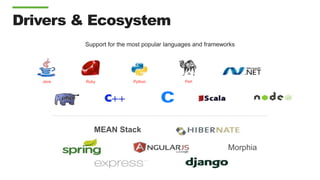
Morphia
MEAN Stack
Java Python PerlRuby
Support for the most popular languages and frameworks
Drivers & Ecosystem
When To Use MongoDB
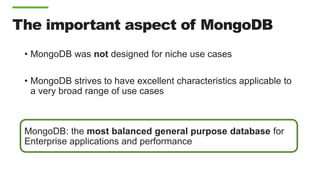
The important aspect of MongoDB
• MongoDB was not designed for niche use cases
• MongoDB strives to have excellent characteristics applicable to
a very broad range of use cases
MongoDB: the most balanced general purpose database for
Enterprise applications and performance
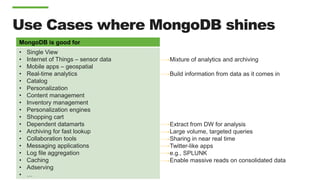
MongoDB is good for
• Single View
• Internet of Things – sensor data
• Mobile apps – geospatial
• Real-time analytics
• Catalog
• Personalization
• Content management
• Inventory management
• Personalization engines
• Shopping cart
• Dependent datamarts
• Archiving for fast lookup
• Collaboration tools
• Messaging applications
• Log file aggregation
• Caching
• Adserving
• …
Use Cases where MongoDB shines
Mixture of analytics and archiving
Build information from data as it comes in
Extract from DW for analysis
Large volume, targeted queries
Sharing in near real time
Twitter-like apps
e.g., SPLUNK
Enable massive reads on consolidated data
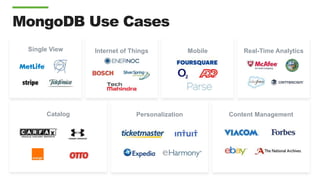
MongoDB Use Cases
Single View Internet of Things Mobile Real-Time Analytics
Catalog Personalization Content Management
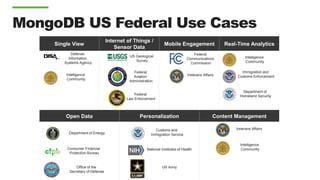
Single View
Internet of Things /
Sensor Data
Mobile Engagement Real-Time Analytics
Open Data Personalization Content Management
Department of Energy
Customs and
Immigration Service
Veterans Affairs
Intelligence
Community
Immigration and
Customs Enforcement
Federal
Communications
Commission
Intelligence
Community
US Geological
Survey
Department of
Homeland Security
Defense
Information
Systems Agency
Federal
Aviation
Administration
Intelligence
Community
National Institutes of HealthConsumer Financial
Protection Bureau
Federal
Law Enforcement
Veterans Affairs
US ArmyOffice of the
Secretary of Defense
MongoDB US Federal Use Cases
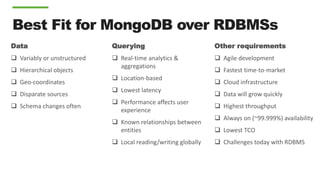
Best Fit for MongoDB over RDBMSs
Data
 Variably or unstructured
 Hierarchical objects
 Geo-coordinates
 Disparate sources
 Schema changes often
Querying
 Real-time analytics &
aggregations
 Location-based
 Lowest latency
 Performance affects user
experience
 Known relationships between
entities
 Local reading/writing globally
Other requirements
 Agile development
 Fastest time-to-market
 Cloud infrastructure
 Data will grow quickly
 Highest throughput
 Always on (~99.999%) availability
 Lowest TCO
 Challenges today with RDBMS
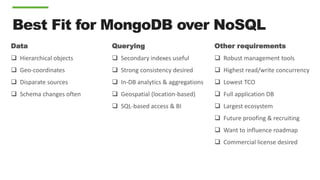
Best Fit for MongoDB over NoSQL
Data
 Hierarchical objects
 Geo-coordinates
 Disparate sources
 Schema changes often
Querying
 Secondary indexes useful
 Strong consistency desired
 In-DB analytics & aggregations
 Geospatial (location-based)
 SQL-based access & BI
Other requirements
 Robust management tools
 Highest read/write concurrency
 Lowest TCO
 Full application DB
 Largest ecosystem
 Future proofing & recruiting
 Want to influence roadmap
 Commercial license desired
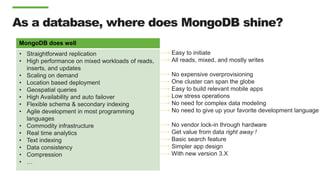
MongoDB does well
• Straightforward replication
• High performance on mixed workloads of reads,
inserts, and updates
• Scaling on demand
• Location based deployment
• Geospatial queries
• High Availability and auto failover
• Flexible schema & secondary indexing
• Agile development in most programming
languages
• Commodity infrastructure
• Real time analytics
• Text indexing
• Data consistency
• Compression
• …
As a database, where does MongoDB shine?
Easy to initiate
All reads, mixed, and mostly writes
No expensive overprovisioning
One cluster can span the globe
Easy to build relevant mobile apps
Low stress operations
No need for complex data modeling
No need to give up your favorite development language
No vendor lock-in through hardware
Get value from data right away !
Basic search feature
Simpler app design
With new version 3.X
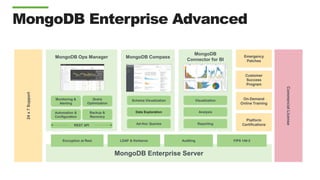
Enterprise Advanced
Features
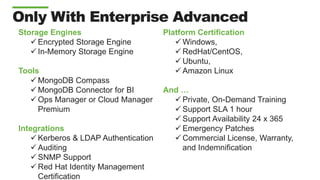
Only With Enterprise Advanced
Storage Engines
 Encrypted Storage Engine
 In-Memory Storage Engine
Tools
 MongoDB Compass
 MongoDB Connector for BI
 Ops Manager or Cloud Manager
Premium
Integrations
 Kerberos & LDAP Authentication
 Auditing
 SNMP Support
 Red Hat Identity Management
Certification
Platform Certification
 Windows,
 RedHat/CentOS,
 Ubuntu,
 Amazon Linux
And …
 Private, On-Demand Training
 Support SLA 1 hour
 Support Availability 24 x 365
 Emergency Patches
 Commercial License, Warranty,
and Indemnification
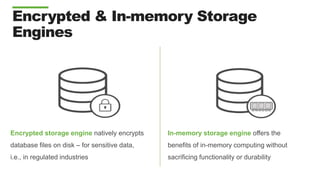
Encrypted & In-memory Storage
Engines
In-memory storage engine offers the
benefits of in-memory computing without
sacrificing functionality or durability
Encrypted storage engine natively encrypts
database files on disk – for sensitive data,
i.e., in regulated industries
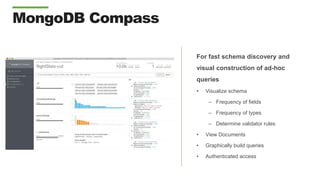
MongoDB Compass
For fast schema discovery and
visual construction of ad-hoc
queries
• Visualize schema
– Frequency of fields
– Frequency of types
– Determine validator rules
• View Documents
• Graphically build queries
• Authenticated access
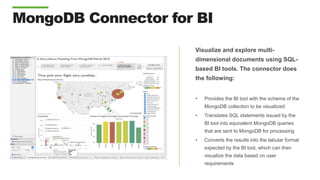
MongoDB Connector for BI
Visualize and explore multi-
dimensional documents using SQL-
based BI tools. The connector does
the following:
• Provides the BI tool with the schema of the
MongoDB collection to be visualized
• Translates SQL statements issued by the
BI tool into equivalent MongoDB queries
that are sent to MongoDB for processing
• Converts the results into the tabular format
expected by the BI tool, which can then
visualize the data based on user
requirements
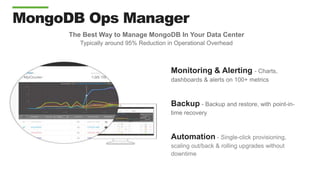
Monitoring & Alerting - Charts,
dashboards & alerts on 100+ metrics
Backup - Backup and restore, with point-in-
time recovery
Automation - Single-click provisioning,
scaling out/back & rolling upgrades without
downtime
MongoDB Ops Manager
The Best Way to Manage MongoDB In Your Data Center
Typically around 95% Reduction in Operational Overhead
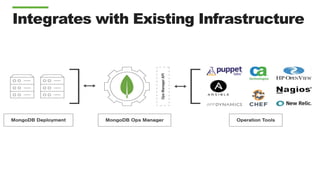
Integrates with Existing Infrastructure
MongoDB Enterprise Server
MongoDB Enterprise Advanced24x7Support
CommercialLicense
Platform
Certifications
Emergency
Patches
On-Demand
Online Training
Customer
Success
Program
MongoDB CompassMongoDB Ops Manager
Monitoring &
Alerting
Query
Optimization
Backup &
Recovery
Automation &
Configuration
Schema Visualization
Data Exploration
Ad-Hoc Queries
MongoDB
Connector for BI
Visualization
Analysis
Reporting
LDAP & Kerberos Auditing FIPS 140-2Encryption at Rest
REST API
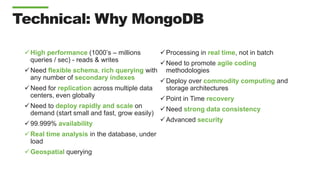
Technical: Why MongoDB
High performance (1000’s – millions
queries / sec) - reads & writes
Need flexible schema, rich querying with
any number of secondary indexes
Need for replication across multiple data
centers, even globally
Need to deploy rapidly and scale on
demand (start small and fast, grow easily)
99.999% availability
Real time analysis in the database, under
load
Geospatial querying
Processing in real time, not in batch
Need to promote agile coding
methodologies
Deploy over commodity computing and
storage architectures
Point in Time recovery
Need strong data consistency
Advanced security
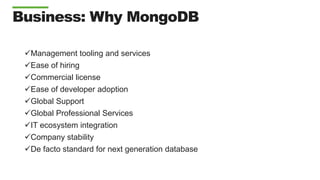
Business: Why MongoDB
Management tooling and services
Ease of hiring
Commercial license
Ease of developer adoption
Global Support
Global Professional Services
IT ecosystem integration
Company stability
De facto standard for next generation database
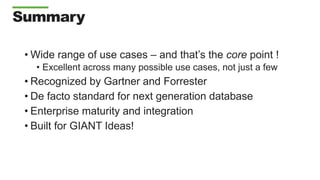
Summary
• Wide range of use cases – and that’s the core point !
• Excellent across many possible use cases, not just a few
• Recognized by Gartner and Forrester
• De facto standard for next generation database
• Enterprise maturity and integration
• Built for GIANT Ideas!
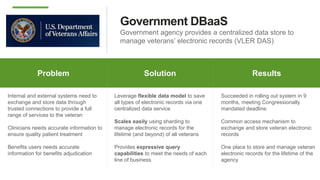
Government DBaaS
Government agency provides a centralized data store to
manage veterans’ electronic records (VLER DAS)
Problem Why MongoDB ResultsProblem Solution Results
Internal and external systems need to
exchange and store data through
trusted connections to provide a full
range of services to the veteran
Clinicians needs accurate information to
ensure quality patient treatment
Benefits users needs accurate
information for benefits adjudication
Leverage flexible data model to save
all types of electronic records via one
centralized data service
Scales easily using sharding to
manage electronic records for the
lifetime (and beyond) of all veterans
Provides expressive query
capabilities to meet the needs of each
line of business
Succeeded in rolling out system in 9
months, meeting Congressionally
mandated deadline
Common access mechanism to
exchange and store veteran electronic
records
One place to store and manage veteran
electronic records for the lifetime of the
agency
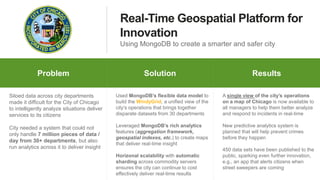
Real-Time Geospatial Platform for
Innovation
Using MongoDB to create a smarter and safer city
Problem Why MongoDB ResultsProblem Solution Results
Siloed data across city departments
made it difficult for the City of Chicago
to intelligently analyze situations deliver
services to its citizens
City needed a system that could not
only handle 7 million pieces of data /
day from 30+ departments, but also
run analytics across it to deliver insight
Used MongoDB’s flexible data model to
build the WindyGrid, a unified view of the
city’s operations that brings together
disparate datasets from 30 departments
Leveraged MongoDB’s rich analytics
features (aggregation framework,
geospatial indexes, etc.) to create maps
that deliver real-time insight
Horizonal scalability with automatic
sharding across commodity servers
ensures the city can continue to cost
effectively deliver real-time results
A single view of the city’s operations
on a map of Chicago is now available to
all managers to help them better analyze
and respond to incidents in real-time
New predictive analytics system is
planned that will help prevent crimes
before they happen
450 data sets have been published to the
public, sparking even further innovation,
e.g., an app that alerts citizens when
street sweepers are coming
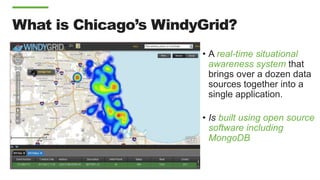
What is Chicago’s WindyGrid?
• A real-time situational
awareness system that
brings over a dozen data
sources together into a
single application.
• Is built using open source
software including
MongoDB
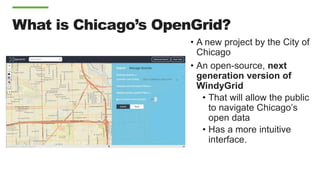
What is Chicago’s OpenGrid?
• A new project by the City of
Chicago
• An open-source, next
generation version of
WindyGrid
• That will allow the public
to navigate Chicago’s
open data
• Has a more intuitive
interface.
DEMO
http://opengrid.io/

MongoDB Evenings DC: MongoDB - The New Default Database for Giant Ideas

  • 1.
    Tweet tonight using#MongoDB to be entered to win a t-shirt!
  • 2.
    Welcome to MongoDBEvenings DC! Agenda 6:00pm: Pizza, Beer & Soft Drinks 6:30pm: Welcome Andrew Lockman, Enterprise Account Executive, MongoDB 6:40pm: MongoDB: The New Default Database for Giant Ideas Gary Taylor, Senior Solutions Architect, MongoDB 7:30pm: Get MEAN and Lean with Docker and Kubernetes Vadim Polyakov, Director of Enterprise Architecture, Inovalon 8:15pm: Announcements Q&A #MongoDB @1776
  • 3.
    MongoDB World Pre-conference training:June 27th Conference: June 28th-29th Hilton Midtown 1335 6th Avenue New York, NY 10019
  • 4.
  • 5.
  • 6.
    Code “AndrewLockman” gets25% off Early Bird Registration Ends May 13, 2016 June 29 - 29, 2016 New York, NY www.mongodbworld.com
  • 7.
    MongoDB The New DefaultDatabase for GIANT Ideas Gary W.Taylor Senior SolutionsArchitect gary.taylor@mongodb.com
  • 8.
    Agenda • The ChangingWorld • The Relational Approach • Challenging the Relational Model • The MongoDB Way • When to use MongoDB • Enterprise Advanced Features • Use Cases Demo (time permitting)
  • 9.
  • 10.
  • 11.
  • 12.
  • 13.
  • 14.
    Software Has Changed •Higherup-front costs •Higher TCO • Lower up-front costs • Lower TCO
  • 15.
    Data Has Changed •90% of the world’s data was created in the last two years • 80% of enterprise data is unstructured • Unstructured data growing 2x faster than structured
  • 16.
    What These ChangesMean YEARS ITERATIVE
  • 17.
    Database Popularity inToday’s World http://db-engines.com/en/ranking
  • 18.
    2015 Gartner MagicQuadrant for Operational Database Management Systems
  • 19.
  • 20.
  • 21.
    Modern Relational Underpinnings ExpressiveQuery Language & Secondary Indexes Strong Consistency Enterprise Management & Integrations
  • 22.
  • 23.
    Relational Data Model Thisis hard… Long time to develop Queries are complex Difficult to change
  • 25.
    Car – ARelational View
  • 26.
    How we reallywant to view the car
  • 27.
  • 29.
    Database Timeline Magnetic tape “flat”(sequential) files Pre-computer technologies: Printing press Dewey decimal system Punched cards Magnetic Disk IMS Relational Model defined Indexed-Sequential Access Mechanism (ISAM) Network Model IDMS ADABAS System R Oracle V2 Ingres dBase DB2 Informix Sybase SQL Server Access Postgres MySQL Cassandra Hadoop Vertica Riak HBase Dynamo MongoDB Redis VoltDB Hana Neo4J Aerospike Hierarchical model 1960-701940-50 1950-60 1970-80 1980-90 1990-2000 2000-2010 Dell Software Group 40 Years Ago Today Relational (SQL) Non-Relational (NoSQL)
  • 31.
    NoSQL Challenger’s Underpinnings Scalability &Performance Always On, Global Deployments FlexibilityExpressive Query Language & Secondary Indexes Strong Consistency Enterprise Management & Integrations
  • 32.
  • 33.
    What’s MongoDB? (shortversion) • MongoDB (from “humongous”) is a full-featured scalable, high-performance and developer friendly open source document-oriented database. • Instead of storing your data in tables and rows as you would with a relational database, in MongoDB you store JSON-like documents with dynamic schemas. • MongoDB bridges the gap between key-value stores (which are fast and scalable) and relational databases (which have rich functionality). • Using BSON (binary JSON), developers can easily map to modern object-oriented languages without a complicated ORM layer. • This new data model simplifies coding significantly, and also improves performance by grouping relevant data together internally.
  • 34.
    What’s MongoDB for •We’refor modern, mission-critical and the previously impossible •We’re for #GIANTideas
  • 35.
    MongoDB’s Nexus Architecture Scalability &Performance Always On, Global Deployments FlexibilityExpressive Query Language & Secondary Indexes Strong Consistency Enterprise Management & Integrations
  • 36.
    { first_name: "Paul", surname: "Miller", cell:447557505611, city: "London", { "type": "Point”, "location”: [- 0.145280,51.510907] }, Profession: ["banking", "finance", "trader"], cars: [ { model: "Bentley", year: 1973, value: 100000, … }, { model: "Rolls Royce", year: 1965, value: 330000, … } ] } MongoDB Document Model RDBMS
  • 37.
    MongoDB vs. SQLterminology MongoDB SQL Database Database Collection Table/View Document Record/Tuple PK: _id Field PK: Any Attribute(s) Dynamic Schema Fixed Schema Index Index Embedded Document Joins Shard Partition
  • 38.
    Documents are RichData Structures{ first_name: "Paul", surname: "Miller", cell: 447557505611, city: "London", loc: { "type": "Point”, ”coordinates”: [-0.145280,51.510907] }, Profession: ["banking", "finance", "trader"], cars: [ { model: "Bentley", year: 1973, value: 100000, … }, { model: "Rolls Royce", year: 1965, value: 330000, … } ] } Fields can contain an array of sub- documents Fields Typed field values Fields can contain arrays
  • 39.
    Document Model Benefits { first_name:"Paul", surname: "Miller", cell: 447557505611, city: "London", loc: { "type": "Point”, ”coordinates”: [- 0.145280,51.510907] }, Profession: ["banking", "finance", "trader"], cars: [ { model: "Bentley", year: 1973, value: 100000, … }, { model: "Rolls Royce", year: 1965, value: 330000, … } ] } Agility and flexibility Data model supports business change Rapidly iterate to meet new requirements Intuitive, natural data representation Eliminates ORM layer Developers are more productive Reduces the need for joins, disk seeks Programming is simpler Performance delivered at scale
  • 40.
    Dynamic Schema (polymorphic) { policyNum:123, type: “auto”, customerId: “abc”, payment: 1200, deductible: 500, make: “Taurus”, model: “Ford”, VIN: “123ABC456”, miles_driven_yr: 15000, start: “jan, 2016”, end: “jul, 2016” } Insurance Policy Collection { policyNum: 456, type: “life”, customerId: “efg”, payment: 240, policyValue: 125000, smoker: “no”, beneficiaries: [ {spouse: “jane”, percent: 80}, {child: “jack”, percent: 20} ], start: “jan, 2016”, end: “jul, 2016” } { policyNum: 789, type: “home”, customerId: “hij”, payment: 2300, deductible: 1000, square_footage: 3000, floodCoverage: “no”, street: “10 Maple Lane”, city: “Springfield”, state: “Maryland”, start: “jan, 2016”, end: “jul, 2016” }
  • 41.
    Rich Queries • Find Paul’scars • Find everybody in London with a car built between 1970 and 1980 db.vehicles.find({ first_name: “Paul” }) db.vehicles.find({ city: “London”, “cars.year” : { $gte : 1970, $lte : 1980 } }) { first_name: "Paul", surname: "Miller", cell: 447557505611, city: "London", loc: { "type": "Point”, ”coordinates”: [- 0.145280,51.510907] }, Profession: ["banking", "finance", "trader"], cars: [ { model: "Bentley", year: 1973, value: 100000, … }, { model: "Rolls Royce", year: 1965, value: 330000, … } ] } Fully Featured .
  • 42.
    Geospatial • Find allof the car owners within 5 miles of Trafalgar Square { first_name: "Paul", surname: "Miller", cell: 447557505611, city: "London", loc: { "type": "Point”, ”coordinates”: [-0.145280,51.510907] }, Profession: ["banking", "finance", "trader"], cars: [ { model: "Bentley", year: 1973, value: 100000, … }, { model: "Rolls Royce", year: 1965, value: 330000, … } ] } var milesToRadian = function(miles) { var earthRadiusInMiles = 3963.2; return miles / earthRadiusInMiles; }; var landmark = db.landmarks.findOne({name: ”Trafalgar Square"}); var query = { "loc" : { $geoWithin : { $centerSphere : [landmark.loc.coordinates, milesToRadian(5) ] } } }; // Query points. db.vehicles.find(query).pretty(); Fully Featured ..
  • 43.
    Fully Featured ... TextSearch • Find all the cars with ‘leather seats’ in their description Aggregation • Calculate average value of every owner’s car collection & show the top 10 sorted descending by average value { first_name: "Paul", surname: "Miller", cell: 447557505611, city: "London", loc: { "type": "Point”, ”coordinates”: [-0.145280,51.510907] }, Profession: ["banking", "finance", "trader"], cars: [ { model: "Bentley", year: 1973, value: 100000, … }, { model: "Rolls Royce", year: 1965, value: 330000, … } ] } Native Binary JSON Support • Add other vehicle classes (boats, motorcycles) to Paul’s vehicle collection. Left Outer Join ($lookup) • Query for Paul’s cell # and lookup all calls made in the last 30 days.
  • 44.
    Morphia MEAN Stack Java PythonPerlRuby Support for the most popular languages and frameworks Drivers & Ecosystem
  • 45.
    When To UseMongoDB
  • 46.
    The important aspectof MongoDB • MongoDB was not designed for niche use cases • MongoDB strives to have excellent characteristics applicable to a very broad range of use cases MongoDB: the most balanced general purpose database for Enterprise applications and performance
  • 47.
    MongoDB is goodfor • Single View • Internet of Things – sensor data • Mobile apps – geospatial • Real-time analytics • Catalog • Personalization • Content management • Inventory management • Personalization engines • Shopping cart • Dependent datamarts • Archiving for fast lookup • Collaboration tools • Messaging applications • Log file aggregation • Caching • Adserving • … Use Cases where MongoDB shines Mixture of analytics and archiving Build information from data as it comes in Extract from DW for analysis Large volume, targeted queries Sharing in near real time Twitter-like apps e.g., SPLUNK Enable massive reads on consolidated data
  • 48.
    MongoDB Use Cases SingleView Internet of Things Mobile Real-Time Analytics Catalog Personalization Content Management
  • 49.
    Single View Internet ofThings / Sensor Data Mobile Engagement Real-Time Analytics Open Data Personalization Content Management Department of Energy Customs and Immigration Service Veterans Affairs Intelligence Community Immigration and Customs Enforcement Federal Communications Commission Intelligence Community US Geological Survey Department of Homeland Security Defense Information Systems Agency Federal Aviation Administration Intelligence Community National Institutes of HealthConsumer Financial Protection Bureau Federal Law Enforcement Veterans Affairs US ArmyOffice of the Secretary of Defense MongoDB US Federal Use Cases
  • 50.
    Best Fit forMongoDB over RDBMSs Data  Variably or unstructured  Hierarchical objects  Geo-coordinates  Disparate sources  Schema changes often Querying  Real-time analytics & aggregations  Location-based  Lowest latency  Performance affects user experience  Known relationships between entities  Local reading/writing globally Other requirements  Agile development  Fastest time-to-market  Cloud infrastructure  Data will grow quickly  Highest throughput  Always on (~99.999%) availability  Lowest TCO  Challenges today with RDBMS
  • 51.
    Best Fit forMongoDB over NoSQL Data  Hierarchical objects  Geo-coordinates  Disparate sources  Schema changes often Querying  Secondary indexes useful  Strong consistency desired  In-DB analytics & aggregations  Geospatial (location-based)  SQL-based access & BI Other requirements  Robust management tools  Highest read/write concurrency  Lowest TCO  Full application DB  Largest ecosystem  Future proofing & recruiting  Want to influence roadmap  Commercial license desired
  • 52.
    MongoDB does well •Straightforward replication • High performance on mixed workloads of reads, inserts, and updates • Scaling on demand • Location based deployment • Geospatial queries • High Availability and auto failover • Flexible schema & secondary indexing • Agile development in most programming languages • Commodity infrastructure • Real time analytics • Text indexing • Data consistency • Compression • … As a database, where does MongoDB shine? Easy to initiate All reads, mixed, and mostly writes No expensive overprovisioning One cluster can span the globe Easy to build relevant mobile apps Low stress operations No need for complex data modeling No need to give up your favorite development language No vendor lock-in through hardware Get value from data right away ! Basic search feature Simpler app design With new version 3.X
  • 53.
  • 54.
    Only With EnterpriseAdvanced Storage Engines  Encrypted Storage Engine  In-Memory Storage Engine Tools  MongoDB Compass  MongoDB Connector for BI  Ops Manager or Cloud Manager Premium Integrations  Kerberos & LDAP Authentication  Auditing  SNMP Support  Red Hat Identity Management Certification Platform Certification  Windows,  RedHat/CentOS,  Ubuntu,  Amazon Linux And …  Private, On-Demand Training  Support SLA 1 hour  Support Availability 24 x 365  Emergency Patches  Commercial License, Warranty, and Indemnification
  • 55.
    Encrypted & In-memoryStorage Engines In-memory storage engine offers the benefits of in-memory computing without sacrificing functionality or durability Encrypted storage engine natively encrypts database files on disk – for sensitive data, i.e., in regulated industries
  • 56.
    MongoDB Compass For fastschema discovery and visual construction of ad-hoc queries • Visualize schema – Frequency of fields – Frequency of types – Determine validator rules • View Documents • Graphically build queries • Authenticated access
  • 57.
    MongoDB Connector forBI Visualize and explore multi- dimensional documents using SQL- based BI tools. The connector does the following: • Provides the BI tool with the schema of the MongoDB collection to be visualized • Translates SQL statements issued by the BI tool into equivalent MongoDB queries that are sent to MongoDB for processing • Converts the results into the tabular format expected by the BI tool, which can then visualize the data based on user requirements
  • 58.
    Monitoring & Alerting- Charts, dashboards & alerts on 100+ metrics Backup - Backup and restore, with point-in- time recovery Automation - Single-click provisioning, scaling out/back & rolling upgrades without downtime MongoDB Ops Manager The Best Way to Manage MongoDB In Your Data Center Typically around 95% Reduction in Operational Overhead
  • 59.
  • 60.
    MongoDB Enterprise Server MongoDBEnterprise Advanced24x7Support CommercialLicense Platform Certifications Emergency Patches On-Demand Online Training Customer Success Program MongoDB CompassMongoDB Ops Manager Monitoring & Alerting Query Optimization Backup & Recovery Automation & Configuration Schema Visualization Data Exploration Ad-Hoc Queries MongoDB Connector for BI Visualization Analysis Reporting LDAP & Kerberos Auditing FIPS 140-2Encryption at Rest REST API
  • 61.
    Technical: Why MongoDB Highperformance (1000’s – millions queries / sec) - reads & writes Need flexible schema, rich querying with any number of secondary indexes Need for replication across multiple data centers, even globally Need to deploy rapidly and scale on demand (start small and fast, grow easily) 99.999% availability Real time analysis in the database, under load Geospatial querying Processing in real time, not in batch Need to promote agile coding methodologies Deploy over commodity computing and storage architectures Point in Time recovery Need strong data consistency Advanced security
  • 62.
    Business: Why MongoDB Managementtooling and services Ease of hiring Commercial license Ease of developer adoption Global Support Global Professional Services IT ecosystem integration Company stability De facto standard for next generation database
  • 63.
    Summary • Wide rangeof use cases – and that’s the core point ! • Excellent across many possible use cases, not just a few • Recognized by Gartner and Forrester • De facto standard for next generation database • Enterprise maturity and integration • Built for GIANT Ideas!
  • 65.
    Government DBaaS Government agencyprovides a centralized data store to manage veterans’ electronic records (VLER DAS) Problem Why MongoDB ResultsProblem Solution Results Internal and external systems need to exchange and store data through trusted connections to provide a full range of services to the veteran Clinicians needs accurate information to ensure quality patient treatment Benefits users needs accurate information for benefits adjudication Leverage flexible data model to save all types of electronic records via one centralized data service Scales easily using sharding to manage electronic records for the lifetime (and beyond) of all veterans Provides expressive query capabilities to meet the needs of each line of business Succeeded in rolling out system in 9 months, meeting Congressionally mandated deadline Common access mechanism to exchange and store veteran electronic records One place to store and manage veteran electronic records for the lifetime of the agency
  • 66.
    Real-Time Geospatial Platformfor Innovation Using MongoDB to create a smarter and safer city Problem Why MongoDB ResultsProblem Solution Results Siloed data across city departments made it difficult for the City of Chicago to intelligently analyze situations deliver services to its citizens City needed a system that could not only handle 7 million pieces of data / day from 30+ departments, but also run analytics across it to deliver insight Used MongoDB’s flexible data model to build the WindyGrid, a unified view of the city’s operations that brings together disparate datasets from 30 departments Leveraged MongoDB’s rich analytics features (aggregation framework, geospatial indexes, etc.) to create maps that deliver real-time insight Horizonal scalability with automatic sharding across commodity servers ensures the city can continue to cost effectively deliver real-time results A single view of the city’s operations on a map of Chicago is now available to all managers to help them better analyze and respond to incidents in real-time New predictive analytics system is planned that will help prevent crimes before they happen 450 data sets have been published to the public, sparking even further innovation, e.g., an app that alerts citizens when street sweepers are coming
  • 67.
    What is Chicago’sWindyGrid? • A real-time situational awareness system that brings over a dozen data sources together into a single application. • Is built using open source software including MongoDB
  • 68.
    What is Chicago’sOpenGrid? • A new project by the City of Chicago • An open-source, next generation version of WindyGrid • That will allow the public to navigate Chicago’s open data • Has a more intuitive interface.
  • 71.