An Overview on Budget
2017 - 2018
A presentation by Ananya Sree Katta
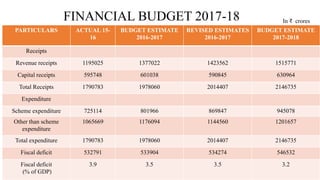
PARTICULARS ACTUAL 15-
16
BUDGET ESTIMATE
2016-2017
REVISED ESTIMATES
2016-2017
BUDGET ESTIMATE
2017-2018
Receipts
Revenue receipts 1195025 1377022 1423562 1515771
Capital receipts 595748 601038 590845 630964
Total Receipts 1790783 1978060 2014407 2146735
Expenditure
Scheme expenditure 725114 801966 869847 945078
Other than scheme
expenditure
1065669 1176094 1144560 1201657
Total expenditure 1790783 1978060 2014407 2146735
Fiscal deficit 532791 533904 534274 546532
Fiscal deficit
(% of GDP)
3.9 3.5 3.5 3.2
FINANCIAL BUDGET 2017-18 In ₹ crores
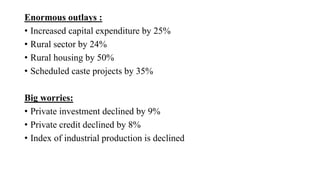
Enormous outlays :
• Increased capital expenditure by 25%
• Rural sector by 24%
• Rural housing by 50%
• Scheduled caste projects by 35%
Big worries:
• Private investment declined by 9%
• Private credit declined by 8%
• Index of industrial production is declined
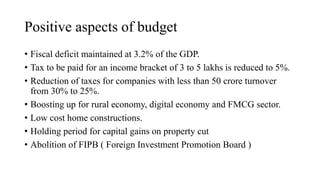
Positive aspects of budget
• Fiscal deficit maintained at 3.2% of the GDP.
• Tax to be paid for an income bracket of 3 to 5 lakhs is reduced to 5%.
• Reduction of taxes for companies with less than 50 crore turnover
from 30% to 25%.
• Boosting up for rural economy, digital economy and FMCG sector.
• Low cost home constructions.
• Holding period for capital gains on property cut
• Abolition of FIPB ( Foreign Investment Promotion Board )
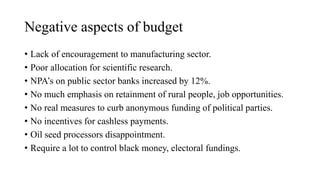
Negative aspects of budget
• Lack of encouragement to manufacturing sector.
• Poor allocation for scientific research.
• NPA’s on public sector banks increased by 12%.
• No much emphasis on retainment of rural people, job opportunities.
• No real measures to curb anonymous funding of political parties.
• No incentives for cashless payments.
• Oil seed processors disappointment.
• Require a lot to control black money, electoral fundings.
Suggestions
• Providing incentives for cash less payments.
• Implementation of RPA { Representation of People Act}
• Duty difference between crude and refined oils is required from 7.5%
to 15%.
• More allocation required for scientific research.
• Balanced budget for all sectors is required.
• Clear statistics regarding the money withdrawn through
demonetisation is to be included.
THANK YOU

Budget 2017 18

  • 1.
    An Overview onBudget 2017 - 2018 A presentation by Ananya Sree Katta
  • 2.
    PARTICULARS ACTUAL 15- 16 BUDGETESTIMATE 2016-2017 REVISED ESTIMATES 2016-2017 BUDGET ESTIMATE 2017-2018 Receipts Revenue receipts 1195025 1377022 1423562 1515771 Capital receipts 595748 601038 590845 630964 Total Receipts 1790783 1978060 2014407 2146735 Expenditure Scheme expenditure 725114 801966 869847 945078 Other than scheme expenditure 1065669 1176094 1144560 1201657 Total expenditure 1790783 1978060 2014407 2146735 Fiscal deficit 532791 533904 534274 546532 Fiscal deficit (% of GDP) 3.9 3.5 3.5 3.2 FINANCIAL BUDGET 2017-18 In ₹ crores
  • 6.
    Enormous outlays : •Increased capital expenditure by 25% • Rural sector by 24% • Rural housing by 50% • Scheduled caste projects by 35% Big worries: • Private investment declined by 9% • Private credit declined by 8% • Index of industrial production is declined
  • 7.
    Positive aspects ofbudget • Fiscal deficit maintained at 3.2% of the GDP. • Tax to be paid for an income bracket of 3 to 5 lakhs is reduced to 5%. • Reduction of taxes for companies with less than 50 crore turnover from 30% to 25%. • Boosting up for rural economy, digital economy and FMCG sector. • Low cost home constructions. • Holding period for capital gains on property cut • Abolition of FIPB ( Foreign Investment Promotion Board )
  • 8.
    Negative aspects ofbudget • Lack of encouragement to manufacturing sector. • Poor allocation for scientific research. • NPA’s on public sector banks increased by 12%. • No much emphasis on retainment of rural people, job opportunities. • No real measures to curb anonymous funding of political parties. • No incentives for cashless payments. • Oil seed processors disappointment. • Require a lot to control black money, electoral fundings.
  • 9.
    Suggestions • Providing incentivesfor cash less payments. • Implementation of RPA { Representation of People Act} • Duty difference between crude and refined oils is required from 7.5% to 15%. • More allocation required for scientific research. • Balanced budget for all sectors is required. • Clear statistics regarding the money withdrawn through demonetisation is to be included.
  • 10.