Mercy Pilkington
Monetizing and Marketing Digital Textbooks
May 21, 2014
Experience the DCL Difference
DCL blends years of conversion experience with cutting-edge technology and
the infrastructure to make the process easy and efficient.
• World-Class Services
• Leading-Edge Technology
• Unparalleled Infrastructure
• US-Based Management
• Complex-Content Expertise
• 24/7 Online Project Tracking
• Automated Quality Control
• Global Capabilities
Valuable Content Transformed
• Document Digitization
• XML and HTML Conversion
• eBook Production
• Hosted Solutions
• Big Data Automation
• Conversion Management
• Editorial Services
• Harmonizer
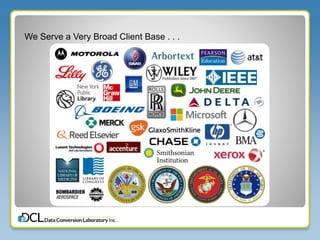
We Serve a Very Broad Client Base . . .
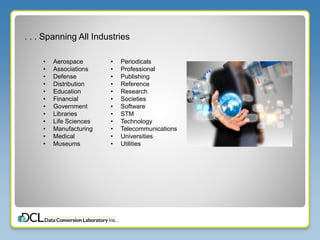
. . . Spanning All Industries
• Aerospace
• Associations
• Defense
• Distribution
• Education
• Financial
• Government
• Libraries
• Life Sciences
• Manufacturing
• Medical
• Museums
• Periodicals
• Professional
• Publishing
• Reference
• Research
• Societies
• Software
• STM
• Technology
• Telecommunications
• Universities
• Utilities
What Is a Digital Textbook?
• More than just an electronic recreation of a paper text, digital textbooks include a
number of features:
• Embedded video
• Hyperlinks to addition resources
• Quizzes and assessment
– This assessment has gone beyond recall-level understanding
– Companies are even providing student feedback on crucial areas of
reteaching
Cost Savings:
As early as 2012, K12 institutions were believed to be able to save $250 per
student per year by making the switch.
More recent estimates put the average elementary school textbook at $100.
Multiply that times the seven to eight textbooks per student, times the student
body…
It’s no wonder we’re hearing cries of disappointment over lagging adoption.
Just How Big Is the Market?
The K12 textbook market is an $8 billion dollar industry, meeting the needs of an
estimated 50 million students.
“K-12 school publishing — including elementary and high school textbooks and other
teaching materials — is the second-largest publishing category in the U.S. after trade. Net
sales revenue was $5.5 billion in 2010, according to the Association of American
Publishers. (K-12 publishing net sales revenue fell 12.4 percent between 2008 and 2009,
but increased by 7.1 percent between 2009 and 2010. Overall, net sales revenue between
2008 and 2010 declined by 6.2 percent.)”
--Laura Hazard Owen, GigaOm
For the most part, those students are not consumers…they aren’t directly paying for
that content—it’s selected for them. That means they have no ability to vote with
their wallets.
Textbooks Are An Incredible
Responsibility
Parents have little to no control over their children’s textbooks, and have no ability
to revoke, remove, or prevent their children from accessing them.
That means they must be foolproof and flawless, and that burden falls on the
textbook publishers.
Publishers realize this, and alleviate any concerns and fears by ensuring that their
authors are highly credentialed and well-recognized experts.
Experts are not cheap.
More Than Money…
• Technology and device penetration
• BYOD vs system-owned
• Digital infrastructure
• Bandwidth concerns
• Online security
• Parent concerns
• Internet access at home
• “That’s not the way we learned it when I was in school!”
• Content Control
• The tight reign of adoption committees
Browser versus App
Browser-based reading is making a comeback, and it can address most of the
current concerns facing the K12 educational market.
• The money is there for classroom computers, eliminating concerns about
expensive device funding.
• The existing “wired” access can support a host of access.
• Parents can login to see the “textbook,” as can other stakeholders.
• The door hasn’t been thrown open to a content free-for-all.
Stop Selling the Book
Textbooks—print and digital—are expensive, but many educational leaders and
taxpayers don’t know why.
In order to encourage greater participation in digital educational opportunities,
publishers need to examine the possibility that selling or licensing an entire
textbook is not the most effective model anymore.
In a print-only world, selling individual units to schools simply wasn’t feasible.
But digital, especially browser-based content, is a whole other model that would
allow schools to adopt only the content their students need, almost on a chapter
by chapter basis.
We Started in the Right Direction…
This isn’t new!
The early adopters and original supporters of digital textbooks—even in the K12
space—were the ones who highlighted the need for updated content.
But we didn’t take the concept far enough, or with enough subject areas.
Pluto Is Still a Planet!
In Alabama, textbooks are adopted on a ten-year rotation. That means discoveries
like the newly defined status of Pluto have not made their way into the curriculum
yet. That led to all sorts of misconceptions and half-truths when the discussion
naturally turns to something students see on the news.
Ironically, what do teachers have to do in order to provide accurate information
about a topic that is not yet available in their classroom materials?
They Google it. Yes, they turn to the internet, find an article, and assign it as
classroom material.
NOTE: The science books aren’t the only textbooks that have not had an adoption
cycle to reflect a MAJOR current event…
Updates: Not Just for Science and
Social Studies Anymore
The bigger issue involves the fact that no subject should be taught on a ten-year
adoption cycle.
While Shakespeare and calculus aren’t likely to change soon, new interpretations
of the work certainly could, along with better understanding of how students
learn it best.
But We’re Back to the Money
Despite criticism that some subjects don’t need “updates” and therefore digital
doesn’t apply.
By that argument, we should be able to say that there is no need to update
textbooks at all in certain subjects. So why aren’t we using the reprints of the
exact same file that our parents and grandparents used?
If all subject areas were able to purchase digital book sections based on what is
actually in the curriculum, schools would monetize on what they will actually use
from the material and publishers could stop investing to produce content that
schools are turning away from.
Common Core
Yes, we have to go there. We have to talk about Common Core.
Politicians and textbook publishers are being blamed for “Common Core” teaching
methods. There is an agenda against the Common Core in which untruths are
being by “blaming” teachers and content developers.
Textbooks and classroom materials are being blamed for some very bizarre
situations, often in math, all under the guise of the “evils” of Common Core.
We’ve already seen our first state repeal Common Core and rebrand it as its own
set of standards, and thirty of the 45 adopting states are considering abandoning it.
What does that mean for all the textbook publishers who branded materials with
“Common Core?”
Q&A
Mercy Pilkington
Senior Editor, Good e-Reader
CEO, Author Options
info@authoroptions.com
Linda Morone Cassola
Senior VP of Sales and Marketing
(718) 307-5728
LCassola@dclab.com

Monetizing and Marketing Digital Textbooks

  • 1.
    Mercy Pilkington Monetizing andMarketing Digital Textbooks May 21, 2014
  • 2.
    Experience the DCLDifference DCL blends years of conversion experience with cutting-edge technology and the infrastructure to make the process easy and efficient. • World-Class Services • Leading-Edge Technology • Unparalleled Infrastructure • US-Based Management • Complex-Content Expertise • 24/7 Online Project Tracking • Automated Quality Control • Global Capabilities
  • 3.
    Valuable Content Transformed •Document Digitization • XML and HTML Conversion • eBook Production • Hosted Solutions • Big Data Automation • Conversion Management • Editorial Services • Harmonizer
  • 4.
    We Serve aVery Broad Client Base . . .
  • 5.
    . . .Spanning All Industries • Aerospace • Associations • Defense • Distribution • Education • Financial • Government • Libraries • Life Sciences • Manufacturing • Medical • Museums • Periodicals • Professional • Publishing • Reference • Research • Societies • Software • STM • Technology • Telecommunications • Universities • Utilities
  • 6.
    What Is aDigital Textbook? • More than just an electronic recreation of a paper text, digital textbooks include a number of features: • Embedded video • Hyperlinks to addition resources • Quizzes and assessment – This assessment has gone beyond recall-level understanding – Companies are even providing student feedback on crucial areas of reteaching
  • 7.
    Cost Savings: As earlyas 2012, K12 institutions were believed to be able to save $250 per student per year by making the switch. More recent estimates put the average elementary school textbook at $100. Multiply that times the seven to eight textbooks per student, times the student body… It’s no wonder we’re hearing cries of disappointment over lagging adoption.
  • 8.
    Just How BigIs the Market? The K12 textbook market is an $8 billion dollar industry, meeting the needs of an estimated 50 million students. “K-12 school publishing — including elementary and high school textbooks and other teaching materials — is the second-largest publishing category in the U.S. after trade. Net sales revenue was $5.5 billion in 2010, according to the Association of American Publishers. (K-12 publishing net sales revenue fell 12.4 percent between 2008 and 2009, but increased by 7.1 percent between 2009 and 2010. Overall, net sales revenue between 2008 and 2010 declined by 6.2 percent.)” --Laura Hazard Owen, GigaOm For the most part, those students are not consumers…they aren’t directly paying for that content—it’s selected for them. That means they have no ability to vote with their wallets.
  • 9.
    Textbooks Are AnIncredible Responsibility Parents have little to no control over their children’s textbooks, and have no ability to revoke, remove, or prevent their children from accessing them. That means they must be foolproof and flawless, and that burden falls on the textbook publishers. Publishers realize this, and alleviate any concerns and fears by ensuring that their authors are highly credentialed and well-recognized experts. Experts are not cheap.
  • 10.
    More Than Money… •Technology and device penetration • BYOD vs system-owned • Digital infrastructure • Bandwidth concerns • Online security • Parent concerns • Internet access at home • “That’s not the way we learned it when I was in school!” • Content Control • The tight reign of adoption committees
  • 11.
    Browser versus App Browser-basedreading is making a comeback, and it can address most of the current concerns facing the K12 educational market. • The money is there for classroom computers, eliminating concerns about expensive device funding. • The existing “wired” access can support a host of access. • Parents can login to see the “textbook,” as can other stakeholders. • The door hasn’t been thrown open to a content free-for-all.
  • 12.
    Stop Selling theBook Textbooks—print and digital—are expensive, but many educational leaders and taxpayers don’t know why. In order to encourage greater participation in digital educational opportunities, publishers need to examine the possibility that selling or licensing an entire textbook is not the most effective model anymore. In a print-only world, selling individual units to schools simply wasn’t feasible. But digital, especially browser-based content, is a whole other model that would allow schools to adopt only the content their students need, almost on a chapter by chapter basis.
  • 13.
    We Started inthe Right Direction… This isn’t new! The early adopters and original supporters of digital textbooks—even in the K12 space—were the ones who highlighted the need for updated content. But we didn’t take the concept far enough, or with enough subject areas.
  • 14.
    Pluto Is Stilla Planet! In Alabama, textbooks are adopted on a ten-year rotation. That means discoveries like the newly defined status of Pluto have not made their way into the curriculum yet. That led to all sorts of misconceptions and half-truths when the discussion naturally turns to something students see on the news. Ironically, what do teachers have to do in order to provide accurate information about a topic that is not yet available in their classroom materials? They Google it. Yes, they turn to the internet, find an article, and assign it as classroom material. NOTE: The science books aren’t the only textbooks that have not had an adoption cycle to reflect a MAJOR current event…
  • 15.
    Updates: Not Justfor Science and Social Studies Anymore The bigger issue involves the fact that no subject should be taught on a ten-year adoption cycle. While Shakespeare and calculus aren’t likely to change soon, new interpretations of the work certainly could, along with better understanding of how students learn it best.
  • 16.
    But We’re Backto the Money Despite criticism that some subjects don’t need “updates” and therefore digital doesn’t apply. By that argument, we should be able to say that there is no need to update textbooks at all in certain subjects. So why aren’t we using the reprints of the exact same file that our parents and grandparents used? If all subject areas were able to purchase digital book sections based on what is actually in the curriculum, schools would monetize on what they will actually use from the material and publishers could stop investing to produce content that schools are turning away from.
  • 17.
    Common Core Yes, wehave to go there. We have to talk about Common Core. Politicians and textbook publishers are being blamed for “Common Core” teaching methods. There is an agenda against the Common Core in which untruths are being by “blaming” teachers and content developers. Textbooks and classroom materials are being blamed for some very bizarre situations, often in math, all under the guise of the “evils” of Common Core. We’ve already seen our first state repeal Common Core and rebrand it as its own set of standards, and thirty of the 45 adopting states are considering abandoning it. What does that mean for all the textbook publishers who branded materials with “Common Core?”
  • 18.
    Q&A Mercy Pilkington Senior Editor,Good e-Reader CEO, Author Options info@authoroptions.com Linda Morone Cassola Senior VP of Sales and Marketing (718) 307-5728 LCassola@dclab.com