



Introduction to
Structured Authoring
What’s the BIG DEAL??
Confidential & Proprietarywww.dclab.com 2
Valuable Content Transformed
• Document Digitization
• XML and HTML Conversion
• eBook Production
• Hosted Solutions
• Big Data Automation
• Conversion Management
• Editorial Services
• Harmonizer
Confidential & Proprietarywww.dclab.com 3
Experience the DCL Difference
DCL blends years of conversion experience with cutting-edge technology and the
infrastructure to make the process easy and efficient.
• World-Class Services
• Leading-Edge Technology
• Unparalleled Infrastructure
• US-Based Management
• Complex-Content Expertise
• 24/7 Online Project Tracking
• Automated Quality Control
• Global Capabilities
Confidential & Proprietarywww.dclab.com
We Serve a Very Broad Client Base . . .
4
Confidential & Proprietarywww.dclab.com 5
. . . Spanning All Industries
• Aerospace
• Associations
• Defense
• Distribution
• Education
• Financial
• Government
• Libraries
• Life Sciences
• Manufacturing
• Medical
• Museums
• Periodicals
• Professional
• Publishing
• Reference
• Research
• Societies
• Software
• STM
• Technology
• Telecommunications
• Universities
• Utilities
About your presenter
6
• Rob Hanna, ECMs
• President of Precision Content Authoring
Solutions Inc. and a director of AIIM First
Canadian Chapter
• Expert in structured authoring and content
management practices and technology
• Instructor at the University of Toronto School
of Continuing Studies – Metadata and
Controlled Vocabularies
Who is Precision Content Authoring
Solutions Inc.?
• We help organizations make their information easier to use
• Our solutions consist of
• Content strategy
• Detailed information architecture
• Content lifecycle design and development
• Turn-key content transformation
• Tools selection and development
• Multi-channel publishing
• www.precisioncontent.com
©2015 Precision Content Authoring Solutions Inc.
STOP THE INSANITY!
Stop
throwing
more
technology
at your
content
problems!
Content problems
require
content solutions!
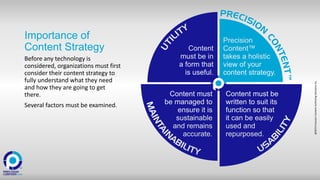
Importance of
Content Strategy
Before any technology is
considered, organizations must first
consider their content strategy to
fully understand what they need
and how they are going to get
there.
Several factors must be examined.
@2015PrecisionContentAuthoringSolutionsInc.
Definitions
What is Structured Authoring?
Do we have a problem that needs
solving?
• 5,900,000,000 google searches per
day (who did we ask these questions
to before Google?)
• 540,000 word in the English
language – 5 times more than in
Shakespeare’s time
• 90% of the world’s data has been
generated in the last 2 years
In the year … Human knowledge doubled …
1900 100 years
1945 25 years
2014 13 months
2020 12 hours
Structured authoring defined
• structured authoring means a standardised, methodological
approach to content creation incorporating
• systematic labelling
• modular, topic-based architecture
• constrained writing environments, and
• the separation of content and form.
Benefits of structured authoring
• Improved
• Collaboration
• Usability
• Consistency, and
• Publishing capabilities.
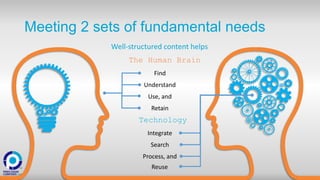
Meeting 2 sets of fundamental needs
The Human Brain
Technology
Find
Understand
Use, and
Retain
Integrate
Search
Process, and
Reuse
Well-structured content helps
Early days in structured authoring
• 1997 GML
• Documentation process long and
fraught with opportunities for
human error
• Parsed GML into Access
• Created taxonomies
• Integrated structured data
• Output to HTML (.chm)
Structured Authoring
The whys and whatfors
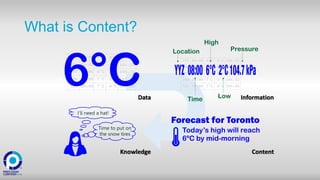
What is Content?
Data Information
ContentKnowledge
Language Arts
Language Arts for Personal Response
(LAFPR)
• To emotionally engage the
reader
• Techniques:
• narrative style
• varied vocabulary & sentence
structure
• withholding information
• Writer driven
• Meant to be READ
Language Arts for Information (LAFI)
• To convey information that
readers need to use
• Techniques:
• consistent modular structure
• concise, direct vocabulary
• use of graphics
• Reader driven
• Meant to be USED
Ikea Instructions: LAFI
Ikea Instructions: LAFPR
• If novelist Michael Ondaatje wrote Ikea instructions ….
“The eel-shaped talisman squirms inside the raspy recycled box. A
series of quarter turns – clock hands marking time – bonds back to
base. An alphabet of connections in English and French. A into groove
B. C slots into D. Chipboard credenza communicating Swedish
hegemony.”
• Author/parodist: Geoff Thomas
Globe & Mail, August 27, 2009
What is Topic-Based Authoring?
“Topic-based authoring is a modular content creation
approach…”
“A topic is a discrete piece of content that is about a specific
subject, has an identifiable purpose, and can stand alone…”
http://en.wikipedia.org/wiki/Topic-based_authoring
Topic-Based Architecture
• Topics are standardized units of information based upon information
type
• Topics require only navigational reference for context and can be read
in any order
• Topics must all contain a descriptive title and normally include a body
and metadata section
• Topics represent a single unit of work for authors
Opportunities for Topic-Based Authoring
• Speed to market
• Reduced maintenance effort
• Better opportunities for reuse
• Balancing workload
• Finer control over project management
• Opportunities for collaboration
• Clearer, more concise minimalist content
Challenges for Topic-Based Authoring
• Writing process requires greater discipline
• Loss of content ownership for authors
• Less control over look and feel
• Responsibilities redefined
• Loss of context for SMEs and authors
• More to manage
Topic-based Content Lifecycle
Input: Topics
Output:
Information
Product
Repository:
Information Core
Reusability
Traceability
Working definitions
Single-sourcing is any process used to systematically
create information products from a single defined
source of information.
or
“Writing information once
and using it many times”
- Ann Rockley, 2001
Single-Sourcing
Single-sourcing is not about content reuse
- it is about reusable content.
Spectrum 2008 - Process Re-engineering for Topic-Based
Authoring – ©2008 All Rights Reserved R.Hanna
Single-sourcing technology
Single-sourcing is a methodology, not a technology. Although the
software tools associated with single-sourcing are complex, it is the
modular writing, not technology, that ultimately determines the
success of your single-sourcing project.
• Kurt Ament – Single Sourcing: Building Modular Documentation, 2003
Can single-sourcing help?
• Single-sourcing will…
• Improve the consistency of information
• Save on maintenance and customization efforts
• Improve the quality of the content
• Require significant upfront planning and investment
Return on investment (ROI)
• Expect return on investment if…
• The document is deliverable to clients or is tied directly to a product or
service
• The document has a long life expectancy
• Many updates can be expected over time
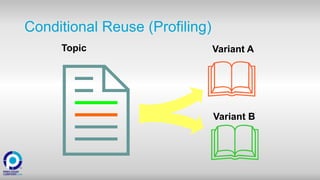
• Several variants may exist at any one time
• Parts of the document are reused elsewhere
• I can expect to recover my actual costs
Planning and process
• Defining your objectives
• Analysing your audience
• Defining your source and structure
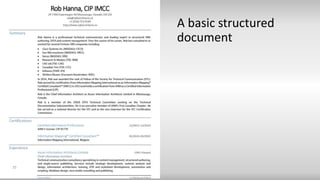
Your Resume
A basic structured
document
35
What are our objectives?
• Key objectives include:
• Produce a résumé that is easy to update and tailor for each new job
application.
• Maintain various versions: Short/Long; Technical Writer/Team Lead;
Contractor/Employee.
• Maintain various formats including: Word, HTML, PDF, and ASCII text.
• Showcase help authoring skills by producing a Windows help version.
Who is my audience
• HR Department
• Placement Agency
• Hiring Manager
• Automated systems
Selecting a source
• Does a source already exist?
• Do multiple sources exist?
• How will you resolve discrepancies between various sources?
• Create your definitive source of information
Resume structure
• Resume title
• Objective
• Target 1
• Target 2
• Personal Profile
• Education
• School
• Location
• Date
• Degree
• Professional Experience
• Company
• Location
• Position
• Tasks
• Accomplishments
• Skills
• Skill name
• Experience level
• Last used
• Years used
• References
• Name
• Position
• Company
• Contact
• E-mail
• Telephone
• Description
Structured building blocks of information
Single-sourcing with MS Word
• Ball & Chain
vs. single-
sourcing
Linda Chung
Senior Technical Writer
123 Que en St E
Toronto, ONM4N 3R8
Tel 416 555-1212
Email: linda.chung @lascan .ca
Towrite t wice as m uch docu mentatio n in half
the time.
Really Bi g Corp
Oct 99 - Present
Helped d evelop a single sou rcing pro ject that
lorem ipsum ad ve lor.
Small En terprises
June 98 - Sep 99
Lorem ip sumad v elor dolot.
Objective
Experience
Small En terprises
June 98 - Sep 99
Lorem ip sumad v elor dolot.
Doc 1
.pdf
Doc 2
.hlp
Doc 3
.doc
Object d
Object a
Object b
Object c
1 ton
Data Source
Workflow
Single-sourcing with FrameMaker
• Consistency is required for
good output
• Consistent style of writing
• Consistent mark-up of conditions
• FrameMaker limitations
• Conditions for multiple purposes
• Text tagged with multiple
conditions
• Cannot use conditional text to
rearrange your content
XML and Markup Languages
Now we get technical…
What is XML?
• (eXtensible Markup Language) is an open
standard for the exchange of information
• first published in 1998 by W3C
• to encode electronic documents readable by
• human, and
• machine
• for a multitude of applications ranging from
• corporate financial reporting applications, to
• Microsoft Word
XML is Everywhere
XML defines meaningful data structures for documents
and data. It is a human-readable file format used to
power
• manufacturing assembly lines
• medical devices
• military applications, and
• many other things.
XML is the language of the Web. It enables smart
phones and web browsers.
45
What are markup languages?
• pre-date desktop publishing and the Internet
• tell computers how to handle data
• such as how to render electronic content on a page
• categorized as either
• presentation, or
• semantic markup
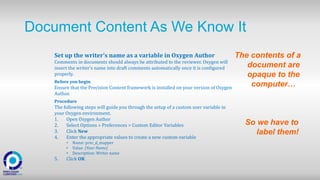
Document Content As We Know It
The contents of a
document are
opaque to the
computer…
So we have to
label them!
Set up the writer’s name as a variable in Oxygen Author
Comments in documents should always be attributed to the reviewer. Oxygen will
insert the writer’s name into draft comments automatically once it is configured
properly.
Before you begin
Ensure that the Precision Content framework is installed on your version of Oxygen
Author.
Procedure
The following steps will guide you through the setup of a custom user variable in
your Oxygen environment.
1. Open Oxygen Author
2. Select Options > Preferences > Custom Editor Variables
3. Click New
4. Enter the appropriate values to create a new custom variable
• Name: prec_d_mapper
• Value: {Your Name}
• Description: Writer name
5. Click OK
Presentation markup
• With electronic presentation markup, we markup the
paragraph and italicize the citation for publication
• This is typical of web pages using hypertext markup (HTML)
The Cancer Journal: The Journal of Principles & Practice of
Oncology provides an integrated view of modern oncology across
all disciplines.
<p><i>The Cancer Journal: The Journal of Principles & Practice
of Oncology</i> provides an integrated view of modern oncology
across <i>all</i> disciplines.</p>
The Cancer Journal: The Journal of Principles & Practice of Oncology
provides an integrated view of modern oncology across all disciplines.
Enter Structured XML
Getting
better…
<topic><title>Set up the writer’s name as a variable in Oxygen
Author</title>
<shortdesc>Comments in documents should always be attributed to the reviewer. Oxygen will
insert the writer’s name into draft comments automatically once it is configured
properly.</shortdesc>
<body><section><title>Before you begin</title>
<p>Ensure that the Precision Content framework is installed on your version of Oxygen
Author.</p></section>
<section><title>Procedure</title>
<p>The following steps will guide you through the setup of a custom user variable in your Oxygen
environment.<ol>
<li>Open Oxygen Author</li>
<li>Select Options > Preferences > Custom Editor Variables</li>
<li>Click <b>New</b></li>
<li>Enter the appropriate values to create a new custom variable
<lines>Name: prec_d_mapper
Value: <i>{Your Name}</i>
Description: Writer name</lines></li>
<li>Click <b>OK</b></li></ol></p></body></topic>
Semantic markup
• With semantic markup, we markup the content to describe the
meaning of the text
• Publishing stylesheets interpret the meaning from the markup
and apply appropriate styles specific to the publishing context
The Cancer Journal: The Journal of Principles & Practice of
Oncology provides an integrated view of modern oncology across
all disciplines.
<intro><cite>The Cancer Journal: The Journal of Principles &
Practice of Oncology</cite> provides an integrated view of
modern oncology across <em>all</em> disciplines.</intro>
The Cancer Journal: The Journal of Principles & Practice of Oncology
provides an integrated view of modern oncology across all disciplines.
The Cancer Journal: The Journal of Principles & Practice of Oncology
provides an integrated view of modern oncology across all disciplines.
Enter Structured Semantic XML
Structure
and
Meaning!
Enable
access!
<task><title>Set up the writer’s name as a variable in Oxygen Author</title>
<shortdesc>Comments in documents should always be attributed to the reviewer. Oxygen will
insert the writer’s name into draft comments automatically once it is configured properly.</shortdesc>
<taskbody><prereq><p>Ensure that the Precision Content framework is installed on your
version of Oxygen Author.</p></prereq>
<steps><stepsection>The following steps will guide you through the setup of a custom user
variable in your Oxygen environment.</stepsection>
<step><cmd>Open Oxygen Author</cmd></step>
<step><cmd>Select
<menucascade><uicontrol>Options</uicontrol><uicontrol>Preferences</uicontrol><uicontr
ol>Custom Editor Variables</uicontrol></menucascade></cmd></step>
<step><cmd>Click <uicontrol>New</uicontrol></cmd></step>
<step><cmd>Enter the appropriate values to create a new custom variable</cmd>
<info><lines>Name: prec_d_mapper
Value: <varname>{Your Name}</varname>
Description: Writer name</lines></info></step>
<step><cmd>Click <uicontrol>OK</uicontrol></cmd></step></steps></taskbody></task>
Semantic markup
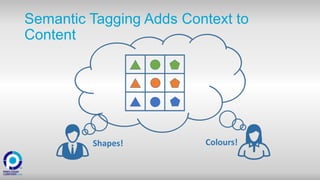
• Using semantic markup, we can
• disambiguate content
• search based on meaning
• connect to other content, and
• reuse or substitute new text.
Semantic Tagging Adds Context to
Content
Shapes! Colours!
Intelligent Content
• Content that is
• not limited to one
• purpose
• technology, or
• output
• structurally rich and semantically aware, making it
• discoverable
• reusable
• reconfigurable, and
• adaptable.
Introduction to DITA/XML
Head-swimmingly technical…
What is DITA? (n. dit-uh)
• (Darwin Information Typing Architecture)
is an XML standard
• developed in late 90’s at IBM, and
• given to the open source community in 2004
• used for topic-based, structured
authoring
• designed for scalability using mechanisms
for specialization and inheritance
• defining an extendable set of information
types
Information types
What does
“ABS”
mean?
How do I
change
the oil?
What does
an airbag
do?
What are my
battery
specifications?
Concept
Task
Reference
Glossary
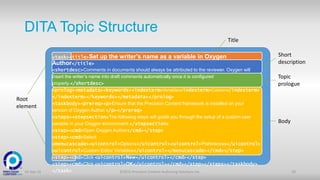
DITA Topic Structure
16-Sep-15 ©2015 Precision Content Authoring Solutions Inc. 58
<task><title>Set up the writer’s name as a variable in Oxygen
Author</title>
<shortdesc>Comments in documents should always be attributed to the reviewer. Oxygen will
insert the writer’s name into draft comments automatically once it is configured
properly.</shortdesc>
<prolog><metadata><keywords><indexterm>Variables<indexterm>Custom</indexterm>
</indexterm></keywords></metadata></prolog>
<taskbody><prereq><p>Ensure that the Precision Content framework is installed on your
version of Oxygen Author.</p></prereq>
<steps><stepsection>The following steps will guide you through the setup of a custom user
variable in your Oxygen environment.</stepsection>
<step><cmd>Open Oxygen Author</cmd></step>
<step><cmd>Select
<menucascade><uicontrol>Options</uicontrol><uicontrol>Preferences</uicontrol>
<uicontrol>Custom Editor Variables</uicontrol></menucascade></cmd></step>
<step><cmd>Click <uicontrol>New</uicontrol></cmd></step>
<step><cmd>Click <uicontrol>OK</uicontrol></cmd></step></steps></taskbody>
</task>
Root
element
Title
Short
description
Topic
prologue
Body
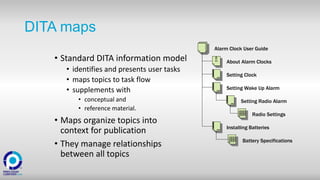
DITA maps
• Standard DITA information model
• identifies and presents user tasks
• maps topics to task flow
• supplements with
• conceptual and
• reference material.
• Maps organize topics into
context for publication
• They manage relationships
between all topics
Alarm Clock User Guide
About Alarm Clocks
Setting Clock
Setting Wake Up Alarm
Setting Radio Alarm
Installing Batteries
Radio Settings
Battery Specifications
Topic Reuse
Conditional Reuse (Profiling)
Fragment-Level Reuse
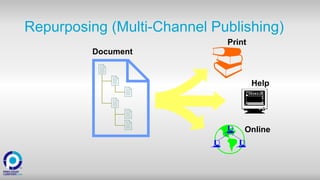
Repurposing (Multi-Channel Publishing)
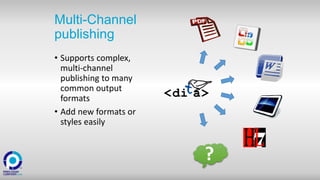
Multi-Channel
publishing
• Supports complex,
multi-channel
publishing to many
common output
formats
• Add new formats or
styles easily
?
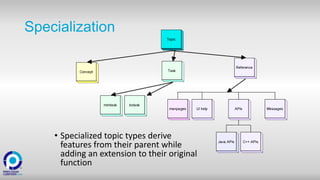
Specialization
• Specialized topic types derive
features from their parent while
adding an extension to their original
function
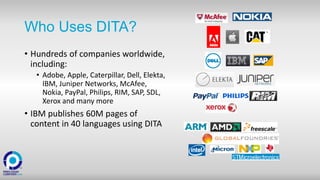
Who Uses DITA?
• Hundreds of companies worldwide,
including:
• Adobe, Apple, Caterpillar, Dell, Elekta,
IBM, Juniper Networks, McAfee,
Nokia, PayPal, Philips, RIM, SAP, SDL,
Xerox and many more
• IBM publishes 60M pages of
content in 40 languages using DITA
Questions?
Rob Hanna, ECMs
+1 (289) 290-4337
www.linkedin.com/in/singlesourceror
rob@precisioncontent.com

Introduction to Structured Authoring

  • 1.
  • 2.
    Confidential & Proprietarywww.dclab.com2 Valuable Content Transformed • Document Digitization • XML and HTML Conversion • eBook Production • Hosted Solutions • Big Data Automation • Conversion Management • Editorial Services • Harmonizer
  • 3.
    Confidential & Proprietarywww.dclab.com3 Experience the DCL Difference DCL blends years of conversion experience with cutting-edge technology and the infrastructure to make the process easy and efficient. • World-Class Services • Leading-Edge Technology • Unparalleled Infrastructure • US-Based Management • Complex-Content Expertise • 24/7 Online Project Tracking • Automated Quality Control • Global Capabilities
  • 4.
    Confidential & Proprietarywww.dclab.com WeServe a Very Broad Client Base . . . 4
  • 5.
    Confidential & Proprietarywww.dclab.com5 . . . Spanning All Industries • Aerospace • Associations • Defense • Distribution • Education • Financial • Government • Libraries • Life Sciences • Manufacturing • Medical • Museums • Periodicals • Professional • Publishing • Reference • Research • Societies • Software • STM • Technology • Telecommunications • Universities • Utilities
  • 6.
    About your presenter 6 •Rob Hanna, ECMs • President of Precision Content Authoring Solutions Inc. and a director of AIIM First Canadian Chapter • Expert in structured authoring and content management practices and technology • Instructor at the University of Toronto School of Continuing Studies – Metadata and Controlled Vocabularies
  • 7.
    Who is PrecisionContent Authoring Solutions Inc.? • We help organizations make their information easier to use • Our solutions consist of • Content strategy • Detailed information architecture • Content lifecycle design and development • Turn-key content transformation • Tools selection and development • Multi-channel publishing • www.precisioncontent.com ©2015 Precision Content Authoring Solutions Inc.
  • 9.
    STOP THE INSANITY! Stop throwing more technology atyour content problems! Content problems require content solutions!
  • 10.
    Importance of Content Strategy Beforeany technology is considered, organizations must first consider their content strategy to fully understand what they need and how they are going to get there. Several factors must be examined. @2015PrecisionContentAuthoringSolutionsInc.
  • 11.
  • 12.
    Do we havea problem that needs solving? • 5,900,000,000 google searches per day (who did we ask these questions to before Google?) • 540,000 word in the English language – 5 times more than in Shakespeare’s time • 90% of the world’s data has been generated in the last 2 years In the year … Human knowledge doubled … 1900 100 years 1945 25 years 2014 13 months 2020 12 hours
  • 13.
    Structured authoring defined •structured authoring means a standardised, methodological approach to content creation incorporating • systematic labelling • modular, topic-based architecture • constrained writing environments, and • the separation of content and form.
  • 14.
    Benefits of structuredauthoring • Improved • Collaboration • Usability • Consistency, and • Publishing capabilities.
  • 15.
    Meeting 2 setsof fundamental needs The Human Brain Technology Find Understand Use, and Retain Integrate Search Process, and Reuse Well-structured content helps
  • 16.
    Early days instructured authoring • 1997 GML • Documentation process long and fraught with opportunities for human error • Parsed GML into Access • Created taxonomies • Integrated structured data • Output to HTML (.chm)
  • 17.
  • 18.
    What is Content? DataInformation ContentKnowledge
  • 19.
    Language Arts Language Artsfor Personal Response (LAFPR) • To emotionally engage the reader • Techniques: • narrative style • varied vocabulary & sentence structure • withholding information • Writer driven • Meant to be READ Language Arts for Information (LAFI) • To convey information that readers need to use • Techniques: • consistent modular structure • concise, direct vocabulary • use of graphics • Reader driven • Meant to be USED
  • 20.
  • 21.
    Ikea Instructions: LAFPR •If novelist Michael Ondaatje wrote Ikea instructions …. “The eel-shaped talisman squirms inside the raspy recycled box. A series of quarter turns – clock hands marking time – bonds back to base. An alphabet of connections in English and French. A into groove B. C slots into D. Chipboard credenza communicating Swedish hegemony.” • Author/parodist: Geoff Thomas Globe & Mail, August 27, 2009
  • 22.
    What is Topic-BasedAuthoring? “Topic-based authoring is a modular content creation approach…” “A topic is a discrete piece of content that is about a specific subject, has an identifiable purpose, and can stand alone…” http://en.wikipedia.org/wiki/Topic-based_authoring
  • 23.
    Topic-Based Architecture • Topicsare standardized units of information based upon information type • Topics require only navigational reference for context and can be read in any order • Topics must all contain a descriptive title and normally include a body and metadata section • Topics represent a single unit of work for authors
  • 24.
    Opportunities for Topic-BasedAuthoring • Speed to market • Reduced maintenance effort • Better opportunities for reuse • Balancing workload • Finer control over project management • Opportunities for collaboration • Clearer, more concise minimalist content
  • 25.
    Challenges for Topic-BasedAuthoring • Writing process requires greater discipline • Loss of content ownership for authors • Less control over look and feel • Responsibilities redefined • Loss of context for SMEs and authors • More to manage
  • 26.
    Topic-based Content Lifecycle Input:Topics Output: Information Product Repository: Information Core
  • 27.
  • 28.
  • 29.
    Working definitions Single-sourcing isany process used to systematically create information products from a single defined source of information. or “Writing information once and using it many times” - Ann Rockley, 2001
  • 30.
    Single-Sourcing Single-sourcing is notabout content reuse - it is about reusable content. Spectrum 2008 - Process Re-engineering for Topic-Based Authoring – ©2008 All Rights Reserved R.Hanna
  • 31.
    Single-sourcing technology Single-sourcing isa methodology, not a technology. Although the software tools associated with single-sourcing are complex, it is the modular writing, not technology, that ultimately determines the success of your single-sourcing project. • Kurt Ament – Single Sourcing: Building Modular Documentation, 2003
  • 32.
    Can single-sourcing help? •Single-sourcing will… • Improve the consistency of information • Save on maintenance and customization efforts • Improve the quality of the content • Require significant upfront planning and investment
  • 33.
    Return on investment(ROI) • Expect return on investment if… • The document is deliverable to clients or is tied directly to a product or service • The document has a long life expectancy • Many updates can be expected over time • Several variants may exist at any one time • Parts of the document are reused elsewhere • I can expect to recover my actual costs
  • 34.
    Planning and process •Defining your objectives • Analysing your audience • Defining your source and structure
  • 35.
    Your Resume A basicstructured document 35
  • 36.
    What are ourobjectives? • Key objectives include: • Produce a résumé that is easy to update and tailor for each new job application. • Maintain various versions: Short/Long; Technical Writer/Team Lead; Contractor/Employee. • Maintain various formats including: Word, HTML, PDF, and ASCII text. • Showcase help authoring skills by producing a Windows help version.
  • 37.
    Who is myaudience • HR Department • Placement Agency • Hiring Manager • Automated systems
  • 38.
    Selecting a source •Does a source already exist? • Do multiple sources exist? • How will you resolve discrepancies between various sources? • Create your definitive source of information
  • 39.
    Resume structure • Resumetitle • Objective • Target 1 • Target 2 • Personal Profile • Education • School • Location • Date • Degree • Professional Experience • Company • Location • Position • Tasks • Accomplishments • Skills • Skill name • Experience level • Last used • Years used • References • Name • Position • Company • Contact • E-mail • Telephone • Description
  • 40.
  • 41.
    Single-sourcing with MSWord • Ball & Chain vs. single- sourcing Linda Chung Senior Technical Writer 123 Que en St E Toronto, ONM4N 3R8 Tel 416 555-1212 Email: linda.chung @lascan .ca Towrite t wice as m uch docu mentatio n in half the time. Really Bi g Corp Oct 99 - Present Helped d evelop a single sou rcing pro ject that lorem ipsum ad ve lor. Small En terprises June 98 - Sep 99 Lorem ip sumad v elor dolot. Objective Experience Small En terprises June 98 - Sep 99 Lorem ip sumad v elor dolot. Doc 1 .pdf Doc 2 .hlp Doc 3 .doc Object d Object a Object b Object c 1 ton Data Source Workflow
  • 42.
    Single-sourcing with FrameMaker •Consistency is required for good output • Consistent style of writing • Consistent mark-up of conditions • FrameMaker limitations • Conditions for multiple purposes • Text tagged with multiple conditions • Cannot use conditional text to rearrange your content
  • 43.
    XML and MarkupLanguages Now we get technical…
  • 44.
    What is XML? •(eXtensible Markup Language) is an open standard for the exchange of information • first published in 1998 by W3C • to encode electronic documents readable by • human, and • machine • for a multitude of applications ranging from • corporate financial reporting applications, to • Microsoft Word
  • 45.
    XML is Everywhere XMLdefines meaningful data structures for documents and data. It is a human-readable file format used to power • manufacturing assembly lines • medical devices • military applications, and • many other things. XML is the language of the Web. It enables smart phones and web browsers. 45
  • 46.
    What are markuplanguages? • pre-date desktop publishing and the Internet • tell computers how to handle data • such as how to render electronic content on a page • categorized as either • presentation, or • semantic markup
  • 47.
    Document Content AsWe Know It The contents of a document are opaque to the computer… So we have to label them! Set up the writer’s name as a variable in Oxygen Author Comments in documents should always be attributed to the reviewer. Oxygen will insert the writer’s name into draft comments automatically once it is configured properly. Before you begin Ensure that the Precision Content framework is installed on your version of Oxygen Author. Procedure The following steps will guide you through the setup of a custom user variable in your Oxygen environment. 1. Open Oxygen Author 2. Select Options > Preferences > Custom Editor Variables 3. Click New 4. Enter the appropriate values to create a new custom variable • Name: prec_d_mapper • Value: {Your Name} • Description: Writer name 5. Click OK
  • 48.
    Presentation markup • Withelectronic presentation markup, we markup the paragraph and italicize the citation for publication • This is typical of web pages using hypertext markup (HTML) The Cancer Journal: The Journal of Principles & Practice of Oncology provides an integrated view of modern oncology across all disciplines. <p><i>The Cancer Journal: The Journal of Principles & Practice of Oncology</i> provides an integrated view of modern oncology across <i>all</i> disciplines.</p> The Cancer Journal: The Journal of Principles & Practice of Oncology provides an integrated view of modern oncology across all disciplines.
  • 49.
    Enter Structured XML Getting better… <topic><title>Setup the writer’s name as a variable in Oxygen Author</title> <shortdesc>Comments in documents should always be attributed to the reviewer. Oxygen will insert the writer’s name into draft comments automatically once it is configured properly.</shortdesc> <body><section><title>Before you begin</title> <p>Ensure that the Precision Content framework is installed on your version of Oxygen Author.</p></section> <section><title>Procedure</title> <p>The following steps will guide you through the setup of a custom user variable in your Oxygen environment.<ol> <li>Open Oxygen Author</li> <li>Select Options > Preferences > Custom Editor Variables</li> <li>Click <b>New</b></li> <li>Enter the appropriate values to create a new custom variable <lines>Name: prec_d_mapper Value: <i>{Your Name}</i> Description: Writer name</lines></li> <li>Click <b>OK</b></li></ol></p></body></topic>
  • 50.
    Semantic markup • Withsemantic markup, we markup the content to describe the meaning of the text • Publishing stylesheets interpret the meaning from the markup and apply appropriate styles specific to the publishing context The Cancer Journal: The Journal of Principles & Practice of Oncology provides an integrated view of modern oncology across all disciplines. <intro><cite>The Cancer Journal: The Journal of Principles & Practice of Oncology</cite> provides an integrated view of modern oncology across <em>all</em> disciplines.</intro> The Cancer Journal: The Journal of Principles & Practice of Oncology provides an integrated view of modern oncology across all disciplines. The Cancer Journal: The Journal of Principles & Practice of Oncology provides an integrated view of modern oncology across all disciplines.
  • 51.
    Enter Structured SemanticXML Structure and Meaning! Enable access! <task><title>Set up the writer’s name as a variable in Oxygen Author</title> <shortdesc>Comments in documents should always be attributed to the reviewer. Oxygen will insert the writer’s name into draft comments automatically once it is configured properly.</shortdesc> <taskbody><prereq><p>Ensure that the Precision Content framework is installed on your version of Oxygen Author.</p></prereq> <steps><stepsection>The following steps will guide you through the setup of a custom user variable in your Oxygen environment.</stepsection> <step><cmd>Open Oxygen Author</cmd></step> <step><cmd>Select <menucascade><uicontrol>Options</uicontrol><uicontrol>Preferences</uicontrol><uicontr ol>Custom Editor Variables</uicontrol></menucascade></cmd></step> <step><cmd>Click <uicontrol>New</uicontrol></cmd></step> <step><cmd>Enter the appropriate values to create a new custom variable</cmd> <info><lines>Name: prec_d_mapper Value: <varname>{Your Name}</varname> Description: Writer name</lines></info></step> <step><cmd>Click <uicontrol>OK</uicontrol></cmd></step></steps></taskbody></task>
  • 52.
    Semantic markup • Usingsemantic markup, we can • disambiguate content • search based on meaning • connect to other content, and • reuse or substitute new text.
  • 53.
    Semantic Tagging AddsContext to Content Shapes! Colours!
  • 54.
    Intelligent Content • Contentthat is • not limited to one • purpose • technology, or • output • structurally rich and semantically aware, making it • discoverable • reusable • reconfigurable, and • adaptable.
  • 55.
  • 56.
    What is DITA?(n. dit-uh) • (Darwin Information Typing Architecture) is an XML standard • developed in late 90’s at IBM, and • given to the open source community in 2004 • used for topic-based, structured authoring • designed for scalability using mechanisms for specialization and inheritance • defining an extendable set of information types
  • 57.
    Information types What does “ABS” mean? Howdo I change the oil? What does an airbag do? What are my battery specifications? Concept Task Reference Glossary
  • 58.
    DITA Topic Structure 16-Sep-15©2015 Precision Content Authoring Solutions Inc. 58 <task><title>Set up the writer’s name as a variable in Oxygen Author</title> <shortdesc>Comments in documents should always be attributed to the reviewer. Oxygen will insert the writer’s name into draft comments automatically once it is configured properly.</shortdesc> <prolog><metadata><keywords><indexterm>Variables<indexterm>Custom</indexterm> </indexterm></keywords></metadata></prolog> <taskbody><prereq><p>Ensure that the Precision Content framework is installed on your version of Oxygen Author.</p></prereq> <steps><stepsection>The following steps will guide you through the setup of a custom user variable in your Oxygen environment.</stepsection> <step><cmd>Open Oxygen Author</cmd></step> <step><cmd>Select <menucascade><uicontrol>Options</uicontrol><uicontrol>Preferences</uicontrol> <uicontrol>Custom Editor Variables</uicontrol></menucascade></cmd></step> <step><cmd>Click <uicontrol>New</uicontrol></cmd></step> <step><cmd>Click <uicontrol>OK</uicontrol></cmd></step></steps></taskbody> </task> Root element Title Short description Topic prologue Body
  • 59.
    DITA maps • StandardDITA information model • identifies and presents user tasks • maps topics to task flow • supplements with • conceptual and • reference material. • Maps organize topics into context for publication • They manage relationships between all topics Alarm Clock User Guide About Alarm Clocks Setting Clock Setting Wake Up Alarm Setting Radio Alarm Installing Batteries Radio Settings Battery Specifications
  • 60.
  • 61.
  • 62.
  • 63.
  • 64.
    Multi-Channel publishing • Supports complex, multi-channel publishingto many common output formats • Add new formats or styles easily ?
  • 65.
    Specialization • Specialized topictypes derive features from their parent while adding an extension to their original function
  • 66.
    Who Uses DITA? •Hundreds of companies worldwide, including: • Adobe, Apple, Caterpillar, Dell, Elekta, IBM, Juniper Networks, McAfee, Nokia, PayPal, Philips, RIM, SAP, SDL, Xerox and many more • IBM publishes 60M pages of content in 40 languages using DITA
  • 67.
    Questions? Rob Hanna, ECMs +1(289) 290-4337 www.linkedin.com/in/singlesourceror rob@precisioncontent.com