Austrian Macroeconomics
Lecture 2
The Origin of Money
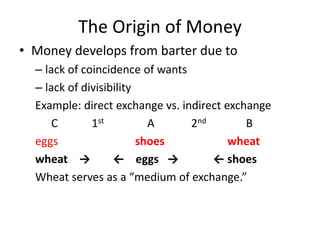
• Money develops from barter due to
– lack of coincidence of wants
– lack of divisibility
Example: direct exchange vs. indirect exchange
C 1st A 2nd B
eggs shoes wheat
wheat → ← eggs → ← shoes
Wheat serves as a “medium of exchange.”
The Origin of Money cont’d
• Media of exchange in history:
–cattle in ancient Greece; leather in ancient
Rome; animal pelts, whiskey and tobacco
leaves in the American colonies; wampum
(strings of beads) among American Indians;
dried fish in Canadian maritime colonies;
maize (corn) in Mexico; salt and iron
farming tools in parts of Africa; wives in
ancient Egypt; and cigarettes in German
POW camps.
The Origin of Money cont’d
• Money evolves as more and more people and
groups begin to use and accept the same
commodity as a medium of exchange; through
this self-reinforcing process the more that
people use a given good as a medium of
exchange the more generally acceptable the
good becomes and the more likely it is for
other people to turn to this good as a medium
of in order to solve the problems of barter.
The Function of Money
• Money:
– is defined as the general medium of exchange accepted by
all people in the economy.
– always originates as a useful commodity. All money comes
into being as commoditiy money, historically, gold and
silver.
– is not the product of a “social contract” or government
fiat. Money cannot originate as paper fiat money.
• Subsidiary functions of money:
store of value; unit of account (tool of economic calculation).
Qualities of a Good Money
• Generally acceptable—widely demanded
nonmonetary employments
• Naturally scarce
• Portable—a high value/weight ratio making it easy to
carry
• Homogeneous—all units are identical to one another
• Divisible—it can be divided into small units without
loss of value
• Durable— does not perish or deteriorate quickly
with use
• Recognizable—easy to confirm or test its
authenticity
Common Confusions about Money
• Money is not wealth. Wealth is the total
(estimated) market value of an indivdual’s
assets.
• Money is not income. Income is a sum of
money payments per unit of time.
• Money does not “circulate.” At every moment
all existing money is always money is always
owned by someone—is lying “idle” in
someone’s cash balance.
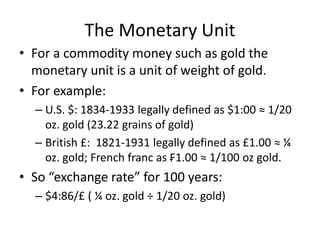
The Monetary Unit
• For a commodity money such as gold the
monetary unit is a unit of weight of gold.
• For example:
– U.S. $: 1834-1933 legally defined as $1:00 ≈ 1/20
oz. gold (23.22 grains of gold)
– British £: 1821-1931 legally defined as £1.00 ≈ ¼
oz. gold; French franc as ₣1.00 ≈ 1/100 oz gold.
• So “exchange rate” for 100 years:
– $4:86/£ ( ¼ oz. gold ÷ 1/20 oz. gold)
Kinds of Money
• Commodity Money: money consisting of a
tangible good supplied by the market.
• Fiat Money: paper money decreed by
governments as legal tender, which legally
must be accepted as payments for taxes and
all private debts.
Features of Fiat Money
fiat money is the logical and historical conclusion of the
process of debasement of the currency.
fiat monetary unit is a pure name which no longer is
defined by a specific quantity of a valuable commodity
and can be affixed by government to a nearly
worthless item.
– fiat money can therefore be created practically
without cost or limit.
– can and has resulted in hyperinflation, a period of
inflation during which the value of money rapidly falls
toward zero as prices rise toward infinity.
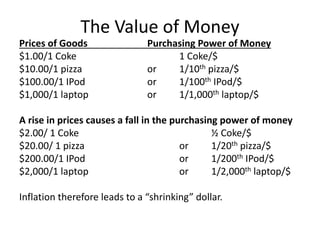
The Value of Money
Prices of Goods Purchasing Power of Money
$1.00/1 Coke 1 Coke/$
$10.00/1 pizza or 1/10th pizza/$
$100.00/1 IPod or 1/100th IPod/$
$1,000/1 laptop or 1/1,000th laptop/$
A rise in prices causes a fall in the purchasing power of money
$2.00/ 1 Coke ½ Coke/$
$20.00/ 1 pizza or 1/20th pizza/$
$200.00/1 IPod or 1/200th IPod/$
$2,000/1 laptop or 1/2,000th laptop/$
Inflation therefore leads to a “shrinking” dollar.
Measuring the Money Supply
• Commodity Money:
– the money supply is the total monetary gold in
existence in the economy, namely, the total
weight of gold coins and bullion available to be
used as a medium of exchange.
– the money supply (M) can be calculated by
summing up the cash balances or individual stocks
of money (m) held by all people in the economy.
– Thus: M = ∑ m.
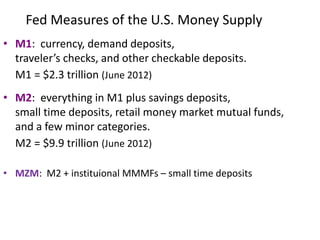
Fed Measures of the U.S. Money Supply
• M1: currency, demand deposits,
traveler’s checks, and other checkable deposits.
M1 = $2.3 trillion (June 2012)
• M2: everything in M1 plus savings deposits,
small time deposits, retail money market mutual funds,
and a few minor categories.
M2 = $9.9 trillion (June 2012)
• MZM: M2 + instituional MMMFs – small time deposits
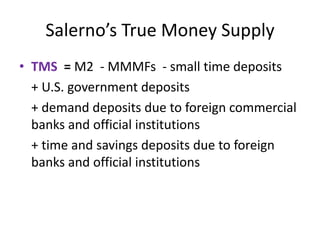
Salerno’s True Money Supply
• TMS = M2 - MMMFs - small time deposits
+ U.S. government deposits
+ demand deposits due to foreign commercial
banks and official institutions
+ time and savings deposits due to foreign
banks and official institutions
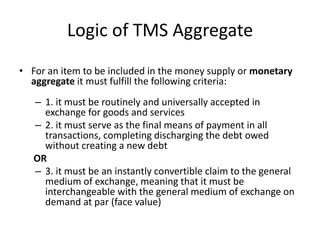
Logic of TMS Aggregate
• For an item to be included in the money supply or monetary
aggregate it must fulfill the following criteria:
– 1. it must be routinely and universally accepted in
exchange for goods and services
– 2. it must serve as the final means of payment in all
transactions, completing discharging the debt owed
without creating a new debt
OR
– 3. it must be an instantly convertible claim to the general
medium of exchange, meaning that it must be
interchangeable with the general medium of exchange on
demand at par (face value)
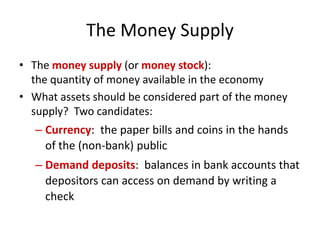
The Money Supply
• The money supply (or money stock):
the quantity of money available in the economy
• What assets should be considered part of the money
supply? Two candidates:
– Currency: the paper bills and coins in the hands
of the (non-bank) public
– Demand deposits: balances in bank accounts that
depositors can access on demand by writing a
check
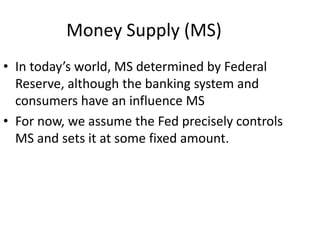
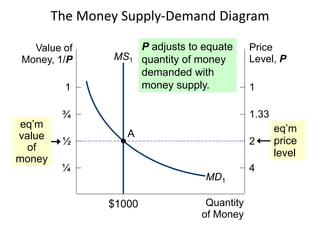
Money Supply (MS)
• In today’s world, MS determined by Federal
Reserve, although the banking system and
consumers have an influence MS
• For now, we assume the Fed precisely controls
MS and sets it at some fixed amount.
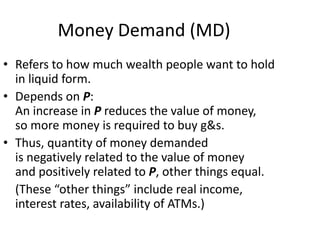
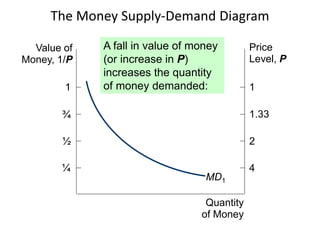
Money Demand (MD)
• Refers to how much wealth people want to hold
in liquid form.
• Depends on P:
An increase in P reduces the value of money,
so more money is required to buy g&s.
• Thus, quantity of money demanded
is negatively related to the value of money
and positively related to P, other things equal.
(These “other things” include real income,
interest rates, availability of ATMs.)
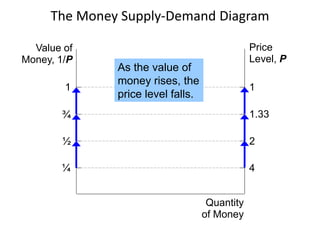
The Money Supply-Demand Diagram
Value of
Money, 1/P
Price
Level, P
Quantity
of Money
1 1
¾ 1.33
½ 2
¼ 4
As the value of
money rises, the
price level falls.
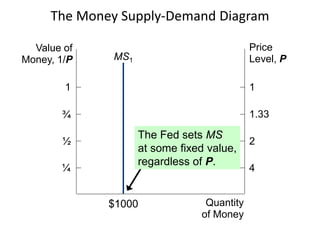
The Money Supply-Demand Diagram
Value of
Money, 1/P
Price
Level, P
Quantity
of Money
1
¾
½
¼
1
1.33
2
4
MS1
$1000
The Fed sets MS
at some fixed value,
regardless of P.
The Money Supply-Demand Diagram
Value of
Money, 1/P
Price
Level, P
Quantity
of Money
1
¾
½
¼
1
1.33
2
4
MD1
A fall in value of money
(or increase in P)
increases the quantity
of money demanded:
MS1
$1000
Value of
Money, 1/P
Price
Level, P
Quantity
of Money
1
¾
½
¼
1
1.33
2
4
The Money Supply-Demand Diagram
MD1
P adjusts to equate
quantity of money
demanded with
money supply.
eq’m
price
level
eq’m
value
of
money
A
MS1
$1000
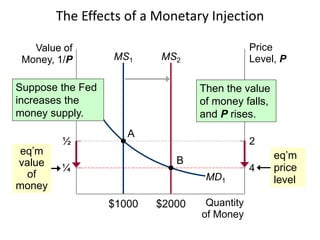
The Effects of a Monetary Injection
Value of
Money, 1/P
Price
Level, P
Quantity
of Money
1
¾
½
¼
1
1.33
2
4
MD1
eq’m
price
level
eq’m
value
of
money
A
MS2
$2000
B
Then the value
of money falls,
and P rises.
Suppose the Fed
increases the
money supply.
A Brief Look at the Adjustment Process
How does this work? Short version:
– At the initial P, an increase in MS causes
excess supply of money.
– People get rid of their excess money by spending it
on g&s or by loaning it to others, who spend it.
Result: increased demand for goods.
– But supply of goods does not increase,
so prices must rise.
(Other things happen in the short run, which we will
study in later chapters.)
Result from graph: Increasing MS causes P to rise.
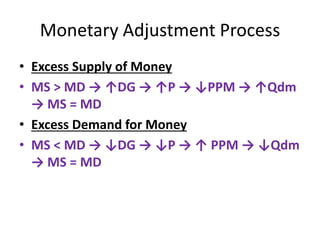
Monetary Adjustment Process
• Excess Supply of Money
• MS > MD → ↑DG → ↑P → ↓PPM → ↑Qdm
→ MS = MD
• Excess Demand for Money
• MS < MD → ↓DG → ↓P → ↑ PPM → ↓Qdm
→ MS = MD
Austrian Macroeconomics, Lecture 2 with Joe Salerno - Mises Academy

Austrian Macroeconomics, Lecture 2 with Joe Salerno - Mises Academy

  • 1.
  • 2.
    The Origin ofMoney • Money develops from barter due to – lack of coincidence of wants – lack of divisibility Example: direct exchange vs. indirect exchange C 1st A 2nd B eggs shoes wheat wheat → ← eggs → ← shoes Wheat serves as a “medium of exchange.”
  • 3.
    The Origin ofMoney cont’d • Media of exchange in history: –cattle in ancient Greece; leather in ancient Rome; animal pelts, whiskey and tobacco leaves in the American colonies; wampum (strings of beads) among American Indians; dried fish in Canadian maritime colonies; maize (corn) in Mexico; salt and iron farming tools in parts of Africa; wives in ancient Egypt; and cigarettes in German POW camps.
  • 4.
    The Origin ofMoney cont’d • Money evolves as more and more people and groups begin to use and accept the same commodity as a medium of exchange; through this self-reinforcing process the more that people use a given good as a medium of exchange the more generally acceptable the good becomes and the more likely it is for other people to turn to this good as a medium of in order to solve the problems of barter.
  • 5.
    The Function ofMoney • Money: – is defined as the general medium of exchange accepted by all people in the economy. – always originates as a useful commodity. All money comes into being as commoditiy money, historically, gold and silver. – is not the product of a “social contract” or government fiat. Money cannot originate as paper fiat money. • Subsidiary functions of money: store of value; unit of account (tool of economic calculation).
  • 6.
    Qualities of aGood Money • Generally acceptable—widely demanded nonmonetary employments • Naturally scarce • Portable—a high value/weight ratio making it easy to carry • Homogeneous—all units are identical to one another • Divisible—it can be divided into small units without loss of value • Durable— does not perish or deteriorate quickly with use • Recognizable—easy to confirm or test its authenticity
  • 7.
    Common Confusions aboutMoney • Money is not wealth. Wealth is the total (estimated) market value of an indivdual’s assets. • Money is not income. Income is a sum of money payments per unit of time. • Money does not “circulate.” At every moment all existing money is always money is always owned by someone—is lying “idle” in someone’s cash balance.
  • 8.
    The Monetary Unit •For a commodity money such as gold the monetary unit is a unit of weight of gold. • For example: – U.S. $: 1834-1933 legally defined as $1:00 ≈ 1/20 oz. gold (23.22 grains of gold) – British £: 1821-1931 legally defined as £1.00 ≈ ¼ oz. gold; French franc as ₣1.00 ≈ 1/100 oz gold. • So “exchange rate” for 100 years: – $4:86/£ ( ¼ oz. gold ÷ 1/20 oz. gold)
  • 9.
    Kinds of Money •Commodity Money: money consisting of a tangible good supplied by the market. • Fiat Money: paper money decreed by governments as legal tender, which legally must be accepted as payments for taxes and all private debts.
  • 10.
    Features of FiatMoney fiat money is the logical and historical conclusion of the process of debasement of the currency. fiat monetary unit is a pure name which no longer is defined by a specific quantity of a valuable commodity and can be affixed by government to a nearly worthless item. – fiat money can therefore be created practically without cost or limit. – can and has resulted in hyperinflation, a period of inflation during which the value of money rapidly falls toward zero as prices rise toward infinity.
  • 11.
    The Value ofMoney Prices of Goods Purchasing Power of Money $1.00/1 Coke 1 Coke/$ $10.00/1 pizza or 1/10th pizza/$ $100.00/1 IPod or 1/100th IPod/$ $1,000/1 laptop or 1/1,000th laptop/$ A rise in prices causes a fall in the purchasing power of money $2.00/ 1 Coke ½ Coke/$ $20.00/ 1 pizza or 1/20th pizza/$ $200.00/1 IPod or 1/200th IPod/$ $2,000/1 laptop or 1/2,000th laptop/$ Inflation therefore leads to a “shrinking” dollar.
  • 12.
    Measuring the MoneySupply • Commodity Money: – the money supply is the total monetary gold in existence in the economy, namely, the total weight of gold coins and bullion available to be used as a medium of exchange. – the money supply (M) can be calculated by summing up the cash balances or individual stocks of money (m) held by all people in the economy. – Thus: M = ∑ m.
  • 13.
    Fed Measures ofthe U.S. Money Supply • M1: currency, demand deposits, traveler’s checks, and other checkable deposits. M1 = $2.3 trillion (June 2012) • M2: everything in M1 plus savings deposits, small time deposits, retail money market mutual funds, and a few minor categories. M2 = $9.9 trillion (June 2012) • MZM: M2 + instituional MMMFs – small time deposits
  • 14.
    Salerno’s True MoneySupply • TMS = M2 - MMMFs - small time deposits + U.S. government deposits + demand deposits due to foreign commercial banks and official institutions + time and savings deposits due to foreign banks and official institutions
  • 15.
    Logic of TMSAggregate • For an item to be included in the money supply or monetary aggregate it must fulfill the following criteria: – 1. it must be routinely and universally accepted in exchange for goods and services – 2. it must serve as the final means of payment in all transactions, completing discharging the debt owed without creating a new debt OR – 3. it must be an instantly convertible claim to the general medium of exchange, meaning that it must be interchangeable with the general medium of exchange on demand at par (face value)
  • 16.
    The Money Supply •The money supply (or money stock): the quantity of money available in the economy • What assets should be considered part of the money supply? Two candidates: – Currency: the paper bills and coins in the hands of the (non-bank) public – Demand deposits: balances in bank accounts that depositors can access on demand by writing a check
  • 17.
    Money Supply (MS) •In today’s world, MS determined by Federal Reserve, although the banking system and consumers have an influence MS • For now, we assume the Fed precisely controls MS and sets it at some fixed amount.
  • 18.
    Money Demand (MD) •Refers to how much wealth people want to hold in liquid form. • Depends on P: An increase in P reduces the value of money, so more money is required to buy g&s. • Thus, quantity of money demanded is negatively related to the value of money and positively related to P, other things equal. (These “other things” include real income, interest rates, availability of ATMs.)
  • 19.
    The Money Supply-DemandDiagram Value of Money, 1/P Price Level, P Quantity of Money 1 1 ¾ 1.33 ½ 2 ¼ 4 As the value of money rises, the price level falls.
  • 20.
    The Money Supply-DemandDiagram Value of Money, 1/P Price Level, P Quantity of Money 1 ¾ ½ ¼ 1 1.33 2 4 MS1 $1000 The Fed sets MS at some fixed value, regardless of P.
  • 21.
    The Money Supply-DemandDiagram Value of Money, 1/P Price Level, P Quantity of Money 1 ¾ ½ ¼ 1 1.33 2 4 MD1 A fall in value of money (or increase in P) increases the quantity of money demanded:
  • 22.
    MS1 $1000 Value of Money, 1/P Price Level,P Quantity of Money 1 ¾ ½ ¼ 1 1.33 2 4 The Money Supply-Demand Diagram MD1 P adjusts to equate quantity of money demanded with money supply. eq’m price level eq’m value of money A
  • 23.
    MS1 $1000 The Effects ofa Monetary Injection Value of Money, 1/P Price Level, P Quantity of Money 1 ¾ ½ ¼ 1 1.33 2 4 MD1 eq’m price level eq’m value of money A MS2 $2000 B Then the value of money falls, and P rises. Suppose the Fed increases the money supply.
  • 24.
    A Brief Lookat the Adjustment Process How does this work? Short version: – At the initial P, an increase in MS causes excess supply of money. – People get rid of their excess money by spending it on g&s or by loaning it to others, who spend it. Result: increased demand for goods. – But supply of goods does not increase, so prices must rise. (Other things happen in the short run, which we will study in later chapters.) Result from graph: Increasing MS causes P to rise.
  • 25.
    Monetary Adjustment Process •Excess Supply of Money • MS > MD → ↑DG → ↑P → ↓PPM → ↑Qdm → MS = MD • Excess Demand for Money • MS < MD → ↓DG → ↓P → ↑ PPM → ↓Qdm → MS = MD