Downloaded 15 times




![Semigroups - what are they?
trait Semigroup[A] {
def combine(x: A, y: A) : A
}
general structure to define things
that can be combined.
*Cats provides “default” implementations; developers
(like you & me) need to provide implementations that conform to the traits. *](https://image.slidesharecdn.com/practicalcats-170707032647/85/Practical-cats-8-320.jpg)
![Monoids - what are they?
trait Monoid[A] extends Semigroup[A] {
def empty: A
def combine(x: A, y: A) : A
}
general structure to define things
that can be combined and has a “default”
element.
*Cats provides “default” implementations; developers
(like you & me) need to provide implementations that conform to the traits. *](https://image.slidesharecdn.com/practicalcats-170707032647/85/Practical-cats-9-320.jpg)
![Monoids - what are they?
> import cats._, data._, implicits._
> Monoid[String].combine(“hi”, “there”)
// res0: String = “hithere”
> “hi” |+| “there”
// res1: String = “hithere”](https://image.slidesharecdn.com/practicalcats-170707032647/85/Practical-cats-10-320.jpg)
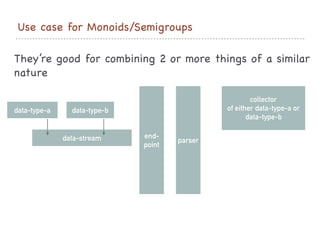
![Use case #1 - Monoids for “smashing” values
* all names used here do not reflect the actuals *
// Monoid[DataTypeAB] defined somewhere else
def buildDataFromStream(datatypeA : DataTypeA,
datatypeB : DataTypeB,
accumulator: DatatypeAB) =
validateData(datatypeA, datatypeB).fold(
onError => {
// `orError` is lifted into the datatype
val errors = Monoid[DatatypeAB].empty.copy(lift(onError))
Monoid[DatatypeAB].combine(accumulator, errors)
},
parsedValue => {
// `parsedValue` is lifted into the datatype
val newValue = Monoid[DatatypeAB].empty.copy(lift(parsedValue))
Monoid[DatatypeAB].combine(accumulator, newValue)
}
)](https://image.slidesharecdn.com/practicalcats-170707032647/85/Practical-cats-12-320.jpg)
![Functors - what are they?
trait Functor[F[_]] {
def map[A,B](fa: F[A])(f: A => B) : F[B]
}
general structure to represent something
that can be mapped over. If you’ve been using Lists
, Options, Eithers, Futures in Scala, you’ve been using
functors.
!!! They are very common structures indeed ☺ !!!
* functors are used in clever things like recursion-schemes *](https://image.slidesharecdn.com/practicalcats-170707032647/85/Practical-cats-13-320.jpg)
![Functors - what are they?
> import cats._, data._, implicits._
> Functor[List].lift((x:Int) => x + 1)
// res0: List[Int] => List[Int]
> res0(List(1))
// res1: List[Int] = List(2)
* Nugget of info: Functors preserve “structure” *](https://image.slidesharecdn.com/practicalcats-170707032647/85/Practical-cats-14-320.jpg)
![Monads - examples
> List(1,2,3) >>= (value => List(value+1))
> res0: List[Int] = List(2,3,4)
def >>=[A,B](fa: F[A])(f:A => F[B]): F[B] =
flatMap(fa)(f)
“>>=“ is also known as “bind” (in Cats, its really “flatMap”)](https://image.slidesharecdn.com/practicalcats-170707032647/85/Practical-cats-19-320.jpg)
![Monads - examples
> Monad[List].lift((x:Int) => x + 1)(List(1,2,3))
> res1: List[Int] = List(2,3,4)
Typeclasses allows you to define re-usable code by
lifting functions.](https://image.slidesharecdn.com/practicalcats-170707032647/85/Practical-cats-20-320.jpg)
![Monads - examples
> Monad[List].pure(4)
> res2: List[Int] = List(4)
This is to lift values into a context, in this case
Monadic context.](https://image.slidesharecdn.com/practicalcats-170707032647/85/Practical-cats-21-320.jpg)
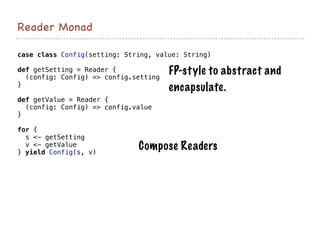
![Monads - flow
scala> def first = Reader( (x:Int) => Monad[List].ifM(List(true,true))(x::Nil, Nil) )
extractGroups: cats.data.Reader[Int,List[Int]]
scala> def second = Reader( (x:Int) => Monad[List].ifM(List(true,true))(x::Nil, Nil) )
loadGroup: cats.data.Reader[Int,List[Int]]
scala> for { g <- first(4); gg <- second(g) } yield gg
res21: List[Int] = List(4, 4, 4, 4)](https://image.slidesharecdn.com/practicalcats-170707032647/85/Practical-cats-22-320.jpg)
![Writer Monad
scala> def logNumber(x: Int): Writer[List[String], Int] =
Writer(List("Got number: " + x.show), 3)
logNumber: (x: Int)cats.data.Writer[List[String],Int]
scala> def multWithLog: Writer[List[String], Int] =
for {
a <- logNumber(3)
b <- logNumber(5)
} yield a * b
multWithLog: cats.data.Writer[List[String],Int]
scala> multWithLog.run
res2: cats.Id[(List[String], Int)] = (List(Got number: 3, Got number: 5),9)
scala> multWithLog.reset
res6: cats.data.WriterT[cats.Id,List[String],Int] = WriterT((List(),9))
scala> multWithLog.swap
res8: cats.data.WriterT[cats.Id,Int,List[String]] = WriterT((9,List(Got number: 4, Got
number: 3)))
scala> multWithLog.value
res9: cats.Id[Int] = 9
scala> multWithLog.written
res10: cats.Id[List[String]] = List(Got number: 4, Got number: 3)
source: http://eed3si9n.com/herding-cats/Writer.html
Compose Writers](https://image.slidesharecdn.com/practicalcats-170707032647/85/Practical-cats-24-320.jpg)
![Use case #3 - Reader + State Monad
def process: Reader[Elem, Seq[Mapping]] = Reader {
(xml: Elem) =>
for {
groups <- extractGroups(dataXml).toOption
group <- groups
grpCfg <- loadGroupConfig(group).toOption
stateObj <- ConfigState(grpCfg).pure[Option]
records <- loadRecords(group).toOption
record <- records
row <- processRecord(i)(stateObj)(record).pure[Option]
} yield {
// processing …
}
}
case class ConfigState(init: Config) {
private[this] var currentState: Config = init
def storeCfg : State[Config, Config] =
State{ (cfg: Config) =>
val prevState = currentState
currentState = cfg
(currentState, prevState) }
def loadCfg : Config =
( for {
s <- State.get[Config]
} yield s ).runA(currentState).value
}](https://image.slidesharecdn.com/practicalcats-170707032647/85/Practical-cats-28-320.jpg)
![Use case #3 - Reader + State Monad
def process: Reader[Elem, Seq[Mapping]] = Reader {
(xml: Elem) =>
for {
groups <- extractGroups(dataXml).toOption
group <- groups
grpCfg <- loadGroupConfig(group).toOption
stateObj <- ConfigState(grpCfg).pure[Option]
records <- loadRecords(group).toOption
record <- records
row <- processRecord(i)(stateObj)(record).pure[Option]
} yield {
// processing …
}
}
case class ConfigState(init: Config) {
private[this] var currentState: Config = init
def storeCfg : State[Config, Config] =
State{ (cfg: Config) =>
val prevState = currentState
currentState = cfg
(currentState, prevState) }
def loadCfg : Config =
( for {
s <- State.get[Config]
} yield s ).runA(currentState).value
}
Separation of concerns
State management](https://image.slidesharecdn.com/practicalcats-170707032647/85/Practical-cats-29-320.jpg)
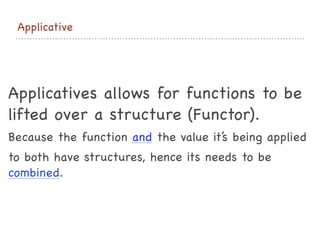
![Applicative - examples
scala> Applicative[List].lift((x:Int) => x + 1)
res1: List[Int] => List[Int] = <function1>
scala> Applicative[List].lift(
| (x:List[Int=>Int]) =>
| x.map(f => f(2)))
| (List( List((x:Int) => x + 1 )))
res7: List[List[Int]] = List(List(3))
scala> val fs = List(List((x:Int) => x + 1))
fs: List[List[Int => Int]] = List(List(<function1>))
scala> fs.map(_(2))
res15: cats.data.Nested[List,List,Int] =
Nested(List(List(3)))
Applicative is like a Functor](https://image.slidesharecdn.com/practicalcats-170707032647/85/Practical-cats-31-320.jpg)
![Applicative - examples
scala> Applicative[List].lift((x:Int) => x + 1)
res1: List[Int] => List[Int] = <function1>
scala> Applicative[List].lift(
| (x:List[Int=>Int]) =>
| x.map(f => f(2)))
| (List( List((x:Int) => x + 1 )))
res7: List[List[Int]] = List(List(3))
scala> val fs = List(List((x:Int) => x + 1))
fs: List[List[Int => Int]] = List(List(<function1>))
scala> fs.map(_(2))
res15: cats.data.Nested[List,List,Int] =
Nested(List(List(3)))
Applicative is like a Functor
Applying a function which is nested.](https://image.slidesharecdn.com/practicalcats-170707032647/85/Practical-cats-32-320.jpg)
![Applicative - examples
scala> Applicative[List].lift((x:Int) => x + 1)
res1: List[Int] => List[Int] = <function1>
scala> Applicative[List].lift(
| (x:List[Int=>Int]) =>
| x.map(f => f(2)))
| (List( List((x:Int) => x + 1 )))
res7: List[List[Int]] = List(List(3))
scala> val fs = List(List((x:Int) => x + 1))
fs: List[List[Int => Int]] = List(List(<function1>))
scala> fs.map(_(2))
res15: cats.data.Nested[List,List,Int] =
Nested(List(List(3)))
Applicative is like a Functor
Applying a function which is nested.
Cat has a “Nested” to achieve the same.](https://image.slidesharecdn.com/practicalcats-170707032647/85/Practical-cats-33-320.jpg)
![import cats.Cartesian
import cats.data.Validated
import cats.instances.list._ // Semigroup for List
type AllErrorsOr[A] = Validated[List[String], A]
Cartesian[AllErrorsOr].product(
Validated.invalid(List("Error 1")),
Validated.invalid(List("Error 2")) )
// res1: AllErrorsOr[(Nothing, Nothing)] = Invalid(List(Error 1,Error 2))
Applicative - examples](https://image.slidesharecdn.com/practicalcats-170707032647/85/Practical-cats-35-320.jpg)
![package xxx.config
import scala.concurrent.duration.{Duration,FiniteDuration}
import cats._
import cats.data._
import cats.implicits._
import cats.data.Validated
import cats.data.Validated.{Invalid, Valid}
// code that needs to remain hidden
sealed abstract class ConfigError
final case class MissingConfig(field : String) extends ConfigError
final case class ParseError(field: String) extends ConfigError
case class Config(map : Map[String,String])
case class HuffConfig(
clusterName: String,
clusterPort : Int,
clusterAddress : String,
hostname: String,
listeningPort: Int)
object Validator {
def getHuffConfig(config: Config) : ValidatedNel[ConfigError, HuffConfig] =
Apply[ValidatedNel[ConfigError, ?]].map5(
config.parse[String] ("DL_CLUSTER_NAME").toValidatedNel,
config.parse[Int] ("DL_CLUSTER_PORT").toValidatedNel,
config.parse[String] ("DL_CLUSTER_ADDRESS").toValidatedNel,
config.parse[String] ("DL_HTTP_ADDRESS").toValidatedNel,
config.parse[Int] ("DL_HTTP_PORT").toValidatedNel) {
case (clusterName, clusterPort, clusterAddress, httpAddr, httpPort) =>
HuffConfig(clusterName, clusterPort, clusterAddress, httpAddr, httpPort)
}
}](https://image.slidesharecdn.com/practicalcats-170707032647/85/Practical-cats-36-320.jpg)
![package xxx.config
import scala.concurrent.duration.{Duration,FiniteDuration}
import cats._
import cats.data._
import cats.implicits._
import cats.data.Validated
import cats.data.Validated.{Invalid, Valid}
// code that needs to remain hidden
sealed abstract class ConfigError
final case class MissingConfig(field : String) extends ConfigError
final case class ParseError(field: String) extends ConfigError
case class Config(map : Map[String,String])
case class HuffConfig(
clusterName: String,
clusterPort : Int,
clusterAddress : String,
hostname: String,
listeningPort: Int)
object Validator {
def getHuffConfig(config: Config) : ValidatedNel[ConfigError, HuffConfig] =
Apply[ValidatedNel[ConfigError, ?]].map5(
config.parse[String] ("DL_CLUSTER_NAME").toValidatedNel,
config.parse[Int] ("DL_CLUSTER_PORT").toValidatedNel,
config.parse[String] ("DL_CLUSTER_ADDRESS").toValidatedNel,
config.parse[String] ("DL_HTTP_ADDRESS").toValidatedNel,
config.parse[Int] ("DL_HTTP_PORT").toValidatedNel) {
case (clusterName, clusterPort, clusterAddress, httpAddr, httpPort) =>
HuffConfig(clusterName, clusterPort, clusterAddress, httpAddr, httpPort)
}
}
Define types to represent “errors"](https://image.slidesharecdn.com/practicalcats-170707032647/85/Practical-cats-37-320.jpg)
![package xxx.config
import scala.concurrent.duration.{Duration,FiniteDuration}
import cats._
import cats.data._
import cats.implicits._
import cats.data.Validated
import cats.data.Validated.{Invalid, Valid}
// code that needs to remain hidden
sealed abstract class ConfigError
final case class MissingConfig(field : String) extends ConfigError
final case class ParseError(field: String) extends ConfigError
case class Config(map : Map[String,String])
case class HuffConfig(
clusterName: String,
clusterPort : Int,
clusterAddress : String,
hostname: String,
listeningPort: Int)
object Validator {
def getHuffConfig(config: Config) : ValidatedNel[ConfigError, HuffConfig] =
Apply[ValidatedNel[ConfigError, ?]].map5(
config.parse[String] ("DL_CLUSTER_NAME").toValidatedNel,
config.parse[Int] ("DL_CLUSTER_PORT").toValidatedNel,
config.parse[String] ("DL_CLUSTER_ADDRESS").toValidatedNel,
config.parse[String] ("DL_HTTP_ADDRESS").toValidatedNel,
config.parse[Int] ("DL_HTTP_PORT").toValidatedNel) {
case (clusterName, clusterPort, clusterAddress, httpAddr, httpPort) =>
HuffConfig(clusterName, clusterPort, clusterAddress, httpAddr, httpPort)
}
}
Define types to represent “errors"
Validate and read into configuration object.](https://image.slidesharecdn.com/practicalcats-170707032647/85/Practical-cats-38-320.jpg)
![package xxx.config
import scala.concurrent.duration.{Duration,FiniteDuration}
import cats._
import cats.data._
import cats.implicits._
import cats.data.Validated
import cats.data.Validated.{Invalid, Valid}
// code that needs to remain hidden
sealed abstract class ConfigError
final case class MissingConfig(field : String) extends ConfigError
final case class ParseError(field: String) extends ConfigError
case class Config(map : Map[String,String])
case class HuffConfig(
clusterName: String,
clusterPort : Int,
clusterAddress : String,
hostname: String,
listeningPort: Int)
object Validator {
def getHuffConfig(config: Config) : ValidatedNel[ConfigError, HuffConfig] =
Apply[ValidatedNel[ConfigError, ?]].map5(
config.parse[String] ("DL_CLUSTER_NAME").toValidatedNel,
config.parse[Int] ("DL_CLUSTER_PORT").toValidatedNel,
config.parse[String] ("DL_CLUSTER_ADDRESS").toValidatedNel,
config.parse[String] ("DL_HTTP_ADDRESS").toValidatedNel,
config.parse[Int] ("DL_HTTP_PORT").toValidatedNel) {
case (clusterName, clusterPort, clusterAddress, httpAddr, httpPort) =>
HuffConfig(clusterName, clusterPort, clusterAddress, httpAddr, httpPort)
}
}
Define types to represent “errors"
Validate and read into configuration object.
Validation logic](https://image.slidesharecdn.com/practicalcats-170707032647/85/Practical-cats-39-320.jpg)
![Let’s take a closer look
scala> case class Cat(name: String, alive: Boolean)
defined class Cat
scala> def isAlive = Reader{ (u:User) => if (u.alive) u.asRight[Throwable].toOption:: Nil
| else scala.util.Try(throw new Exception("Dead!")).asLeft[User].toOption::Nil }
isAlive2: cats.data.Reader[User,List[Option[User]]]
scala> def lookup = Cat("cat", true).some::Nil
lookup: List[Option[Cat]]
scala> for {
| someCat <- lookup
| } yield {
| for {
| cat <- someCat
| } yield isAlive(cat)
|}
res47: List[Option[cats.Id[List[Option[Cat]]]]] = List(Some(List(User(cat,true))))
Let’s say we like to look up a cat and find out whether its alive.
We would use Option[Cat] to say whether we can find one, and perhaps
Either[Throwable,Cat] to represent when cat is dead, we throw an exception
else we return the Cat
First Attempt](https://image.slidesharecdn.com/practicalcats-170707032647/85/Practical-cats-42-320.jpg)
![Let’s take a closer look
scala> case class Cat(name: String, alive: Boolean)
defined class Cat
scala> def isAlive =
| Reader{ (u: Cat) => if (u.alive) OptionT( u.asRight[Throwable].toOption:: Nil)
| else OptionT( scala.util.Try(throw new Exception("Dead!")).asLeft[Cat].toOption::Nil) }
isAlive: cats.data.Reader[Cat,cats.data.OptionT[List, Cat]]
scala> def lookup = OptionT(Cat("cat", true).some::Nil)
lookup: cats.data.OptionT[List, Cat]
scala> for {
| cat <- lookup
| checked <- isAlive(cat)
| } yield checked
res32: cats.data.OptionT[List, Cat] = OptionT(List(Some(Cat(cat,true))))
The nested-yield loops can quickly get very confusing ….
that’s where Monad Transformers help!
Second Attempt](https://image.slidesharecdn.com/practicalcats-170707032647/85/Practical-cats-43-320.jpg)
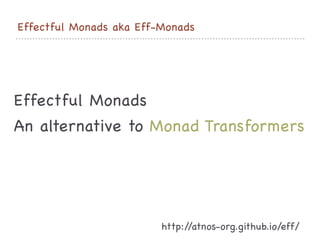
![Use-case #4
Putting in the type-definitions: making use of the
Reader, Writer, Either Effects from Eff !
import xxx.workflow.models.{WorkflowDescriptor, Service}
import scala.language.{postfixOps, higherKinds}
import org.atnos.eff._, all._, syntax.all._
import com.typesafe.config._
import com.typesafe.scalalogging._
class LoadWorkflowDescriptorEff {
import cats._, data._, implicits._
import io.circe._, io.circe.generic.auto._, io.circe.parser._, io.circe.syntax._
lazy val config = ConfigFactory.load()
lazy val logger = Logger(getClass)
type WorkflowIdReader[A] = Reader[String, A]
type WriterString[A] = Writer[String,A]
type DecodeFailure[A] = io.circe.DecodingFailure Either A
type ParseFailure[A] = io.circe.ParsingFailure Either A
// ...
}](https://image.slidesharecdn.com/practicalcats-170707032647/85/Practical-cats-45-320.jpg)
![import java.time._
type LoadDescStack =
Fx.fx6[WorkflowIdReader, WriterString, DecodeFailure, ParseFailure, Throwable Either ?, Eval]
def loadDescriptor : Eff[LoadDescStack, WorkflowDescriptor] =
for {
workflowId <- ask[LoadDescStack,String]
_ <- tell[LoadDescStack,String](s"[${Instant.now()}] About to load data about workflow: $workflowId")
contents <- fromEither[LoadDescStack,java.lang.Throwable,String](loadContents(workflowId))
_ <- tell[LoadDescStack,String](s"[${Instant.now()}] Data is loaded from storage: $contents")
json <- fromEither[LoadDescStack,io.circe.ParsingFailure,io.circe.Json](parse(contents))
_ <- tell[LoadDescStack, String](s"[${Instant.now()}] Workflow descriptor parsed successfully")
desc <- fromEither[LoadDescStack, io.circe.DecodingFailure, WorkflowDescriptor](json.as[WorkflowDescriptor])
_ <- tell[LoadDescStack, String](s"[${Instant.now()}] Workflow descriptor hydrated into object.")
} yield desc
// Below is a test and you can choose either runEval or attemptEval
// attemptEval is a better option as it captures any errors met during the
// computation.
//println(loadDescriptor.runReader("1").runWriter.runEither.runEither.runEither.runPure)
lazy val result = {
val a = loadDescriptor.runReader("1").runWriter.runEither.runEither.runEither.runPure
val t = a.get
t.joinRight
}
// the logging version
lazy val result2 = {
val a = loadDescriptor.runReader("1").runWriterLog.runEither.runEither.runEither.runPure
val t = a.get
t.joinRight
}
}
Use-case #4](https://image.slidesharecdn.com/practicalcats-170707032647/85/Practical-cats-46-320.jpg)
![import java.time._
type LoadDescStack =
Fx.fx6[WorkflowIdReader, WriterString, DecodeFailure, ParseFailure, Throwable Either ?, Eval]
def loadDescriptor : Eff[LoadDescStack, WorkflowDescriptor] =
for {
workflowId <- ask[LoadDescStack,String]
_ <- tell[LoadDescStack,String](s"[${Instant.now()}] About to load data about workflow: $workflowId")
contents <- fromEither[LoadDescStack,java.lang.Throwable,String](loadContents(workflowId))
_ <- tell[LoadDescStack,String](s"[${Instant.now()}] Data is loaded from storage: $contents")
json <- fromEither[LoadDescStack,io.circe.ParsingFailure,io.circe.Json](parse(contents))
_ <- tell[LoadDescStack, String](s"[${Instant.now()}] Workflow descriptor parsed successfully")
desc <- fromEither[LoadDescStack, io.circe.DecodingFailure, WorkflowDescriptor](json.as[WorkflowDescriptor])
_ <- tell[LoadDescStack, String](s"[${Instant.now()}] Workflow descriptor hydrated into object.")
} yield desc
// Below is a test and you can choose either runEval or attemptEval
// attemptEval is a better option as it captures any errors met during the
// computation.
//println(loadDescriptor.runReader("1").runWriter.runEither.runEither.runEither.runPure)
lazy val result = {
val a = loadDescriptor.runReader("1").runWriter.runEither.runEither.runEither.runPure
val t = a.get
t.joinRight
}
// the logging version
lazy val result2 = {
val a = loadDescriptor.runReader("1").runWriterLog.runEither.runEither.runEither.runPure
val t = a.get
t.joinRight
}
}
Use-case #4
Eff-Monads allows us to stack computations](https://image.slidesharecdn.com/practicalcats-170707032647/85/Practical-cats-47-320.jpg)
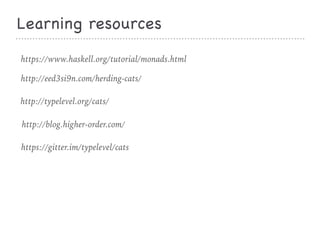

The document discusses various programming constructs within the Cats library, such as functors, monads, and applicatives, emphasizing their roles and laws in functional programming. It provides examples of how these constructs can be used for effective code separation, state management, and error handling, showcasing practical applications in Scala. Additionally, it highlights the use of type classes as a means of creating reusable code, along with detailed descriptions and examples of monoids, semigroups, and the validation of configurations.


![5G Explained! A High Level Overview [Introduction]](https://cdn.slidesharecdn.com/ss_thumbnails/5gexplainedahighleveloverview-260119165306-cc137a3e-thumbnail.jpg?width=640&height=640&fit=bounds)


