Downloaded 23 times
: A = a
// compose function:
// def compose[A,B,C](f: B => C, g:
A => B): A => C =
// a => f(g(a))
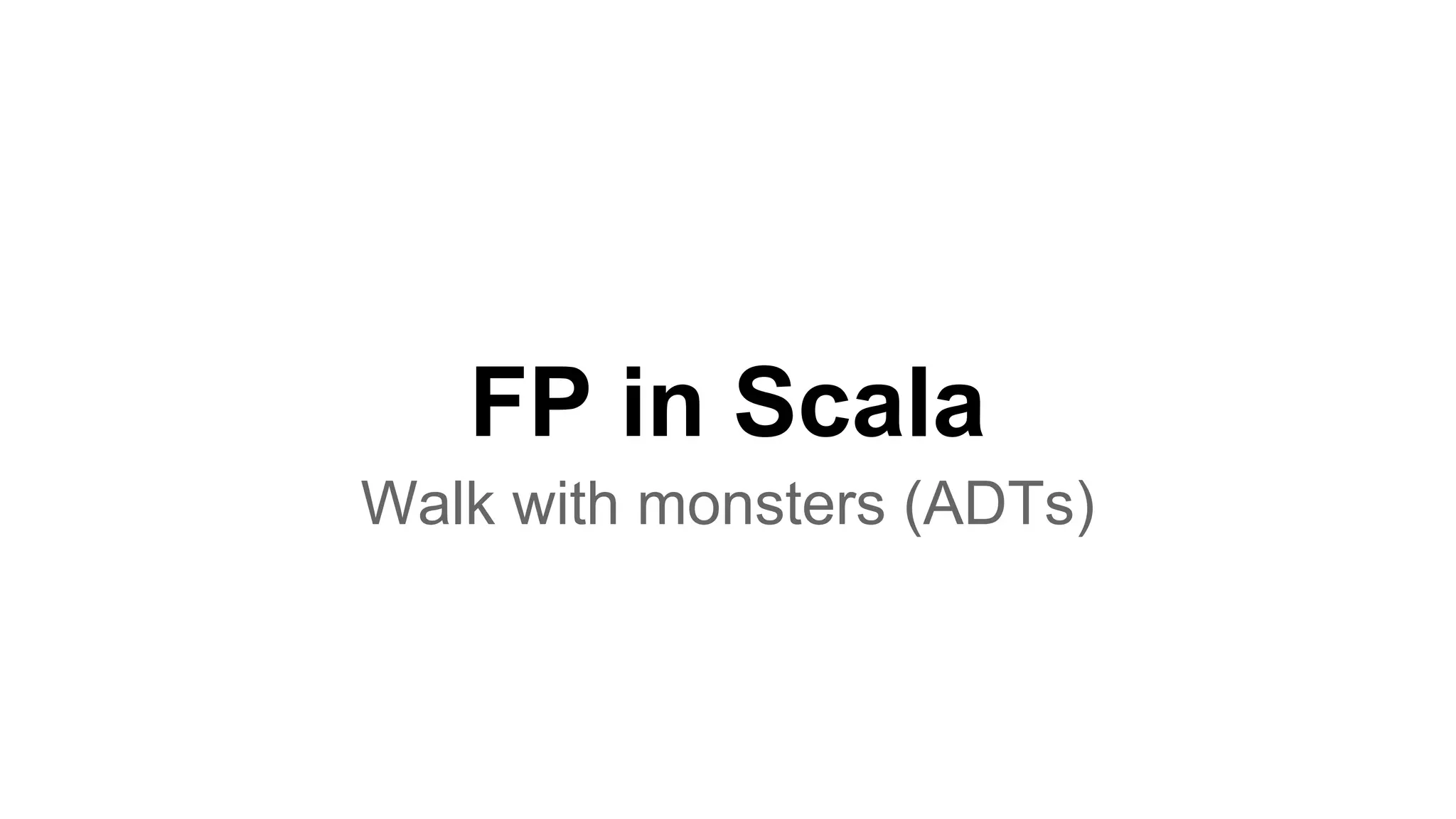
trait Functor[F[_]] {
def map[A,B](fa: F[A])(f: A =>
B): F[B]
}
// Functor Law
// identity: map(x)(id) == x
// composition: map(a)(compose(f,
g)) == map(map(a,g), f)
trait Applictive[F[_]] extends Functor
[F] {
def unit[A](a: => A): F[A]
def ap[A,B](la: F[A])(f: F[A => B]): F
[B]
override def map[A, B](la: F[A])(f: A
=> B): F[B] =
ap(la)(unit(f))
}
// Applicative Law
// identity: ap(a, unit(id)) == a
// composition: ap(ap(a, g), f) == ap(a, ap
(g, ap(f, unit(compose))))
// homomorphism: ap(unit(a), unit(f)) ==
unit(f(a))
// interchange: ap(unit(a), f) == ap(f, unit(f
=> f(x)))
trait Monad[F[_]] extends Applictive[F] {
def unit[A](a: => A): F[A]
def flatMap[A,B](ma: F[A])(f: A => F[B]): F[B]
override def ap[A,B](la: F[A])(f: F[A => B]): F
[B] =
flatMap(f)(t1 => flatMap(la)(t2 => unit(t1
(t2))))
override def map[A,B](ma: F[A])(f: A => B): F
[B] =
flatMap(ma)(a => unit(f(a)))
}
// Monad Law
// left identity: f(a) == flatmap(unit(a), f)
// right identity: a == flatMap(a, x => unit(x))
// associativity: flatMap(a, x => flatMap(f(x), g)) ==
flatMap(flatMap(a, f), g)](https://image.slidesharecdn.com/fpinscalawithadts-140918140658-phpapp02/85/Fp-in-scala-with-adts-2-320.jpg)
: Future[(T, U)]](https://image.slidesharecdn.com/fpinscalawithadts-140918140658-phpapp02/85/Fp-in-scala-with-adts-4-320.jpg)
: A =>
M[C] = ???](https://image.slidesharecdn.com/fpinscalawithadts-140918140658-phpapp02/85/Fp-in-scala-with-adts-5-320.jpg)
![Monad Transformer
Want a Applicative/Monad that has multiple
property by compose 2 or more
Applicatives/Monads, for example.
List[Option[Future[Int]]]
Can this type be also a Applicative/Monad, has ap
and flatMap defined. Can we just have generic way
to do this instead of write one for every type?](https://image.slidesharecdn.com/fpinscalawithadts-140918140658-phpapp02/85/Fp-in-scala-with-adts-6-320.jpg)
![Applicative Composition
trait Functor[F[_]] {
def map[A,B](fa: F[A])(f: A => B): F[B]
}
trait Applictive[F[_]] extends Functor[F] {
def unit[A](a: => A): F[A]
def ap[A,B](la: F[A])(f: F[A => B]): F[B]
override def map[A, B](la: F[A])(f: A => B): F[B] =
ap(la)(unit(f))
def apply2[A, B, C](fa: => F[A], fb: => F[B])(f: (A, B) => C): F
[C] =
ap(fb)(map(fa)(f.curried))
}
trait CompositionApplicative[F[_], G[_]] extends Applicative
[({type λ[α] = F[G[α]]})#λ] {
implicit def F: Applicative[F]
implicit def G: Applicative[G]
def ap[A, B](fa: => F[G[A]])(f: => F[G[A => B]]): F[G[B]]
=
F.apply2(f, fa)((ff, ga) => G.ap(ga)(ff))
def unit[A](a: => A): F[G[A]] = F.unit(G.unit(a))
}
Yes, we can do it for Applicative in a generic way](https://image.slidesharecdn.com/fpinscalawithadts-140918140658-phpapp02/85/Fp-in-scala-with-adts-7-320.jpg)
![Monad Composition
trait Monad[F[_]] extends Applictive[F] {
def unit[A](a: => A): F[A]
def flatMap[A,B](ma: F[A])(f: A => F[B]): F[B]
override def ap[A,B](la: F[A])(f: F[A => B]): F[B] =
flatMap(f)(t1 => flatMap(la)(t2 => unit(t1(t2))))
override def map[A,B](ma: F[A])(f: A => B): F[B] =
flatMap(ma)(a => unit(f(a)))
}
case class OptionT[M[_],A](value: M[Option[A]]) {
self =>
def unit(a: A)(implicit m: Monad[M]): OptionT[M, A] =
new OptionT[M, A](m.unit(Some(a)))
def flatMap[B](f: A => OptionT[M, B])(implicit m: Monad[M])
: OptionT[M, B] = new OptionT[M, B](
m.flatMap(self.value) {
case None => m.unit(None)
case Some(a) => f(a).value
})
}
No, we can not do it for Monad in a generic way](https://image.slidesharecdn.com/fpinscalawithadts-140918140658-phpapp02/85/Fp-in-scala-with-adts-8-320.jpg)
![Foldable
trait Semigroup[A] {
def op(a: A, b: A): A
}
trait Monoid[A] extends Semigroup[A] {
val zero: A
}
trait Foldable[F[_]] {
def foldMap[A,B](fa: F[A], f: A => B)(implicit m: Monoid
[B]): B
/*
def fold[M: Monoid](t: F[M]): M // also called reduce with
variance
def foldRight[A, B](t: F[A], z: => B, f: (A, B) => B): B
def foldLeft[A, B](t: F[A], z: B, f: (B, A) => B): B
def foldr1[A, B](t: F[A], f: (A, => A) => A): Option[A]
def foldl1[A, B](t: F[A], f: (A, A) => A): Option[A]
*/
}
This the definition of
Monoid and Foldable,
simple and generic but very
very useful.
In fact, it is the conceptual
base for MapReduce
With Applicative and
Foldable, we will introduce
Traversable](https://image.slidesharecdn.com/fpinscalawithadts-140918140658-phpapp02/85/Fp-in-scala-with-adts-9-320.jpg)
![Foldable
val IntMonoid = new Monoid[Int] {
def op(a: Int, b: Int): Int = a * b
val zero: Int = 1
}
val ListFodable = new Foldable[List] {
def foldMap[A, B](t: List[A], f: A => B)(implicit m: Monoid[B]): B =
t.foldRight(m.zero)((a,b) => m.op(f(a), b))
}
object test {
val x1 = List(1,2,3,4)
val r1 = ListFodable.foldMap(x1, (x: Int) => x)(IntMonoid)
}
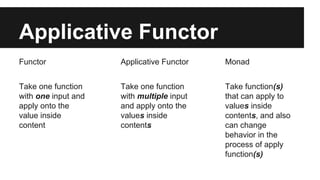
Foldable use a Monoid to
go through a structure, and
in the process return some
aggregated value with the
original structure collapsed.](https://image.slidesharecdn.com/fpinscalawithadts-140918140658-phpapp02/85/Fp-in-scala-with-adts-10-320.jpg)
![Traversable
trait Foldable[F[_]] {
def foldMap[A, M: Monoid](t: F[A], f: A => M): M
}
trait Applicative[F[_]] extends Functor[F]{
def unit[A](a: => A): F[A]
def ap[A,B](fa: F[A])(fab: F[A => B]): F[B]
override def map[A,B](t: F[A])(f: A => B): F[B] =
ap(t)(unit(f))
}
type Const[A, B] = A
implicit def monoidApplicative[M](m: Monoid[M]) =
new Applicative[({ type f[x] = Const[M, x] })#f] {
def unit[A](a: => A): M = m.zero
override def ap[A,B](m1: M)(m2: M): M = m.op
(m1, m2)
}
import scala.Predef.identity
trait Traversable[T[_]] extends Functor[T] with Foldable[T] {
def traverse[F[_]: Applicative, A, B](f: A => F[B], t: T[A]): F[T[B]] // =
sequence(map(t)(f))
def sequence[F[_]: Applicative, A](tfa: T[F[A]]): F[T[A]] = traverse(identity
[F[A]], tfa)
// def mapM[M[_]: Monad, A, B](f: A => M[B], t: T[A]): M[T[B]] = ???
// def sequenceM[M[_]: Monad](tmb: T[M[B]]): M[T[B]] = ???
type Id[A] = A
val Identity = new Applicative[Id] {
def unit[A](a: => A) = a
def ap[A,B](a: A)(f: A => B): B = f(a)
}
override def map[A, B](k: T[A])(f: A => B) = traverse[Id, A, B](f, k)
(Identity)
override def foldMap[A, M](as: T[A], f: A => M)(implicit m: Monoid[M]):
M=
traverse[({type f[x] = Const[M,x]})#f,A,Nothing](f, as)(monoidApplicative
(m))](https://image.slidesharecdn.com/fpinscalawithadts-140918140658-phpapp02/85/Fp-in-scala-with-adts-12-320.jpg)
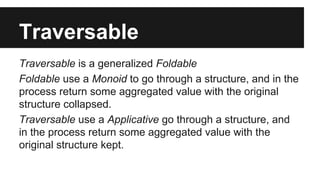
![Traversable
As you can see, transverse preserves the structure, it is the
strength and weakness.
The sequence method is very interesting, F[G[A]], if F is a
Traversable, and G is a Applicative, it in fact can be
reversed as G[F[A]]
It also works with Monad as every Monad is a Applicative
(does not means Monad composable, as you need a
Traversable)
Traversable is composable, like Applicative](https://image.slidesharecdn.com/fpinscalawithadts-140918140658-phpapp02/85/Fp-in-scala-with-adts-13-320.jpg)
![Traversable in Action
import scala.language.higherKinds
val OptionApplicatable = new Applicative[Option] {
def unit[A](a: => A) = Some(a)
def ap[A,B](a: Option[A])(f: Option[A => B]): Option[B] =
f.flatMap {
t1 => a.flatMap {
t2 => unit(t1(t2))
}
}
}
val ListTraversable = new Traversable[List] {
def traverse[F[_], A, B](f: A => F[B], t: List[A])(implicit m:
Applicative[F]): F[List[B]] =
t.foldRight(m.unit(List[B]()))((a, fbs) => m.zip(f(a),fbs)(_
:: _))
}
object test {
val x1 = List(1,2,3,4)
val x2 = List(Option(1), Option(2), Option(3))
val x3 = List(Option(1), Option(2), Option(3), Option(null))
def f1(a: Int): Option[Int] = Some(a)
val r1 = ListTraversable.traverse(f1, x1)(OptionApplicatable)
val r2 = ListTraversable.sequence(x2)(OptionApplicatable)
val r3 = ListTraversable.sequence(x3)(OptionApplicatable)
}](https://image.slidesharecdn.com/fpinscalawithadts-140918140658-phpapp02/85/Fp-in-scala-with-adts-14-320.jpg)

The document discusses Applicative Functors, Monads, Foldables and Traversables in Scala. Some key points: 1. Applicative Functors allow applying functions to values inside data structures in a point-free style, while preserving the structure. 2. Monads are more powerful than Applicative Functors as they can flatten nested structures and change behavior through chaining of functions. 3. Foldables allow aggregating values inside a data structure using a Monoid. Traversables generalize Foldables by keeping the structure intact using an Applicative instead of a Monoid. 4. Composition of Applicative Functors is possible generically, but composition of


