Kleisli composition, flatMap, join, map, unit
a study/memory aid
to help learn/recall their implementation/interrelation
inspired by, and based on, the work of
Rob Norris
@tpolecat @BartoszMilewski
Bartosz Milewski Runar Bjarnason
@runarorama
Paul Chiusano
@pchiusano
VERSION 2 – UPDATED FOR SCALA 3
@philip_schwarz
slides by http://fpilluminated.com/
This slide deck is meant both for (1) those who are familiar with the monadic functions that are Kleisli
composition, unit, map, join and flatMap, and want to reinforce their knowledge (2) and as a memory aid,
for those who sometimes need a reminder of how these functions are implemented and how they
interrelate.
I learned about this subject mainly from Functional Programming in Scala, from Bartosz Milewski’s
YouTube videos (and his book), and from Rob Norris’s YouTube video, Functional Programming with Effects.
@philip_schwarz
Functional Programming in Scala
Rob Norris
@tpolecat
@BartoszMilewski
Bartosz Milewski
Paul Chiusano
Runar Bjarnason
@pchiusano
@runarorama
If you need an intro to, or refresher on, the monadic functions that are
Kleisli composition, unit, map, join and flatMap, then see the following
https://www.slideshare.net/pjschwarz/kleisli-monad-as-functor-with-pair-of-natural-transformations
https://www.slideshare.net/pjschwarz/fish-operator-anatomy
https://www.slideshare.net/pjschwarz/compositionality-and-category-theory-a-montage-of-slidestranscript-for-sections-of-rnar-bjarnasons-keynote-composing-programs
https://www.slideshare.net/pjschwarz/kleisli-composition
https://www.slideshare.net/pjschwarz/rob-norrisfunctionalprogrammingwitheffects
See the final slide of this
deck for some of the
inspiration/ideas I got from
Rob Norris’s video.
case class Insurance(name:String)
case class Car(insurance: Option[Insurance])
case class Person(car: Option[Car])
val car: Person => Option[Car] =
person => person.car
val insurance: Car => Option[Insurance] =
car => car.insurance
val toChars: String => List[Char] = _.toList
val toAscii: Char => List[Char] = _.toInt.toString.toList
assert( toChars("AB") == List('A','B'))
assert( toAscii('A') == List('6','5') )
val carInsurance: Person => Option[Insurance] =
car >=> insurance
val nonDriver= Person(car=None)
val uninsured = Person(Some(Car(insurance=None)))
val insured = Person(Some(Car(Some(Insurance("Acme")))))
assert(carInsurance(nonDriver).isEmpty)
assert(carInsurance(uninsured).isEmpty)
assert(carInsurance(insured).contains(Insurance("Acme")))
val toCharsAscii: String => List[Char] =
toChars >=> toAscii
assert(toCharsAscii("AB") == List('6','5','6','6'))
extension [A,B](f: A => Option[B])
def >=>[C](g: B => Option[C]): A => Option[C] =
a => f(a) match
case Some(b) => g(b)
case None => None
extension [A,B](f: A => List[B])
def >=>[C](g: B => List[C]): A => List[C] =
a => f(a).foldRight(List.empty[C]):
(b, cs) => g(b) ++ cs
A simple example of hand-coding Kleisli composition (i.e. >=>, the fish operator) for Option and List
Option List
We have implemented >=> by hand. Twice. Once for Option and once for List.
Now let’s make >=> generic and implement it in terms of the built-in flatMap
function of the Option and List Monads.
extension [A,B,F[_]: Monad](f: A => F[B])
def >=>[C](g: B => F[C]): A => F[C] =
a => f(a).flatMap(g)
trait Monad[F[_]]:
def unit[A](a: => A): F[A]
extension [A](fa: F[A])
def flatMap[B](f: A => F[B]): F[B]
given Monad[Option] with
def unit[A](a: => A): Option[A] = Some(a)
extension [A](fa: Option[A])
def flatMap[B](f: A => Option[B]): Option[B] = fa.flatMap(f)
given Monad[List] with
def unit[A](a: => A): List[A] = List(a)
extension [A](fa: List[A])
def flatMap[B](f: A => List[B]): List[B] = fa.flatMap(f)
Before After
>=> is hand-coded and specialised for Option and List >=> is generic and defined in terms of built-in flatMap
extension [A,B](f: A => Option[B])
def >=>[C](g: B => Option[C]): A => Option[C] =
a => f(a) match
case Some(b) => g(b)
case None => None
extension [A,B](f: A => List[B])
def >=>[C](g: B => List[C]): A => List[C] =
a => f(a).foldRight(List.empty[C]):
(b, cs) => g(b) ++ cs
I first saw the definition of >=> in a
YouTube video by Bartosz Milewski.
Bartosz Milewski’s definition of the fish operator
(Kleisli composition) in his lecture on monads.
Category Theory 10.1: Monads
@BartoszMilewski
Kleisli Composition (fish operator) >=> compose
Bind >>= flatMap
lifts a to m a (lifts A to F[A]) return unit/pure
See the next
slide for more
class Monad m where
(>>=) :: m a -> (a -> m b) -> m b
return :: a -> m a
class Monad m where
(>=>) :: (a -> m b) -> (b -> m c) -> (a -> m c)
return :: a -> m a
class Functor f where
fmap :: (a -> b) -> f a -> f b
class Functor m => Monad m where
join :: m(m a) -> ma
return :: a -> m a
>=> Kleisli Composition (aka the fish operator)
>>= Bind
f >=> g = λa -> let mb = f a in mb >>= g
= λa -> (f a) >>= g
Kleisli Composition (fish operator) >=> compose
Bind >>= flatMap
lifts a to m a (lifts A to F[A]) return unit/pure
Now let’s hand-code ourselves the flatMap
functions of the Option and List Monads.
given Monad[Option] with
def unit[A](a: => A): Option[A] = Some(a)
extension [A](fa: Option[A])
def flatMap[B](f: A => Option[B]): Option[B] = fa.flatMap(f)
given Monad[List] with
def unit[A](a: => A): List[A] = List(a)
extension [A](fa: List[A])
def flatMap[B](f: A => List[B]): List[B] = fa.flatMap(f)
given Monad[Option] with
def unit[A](a: => A): Option[A] = Some(a)
extension [A](fa: Option[A])
def flatMap[B](f: A => Option[B]): Option[B] =
fa match
case Some(a) => f(a)
case None => None
given Monad[List] with
def unit[A](a: => A): List[A] = List(a)
extension [A](fa: List[A])
def flatMap[B](f: A => List[B]): List[B] =
fa.foldRight(List.empty[B]):
(a,bs) => f(a) ++ bs
trait Monad[F[_]]: extension [A,B,F[_]: Monad](f: A => F[B])
def unit[A](a: => A): F[A] def >=>[C](g: B => F[C]): A => F[C] =
extension [A](fa: F[A]) a => f(a).flatMap(g)
def flatMap[B](f: A => F[B]): F[B]
Before After
>=> is generic and defined in terms of built-in flatMap >=> is generic and defined in terms of hand-coded flatMap
Earlier we implemented a generic >=> in terms of the built-in flatMap
function of the Option and List Monads.
Let’s do that again but this time implementing >=> in terms of the built-in
map and join functions of the Option and List Monads.
@philip_schwarz
in Scala, join is called flatten
The next slide is just a refresher on the fact that it is possible to define a
Monad in terms of unit, map and join, instead of in terms of unit and
flatMap, or in terms of unit and the fish operator. If it is the first time that
you go through this slide deck, you may want to skip the slide.
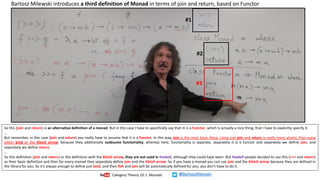
Bartosz Milewski introduces a third definition of Monad in terms of join and return, based on Functor
So this (join and return) is an alternative definition of a monad. But in this case I have to specifically say that m is a Functor, which is actually a nice thing, that I have to explicitly specify it.
…
But remember, in this case (join and return) you really have to assume that it is a functor. In this way, join is the most basic thing. Using just join and return is really more atomic than using
either bind or the Kleisli arrow, because they additionally susbsume functoriality, whereas here, functoriality is separate, separately it is a functor and separately we define join, and
separately we define return.
…
So this definition (join and return) or the definition with the Kleisli arrow, they are not used in Haskell, although they could have been. But Haskell people decided to use this (>>= and return)
as their basic definition and then for every monad they separately define join and the Kleisli arrow. So if you have a monad you can use join and the Kleisli arrow because they are defined in
the library for you. So it’s always enough to define just bind, and then fish and join will be automatically defined for you, you don’t have to do it.
#1
#2
#3
Category Theory 10.1: Monads @BartoszMilewski
given Monad[Option] with
def unit[A](a: => A): Option[A] = Some(a)
extension [A](fa: Option[A])
def map[B](f: A => B): Option[B] = fa.map(f)
extension [A](ffa: Option[Option[A]])
def join: Option[A] = ffa.flatten
given Monad[List] with
def unit[A](a: => A): List[A] = List(a)
extension [A](fa: List[A])
def map[B](f: A => B): List[B] = fa.map(f)
extension [A](ffa: List[List[A]])
def join: List[A] = ffa.flatten
Before After
>=> is generic and defined in terms of built-in flatMap >=> is generic and defined in terms of built-in map and join
given Monad[Option] with
def unit[A](a: => A): Option[A] = Some(a)
extension [A](fa: Option[A])
def flatMap[B](f: A => Option[B]): Option[B] = fa.flatMap(f)
given Monad[List] with
def unit[A](a: => A): List[A] = List(a)
extension [A](fa: List[A])
def flatMap[B](f: A => List[B]): List[B] = fa.flatMap(f)
trait Functor[F[_]]:
extension [A](fa: F[A])
def map[B](f: A => B): F[B]
trait Monad[F[_]] extends Functor[F]:
def unit[A](a: => A): F[A]
extension [A](ffa: F[F[A]])
def join: F[A]
extension [A,B,F[_]: Monad](f: A => F[B])
def >=>[C](g: B => F[C]): A => F[C] =
a => f(a).map(g).join
trait Monad[F[_]]:
def unit[A](a: => A): F[A]
extension [A](fa: F[A])
def flatMap[B](f: A => F[B]): F[B]
extension [A,B,F[_]: Monad](f: A => F[B])
def >=>[C](g: B => F[C]): A => F[C] =
a => f(a).flatMap(g)
Now let’s hand-code ourselves the map and
join functions of the Option and List Monads.
given Monad[Option] with
def unit[A](a: => A): Option[A] = Some(a)
extension [A](fa: Option[A])
def map[B](f: A => B): Option[B] = fa.map(f)
extension [A](ffa: Option[Option[A]])
def join: Option[A] = ffa.flatten
given Monad[List] with
def unit[A](a: => A): List[A] = List(a)
extension [A](fa: List[A])
def map[B](f: A => B): List[B] = fa.map(f)
extension [A](ffa: List[List[A]])
def join: List[A] = ffa.flatten
given Monad[Option] with
def unit[A](a: => A): Option[A] = Some(a)
extension [A](fa: Option[A])
def map[B](f: A => B): Option[B] = fa match
case Some(a) => Some(f(a))
case None => None
extension [A](ffa: Option[Option[A]])
def join: Option[A] = ffa match
case Some(a) => a
case None => None
given Monad[List] with
def unit[A](a: => A): List[A] = List(a)
extension [A](fa: List[A])
def map[B](f: A => B): List[B] =
fa.foldRight(List.empty[B])((a,bs) => f(a)::bs)
extension [A](ffa: List[List[A]])
def join: List[A] =
ffa.foldRight(List.empty[A])((a,bs) => a ++ bs)
trait Functor[F[_]]:
extension [A](fa: F[A])
def map[B](f: A => B): F[B]
trait Monad[F[_]] extends Functor[F]:
def unit[A](a: => A): F[A]
extension [A](ffa: F[F[A]])
def join: F[A]
extension [A,B,F[_]: Monad](f: A => F[B])
def >=>[C](g: B => F[C]): A => F[C] =
a => f(a).map(g).join
Before After
>=> is generic and defined in terms of built-in map and join >=> is generic and defined in terms of hand-coded map and join
I would like to thank Rob Norris for his great talk (see next slide), from
which I learned a lot about Kleisli composition and in which I first saw
the use of a syntax class to add the fish operator to a type class.
scale.bythebay.io
Rob Norris
Functional Programming with Effects
Rob Norris @tpolecat
the fish operator (Kleisli composition),
can be implemented using flatMap.
And this Fishy typeclass that we have derived from nothing,
using math, is Monad. So this scary thing, it just comes
naturally and I haven’t seen people talk about getting to it
from this direction. And so I hope that was helpful.
We can implement compose, the fish operator using
flatMap, so the fish operator is something we can
derive later really, the operation we need is flatMap.
We can define a syntax class
that adds these methods so that
anything that is an F[A], if there
is a Fishy instance, gets these
operations by syntax.

Kleisli composition, flatMap, join, map, unit - implementation and interrelation - V2 updated for Scala 3

  • 1.
    Kleisli composition, flatMap,join, map, unit a study/memory aid to help learn/recall their implementation/interrelation inspired by, and based on, the work of Rob Norris @tpolecat @BartoszMilewski Bartosz Milewski Runar Bjarnason @runarorama Paul Chiusano @pchiusano VERSION 2 – UPDATED FOR SCALA 3 @philip_schwarz slides by http://fpilluminated.com/
  • 2.
    This slide deckis meant both for (1) those who are familiar with the monadic functions that are Kleisli composition, unit, map, join and flatMap, and want to reinforce their knowledge (2) and as a memory aid, for those who sometimes need a reminder of how these functions are implemented and how they interrelate. I learned about this subject mainly from Functional Programming in Scala, from Bartosz Milewski’s YouTube videos (and his book), and from Rob Norris’s YouTube video, Functional Programming with Effects. @philip_schwarz Functional Programming in Scala Rob Norris @tpolecat @BartoszMilewski Bartosz Milewski Paul Chiusano Runar Bjarnason @pchiusano @runarorama If you need an intro to, or refresher on, the monadic functions that are Kleisli composition, unit, map, join and flatMap, then see the following https://www.slideshare.net/pjschwarz/kleisli-monad-as-functor-with-pair-of-natural-transformations https://www.slideshare.net/pjschwarz/fish-operator-anatomy https://www.slideshare.net/pjschwarz/compositionality-and-category-theory-a-montage-of-slidestranscript-for-sections-of-rnar-bjarnasons-keynote-composing-programs https://www.slideshare.net/pjschwarz/kleisli-composition https://www.slideshare.net/pjschwarz/rob-norrisfunctionalprogrammingwitheffects See the final slide of this deck for some of the inspiration/ideas I got from Rob Norris’s video.
  • 3.
    case class Insurance(name:String) caseclass Car(insurance: Option[Insurance]) case class Person(car: Option[Car]) val car: Person => Option[Car] = person => person.car val insurance: Car => Option[Insurance] = car => car.insurance val toChars: String => List[Char] = _.toList val toAscii: Char => List[Char] = _.toInt.toString.toList assert( toChars("AB") == List('A','B')) assert( toAscii('A') == List('6','5') ) val carInsurance: Person => Option[Insurance] = car >=> insurance val nonDriver= Person(car=None) val uninsured = Person(Some(Car(insurance=None))) val insured = Person(Some(Car(Some(Insurance("Acme"))))) assert(carInsurance(nonDriver).isEmpty) assert(carInsurance(uninsured).isEmpty) assert(carInsurance(insured).contains(Insurance("Acme"))) val toCharsAscii: String => List[Char] = toChars >=> toAscii assert(toCharsAscii("AB") == List('6','5','6','6')) extension [A,B](f: A => Option[B]) def >=>[C](g: B => Option[C]): A => Option[C] = a => f(a) match case Some(b) => g(b) case None => None extension [A,B](f: A => List[B]) def >=>[C](g: B => List[C]): A => List[C] = a => f(a).foldRight(List.empty[C]): (b, cs) => g(b) ++ cs A simple example of hand-coding Kleisli composition (i.e. >=>, the fish operator) for Option and List Option List
  • 4.
    We have implemented>=> by hand. Twice. Once for Option and once for List. Now let’s make >=> generic and implement it in terms of the built-in flatMap function of the Option and List Monads.
  • 5.
    extension [A,B,F[_]: Monad](f:A => F[B]) def >=>[C](g: B => F[C]): A => F[C] = a => f(a).flatMap(g) trait Monad[F[_]]: def unit[A](a: => A): F[A] extension [A](fa: F[A]) def flatMap[B](f: A => F[B]): F[B] given Monad[Option] with def unit[A](a: => A): Option[A] = Some(a) extension [A](fa: Option[A]) def flatMap[B](f: A => Option[B]): Option[B] = fa.flatMap(f) given Monad[List] with def unit[A](a: => A): List[A] = List(a) extension [A](fa: List[A]) def flatMap[B](f: A => List[B]): List[B] = fa.flatMap(f) Before After >=> is hand-coded and specialised for Option and List >=> is generic and defined in terms of built-in flatMap extension [A,B](f: A => Option[B]) def >=>[C](g: B => Option[C]): A => Option[C] = a => f(a) match case Some(b) => g(b) case None => None extension [A,B](f: A => List[B]) def >=>[C](g: B => List[C]): A => List[C] = a => f(a).foldRight(List.empty[C]): (b, cs) => g(b) ++ cs
  • 6.
    I first sawthe definition of >=> in a YouTube video by Bartosz Milewski. Bartosz Milewski’s definition of the fish operator (Kleisli composition) in his lecture on monads. Category Theory 10.1: Monads @BartoszMilewski Kleisli Composition (fish operator) >=> compose Bind >>= flatMap lifts a to m a (lifts A to F[A]) return unit/pure See the next slide for more
  • 7.
    class Monad mwhere (>>=) :: m a -> (a -> m b) -> m b return :: a -> m a class Monad m where (>=>) :: (a -> m b) -> (b -> m c) -> (a -> m c) return :: a -> m a class Functor f where fmap :: (a -> b) -> f a -> f b class Functor m => Monad m where join :: m(m a) -> ma return :: a -> m a >=> Kleisli Composition (aka the fish operator) >>= Bind f >=> g = λa -> let mb = f a in mb >>= g = λa -> (f a) >>= g Kleisli Composition (fish operator) >=> compose Bind >>= flatMap lifts a to m a (lifts A to F[A]) return unit/pure
  • 8.
    Now let’s hand-codeourselves the flatMap functions of the Option and List Monads.
  • 9.
    given Monad[Option] with defunit[A](a: => A): Option[A] = Some(a) extension [A](fa: Option[A]) def flatMap[B](f: A => Option[B]): Option[B] = fa.flatMap(f) given Monad[List] with def unit[A](a: => A): List[A] = List(a) extension [A](fa: List[A]) def flatMap[B](f: A => List[B]): List[B] = fa.flatMap(f) given Monad[Option] with def unit[A](a: => A): Option[A] = Some(a) extension [A](fa: Option[A]) def flatMap[B](f: A => Option[B]): Option[B] = fa match case Some(a) => f(a) case None => None given Monad[List] with def unit[A](a: => A): List[A] = List(a) extension [A](fa: List[A]) def flatMap[B](f: A => List[B]): List[B] = fa.foldRight(List.empty[B]): (a,bs) => f(a) ++ bs trait Monad[F[_]]: extension [A,B,F[_]: Monad](f: A => F[B]) def unit[A](a: => A): F[A] def >=>[C](g: B => F[C]): A => F[C] = extension [A](fa: F[A]) a => f(a).flatMap(g) def flatMap[B](f: A => F[B]): F[B] Before After >=> is generic and defined in terms of built-in flatMap >=> is generic and defined in terms of hand-coded flatMap
  • 10.
    Earlier we implementeda generic >=> in terms of the built-in flatMap function of the Option and List Monads. Let’s do that again but this time implementing >=> in terms of the built-in map and join functions of the Option and List Monads. @philip_schwarz in Scala, join is called flatten The next slide is just a refresher on the fact that it is possible to define a Monad in terms of unit, map and join, instead of in terms of unit and flatMap, or in terms of unit and the fish operator. If it is the first time that you go through this slide deck, you may want to skip the slide.
  • 11.
    Bartosz Milewski introducesa third definition of Monad in terms of join and return, based on Functor So this (join and return) is an alternative definition of a monad. But in this case I have to specifically say that m is a Functor, which is actually a nice thing, that I have to explicitly specify it. … But remember, in this case (join and return) you really have to assume that it is a functor. In this way, join is the most basic thing. Using just join and return is really more atomic than using either bind or the Kleisli arrow, because they additionally susbsume functoriality, whereas here, functoriality is separate, separately it is a functor and separately we define join, and separately we define return. … So this definition (join and return) or the definition with the Kleisli arrow, they are not used in Haskell, although they could have been. But Haskell people decided to use this (>>= and return) as their basic definition and then for every monad they separately define join and the Kleisli arrow. So if you have a monad you can use join and the Kleisli arrow because they are defined in the library for you. So it’s always enough to define just bind, and then fish and join will be automatically defined for you, you don’t have to do it. #1 #2 #3 Category Theory 10.1: Monads @BartoszMilewski
  • 12.
    given Monad[Option] with defunit[A](a: => A): Option[A] = Some(a) extension [A](fa: Option[A]) def map[B](f: A => B): Option[B] = fa.map(f) extension [A](ffa: Option[Option[A]]) def join: Option[A] = ffa.flatten given Monad[List] with def unit[A](a: => A): List[A] = List(a) extension [A](fa: List[A]) def map[B](f: A => B): List[B] = fa.map(f) extension [A](ffa: List[List[A]]) def join: List[A] = ffa.flatten Before After >=> is generic and defined in terms of built-in flatMap >=> is generic and defined in terms of built-in map and join given Monad[Option] with def unit[A](a: => A): Option[A] = Some(a) extension [A](fa: Option[A]) def flatMap[B](f: A => Option[B]): Option[B] = fa.flatMap(f) given Monad[List] with def unit[A](a: => A): List[A] = List(a) extension [A](fa: List[A]) def flatMap[B](f: A => List[B]): List[B] = fa.flatMap(f) trait Functor[F[_]]: extension [A](fa: F[A]) def map[B](f: A => B): F[B] trait Monad[F[_]] extends Functor[F]: def unit[A](a: => A): F[A] extension [A](ffa: F[F[A]]) def join: F[A] extension [A,B,F[_]: Monad](f: A => F[B]) def >=>[C](g: B => F[C]): A => F[C] = a => f(a).map(g).join trait Monad[F[_]]: def unit[A](a: => A): F[A] extension [A](fa: F[A]) def flatMap[B](f: A => F[B]): F[B] extension [A,B,F[_]: Monad](f: A => F[B]) def >=>[C](g: B => F[C]): A => F[C] = a => f(a).flatMap(g)
  • 13.
    Now let’s hand-codeourselves the map and join functions of the Option and List Monads.
  • 14.
    given Monad[Option] with defunit[A](a: => A): Option[A] = Some(a) extension [A](fa: Option[A]) def map[B](f: A => B): Option[B] = fa.map(f) extension [A](ffa: Option[Option[A]]) def join: Option[A] = ffa.flatten given Monad[List] with def unit[A](a: => A): List[A] = List(a) extension [A](fa: List[A]) def map[B](f: A => B): List[B] = fa.map(f) extension [A](ffa: List[List[A]]) def join: List[A] = ffa.flatten given Monad[Option] with def unit[A](a: => A): Option[A] = Some(a) extension [A](fa: Option[A]) def map[B](f: A => B): Option[B] = fa match case Some(a) => Some(f(a)) case None => None extension [A](ffa: Option[Option[A]]) def join: Option[A] = ffa match case Some(a) => a case None => None given Monad[List] with def unit[A](a: => A): List[A] = List(a) extension [A](fa: List[A]) def map[B](f: A => B): List[B] = fa.foldRight(List.empty[B])((a,bs) => f(a)::bs) extension [A](ffa: List[List[A]]) def join: List[A] = ffa.foldRight(List.empty[A])((a,bs) => a ++ bs) trait Functor[F[_]]: extension [A](fa: F[A]) def map[B](f: A => B): F[B] trait Monad[F[_]] extends Functor[F]: def unit[A](a: => A): F[A] extension [A](ffa: F[F[A]]) def join: F[A] extension [A,B,F[_]: Monad](f: A => F[B]) def >=>[C](g: B => F[C]): A => F[C] = a => f(a).map(g).join Before After >=> is generic and defined in terms of built-in map and join >=> is generic and defined in terms of hand-coded map and join
  • 15.
    I would liketo thank Rob Norris for his great talk (see next slide), from which I learned a lot about Kleisli composition and in which I first saw the use of a syntax class to add the fish operator to a type class.
  • 16.
    scale.bythebay.io Rob Norris Functional Programmingwith Effects Rob Norris @tpolecat the fish operator (Kleisli composition), can be implemented using flatMap. And this Fishy typeclass that we have derived from nothing, using math, is Monad. So this scary thing, it just comes naturally and I haven’t seen people talk about getting to it from this direction. And so I hope that was helpful. We can implement compose, the fish operator using flatMap, so the fish operator is something we can derive later really, the operation we need is flatMap. We can define a syntax class that adds these methods so that anything that is an F[A], if there is a Fishy instance, gets these operations by syntax.