MOLLUSKS AND
UNIVALVES
BY VANCE JARRETT SANTOS
GRADE 5 SIMON
MOLLUSKS
There are over 50,000 known species of Mollusks, which
makes them second only to the Arthropods in invertebrate
phylum size.
Among the Mollusks are some of the most well known of
invertebrate sea creatures, like snails, clams, mussels, squid,
and octopods.
Mollusks are other animals with soft bodies.
They live in the ocean, streams, ponds, and even in moist
soil.
MOLLUSKS have 3 BODY REGIONS
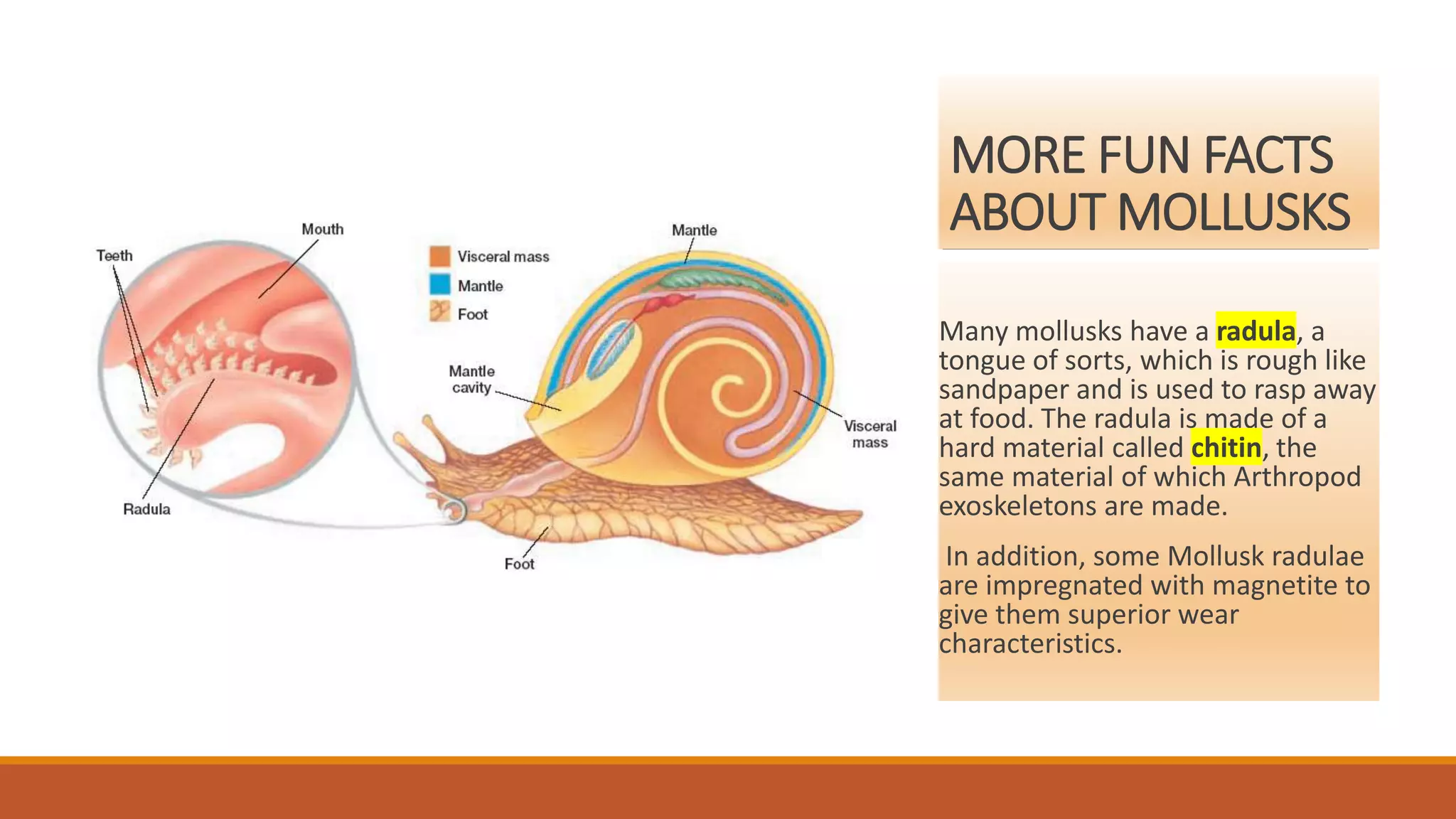
In general, mollusks have 3 body regions: a head, a visceral
mass, and a "foot."
HEAD - contains the sense organs and "brain“
VISCERAL MASS - contains the internal organs
“FOOT" - is the muscular lower part of the body which is in
contact with the substrate
Mollusks usually have a shell (although some do not).
Mollusks also have an extension of the body wall called the
MANTLE. This portion of the animal's anatomy is responsible
for secreting the shell. The mantle encloses the mantle cavity
which contains the Ctenidia (gills), anus and excretory pores.
MORE FUN FACTS
ABOUT MOLLUSKS
Many mollusks have a radula, a
tongue of sorts, which is rough like
sandpaper and is used to rasp away
at food. The radula is made of a
hard material called chitin, the
same material of which Arthropod
exoskeletons are made.
In addition, some Mollusk radulae
are impregnated with magnetite to
give them superior wear
characteristics.
MORE FUN FACTS
ABOUT MOLLUSKS
Mollusks have a digestive system
with two openings and a circulatory
system.
They have gills, a special organ they
use for absorbing oxygen from
water.
They have hard body coverings
called shells that can be single,
double or composed of several
parts.
THREE TYPES
OF MOLLUSKS
1. UNIVALVE OR
GASTROPODS
2. BIVALVES
3. CEPHALOPODS
UNIVALVE OR
GASTROPOD
Univalves are as the name suggests –
‘one’ shell or a shell having one piece.
are also known as gastropods.
A mollusk with a univalve shell
and head that live inside the shell and
or retract outside or inside the shell.
live in the water or outside the water.
Examples of univalves include
abalone, and conchs.
MORE FUN FACTS ABOUT
THE UNIVALVE
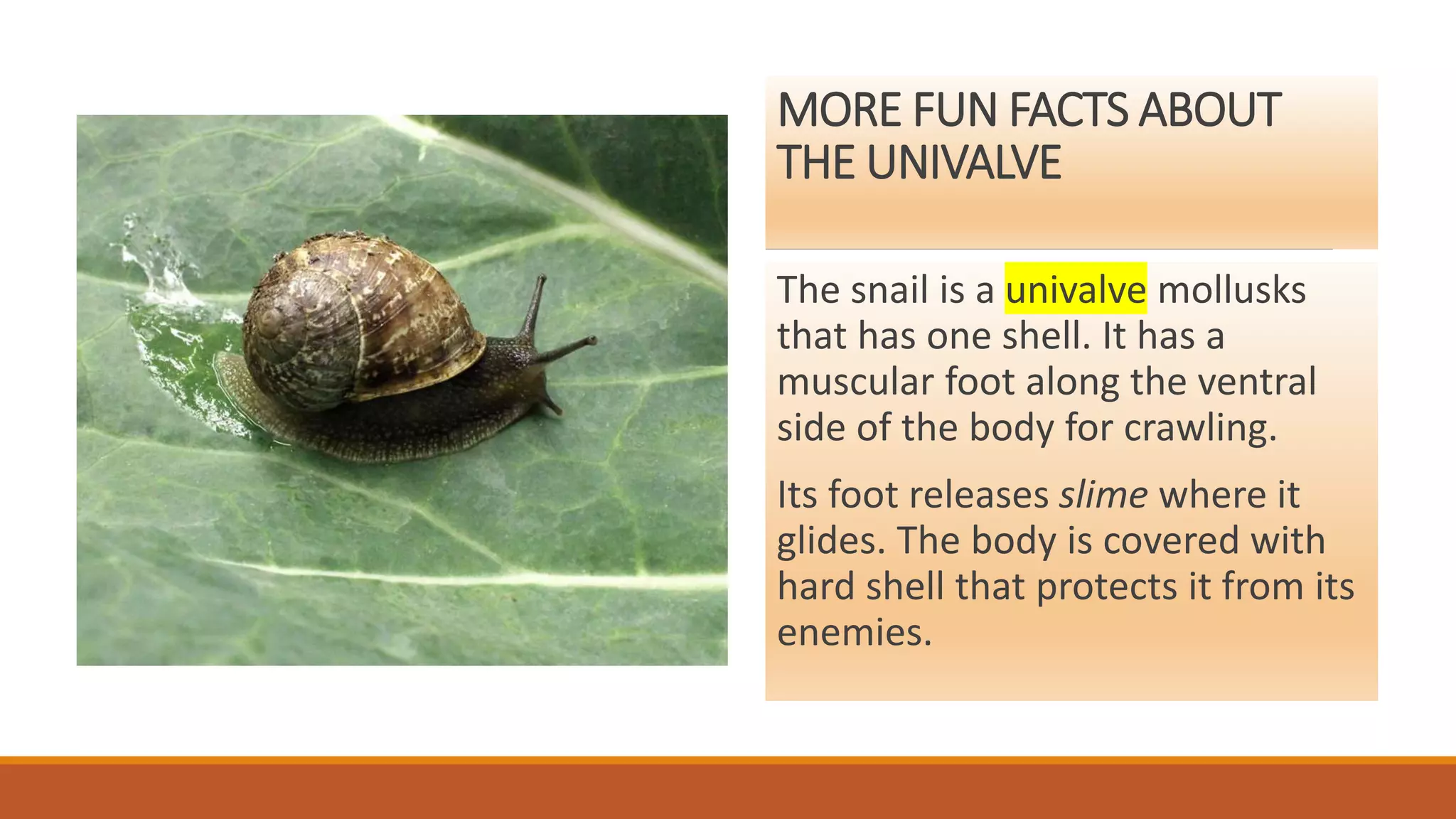
The snail is a univalve mollusks
that has one shell. It has a
muscular foot along the ventral
side of the body for crawling.
Its foot releases slime where it
glides. The body is covered with
hard shell that protects it from its
enemies.
HOW DO UNIVALVES
GROW?
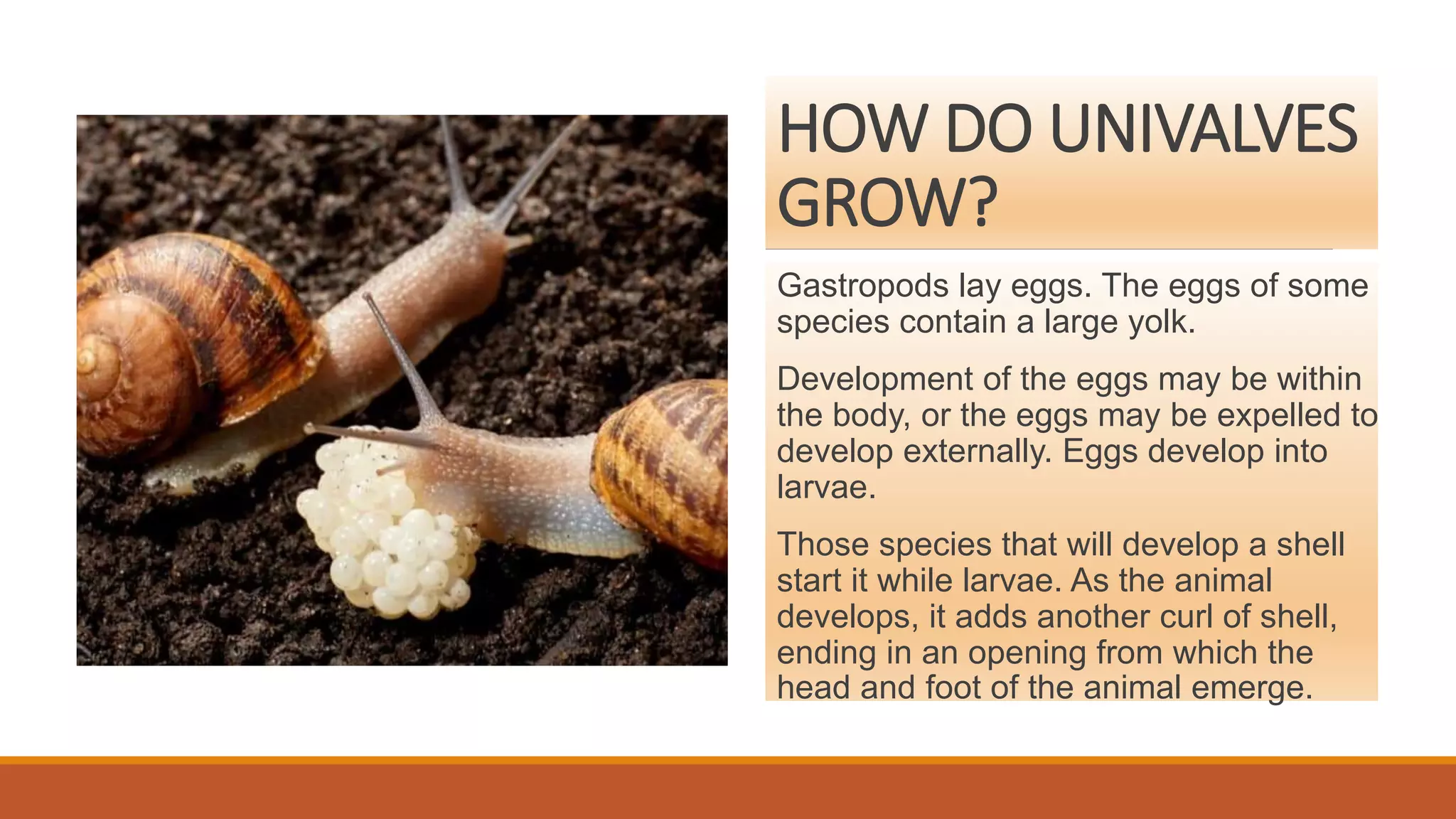
Gastropods lay eggs. The eggs of some
species contain a large yolk.
Development of the eggs may be within
the body, or the eggs may be expelled to
develop externally. Eggs develop into
larvae.
Those species that will develop a shell
start it while larvae. As the animal
develops, it adds another curl of shell,
ending in an opening from which the
head and foot of the animal emerge.
WHAT DO
THEY EAT?
Gastropods feed on very small
things. Most of them scrape or brush
particles from surfaces of rocks,
seaweeds, animals that don't move,
and other objects.
For feeding, gastropods use a
radula, a hard plate that has teeth.
Gastropod feeding habits are
extremely varied, although most
species make use of a radula in
some aspect of their feeding
behavior. Some graze, some browse,
some feed on plankton, some are
scavengers or detritivores, some are
active carnivores.
EXAMPLES OF
UNIVALVES
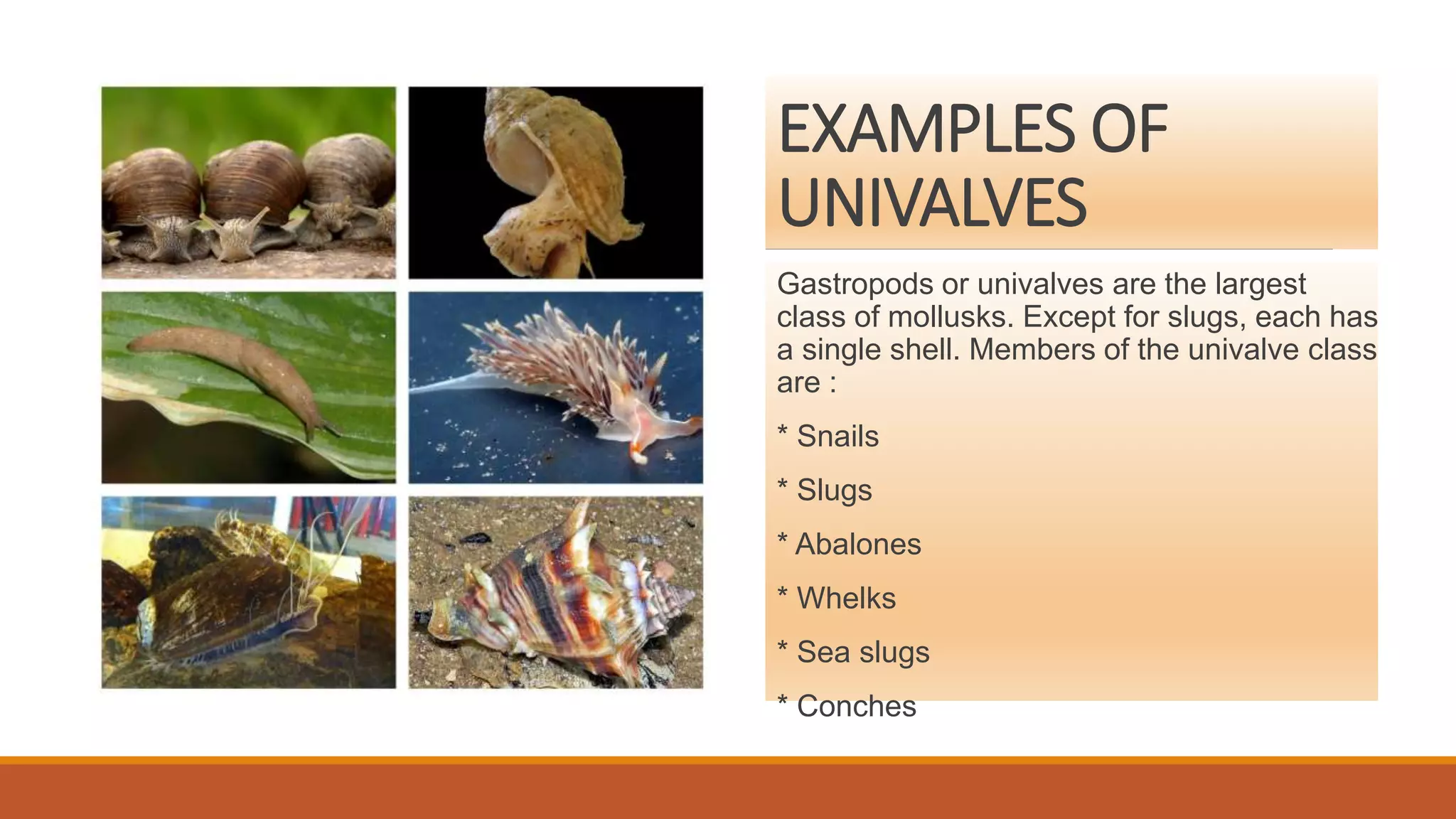
Gastropods or univalves are the largest
class of mollusks. Except for slugs, each has
a single shell. Members of the univalve class
are :
* Snails
* Slugs
* Abalones
* Whelks
* Sea slugs
* Conches
PREPARED AND PRESENTED BY :
VANCE JARRETT SANTOS

MOLLUSKS AND UNIVALVES.pptx

  • 1.
    MOLLUSKS AND UNIVALVES BY VANCEJARRETT SANTOS GRADE 5 SIMON
  • 2.
    MOLLUSKS There are over50,000 known species of Mollusks, which makes them second only to the Arthropods in invertebrate phylum size. Among the Mollusks are some of the most well known of invertebrate sea creatures, like snails, clams, mussels, squid, and octopods. Mollusks are other animals with soft bodies. They live in the ocean, streams, ponds, and even in moist soil.
  • 3.
    MOLLUSKS have 3BODY REGIONS In general, mollusks have 3 body regions: a head, a visceral mass, and a "foot." HEAD - contains the sense organs and "brain“ VISCERAL MASS - contains the internal organs “FOOT" - is the muscular lower part of the body which is in contact with the substrate Mollusks usually have a shell (although some do not). Mollusks also have an extension of the body wall called the MANTLE. This portion of the animal's anatomy is responsible for secreting the shell. The mantle encloses the mantle cavity which contains the Ctenidia (gills), anus and excretory pores.
  • 4.
    MORE FUN FACTS ABOUTMOLLUSKS Many mollusks have a radula, a tongue of sorts, which is rough like sandpaper and is used to rasp away at food. The radula is made of a hard material called chitin, the same material of which Arthropod exoskeletons are made. In addition, some Mollusk radulae are impregnated with magnetite to give them superior wear characteristics.
  • 5.
    MORE FUN FACTS ABOUTMOLLUSKS Mollusks have a digestive system with two openings and a circulatory system. They have gills, a special organ they use for absorbing oxygen from water. They have hard body coverings called shells that can be single, double or composed of several parts.
  • 6.
    THREE TYPES OF MOLLUSKS 1.UNIVALVE OR GASTROPODS 2. BIVALVES 3. CEPHALOPODS
  • 7.
    UNIVALVE OR GASTROPOD Univalves areas the name suggests – ‘one’ shell or a shell having one piece. are also known as gastropods. A mollusk with a univalve shell and head that live inside the shell and or retract outside or inside the shell. live in the water or outside the water. Examples of univalves include abalone, and conchs.
  • 8.
    MORE FUN FACTSABOUT THE UNIVALVE The snail is a univalve mollusks that has one shell. It has a muscular foot along the ventral side of the body for crawling. Its foot releases slime where it glides. The body is covered with hard shell that protects it from its enemies.
  • 9.
    HOW DO UNIVALVES GROW? Gastropodslay eggs. The eggs of some species contain a large yolk. Development of the eggs may be within the body, or the eggs may be expelled to develop externally. Eggs develop into larvae. Those species that will develop a shell start it while larvae. As the animal develops, it adds another curl of shell, ending in an opening from which the head and foot of the animal emerge.
  • 10.
    WHAT DO THEY EAT? Gastropodsfeed on very small things. Most of them scrape or brush particles from surfaces of rocks, seaweeds, animals that don't move, and other objects. For feeding, gastropods use a radula, a hard plate that has teeth. Gastropod feeding habits are extremely varied, although most species make use of a radula in some aspect of their feeding behavior. Some graze, some browse, some feed on plankton, some are scavengers or detritivores, some are active carnivores.
  • 11.
    EXAMPLES OF UNIVALVES Gastropods orunivalves are the largest class of mollusks. Except for slugs, each has a single shell. Members of the univalve class are : * Snails * Slugs * Abalones * Whelks * Sea slugs * Conches
  • 12.
    PREPARED AND PRESENTEDBY : VANCE JARRETT SANTOS