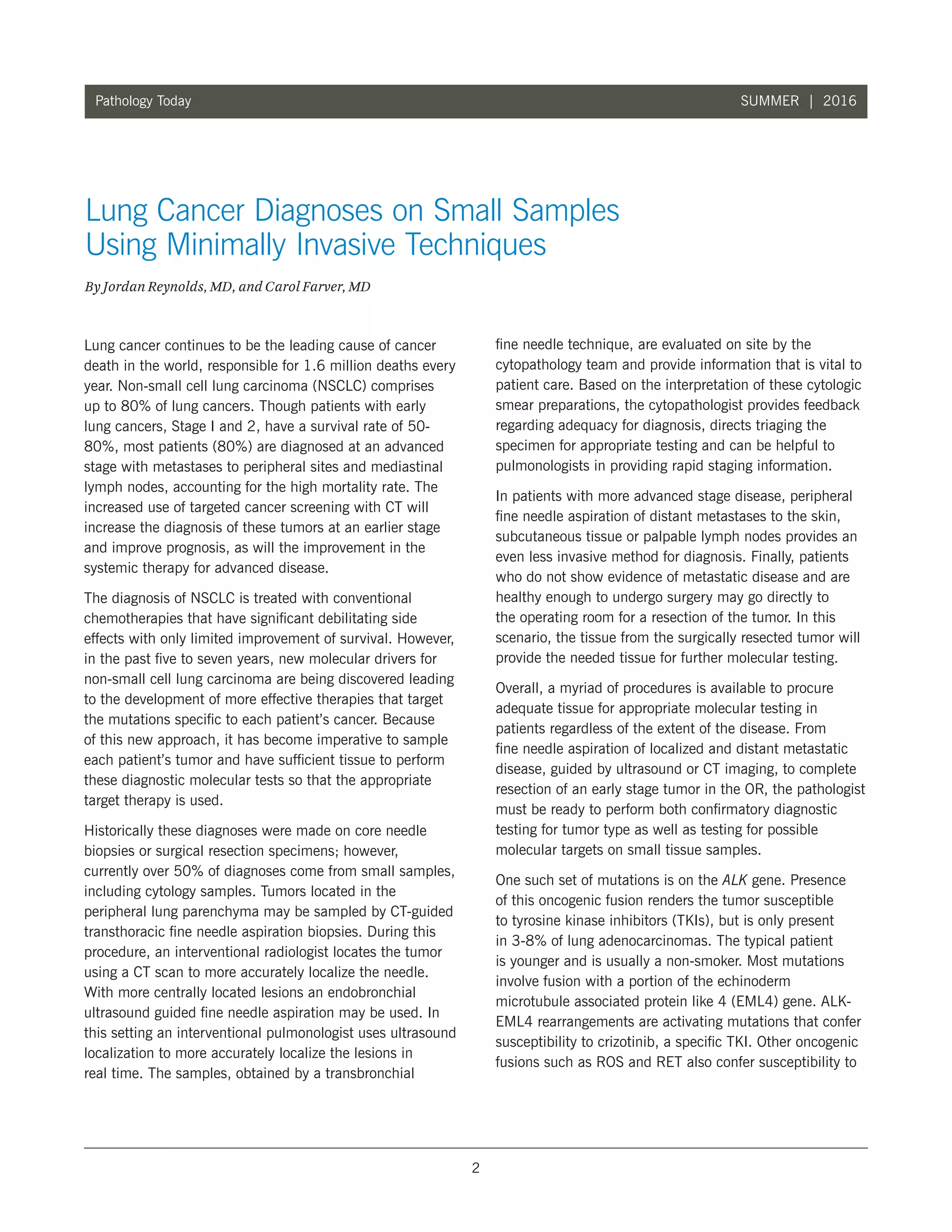
This document discusses lung cancer diagnoses made using minimally invasive techniques on small samples obtained non-surgically. It outlines various procedures like fine needle aspiration that can acquire adequate tissue for molecular testing to guide targeted therapy. Key points include:
- Molecular drivers like ALK, ROS1, RET, and EGFR mutations are increasingly detected to select effective targeted therapies with fewer side effects than chemotherapy.
- Immunohistochemistry, fluorescence in situ hybridization, and next generation sequencing can identify these mutations using small samples from minimally invasive procedures.
- A single fine needle aspiration can provide a diagnosis, tumor subtype, and theranostic molecular information to personalize treatment.
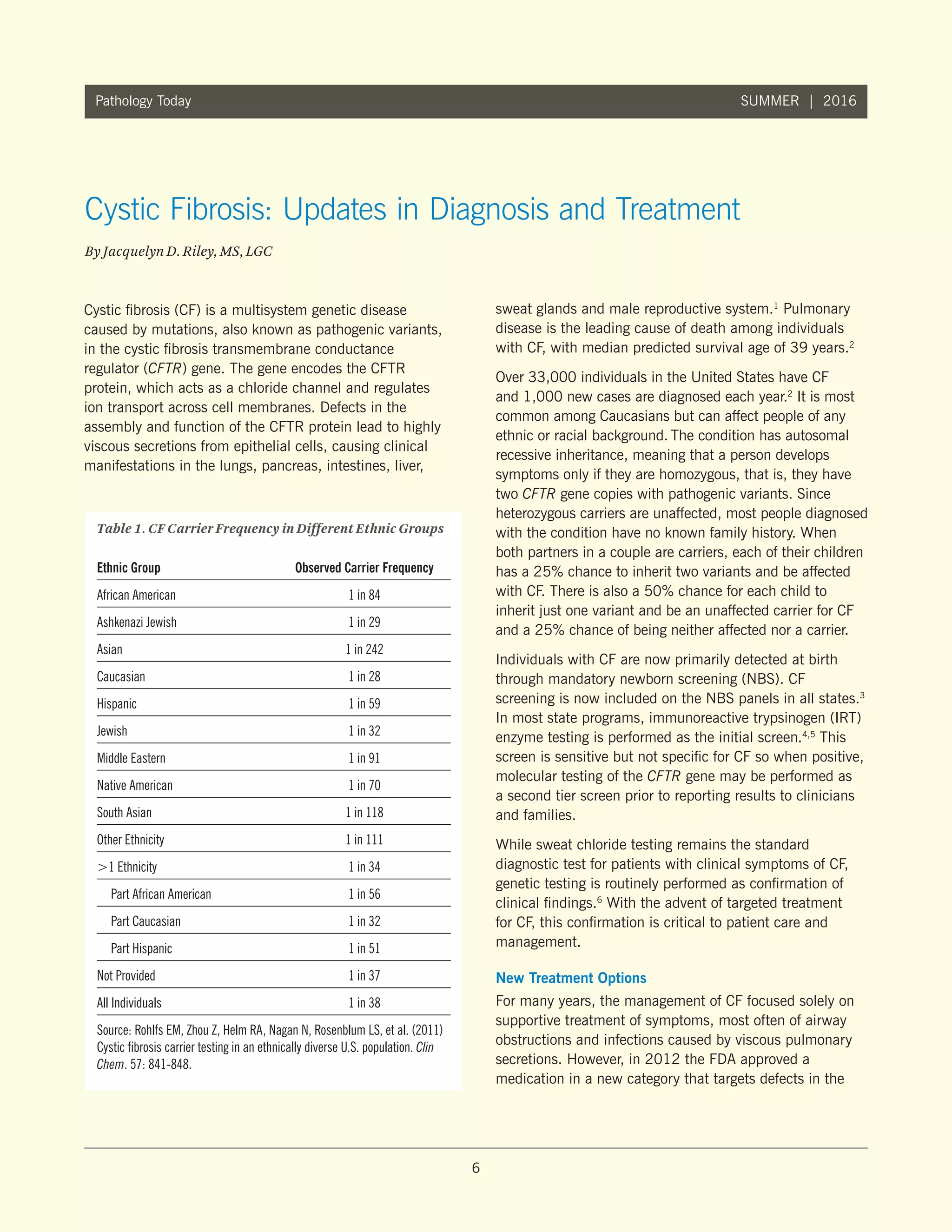
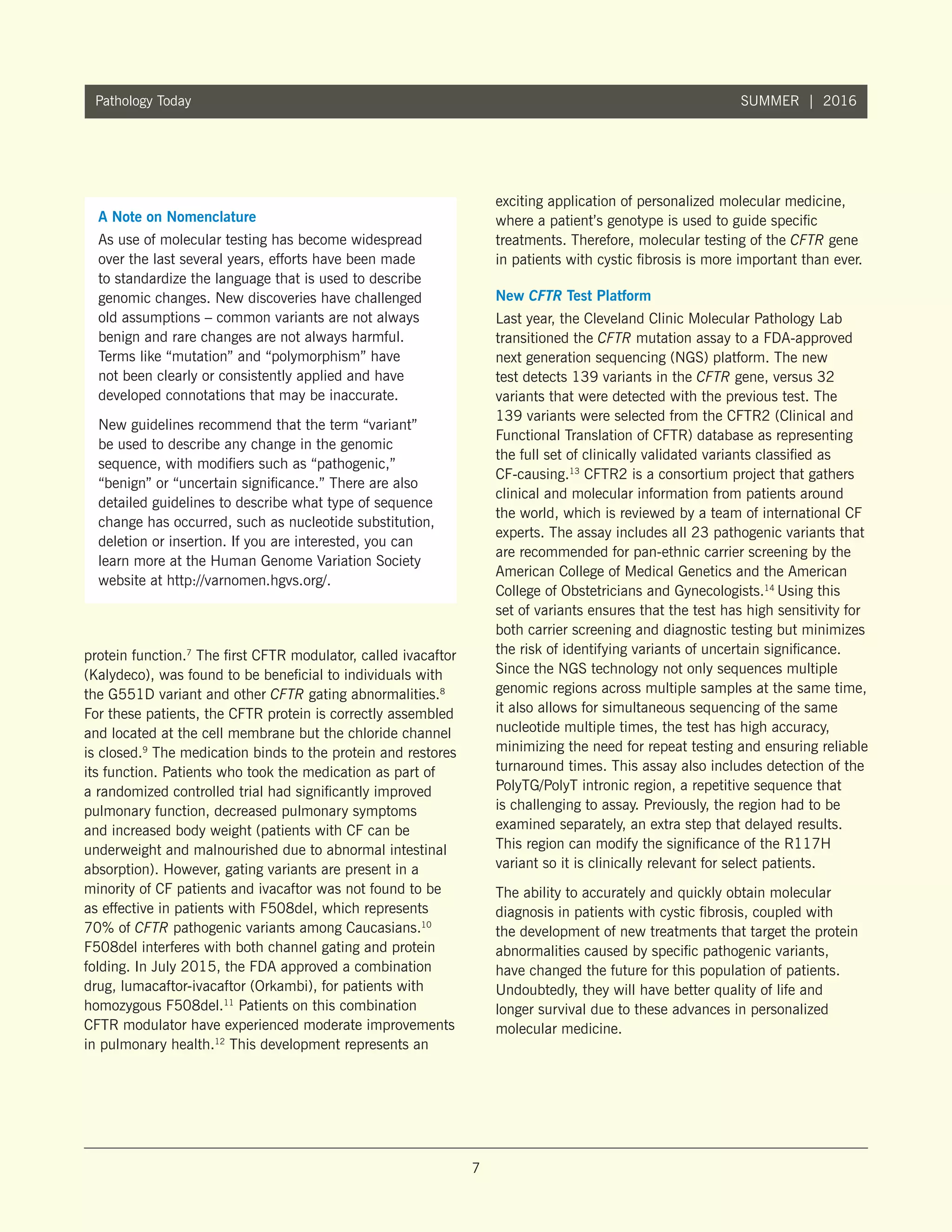
![8
Pathology Today SUMMER | 2016
References
1. Cutting GR. Cystic fibrosis genetics: from molecular
understanding to clinical application. Nat Rev Genet.
2015;16(1):45-56.
2. Cystic Fibrosis Foundation Patient Registry: Annual
Data Report 2014. Available at http://www.cff.org/
[Online].
3. National Newborn Screening and Genetics Resource
Center. National newborn screening status report.
Austin (TX) Available at http://genes-r-us.uthscsa.
edu/sites/ genes-r-us/files/nbsdisorders.pdf [Online].
Updated Nov 02, 2014.
4. Comeau AM, Parad RB, Dorkin HL, Dovey M,
Gerstle R, Haver K, Lapey A, O’Sullivan BP, Waltz
DA, Zwerdling RG, Eaton RB. Population-based
newborn screening for genetic disorders when multiple
mutation DNA testing is incorporated: a cystic fibrosis
newborn screening model demonstrating increased
sensitivity but more carrier detections. Pediatr.
2004;113(6):1573-1581.
5. Sontag MK, Hammond KB, Zielenski J, Wagener JS,
Accurso FJ. Two-tiered immunoreactive trypsinogen
(IRT/IRT)-based newborn screening for cystic fibrosis in
Colorado: screening efficacy and diagnostic outcomes.
J Pediatr. 2005;147(Suppl):S83-8.
6. Farrell PM, Rosenstein BJ, White TB, Accurso FJ,
Castellani C, Gutting GR, Burie PR, LeGrys VA, Massie
J, Parad RB, Rock MJ, Campbell, III, PW. Guidelines
for diagnosis of cystic fibrosis in newborns through
older adults: Cystic Fibrosis Foundation consensus
report. J Pediatr. 2008;153:S4-S14.
7. Food and Drug Administration News Release.
FDA approves Kalydeco to treat rare form of cystic
fibrosis. 2012 Jan 31. Available at http://www.fda.
gov/NewsEvents/Newsroom/PressAnnouncements/
ucm289633.htm [Online].
8. Ramsey BW, Davies J, McElvaney NG, Tullis E, Bell
SC, D˘revínek P, Griese M, McKone EF, Wainwright
CE, Konstan MW, Moss R, Ratjen F, Sermet-Gaudelus
I, Rowe SM, Dong Q, Rodriguez S, Yen K, Ordoñez
C, Elborn JS; VX08-770-102 Study Group. A CFTR
potentiator in patients with cystic fibrosis and
the G551D mutation. N Engl J Med. 2011 Nov
3;365(18):1663-72.
9. Sloane PA, Rowe SM. Cystic fibrosis transmembrane
conductance regulator protein repair as a therapeutic
strategy in cystic fibrosis. Curr Opin Pulm Med. 2010
Nov; 16(6): 591–597.
10. Kerem BS, Rommens JM, Buchanan JA, Markiewicz
D, Cox TK, Charavarti A, Buchwald M, Tsui LC.
Identification of the cystic fibrosis gene: genetic
analysis. Science. 1989;245:1073-1080.
11. Food and Drug Administration News Release. FDA
approves new treatment for cystic fibrosis. 2015
Jul 2. Available at http://www.fda.gov/NewsEvents/
Newsroom/PressAnnouncements/ucm453565.htm
[Online].
12. Wainwright CE, Elborn JS, Ramsey BW, Marigowda G,
Huang X, Cipolli M, Colombo C, Davies JC, De Boeck
K, Flume PA, et al. Lumacaftor-ivacaftor in patients
with cystic fibrosis homozygous for Phe508del CFTR.
N Engl J Med. 2015;373:220–231.
13. The Clinical and Functional Translation of CFTR
(CFTR2). Available at http://www.cftr2.org/ [Online].
14. American College of Obstetricians and Gynecologists
Committee on Genetics. ACOG committee opinion No.
486: Update on Carrier Screening for Cystic Fibrosis.
Obstet Gynecol. 2011;117(4):1028-1031.
15. Cutting GR. Cystic fibrosis genetics: from molecular
understanding to clinical application. Nat Rev Genet.
2015;16(1):45-56.
16. Cystic Fibrosis Foundation Patient Registry: Annual
Data Report 2014. Available at http://www.cff.org/
[Online].
17. National Newborn Screening and Genetics Resource
Center. National newborn screening status report.
Austin (TX) Available at http://genes-r-us.uthscsa.
edu/sites/ genes-r-us/files/nbsdisorders.pdf [Online].
Updated Nov 02, 2014.
18. Comeau AM, Parad RB, Dorkin HL, Dovey M,
Gerstle R, Haver K, Lapey A, O’Sullivan BP, Waltz
DA, Zwerdling RG, Eaton RB. Population-based
newborn screening for genetic disorders when multiple](https://image.slidesharecdn.com/5d2382e7-c8ee-4fd1-8d2f-e7a1fc2d3c7a-161219050225/75/Pathology-Today-2016-Q2-8-2048.jpg)
![9
Pathology Today SUMMER | 2016
mutation DNA testing is incorporated: a cystic fibrosis
newborn screening model demonstrating increased
sensitivity but more carrier detections. Pediatr.
2004;113(6):1573-1581.
19. Sontag MK, Hammond KB, Zielenski J, Wagener JS,
Accurso FJ. Two-tiered immunoreactive trypsinogen
(IRT/IRT)-based newborn screening for cystic fibrosis in
Colorado: screening efficacy and diagnostic outcomes.
J Pediatr. 2005;147(Suppl):S83-8.
20. Farrell PM, Rosenstein BJ, White TB, Accurso FJ,
Castellani C, Gutting GR, Burie PR, LeGrys VA, Massie
J, Parad RB, Rock MJ, Campbell, III, PW. Guidelines
for diagnosis of cystic fibrosis in newborns through
older adults: Cystic Fibrosis Foundation consensus
report. J Pediatr. 2008;153:S4-S14.
21. Food and Drug Administration News Release.
FDA approves Kalydeco to treat rare form of cystic
fibrosis. 2012 Jan 31. Available at http://www.fda.
gov/NewsEvents/Newsroom/PressAnnouncements/
ucm289633.htm [Online].
22. Ramsey BW, Davies J, McElvaney NG, Tullis E, Bell
SC, D˘revínek P, Griese M, McKone EF, Wainwright
CE, Konstan MW, Moss R, Ratjen F, Sermet-Gaudelus
I, Rowe SM, Dong Q, Rodriguez S, Yen K, Ordoñez
C, Elborn JS; VX08-770-102 Study Group. A CFTR
potentiator in patients with cystic fibrosis and
the G551D mutation. N Engl J Med. 2011 Nov
3;365(18):1663-72.
23. Sloane PA, Rowe SM. Cystic fibrosis transmembrane
conductance regulator protein repair as a therapeutic
strategy in cystic fibrosis. Curr Opin Pulm Med. 2010
Nov; 16(6): 591–597.
24. Kerem BS, Rommens JM, Buchanan JA, Markiewicz
D, Cox TK, Charavarti A, Buchwald M, Tsui LC.
Identification of the cystic fibrosis gene: genetic
analysis. Science. 1989;245:1073-1080.
25. Food and Drug Administration News Release. FDA
approves new treatment for cystic fibrosis. 2015
Jul 2. Available at http://www.fda.gov/NewsEvents/
Newsroom/PressAnnouncements/ucm453565.htm
[Online].
26. Wainwright CE, Elborn JS, Ramsey BW, Marigowda G,
Huang X, Cipolli M, Colombo C, Davies JC, De Boeck
K, Flume PA, et al. Lumacaftor-ivacaftor in patients
with cystic fibrosis homozygous for Phe508del CFTR.
N Engl J Med. 2015;373:220–231.
27. The Clinical and Functional Translation of CFTR
(CFTR2). Available at http://www.cftr2.org/ [Online].
28. American College of Obstetricians and Gynecologists
Committee on Genetics. ACOG committee opinion No.
486: Update on Carrier Screening for Cystic Fibrosis.
Obstet Gynecol. 2011;117(4):1028-1031.
For a disease summary, see: Moskowitz SM, Chmiel JF,
Sternen DL, Cheng E, Cutting GR. CFTR-related disorders.
Pagon RA, Bird TC, Dolan CR, Stephens K, editors.
GeneReviews. Seattle (WA): University of Washington;
2008. Available at www.ncbi.nlm.nih.gov/books/
NBK1250. [Online] Updated Feb 19, 2008.
About the Author
Jacquelyn Riley, MS, LGC
Certified Genetic Counselor
Jacquelyn Riley is a genetic
counselor in the Cleveland Clinic
Pathology Laboratory Medicine
Institute. She received a masters
in science degree in medical
genetics from the University of
Wisconsin-Madison. Before joining Cleveland Clinic in
June 2011, she worked for Spectrum Health in Grand
Rapids and Kalamazoo, Michigan, where she specialized
in prenatal genetic counseling and also worked in the
adult general genetics clinic. She is Cleveland Clinic’s first
laboratory genetic counselor, where she supports molecular
genetics, cytogenetics and prenatal screening labs. Her
interests include appropriate genetic test utilization and
the variety of roles that genetic counselors can play in
clinical laboratories. She is an active member of the
National Society of Genetic Counselors where she co-
chairs the Test Utilization Sub-committee. Riley can be
reached at rileyj2@ccf.org or through Client Services at
800.628.6816.](https://image.slidesharecdn.com/5d2382e7-c8ee-4fd1-8d2f-e7a1fc2d3c7a-161219050225/75/Pathology-Today-2016-Q2-9-2048.jpg)


![[SSA] 01.bigdata database technology (2014.02.05)](https://cdn.slidesharecdn.com/ss_thumbnails/01-140225072202-phpapp02-thumbnail.jpg?width=640&height=640&fit=bounds)


