Moira Bent, Newcastle University.
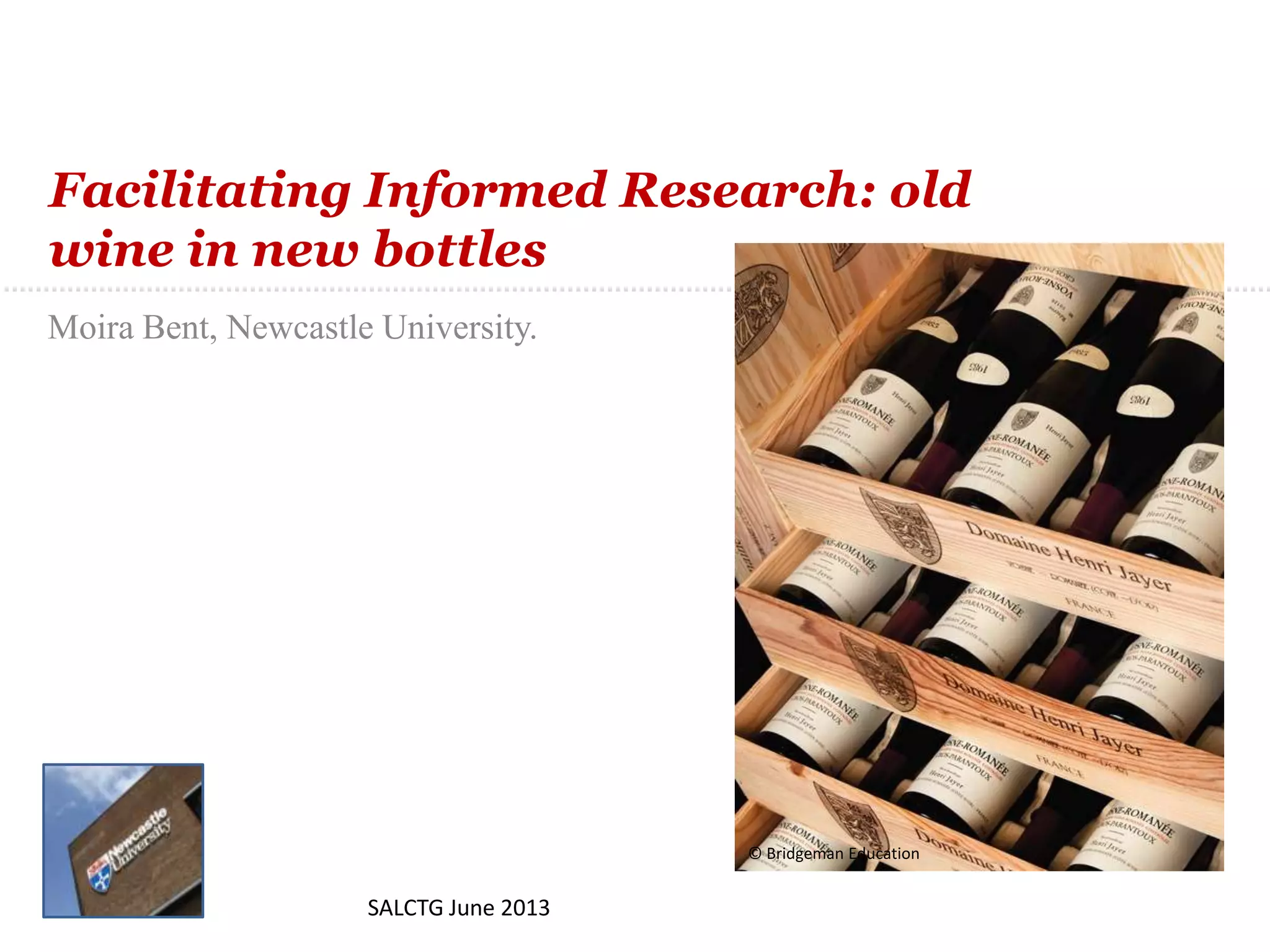
Facilitating Informed Research: old
wine in new bottles
SALCTG June 2013
© Bridgeman Education© Bridgeman Education
What do researchers do?
SALCTG June 2013
© Bridgeman Education
What the researchers said
Research is
• Theory-led; Data-led; Scholarship
• Grounded in disciplines; multi / inter / trans disciplinary
• Investigation; interpretation; gathering evidence
• A holistic activity; a set of transferable skills
• Collaborative / solo activity
• Related to self
• Validated by peer group
• Made meaningful by an external audience
SALCTG June 2013
© Bridgeman Education
What do researchers do?
 Manage research projects
 Search for existing information
 Seek out new data
 Analyse information and data
 Evaluate information and data
 Manage information and data
 Communicate
 Network
 Write and present their findings
 Market their outcomes
“Research is a process of investigation leading to
new insights, effectively shared”
David Sweeney, HEFCE, April 2013
SALCTG June 2013
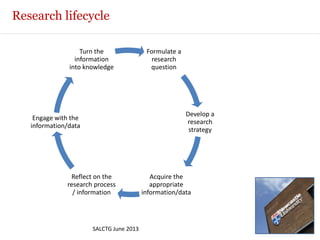
Research lifecycle
SALCTG June 2013
Formulate a
research
question
Develop a
research
strategy
Acquire the
appropriate
information/data
Reflect on the
research process
/ information
Engage with the
information/data
Turn the
information
into knowledge
Are all researchers the same?
 Disciplinary differences
 Age
 Experience
 Motivation
 Funding
 Workplace - HE, Industry, independent research
body....
 Stage in their research “lifecycle”
 Personal preferences – learning styles, habits,
attitudes.
SALCTG June 2013
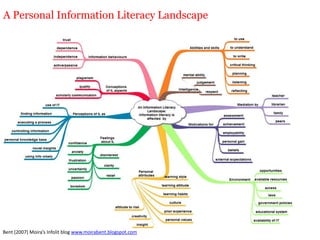
A Personal Information Literacy Landscape
Bent (2007) Moira’s Infolit blog www.moirabent.blogspot.com
The 7 ages concept – the researcher’s lifecycle
 Masters students
 Doctoral students
 Contract researchers
 Early career researchers
 Established academic staff
 Senior researchers
 Experts
Bent, M., Gannon-Leary, P. and Webb, J. (2007) 'Information Literacy in a
researcher‟s learning life: the 7 ages of research. ', New Review of Information
Networking, 13, (2), pp. 81-99.
SALCTG June 2013
Early
 Apprenticeship - influenced by supervisors / tutors / mentors
 Skills and competences are defined
 Different levels of control
 Transition from structured learning to self-organization
 Interaction between personal life / prior experiences
 Managing different roles e.g. other jobs, developing teaching skills
 Information consumer, objective is production
SALCTG June 2013
Mid
• Moving field / moving role / learning a different landscape
• Balancing teaching and research
• Situating themselves / making their name / establishing credentials
– locally (e.g. in department)
– wider research community
• Need to be adaptable / avoiding isolation
• Starting to supervise other researchers
• Starting role in management / administration
• Information production and consumption
• Shift from systematic to pragmatic information retrieval
„Librarians love to search. Everyone else likes to find‟
SALCTG June 2013
Late / Senior
• Developing into/ having a significant role in research leadership and
administration
• Leading research teams / research centres / research projects / mainstream
management
• Supervising and examining theses
• Teaching research methods
• Plenary conference speaker
• Editorial board of journals etc.
• Refereeing / peer reviewer / specialist assessor
• Disseminating research practice or defining their field
SALCTG June 2013
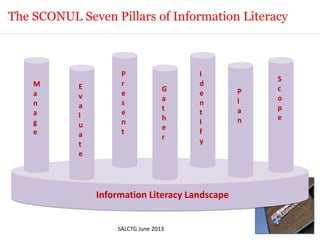
Information Literacy Landscape
M
a
n
a
g
e
P
r
e
s
e
n
t
E
v
a
l
u
a
t
e
I
d
e
n
t
I
f
y
G
a
t
h
e
r
S
c
o
p
e
P
l
a
n
The SCONUL Seven Pillars of Information Literacy
SALCTG June 2013
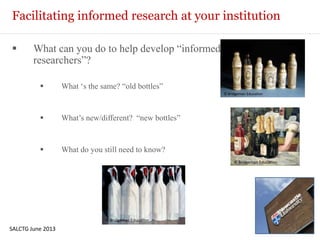
Facilitating informed research at your institution
 What can you do to help develop “informed
researchers”?
 What „s the same? “old bottles”
 What‟s new/different? “new bottles”
 What do you still need to know?
SALCTG June 2013
© Bridgeman Education
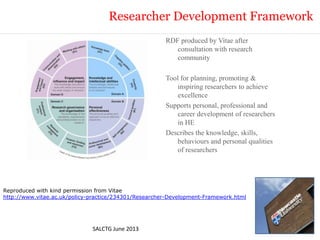
RDF produced by Vitae after
consultation with research
community
Tool for planning, promoting &
inspiring researchers to achieve
excellence
Supports personal, professional and
career development of researchers
in HE
Describes the knowledge, skills,
behaviours and personal qualities
of researchers
Researcher Development Framework
Reproduced with kind permission from Vitae
http://www.vitae.ac.uk/policy-practice/234301/Researcher-Development-Framework.html
SALCTG June 2013
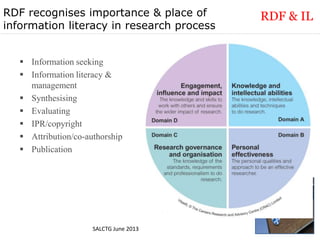
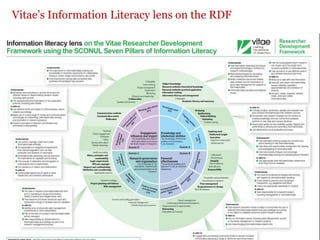
 Information seeking
 Information literacy &
management
 Synthesising
 Evaluating
 IPR/copyright
 Attribution/co-authorship
 Publication
RDF recognises importance & place of
information literacy in research process
RDF & IL
SALCTG June 2013
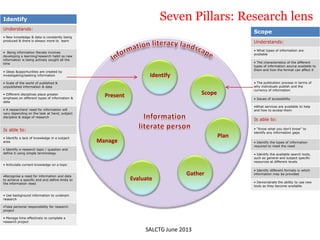
Seven Pillars: Research lens
Scope
Understands:
• What types of information are
available
• The characteristics of the different
types of information source available to
them and how the format can affect it
• The publication process in terms of
why individuals publish and the
currency of information
• Issues of accessibility
•What services are available to help
and how to access them
Is able to:
• “Know what you don’t know” to
identify any information gaps
• Identify the types of information
required to meet the need
• Identify the available search tools,
such as general and subject specific
resources at different levels
• Identify different formats in which
information may be provided
• Demonstrate the ability to use new
tools as they become available
Identify
Understands:
• New knowledge & data is constantly being
produced & there is always more to learn
• Being information literate involves
developing a learning/research habit so new
information is being actively sought all the
time
• Ideas &opportunities are created by
investigating/seeking information
• Scale of the world of published &
unpublished information & data
• Different disciplines place greater
emphasis on different types of information &
data
• A researchers’ need for information will
vary depending on the task at hand, subject
discipline & stage of research
Is able to:
• Identify a lack of knowledge in a subject
area
• Identify a research topic / question and
define it using simple terminology
• Articulate current knowledge on a topic
•Recognise a need for information and data
to achieve a specific end and define limits to
the information need
• Use background information to underpin
research
•Take personal responsibility for research
project
• Manage time effectively to complete a
research project
Identify
Scope
Plan
Gather
Evaluate
Manage
Present
SALCTG June 2013
Vitae’s Information Literacy lens on the RDF
The Informed Researcher
SALCTG June 2013
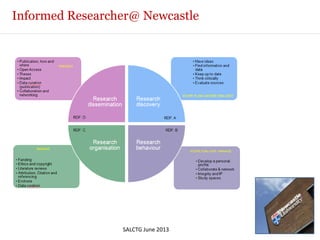
Informed Researcher@ Newcastle
SALCTG June 2013
Old and new bottles?
 Structures
 Subject staff with additional/changed roles &/or Specialist Research
Support Librarian
 Blurred roles of library and other university departments – alliances and
collaborations
 Buildings and Locations
 Retaining the “wow” factor of a scholarly research collection
 Dedicated space in the library for researchers
 Taking the research support service to the users
 Collections
 Archives and special collections as USP
 Traditional research monographs
 Access to everything they need, where they need it, when they need it
 Specific research activities
 Systematic reviews
 Institutional repository / REF
 Data curation and management
 Information Literacy
 IL Skills: Finding, using, managing, but extending into how and where to
publish, bibliometrics
 IL attributes: Understanding their role and responsibilities
SALCTG June 2013
© Bridgeman Education
Thank you
 Moira Bent
moira.bent@newcastle.ac.uk
 More about RIDLs:
http://www.researchinfonet.org/infolit/ridls/
 Download the Vitae resources:
http://tinyurl.com/aqmnlhs
SALCTG June 2013
© Bridgeman Education

Moira Bent "Facilitating informed research: old wine in new bottles” SALCTG June 2013

  • 1.
    Moira Bent, NewcastleUniversity. Facilitating Informed Research: old wine in new bottles SALCTG June 2013 © Bridgeman Education© Bridgeman Education
  • 2.
    What do researchersdo? SALCTG June 2013 © Bridgeman Education
  • 3.
    What the researcherssaid Research is • Theory-led; Data-led; Scholarship • Grounded in disciplines; multi / inter / trans disciplinary • Investigation; interpretation; gathering evidence • A holistic activity; a set of transferable skills • Collaborative / solo activity • Related to self • Validated by peer group • Made meaningful by an external audience SALCTG June 2013 © Bridgeman Education
  • 4.
    What do researchersdo?  Manage research projects  Search for existing information  Seek out new data  Analyse information and data  Evaluate information and data  Manage information and data  Communicate  Network  Write and present their findings  Market their outcomes “Research is a process of investigation leading to new insights, effectively shared” David Sweeney, HEFCE, April 2013 SALCTG June 2013
  • 5.
    Research lifecycle SALCTG June2013 Formulate a research question Develop a research strategy Acquire the appropriate information/data Reflect on the research process / information Engage with the information/data Turn the information into knowledge
  • 6.
    Are all researchersthe same?  Disciplinary differences  Age  Experience  Motivation  Funding  Workplace - HE, Industry, independent research body....  Stage in their research “lifecycle”  Personal preferences – learning styles, habits, attitudes. SALCTG June 2013
  • 7.
    A Personal InformationLiteracy Landscape Bent (2007) Moira’s Infolit blog www.moirabent.blogspot.com
  • 8.
    The 7 agesconcept – the researcher’s lifecycle  Masters students  Doctoral students  Contract researchers  Early career researchers  Established academic staff  Senior researchers  Experts Bent, M., Gannon-Leary, P. and Webb, J. (2007) 'Information Literacy in a researcher‟s learning life: the 7 ages of research. ', New Review of Information Networking, 13, (2), pp. 81-99. SALCTG June 2013
  • 9.
    Early  Apprenticeship -influenced by supervisors / tutors / mentors  Skills and competences are defined  Different levels of control  Transition from structured learning to self-organization  Interaction between personal life / prior experiences  Managing different roles e.g. other jobs, developing teaching skills  Information consumer, objective is production SALCTG June 2013
  • 10.
    Mid • Moving field/ moving role / learning a different landscape • Balancing teaching and research • Situating themselves / making their name / establishing credentials – locally (e.g. in department) – wider research community • Need to be adaptable / avoiding isolation • Starting to supervise other researchers • Starting role in management / administration • Information production and consumption • Shift from systematic to pragmatic information retrieval „Librarians love to search. Everyone else likes to find‟ SALCTG June 2013
  • 11.
    Late / Senior •Developing into/ having a significant role in research leadership and administration • Leading research teams / research centres / research projects / mainstream management • Supervising and examining theses • Teaching research methods • Plenary conference speaker • Editorial board of journals etc. • Refereeing / peer reviewer / specialist assessor • Disseminating research practice or defining their field SALCTG June 2013
  • 12.
  • 13.
    Facilitating informed researchat your institution  What can you do to help develop “informed researchers”?  What „s the same? “old bottles”  What‟s new/different? “new bottles”  What do you still need to know? SALCTG June 2013 © Bridgeman Education © Bridgeman Education © Bridgeman Education
  • 14.
    RDF produced byVitae after consultation with research community Tool for planning, promoting & inspiring researchers to achieve excellence Supports personal, professional and career development of researchers in HE Describes the knowledge, skills, behaviours and personal qualities of researchers Researcher Development Framework Reproduced with kind permission from Vitae http://www.vitae.ac.uk/policy-practice/234301/Researcher-Development-Framework.html SALCTG June 2013
  • 15.
     Information seeking Information literacy & management  Synthesising  Evaluating  IPR/copyright  Attribution/co-authorship  Publication RDF recognises importance & place of information literacy in research process RDF & IL SALCTG June 2013
  • 16.
    Seven Pillars: Researchlens Scope Understands: • What types of information are available • The characteristics of the different types of information source available to them and how the format can affect it • The publication process in terms of why individuals publish and the currency of information • Issues of accessibility •What services are available to help and how to access them Is able to: • “Know what you don’t know” to identify any information gaps • Identify the types of information required to meet the need • Identify the available search tools, such as general and subject specific resources at different levels • Identify different formats in which information may be provided • Demonstrate the ability to use new tools as they become available Identify Understands: • New knowledge & data is constantly being produced & there is always more to learn • Being information literate involves developing a learning/research habit so new information is being actively sought all the time • Ideas &opportunities are created by investigating/seeking information • Scale of the world of published & unpublished information & data • Different disciplines place greater emphasis on different types of information & data • A researchers’ need for information will vary depending on the task at hand, subject discipline & stage of research Is able to: • Identify a lack of knowledge in a subject area • Identify a research topic / question and define it using simple terminology • Articulate current knowledge on a topic •Recognise a need for information and data to achieve a specific end and define limits to the information need • Use background information to underpin research •Take personal responsibility for research project • Manage time effectively to complete a research project Identify Scope Plan Gather Evaluate Manage Present SALCTG June 2013
  • 17.
  • 18.
  • 19.
  • 20.
    Old and newbottles?  Structures  Subject staff with additional/changed roles &/or Specialist Research Support Librarian  Blurred roles of library and other university departments – alliances and collaborations  Buildings and Locations  Retaining the “wow” factor of a scholarly research collection  Dedicated space in the library for researchers  Taking the research support service to the users  Collections  Archives and special collections as USP  Traditional research monographs  Access to everything they need, where they need it, when they need it  Specific research activities  Systematic reviews  Institutional repository / REF  Data curation and management  Information Literacy  IL Skills: Finding, using, managing, but extending into how and where to publish, bibliometrics  IL attributes: Understanding their role and responsibilities SALCTG June 2013 © Bridgeman Education
  • 21.
    Thank you  MoiraBent moira.bent@newcastle.ac.uk  More about RIDLs: http://www.researchinfonet.org/infolit/ridls/  Download the Vitae resources: http://tinyurl.com/aqmnlhs SALCTG June 2013 © Bridgeman Education