Computing Essentials 2014
Privacy, Security and Ethics
© 2014 by McGraw-Hill Education. This proprietary material solely for authorized instructor use. Not authorized for sale or distribution in any manner. This document may not be copied, scanned,
duplicated, forwarded, distributed, or posted on a website, in whole or part.
© 2014 by McGraw-Hill Education. This proprietary material solely for authorized instructor use. Not
authorized for sale or distribution in any manner. This document may not be copied, scanned,
duplicated, forwarded, distributed, or posted on a website, in whole or part.
Computing
Essentials 2014
Privacy, Security,
and Ethics
Computing Essentials 2014
Privacy, Security and Ethics
© 2014 by McGraw-Hill Education. This proprietary material solely for authorized instructor use. Not authorized for sale or distribution in any manner. This document may not be copied, scanned,
duplicated, forwarded, distributed, or posted on a website, in whole or part.
Competencies (Page 1 of 3)
▪Identify the most significant concerns for
effective implementation of computer
technology.
▪Discuss the primary privacy issues of accuracy,
property, and access.
▪Describe the impact of large databases, private
networks, the Internet, and the Web on privacy.
▪Discuss online identity and major laws on
privacy.
2
Computing Essentials 2014
Privacy, Security and Ethics
© 2014 by McGraw-Hill Education. This proprietary material solely for authorized instructor use. Not authorized for sale or distribution in any manner. This document may not be copied, scanned,
duplicated, forwarded, distributed, or posted on a website, in whole or part.
Competencies (Page 2 of 3)
▪Discuss cybercrimes including creation of
malicious programs such as viruses, worms,
Trojan horse, and zombies as well as denial of
service attacks, Internet scams, social
networking risks, cyberbullying, rogue Wi-Fi
hotspots, theft, and data manipulation.
▪Detail ways to protect computer security
including restricting access, encrypting data,
anticipating disasters, and preventing data
loss.
3
Computing Essentials 2014
Privacy, Security and Ethics
© 2014 by McGraw-Hill Education. This proprietary material solely for authorized instructor use. Not authorized for sale or distribution in any manner. This document may not be copied, scanned,
duplicated, forwarded, distributed, or posted on a website, in whole or part.
Competencies (Page 3 of 3)
▪Discuss computer ethics including
copyright law, software piracy, digital rights
management , the Digital Millennium
Copyright Act, as well as plagiarism and
ways to identify plagiarism.
4
Computing Essentials 2014
Privacy, Security and Ethics
© 2014 by McGraw-Hill Education. This proprietary material solely for authorized instructor use. Not authorized for sale or distribution in any manner. This document may not be copied, scanned,
duplicated, forwarded, distributed, or posted on a website, in whole or part.
Introduction
▪The ubiquitous use of computers and
technology prompts some very important
questions about the use of personal data
and our right to privacy.
▪This chapter covers issues
related to the impact of
technology on people and
how to protect ourselves
on the Web.
5
Computing Essentials 2014
Privacy, Security and Ethics
© 2014 by McGraw-Hill Education. This proprietary material solely for authorized instructor use. Not authorized for sale or distribution in any manner. This document may not be copied, scanned,
duplicated, forwarded, distributed, or posted on a website, in whole or part.
People
▪ Privacy – What are the threats to personal privacy
and how can we protect ourselves?
▪ Security – How can access to sensitive information
be controlled and how can we secure hardware and
software?
▪ Ethics – How do the actions of individual users and
companies affect society?
6
Computing Essentials 2014
Privacy, Security and Ethics
© 2014 by McGraw-Hill Education. This proprietary material solely for authorized instructor use. Not authorized for sale or distribution in any manner. This document may not be copied, scanned,
duplicated, forwarded, distributed, or posted on a website, in whole or part.
Privacy
▪Privacy – concerns the collection and use
of data about individuals
▪Three primary privacy issues:
▪Accuracy
▪Property
▪Access
7
Computing Essentials 2014
Privacy, Security and Ethics
© 2014 by McGraw-Hill Education. This proprietary material solely for authorized instructor use. Not authorized for sale or distribution in any manner. This document may not be copied, scanned,
duplicated, forwarded, distributed, or posted on a website, in whole or part.
Large Databases (Page 1 of 2)
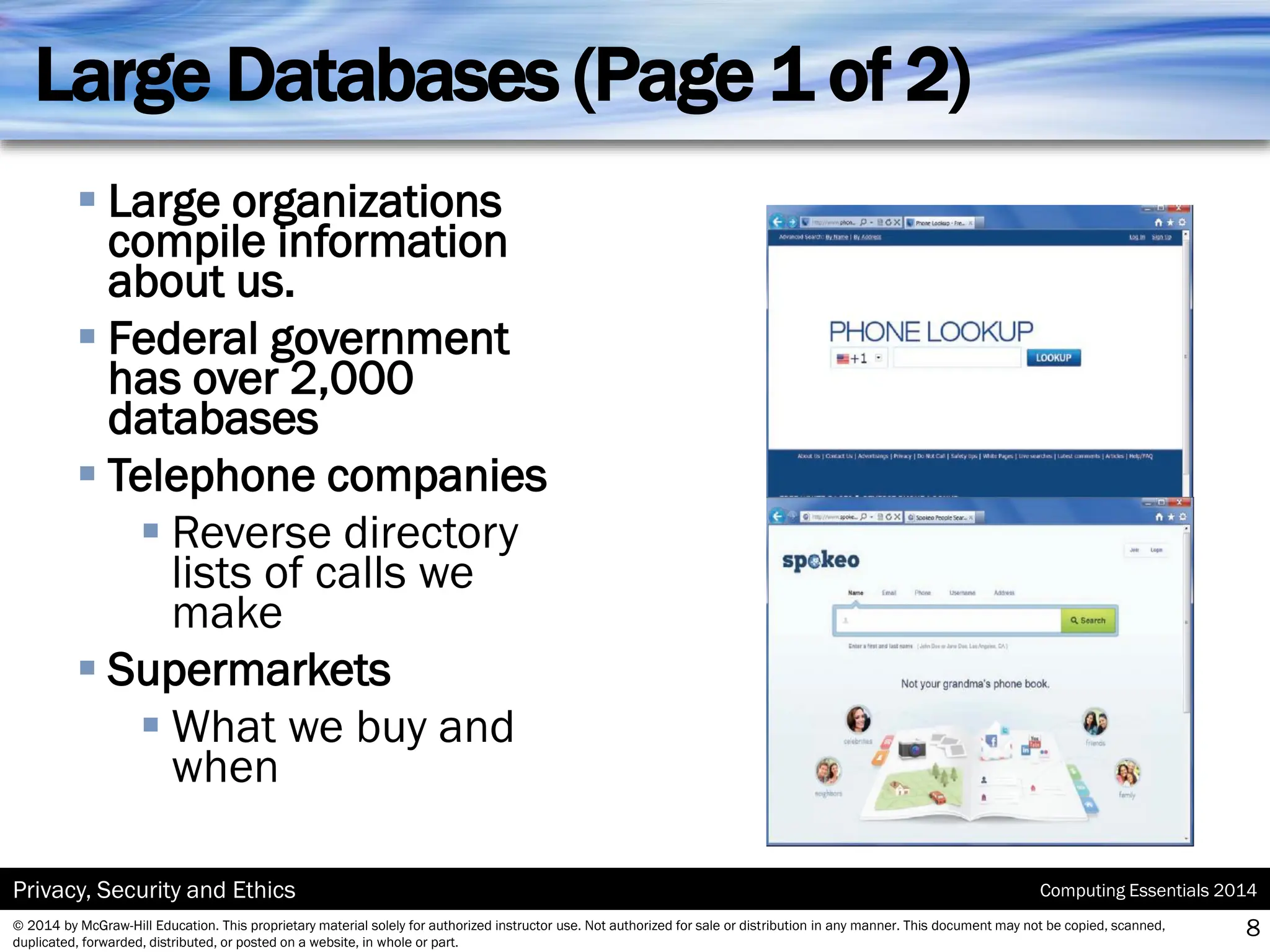
▪ Large organizations
compile information
about us.
▪ Federal government
has over 2,000
databases
▪ Telephone companies
▪ Reverse directory
lists of calls we
make
▪ Supermarkets
▪ What we buy and
when
8
Computing Essentials 2014
Privacy, Security and Ethics
© 2014 by McGraw-Hill Education. This proprietary material solely for authorized instructor use. Not authorized for sale or distribution in any manner. This document may not be copied, scanned,
duplicated, forwarded, distributed, or posted on a website, in whole or part.
Large Databases (Page 2 of 2)
▪ Information resellers or information brokers
▪ Collect and sell personal data
▪ Electronic profiles easily created
▪ Personal information is a marketable commodity,
which raises many issues:
▪ Collecting public, but personally identifying
information (e.g., Google’s Street View)
▪ Spreading information without personal
consent, leading to identity theft
▪ Spreading inaccurate information
▪ Mistaken identity
▪ Freedom of Information Act
9
Computing Essentials 2014
Privacy, Security and Ethics
© 2014 by McGraw-Hill Education. This proprietary material solely for authorized instructor use. Not authorized for sale or distribution in any manner. This document may not be copied, scanned,
duplicated, forwarded, distributed, or posted on a website, in whole or part.
Private Networks
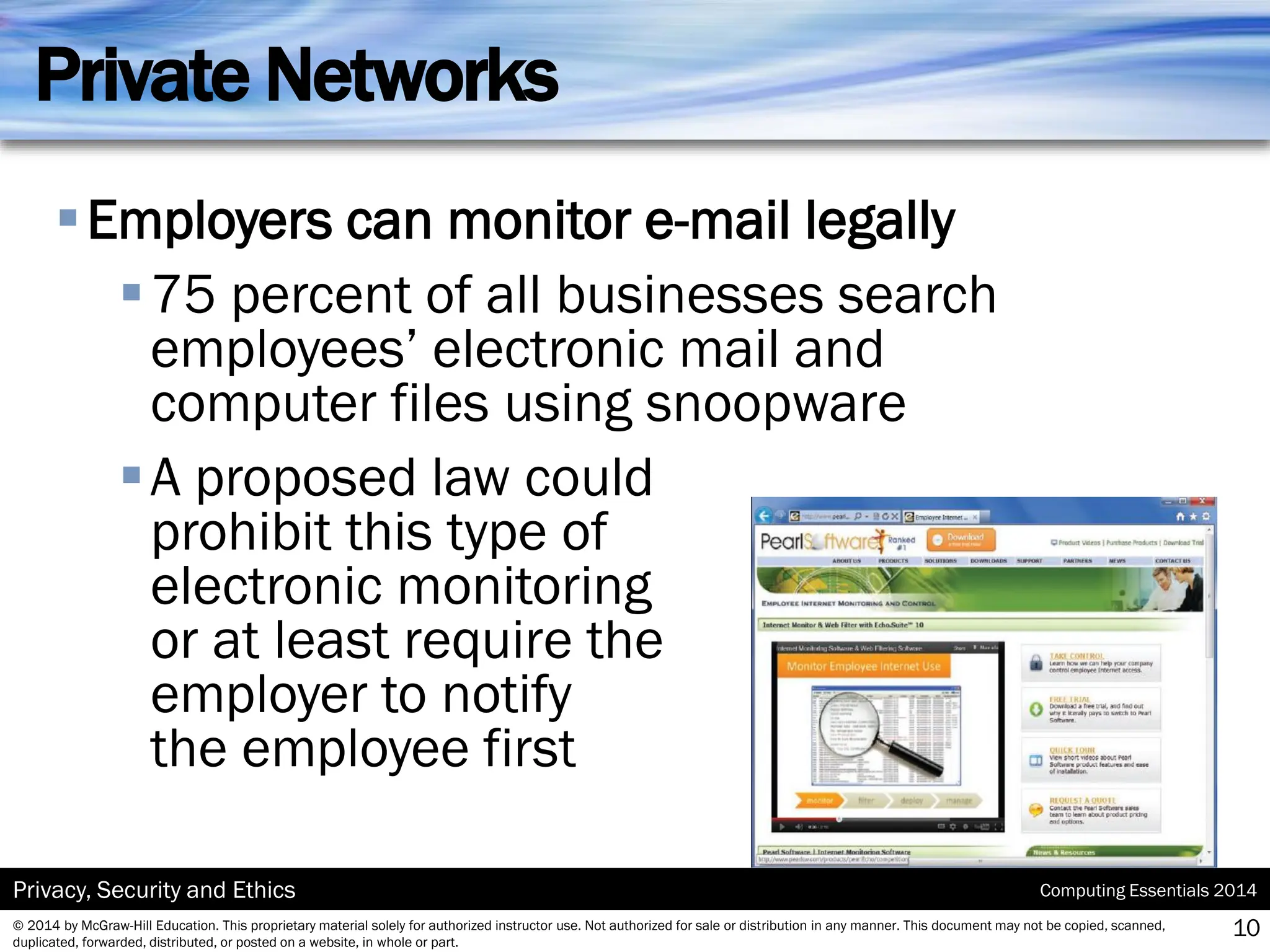
▪Employers can monitor e-mail legally
▪75 percent of all businesses search
employees’ electronic mail and
computer files using snoopware
▪A proposed law could
prohibit this type of
electronic monitoring
or at least require the
employer to notify
the employee first
10
Computing Essentials 2014
Privacy, Security and Ethics
© 2014 by McGraw-Hill Education. This proprietary material solely for authorized instructor use. Not authorized for sale or distribution in any manner. This document may not be copied, scanned,
duplicated, forwarded, distributed, or posted on a website, in whole or part.
Viewing and Blocking Cookies
▪Cookies
▪Small pieces of information
that are deposited on your
hard disk from web sites you
have visited
▪ First-party cookies
▪ Third-party cookies
11
Computing Essentials 2014
Privacy, Security and Ethics
© 2014 by McGraw-Hill Education. This proprietary material solely for authorized instructor use. Not authorized for sale or distribution in any manner. This document may not be copied, scanned,
duplicated, forwarded, distributed, or posted on a website, in whole or part.
Online Identity
▪The information that people voluntarily post
about themselves online
▪Archiving and search features of the Web
make it available indefinitely
▪Major Laws on Privacy
▪Gramm-Leach-Bliley Act
▪Health Insurance Portability and
Accountability Act (HIPAA)
▪Family Educational Rights and Privacy Act
(FERPA)
12
Computing Essentials 2014
Privacy, Security and Ethics
© 2014 by McGraw-Hill Education. This proprietary material solely for authorized instructor use. Not authorized for sale or distribution in any manner. This document may not be copied, scanned,
duplicated, forwarded, distributed, or posted on a website, in whole or part.
Security
▪Cybercrime or computer crime is any
offense that involves a computer and a
network
▪Hackers
▪Gain unauthorized access
13
Computing Essentials 2014
Privacy, Security and Ethics
© 2014 by McGraw-Hill Education. This proprietary material solely for authorized instructor use. Not authorized for sale or distribution in any manner. This document may not be copied, scanned,
duplicated, forwarded, distributed, or posted on a website, in whole or part.
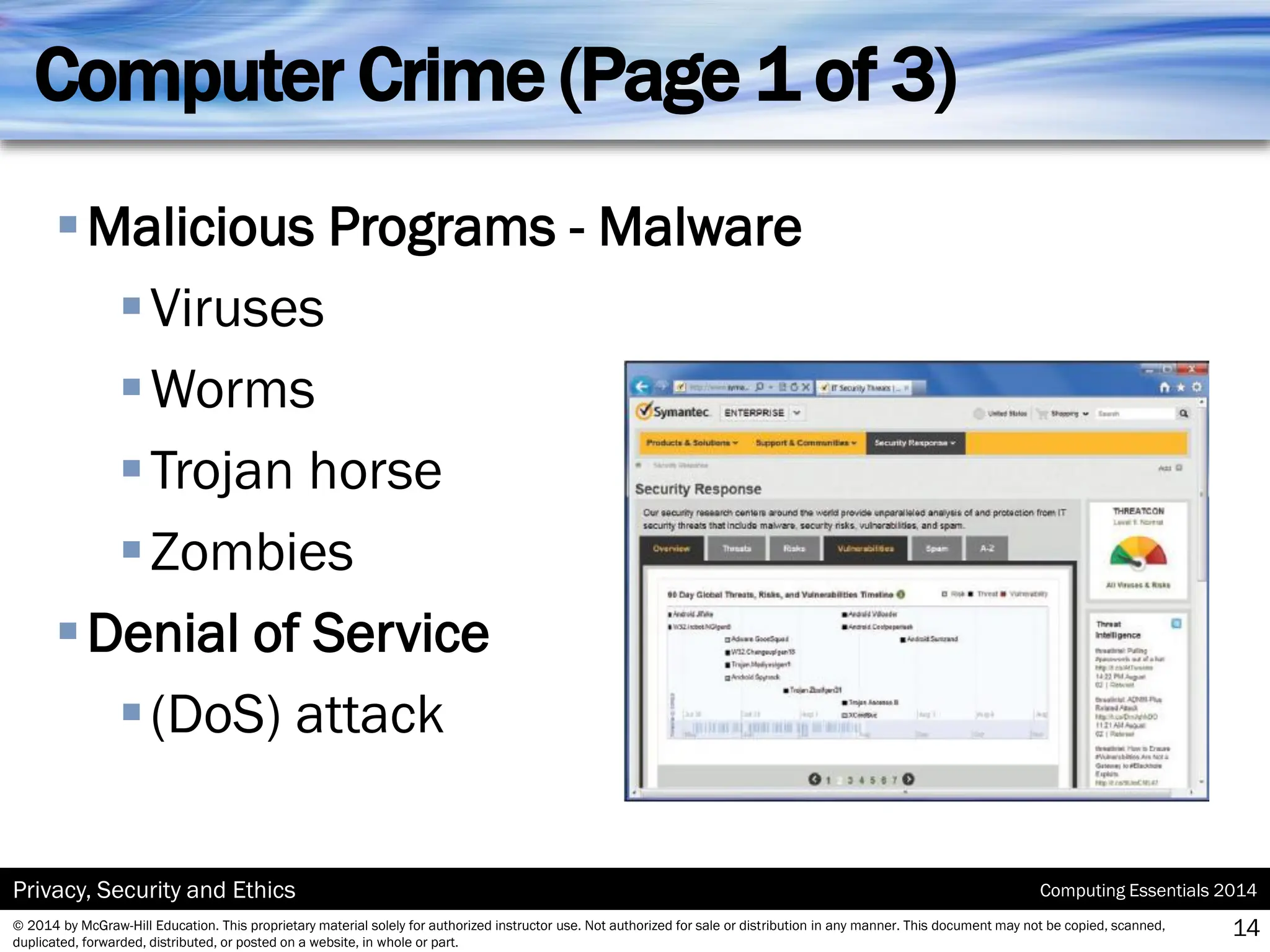
Computer Crime (Page 1 of 3)
▪Malicious Programs - Malware
▪Viruses
▪Worms
▪Trojan horse
▪Zombies
▪Denial of Service
▪(DoS) attack
14
Computing Essentials 2014
Privacy, Security and Ethics
© 2014 by McGraw-Hill Education. This proprietary material solely for authorized instructor use. Not authorized for sale or distribution in any manner. This document may not be copied, scanned,
duplicated, forwarded, distributed, or posted on a website, in whole or part.
Computer Crime (Page 2 of 3)
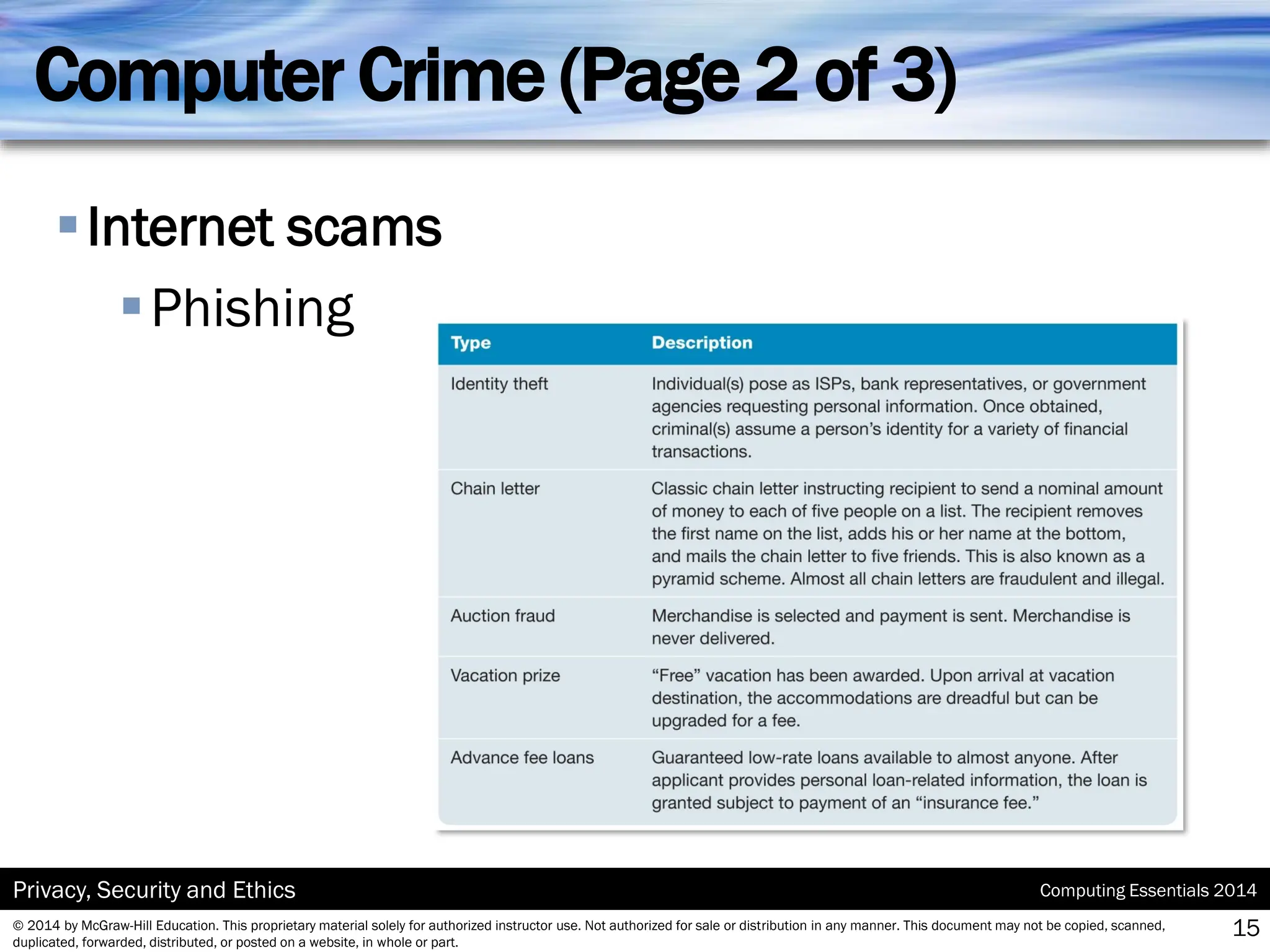
▪Internet scams
▪Phishing
15
Computing Essentials 2014
Privacy, Security and Ethics
© 2014 by McGraw-Hill Education. This proprietary material solely for authorized instructor use. Not authorized for sale or distribution in any manner. This document may not be copied, scanned,
duplicated, forwarded, distributed, or posted on a website, in whole or part.
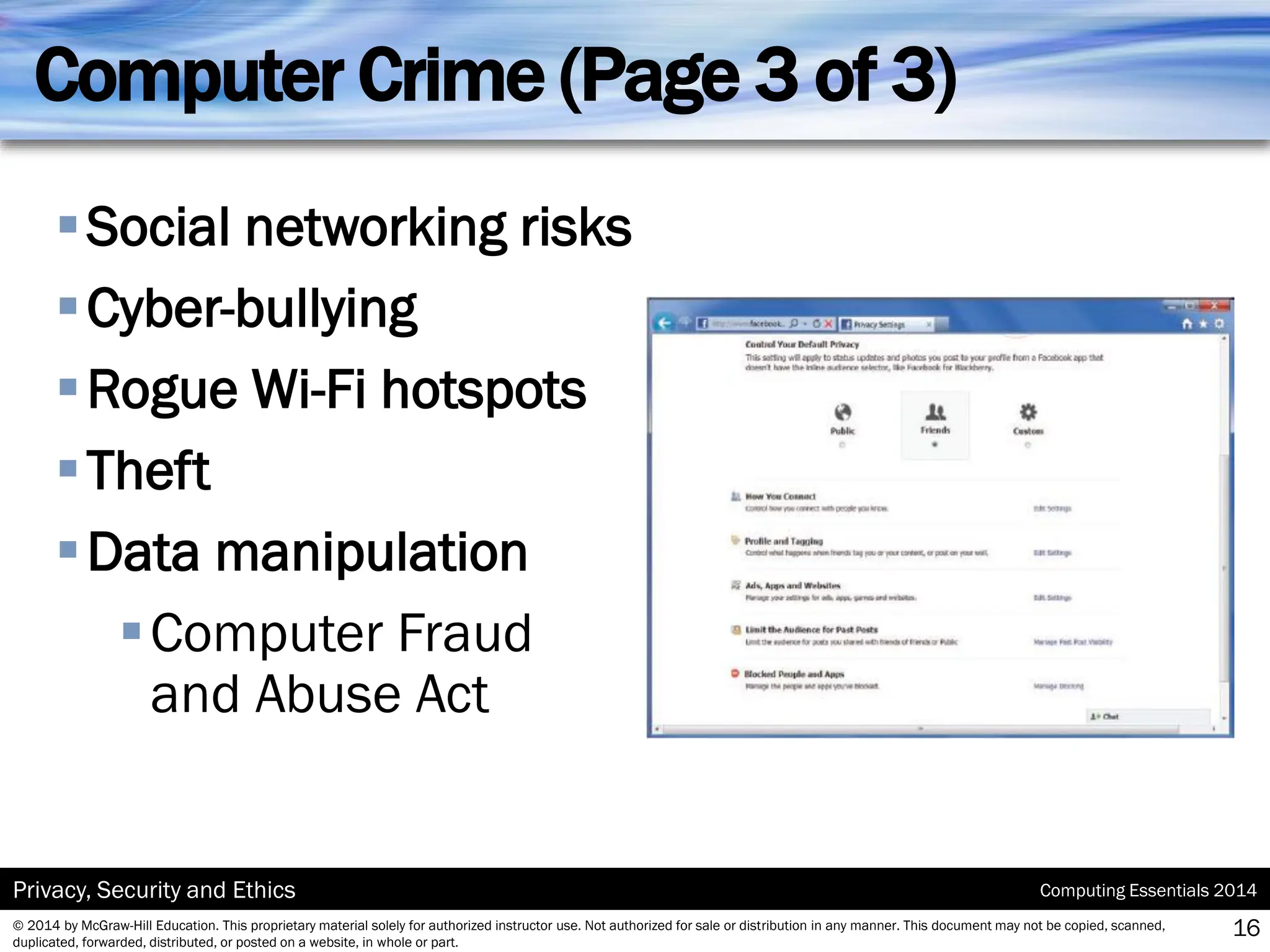
Computer Crime (Page 3 of 3)
▪Social networking risks
▪Cyber-bullying
▪Rogue Wi-Fi hotspots
▪Theft
▪Data manipulation
▪Computer Fraud
and Abuse Act
16
Computing Essentials 2014
Privacy, Security and Ethics
© 2014 by McGraw-Hill Education. This proprietary material solely for authorized instructor use. Not authorized for sale or distribution in any manner. This document may not be copied, scanned,
duplicated, forwarded, distributed, or posted on a website, in whole or part.
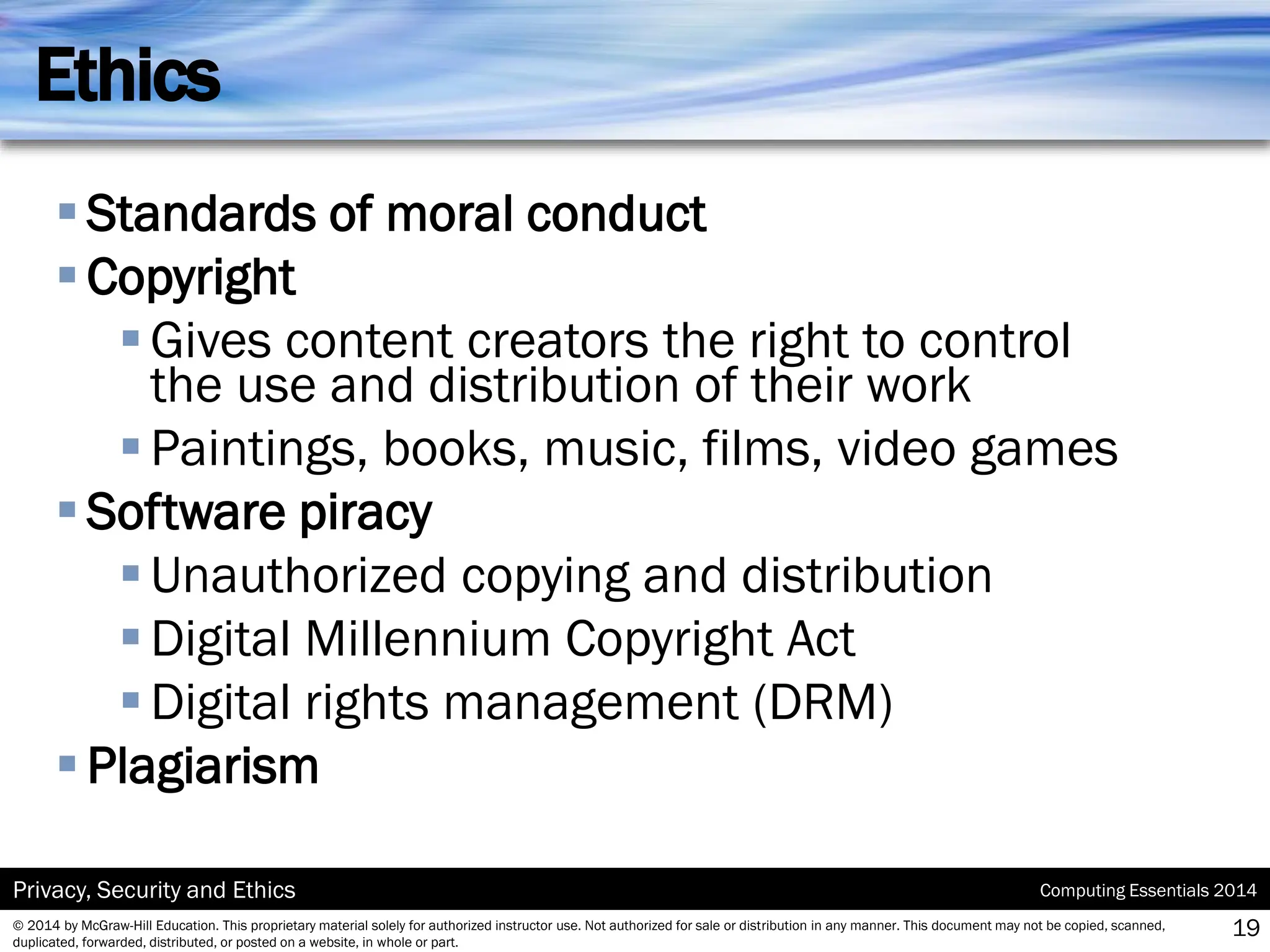
Ethics
▪Standards of moral conduct
▪Copyright
▪Gives content creators the right to control
the use and distribution of their work
▪Paintings, books, music, films, video games
▪Software piracy
▪Unauthorized copying and distribution
▪Digital Millennium Copyright Act
▪Digital rights management (DRM)
▪Plagiarism
19
Computing Essentials 2014
Privacy, Security and Ethics
© 2014 by McGraw-Hill Education. This proprietary material solely for authorized instructor use. Not authorized for sale or distribution in any manner. This document may not be copied, scanned,
duplicated, forwarded, distributed, or posted on a website, in whole or part.
24
End of Module

Module#7 Privacy Security and Ethics.pdf

  • 1.
    Computing Essentials 2014 Privacy,Security and Ethics © 2014 by McGraw-Hill Education. This proprietary material solely for authorized instructor use. Not authorized for sale or distribution in any manner. This document may not be copied, scanned, duplicated, forwarded, distributed, or posted on a website, in whole or part. © 2014 by McGraw-Hill Education. This proprietary material solely for authorized instructor use. Not authorized for sale or distribution in any manner. This document may not be copied, scanned, duplicated, forwarded, distributed, or posted on a website, in whole or part. Computing Essentials 2014 Privacy, Security, and Ethics
  • 2.
    Computing Essentials 2014 Privacy,Security and Ethics © 2014 by McGraw-Hill Education. This proprietary material solely for authorized instructor use. Not authorized for sale or distribution in any manner. This document may not be copied, scanned, duplicated, forwarded, distributed, or posted on a website, in whole or part. Competencies (Page 1 of 3) ▪Identify the most significant concerns for effective implementation of computer technology. ▪Discuss the primary privacy issues of accuracy, property, and access. ▪Describe the impact of large databases, private networks, the Internet, and the Web on privacy. ▪Discuss online identity and major laws on privacy. 2
  • 3.
    Computing Essentials 2014 Privacy,Security and Ethics © 2014 by McGraw-Hill Education. This proprietary material solely for authorized instructor use. Not authorized for sale or distribution in any manner. This document may not be copied, scanned, duplicated, forwarded, distributed, or posted on a website, in whole or part. Competencies (Page 2 of 3) ▪Discuss cybercrimes including creation of malicious programs such as viruses, worms, Trojan horse, and zombies as well as denial of service attacks, Internet scams, social networking risks, cyberbullying, rogue Wi-Fi hotspots, theft, and data manipulation. ▪Detail ways to protect computer security including restricting access, encrypting data, anticipating disasters, and preventing data loss. 3
  • 4.
    Computing Essentials 2014 Privacy,Security and Ethics © 2014 by McGraw-Hill Education. This proprietary material solely for authorized instructor use. Not authorized for sale or distribution in any manner. This document may not be copied, scanned, duplicated, forwarded, distributed, or posted on a website, in whole or part. Competencies (Page 3 of 3) ▪Discuss computer ethics including copyright law, software piracy, digital rights management , the Digital Millennium Copyright Act, as well as plagiarism and ways to identify plagiarism. 4
  • 5.
    Computing Essentials 2014 Privacy,Security and Ethics © 2014 by McGraw-Hill Education. This proprietary material solely for authorized instructor use. Not authorized for sale or distribution in any manner. This document may not be copied, scanned, duplicated, forwarded, distributed, or posted on a website, in whole or part. Introduction ▪The ubiquitous use of computers and technology prompts some very important questions about the use of personal data and our right to privacy. ▪This chapter covers issues related to the impact of technology on people and how to protect ourselves on the Web. 5
  • 6.
    Computing Essentials 2014 Privacy,Security and Ethics © 2014 by McGraw-Hill Education. This proprietary material solely for authorized instructor use. Not authorized for sale or distribution in any manner. This document may not be copied, scanned, duplicated, forwarded, distributed, or posted on a website, in whole or part. People ▪ Privacy – What are the threats to personal privacy and how can we protect ourselves? ▪ Security – How can access to sensitive information be controlled and how can we secure hardware and software? ▪ Ethics – How do the actions of individual users and companies affect society? 6
  • 7.
    Computing Essentials 2014 Privacy,Security and Ethics © 2014 by McGraw-Hill Education. This proprietary material solely for authorized instructor use. Not authorized for sale or distribution in any manner. This document may not be copied, scanned, duplicated, forwarded, distributed, or posted on a website, in whole or part. Privacy ▪Privacy – concerns the collection and use of data about individuals ▪Three primary privacy issues: ▪Accuracy ▪Property ▪Access 7
  • 8.
    Computing Essentials 2014 Privacy,Security and Ethics © 2014 by McGraw-Hill Education. This proprietary material solely for authorized instructor use. Not authorized for sale or distribution in any manner. This document may not be copied, scanned, duplicated, forwarded, distributed, or posted on a website, in whole or part. Large Databases (Page 1 of 2) ▪ Large organizations compile information about us. ▪ Federal government has over 2,000 databases ▪ Telephone companies ▪ Reverse directory lists of calls we make ▪ Supermarkets ▪ What we buy and when 8
  • 9.
    Computing Essentials 2014 Privacy,Security and Ethics © 2014 by McGraw-Hill Education. This proprietary material solely for authorized instructor use. Not authorized for sale or distribution in any manner. This document may not be copied, scanned, duplicated, forwarded, distributed, or posted on a website, in whole or part. Large Databases (Page 2 of 2) ▪ Information resellers or information brokers ▪ Collect and sell personal data ▪ Electronic profiles easily created ▪ Personal information is a marketable commodity, which raises many issues: ▪ Collecting public, but personally identifying information (e.g., Google’s Street View) ▪ Spreading information without personal consent, leading to identity theft ▪ Spreading inaccurate information ▪ Mistaken identity ▪ Freedom of Information Act 9
  • 10.
    Computing Essentials 2014 Privacy,Security and Ethics © 2014 by McGraw-Hill Education. This proprietary material solely for authorized instructor use. Not authorized for sale or distribution in any manner. This document may not be copied, scanned, duplicated, forwarded, distributed, or posted on a website, in whole or part. Private Networks ▪Employers can monitor e-mail legally ▪75 percent of all businesses search employees’ electronic mail and computer files using snoopware ▪A proposed law could prohibit this type of electronic monitoring or at least require the employer to notify the employee first 10
  • 11.
    Computing Essentials 2014 Privacy,Security and Ethics © 2014 by McGraw-Hill Education. This proprietary material solely for authorized instructor use. Not authorized for sale or distribution in any manner. This document may not be copied, scanned, duplicated, forwarded, distributed, or posted on a website, in whole or part. Viewing and Blocking Cookies ▪Cookies ▪Small pieces of information that are deposited on your hard disk from web sites you have visited ▪ First-party cookies ▪ Third-party cookies 11
  • 12.
    Computing Essentials 2014 Privacy,Security and Ethics © 2014 by McGraw-Hill Education. This proprietary material solely for authorized instructor use. Not authorized for sale or distribution in any manner. This document may not be copied, scanned, duplicated, forwarded, distributed, or posted on a website, in whole or part. Online Identity ▪The information that people voluntarily post about themselves online ▪Archiving and search features of the Web make it available indefinitely ▪Major Laws on Privacy ▪Gramm-Leach-Bliley Act ▪Health Insurance Portability and Accountability Act (HIPAA) ▪Family Educational Rights and Privacy Act (FERPA) 12
  • 13.
    Computing Essentials 2014 Privacy,Security and Ethics © 2014 by McGraw-Hill Education. This proprietary material solely for authorized instructor use. Not authorized for sale or distribution in any manner. This document may not be copied, scanned, duplicated, forwarded, distributed, or posted on a website, in whole or part. Security ▪Cybercrime or computer crime is any offense that involves a computer and a network ▪Hackers ▪Gain unauthorized access 13
  • 14.
    Computing Essentials 2014 Privacy,Security and Ethics © 2014 by McGraw-Hill Education. This proprietary material solely for authorized instructor use. Not authorized for sale or distribution in any manner. This document may not be copied, scanned, duplicated, forwarded, distributed, or posted on a website, in whole or part. Computer Crime (Page 1 of 3) ▪Malicious Programs - Malware ▪Viruses ▪Worms ▪Trojan horse ▪Zombies ▪Denial of Service ▪(DoS) attack 14
  • 15.
    Computing Essentials 2014 Privacy,Security and Ethics © 2014 by McGraw-Hill Education. This proprietary material solely for authorized instructor use. Not authorized for sale or distribution in any manner. This document may not be copied, scanned, duplicated, forwarded, distributed, or posted on a website, in whole or part. Computer Crime (Page 2 of 3) ▪Internet scams ▪Phishing 15
  • 16.
    Computing Essentials 2014 Privacy,Security and Ethics © 2014 by McGraw-Hill Education. This proprietary material solely for authorized instructor use. Not authorized for sale or distribution in any manner. This document may not be copied, scanned, duplicated, forwarded, distributed, or posted on a website, in whole or part. Computer Crime (Page 3 of 3) ▪Social networking risks ▪Cyber-bullying ▪Rogue Wi-Fi hotspots ▪Theft ▪Data manipulation ▪Computer Fraud and Abuse Act 16
  • 17.
    Computing Essentials 2014 Privacy,Security and Ethics © 2014 by McGraw-Hill Education. This proprietary material solely for authorized instructor use. Not authorized for sale or distribution in any manner. This document may not be copied, scanned, duplicated, forwarded, distributed, or posted on a website, in whole or part. Ethics ▪Standards of moral conduct ▪Copyright ▪Gives content creators the right to control the use and distribution of their work ▪Paintings, books, music, films, video games ▪Software piracy ▪Unauthorized copying and distribution ▪Digital Millennium Copyright Act ▪Digital rights management (DRM) ▪Plagiarism 19
  • 18.
    Computing Essentials 2014 Privacy,Security and Ethics © 2014 by McGraw-Hill Education. This proprietary material solely for authorized instructor use. Not authorized for sale or distribution in any manner. This document may not be copied, scanned, duplicated, forwarded, distributed, or posted on a website, in whole or part. 24 End of Module